Biotech ETFs Surge in 2025: The Complete Investor's Guide to a Sector Reborn
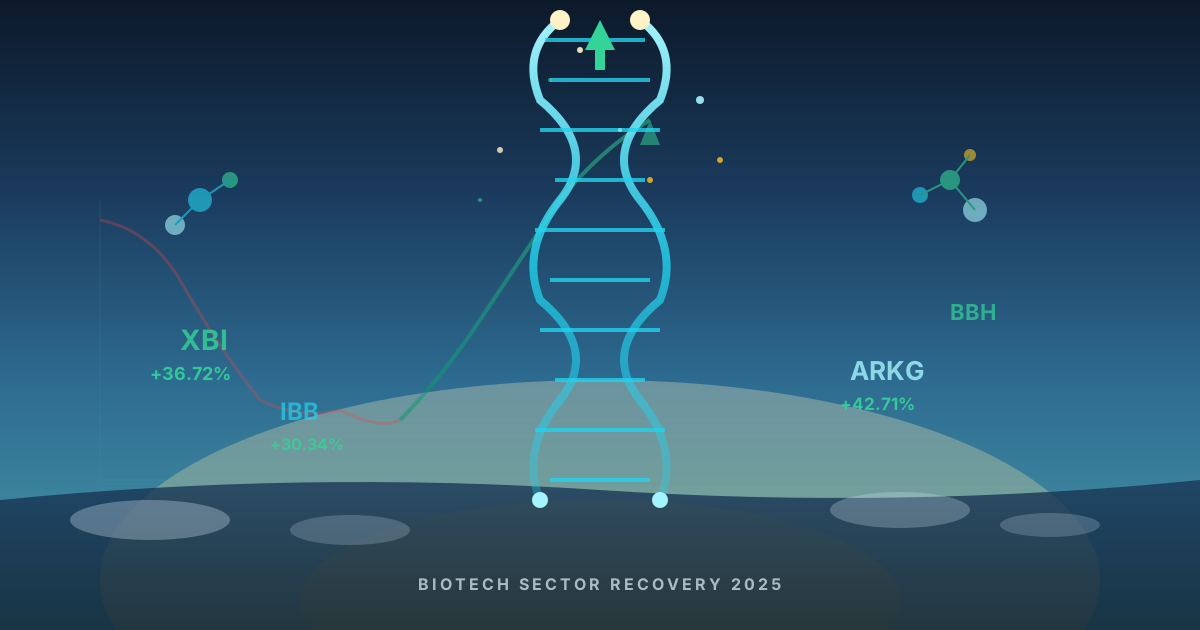
After years of painful underperformance, biotech exchange-traded funds are delivering their strongest returns since the pandemic peak. XBI leads the pack at +36.72% YTD, while actively managed ARKG has surged +42.71%—though it remains 73% below its all-time high. Both funds are dramatically outperforming the S&P 500's +18.22% return, signaling that the biotech winter may finally be over.
Is the Nuclear Funding Winter Finally Over?
The biotech sector endured what many called a "nuclear winter" from 2021 through early 2024. XBI collapsed 60% from its February 2021 peak, erasing $200 billion in market capitalization. The IPO market effectively shut down—only 18 biotech companies went public in 2025 compared to 104 in 2021. Venture funding cratered, with early-stage investments tracking toward multi-year lows. ARKG became the poster child of the carnage, losing 83% of its value while hemorrhaging $12 billion in redemptions as investors fled Cathie Wood's genomics thesis.
The damage was structural, not cyclical. Rising interest rates crushed the present value of biotech's distant cash flows. Generalist investors who had flooded into the sector during COVID abandoned ship. Clinical trial failures at high-profile companies like Biogen and Sarepta shattered confidence. The sector traded at decade-low valuations as capital dried up.
But 2025 has delivered a decisive inflection point. Three converging forces have thawed the frozen landscape: Big Pharma's $176 billion patent cliff has created desperate buyers willing to pay 100%+ premiums for scarce innovation. The Federal Reserve's pivot toward rate cuts has revived growth stock valuations. And the GLP-1 obesity revolution has demonstrated that biotech can still produce transformative, multi-billion-dollar franchises.
The evidence is now overwhelming. IBB has attracted $1.75 billion in three-month inflows—reversing years of redemptions. XBI has rebounded 85% from its April lows. M&A activity has exploded with over $40 billion in announced deals in Q4 alone. Fund flows across the sector have turned decisively positive for the first time since 2021. The nuclear winter appears to be ending—not with a whimper, but with a bang.
The rally reflects a confluence of powerful catalysts: Big Pharma's desperate acquisition spree, the GLP-1 obesity drug market creating new growth paradigms, declining interest rates benefiting growth stocks, and renewed investor appetite for innovation-driven healthcare. For the first time since 2021, multiple biotech ETFs are trading within striking distance of their historical highs.
IBB Approaches Record Highs With $1.55 Billion in Monthly Inflows
The iShares Biotechnology ETF (IBB) remains the industry's most established biotech fund, now trading at $171.17—just 2% below its all-time high of $174.23 set in August 2021. The fund has attracted $1.55 billion in one-month inflows and $1.75 billion over three months, signaling strong institutional conviction after years of redemptions totaling $2.46 billion.
| Metric | Value |
|---|---|
| Current NAV/Price | $171.17 / $171.16 |
| YTD Return | +30.34% |
| Total AUM | $8.65 billion |
| Number of Holdings | 247 |
| Expense Ratio | 0.44% |
| 52-Week Range | $107.43 – $174.40 |
| All-Time High | $174.23 (August 9, 2021) |
IBB tracks the NYSE Biotechnology Index, using modified market-cap weighting with concentration caps. The index limits the top five constituents to 8% maximum weight each, with remaining holdings capped at 4%. This methodology produces a large-cap tilt while preventing excessive single-stock concentration.
Top Holdings Reveal Large-Cap Dominance
| Rank | Company | Ticker | Weight |
|---|---|---|---|
| 1 | Amgen | AMGN | 7.60% |
| 2 | Vertex Pharmaceuticals | VRTX | 7.52% |
| 3 | Gilead Sciences | GILD | 6.98% |
| 4 | Regeneron Pharmaceuticals | REGN | 6.16% |
| 5 | Alnylam Pharmaceuticals | ALNY | 4.88% |
| 6 | Insmed | INSM | 3.54% |
| 7 | argenx | ARGX | 3.29% |
| 8 | IQVIA Holdings | IQV | 3.16% |
| 9 | Natera | NTRA | 2.67% |
| 10 | Mettler-Toledo | MTD | 2.43% |
The top 10 holdings represent approximately 48% of assets, demonstrating significant concentration in established large-cap biotech names. A single-day inflow of $253.8 million on December 3 increased shares outstanding by 3%, underscoring the rush of institutional capital into the sector.
XBI Hits New 52-Week High as Small-Cap Biotech Rallies
The SPDR S&P Biotech ETF (XBI) reached a new 52-week high of $123.61 on December 4, 2025, having rebounded 85% from its April 9 low of $66.66. XBI's outperformance stems directly from its modified equal-weight methodology, which systematically rebalances holdings to approximately equal weights each quarter—creating a structural tilt toward small and mid-cap biotechs precisely as M&A activity intensifies.
| Metric | Value |
|---|---|
| Current Price/NAV | $123.41 / $123.23 |
| YTD Return | +36.72% |
| Total AUM | $7.67 billion |
| Number of Holdings | 133 |
| Expense Ratio | 0.35% |
| 52-Week Range | $66.66 – $123.61 |
| All-Time High | ~$174 (February 2021) |
How Equal-Weighting Amplifies Biotech Rallies
Unlike IBB's market-cap approach where Amgen, Vertex, and Gilead dominate, XBI's methodology means each company carries roughly similar influence at rebalancing. The fund's weighted average market cap is $25.3 billion, but its median market cap is just $2.84 billion—demonstrating the fund's true small-cap exposure despite owning large names.
| Rank | Company | Ticker | Weight |
|---|---|---|---|
| 1 | Exact Sciences | EXAS | 2.78% |
| 2 | Revolution Medicines | RVMD | 2.65% |
| 3 | Avidity Biosciences | RNA | 2.35% |
| 4 | Natera | NTRA | 2.15% |
| 5 | BridgeBio Pharma | BBIO | 2.13% |
| 6 | Insmed | INSM | 2.12% |
| 7 | Madrigal Pharmaceuticals | MDGL | 2.06% |
| 8 | Regeneron | REGN | 1.96% |
| 9 | Ionis Pharmaceuticals | IONS | 1.93% |
| 10 | Biogen | BIIB | 1.92% |
The top 10 holdings represent just 22% of assets—less than half of IBB's concentration. Fund flows have surged with $355 million in 5-day inflows and $1.22 billion over three months, reversing three years of cumulative outflows totaling $2.15 billion.
ARKG Delivers Stellar Returns But Remains Far From Recovery
The ARK Genomic Revolution ETF (ARKG) has delivered 2025's strongest biotech returns at +42.71% YTD, significantly outperforming the Health ETF category average of 6.55%. Yet the fund remains a stark reminder of the sector's boom-bust volatility: at approximately $31 per share, ARKG trades 73% below its all-time high of $115.15 set on February 10, 2021—requiring a 270% gain to recover.
| Metric | Value |
|---|---|
| Current Price | ~$31.11 |
| YTD Return | +42.71% |
| Total AUM | $1.02 – $1.09 billion |
| Number of Holdings | 32-37 |
| Expense Ratio | 0.75% |
| 52-Week Range | $17.50 – $34.06 |
| All-Time High | $115.15 (February 10, 2021) |
Cathie Wood's Aggressive Gene-Editing Bets
ARKG's concentrated, actively-managed approach distinguishes it from passive alternatives. Cathie Wood and her team employ an "open research ecosystem" combining proprietary analysis with external insights, making dynamic portfolio adjustments based on conviction levels. The fund publishes all trades daily, providing unusual transparency for active management.
| Rank | Company | Ticker | Weight | Focus Area |
|---|---|---|---|---|
| 1 | Tempus AI | TEM | 10.54% | AI-Driven Diagnostics |
| 2 | CRISPR Therapeutics | CRSP | 9.96% | Gene Editing |
| 3 | Twist Bioscience | TWST | 5.08% | Synthetic Biology |
| 4 | Guardant Health | GH | 6.26% | Liquid Biopsy |
| 5 | Personalis | PSNL | 5.84% | Cancer Genomics |
| 6 | Natera | NTRA | 5.01% | Genetic Testing |
| 7 | 10x Genomics | TXG | 4.83% | Genomics Technology |
| 8 | Illumina | ILMN | 4.18% | Genome Sequencing |
| 9 | Beam Therapeutics | BEAM | 4.11% | Gene Editing |
| 10 | Veracyte | VCYT | 4.01% | Molecular Diagnostics |
Wood has aggressively rotated into biotech throughout 2025, purchasing 1,964 shares of CRISPR Therapeutics on November 26 and making a $19.2 million bet on Intellia Therapeutics (750,000 shares)—ARK's largest biotech position addition of 2025. Her commentary emphasizes the convergence of DNA sequencing, AI, and gene therapies, stating that "one-time cures will be a good business" contrary to Wall Street skepticism about durability of revenue from curative therapies.
Fund flows show +$31.56 million over 5 days but -$20.25 million monthly, reflecting volatile sentiment. AUM of approximately $1 billion represents just 8% of the fund's peak of roughly $13 billion.
BBH Offers Concentrated Large-Cap Conviction
The VanEck Biotech ETF (BBH) takes a distinctly different approach: a concentrated portfolio of exactly 25 holdings designed to capture the largest, most liquid biotech names while maintaining pure-play sector exposure.
| Metric | Value |
|---|---|
| Current Price/NAV | $194.61 / $194.57 |
| YTD Return | +23.99% |
| Total AUM | $386.51 million |
| Number of Holdings | 25 |
| Expense Ratio | 0.35% |
| All-Time High | $216.61 (August 2021) |
| Distance from ATH | -10% |
| Rank | Company | Ticker | Weight |
|---|---|---|---|
| 1 | Gilead Sciences | GILD | 12.68% |
| 2 | Amgen | AMGN | 12.65% |
| 3 | Vertex Pharmaceuticals | VRTX | 9.70% |
| 4 | Regeneron | REGN | 6.97% |
| 5 | AstraZeneca | AZN | 6.85% |
The top 5 holdings represent 44.84% of assets, while the top 10 comprise 67.89%—the highest concentration among major biotech ETFs. This approach delivers lower volatility (4.24%) compared to XBI (7.31%) but may miss breakout returns from smaller companies. The fund appeals to investors seeking tactical, large-cap biotech exposure without small-cap volatility.
SBIO: European Investors' Gateway to Nasdaq Biotech
The Invesco Nasdaq Biotech UCITS ETF (SBIO) provides European investors with UCITS-compliant access to the same biotech index exposure available through US-listed alternatives.
| Metric | Value |
|---|---|
| Current Price (SIX/USD) | $60.20 |
| Current Price (XETRA/EUR) | €49.79 |
| YTD Return (USD) | +33.35% |
| YTD Return (EUR) | +19.18% |
| Total AUM | €375 million (~$449M) |
| Expense Ratio | 0.40% |
| Replication Method | Synthetic (Swap-Based) |
The 14-percentage-point difference between USD and EUR returns illustrates currency's significant impact. Dollar strength throughout 2025 has amplified returns for USD investors while creating headwinds for those measuring performance in euros. The fund is unhedged, meaning investors bear full currency exposure.
SBIO uses synthetic replication via total return swaps with counterparties including Goldman Sachs, J.P. Morgan, and Morgan Stanley. This approach offers potential advantages in tracking error and tax efficiency but introduces counterparty risk, mitigated by UCITS regulations limiting exposure to 10% of NAV per counterparty.
The fund shares virtually 100% holdings overlap with IBB, providing functionally identical exposure in different regulatory wrappers. European investors choose SBIO due to PRIIPs regulations preventing retail purchase of US-listed ETFs, advantageous Irish domicile (no US estate tax), and accumulating share class for tax-efficient dividend reinvestment.
GNOM: Passive Genomics at Lower Cost
The Global X Genomics & Biotechnology ETF (GNOM) offers passive, index-based exposure to the genomics subsector at a lower expense ratio than actively-managed ARKG—but has significantly trailed its rival in 2025.
| Metric | Value |
|---|---|
| Current Price | $46.88 |
| YTD Return | +21.20% |
| Total AUM | $55.06 million |
| Number of Holdings | 50-51 |
| Expense Ratio | 0.50% |
| 52-Week Range | $27.20 – $46.88 |
| Index Tracked | Solactive Genomics Index |
GNOM tracks the Solactive Genomics Index, which uses natural language processing to identify companies with significant genomics exposure. Holdings must derive at least 50% of revenues from genomics activities including gene editing, sequencing, genetic medicine development, and computational genomics.
| Feature | GNOM | ARKG |
|---|---|---|
| Management Style | Passive (Index) | Active (Cathie Wood) |
| Expense Ratio | 0.50% | 0.75% |
| YTD 2025 Return | +21.20% | +42.71% |
| Number of Holdings | 50-51 | 32-37 |
| Volatility | 8.66% | 13.48% |
ARKG's 21-percentage-point outperformance in 2025 demonstrates active management's potential in a recovering sector, though GNOM's lower volatility and broader diversification may appeal to more risk-conscious investors.
M&A Frenzy Drives Sector Optimism With $40+ Billion in Deals
Big Pharma's acquisition activity has reached fever pitch, with multiple $10 billion+ transactions announced in late 2025 as companies scramble to address the looming patent cliff:
Merck acquired Cidara Therapeutics for $9.2 billion (November 14)—a 109% premium—to secure CD388, a breakthrough flu prevention antiviral. Pfizer won Metsera in a bidding war against Novo Nordisk for approximately $10 billion, gaining four GLP-1 obesity drug candidates. Alkermes outbid Lundbeck for Avadel Pharmaceuticals at $2.37 billion after a three-way contest.
Earlier 2025 deals included Novartis/Avidity ($12B), Genmab/Merus ($8B), and Johnson & Johnson/Intra-Cellular ($14.6B).
Morgan Stanley projects that $176 billion in revenue from current drugs loses patent exclusivity by 2030, creating urgent demand for pipeline replenishment. The firm sees "stars aligning" for small/mid-cap biotech, projecting 14% revenue CAGR for commercial-stage companies through 2030 and $109 billion in SMID-cap biotech revenue by 2030—nearly double 2025 levels. JPMorgan named Ultragenyx Pharmaceutical as a top 2026 pick with potential 200%+ upside.
GLP-1 Dominance Reshapes the Obesity Drug Landscape
The GLP-1 obesity drug market has been transformed in 2025. Eli Lilly's tirzepatide products (Zepbound/Mounjaro) generated $10.1 billion in Q3 2025, making it the world's best-selling drug and overtaking Merck's Keytruda. Lilly now commands 57% of the U.S. obesity market while Novo Nordisk's stock has declined 46% YTD as competition intensifies.
The WHO issued first-ever global guidelines recommending GLP-1s for long-term obesity treatment on December 1, 2025, calling it "a new chapter in how society approaches obesity." This regulatory endorsement provides a powerful tailwind for companies developing next-generation weight-loss therapies.
Fed Rate Outlook and FDA Approval Momentum
The Federal Reserve's December 9-10, 2025 FOMC meeting had not yet occurred as of this report. The current federal funds rate stands at 3.75-4.00% following a 25 basis point cut in October. Markets price an 80% probability of another 25bp cut, which would provide additional tailwinds for rate-sensitive biotech stocks that typically benefit from lower discount rates applied to their distant cash flows.
The FDA approved 5 novel drugs in November 2025, including Novartis's expanded gene therapy Itvisma for spinal muscular atrophy, Arrowhead's siRNA therapy Redemplo for familial chylomicronemia, and Kura Oncology's AML treatment Komzifti. Year-to-date novel approvals total 39 drugs.
Venture Funding Recovers But IPO Window Remains Shut
Biotech venture funding showed 70.9% Q3 recovery from Q2's trough, though YTD early-stage funding of $8.2 billion tracks toward multi-year lows. The IPO market effectively remains closed with only 18 biotech IPOs in 2025 versus 104 in 2021. Notable Q4 rounds include Tubulis ($361M Series C), Odyssey Therapeutics ($213M Series D), and Protego Biopharma ($130M Series B).
Comparative Performance: All Six ETFs at a Glance
| ETF | YTD 2025 | AUM | Holdings | Expense Ratio | Methodology |
|---|---|---|---|---|---|
| ARKG | +42.71% | $1.09B | 32-37 | 0.75% | Active (ARK) |
| XBI | +36.72% | $7.67B | 133 | 0.35% | Equal-Weight |
| SBIO | +33.35% | €375M | ~265 | 0.40% | Synthetic (UCITS) |
| IBB | +30.34% | $8.65B | 247 | 0.44% | Market-Cap Weight |
| BBH | +23.99% | $387M | 25 | 0.35% | Concentrated |
| GNOM | +21.20% | $55M | 50-51 | 0.50% | Index (Genomics) |
The performance hierarchy reveals clear patterns: actively-managed and equal-weighted strategies have captured more upside in 2025's rally, while concentrated large-cap approaches have delivered steadier but more modest gains.
Fund Flows Signal Renewed Institutional Interest
After years of persistent outflows, biotech ETFs have experienced a dramatic reversal in 2025. IBB attracted $1.75 billion in three-month net inflows while XBI pulled in $1.22 billion over the same period. ARKG is stabilizing after $670 million in three-year redemptions, and ARK ETFs broadly recorded $3.7 billion in weekly inflows in late 2025—the largest since 2021.
This capital rotation reflects growing conviction that biotech's multi-year correction has ended, supported by accelerating M&A activity, FDA approval momentum, and lower interest rates making growth stocks more attractive.
Selecting the Right Biotech ETF
For broad, liquid exposure: IBB offers the largest AUM ($8.65B), tightest spreads, and established large-cap focus. Its 0.44% expense ratio is reasonable for comprehensive biotech coverage.
For small-cap and M&A exposure: XBI's equal-weight methodology has captured more upside in 2025's rally and positions the fund to benefit from continued acquisition activity targeting smaller biotechs.
For high-conviction genomics: ARKG delivers concentrated exposure to cutting-edge gene editing and genomics names with active management—but at higher expense (0.75%) and substantially greater volatility.
For concentrated large-cap: BBH's 25-stock portfolio offers focused exposure to the sector's largest names with lower expense (0.35%) and reduced volatility.
For European investors: SBIO provides UCITS-compliant access with favorable tax treatment and multi-currency trading options.
For passive genomics exposure: GNOM offers rules-based genomics investing at lower cost than ARKG, though with historically weaker performance during sector rallies.
Outlook: Biotech Positioned for Continued Momentum Into 2026
The biotech sector enters 2026 with powerful catalysts intact. IBB's 30% outperformance versus the S&P 500 reflects genuine fundamental improvement, not just multiple expansion—M&A premiums averaging 100%+ signal Big Pharma's desperation to acquire scarce innovation. The $176 billion patent cliff creates a structural buyer for the next five years.
While ARKG's 73% distance from its all-time high illustrates the painful hangover from 2021's speculative excess, Cathie Wood's concentrated gene-editing bets position the fund for asymmetric upside if CRISPR-based cures advance through late-stage trials. With XBI hitting fresh 52-week highs and fund flows turning decisively positive, the weight of evidence supports continued sector strength through early 2026.
Key risks include potential FDA leadership disruption, Medicare drug pricing pressures from the Inflation Reduction Act, and GLP-1 competition commoditizing margins. Investors should size positions appropriately given biotech's inherent volatility—but for those with appropriate risk tolerance, the sector offers compelling opportunity.
Disclaimer: This article is for informational purposes only and does not constitute investment advice, financial advice, or legal advice. The author is not a registered investment adviser, financial adviser, or attorney. Past performance does not guarantee future results. All investments involve risk, including potential loss of principal. Biotech investments are particularly volatile and may experience significant price fluctuations. Readers should conduct their own research and consult with qualified financial professionals before making any investment decisions.
Member discussion