Company of the week: Mendra
Executive Summary
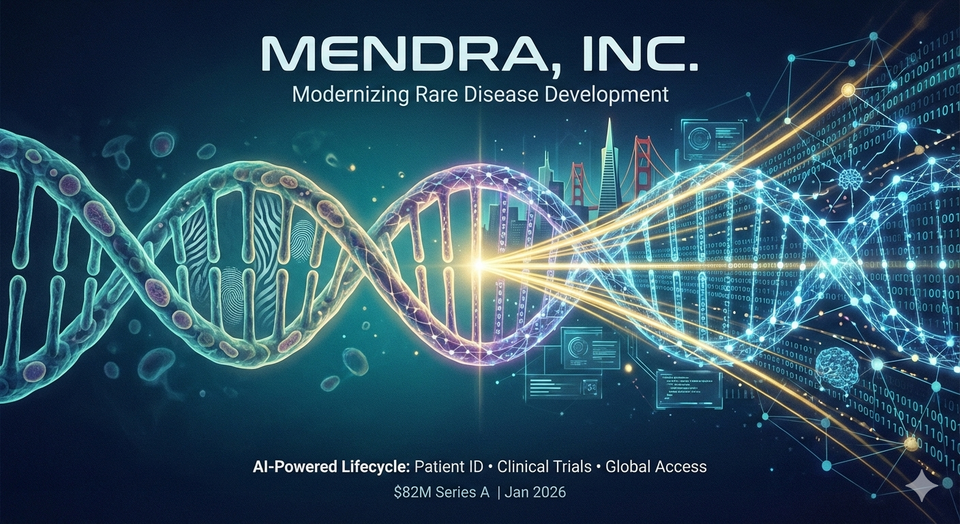
Mendra, Inc. is a newly launched San Francisco-based biopharmaceutical company targeting high-unmet-need rare diseases. In January 2026, the company announced an oversubscribed $82 million Series A financing co-led by OrbiMed, 8VC, and 5AM Ventures, with participation from Lux Capital and Wing VC.
The startup's mission is to modernize rare disease drug development and commercialization by leveraging artificial intelligence across the entire lifecycle—from patient identification through clinical trials to global market access. Rather than discovering new drugs from scratch, Mendra's model centers on acquiring or in-licensing existing therapeutic candidates and applying its AI-driven platform to develop and commercialize these treatments faster and more effectively.
Leadership Team
Founded in 2025 as a collaboration between venture firms 8VC and 5AM Ventures, Mendra is led by a seasoned team of rare disease and technology veterans:
| Executive | Role | Background |
|---|---|---|
| Joshua Grass | Co-founder & CEO | 15 years at BioMarin Pharmaceutical; led Modis Therapeutics and Escient Pharmaceuticals to successful exits |
| Jeff Ajer | Chief Commercial Officer | Former CCO of BioMarin; oversaw global launch of multiple rare disease therapies |
| Lalarukh Haris Shaikh, Ph.D. | Co-founder & CTO | Former EVP for Life Sciences at Palantir; deep expertise in healthcare analytics |
| Gregory Balani, Pharm.D. | VP of Business Development | BD experience at Escient, Zogenix, Bayer; venture investing background |
This blend of rare disease domain experience and AI/data science know-how underpins Mendra's unique thesis.
The Mendra Thesis: What Makes It Unique
Mendra's core thesis is that many promising therapies for rare diseases stall or fail to reach patients due to operational inefficiencies—not necessarily lack of scientific validity. Rare disease drug development is hampered by small, geographically dispersed patient populations, difficulty identifying eligible patients, slow trial enrollment, and complex global market access challenges.
The company proposes to "modernize" rare disease development by deploying AI across each major bottleneck rather than using technology only for drug discovery. In practice, Mendra's platform focuses on three key areas:
1. Accelerating Patient Identification
AI/ML algorithms comb through medical records, genetic databases, and real-world data to find patients (or subpopulations) with a given rare condition faster and more accurately. Early diagnosis is critical in rare diseases, yet 25% of patients endure a diagnostic odyssey of 5–30 years before receiving a correct diagnosis. By integrating heterogeneous data—genomic, clinical, even imaging—AI can detect patterns that help pinpoint undiagnosed or misdiagnosed patients who might benefit from a therapy, meaningfully expanding the pool of patients identified for trials or treatment.
2. Improving Clinical Trial Enrollment and Design
Rare disease trials often struggle to recruit enough participants, delaying development. AI tools can optimize trial site selection, predict where eligible patients are located, and match patients to trials more efficiently. Predictive modeling has been used to forecast disease progression and identify which patients are most likely to respond to a given therapy, which can help in designing smarter inclusion criteria or surrogate endpoints. By shortening enrollment times and enabling adaptive designs, Mendra aims to accelerate clinical development timelines for its portfolio candidates.
3. Supporting Global Market Access and Commercialization
Even after approval, delivering rare disease drugs worldwide is challenging—many small companies focus only on U.S./EU markets due to limited resources. Mendra is explicitly planning for global commercialization from the outset. Its AI-driven infrastructure might analyze epidemiological and healthcare data across countries to prioritize launch regions, identify treatment centers and reimbursement pathways, and optimize supply chains for orphan drugs.
Asset-Centric, Platform-Enabled
Unlike "pure" AI drug discovery startups, Mendra is asset-centric but platform-enabled. It is not developing a novel AI algorithm to invent new molecules in silico; rather, it positions itself as a biopharma company augmented by AI in decision-making.
This hybrid model means Mendra will in-license or acquire drug candidates—likely ones with strong scientific rationale or early clinical data for a rare condition—and then use its AI and expert systems to drive those candidates through clinical development and commercialization more efficiently. By focusing on execution and scale-up (clinical trial management, regulatory strategy, patient outreach, global distribution) rather than basic discovery, Mendra aims to tackle the often overlooked "last mile" problems in rare disease drug development.
Many rare disease therapies originate in academia or small biotechs but struggle to scale due to limited trial infrastructure or commercial expertise. Mendra's model could serve as an alternative path for such assets—providing a home where scientific risk is already reduced (e.g., proof-of-concept achieved) but the operational hurdles (trials, regulatory, market delivery) are taken on by an experienced, well-resourced team.
What makes Mendra potentially unique is this integration of deep rare disease experience with cutting-edge AI capabilities under one roof. The co-founders explicitly highlight that they are combining domain expertise with AI across asset selection, clinical development, and commercialization, which addresses "some of the greatest challenges in rare disease drug development." While other startups have used AI in drug discovery, Mendra's emphasis on applying AI to clinical and commercial phases sets it apart.
Investor Profile and Funding Strategy
Mendra's hefty Series A round was funded by a syndicate of top-tier venture investors, reflecting a mix of biotech-specialist and technology-focused backers:
| Investor | Type | Thesis/Relevance |
|---|---|---|
| OrbiMed | Life Sciences VC | Global healthcare-focused venture investor; track record in rare disease and AI-driven drug development ventures |
| 5AM Ventures | Early-Stage Biotech VC | Co-incubated Mendra in 2025; specializes in therapeutics and health technologies with hands-on company formation approach |
| 8VC | Tech-Focused VC | Silicon Valley firm known for "full-stack" solutions; brings Palantir-style big data and AI services expertise |
| Lux Capital | Deep Tech VC | Backs AI and advanced technology startups; investor in Recursion (AI + rare disease drug screening) |
| Wing VC | AI-First VC | BioXData-focused investor specializing in data/AI platforms and next-generation enterprise technology |
Importantly, no large pharmaceutical "strategic" investors (corporate venture arms) are listed in this Series A—all backers are independent venture funds, indicating this is a pure venture-backed play. The upside is that Mendra has investors aligned for high-growth and eventual exit, providing flexibility in partnering or selling assets without a big pharma stakeholder complicating ownership. The downside is Mendra cannot yet draw on a pharma's in-house resources or global footprint; however, its investors' capital and networks are substantial.
The $82M raise is unusually large for a Series A, signifying strong conviction from these investors that Mendra's model justifies significant funding upfront. As Fierce Biotech noted, "a new AI biotech with a focus on rare disease is taking off in the Bay Area," with the Series A "used to buy rare disease candidates ... and use AI to speed up clinical development."
This war chest should enable Mendra to aggressively pursue multiple asset acquisitions and build out its AI platform in parallel, rather than a more incremental single-program approach. The investor syndicate itself provides a strategic advantage: OrbiMed and 5AM bring deep biotech and rare disease insight, while 8VC, Lux, and Wing contribute tech-sector expertise and a data-centric perspective.
Prior Relevant Bets by Investors
Several of Mendra's investors have track records in areas overlapping Mendra's space, such as neurological rare diseases and AI-driven biotechs:
OrbiMed has invested in numerous rare genetic and neurological disease companies (e.g., Voyager Therapeutics for gene therapy in Parkinson's, NeuroPore for neurodegeneration) as well as AI-enabled drug discovery firms (like Insilico Medicine in its early rounds).
5AM Ventures helped launch Certa Therapeutics (fibrosis, including rare kidney disease) and backed Aprea (p53-targeted therapy with AI-aided discovery). While not explicitly "neurotech," 5AM often funds platform biotechs exploring novel modalities, some of which involve neurological indications.
8VC's portfolio includes CTRL-Labs (neural interface tech, via its partners' prior investments) and health AI startups. They also invest in companies like Osso VR (medical VR training)—illustrating an appetite for tech in medicine.
Lux Capital, beyond Recursion (AI + rare disease drug screening), has funded Vicarious Surgical (robotics) and Eikon Therapeutics (advanced imaging for drug discovery). Lux's involvement suggests confidence in Mendra's AI-driven approach.
Wing VC is newer to biotech, but their Wing at JPM 2026 summit highlighted that healthcare is entering a "forced-acceleration era" with deployable AI and rising patient expectations. Wing has invested in platforms like H1 (H1 Insights)—which uses data to connect healthcare professionals—indicating interest in healthcare data platforms that could relate to patient identification strategies.
Collectively, the prior bets of these investors indicate they are betting on convergence of AI and life sciences. Their experience will help Mendra avoid pitfalls: Lux and others have seen AI drug discovery ventures scale up (and the need for experimental validation alongside algorithms), while 5AM/OrbiMed know the regulatory and clinical complexities in rare conditions.
Blue Team Perspective: Strengths and Opportunities
From an optimistic perspective, Mendra enters the arena with remarkable strengths and timely opportunities:
Experienced Leadership & Credibility
Mendra's executive team brings decades of directly relevant experience in rare disease drug development and commercialization. This is a crucial asset—rare diseases require specialized know-how in clinical trial design (e.g., using surrogate endpoints, small-n statistics), regulatory navigation (Orphan Drug designations, FDA's incentive programs), and patient engagement (working with advocacy groups and registries).
The CEO's history at BioMarin and two successful biotech exits suggests he can steer a program from early stages to acquisition or approval. Having BioMarin's former CCO on board means Mendra can deftly plan global launches and pricing strategies for orphan drugs, which often must justify premium pricing and negotiate reimbursement in different healthcare systems.
Large Unmet Needs, Niche Advantage
The rare disease landscape is vast—over 7,000 known rare disorders affect more than 500 million people worldwide, yet the majority (~95%) have no FDA-approved treatment. This huge unmet medical need means there are many opportunities for Mendra to find promising therapies that can be life-changing for patients.
Focusing on rare conditions can also yield strategic advantages: regulatory pathways are often more favorable (e.g., Orphan Drug Act incentives, accelerated approvals), and successful rare disease therapies typically command premium pricing with long market exclusivity. For example, orphan drugs often receive 7-year exclusivity in the US (10 years in EU), and therapies for severe rare diseases can be priced in the six to seven figures per patient annually.
AI as a Force Multiplier
If Mendra successfully implements its AI-driven platform, it could significantly reduce development time and costs per drug. AI/ML algorithms excel at sifting through complex data—for instance, identifying phenotypic patterns in electronic health records or flagging potential patients via natural language processing of clinical notes. This can drastically cut down the manual effort and time to recruit rare disease patients (often scattered across specialties and geographies).
A faster trial enrollment means fewer years in development and earlier readouts. Moreover, AI can help stratify patients by disease subtypes or likely responders, enabling smaller, more targeted trials that still demonstrate efficacy, which is particularly useful when patient numbers are inherently limited.
Strong Financial Backing & Network
The ~$82M funding provides Mendra with a multi-year runway and "firepower" to acquire assets. Unlike a typical biotech that might rely on one lead program, Mendra can pursue a portfolio of therapies in parallel, diversifying risk. The involvement of high-profile VCs also brings extensive networks—e.g., OrbiMed and 5AM can connect Mendra to academic researchers or smaller biotechs with assets for sale; 8VC and Wing can facilitate partnerships with tech companies for data infrastructure or AI talent.
The timing may also be opportune: regulators and public agencies are prioritizing rare diseases more than ever. The U.S. FDA in late 2025 announced a new pathway to accelerate development of bespoke genetic therapies for ultra-rare diseases, illustrating a regulatory tailwind for innovative approaches.
Potential to Redefine the Rare Disease Ecosystem
If Mendra succeeds, it could demonstrate a reproducible model for how to bring many niche therapies to market efficiently. Mendra can serve as a center of excellence that acquires assets from academia or small biotechs and consistently shepherds them to approval using its platform. That is potentially a win-win for the ecosystem: academic groups know where to go with their clinical candidate; large pharmas might see Mendra as a feeder (acquire the asset from Mendra after proof-of-concept in humans); and patients benefit from otherwise shelved drugs being given a second chance.
Red Team Perspective: Challenges and Risks
Balanced against the optimism, a critical analysis reveals several challenges, risks, and skeptical considerations:
Scientific and Clinical Uncertainties
Acquiring rare disease assets does not eliminate scientific risk—it merely changes its nature. While Mendra might seek candidates with some proof-of-concept, many rare disease drugs fail in clinical trials due to unforeseen biology or difficulty demonstrating efficacy in small populations.
Even BioMarin, the exemplar rare disease company, "has had its stumbles"—for instance, BioMarin's Phase 3 failure of a therapy for achondroplasia and past FDA rejections show that rare disease R&D is fraught with risk. Mendra's model assumes that operational efficiencies can significantly "de-risk" programs that have sound biology. The red team would argue that biology is often the ultimate bottleneck: if a drug mechanism doesn't work or the disease is not well understood, AI and efficient execution won't save it.
Data Limitations for AI
Applying AI to rare diseases faces a fundamental hurdle: data scarcity and quality. By definition, rare conditions have very few patients, and often minimal datasets to learn from. Electronic health records for rare disease patients can be riddled with misdiagnoses or missing data.
The red team would point out that machine learning models require robust, well-annotated datasets to perform reliably, yet "a lack of large, well-annotated datasets" is a known challenge in this field. If Mendra's AI is trying to find undiagnosed patients or stratify subgroups, it might be limited by incomplete knowledge. This raises the risk of false positives or biased predictions.
Furthermore, interpretability is crucial: clinicians and regulators will want to trust the AI's output. The literature notes the need for interpretable models that clinicians can understand and trust. If Mendra uses "black box" algorithms to, say, rank which asset to acquire or which patients to target, it may face skepticism from its own pharma partners or the FDA unless it can explain the rationale.
Market and Commercial Challenges
While rare disease drugs can command high prices, the market realities are complicated. Payers (insurance and national health systems) have started pushing back on ultra-expensive therapies, especially as more come to market. Gene therapies costing $2 million+ have faced questions about cost-effectiveness.
Global expansion, one of Mendra's selling points, is easier said than done. Many countries lack frameworks for approving and paying for ultra-rare disease drugs; some developing markets may have tiny patient numbers and limited healthcare budgets, making it not financially viable to launch there despite the altruistic intent.
Another competitive consideration: big pharma and established biotechs are also in the rare disease space. Companies like Takeda (after acquiring Shire) and Sanofi Genzyme have large rare disease portfolios and are investing in their own data capabilities for patient finding. Even mid-size players like Ultragenyx, BioMarin, BridgeBio, and Beam Therapeutics cover many orphan conditions and often scoop up academic programs.
Execution and Focus Risks
Mendra is attempting a broad scope—building a tech platform and running drug development and handling commercialization. Each of these is itself challenging. Combining them means Mendra must execute almost like a pharmaceutical company (with R&D, clinical ops, commercial divisions) while also acting like a tech startup (iterating on software).
There's a risk of focus dilution. Will management attention be split between acquiring new assets versus developing the AI algorithms? Prioritization will be key: a red-teamer might worry that Mendra could become a "jack of all trades, master of none" if it tries to do too much simultaneously.
Financial burn rate is another consideration: $82M is sizable, but drug development is extremely expensive. Multiple parallel programs could burn through cash quickly, especially if Phase 2/3 trials are needed. Without a clear near-term revenue stream, Mendra will likely need additional funding in a couple of years.
AI/Technology Hype and Integration Challenges
While AI is a key selling point, the red perspective warns of hype vs. reality. The biopharma industry has seen waves of AI hype; many AI-driven startups struggled to translate computational insights into actual drugs or meaningful savings in time.
One challenge is integrating AI into an organization's workflow. Mendra will need its biologists and clinicians to work hand-in-hand with data scientists. Cultural clashes can occur if traditional pharma veterans are wary of tech folks overpromising, or vice versa if tech people underestimate the nuances of biology.
Lalarukh Shaikh's Palantir experience can help, but Palantir's deployments in healthcare have sometimes faced resistance on data-sharing or proved expensive without clear ROI. Mendra must ensure that its AI platform remains grounded in real-world utility—e.g., does it actually reduce the time to find a patient by, say, 50%? Will that translate to shorter trials? Those metrics must be proven.
Lack of Strategic Partner Early On
The absence of a pharma strategic investor could be a double-edged sword. While it gives freedom, it might also indicate that no pharma wanted to commit capital yet—perhaps they'd rather wait to see data. In the red view, that suggests Mendra still has to prove its model to potential acquirers/partners.
Eventually, for commercialization of multiple drugs, partnering with larger companies or regional distributors could be necessary (Mendra can't build a full global salesforce overnight). If Mendra's results don't clearly impress by mid-stage trials, big players might not partner and instead push their own programs.
Investment Analysis Summary
| Factor | Assessment |
|---|---|
| Team Quality | Exceptional—BioMarin pedigree + Palantir AI expertise |
| Market Opportunity | Large—7,000+ rare diseases, 95% without approved treatments |
| Differentiation | Moderate-to-High—AI for clinical/commercial execution, not just discovery |
| Funding Adequacy | Sufficient for 2-3 years; will require follow-on financing |
| Scientific Risk | High—biology remains ultimate bottleneck regardless of AI |
| Execution Risk | High—multiple parallel programs across tech + pharma domains |
| Competitive Position | Challenging—big pharma and established biotechs also pursuing AI strategies |
| Regulatory Environment | Favorable—orphan drug incentives and FDA's rare disease focus |
Conclusion
Mendra represents a bold and interdisciplinary attempt to change the playbook for rare disease therapeutics. By marrying a Silicon Valley-style AI platform with veteran orphan drug expertise, the company has sketched out a vision to accelerate and scale up the delivery of cures for rare conditions.
This 360-degree examination shows a landscape of both high promise and considerable risk. On one hand, Mendra enjoys exceptional strengths: a top-notch team, substantial funding from reputable investors, and a mission addressing a profound unmet need with the help of modern technology. The context of the industry—regulatory incentives for rare diseases, increasing patient advocacy, and maturation of AI in healthcare—provides a tailwind that could amplify Mendra's impact if it executes well.
On the other hand, Mendra must navigate formidable hurdles. It operates in a field where clinical failure is common, and it must prove that its AI-enhanced approach truly outperforms traditional methods. The company will be judged not by its slick thesis but by concrete outcomes: the drugs it acquires, the trial results it achieves, and the patients it ultimately reaches.
What to Watch
In the next couple of years, look for signs of validation in several forms:
- Asset Acquisition: Did Mendra secure a compelling rare disease asset and advance it into clinical trials rapidly?
- AI Platform Efficacy: Is its AI platform yielding measurable efficiencies (such as finding more patients for a trial than historical norms would suggest)?
- Partnership Signals: Are there partnerships or follow-on financings that indicate confidence from industry stakeholders?
Early success in any one program—say, expediting a Phase II study for a rare metabolic disease—would support the notion that Mendra's integrated model works, potentially encouraging more investment and even copycats following their model. Conversely, any early stumbles will raise questions about the scalability of their approach.
From an investment analysis standpoint, Mendra embodies a convergence of biotech and tech investing. The financial VCs backing it are placing a bet that an "AI-first" strategy can create a new kind of biopharma company, one that might achieve higher returns by shortening drug timelines and tackling multiple niche markets efficiently. If Mendra delivers even a couple of successful therapies, the upside could be significant—each rare disease drug approval can be a valuable asset (often leading to acquisitions well above $1B valuations in this space).
Ultimately, Mendra's story is one of ambition at the crossroads of innovation and practicality. It aims to do something noble—get cures to those who need them, faster—using very modern tools. The coming years will reveal whether Mendra can indeed modernize rare disease therapeutics at scale, or whether the complexities of rare disorders and drug development temper its grand plan. For now, the company has our attention, and cautiously, our hope that its unique approach might succeed in bringing new hope to patients with diseases long deemed too rare to treat.
Disclaimer: The author is not a lawyer or financial adviser. This content is for informational purposes only and does not constitute investment or legal advice.
Member discussion