Cure-Backed Securities: The Investor Return Problem Gene Therapy Finance Hasn't Solved

A new paper published in Gene Therapy this week proposes securitizing 30-year performance-based annuities to solve the upfront payment problem for cell and gene therapies. The mechanics are elegant, the Monte Carlo results are encouraging, and the analogy to mortgage-backed securities is deliberately chosen. But read from the perspective of the capital markets — rather than from the perspective of payers and developers who are the paper's primary audience — the structure has a problem that sits in the open and goes largely unaddressed: the returns on offer are not competitive with the alternatives available to investors in March 2026.
The paper sets senior bond coupons at 3.61% and junior bond coupons at 4.01%, calibrated to 2018 US Treasury Bill yields plus a small spread. The 30-year US Treasury yield today is approximately 4.77%. The senior CBS bond, as modeled, pays 116 basis points below the risk-free rate for the matching duration. At current benchmarks, that spread would make the senior tranche difficult to place with institutional fixed-income investors.
This is not a minor recalibration problem. It goes to the heart of whether the structure is commercially viable without public-sector underwriting — and the paper's answer to that question, if you read carefully, is that it probably is not.
Beyond the return arithmetic, the paper does not address what happens to the royalty holders, licensors, and royalty finance firms that already sit on top of the same cash flows the proposed structure is designed to redistribute. Cure-backed securities, if they scale, would not enter a clean contractual landscape. They would enter a market already layered with royalty purchase agreements, milestone obligations, sublicensing terms, and structured royalty financing deals — and the interaction between securitization mechanics and existing royalty claims is not resolved anywhere in the paper's framework.
What the Paper Proposes
Lu et al. start from a genuine problem. Cell and gene therapies are priced as one-time curative interventions, but their clinical benefit accrues over decades. Paying $2.1 million upfront for Zolgensma — Novartis's SMA gene therapy, the paper's case study — requires a payer to assume all clinical uncertainty at the moment of administration. If the therapy fails at year three instead of delivering its projected 30 years of benefit, the payer has massively overpaid. If it succeeds fully, the payer paid a fair price — but carried enormous balance-sheet risk in the interim.
Novartis's existing 5-year outcomes-based installment plan, at approximately $425,000 per year contingent on patient survival, addresses this partially. Five years is not long enough to match the expected benefit duration, so payers retain substantial overpayment risk for the remaining two-plus decades of projected efficacy.
The proposed solution is a 30-year performance-based annuity (PBA) of $130,000 per year, contingent on patient survival, with an expected total payment under base-case assumptions equivalent to the current present-value cost. The problem with a standalone 30-year PBA is commercially obvious: Novartis receives the equivalent of one annual installment in the year of sale rather than $2.1 million upfront.
The fix is securitization. Novartis sells the rights to collect those 30-year annuity streams — pooled across 500 annual SMA cases — to a special-purpose vehicle. The SPV issues cure-backed securities in two bond tranches plus an equity tranche. The bond proceeds flow to Novartis immediately, frontloading between 50% and 83% of the expected net present value. Payers continue paying annual installments to the SPV rather than to Novartis.
The paper sits in an intellectual lineage running through Montazerhodjat, Weinstock, and Lo's 2016 paper in Science Translational Medicine, which proposed securitized healthcare loans — effectively drug mortgages for patients — and projected hypothetical annual returns of 12% for diversified pools. The Lu et al. paper is a more targeted descendant applied to payer-level annuity streams rather than patient-level consumer loans. The direction of travel across a decade of proposals in this space is toward lower projected investor returns at greater structural complexity.
The Rate Environment Has Moved Significantly Since the Model Was Calibrated
The paper's bond coupons were calibrated to conditions that no longer exist.
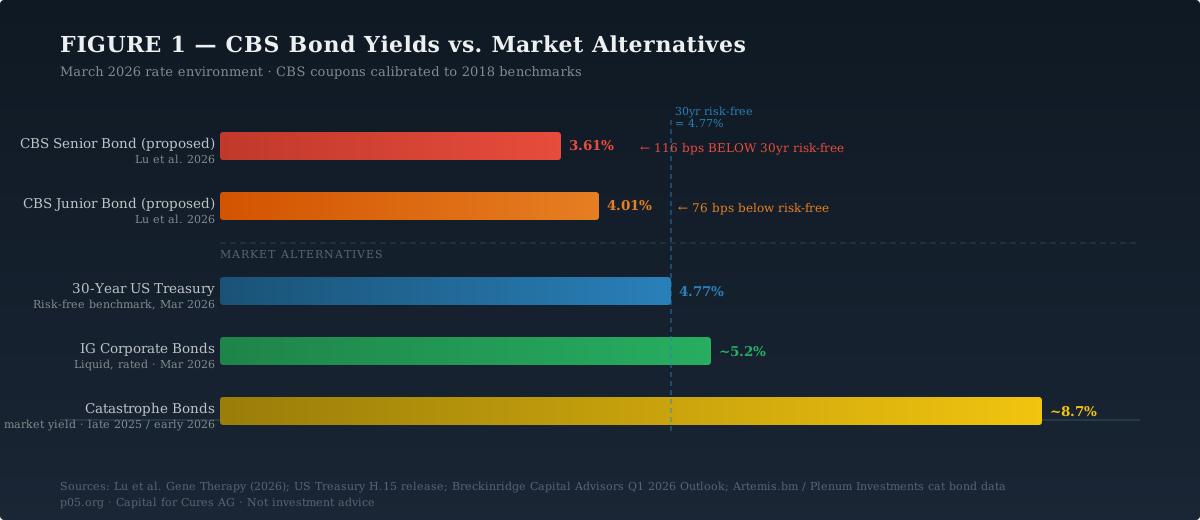
The table below shows the gap between what the paper proposes and what investors can earn elsewhere today:
| Instrument | Yield / Return |
|---|---|
| CBS Senior Bond (paper's proposal) | 3.61% |
| CBS Junior Bond (paper's proposal) | 4.01% |
| 30-year US Treasury (March 2026) | ~4.77% |
| 10-year US Treasury (March 2026) | ~4.11–4.16% |
| Investment-grade corporate bonds (March 2026) | ~5.0–5.5% |
| Catastrophe bonds (early 2026 market yield) | ~8.7–9.0% |
| CBS Equity tranche — median IRR (paper's own finding) | Below T-bill rate |
The senior CBS bond, as currently modeled, yields 116 basis points below the 30-year risk-free rate. For a 30-year, illiquid, novel, unrated security backed by gene therapy survival outcomes and extrapolated clinical models, a rational pricing would need to sit well above the sovereign benchmark — not below the 10-year note.
A realistic senior CBS bond coupon in March 2026, reflecting duration, illiquidity, novelty premium, and credit risk, would sit somewhere in the 5.5–6.5% range. At those coupon rates, the present value of bond proceeds falls materially. The paper shows that a 50% frontload comes from selling the bond tranches alone at 2018-calibrated rates. At market-rate 2026 pricing, that percentage shrinks considerably — and the primary commercial benefit to Novartis weakens with it.
The paper is aware of the rate-calibration issue at some level. It explicitly states coupon rates were set against 2018 benchmarks, noting the senior tranche at "0.50% above the average yields of US Treasury Bills in 2018." It does not, however, revisit what happens to the structure's commercial feasibility when the risk-free rate for the relevant duration has risen by more than 200 basis points since that baseline.
Who Holds the Risk — and What the Paper's Own Results Show
The equity tranche — 50% of the CBS structure — is where the paper's own results raise the sharpest questions.

The paper states plainly: the median internal rate of return on the equity tranche is "almost always lower than the yield on US Treasury Bills of the same maturity." The proposed resolution is that Novartis retains the equity, framing it as a reward structure — Novartis gets more if the therapy outperforms clinically.
The paper characterizes this as an incentive structure, but the economics of the position warrant closer examination. In standard capital structure terms, Novartis would be holding a first-loss, residual position — 50% of the structure, with a median expected return below Treasury Bills, subject to full first-loss on PBA shortfalls, with no liquidity and a 30-year duration. That is the tranche that absorbs what senior and junior investors declined to hold, which is not quite the same thing as an upside incentive.
The paper does offer an alternative: sell the equity at a 33.90% discount to create a 7.00% annualized expected return for investors, enabling an 83% frontload. But 7.00% for a 30-year, subordinated, illiquid, gene-therapy-outcome-linked equity instrument with no secondary market — against a 30-year Treasury of 4.77% and investment-grade corporate bonds offering coupon income near 5% — is a premium of roughly 220 basis points over risk-free for a security with substantially more risk than either. The catastrophe bond market, which is the closest structural analogue, delivered total returns of 14.1% in the 12 months to June 2025, with a market yield around 8.7% at end-2025.
The CBS equity tranche's 7.00% target return faces a meaningful pricing gap relative to comparable instruments available to institutional investors today — particularly given the subordinated, illiquid, clinical-outcome risk profile in a gene therapy market where venture funding fell 83% from 2021 to 2024.
The Closest Analogue: Catastrophe Bonds and the Pandemic Bond Failure
The intellectual architecture of cure-backed securities — SPV, tranched securities, parametric triggers tied to survival outcomes, public-health exposure passed to capital markets — maps almost exactly onto the catastrophe bond market, and particularly onto the World Bank's pandemic bond program. The comparison is instructive, and not entirely in the CBS structure's favor.
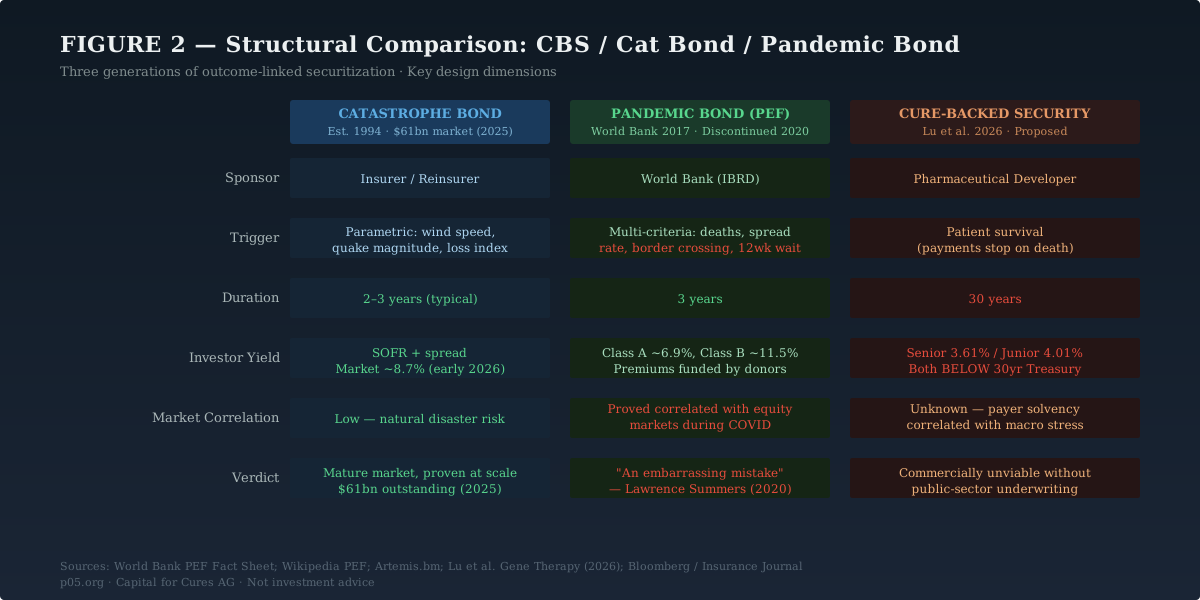
The catastrophe bond market emerged in the mid-1990s following Hurricane Andrew, when reinsurers needed to transfer extreme event risk to capital markets. The structure is now a $61 billion market as of end-2025, having grown 24% in that year alone. Cat bonds work as follows: a sponsor (insurer or reinsurer) pays a premium to an SPV; the SPV issues floating-rate bonds to investors (typically SOFR plus a spread); if a defined trigger event occurs and meets parametric thresholds, the investors forfeit principal to the sponsor; if no event occurs by maturity, investors receive principal back plus coupons. The market delivered 14.1% returns in the 12 months to June 2025, and even after significant spread compression, market yields remained around 8.7% at end-2025.
Cat bonds attract investors for three reasons that the CBS structure does not replicate. First, low correlation: hurricane and earthquake risk is structurally uncorrelated with equity markets and the economic cycle. Second, competitive yields: cat bond spreads over collateral yields have historically been attractive relative to equivalently-rated corporate bonds. Third, short duration: most cat bonds mature in 2–3 years, limiting the time investors are exposed to model error and trigger uncertainty.
The CBS structure, as modeled, does not share these three characteristics. Correlation with macroeconomic conditions is unclear — gene therapy outcomes are somewhat correlated with healthcare system functioning, and PBA payments depend on payer solvency over 30 years. Yields are, as established, below the risk-free rate at current benchmarks. And a 30-year duration exposes investors to three decades of model uncertainty for clinical extrapolations derived from trials with a few years of follow-up data.
The World Bank pandemic bond failure is the more pointed cautionary tale.
In June 2017, the World Bank issued $320 million in pandemic bonds under its Pandemic Emergency Financing Facility. The Class A tranche raised $225 million at approximately 6.9% (6.5% plus LIBOR), covering influenza and coronavirus. The Class B tranche raised $95 million at approximately 11.5% (11.1% plus LIBOR), covering Ebola, Lassa Fever, and other hemorrhagic fevers. The bond sale was 200% oversubscribed — investors were eager for the yield. Premiums were paid by donor countries (Germany, Japan, Australia), making the coupon economics viable in a way that CBS bonds do not contemplate.
The bonds had a critical design flaw that the CBS structure shares in modified form: the trigger conditions were too complex and too slow to activate when actually needed. The bonds required outbreaks to cross national borders, reach specified death tolls, sustain a growth rate above a threshold for 12 consecutive weeks, and receive certification from the World Bank's pandemic risk modeler (AIR Worldwide) — before any payout would occur. When Ebola killed over 2,000 people in the Democratic Republic of Congo between 2018 and 2020, the bonds did not trigger: the outbreak failed to cross into a second country at sufficient scale. By the 13th month, the PEF had paid out only $31 million while having paid $75.5 million in coupons to bondholders.
When COVID-19 arrived, the Class B bonds triggered and paid out $196 million — but too late. The 12-week confirmation period meant payout came months after the pandemic had already engulfed the global economy. Former World Bank chief economist Lawrence Summers described the program as "an embarrassing mistake" and "a dumb idea." The World Bank did not renew the program when the bonds matured in July 2020.
The CBS structure's survival-contingent annual payments face an analogous trigger precision problem. The PBA payments stop when the patient dies. But gene therapy clinical failure is not a binary mortality event — it may manifest as gradual efficacy waning, partial response, or quality-of-life deterioration that does not meet the survival trigger. As the paper acknowledges, clinical uncertainties arise precisely because these therapies "promise decades — or even a lifetime — of clinical benefit based on just a few years of data from small and uncontrolled clinical trials." The trigger mechanism may be simpler than the pandemic bond's, but it is also blunter: it captures only one mode of underperformance (death) while ignoring others (loss of therapeutic benefit while the patient remains alive).
The pandemic bond experience also revealed a structural tension that the CBS paper does not fully resolve: the conflict between making the trigger conditions tight enough that investors find the risk premium reasonable, and loose enough that payouts actually occur when needed. Tighten the trigger and the expected loss rises, requiring higher coupons that erode the structure's affordability advantage. Loosen it — as the current proposal does with simple survival — and the structure may pay out in cases where the therapy has still provided meaningful benefit, reducing the developer's incentive to maintain the annuity program.
Three Structural Questions for Royalty Holders
The rate and trigger problems affect investors in the new CBS securities. The royalty layer problem affects investors who already have claims on the same underlying cash flows.
Zolgensma did not emerge from Novartis's internal pipeline. The therapy was developed by AveXis, built on foundational research licensed from Nationwide Children's Hospital under a licensing agreement that predates the AveXis acquisition. That license almost certainly includes royalty obligations tied to net sales. In 2020, Royalty Pharma acquired a royalty interest in Zolgensma from the hospital's Research Institute — a publicly disclosed transaction that sits directly on top of the cash flows the CBS structure proposes to redistribute.
First: Does the royalty base change?
Standard pharmaceutical royalty agreements calculate payments on net sales — a defined term meaning gross revenue less specific deductions. Under a CBS structure, who is making the "sale," and when?
If Novartis sells Zolgensma to a payer under a 30-year PBA contract and simultaneously assigns the right to collect payments to an SPV, two interpretations follow. First, the sale occurred at therapy administration, and the royalty base is the undiscounted list-price value of the 30-year stream — base unchanged. Second, the cash Novartis actually receives (frontloaded SPV proceeds, net of the 17% transaction fee for an 83% frontload) represents a discounted sale, which aggressive licensees may argue reduces the net sales base. Royalty calculation disputes — particularly around deductions that reduce the net sales figure — are among the most litigated issues in pharmaceutical licensing. The CBS structure creates new ambiguity that careful licensees may try to exploit.
Second: Does the SPV assignment trigger consent rights?
Novartis assigning the right to collect PBA payments to an SPV may trigger review obligations under existing licensing agreements. Many licenses include provisions requiring licensor consent for any assignment of rights tied to the licensed product. An assignment of revenue collection rights is narrower than a license assignment — Novartis retains the license and continues to manufacture and sell Zolgensma — but sophisticated licensors may argue that assigning the economic benefit of sales without consent implicates the spirit of the anti-assignment clause, particularly where the underlying licensing agreement predates the modern era of royalty securitization.
Third: Where does the royalty claim sit relative to the SPV waterfall?
The CBS structure creates an SPV that holds a priority claim on PBA cash flows — senior bondholders are paid first, junior bondholders second, and the Novartis equity tranche receives the residual. The royalty obligation to Nationwide Children's Hospital / Royalty Pharma is a claim on Novartis's net sales, not on the SPV's assets.
Under normal operations this matters little — Novartis pays royalties from its own revenues regardless of how it has financed those revenues. But in a distress scenario, it matters considerably. If the CBS equity tranche underperforms and Novartis faces financial pressure, the SPV bond obligations could effectively subordinate Novartis's general creditors — including royalty holders who hold unsecured claims against Novartis's net sales — to the secured claims of CBS bondholders on the annuity streams. The CBS structure, by removing a layer of Novartis's cash flows into an SPV with priority obligations, reduces the pool of assets available to general creditors.
The Broader Context: Why the Public Sponsorship Argument Is Load-Bearing, Not Optional
The paper's most important paragraph is buried near the end of the discussion section: "By pooling risks and applying tranching, securitization can increase the effective net present value of PBA cash flows above the single-patient baseline, thereby lowering the cost of capital. If structured with the involvement of powerful public payers such as CMS or other national purchasers, this could enable reductions in annual installment payments and improve patient access. The analogy is to the emergence of mortgage-backed securities, which spread long-term risks across capital markets and allowed the development of affordable 30-year fixed-rate mortgages."
This framing is accurate but reveals the structure's real dependency. The 30-year fixed-rate mortgage did not become a mass-market product because the math was attractive to private investors. It became one because Fannie Mae and Freddie Mac — government-sponsored enterprises with implicit federal guarantees — created the secondary market, standardized the documentation, and absorbed the credit risk that private investors would not. Without GSE backing, the 30-year fixed rate mortgage at rates accessible to ordinary homebuyers does not exist.
The CBS structure, as modeled, requires an equivalent institutional sponsor. Without CMS or a national health authority providing credit enhancement, the commercial investor market will demand yields that make the structure economically unattractive to developers and potentially pass costs to payers. The paper treats public sponsorship as an enhancement that "could" improve patient access. It is more accurately described as a precondition for commercial viability.
The gene therapy investment climate reinforces this. In 2024, gene therapy developers raised less than $1.4 billion across 39 venture rounds, down from $8.2 billion in 2021. Pfizer recently stopped selling its gene therapy for hemophilia priced at $3.5 million per patient. Bluebird Bio — once valued at nearly $10 billion — was acquired by private equity for $30 million. Vertex's Casgevy, approved for sickle cell disease, generated just $10 million in 2024 sales. The institutional investors who would need to absorb CBS bonds — pension funds, insurance companies, fixed-income allocators — absorbed nearly half a trillion dollars in IG taxable bond fund inflows in 2025 at 5%+ coupons, liquid, rated, and transparent. Against that backdrop, a 30-year CBS bond at 3.61% would need to offer a compelling case for the yield concession — one the current structure does not make.
What Good CBS Documentation Would Look Like — For Royalty Holders
If the CBS structure gains traction — and its publication in Gene Therapy alongside current policy attention to gene therapy financing suggests interest is growing — royalty holders and royalty investors will need contractual provisions that address the interaction explicitly.
Net sales definition clarity. The royalty agreement should specify that net sales are calculated based on the undiscounted value of any installment or annuity-based payment stream at the time of therapy administration, regardless of whether the developer has subsequently assigned, securitized, or monetized those payment obligations. This prevents any argument that the royalty base is reduced by the financing cost of securitization.
Covenant against structural subordination. The royalty agreement should prohibit the developer from creating any security interest, assignment, or priority claim on therapy revenues — including through SPV arrangements — that would rank ahead of the royalty obligation without licensor or royalty investor consent. This addresses the scenario where SPV bond obligations subordinate the royalty claim in a distress scenario.
CBS-specific notice and consent. By analogy to the RMT-specific provisions discussed in this publication's earlier analysis of change-of-control triggers, royalty agreements should require advance notice of any securitization of therapy revenue streams and afford the royalty holder a right to review SPV documentation and confirm its claims are not impaired.
Direct payment election. In the most protective drafting, the royalty agreement can permit the royalty holder to elect direct payment from the SPV — inserting the royalty claim into the CBS payment waterfall at a specified priority level. This converts the royalty from a claim on the developer's net income to a claim on the underlying cash flows, which is structurally more robust.
The Verdict
The Lu et al. paper identifies a real problem — upfront payment for long-duration gene therapies creates misaligned incentives — and proposes a solution with genuine structural logic. The CBS mechanism, if implemented with realistic parameters, would benefit payers. The problem is what "realistic parameters" means in March 2026.
The structure as modeled requires investors to accept below-risk-free-rate returns on 30-year, illiquid, novel securities backed by clinical models extrapolated from small trials. It requires a developer to hold 50% of a structure whose median IRR falls below Treasury Bill yields, and frame that as an incentive rather than a residual loss. And it faces the same fundamental tension that doomed the World Bank's pandemic bonds: the more the trigger conditions are tightened to protect investors, the less effectively they transfer risk; the more they are loosened, the harder it becomes to price the security to market.
The analogy to mortgage-backed securities is apt — but the lesson of MBS is not that securitization solves financing problems automatically. The lesson is that securitization scales when public institutions provide the credit enhancement that private investors will not. Fannie and Freddie made the 30-year mortgage work. Their gene therapy equivalent — CMS, a national health authority, or a government-sponsored reinsurer — has not yet been created. Until it is, cure-backed securities remain an intellectually compelling proposal whose commercial viability depends on assumptions that do not currently hold.
For royalty investors and licensors in the gene therapy space, the CBS proposal is worth monitoring precisely because its policy-level traction may eventually create the public infrastructure that makes it work. When that happens, the interaction between CBS waterfall mechanics and existing royalty claims will become a live contractual issue. The time to draft provisions addressing that interaction is now, not after the first CBS pool is issued.
I am not a lawyer or financial adviser. Nothing in this article constitutes investment advice, legal advice, or financial advice. All information is derived from publicly available sources and is provided for informational purposes only.
Member discussion