
Fund of the Week: European Investment Bank

The European Investment Bank is the lending arm of the European Union, owned by its 27 member states. It signed $99.8bn (EUR 86.0bn) of financing in 2025 and holds a life sciences venture debt book of about $4.1bn (EUR 3.5bn) across 135 projects. Most of its biotech loans are paid for with interest and warrants.
Four borrowers have disclosed loans with a royalty or a revenue share on top. One of the four royalties has been cancelled, and on 21 October the bank sold another, with its overdue loan, to a vehicle owned by the borrower's chairman.
On 11 November 2026 the European Investment Bank (EIB) signed a $35M (EUR 30M) convertible loan with VectorY Therapeutics, an Amsterdam company developing vectorised antibodies for amyotrophic lateral sclerosis and Huntington's disease.
The loan is backed by the EU's InvestEU programme and is part of a $86.4M (EUR 74.5M) round, according to the bank, in which Angelini Ventures and Invest-NL joined as new investors. It can later be converted into VectorY's shares.
The loan is one of a run of life sciences deals the bank has signed under BioTechEU, an initiative announced with the European Commission in December 2025 to mobilise $11.6bn (EUR 10bn) of investment in 2026 and 2027. BioLamina, Ethris and VectorY each borrowed $23M to $35M (EUR 20M to EUR 30M) this year.
The bank lends as a creditor, and is paid on top of interest in one of three ways. Most biotech borrowers give it warrants. A few have given it a share of their sales or revenue. Three weeks before the VectorY signing, on 21 October, the bank signed a loan sale agreement with Chutzpah Holdings, a partnership owned by the chairman of Pluri, for Pluri's overdue EIB loan. The loan carries a royalty on Pluri's revenue until 2030. The price was described only as discounted.
At a Glance
- What it is: the long-term lending institution of the European Union, founded in 1958 and based in Luxembourg; with the European Investment Fund (EIF) it forms the EIB Group
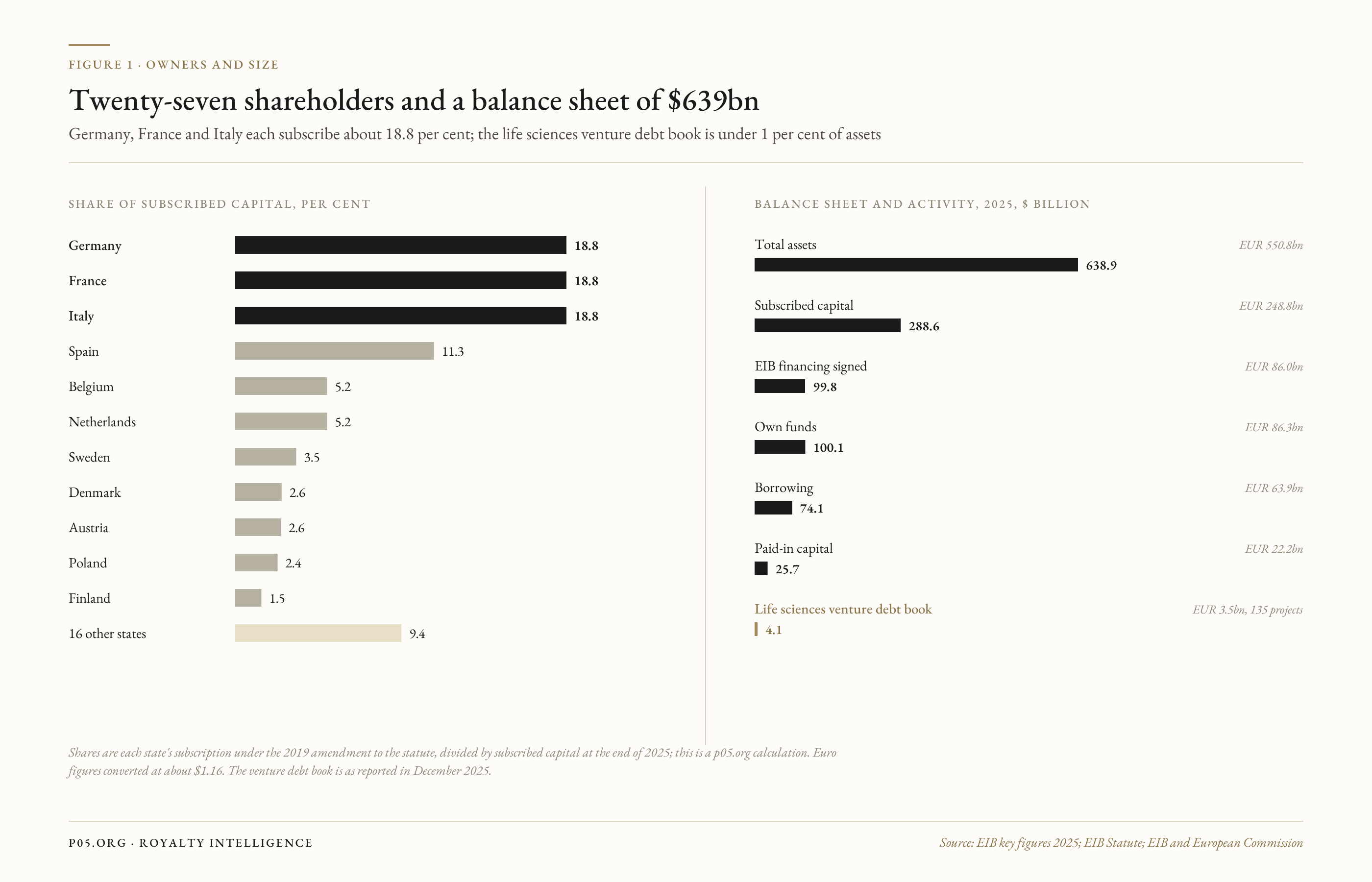
- Owners: the 27 EU member states; Germany, France and Italy each hold about 18.8 per cent of subscribed capital
- Size: total assets of $638.9bn (EUR 550.8bn), own funds of $100.1bn (EUR 86.3bn) and a 2025 surplus of $3.2bn (EUR 2.7bn), at the end of 2025
- 2025 financing: $116bn (EUR 100bn) for the group, of which $99.8bn (EUR 86.0bn) by the EIB and $18.2bn (EUR 15.7bn) by the EIF
- Life sciences venture debt: about $4.1bn (EUR 3.5bn) across 135 projects at December 2025
- Typical biotech ticket: $23M to $67M (EUR 20M to EUR 57.5M), in tranches tied to milestones, with bullet repayment after five or six years
- Remuneration beyond interest: warrants in most cases; a conversion right at VectorY; a share of equity value at Curetis
- Royalty and revenue-linked loans disclosed: Nanobiotix (live, not yet paying), Medincell (revenue share capped at EUR 20M, half the loan repaid), Pluri (sold to the chairman's vehicle, October 2026) and BiondVax, now Scinai (cancelled, August 2024)
- Royalty book: no separate royalty vehicle; royalties sit inside loan agreements as part of the bank's return, and the bank publishes no figure for them
A Note on Scope
The EIB publishes a summary sheet for each project, with the approximate amount and dates, but not the loan terms. Terms in this profile come from the borrowers' filings and releases, including the Nanobiotix royalty agreement filed with the SEC, whose rates and thresholds are redacted.
The bank reports its venture debt book in aggregate. It publishes no figure for royalty income, no count of loans that carry royalties, and no loss rate. The four royalty or revenue-linked loans described here are those that borrowers have disclosed; others may exist.
The EIB is a lender with shareholders, not a fund with limited partners. The section on investors therefore describes its owners and the guarantees behind its riskier lending. Euro amounts are converted at about $1.16 to the euro, including for past transactions, so dollar figures for older deals are indicative.
Investment Thesis and Mandate
The bank lends to projects that serve EU policy objectives. In 2025 almost 60 per cent of group financing went to green projects, and energy, defence and Ukraine took record amounts. Health and life sciences are a smaller part of the book, financed through large corporate loans, such as a $116M (EUR 100M) loan to Orion in 2026, and through venture debt to younger companies.
Venture debt is the instrument that brings the bank into contact with royalties. The EIB describes it as long-term debt with bullet repayment and remuneration linked to the equity risk of the borrower, designed to complement venture capital.
In 2019 the bank called itself Europe's largest provider of venture debt, at about $696M (EUR 600M) a year across sectors. Its project sheets describe the product as direct, equity-type financing for research, development and innovation. Bank presentations to borrowers say the remuneration may include warrants, interest, payment in kind, royalties or other forms, alone or combined, with a target return set by the risk of the investment.
The bank's own impact assessment of 2022 counted $3.07bn (EUR 2.65bn) of venture debt signed with 134 companies from 2015 to mid-2021, with a median ticket of about EUR 20M and interest of 3 to 10 per cent before warrants. It describes warrants as the standard kicker, settled in cash, and does not mention royalties. A separate evaluation of the group's quasi-equity, covering $5.1bn (EUR 4.4bn) signed from 2010 to 2021, found the portfolio not yet profitable overall.
The riskier loans are guaranteed by the EU budget. Earlier deals were covered by InnovFin under Horizon 2020 and by the European Fund for Strategic Investments. Current ones, including VectorY, BioLamina and SNIPR Biome, sit under InvestEU, which uses a $33.8bn (EUR 29.1bn) EU budget guarantee. HERA Invest, a top-up for health emergency preparedness, covers infectious disease deals such as Leyden Labs.
How Capital Enters and Returns
The bank raises money on the bond markets. It borrowed $74.1bn (EUR 63.9bn) in 2025. Member states have subscribed $288.6bn (EUR 248.8bn) of capital, of which $25.7bn (EUR 22.2bn) is paid in. The rest is callable and backs the bank's borrowing, as do its reserves.
A venture loan is drawn in tranches, each conditional on a clinical, regulatory or financing milestone. IO Biotech's facility of up to $66.7M (EUR 57.5M) has three committed tranches and an uncommitted accordion. Each tranche matures six years after drawdown, with interest capitalised and paid at maturity, and the loan is unsecured. Novadip's raise in September 2026 was made partly to unlock an EIB tranche.
Capital returns at maturity, on prepayment or on a sale of the borrower. The equity-linked part of the return comes as warrants, issued as each tranche is drawn, or as a royalty on revenue over a fixed period. Inventiva, which gave the bank warrants, repaid its loan in June 2026 and bought back part of the warrants for EUR 50M.
Medincell, which gave the bank both warrants and a share of revenue, repaid the first $23.2M (EUR 20M) tranche early in July 2026 from new bank loans and moved the rest to amortisation.
Financial Profile and Assets
| Item | Amount | Source and Date |
|---|---|---|
| EIB Group financing signed | $116bn (EUR 100bn) | EIB key figures, 2025 |
| of which EIB | $99.8bn (EUR 86.0bn), against EUR 76.6bn in 2024 | EIB annual accounts summary, 2025 |
| of which EIF | $18.2bn (EUR 15.7bn) | EIB key figures, 2025 |
| Total assets | $638.9bn (EUR 550,838M) | EIB key figures, 31 Dec 2025 |
| Own funds | $100.1bn (EUR 86,326M) | same |
| Net surplus | $3.2bn (EUR 2,725M) | same |
| Subscribed capital | $288.6bn (EUR 248,796M), of which EUR 22,191M called | same |
| Borrowing | $74.1bn (EUR 63.9bn) | EIB key figures, 2025 |
| Life sciences venture debt | about $4.1bn (EUR 3.5bn), 135 projects | EIB and Commission, Dec 2025 |
| EIF venture capital in biotech | about $928M (EUR 800M) a year | same |
| BioTechEU target | $11.6bn (EUR 10bn) of investment mobilised, 2026 to 2027 | same |
Portfolio Book
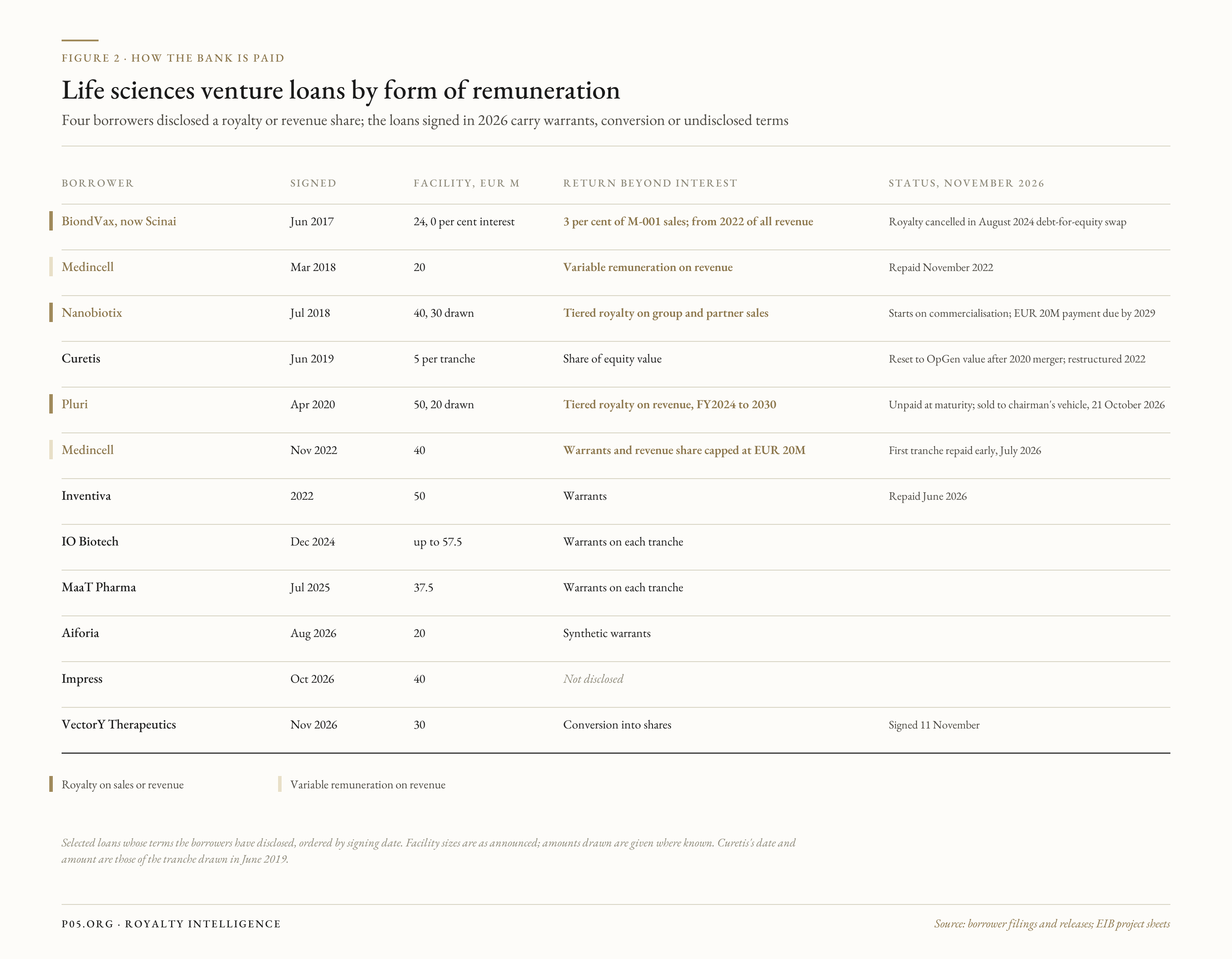
The list below covers life sciences venture loans named in this profile, with the form of return where disclosed.
Royalty on sales or revenue: Nanobiotix (2018, amended 2022, 2024 and 2025); Pluri, formerly Pluristem (2020, sold October 2026); BiondVax, now Scinai (2017, royalty cancelled 2024)
Revenue-linked remuneration and warrants: Medincell (EUR 20M in 2018, repaid 2022; EUR 40M in 2022, half repaid July 2026)
Share of equity value: Curetis, now part of OpGen (tranches in 2019 and 2020, restructured 2022)
Warrants: IO Biotech (up to EUR 57.5M, December 2024); MaaT Pharma (EUR 37.5M, July 2025); Oncopeptides (up to EUR 30M, 2025); OSE Immunotherapeutics (up to EUR 25M, 2021); Affibody (EUR 20M, warrants on drawdown); Aiforia (EUR 20M, synthetic warrants, August 2026); Inventiva (EUR 50M, 2022, repaid June 2026 for about $72.2M (EUR 62.2M) from a Claret and BlackRock facility)
Convertible: VectorY Therapeutics (EUR 30M, November 2026)
Venture debt, terms not disclosed: Impress (EUR 40M, October 2026); BioLamina (EUR 20M, signed 14 April 2026); Ethris (EUR 30M, 2026); SNIPR Biome (up to EUR 20M); Leyden Labs (EUR 20M); ExeVir Bio (up to EUR 25M, January 2023); Novadip
Investors
The bank's shareholders are the EU member states, which unanimously endorsed its strategic roadmap and in 2025 increased its financial headroom. Each state's share follows its economic weight when it joined. Under the 2019 amendment to the statute, made when the United Kingdom left, Germany, France and Italy subscribed EUR 46.7bn each, Spain EUR 28.0bn, and Belgium and the Netherlands EUR 13.0bn each.
Against current subscribed capital, that is about 18.8 per cent for each of the three largest, 11.3 per cent for Spain and 5.2 per cent for Belgium and the Netherlands. The bank gives the Dutch share as 5.2 per cent.
A share cannot be transferred, pledged or attached, and a state is liable only up to its uncalled capital.
The EU budget sits beside the shareholders as a risk-taker. Under InvestEU and its predecessors, the Commission guarantees part of the losses on the bank's riskier loans, which allows the bank to lend to pre-revenue biotechs.
The EIF commits about $928M (EUR 800M) a year to European venture capital, and in January 2022 the EIB signed a $41M (EUR 35M) co-investment facility alongside Claret's Fund III.
Governance and Team
The Board of Governors is made up of the member states' ministers, usually of finance. A Board of Directors approves operations, and a Management Committee runs the bank. Nadia Calviño, a former Spanish economy minister, is president of the EIB Group.
The VectorY loan was presented by Chantal Schrijver, head of the group's Amsterdam office. Ambroise Fayolle, as vice-president, signed Valneva's loan in 2016 and spoke for the bank on OSE's in 2021.
IP, Royalties and Return Economics
Royalties as Part of the Price of a Loan
The bank does not buy royalties. Where it holds one, the royalty is written into the loan as a percentage of a product's sales or of the borrower's revenue over a fixed number of years, beside or in place of warrants.
All four disclosed cases are loans to companies that were clinical-stage when they signed, each with one main asset. Two carry a make-whole set to give the bank a 20 per cent internal rate of return if the loan is repaid early.
Nanobiotix
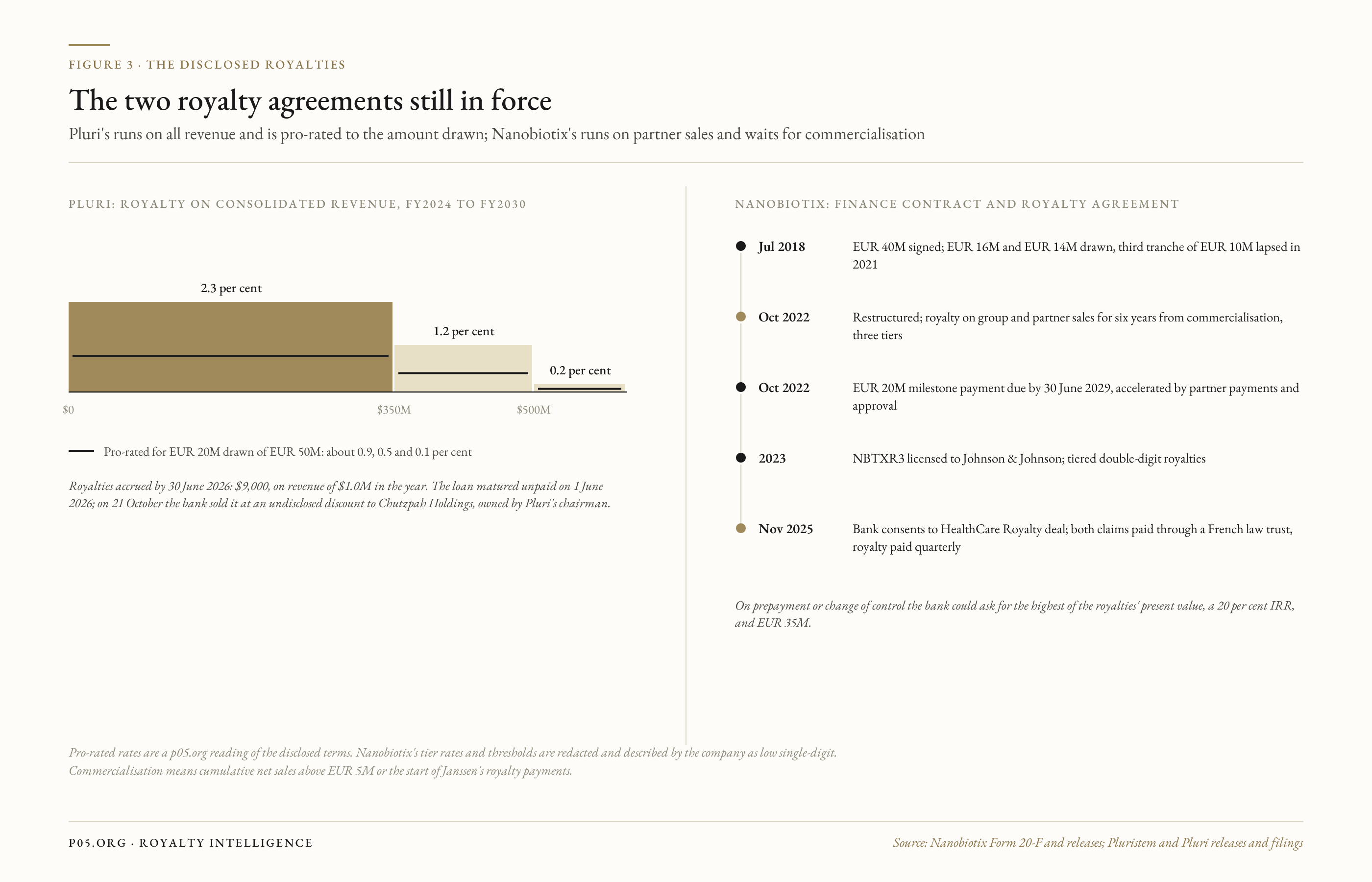
The finance contract and royalty agreement of 26 July 2018 set a credit of EUR 40M. Nanobiotix drew $18.6M (EUR 16.0M) in October 2018 and $16.2M (EUR 14.0M) in March 2019. A third tranche of EUR 10.0M lapsed in 2021 when performance conditions were not met.
The agreement has been amended three times: in October 2022, in April 2024 and, in November 2025, to make room for HealthCare Royalty.
The royalty, as restated, is charged on net sales of NBTXR3 and products derived from it, made by Nanobiotix or any partner, which includes Johnson & Johnson's Janssen. Sales in mainland China, Hong Kong, Macau, Taiwan, South Korea, Singapore and Thailand are excluded, as are partners' upfront and milestone payments.
There are three marginal tiers. Their rates and thresholds are redacted, and the company calls them low single-digit.
The royalty runs for six financial years from commercialisation, defined as the quarter in which cumulative net sales pass EUR 5.0M or Janssen starts paying royalties, whichever is earlier. Since November 2025 it is paid quarterly, with an annual true-up. It survives repayment of the loan.
The 2022 restructuring of about $35.6M (EUR 30.7M) of debt also added an interest-free milestone payment of $23.2M (EUR 20M), due by 30 June 2029 at the latest. According to the 2025 annual report, it falls due earlier out of several sources:
- 10 per cent of partner upfront and milestone payments above EUR 90M, and a tiered share below that
- the whole remaining balance on American approval
- a share of new equity or debt raised since October 2023
- 2 per cent of HealthCare Royalty's proceeds that are not debt
If the loan is prepaid, if control changes after final maturity or if Nanobiotix defaults, the bank may demand the highest of three amounts: the present value of all future royalties, the sum giving it a 20 per cent return, and $40.6M (EUR 35M).
NBTXR3, now JNJ-1900, was licensed to Johnson & Johnson in 2023 for up to $1.8bn of milestones and tiered double-digit royalties. In October 2025 Nanobiotix sold part of those royalties and milestones to HealthCare Royalty for $50M upfront and $21M more on conditions. Both claims are now paid through a French law trust that receives the Janssen receivables.
Nanobiotix is the settlor, and HealthCare Royalty's funds and the bank are beneficiaries. In its consent letter the bank capped the share of milestones and royalties that may go to HealthCare Royalty, and breaching the cap is an event of default. The percentages are redacted.
Pluri
Pluristem, now Pluri, signed a facility of up to $58.0M (EUR 50M) on 30 April 2020, guaranteed under the European Fund for Strategic Investments, in tranches of EUR 20M, EUR 18M and EUR 12M. Only the first, $23.2M (EUR 20M), was drawn, in June 2021. It carried 4 per cent interest, all of it deferred to maturity.
The royalty is charged on Pluri's consolidated revenue in fiscal years 2024 to 2030:
- 2.3 per cent on revenue below $350M
- 1.2 per cent between $350M and $500M
- 0.2 per cent above $500M
The rates are pro-rated to the amount drawn, which on EUR 20M of EUR 50M gives about 0.9, 0.5 and 0.1 per cent on the author's reading. Pluri does not book future royalties, because they cannot be measured. It had accrued $9,000 of royalties by 30 June 2026, on revenue of $1.0M in the year.
The loan fell due on 1 June 2026 and was not repaid. The bank reserved its rights but did not enforce. On 21 October it signed a loan sale and purchase agreement with Chutzpah Holdings, a partnership beneficially owned by Pluri's chairman and largest shareholder, Alejandro Weinstein.
The sale covers all the bank's rights in the loan and the guarantees, at a negotiated discounted price that was not disclosed. About $27.5M, including interest, was outstanding at 30 September. Pluri says the buyer succeeds to all the lender's rights. The royalty is part of the finance contract, but no filing says whether it will survive the settlement the buyer and Pluri still have to negotiate.
BiondVax, Now Scinai
BiondVax signed a $23.2M (EUR 20M) finance contract in June 2017 under InnovFin's infectious disease window, raised to EUR 24M in 2019. The loan bore no interest. Instead the bank was to receive 3 per cent of sales of M-001, a universal flu vaccine, for ten years (later 12), or a 2.8 times multiple of cash, if higher.
M-001 failed its Phase 3 trial. In the August 2022 restructuring:
- maturity moved to December 2027 and interest rose to 7 per cent
- the royalty became 3 per cent of all revenue once sales passed EUR 5M, until the bank had received the higher of 2.8 times the EUR 24M principal or a 20 per cent return
- the bank took 10 per cent of the net proceeds of equity raises
No royalty was ever paid. A draft letter of intent proposed capping it at EUR 70M. The final deal, in August 2024, dropped it: about $30.9M (EUR 26.6M) was converted into preferred shares worth 19.5 per cent of Scinai on a fully diluted basis, and EUR 250,000 was left outstanding, interest-free, to 2031.
Medincell
Medincell's first EIB loan, of EUR 20M in 2018, carried a variable remuneration on revenue. In 2022 it was amended to count revenue from Teva, and it was repaid that November. The second, of $46.4M (EUR 40M) and fully drawn by July 2023, combines interest, 774,648 warrants and an annual variable remuneration on the company's sales, which include its UZEDY royalties from Teva.
The royalty part is capped at EUR 20M, the nominal amount, and limited to ten years of marketing for each product. At 30 September 2025 Medincell estimated the total at $27.1M (EUR 23.4M) undiscounted, carried at EUR 11.0M.
In March 2026 the bank waived its right to have the warrants settled in cash. In July Medincell repaid the first tranche early. Its releases do not say whether the revenue share was changed.
Equity Value at Curetis, Warrants Elsewhere
Curetis gave the bank a participation in its equity value, not its sales, reset to a share of OpGen's value after the 2020 merger. Most recent biotech loans carry warrants instead. MaaT Pharma issues them on each tranche, priced at 99 per cent of a five-day average. OSE gave the bank warrants over 2.97 per cent of its capital for a second tranche, with anti-dilution protection.
Aiforia's 2026 loan uses synthetic warrants, and VectorY's converts into shares. In each case the return attaches to the company's value, not to a product's sales.
Blue Team
- A shareholder base of 27 sovereign states and $100.1bn (EUR 86.3bn) of own funds
- A life sciences venture debt book of about $4.1bn (EUR 3.5bn) across 135 projects, and a target of $11.6bn (EUR 10bn) mobilised in 2026 and 2027
- Long tenors, bullet repayment and capitalised interest, suited to companies without revenue
- EU budget guarantees under InvestEU that absorb part of the credit risk
- Loans repaid or refinanced at Inventiva and, in part, Medincell as products reached the market
- A royalty at Nanobiotix charged on Johnson & Johnson's sales as well as Nanobiotix's own, surviving repayment, with a $23.2M (EUR 20M) milestone payment due by 2029 and a EUR 35M floor on prepayment
- A revenue share at Medincell on a marketed product, capped at EUR 20M
Red Team
- Royalty rates, amounts received and loss rates are not published at portfolio level; the bank's own 2022 evaluation found its quasi-equity portfolio not yet profitable overall
- The Nanobiotix royalty depends on the commercialisation of a product still in Phase 3
- BiondVax's royalty was cancelled after a failed trial, Pluri accrued $9,000 of royalties before defaulting, and Nanobiotix's has not started
- The Pluri loan and its royalty claim were sold to a vehicle of the company's chairman at an undisclosed discount
- Unsecured, milestone-based lending to pre-revenue companies; some tranches, such as Nanobiotix's third, are never drawn
- Health is a small share of a book dominated by energy, transport and defence
- Members of the European Parliament have asked for an impact assessment of the BioTechEU money
Implications for the Pharmaceutical Royalty and Biotech Capital Markets
The bank's royalties are a feature of its loans, used where other borrowers give warrants. Some are set on one product (Nanobiotix, BiondVax at first) and some on the borrower's whole revenue (Pluri, Medincell). All run for a fixed number of years, and two are pro-rated or capped by reference to principal.
For a royalty buyer these are claims that differ from a licence royalty in their base, their term and their make-whole floors.
Nanobiotix shows the two kinds of claim meeting. HealthCare Royalty's purchase and the bank's royalty agreement are both paid through one trust that receives the Johnson & Johnson receivables. Any later buyer of Nanobiotix's royalties would need to know how the trust allocates between them.
Pluri and Scinai show what happens to such a royalty when the borrower cannot repay. At Scinai the bank gave up the royalty for equity. At Pluri it sold the loan, and with it the claim, to an insider. The Pluri sale is the first disclosed case found of the bank selling a royalty-bearing venture loan.
The Kura profile this week described a commercial lender that attached a capped royalty to its loan. The EIB has attached royalties to loans since at least 2018, at low single-digit rates and on smaller amounts.
Recent Developments
- The EIB signs a $35M (EUR 30M) convertible loan with VectorY Therapeutics on 11 November 2026
- The EIB lends $46.4M (EUR 40M) to Impress, a Barcelona orthodontics company, under TechEU on 27 October 2026
- The EIB sells Pluri's overdue loan to Chutzpah Holdings, owned by Pluri's chairman, on 21 October 2026
- Aiforia signs $23.2M (EUR 20M) with synthetic warrants in August 2026
- Novadip raises $12.1M (EUR 10.4M) to unlock an EIB tranche in September 2026
- The EU and the EIB launch an institutional investor pact on scale-up funding on 23 September 2026
- Medincell repays the first EIB tranche early in July 2026
- Inventiva repays its EIB loan from a Claret and BlackRock facility in June 2026
- Pluri's EIB loan reaches maturity unpaid on 1 June 2026
- The EIB waives the cash put on Medincell's warrants on 26 March 2026
- BioLamina signs a $23.2M (EUR 20M) venture loan on 14 April 2026
Financial History and Recent Developments
| Date | Event |
|---|---|
| 1958 | EIB founded under the Treaty of Rome |
| 2016 | Venture debt operations begin; Valneva signs EUR 25M under InnovFin |
| Jun 2017 | BiondVax EUR 20M at 0 per cent with 3 per cent of M-001 sales; raised to EUR 24M in 2019 |
| Mar 2018 | Medincell EUR 20M with variable remuneration on revenue |
| Jul 2018 | Nanobiotix finance contract and royalty agreement, EUR 40M |
| 2019 | Bank describes itself as Europe's largest venture debt provider, about EUR 600M a year |
| Apr 2020 | Pluristem facility of up to EUR 50M with a revenue royalty for fiscal 2024 to 2030 |
| Jun 2021 | Pluristem draws EUR 20M |
| Aug 2022 | BiondVax restructuring: 7 per cent interest, 3 per cent of all revenue above EUR 5M to 2.8x or a 20 per cent return |
| Oct 2022 | Nanobiotix restructuring: royalty start moved to commercialisation, EUR 20M milestone payment due by 2029 |
| Nov 2022 | Medincell repays the 2018 loan and signs EUR 40M with warrants and a revenue share |
| Aug 2024 | Scinai converts about EUR 26.6M into preferred shares; royalty cancelled |
| Dec 2024 | IO Biotech signs up to EUR 57.5M |
| Oct 2025 | Nanobiotix sells part of its J&J royalties to HealthCare Royalty |
| Nov 2025 | EIB consents; its royalty and HealthCare Royalty's paid through one trust |
| Dec 2025 | BioTechEU announced; life sciences venture debt book about EUR 3.5bn |
| Jan 2026 | Group reports EUR 100bn of 2025 financing |
| Jun 2026 | Pluri loan matures unpaid; Inventiva repays |
| Jul 2026 | Medincell repays the first tranche early |
| Mar 2026 | Cash put on Medincell warrants waived |
| 21 Oct 2026 | EIB sells the Pluri loan to Chutzpah Holdings |
| 11 Nov 2026 | VectorY convertible loan |
Conclusion
The EIB lends to European biotechs over long maturities, with interest paid at the end and part of the risk borne by the EU budget. It takes its equity-linked return mostly in warrants. At four companies it took a royalty or a share of revenue as well or instead.
Of those, one royalty was converted into equity, one was sold with its loan, one revenue share sits on a loan that is half repaid, and one shares a trust with a royalty fund.
In the week the bank signed with VectorY, its one live product royalty was waiting for Johnson & Johnson's first sales of JNJ-1900. The new biotech loans it signed in 2026 carried warrants, conversion rights or undisclosed terms.
All information in this report was accurate as of the research date and is derived from publicly available sources including court opinions, regulatory guidance, academic literature, SEC filings, and financial news reporting. Information may have changed since publication. This content is for informational purposes only and does not constitute investment, legal, or financial advice. The author is not a lawyer or financial adviser.