Global Royalty-Related Deals in Veterinary Pharmaceuticals: A Complete 2023-2025 Market Analysis
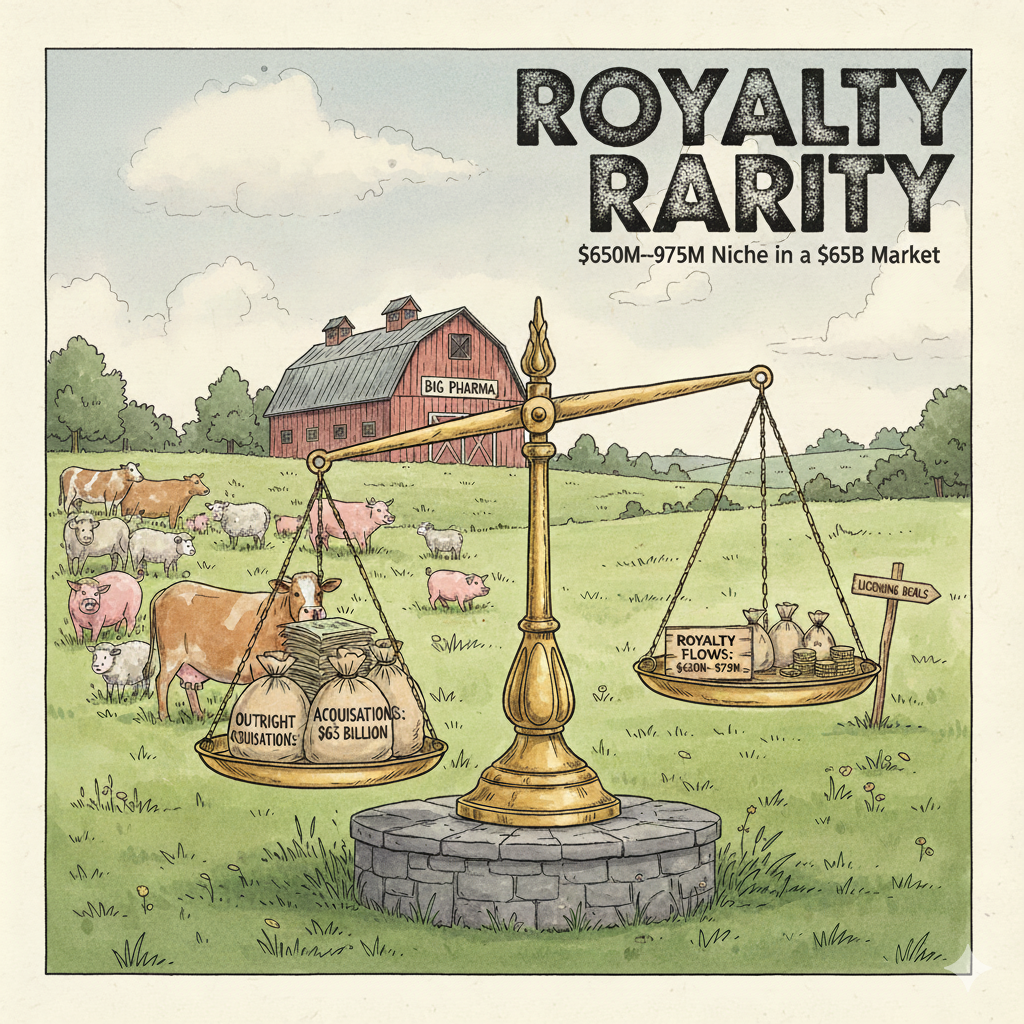
The veterinary pharmaceutical sector generated an estimated $650 million to $975 million in annual royalty flows in 2024, representing approximately 1-1.5% of the global $65 billion animal health market. Between 2023 and December 2025, the animal health industry executed numerous royalty-bearing deals and partnerships as companies sought innovation and strategic growth—yet unlike human pharma, where royalty monetization is a mature industry with dedicated multi-billion-dollar funds, veterinary royalty deals remain relatively rare. Major players consistently prefer outright acquisitions over licensing arrangements.
This comprehensive analysis examines royalty-bearing transactions across all segments: companion animal therapeutics, livestock biologics, aquaculture vaccines, and novel technology platforms. It consolidates deal-by-deal data, financial terms, strategic rationales, and emerging patterns across leading animal health companies.
Market Context and Industry Economics
The global animal health market reached approximately $65-67 billion in 2024, growing at 7-9% annually. Understanding this market structure is essential context for evaluating royalty deal economics.
Table 1: Global Animal Health Market Structure (2024)
| Segment | 2024 Value | Market Share | Growth Rate (CAGR) |
|---|---|---|---|
| Livestock/Production Animals | ~$38-40B | 55-60% | 5-7% |
| Companion Animals | ~$25-28B | 38-45% | 8.5-13% |
| Aquaculture | ~$1.4-2.5B | 2-3% | 7-8% |
| Product Category | Market Share | Estimated Value |
|---|---|---|
| Pharmaceuticals | 42-44% | ~$28B |
| Biologics/Vaccines | 28-30% | ~$19B |
| Diagnostics | 12-15% | ~$9B |
| Feed Additives | 8-10% | ~$6B |
Estimated royalty flows of $650 million to $975 million annually represent 1-1.5% of the market—significantly below human pharma's approximately $20+ billion annual royalty market (1.3% of ~$1.5 trillion market). Geographic distribution shows North America (34-44% share, ~$24B) and Europe (25-30%, ~$17B) leading, with Asia-Pacific (20-22%, ~$14B) growing fastest at 10-12% CAGR.
Table 2: Competitive Landscape – Market Leaders by Revenue (2024)
| Rank | Company | Estimated Revenue | YoY Growth | Global Share | Deal Strategy |
|---|---|---|---|---|---|
| 1 | Zoetis | ~$9.3B | +8-11% | ~14% | Hybrid: acquisitions + exclusive licenses + internal R&D |
| 2 | Boehringer Ingelheim Animal Health | ~$5.6B | — | ~8% | Build-plus-buy; option-to-acquire model |
| 3 | MSD Animal Health | ~$5.8B | Boosted by Elanco aqua | ~9% | Acquisition-focused; internal mRNA platform |
| 4 | Elanco | ~$4.4B | Refocusing post-divestiture | ~7% | Focus-and-divest; debt reduction priority |
| 5 | Ceva Santé Animale | ~$1.77B | IPO-ready | ~3% | Deal-driven growth; aggressive biotech acquisitions |
| 6 | Virbac | ~$1.6B | — | ~2% | Regional expansion via M&A + biotech licensing |
Veterinary Royalty Deal Economics: Benchmarks and Structures
Before examining individual deals, understanding the typical economics of veterinary licensing arrangements provides essential context for evaluating specific transactions.
Table 3: Veterinary Licensing Deal Economics (2019-2025 Benchmarks)
| Parameter | Typical Range | Notable Examples | Comparison to Human Pharma |
|---|---|---|---|
| ROYALTY RATES | |||
| Novel biologics (mAbs, gene therapy) | 10-18% of net sales | Kindred Bio KIND-030 to Elanco: "low-to-high teens" (10-18%) | Comparable (12-20% for biologics) |
| Approved pharmaceuticals | 5-15% of net sales | Industry standard for marketed products | Similar range |
| Diagnostic technology | 1-10% of net sales | IDEXX-University of Texas: 1-4% tiered by product configuration | Similar range |
| Academic-to-corporate licenses | 2-5% of net sales | Neogen: 2-10% on university-licensed products ($1.6-3.4M annually) | Similar (2-5%) |
| Feed additives/nutraceuticals | 3-8% of net sales | Elanco-DSM Bovaer: undisclosed royalties on US sales | Limited comparables |
| UPFRONT PAYMENTS | |||
| Early-stage development candidates | $500K - $2M | Kane Biotech/Skout's Honor: $500K; Kindred/Elanco KIND-030: $500K | Much smaller (human: $5-50M) |
| Late-stage development candidates | $2M - $10M | Typical for Phase II-equivalent programs | Much smaller (human: $20-100M) |
| Approved products with sales history | $10M - $45M | Aratana/Elanco Galliprant: $45M upfront | Much smaller (human: $50-500M) |
| Technology platforms | Single-digit millions | Elanco/DSM Bovaer: single-digit millions USD | Much smaller (human: $20-200M) |
| MILESTONE STRUCTURES | |||
| Development milestones (cumulative) | $5-20M | Target animal safety studies, manufacturing scale-up, formulation completion | Much smaller (human: $50-200M) |
| Regulatory milestones (cumulative) | $10-30M | NADA/ANADA submission ($5-10M), FDA-CVM approval ($10-20M), foreign authorizations ($2-5M each) | Much smaller (human: $50-150M) |
| Commercial/sales milestones (cumulative) | $20-95M | First commercial sale ($5-10M), $10M sales ($10M), $50M sales ($20M), $100M+ sales ($30-50M) | Smaller (human: $100-500M) |
| Total milestone potential | $80-130M | Kindred KIND-030: $110M total; Aratana Galliprant: $83-85M | Much smaller (human: $500M-2B) |
| DEAL DURATION | |||
| Patent-life based | Through patent expiration | Most common structure | Same |
| Fixed term agreements | 10-15 years typical | Kane Biotech: 10-year term | Similar |
| Perpetual licenses | Rare; usually with caps | Some diagnostic licenses | Less common |
| RETURN METRICS (from broader royalty monetization data, Covington 2019-2023) | |||
| Median return multiple on capped deals | 2.25× | Range observed: 1.3×-3.4× | Similar (2-3×) |
| Deal structure | 44% capped, 51% uncapped | 5% with other structures | More uncapped in human |
| Fixed termination dates | Only 11% of deals | Majority tied to patent/product life | Similar |
| Geographic scope | 69% worldwide, 31% territory-limited | Territory carve-outs common for Asia | More worldwide in human |
Key Observations on Veterinary vs. Human Pharma Economics
The veterinary royalty market differs fundamentally from human pharmaceuticals in several ways that affect deal structures:
Smaller absolute values, similar percentage rates: While upfront payments and milestones are 10-50× smaller in absolute terms, royalty rates as percentages of net sales are comparable. A 15% royalty on a $100M veterinary product generates $15M annually versus $150M on a $1B human drug—but the percentage economics are similar.
Compressed milestone structures: Veterinary development follows a different regulatory pathway (FDA-CVM vs. FDA-CDER) with generally shorter timelines. The absence of Phase I/II/III human trial paradigm means milestone triggers focus on: target animal safety, pivotal efficacy, manufacturing scale-up, regulatory submission, and approval.
Species fragmentation: A single human drug serves one species; veterinary products often require separate approvals for dogs, cats, horses, cattle, swine, poultry, and fish—each potentially a separate milestone trigger or royalty stream.
Limited blockbuster potential: The largest veterinary products (Apoquel, Simparica Trio, Librela) generate $500M-1.5B annually. Human pharma blockbusters routinely exceed $5-10B. This caps the absolute royalty potential.
Overview and Key Trends (2023–2025)
Major veterinary pharmaceutical firms entered licensing agreements, co-development partnerships, acquisitions with earn-outs or royalties, and out-licensing arrangements throughout this period. These deals frequently featured upfront payments, milestone fees, and ongoing royalties on product sales. They spanned companion animal and livestock segments—from pet parasiticides and vaccines to livestock biologics and novel therapeutics—and involved collaboration with biotech startups and academic spin-offs.
A common strategic theme was leveraging external innovation (e.g., licensing new technologies or drug candidates) to bolster R&D pipelines, while monetizing non-core assets to refocus and fund growth. Debt-laden companies like Elanco turned to royalty monetization for immediate cash, whereas others like Zoetis and Boehringer Ingelheim pursued cutting-edge science via partnerships with biotech firms.
Geographically, these deals underscored the global nature of animal health: Western multinationals often partnered with or acquired innovative startups across North America, Europe, and Asia. Japanese and European biotech firms (e.g., MabGenesis in Japan, Vaxinano in France) licensed veterinary candidates to international players. Some deals aimed at regional market expansion—for instance, Virbac's acquisition of India's Globion strengthened its vaccines presence in Asia.
The Industry Prefers Acquisitions Over Royalty Licensing
The 2023-2025 period has been characterized by consolidation rather than traditional licensing. MSD Animal Health's $1.3 billion acquisition of Elanco's aquaculture business (completed July 2024) exemplifies this trend—structured as a clean cash transaction with no disclosed retained royalties or earn-outs. Similarly, Mars Petcare's $1.3 billion acquisition of Heska (June 2023), Novo Holdings' £260 million purchase of Benchmark Genetics (2024-2025), and Virbac's acquisition of Globion in India all transferred full ownership rather than establishing royalty streams.
This preference for acquisition has strategic logic: major players can capture full margins without ongoing royalty obligations. When Elanco acquired Kindred Biosciences for $444 million (2021) and Aratana Therapeutics for $234 million (2019), both transactions explicitly aimed to eliminate ongoing royalty payments that would otherwise have been owed on products like Galliprant and KIND-030.
Deals with Disclosed Royalty and Milestone Terms
The following transactions provide the clearest window into veterinary licensing economics, with specific financial terms disclosed or reliably estimated.
Table 4: Deals with Disclosed Financial Terms
| Deal | Year | Upfront | Development Milestones | Regulatory Milestones | Commercial Milestones | Royalty Rate | Total Potential | Notes |
|---|---|---|---|---|---|---|---|---|
| Kindred Bio KIND-030 → Elanco | 2020 | $500K | Included in total | Included in total | Included in total | Low-to-high teens (10-18%) | ~$110.5M | Biologic for canine atopic dermatitis; acquired via Kindred buyout |
| Aratana Galliprant → Elanco | 2019 | $45M | — | — | $83-85M in sales milestones | Not disclosed | ~$128M+ | Pain management; eliminated royalties via $234M Aratana acquisition |
| Kane Biotech → Skout's Honor | 2023 | $500K | N/A | N/A | Ongoing % on sales | Undisclosed % + 14% on sublicenses | 10-year term | Biofilm technology for pet products |
| Elanco → DSM Bovaer | 2022 | Single-digit millions | Performance-based | Included | Royalties on US sales | Undisclosed | Blockbuster potential ($200M+ US) | Methane-reducing feed additive; 30-45% emission reduction |
| Elanco → Blackstone (XDEMVY royalties) | May 2025 | $295M (to Elanco) | N/A | N/A | Sales milestones included | Mid-single-digit tiered (estimated 4-6%) | Through 2033 | US royalties only; Elanco retains ex-US and new indications |
| Elanco → Neurizon (monepantel) | July 2025 | Nominal | $9.75M | Included in dev milestones | $65M | Tiered single-digit (estimated 3-8%) | ~$75M+ | Vet parasiticide licensed for human ALS development |
| IDEXX → University of Texas | 2000 (litigation 2025) | Original terms undisclosed | N/A | N/A | N/A | 1-4% tiered by product | $80M settlement (April 2025) | Lyme disease diagnostic technology |
| Neogen → Multiple universities | Ongoing | Various | Various | Various | Various | 2-10% depending on product | $1.6-3.4M annual royalty expense | Stacked academic licenses |
Detailed Analysis: Elanco-Blackstone XDEMVY Transaction
The May 2025 Elanco-Blackstone deal represents the most significant veterinary-originated royalty monetization in recent years and provides detailed insight into deal structuring:
Background: Elanco out-licensed its isoxazoline molecule lotilaner (the active ingredient in pet parasiticide Credelio) to Tarsus Pharmaceuticals for human ophthalmic use. Tarsus developed XDEMVY® for treating Demodex blepharitis, launching in 2023 as the first lotilaner-based human medicine.
Transaction Structure:
- Upfront payment: $295 million cash to Elanco
- Royalty stream sold: Tiered royalties (estimated mid-single-digit, 4-6%) on US net sales from April 2025 through 2033
- Milestone payments sold: Certain US sales milestones
- Rights retained by Elanco: All royalties outside the US; royalties on any new human indications beyond ophthalmology; all veterinary rights to lotilaner
Implied Economics: XDEMVY generated approximately $250-300M in 2024 US sales (growing rapidly). At a 5% average royalty rate, this implies ~$12-15M annual royalty income. Blackstone's $295M purchase price suggests they expect cumulative royalties plus milestones of $450-600M+ through 2033 (approximately 1.5-2× return), implying continued strong XDEMVY growth.
Strategic Rationale: Elanco converted a passive, long-dated income stream into immediate cash for debt reduction, targeting net leverage below 4× EBITDA by end of 2025. The $295M inflow reduces annual interest expense by approximately $10M.
Detailed Analysis: Elanco-Neurizon Monepantel License
The July 2025 Neurizon licensing agreement represents a rare veterinary-to-human reverse licensing, providing a template for such cross-sector deals:
Background: Monepantel is the active ingredient in Zolvix, Elanco's sheep parasiticide. Australian biotech Neurizon licensed the compound to develop NUZ-001 for amyotrophic lateral sclerosis (ALS) treatment in humans.
Transaction Structure:
- Upfront payment: Nominal (not material to Elanco financials)
- Development milestones: $9.75 million for initial NUZ-001 product
- Sales milestones: $65 million cumulative
- Royalty rate: Tiered single-digit percentages on global net sales (estimated 3-8% based on stage and risk)
- Additional products: Potential for additional milestones and royalties on future monepantel-based human therapeutics
Implied Economics: Total potential value of ~$75M+ for initial product, with upside from additional indications. Low upfront reflects early development stage and high clinical risk for ALS indication.
Key Deals by Leading Animal Health Companies (2023–2025)
Zoetis
Zoetis, the world's largest animal health company, engaged in licensing collaborations to tap novel biotechnologies while divesting non-core assets.
Numaferm Partnership (Mid-2023): Zoetis partnered with Numaferm GmbH (Germany) to license its protein production platform for "pepteins"—complex mid-size peptides with high biological activity. Financial terms were undisclosed, but this royalty-bearing license aimed to enhance Zoetis' ability to develop innovative protein therapeutics by leveraging Numaferm's high-yield expression system. Based on comparable platform deals, terms likely include: low single-digit millions upfront, development milestones per product ($5-15M cumulative), and royalties in the 3-8% range on products utilizing the platform.
Phibro Divestiture (April 2024): Zoetis agreed to sell its Medicated Feed Additives portfolio to Phibro Animal Health for $350 million (closed October 2024 at $297.5 million). The sale included approximately 37 product lines across 80 countries and six manufacturing sites. This was an outright asset sale with no ongoing royalty—reflecting Zoetis's strategy to exit declining categories (the portfolio generated ~$400M revenue but was declining) at under 1× revenue, reallocating capital to higher-growth vaccines and biologics.
PetMedix Acquisition (September 2023): Zoetis acquired PetMedix, a Cambridge-based biotech with proprietary Ky9™ (canine) and Felyne™ (feline) transgenic antibody platforms. Terms were undisclosed, but the acquisition eliminated any future royalty obligations to PetMedix on antibodies developed using these platforms—a key motivation given Zoetis now has three marketed companion animal mAbs with Bedinvetmab driving 18% companion portfolio growth in Q3 2024.
Veterinary Pathology Group Acquisition (November 2025): Zoetis acquired VPG to strengthen veterinary diagnostics capabilities in the UK and Ireland.
Elanco Animal Health
Facing high debt and the need for pipeline renewal, Elanco pursued both royalty monetization and R&D partnerships alongside strategic divestitures.
Blackstone Royalty Monetization (May 2025): Detailed above. The $295 million transaction converted future XDEMVY royalties into immediate debt reduction.
WEDterinary Research Partnership (March 2025): Elanco signed a research and licensing agreement with WEDterinary LLC to develop gene therapies for chronic kidney disease (CKD) in cats and explore life-extension treatments for pets. Financial structure (based on comparable deals):
- Research funding: Elanco funds R&D through its budget (estimated $2-5M annually)
- Option rights: Elanco likely holds exclusive option to license resulting therapies
- Future terms if exercised: Estimated $5-15M upfront upon option exercise, $20-50M in milestones, 8-15% royalties on commercialized products
Neurizon Global License (July 2025): Detailed above. Nominal upfront, $9.75M development milestones, $65M sales milestones, tiered single-digit royalties.
Aquaculture Divestiture to Merck (February 2024): Elanco sold its aquaculture business to Merck Animal Health for $1.3 billion cash (completed July 2024). No royalties retained—a clean exit from aquaculture to focus on core pet and farm animal segments. Net proceeds of $1.05-1.1 billion (after taxes) applied to debt reduction.
Speke Manufacturing Acquisition (Early 2025): Elanco acquired the Speke facility for approximately $25 million to secure supply chain.
Boehringer Ingelheim Animal Health
Boehringer Ingelheim (BI) engaged in multi-stage partnerships that evolved from licensing to full acquisitions—a model that reveals how royalty arrangements can transition.
Saiba Animal Health Collaboration and Acquisition: BI's relationship with Saiba Animal Health AG (University of Zurich spin-off) demonstrates the option-to-acquire model:
| Stage | Date | Structure | Estimated Terms |
|---|---|---|---|
| Initial collaboration | 2020 | Research partnership with options | R&D funding; options on vaccine candidates |
| First option exercise | June 2023 | Exclusive license for one VLP vaccine candidate | Upfront payment (described as "significant"—estimated $10-30M); development milestones; royalties on future sales (estimated 8-15%) |
| Full acquisition | September 2024 | 100% acquisition | Undisclosed; likely included buyout of prior royalty obligations plus earn-outs |
Through the acquisition, BI absorbed Saiba's virus-like particle (VLP) vaccine platform for chronic pet conditions (allergy, inflammation, pain) including HypoCat (neutralizes cat allergens in humans). The progression from collaboration to license to acquisition is typical when an asset proves valuable—the acquirer eliminates ongoing royalty obligations by buying the company outright.
Five New R&D Partnerships (2024): BI reported "five new R&D partnerships" in animal health. These early-stage collaborations typically feature: research funding ($1-5M annually), option rights to license discoveries, and if exercised, milestone/royalty structures similar to the Saiba model.
Merck Animal Health (MSD)
Elanco Aquaculture Acquisition ($1.3 billion, 2024): The largest veterinary transaction of the period, structured as a clean cash acquisition with no retained royalties. Key metrics:
| Metric | Value |
|---|---|
| Purchase price | $1.3 billion |
| 2023 revenue (estimated) | ~$175 million |
| Revenue multiple | ~7.4× |
| EBITDA multiple (estimated) | ~14× |
| Products acquired | 90+ (including Clynav DNA vaccine, Imvixa sea lice treatment) |
| Facilities | 2 manufacturing sites (PEI, Vietnam), 1 R&D center (Chile) |
| Employees | ~280 |
The premium valuation (vs. Zoetis MFA at <1× revenue) reflects aquaculture's growth trajectory versus declining feed additives.
Virbac
French company Virbac executed a multi-continent expansion strategy totaling approximately €580+ million across 2023-2025, combining acquisitions with strategic licensing.
MabGenesis Licensing Agreement (April 2025): Virbac entered a licensing agreement with MabGenesis Inc. (Japan) for novel monoclonal antibodies for canine diseases:
| Term | Structure |
|---|---|
| Upfront license fee | Undisclosed (estimated $2-10M based on stage) |
| Development milestones | Tied to IND-equivalent, pivotal studies, approval (estimated $10-30M cumulative) |
| Royalty rate | On net sales of resulting canine antibody therapies (estimated 8-15%) |
| Territory | Worldwide rights |
| Technology | Fully canine monoclonal antibodies from proprietary phage-display library |
Regional Acquisitions: All structured as cash acquisitions without ongoing royalties:
| Acquisition | Date | Value | Assets | Strategic Rationale |
|---|---|---|---|---|
| Sasaeah (Japan) | April 2024 | €280M | Farm animal vaccines, cattle focus | Largest vet deal in Japanese history; establishes market leadership |
| Globion (India) | Nov 2023 + June 2024 | Undisclosed | Poultry vaccines, ~€12M revenue | Entry into fast-growing Indian market |
| Centrovet (Chile) | 2024 | $43.7M (for 34% minority) | #2 Chilean salmon vaccine producer | Complete 100% ownership |
| Mopsan (Turkey) | Dec 2024 | Undisclosed | Companion animal distribution | Turkish market access |
Bio-Gene Flavocide R&D Collaboration: Ongoing since 2017 with Bio-Gene Technology (Australia) for Flavocide™ insecticide in livestock. Structure: Virbac funds trials; if successful, would license for commercialization with royalties to Bio-Gene (estimated 5-10% on sales). Results mixed as of 2023; status uncertain.
Vetoquinol
Vaxinano Leishmaniasis Vaccine License (November 2024): Vetoquinol announced an exclusive worldwide license with Vaxinano (France) for a novel canine leishmaniasis vaccine using nanoparticle-based nasal delivery (Stellar-NP platform):
| Term | Structure |
|---|---|
| Upfront payment | Undisclosed (estimated $5-15M) |
| R&D funding | Vetoquinol funds development |
| Development milestones | Tied to clinical progress, approval (estimated $15-40M cumulative) |
| Royalty rate | On global vaccine sales (estimated 10-18% given novel platform) |
| Territory | Worldwide exclusive |
| Market opportunity | Southern Europe, Latin America, North Africa—expanding due to climate change |
Klox Technologies Phovia Partnership: Ongoing since 2019. Vetoquinol licensed Klox's Fluorescent Light Energy (FLE) technology for Phovia wound healing system:
| Term | Structure |
|---|---|
| Territory | Global excluding China |
| Royalty structure | Likely royalties to Klox on device and consumable sales (estimated 5-12%) |
| Product status | Launched in US, EU, multiple markets |
| Strategic value | Leadership in veterinary dermatology devices; diversification from pharmaceuticals |
Dechra Pharmaceuticals
EQT Take-Private (2023): Dechra was acquired by EQT and Luxinva for £4.46 billion (3,875 pence/share, 44% premium). EQT took 74% ownership, with plans for long-term investment.
Akston Biosciences Insulin Program Acquisition (2024): Dechra acquired long-acting insulin programs for pets from Akston Biosciences, following earlier licensing/co-development agreements (2019 canine, 2021 feline):
| Term | Structure |
|---|---|
| Upfront cash payment | Undisclosed (estimated $20-50M) |
| Technology transfer fees | Additional payment for manufacturing know-how |
| Development milestones | Near-term payments based on clinical progress |
| Royalty arrangement | Akston retained no equity or ongoing royalties—full IP transfer |
| Products | AKS-321d (once-weekly canine insulin), AKS-425c (once-weekly feline insulin) |
The evolution from license to full acquisition mirrors the BI-Saiba pattern: Dechra eliminated future royalty obligations by purchasing the programs outright after proof-of-concept.
Invetx Acquisition (July 2024): Dechra acquired Invetx for up to $520 million, securing half-life extended monoclonal antibody technology. The "up to" language suggests earn-out/milestone structure—estimated $300-400M upfront with $120-220M in development and commercial milestones.
Ceva Santé Animale
Scout Bio Acquisition (January 2024): Ceva acquired Scout Bio, a University of Pennsylvania spin-out with AAV gene therapy programs for pets:
| Term | Structure |
|---|---|
| Purchase price | Undisclosed (estimated $50-150M based on stage and platform value) |
| Retained royalties | UPenn retained royalty interests on licensed IP post-acquisition |
| Earn-outs | Likely milestone payments to founders/UPenn tied to clinical progress |
| Assets acquired | AAV gene therapy platform; multiple preclinical candidates |
| Integration | Scout team integrated into new "Ceva Biotechnology Campus" in Philadelphia |
The UPenn royalty retention is notable—even in acquisitions, academic licensors often maintain economic participation in commercialized products.
MabGenesis License (June 2024): Ceva exercised an option for an exclusive worldwide license to therapeutic antibodies from MabGenesis (separate from Virbac's agreement, likely different disease targets):
| Term | Structure |
|---|---|
| Upfront payment | Triggered upon option exercise (estimated $5-15M) |
| Development milestones | Regular payments as programs advance (estimated $15-40M cumulative) |
| Royalty rate | On eventual sales (estimated 8-15%) |
| Technology | Canine monoclonal antibodies from fully-canine phage display library |
Touchlight dbDNA Collaboration (2023): Ceva licensed Touchlight's doggybone DNA (dbDNA) platform for veterinary vaccines. Structure: license fees for platform access plus milestones per vaccine project developed using the technology.
Comprehensive Deal Summary Tables
Table 5: All Major Royalty-Related Veterinary Pharma Deals by Company (2023–2025)
| Company | Partner(s) & Deal Type | Upfront | Milestones | Royalty Terms | Therapeutic Area | Strategic Rationale |
|---|---|---|---|---|---|---|
| Zoetis | Numaferm GmbH (License) | Undisclosed (est. low single-digit $M) | Per-product (est. $5-15M each) | Est. 3-8% on platform products | Peptein production platform | Access novel manufacturing for complex peptides |
| Zoetis | Phibro (Asset sale) | $297.5M (no ongoing) | None | None | Medicated feed additives | Exit declining category at <1× revenue |
| Zoetis | PetMedix (Acquisition) | Undisclosed | Eliminated via acquisition | Eliminated via acquisition | Transgenic antibody platforms | Control species-specific mAb technology |
| Elanco | Blackstone (Royalty sale) | $295M received | Sold | Mid-single-digit through 2033 (sold) | Human ophthalmic (XDEMVY) | Monetize passive income for debt reduction |
| Elanco | WEDterinary (R&D collab) | R&D funding (est. $2-5M/yr) | Option; if exercised est. $20-50M | Est. 8-15% if commercialized | Gene therapy for feline CKD | Pipeline renewal in novel modalities |
| Elanco | Neurizon (License out) | Nominal | $9.75M dev + $65M sales | Tiered single-digit | Human ALS (vet compound) | Monetize non-core human application |
| Elanco | MSD (Aqua divestiture) | $1.3B (no ongoing) | None | None | Aquaculture portfolio | Exit to focus core; debt reduction |
| Boehringer | Saiba (License then acquisition) | Est. $10-30M (2023 license) | Included then eliminated | Eliminated via Sept 2024 acquisition | VLP therapeutic vaccines | Secure then internalize platform |
| MSD | Elanco Aqua (Acquisition) | $1.3B | None | None | Aquaculture vaccines/meds | Species expansion into fish health |
| Virbac | MabGenesis (License) | Est. $2-10M | Est. $10-30M | Est. 8-15% | Canine monoclonal antibodies | Augment biologics pipeline |
| Virbac | Globion (Acquisition) | Undisclosed | Possible earn-outs | None disclosed | Poultry vaccines (India) | Emerging market entry |
| Virbac | Sasaeah (Acquisition) | €280M | None disclosed | None | Farm animal vaccines (Japan) | Market leadership in Japan |
| Virbac | Bio-Gene (R&D collab) | Trial funding | If successful, license triggers | Est. 5-10% if commercialized | Novel cattle parasiticide | Access new mode-of-action |
| Vetoquinol | Vaxinano (License) | Est. $5-15M | Est. $15-40M | Est. 10-18% | Canine leishmaniasis vaccine | First-in-class vaccine opportunity |
| Vetoquinol | Klox (License) | Undisclosed | Undisclosed | Est. 5-12% on devices/consumables | Wound healing LED therapy | Dermatology device diversification |
| Dechra | Akston (Program acquisition) | Est. $20-50M | Near-term dev milestones | Eliminated via acquisition | Once-weekly pet insulin | Secure blockbuster potential |
| Dechra | Invetx (Acquisition) | Up to $520M (includes earn-outs) | Included in "up to" | Eliminated via acquisition | Half-life extended mAbs | Competitive advantage in vet biologics |
| Ceva | Scout Bio (Acquisition) | Est. $50-150M | Likely earn-outs to founders/UPenn | UPenn retains royalty on licensed IP | AAV gene therapy platform | Lead in pet gene therapy |
| Ceva | MabGenesis (License) | Est. $5-15M | Est. $15-40M | Est. 8-15% | Canine monoclonal antibodies | Build biotherapeutics portfolio |
| Ceva | Touchlight (Tech license) | Platform license fees | Per-project milestones | Undisclosed | dbDNA vaccine production | Rapid-response vaccine capability |
Table 6: Deals by Structure Type
| Deal Structure | Examples | Typical Financial Terms | Strategic Purpose |
|---|---|---|---|
| Pure licensing (in-licensing) | Virbac-MabGenesis; Vetoquinol-Vaxinano; Ceva-MabGenesis; Zoetis-Numaferm | Upfront $2-15M; Milestones $10-50M; Royalties 5-18% | Access external innovation without R&D risk; speed to market |
| Co-development with option | Elanco-WEDterinary; BI-Saiba (initial); Virbac-Bio-Gene; Ceva-Touchlight | R&D funding $1-5M/year; Option exercise triggers license terms | Share early-stage risk; defer commitment until proof-of-concept |
| Option exercise → License | BI-Saiba (June 2023); Ceva-MabGenesis (June 2024) | Upfront $10-30M triggered; Milestones $15-40M; Royalties 8-15% | Convert successful collaboration to exclusive rights |
| License → Full acquisition | BI-Saiba (Sept 2024); Dechra-Akston (2024) | Acquisition price buyouts royalty obligations; may include earn-outs | Eliminate ongoing royalty payments; full control |
| Acquisition with earn-out | Dechra-Invetx ($520M "up to"); Novo-Benchmark (£30M contingent); Ceva-Scout Bio (likely) | Base price + 15-40% contingent on milestones | Bridge valuation gaps; align incentives |
| Clean acquisition (no royalties) | MSD-Elanco Aqua; Virbac-Sasaeah; Virbac-Globion; Zoetis-PetMedix | Full cash payment; no ongoing obligations | Capture full margins; strategic control |
| Royalty monetization (out-licensing) | Elanco-Blackstone (XDEMVY); Elanco-Neurizon | Upfront cash for future royalties; or nominal upfront + milestones + royalties | Convert passive income to immediate cash; monetize non-core |
| Asset divestiture | Zoetis-Phibro (MFA); Elanco-MSD (Aqua) | Cash purchase <1× to 7× revenue depending on growth profile | Exit non-core; fund strategic priorities |
Table 7: Deals by Geographic Focus
| Region | Deal | Parties | Value | Structure | Significance |
|---|---|---|---|---|---|
| Global | Leishmaniasis vaccine license | Vetoquinol-Vaxinano | Undisclosed | Worldwide exclusive license | First-in-class vaccine for zoonotic disease |
| Global | Canine mAb license | Virbac-MabGenesis | Undisclosed | Worldwide rights | Japanese innovation for global markets |
| Global | Canine mAb license | Ceva-MabGenesis | Undisclosed | Worldwide rights | Different targets vs. Virbac deal |
| Global ex-China | Phovia wound therapy | Vetoquinol-Klox | Undisclosed | Territory carve-out | China retained separately |
| North America + Europe | Once-weekly insulin | Dechra-Akston | Est. $20-50M+ | Full program acquisition | Major pet diabetes markets |
| North America + Europe | Half-life extended mAbs | Dechra-Invetx | Up to $520M | Acquisition with earn-outs | US innovation for global deployment |
| Japan | Farm animal vaccines | Virbac-Sasaeah | €280M | Full acquisition | Largest vet deal in Japanese history |
| India | Poultry vaccines | Virbac-Globion | Undisclosed | Staged acquisition | Fast-growing emerging market |
| China | Pet healthcare services | BI-NewRuipeng | Undisclosed | Equity investment + partnership | Access to world's fastest-growing pet market |
| Chile | Salmon vaccines | Virbac-Centrovet | $43.7M (minority) | Complete 100% ownership | Latin American aquaculture leadership |
| US only | XDEMVY royalties | Elanco-Blackstone | $295M | Royalty sale | Territory-specific monetization |
Table 8: Aquaculture Pharmaceutical Deals (2023-2025)
| Deal | Date | Value | Structure | Key Assets | Implied Multiples |
|---|---|---|---|---|---|
| Elanco Aqua → MSD | Feb 2024 (closed July) | $1.3B cash | Full acquisition; no royalties | Clynav, Imvixa, AQUAVAC, NORVAX; 2 plants; Chile R&D | 7.4× revenue; ~14× EBITDA |
| Benchmark Genetics → Novo | Nov 2024 (Q1 2025 close) | £230M + £30M earn-out | Acquisition with contingent payment | Salmon/shrimp genetics; Norway, Iceland, Chile, Faroe | ~4× revenue |
| Centrovet → Virbac | 2024 | $43.7M (34% minority) | Complete ownership | #2 Chilean salmon vaccines | N/A (minority stake) |
| Pharmaq UK → STIM | July 2024 | Undisclosed | Asset acquisition | Aquaculture vet services (Scotland, Ireland) | N/A |
| Nodavac-R commercialization | Aug 2024 | Undisclosed | Tech transfer partnership | Fish vaccine for viral nervous necrosis | N/A |
The £30 million earn-out in the Novo-Benchmark deal (contingent on salmon segment performance 2024-2027) represents the closest structure to an ongoing royalty in major aquaculture transactions.
Table 9: Novel Technology Platform Deals
| Technology | Deal Type | Partners | Year | Terms | Status |
|---|---|---|---|---|---|
| mRNA Vaccines | Exclusive license | Bayer-BioNTech | 2016 | Exclusive vet rights to BioNTech mRNA | Active; Bayer Lifescience Center |
| mRNA Vaccines | Exclusive license | Zoetis-BioNTech | Pre-2023 | Exclusive animal health rights | First conditional USDA approval (canine melanoma) |
| mRNA Vaccines | Internal platform | MSD SEQUIVITY | Ongoing | Proprietary | Only commercialized mRNA vet system |
| mRNA Vaccines | Research collab | Kansas State-Tonix | Ongoing | R&D partnership | Thermostable mRNA for developing markets |
| Monoclonal Antibodies | Acquisition | Zoetis-PetMedix | Sept 2023 | Full company | Ky9™, Felyne™ platforms; 3 marketed mAbs |
| Monoclonal Antibodies | License | Virbac-MabGenesis | April 2025 | Upfront + milestones + royalties | Fully canine antibody library |
| Monoclonal Antibodies | License | Ceva-MabGenesis | June 2024 | Upfront + milestones + royalties | Different disease targets |
| Monoclonal Antibodies | Acquisition | Dechra-Invetx | July 2024 | Up to $520M | Half-life extension platform |
| VLP Vaccines | License → Acquisition | Boehringer-Saiba | 2020-2024 | License 2023; acquisition 2024 | Therapeutic vaccines for chronic pet diseases |
| Gene Therapy (AAV) | Acquisition | Ceva-Scout Bio | Jan 2024 | Est. $50-150M + earn-outs | UPenn spin-out; chronic disease programs |
| Gene Therapy (AAV) | R&D collaboration | Elanco-WEDterinary | March 2025 | R&D funding + option | Feline CKD; pet longevity |
| Synthetic DNA | Tech license | Ceva-Touchlight | 2023 | Platform fees + per-project milestones | dbDNA for rapid vaccine production |
| Peptide Production | Tech license | Zoetis-Numaferm | Mid-2023 | Undisclosed; likely royalties | Peptein platform |
Emerging Biotechs and Novel Modality Funding
Table 10: Veterinary Biotech Funding and Regulatory Milestones (2024-2025)
| Company | Technology | Recent Funding | Key Milestone | Licensing Potential |
|---|---|---|---|---|
| ELIAS Animal Health | Autologous cell therapy (ECI®) for canine osteosarcoma | Expansion funding (undisclosed) | First full USDA approval for vet cancer immunotherapy (March 2025) | Available at ~100 US centers; partnership potential for international expansion |
| Loyal | Dog longevity therapeutics | $150M+ total ($45M Series B March 2024; $22M B-2 Feb 2025) | FDA reasonable expectation of efficacy acceptance for LOY-002 (Feb 2025) | Expanded conditional approval targeted end 2025; major pharma partnership candidate |
| Gallant Therapeutics | Allogeneic stem cell platform | $18M Series B (2025) | Targeting first FDA-labeled allogeneic stem cell therapy by early 2026 | Lead product for feline chronic gingivostomatitis |
| Invetx (acquired) | Half-life extended mAbs | Acquired by Dechra for up to $520M | Platform validated | No longer independent |
| Scout Bio (acquired) | AAV gene therapy | Acquired by Ceva | Platform validated | No longer independent |
Risk Factors for Veterinary Royalty Investments
Table 11: Veterinary vs. Human Pharma Royalty Investment Comparison
| Factor | Veterinary | Human Pharma | Implication for Royalty Investors |
|---|---|---|---|
| Total addressable market | ~$65B globally | ~$1.5T globally | ~25× smaller absolute opportunity |
| Blockbuster threshold | $500M-1.5B (rare) | $1B+ (common) | Caps absolute royalty potential |
| Regulatory pathway | FDA-CVM; shorter timelines | FDA-CDER; longer, more expensive | Lower development costs but less predictable |
| Species fragmentation | Separate approvals per species | One approval for humans | Fragments market opportunity |
| Insurance/reimbursement | Minimal; cash-pay market | Extensive; payer negotiations | Lower reimbursement risk; less pricing power |
| Generic competition | ANADA pathway exists | ANDA pathway well-established | Similar dynamics but smaller markets |
| Patent protection | Similar to human | Standard terms | Same duration |
| Extra-label use | AMDUCA permits | Off-label more restricted | Reduces exclusivity benefits |
| Royalty investor interest | Very limited | Mature market ($20B+ annually) | Few dedicated buyers; less liquidity |
| Typical deal sizes | $50-300M | $500M-5B+ | Smaller absolute returns |
Positive differentiators for veterinary:
- Lower clinical development costs and timelines
- Direct consumer relationships (no PBM negotiations)
- Growing pet ownership and humanization trends
- More predictable demand (less economic sensitivity for pets)
Conclusion
The 2023-2025 veterinary pharmaceutical landscape reveals a sector where acquisitions dominate over traditional royalty licensing. Major players prefer to buy assets outright, eliminating ongoing royalty obligations and capturing full margins. The estimated $650-975 million annual royalty market represents a small fraction of the industry's value, with limited dedicated royalty investor interest.
Key Valuation Benchmarks Observed
| Transaction Type | Valuation Range | Examples |
|---|---|---|
| Declining portfolios | <1× revenue | Zoetis MFA to Phibro ($297.5M for ~$400M revenue) |
| Growth businesses | 4-7× revenue | Elanco Aqua to MSD (7.4×); Benchmark to Novo (~4×) |
| Take-private premiums | 40-50% | Dechra by EQT (44% premium) |
| Biotech platforms | $50-520M depending on stage | Scout Bio, Invetx, PetMedix |
Typical Licensing Economics
| Parameter | Range | Best Disclosed Example |
|---|---|---|
| Upfront payments | $500K - $45M | Aratana-Elanco Galliprant: $45M |
| Development milestones | $5-50M cumulative | Neurizon: $9.75M |
| Commercial milestones | $20-95M cumulative | Neurizon: $65M; Kindred: $110M total |
| Royalty rates (novel biologics) | 10-18% | Kindred KIND-030: "low-to-high teens" |
| Royalty rates (platforms) | 3-8% | Industry estimates |
| Deal duration | Patent life or 10-15 year terms | Kane Biotech: 10-year |
Strategic Patterns
- Option-to-acquire model: Companies like Boehringer (Saiba) and Dechra (Akston) increasingly use collaboration → license → acquisition progressions, allowing them to de-risk investments while ultimately eliminating royalty obligations through buyout.
- Royalty monetization for deleveraging: Elanco's $295M Blackstone transaction demonstrates how non-core royalty streams can be converted to immediate cash for debt reduction.
- Platform premiums: Technology platforms (mRNA, species-specific antibodies, gene therapy) command significant valuations even at early stages, reflecting their potential to generate multiple products.
- Geographic expansion via M&A: Companies prefer to acquire regional players (Virbac-Sasaeah, Virbac-Globion) rather than license products into new territories.
The most significant opportunities for royalty-style investments lie in novel technology platforms where major players continue seeking external innovation, and in sustainability-focused solutions where ESG drivers create new market categories. However, the structural preference for acquisition over licensing means true royalty deals will remain relatively uncommon compared to human pharmaceutical markets.
Member discussion