
M&A with Embedded Synthetic Royalty: How Acquirers Close Deals with a Royalty Partner at the Table

When a buyer cannot, or will not, fund an acquisition entirely from cash, stock, or traditional debt, a synthetic royalty sold concurrently with the signing of the merger agreement can close the funding gap.
The structure is now an established piece of the life sciences M&A toolkit, with more than $5 billion of transaction value touching this pattern between 2021 and early 2026. This post walks through the mechanics, the typology, and the deals on the public record through April 2026.
What "Embedded" Means Here
In a standard synthetic royalty, a company sells a contractual percentage of future net sales of one of its own products in exchange for upfront cash. The product sits on the seller's balance sheet, the seller remains the commercial owner, and the investor gets a revenue-linked cash flow that is typically a true sale for tax and bankruptcy purposes.
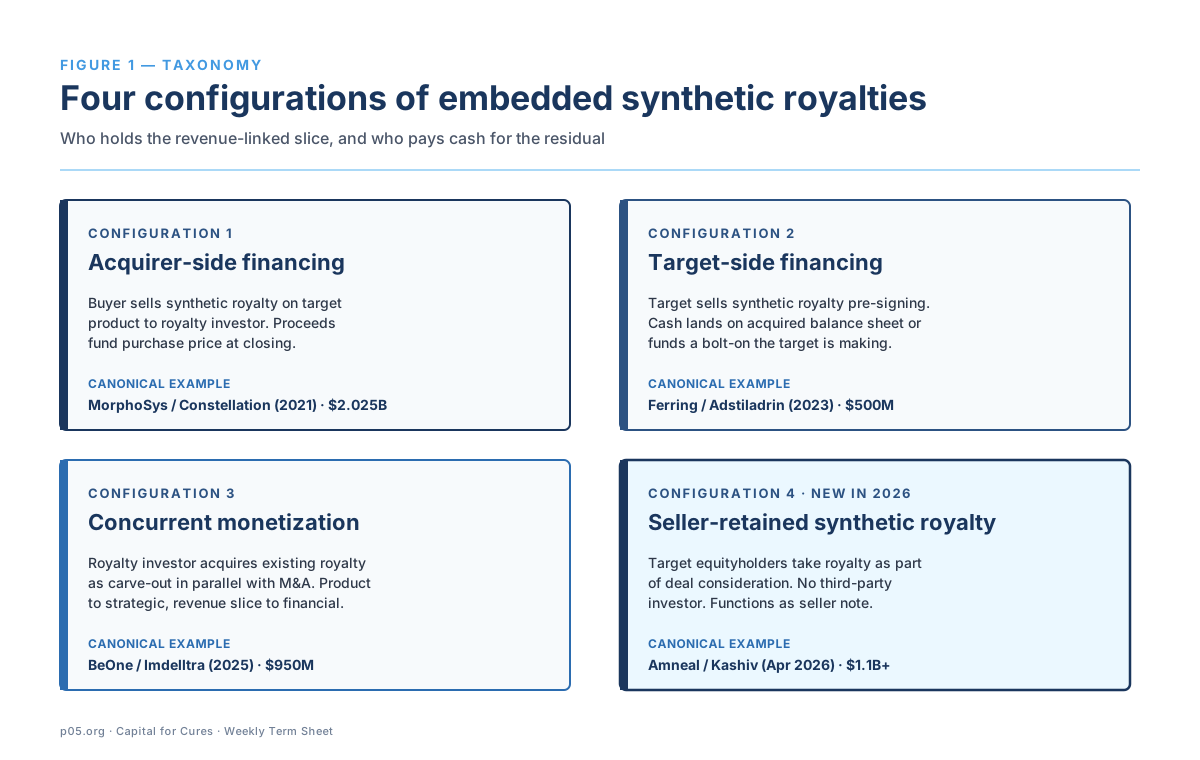
An embedded synthetic royalty in an M&A transaction is the same instrument used as acquisition currency. Four configurations show up in practice:
- Acquirer-side financing. The buyer sells a synthetic royalty on a product of the target (or on a product already in its own portfolio) to a royalty investor, and uses the proceeds to fund part of the purchase price at closing.
- Target-side financing. The target sells a synthetic royalty to a royalty investor days or weeks before signing, converting an illiquid future revenue stream into cash that then flows to the acquirer as part of the acquired balance sheet, or that funds a bolt-on acquisition the target itself is making.
- Concurrent monetization. The royalty investor acquires an existing traditional royalty held by the target as a carve-out in parallel with the M&A transaction, effectively splitting the economic rights into a product sale to a strategic and a royalty sale to a financial buyer.
- Seller-retained synthetic royalty. The target's equityholders take part of the acquisition consideration as a contingent royalty interest on the acquired products, paid by the acquirer to the sellers over a defined term. The royalty is not sold to a third-party financial buyer; it remains with the former owners and functions as a seller note with pay-as-you-earn economics.
The economic logic of configurations 1-3 is identical: the royalty investor takes the revenue-linked slice of the asset at a discount rate that reflects commercial risk, and the strategic pays cash for the residual equity-like upside. Splitting the asset this way typically produces a higher combined price than any single counterparty would pay, because each side holds what it underwrites best.
Configuration 4 does not involve a third-party royalty investor at all, but the mechanics, accounting treatment, and covenant architecture are the same as a synthetic royalty, which is why it belongs in this taxonomy rather than in the CVR category.
Why the Structure Exists
The embedded synthetic royalty sits at the intersection of three 2025-2026 realities.
Patent cliff pressure. Big pharma is facing roughly $200 billion in LOE exposure through 2030, which has pushed acquisition premiums to 60-120% over unaffected stock prices. Buyers are looking for every mechanism to avoid dilutive equity and to preserve investment-grade credit.
Royalty capital abundance. Gibson Dunn's 2026 Royalty Finance Report tracks 133 royalty finance transactions from 2020 through 2025 with more than $32 billion in aggregate value, with 2025 alone at $7.1 billion across 25-27 deals and median deal size reaching $221 million. Royalty Pharma deployed a record $2.6 billion in 2025 including its highest year ever for announced synthetic royalty transactions. KKR's majority-stake acquisition of Healthcare Royalty Partners in mid-2025 confirmed the asset class at institutional scale. Capital is available in size and fast.
Valuation gap tooling. Morgan Lewis notes that hybrid transaction structures combining acquisition and royalty elements are increasingly deployed to allocate risk, preserve optionality, and facilitate continued development. Where a CVR ties consideration to a binary readout, a synthetic royalty ties it to a continuous variable, actual net sales, and is paid to a third party rather than back to the seller's shareholders.
The Canonical Example: MorphoSys / Constellation / Royalty Pharma (2021)
The archetype of the embedded synthetic royalty in M&A remains the June 2021 $2.025 billion MorphoSys / Royalty Pharma partnership that funded MorphoSys's $1.7 billion cash acquisition of Constellation Pharmaceuticals. The structure had four components executed simultaneously with the merger agreement:
- Traditional royalty sale. Royalty Pharma acquired MorphoSys's rights to receive future royalties on Janssen's Tremfya (guselkumab) for $1.425 billion upfront. This was the anchor asset, a commercial product with a long tail.
- Development-stage royalty acquisitions. Royalty Pharma acquired portions of future royalties on gantenerumab (60%), otilimab (80%), and two other pipeline programs, funded at closing but economically a synthetic-style interest in pipeline assets.
- Development Funding Bonds. $150 million in bonds with fixed repayment schedules, debt-like in character.
- Equity. $100 million primary equity investment in MorphoSys common stock at the prevailing market price.
Royalty Pharma provided the entire $2.025 billion as acquisition currency. MorphoSys never issued dilutive equity at the depressed trading level it would otherwise have needed. Constellation shareholders received cash at a full premium. Royalty Pharma locked in a diversified royalty portfolio spanning an approved blockbuster, a potential Alzheimer's asset, and the myelofibrosis pipeline that Constellation was bringing in.
When Novartis later acquired MorphoSys at €68 per share in 2024, Royalty Pharma had already monetized the remaining Development Funding Bonds for $511 million in January 2025, crystallizing $530 million of cash proceeds on the original $300 million bond investment.
This deal established the template: use one transaction to close an acquisition, diversify the royalty investor across approved and pipeline assets, and structure the financing across the full capital stack from true-sale royalty through bonds to equity.
The Revolution Medicines Template: Embedded Financing as Strategic Option
The June 2025 Revolution Medicines / Royalty Pharma arrangement reframed the embedded synthetic royalty as an optional war chest rather than a closing-day necessity. The structure:
- Up to $1.25 billion synthetic royalty on worldwide net sales of daraxonrasib ($250 million upfront, five tranches of $250 million). The first two tranches ($500 million) are drawable before FDA approval; royalty obligations begin only after approval.
- Up to $750 million senior secured term loan, first tranche drawable following FDA approval, interest at SOFR + 5.75%.
- Royalty rate structure: tiered, starting at 4.55% for the first $2 billion in annual sales, declining to zero above $8 billion, 15-year term.
$1.25 billion of the $2 billion is at Revolution Medicines' discretion. This is not conventional deal financing; it is an embedded synthetic royalty facility structured to give the company optionality to fund either independent commercial launch or an acquisition without going back to the capital markets.
The contractual commitment to pay the tranches against a fixed royalty economics effectively preselects Royalty Pharma as the forward financing partner if and when an opportunity materializes. For a company repeatedly speculated as an M&A target, the structure also functions as anti-takeover capital: the synthetic royalty becomes an assumed liability for any acquirer.
Variant: Cytokinetics as Anti-M&A Embedded Royalty
The May 2024 $575 million Cytokinetics / Royalty Pharma expansion is the mirror image of the M&A-enabling use case: an embedded synthetic royalty structured specifically to deter M&A.
With Novartis, J&J, and AstraZeneca reportedly circling aficamten, Cytokinetics restructured the existing aficamten royalty to 4.5% up to $5 billion and 1% above, added $50 million upfront plus $175 million drawable post-approval (1.9x repayable over 10 years), a $100 million omecamtiv mecarbil development tranche with conditional $237.5 million failure payments, and $50 million equity.
The embedded royalty dropped the stock 14-17% immediately as investors repriced the probability of a near-term acquisition. Any acquirer must now assume 4.5% of aficamten's global net sales up to $5 billion as a first-dollar obligation, which at analyst consensus peak sales of $3-4 billion translates to ~$135-180 million of annual royalty expense flowing through to a combined pro forma.
The structure does not prevent M&A; it repositions the valuation so that the equity holders get less and the synthetic royalty holder gets more.
Variant: Concurrent Carve-Out at Signing (Amgen / BeOne / Royalty Pharma, August 2025)
The BeOne / Royalty Pharma $950 million Imdelltra transaction illustrates the concurrent monetization variant, although here executed separately from an M&A. BeOne (formerly BeiGene) held an approximately 7% royalty on ex-China net sales of Imdelltra through its 2019 collaboration with Amgen. The transaction terms:
- $885 million upfront for the royalty interest.
- $65 million option for BeOne to sell additional royalties within 12 months.
- Royalty sharing on annual net sales above $1.5 billion retained by BeOne.
- Term: through 2038-2041.
Crucially, BeOne retained the economic right to participate above $1.5 billion in annual sales, meaning the royalty was split into a lower-tier slice sold to Royalty Pharma and an upper-tier slice retained.
In an M&A context, this exact mechanic can be used pre-signing: the target carves out the royalty slice below a threshold, sells it to a royalty investor to free cash flow, and the strategic acquires the residual (which is often the higher-beta upside piece). When an acquirer values the asset on a peak-sales DCF basis but a royalty investor values it on a probability-weighted cash yield basis, the split maximizes total proceeds.
Variant: Launch-Stage Synthetic Royalty Against an Acquired Asset (Ferring / Royalty Pharma, 2023)
The Ferring Adstiladrin $500 million synthetic royalty (5.1% stepping to 8% post-manufacturing milestone, US net sales, payments through mid-2030s) is the cleanest example of a private-company M&A-adjacent use case.
Ferring privately acquired Adstiladrin via its 2016 acquisition of FKD Therapies's gene therapy platform, then used the synthetic royalty at launch to fund manufacturing capacity, commercialization infrastructure, and further clinical development. In a public-company framing, the equivalent transaction is the synthetic royalty sold concurrently with a late-stage product acquisition to fund the purchase price and the commercial build-out in a single financing round.
Variant: M&A Debt Package with Royalty Co-Investor (Paratek / Radius, March 2026)
The March 2026 Paratek / Radius Health combination, backed by B-FLEXION Life Sciences, closed with a $1.3 billion debt financing from Blackstone Credit & Insurance, Sixth Street, Oaktree, Silver Point Capital, and Pharmakon Advisors.
Pharmakon's participation alongside traditional private credit funds is the signal: royalty-based and royalty-adjacent investors are now sitting inside the debt stack of specialty pharma M&A financings, which positions them to provide synthetic royalty extensions against the acquired products NUZYRA, XHANCE, and TYMLOS post-close.
The combined pro forma is expected to generate nearly $1 billion in 2026 annual revenue, giving the royalty funders a clear forward path to recycle into revenue-linked instruments.
Deep Dive: Amneal / Kashiv BioSciences, April 2026 ($1.1B+, seller-retained synthetic royalty)
The April 22, 2026 Amneal Pharmaceuticals acquisition of Kashiv BioSciences is the cleanest public-market example of configuration 4 to date, and it is worth unpacking at the contract-level detail because it compresses almost every embedded-royalty design choice into a single Membership Interest Purchase Agreement.
The full consideration stack:
- Cash. $375 million at closing, subject to purchase price adjustments for cash, indebtedness, transaction expenses, working capital relative to target, and the funding of Kashiv operations between signing and closing (subject to a specified cap).
- Equity. 28,942,108 Class A common shares at closing. At AMRX's closing price of approximately $13 on April 22, 2026, this equates to ~$376 million of equity consideration and represents roughly 9% of the pro forma share count against Amneal's pre-announcement $4.1-4.3 billion market capitalization.
- Regulatory milestones. Up to $350 million in contingent payments tied to the achievement of U.S. regulatory milestones for up to six designated Kashiv product candidates.
- Synthetic royalty to sellers. For 12 years post-closing, sellers receive 25% of the amount by which annual aggregate gross profits on certain products exceed specified gross profit hurdle amounts for the corresponding annual royalty period.
Headline value: ~$1.1 billion+ at signing, with meaningful variance around the synthetic royalty tail depending on how the Xolair biosimilar (ADL-018, BLA expected Q4 2025) and the other five designated biosimilars perform against their hurdles.
Why this is a seller-retained synthetic royalty, not an earnout or CVR
The instrument is economically equivalent to a synthetic royalty, not an earnout and not a CVR.
An earnout typically references a defined metric over a short tail (1-3 years) and caps at a specified dollar amount. A CVR typically references a binary regulatory or commercial event and makes a lump-sum payment.
The Kashiv instrument references a continuous economic variable (gross profit above hurdles), runs for 12 years (matching a commercial biosimilar life cycle more than a typical earnout horizon), is uncapped in dollar terms, and applies to a defined basket of products. The 25% gross-profit rate is economically the same as a royalty on net sales tiered against COGS, which is how a sophisticated financial buyer would have priced the stream.
The choice of gross profit rather than net sales as the royalty reference is the single most important structural decision in this transaction.
Biosimilar economics are brutal on the gross margin line. Amneal's own Q1 2026 blended gross margin was 44.3%, and biosimilars typically run structurally below the corporate blended rate because of complex manufacturing, cold-chain logistics, and price erosion from payor rebates. A net-sales royalty at the 4-7% levels that a Royalty Pharma or HCRx would price for a commercial biosimilar would put the stream at risk of crowding out the product's contribution margin entirely.
A 25%-of-gross-profit-above-hurdle structure, by contrast, is self-absorbing: the royalty pays only out of economic margin that the acquirer is genuinely generating, and it disappears in any year in which the product fails to clear the hurdle. This is the structure that a seller agrees to when they fundamentally trust the acquirer's commercialization economics and want to participate in the upside, and it is the structure an acquirer offers when it wants to preserve cash flow integrity under any reasonable downside.
The related-party dimension
The Patel brothers, Chirag and Chintu (co-CEOs of Amneal), directly or indirectly own half of Kashiv. This makes the acquisition a related-party transaction, which in turn drove two governance features that sit on top of the financial engineering:
- Independent Conflicts Committee. An Independent Committee of five independent Amneal directors was charged with and directed the negotiation of the Purchase Agreement. The Committee unanimously determined the transaction advisable, fair to, and in the best interests of the Company and its stockholders (including the Buyer Disinterested Stockholders, a defined term that excludes the Patel-affiliated shareholders).
- Disinterested shareholder vote. Closing requires the affirmative vote of both (a) a majority of votes cast by all holders of Company common stock and (b) a majority of votes cast by the Buyer Disinterested Stockholders on the Purchase Agreement itself. This is effectively a majority-of-the-minority vote, a standard Delaware-law protection for related-party M&A.
From a royalty-stack perspective, the related-party dimension is not incidental.
The 12-year, 25%-of-gross-profit-above-hurdle synthetic royalty keeps the Patel-affiliated sellers economically exposed to the Kashiv biosimilar portfolio long after the acquisition closes and after their equity stake has been issued and diluted. This alignment is the soft argument for the fairness finding: the sellers are not taking a lump-sum exit, they are continuing to bear commercial risk on the assets they built.
It also solves a hard problem for Amneal's underwriting. Biosimilar commercialization depends heavily on manufacturing know-how and regulatory pathway execution. The synthetic royalty gives the sellers, who are also operational principals via the Patel CEO roles, a direct line of sight to the gross-profit line of the asset they just sold.
The stack viewed as a financial engineering artifact
Read in sequence, the consideration mix is a layered risk-transfer structure, not a blunt mix-and-match of M&A instruments:
| Layer | Amount | Risk borne by | Economic character |
|---|---|---|---|
| Cash | $375M | Amneal | Certain cost at T+0 |
| Equity (28.9M shares) | ~$376M at signing | Kashiv sellers | Pro forma exposure to combined company; mark-to-market |
| Regulatory milestones | Up to $350M | Kashiv sellers | Binary, contingent on FDA regulatory events for up to 6 product candidates |
| Synthetic royalty | 25% of gross profit above hurdle, 12 years | Kashiv sellers | Continuous, non-linear (hurdle-gated), unbounded on upside |
| Funding of operations through close | Specified cap | Amneal | Bridge funding, adjusts cash at close |
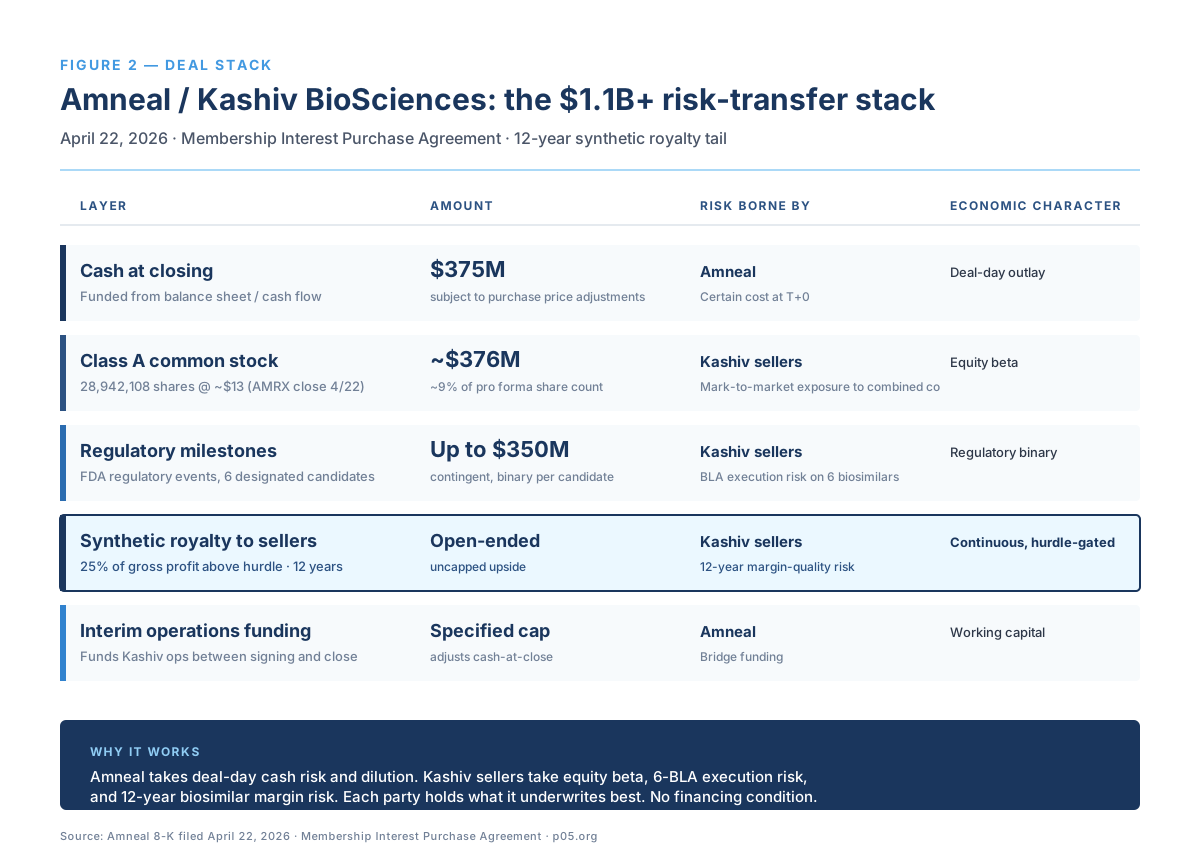
Amneal takes $375M of deal-day cash risk and an equity dilution that pushes pro forma net leverage above the reported 3.5x. Kashiv sellers take the rest: equity beta, regulatory execution risk on six BLAs, and 12 years of margin-quality risk on commercial biosimilars in the U.S. market. The two parties split the ~$1.1 billion headline cleanly along the dimensions each is best positioned to bear.
This is also the reason the transaction carries no financing condition.
Amneal needed to commit only $375M of cash, which is deliverable from its $350-400M 2026 operating cash flow guidance plus the balance sheet. The equity is self-financed via share issuance. The regulatory milestones and the synthetic royalty require no financing at all: they are pay-as-you-earn obligations backed by the same cash flows that would make them payable.
The entire $1.1B+ headline is achievable without an incremental revolver draw, a bond issuance, or a preferred stock round. That would have been impossible with a 100% cash-and-debt structure given Amneal's 3.5x leverage starting point.
Interaction with Amneal's existing senior debt
The embedded royalty needs to be analyzed against Amneal's existing capital structure. Based on Amneal's 2025-2026 disclosures, the relevant facilities are:
- $2.1 billion term B loans, issued under the November 2023 credit agreement as amended in July 2025 and repriced in February 2026. Post-repricing, margins are SOFR + 3.00% / Base + 2.00%. Maturity August 1, 2032. The term loans are issued by Amneal Pharmaceuticals LLC (the operating subsidiary), guaranteed by specified subsidiaries, and not guaranteed by the parent.
- $600 million 6.875% senior secured notes due 2032, issued July 2025, ranking pari passu with the term loans on the non-ABL collateral.
- ABL facility, with first-priority liens on inventory, accounts receivable, and related assets; second-priority on the term loan/notes collateral.
Amneal's weighted average cost of debt reportedly dropped from 10% in 2024 to ~6.8% in 2026. Net leverage at March 31, 2026 was 3.5x adjusted EBITDA. Against this backdrop, the Kashiv synthetic royalty interacts with existing debt in several ways:
- Permitted indebtedness and restricted payments. The 2023 credit agreement almost certainly includes negative covenants restricting new debt, liens, and restricted payments. A seller-retained synthetic royalty that is properly characterized as contingent contractual consideration (not debt) for GAAP and credit agreement purposes can typically be fit within permitted basket provisions for acquisition-related consideration. Whether it is debt under the credit agreement definitions is a technical question that will have been negotiated specifically for this transaction.
- Collateral coverage. Kashiv's biosimilar assets, once acquired, presumably become part of Amneal's collateral package securing the term loans and notes. The synthetic royalty claim on Kashiv gross profits sits economically ahead of Amneal's residual cash flows from those assets, which reduces the free cash flow available to service senior debt. Whether the synthetic royalty obligation is structurally subordinated to the term loans (because it is a contingent payment obligation rather than a secured claim) or whether the sellers have negotiated any lien rights is a closing-day question that will appear in the purchase agreement exhibits.
- Change of control in Amneal's debt documents. The Amneal term loan and notes include their own change-of-control triggers that operate at the Amneal level. A future acquisition of Amneal by a third party would trigger both Amneal's debt put rights and the Kashiv sellers' rights under the synthetic royalty. These would need to be harmonized in any future sale of Amneal.
Documentation architecture
The transaction is documented as a Membership Interest Purchase Agreement (MIPA) rather than an asset purchase agreement or a merger agreement.
This choice matters: Kashiv is a Delaware LLC, and the MIPA structure transfers 100% of the LLC membership interests to Amneal in a single transaction, avoiding the asset-level conveyance work and the need for landlord consents, IP assignments, and regulatory change-of-ownership filings that an asset deal would require. The MIPA architecture also keeps Kashiv's existing contracts (the licensing agreements with Amneal for Fylnetra, Releuko, and the Xolair biosimilar ADL-018) in place with no counterparty consent needed.
The synthetic royalty itself will almost certainly be documented in a separate royalty agreement attached as an exhibit to the MIPA, rather than folded into the MIPA body. The reasons:
- The royalty agreement is a long-dated instrument (12 years) with its own dispute resolution, audit, and amendment mechanics that need to survive the MIPA closing and indemnification periods.
- The royalty agreement will need to specify, at a level of detail the MIPA would not accommodate, the definition of "gross profit" (COGS allocation methodologies, transfer pricing for internal manufacturing, treatment of chargebacks and rebates, Medicaid rebate allocation), the hurdle calculation mechanics, the escalation or resetting of hurdles, the carve-outs for new indications and line extensions, and the audit and true-up procedures.
- Separating the royalty agreement facilitates future secondary sales: if the Kashiv sellers wanted to monetize the royalty stream at a later date by selling it to Royalty Pharma or HCRx, they could assign the royalty agreement without touching the MIPA.
The MIPA also includes the usual M&A package: representations and warranties (biosimilar regulatory status, patent ownership, manufacturing compliance, product liability, specified litigation), interim operating covenants covering the period between signing and closing, HSR and regulatory closing conditions, the Independent Committee approval carve-outs, the majority-of-the-minority vote requirement, termination rights, and reverse termination fee provisions.
The Holland & Knight representation of Kashiv and J.P. Morgan as financial advisor confirm that standard M&A documentation practice was followed.
Accretion math and guidance reset
On the same day the deal was announced, Amneal raised 2026 standalone adjusted EBITDA guidance to $740-770 million (from prior guidance) and operating cash flow to $350-400 million. Preliminary Q1 2026 came in with $723 million net revenue (+4% YoY), $202 million adjusted EBITDA (+19% YoY), and $0.27 adjusted diluted EPS (+29% YoY). Gross margin expanded 750 bps to 44.3%, driven by mix shift toward higher-margin products.
The embedded synthetic royalty interacts with forward guidance in a structurally favorable way for Amneal.
The 25%-of-gross-profit-above-hurdle construction means that in the early years post-close, while biosimilar launches are ramping and hurdle amounts are probably set conservatively, the royalty obligation should be small in absolute dollar terms. Accretion to EBITDA and EPS from the Kashiv commercial portfolio flows largely to Amneal.
As the Xolair biosimilar scales into its $3.9 billion reference market and the other designated products launch, the royalty grows, but it grows against a gross-profit base that the hurdle is explicitly designed to claim only the supra-normal portion of. If management's hurdle design is reasonable, the synthetic royalty should be sub-accretive rather than accretive-dilutive.
What this deal demonstrates about the market
The Amneal / Kashiv structure extends the embedded-synthetic-royalty market in three directions:
- Biosimilars. The pharmaceutical royalty market has historically concentrated on novel biologics and small molecules with clear patent-protected revenue tails. Biosimilars have been underweight in the royalty universe because of margin volatility and the structural difficulty of pricing a stream against a ranger of erosion curves. The 25%-of-gross-profit-above-hurdle construction is a design answer to that pricing problem: it lets the royalty coexist with margin compression without forcing renegotiation.
- Related-party M&A. The structure is particularly well-suited to insider-controlled transactions because the synthetic royalty functions as a built-in alignment mechanism that the fairness committee and disinterested shareholders can point to when approving the deal. Expect more Patel-brothers-style transactions to use this template.
- Private target M&A. Kashiv was a private company with no traditional public-market currency. A third-party synthetic royalty sale pre-close was likely infeasible in the timeline available, and the target's existing shareholders were the only natural holders of the revenue-linked slice. The seller-retained variant is the configuration that fits private-target M&A by default.
The deal is expected to close in the second half of 2026 subject to HSR expiration, shareholder and disinterested shareholder approvals, and customary conditions. J.P. Morgan advised Kashiv; Holland & Knight served as legal counsel.
Structural and Legal Mechanics
The embedded synthetic royalty is a deceptively simple contract that hides a substantial stack of legal and accounting questions. This section walks through each of them at the level a transaction lawyer, CFA, or clinical executive would actually need to negotiate.
True Sale versus Disguised Financing
The most consequential legal question for any synthetic royalty is whether the transaction will be respected as a sale of the revenue stream or recharacterized as a secured loan.
The stakes are asymmetric. If treated as a true sale, the royalty stream leaves the seller's bankruptcy estate and the investor collects directly on the contract cash flows, immune from an automatic stay. If recharacterized as a loan, the investor becomes a secured creditor whose enforcement rights are stayed under Bankruptcy Code §362, who must seek relief from stay or treatment in a plan of reorganization, and whose recovery may be subject to cramdown under §1129.
The test is not the label on the document. The leading case is CapCall LLC v. Foster (In re Shoot the Moon) (Bankr. D. Mont. 2021), where the bankruptcy court held that simply calling a cash advance against receivables a true sale did not make it one. Courts apply a multifactor test typically enumerated as eight factors, of which six are most heavily weighted:
- Language of the documents. Explicit sale language, absence of loan terminology, no reference to principal or interest.
- Conduct of the parties. Post-closing, does the seller account for the royalty as a sold asset or as ongoing debt service?
- Allocation of risk of loss. The single most important factor. In a true sale, the buyer bears the risk that the royalty stream underperforms; in a loan, the seller must make the buyer whole. Caps above 1.5x, make-whole payments on milestone failure, guaranteed minimum returns, and personal guarantees all pull toward loan characterization.
- Right to surplus / obligation for deficiency. In a loan, the seller owns any upside above the payoff amount and remains liable for any shortfall. In a true sale, the buyer owns the whole stream subject to any contractual cap.
- Recourse provisions. Non-recourse language (typical of true sales) versus cross-collateral on the seller's other assets (typical of loans).
- Purchase price relative to fair value. A price deeply discounted from a reasonable expected-value calculation suggests the parties priced in loan-like protections; a price close to risk-adjusted NPV supports sale treatment.
The 2020-2025 market has converged heavily on true-sale structuring.
Gibson Dunn's Royalty Finance Tracker reports that 71% of 2024-2025 synthetic royalty deals and 91% of deal value were structured as true sales, up from roughly 50% in 2020-2021. This convergence was catalyzed by Royalty Pharma's insistence on the structure and has become the institutional standard.
Tax treatment follows the same analysis in parallel: a true sale for federal income tax purposes means the seller recognizes gain or loss at closing and the buyer amortizes the purchase price against incoming royalties; a loan means the seller receives nontaxable loan proceeds and must include royalties in gross income as received, with imputed interest expense.
The Backup Security Interest Architecture
Because even a well-documented true sale can be recharacterized by a bankruptcy court, every institutional synthetic royalty purchaser takes a backup security interest as a belt-and-braces structure. The architecture typically includes:
- Granting language. The agreement conveys the royalty stream as a sale, but in the alternative, the seller grants the buyer a security interest in the royalty and specified related collateral to the extent the sale is recharacterized.
- UCC-1 financing statements filed at the seller's state of incorporation (for a Delaware LLC, in Delaware), covering the royalty receivables as "accounts" under UCC §9-102(a)(2) and "general intangibles" under §9-102(a)(42).
- Intellectual property security agreements recorded at the USPTO and the FDA (via change of agent filings) covering the patents, trademarks, and regulatory approvals supporting the product.
- Control agreements over collection accounts into which the royalty payments flow, often with springing dominion rights that activate on an event of default.
- Lockbox or collection account structures in some deals, particularly where the royalty is calculated on gross sales rather than net sales from the product-level P&L.
About 86% of synthetic royalty financings include product-asset liens, compared to only ~11% of traditional royalty monetizations. The liens are almost never intended as primary security; they exist precisely to protect the investor if the sale is recharacterized.
Intercreditor Mechanics
Where the seller has existing secured debt, or where the acquirer has existing secured facilities that will survive the merger, the synthetic royalty investor and the senior lenders must execute an intercreditor agreement. The key negotiated terms:
- Priority ordering. In most true-sale synthetic royalty structures, the investor's interest in the royalty stream is asserted as an ownership interest that sits outside the senior lender's collateral package entirely. The backup security interest, if recharacterized, is typically subordinated to the senior lender on all collateral except the royalty receivables themselves.
- Enforcement standstill. Senior lenders typically insist on a 90-180 day standstill period during which the royalty investor cannot exercise remedies against shared collateral, giving the senior lenders first claim on enforcement proceeds.
- Cross-acceleration carve-outs. The synthetic royalty agreement typically carves out from its events of default any acceleration by senior lenders, and vice versa, to prevent a single covenant breach from triggering a cascade.
- Payment blockage. Senior lenders may negotiate blockage rights that prevent the seller from paying the synthetic royalty during specified default periods. Whether these are effective against a true-sale royalty (which is economically the investor's own property) is legally contested and deal-specific.
Covenants
Synthetic royalty covenant packages are typically less onerous than senior debt covenants but more restrictive than a pure commercial contract would be. The standard package:
- Affirmative covenants: maintenance of regulatory approvals, commercially reasonable efforts to commercialize the product, maintenance of patents and prosecution of patent infringement, timely reporting (monthly or quarterly sales data, annual audited statements), notice of material adverse events.
- Negative covenants: restrictions on out-licensing, divestiture, or encumbrance of the product assets without investor consent; limitations on incremental debt secured by the same collateral; restrictions on transactions with affiliates that could divert revenue from the royalty base; change-of-control notification requirements.
- Financial covenants: rare in pure synthetic royalties (the investor's recovery depends on sales, not solvency ratios), but more common in hybrid structures that include debt tranches.
- Reporting covenants: detailed audit rights over the royalty calculation, typically exercisable annually, with true-up mechanisms for overpayments and underpayments.
For biosimilar and generic synthetic royalties, an additional covenant cluster addresses the manufacturing chain: qualification of alternative CMOs, maintenance of ANDA/BLA site transfers, and supply continuity obligations.
These are the covenants that make a biosimilar royalty underwritable, because the margin profile depends heavily on manufacturing cost control.
Change of Control: The M&A-Critical Mechanic
Every synthetic royalty agreement includes change of control provisions, and the design of these provisions determines whether the royalty becomes an asset, a liability, or an obstacle in a future M&A. Three common configurations:
- Automatic assumption by acquirer. The royalty obligation transfers to the acquirer by operation of the change of control clause, with no consent right for the royalty investor beyond notice. This is the most acquirer-friendly configuration and the most common in 2024-2025 deals.
- Consent right for the royalty investor. The acquirer must obtain the investor's consent to the change of control, typically on pre-agreed terms (e.g., no consent required if the acquirer meets specified credit quality tests, consent required otherwise). This gives the investor a seat at the M&A table.
- Buy-out right for the acquirer. The acquirer can extinguish the royalty at a contractually specified multiple, typically 1.5x to 4x of the upfront payment less royalties already paid, or at a percentage of the remaining undiscounted expected cash flows. This is the clean-up option that lets the acquirer take the asset free and clear.
A fourth configuration, the put right for the investor, is rarer but shows up in riskier deals. On a change of control, the investor can accelerate the royalty and demand a make-whole payment calculated to deliver a minimum IRR on the upfront. This is economically equivalent to a prepayment penalty on a loan and pulls strongly toward loan characterization for tax and bankruptcy purposes.
The Cytokinetics / Royalty Pharma expansion is instructive: the restructured aficamten royalty (4.5% to $5 billion, 1% above) carries no buy-out right for a future acquirer, which is precisely what makes it function as anti-M&A capital. A would-be acquirer of Cytokinetics must assume the royalty indefinitely, which repositions the valuation.
Accounting Treatment
Under US GAAP, the accounting for the seller's side of a synthetic royalty is governed by ASC 470-10-25 (Sales of Future Revenues) and turns on the same question as the tax analysis: is the upfront payment a sale of a future revenue stream or a financing?
The SEC staff has been increasingly willing to respect true-sale accounting where the legal analysis supports it, but the default presumption for a structured revenue monetization is debt treatment under ASC 470.
If treated as debt:
- The upfront payment is recorded as a long-term liability on the seller's balance sheet.
- Each royalty payment is allocated between interest expense (below the line) and principal repayment, using the effective interest method.
- The imputed interest rate is typically set at inception to amortize the liability to zero at the expected end of the royalty term, which can produce high imputed rates (15-25%+) for risky pipeline assets.
If treated as a sale:
- The seller derecognizes the carrying value of the royalty asset (if any) and records a gain or loss at closing.
- Subsequent royalty payments flow off the income statement as reductions of revenue (if the seller is the commercial party) or are simply not recognized (if the buyer collects directly from a licensee).
For the investor (buyer), the asset is recorded as a financial asset under ASC 310 (if treated as a loan) or as a contract asset under ASC 606 / 805 (if treated as a purchased revenue stream).
Most institutional royalty investors apply the fair value option under ASC 825 to avoid the accounting mismatch between the revenue-linked cash flows and amortized-cost accounting.
Tax Treatment in More Detail
The federal income tax consequences follow a similar sale-or-loan analysis, governed by decades of case law on the characterization of advances against future income streams.
The RSM analysis summarizes the framework: the key question is whether the seller has an unconditional obligation to repay the advance, or whether the risk of loss has shifted to the buyer. Where the buyer's recovery depends entirely on the product's revenue performance, the transaction is typically treated as a sale for tax purposes.
The tax consequences:
- Sale treatment: Seller recognizes capital gain equal to upfront minus tax basis in the royalty rights. The basis is often zero or near zero for internally developed products, which means most of the upfront is taxable at long-term capital gains rates (or ordinary rates if the royalty is treated as a hot asset under §751). Buyer takes a cost basis equal to the upfront and amortizes it against incoming royalties.
- Loan treatment: Seller receives the upfront tax-free as loan proceeds. Each royalty payment is allocated between interest expense (deductible) and principal repayment (non-deductible). The seller's revenue from the product remains fully taxable. Buyer recognizes interest income over the life of the loan.
In an M&A context, the tax treatment is imported into the acquirer's tax attributes post-close. An acquirer who values future royalty deductibility highly may prefer the loan characterization; an acquirer who wants clean P&L optics may prefer the sale characterization. These preferences drive the documentation choices.
Is This Structurally Special, or Just Standard Royalty Finance in an M&A Wrapper?
The instrument is the same synthetic royalty that has been documented in the Covington & Burling synthetic royalty studies since 2019. What is special about the embedded variant is the deal orchestration:
- Timing. The royalty transaction must close concurrently with or sufficiently before the M&A closing to make the funds available. This requires the royalty investor to complete diligence on the target's asset at the same time the strategic acquirer is completing merger diligence, often under a confidentiality wall enforced by a clean-team protocol.
- Covenant harmonization. The royalty investor's covenants, the acquirer's financing covenants, and the merger agreement's interim operating covenants must be reconciled across three separate documentation streams on a single closing timeline. This is the legal work that drives the $5-15M typical transaction cost on a deal of this size.
- Economic split. The strategic and the royalty investor are effectively co-bidding for the same asset. The royalty investor takes a fixed percentage of revenue at a fixed discount rate; the strategic takes the residual cash flows plus the option value. Both are better off than either would be as a solo bidder. This is why the structure tends to produce deal-completing premiums rather than deal-killing discounts.
- Counterparty concentration. Royalty Pharma has participated in most of the public-market examples because it has the balance sheet (~$30 billion) to underwrite $1+ billion commitments in the timeline an M&A transaction requires. Blackstone Life Sciences, HCRx (now KKR), and Sixth Street are the other credible participants at scale. There is no deep market of royalty investors who can underwrite and fund a $500 million+ synthetic royalty in a 4-8 week M&A timeline.
- True-sale and backup security interest perfection. In the compressed M&A timeline, UCC-1 filings, IP security agreement recordations at the USPTO, and the execution of control agreements over collection accounts must all be completed by the closing date of the merger. Any gap in perfection can be fatal if the target subsequently files for bankruptcy: the investor's claim may be avoided as a preferential transfer under §547 of the Bankruptcy Code if the security interest is perfected within the 90-day preference period preceding the filing.
Market Sizing and Outlook
Public-record transactions incorporating an embedded or M&A-adjacent synthetic royalty:
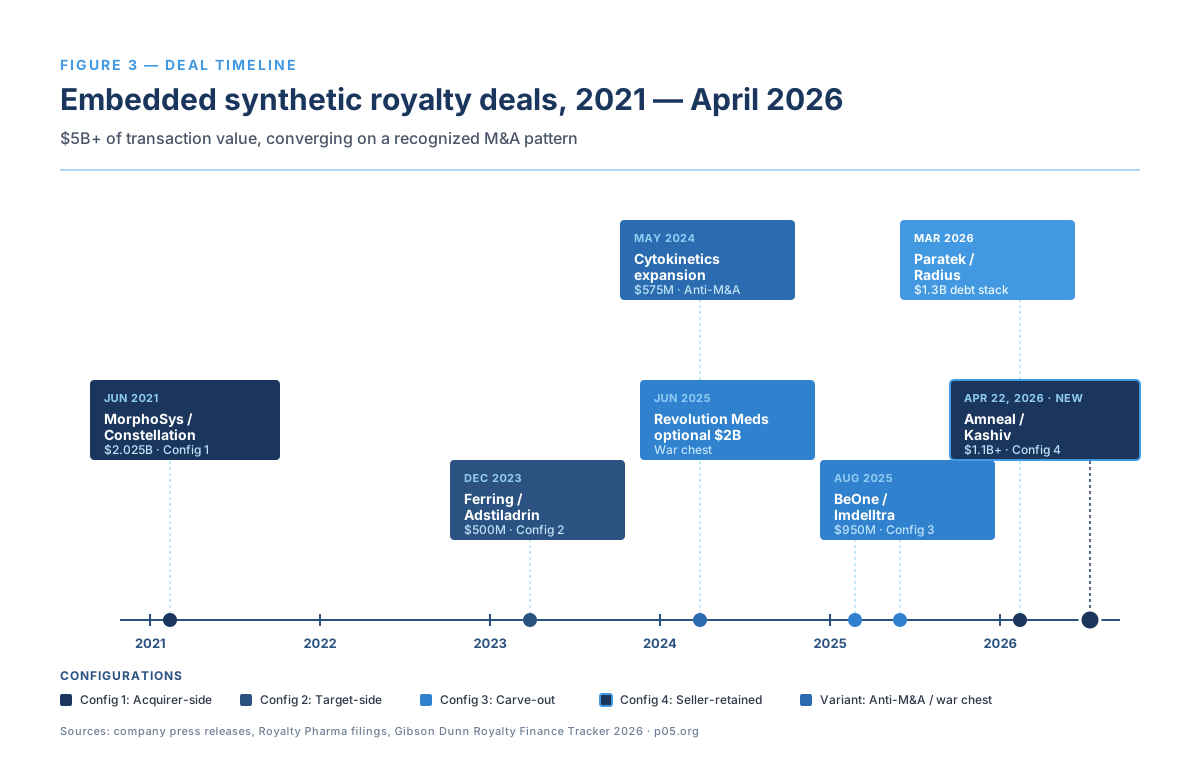

| Year | Deal | Synthetic Royalty | Total Package | Use Case |
|---|---|---|---|---|
| 2021 | MorphoSys / Constellation | ~$600M dev-stage royalties | $2.025B | Acquisition financing |
| 2023 | Ferring / Adstiladrin | $500M | $500M | Launch capital post-acquisition |
| 2024 | Cytokinetics expansion | $575M | $575M | Anti-M&A entrenchment |
| 2025 | Revolution Medicines | $1.25B | $2B | Optional war chest |
| 2025 | BeOne / Imdelltra | $950M | $950M | Concurrent carve-out |
| 2025 | Blackstone / Merck sac-TMT | $700M | $700M | Portfolio de-risking |
| 2026 | Paratek / Radius | $1.3B (debt w/ royalty co-investors) | $1.3B+ | M&A debt with royalty stack |
| 2026 | Amneal / Kashiv | 25% gross profit >hurdle, 12 years | $1.1B+ | Seller-retained synthetic royalty |
Aggregate transaction value across leading market participants reached approximately $6.5 billion in 2025, up from ~$5.7 billion in 2024. The embedded-in-M&A subset is probably 15-25% of that total depending on how the perimeter is drawn, which makes it a $1-1.5 billion per-year sub-market.
The forward trajectory is straightforward. 90% of biotech executives are considering a royalty financing in the next three years. The 2025-2026 pharma M&A wave is running at $228.4 billion in announced global biotech deals, up 73% from 2024.
The intersection, where the acquirer needs non-dilutive financing and the royalty investor needs scaled deployment, is where embedded synthetic royalty structures will continue to proliferate.
Expect more European participation (Ferring, MorphoSys, and Heidelberg Pharma and GENFIT have already signed), more tiered royalty rate schedules that approximate optionality (Revolution Medicines style), more royalty funds participating inside private credit debt stacks for specialty pharma roll-ups (Paratek / Radius style), and more seller-retained gross-profit-above-hurdle royalty tails in private-target and related-party M&A (Amneal / Kashiv style).
The instrument is not new. The use of the instrument as M&A closing currency is the innovation, and the innovation is now standard.
Sources: Royalty Pharma transaction press releases and SEC filings. This post is informational and does not constitute investment, legal, or tax advice.