Royalties as a Credit Derivative: Modeling Default Risk in a High-Yield Environment
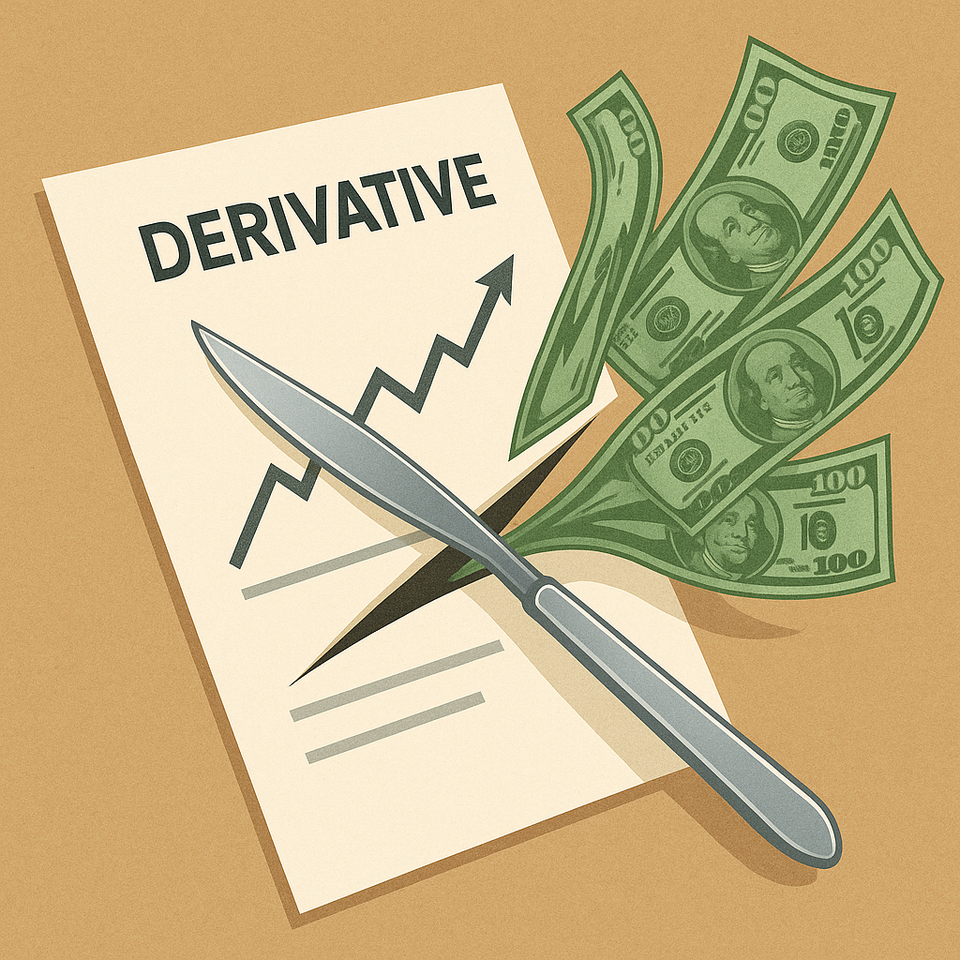
A synthetic royalty stream can be viewed not just as an asset purchase but as a complex credit derivative. In essence, when an investor advances cash in exchange for future royalties from a biotech product, they assume a risk profile analogous to a high-yield lender or a seller of credit protection.
The cash flows from the royalty are contingent on the biotech company (and its product) not defaulting or failing commercially, making the royalty resemble a bond with default risk. By applying credit risk modeling – traditionally used for bonds or loans – to the biotech royalty issuer, investors can price the royalty stream through a credit-risk framework, quantifying how the royalty's cash flow and contractual features behave as the company approaches or enters default.
This perspective is admittedly speculative and emerging, but it offers a fresh analytical angle for sophisticated investors in high-yield biotech financings.
Contrasting Recovery Paths: Royalty vs. Secured Debt in Bankruptcy
When considering default scenarios, a key question is how recoveries on a royalty interest might differ from recoveries on traditional debt. In a typical Chapter 11 bankruptcy of a biotech, a secured term loan lender often has a first claim on the company's assets, whereas a royalty investor's claim depends on how the deal was structured.
"True Sale" Isolation
If the royalty transaction is structured as a true sale of the IP revenue stream (often by selling rights to an SPV or via an assignment), the idea is that the royalty assets are isolated from the bankruptcy estate of the biotech. This could, in theory, offer superior protection – the royalty holder would continue receiving its share of product revenues even if the company files Chapter 11.
However, this only holds if the court respects the transaction as a true sale and not a disguised financing. Recent case law shows the risk: in the Mallinckrodt bankruptcy, a drug maker had sold product rights to another company in return for a perpetual royalty. When that buyer (Mallinckrodt) went bankrupt years later, the Third Circuit ruled the ongoing royalty obligation was an unsecured claim that could be discharged – because the seller had not retained an ownership interest or security interest in the IP.
In other words, without proper structuring, a "sold" royalty can end up being treated like unsecured debt in bankruptcy, yielding a "paltry" recovery. The lesson is that to truly isolate the royalty stream, the contract must be airtight (e.g. structured as a license or with a retained interest) to avoid being lumped in with general creditor claims.
Secured Interest vs. Unsecured Claim
Traditional secured lenders typically have collateral that ensures higher recovery in default. For example, historical data shows senior secured creditors might recover on the order of 60% of their claims in default on average, whereas unsecured bondholders might recover under 40%.
This gap is illustrated in the table below, highlighting how priority and collateral markedly improve credit outcomes for lenders:
| Debt Type | Average Recovery Rate | Typical Priority | Collateral |
|---|---|---|---|
| Senior Secured | ~60% | First lien on assets | IP, equipment, inventory |
| Senior Unsecured | ~40% | General claim | None |
| Subordinated | ~25% | Junior to senior claims | None |
| Royalty (well-structured) | 40-60%* | Depends on structure | IP rights/license |
| Royalty (poorly structured) | 10-25%* | Treated as unsecured | None |
*Estimated based on structural characteristics and case law
For a royalty investor, achieving a secured position in bankruptcy can be tricky but is critical for recovery. Many royalty deals include provisions to mitigate this risk, such as the investor taking a security interest in the royalty rights or even the underlying IP as a backup. If the royalty sale is recharacterized as a loan in bankruptcy, having a perfected security interest at least elevates the investor to secured creditor status on that collateral.
This could prevent the IP from being sold free and clear without either the investor's consent or repayment of their claim. By contrast, a royalty without such protection could be wiped out or crammed down like any unsecured claim, as seen in Mallinckrodt's case.
True Sale vs. Loan Recharacterization
Courts will look beyond labels – simply calling an agreement a "true sale" doesn't guarantee it will be treated as such. They examine how risk is allocated in the deal. If the biotech has effectively guaranteed or limited the investor's risk (through recourse, broad collateral, fixed buyback obligations, etc.), the transaction starts to smell like a loan rather than a sale.
For instance, if the agreement caps the investor's return or includes an obligation to repay regardless of product performance, it could be deemed debt. In one case, a so-called receivables "sale" was recharacterized as a loan because the buyer had obtained expansive security interests and guarantees – meaning the seller hadn't truly transferred the risk of the asset.
Key Factors Courts Examine for True Sale vs. Loan
| True Sale Indicators | Loan Indicators |
|---|---|
| Investor bears full performance risk | Guarantees or recourse provisions |
| No fixed repayment obligation | Fixed buyback obligations |
| Unlimited potential return | Capped returns |
| IP rights transferred to investor | Broad collateral over all assets |
| No obligations to repay if product fails | Repayment required regardless of performance |
Royalty investors hedge against this by structuring the deal to absorb genuine performance risk (aligning with sale treatment) and by taking backup liens as a safety net. Nonetheless, the possibility of recharacterization injects uncertainty: the "true sale" protection might only be proven (or lost) when it's tested in court during a default.
Example – Chapter 11 Outcomes
To crystallize the difference, consider a hypothetical distressed biotech with a promising drug:
Secured term loan creditor: Will enforce its lien on all assets (including the drug IP). In bankruptcy, this lender could credit-bid or force a sale of the drug, often ensuring they get either the asset or cash value, leading to a substantial recovery (if the asset has value). They also typically have seniority in the payout waterfall.
Royalty investor: Who bought 10% of future drug sales via an assignment might find that in bankruptcy, without structure, they are simply a contract counterparty owed "contingent" payments. As Mallinckrodt showed, such a claim can be discharged, leaving the investor with perhaps cents on the dollar as an unsecured creditor – even if the drug is successful.
On the other hand, if properly structured (say the investor had an exclusive license to that 10% revenue or a co-ownership stake), the investor could argue that the drug cannot be sold or used free of their interest. This leverage could either preserve the ongoing royalty or force the debtor to treat the investor's stake as a secured obligation that must be satisfied.
Summary on Isolation
In summary, isolation of the IP revenue stream can offer superior protection, but only if legally perfected. A "true sale" that is respected in court would mean the royalty cash flows bypass the bankruptcy estate entirely. In practice, investors achieve this by meticulous structuring: using IP licenses, separate SPVs, or registering security interests under the UCC.
Absent that, a royalty interest is likely to be swept into the bankruptcy just like any unsecured contract claim, with far inferior recovery to a secured loan. Thus, from a credit-risk perspective, the royalty investor should conservatively assume recovery rates akin to subordinate debt unless they have secured or priority status contractually.
The Royalty–CDS Analogy: Pricing Royalty Risk via Credit Spreads
Viewing a biotech royalty through a credit lens allows investors to price it similarly to a high-yield bond or a credit default swap (CDS). In a CDS contract, a protection seller receives periodic payments (analogous to an investor receiving royalties) and in return bears the risk of a default event (losing future payments or having to pay out).
_diagram.svg?ref=p05.org)
Likewise, a royalty investor pays an upfront sum (effectively analogous to buying a bond or selling credit protection) and then collects a stream of royalty payments as long as the company stays solvent and the product succeeds. If the company defaults or the product fails (a "credit event" for the royalty), the future payments could vanish, meaning the investor's ultimate return is less than expected.
Basic structure of a Credit Default Swap (CDS). In a CDS, the protection seller receives periodic premiums and only has to compensate the buyer upon a default event. A royalty investor's position is analogous: they pay upfront for an income stream and bear the risk that a default (or commercial failure) will cut off those payments. This analogy guides credit-based pricing of royalties. (Source: Wikimedia Commons, CC BY 3.0)
How to Price a Royalty Using Credit-Risk Modeling
Essentially by imputing a credit spread or default probability into the discount rate for the royalty cash flows. A few approaches include:
Yield Spread Method
Estimate the biotech issuer's credit spread over risk-free rates, similar to a comparably rated bond. For example, if a particular biotech's unsecured debt yields 12% (implying a high-yield credit spread of, say, 800 basis points above Treasuries), an investor might demand a similar or higher effective yield on the royalty.
The expected royalty cash flows would thus be discounted at a high discount rate reflecting both time value and significant default risk. This credit-adjusted discount rate prices the royalty lower than a naive DCF would, compensating for the chance that payments terminate early due to default or insolvency.
Notably, in the current environment of higher interest rates, royalty finance providers have indeed increased the discount rates applied to royalty streams – driving up the cost of capital for these deals.
Example Credit Spread Pricing
| Credit Rating | Typical Spread Over Treasuries | Total Discount Rate (assuming 4% risk-free) | Implied Default Risk |
|---|---|---|---|
| BB (High Yield) | 300-400 bps | 7-8% | Moderate |
| B (Speculative) | 500-800 bps | 9-12% | Elevated |
| CCC (Distressed) | 1000-1500 bps | 14-19% | High |
| Biotech Royalty* | 800-1200+ bps | 12-16%+ | Very High |
*Royalties often command higher spreads than comparable debt due to concentrated product risk
Default Probability and Recovery Modeling
One can model the royalty's value as the probability-weighted present value of cash flows across scenarios: (1) if the company stays solvent (or the product remains in market) vs. (2) if a default/insolvency occurs.
For instance, suppose you estimate a 20% probability that the biotech will hit financial distress and default within the royalty's life. In a default scenario, assume the royalty investor might recover, say, 25% of the remaining cash flow value (either through a settlement or asset sale in bankruptcy) – or potentially 0% if worst-case.
The expected value = 0.8 × PV(no-default cash flows) + 0.2 × PV(recovery in default).
Using a hazard-rate framework, you discount cash flows continuously with a default intensity (like pricing a corporate bond that can default). The company's credit spread essentially serves to adjust for this hazard.
In effect, the royalty can be priced similar to a risky bond where the "coupons" are the royalty payments. If a traded CDS or bond exists for comparable biotech risk, that spread can be a guide to how much extra yield the royalty should earn for the embedded default risk.
Structural Models
A more complex approach might adapt structural credit models (à la Merton) to the royalty. The idea here is that the biotech's assets (including the IP) have some volatility and default is triggered if asset value falls below liabilities. The royalty's fate is tied to the asset value of the drug program.
In this view, the royalty could be seen as deeply subordinated claim on the project's value – somewhat analogous to equity in that it only pays if the project succeeds, but also analogous to debt in that it doesn't share upside beyond the fixed percentage.
By simulating the distribution of outcomes (product success vs failure, company survival vs bankruptcy), an investor can estimate a distribution of returns for the royalty and demand a price that yields an appropriate risk-adjusted return. This overlaps with venture-style analysis, but layering in default as a specific risk event.
CDS as Benchmark
If one really takes the CDS analogy to heart, the royalty could even be structured or hedged via credit derivatives. For instance, an investor might short the company's bonds or buy CDS protection to hedge the risk of complete loss in bankruptcy, while still retaining upside from the royalty if the product performs.
In practice, many small biotechs won't have liquid CDS, but the concept clarifies the risk premium: The royalty's discount rate should roughly equal risk-free + product risk premium + issuer default spread. The issuer default spread is essentially the CDS premium for that credit.
So if similar-rated credits trade at a 10% spread (commensurate with a high likelihood of default and low recovery), that 10% (plus any additional product-specific risk premium) gets baked into the royalty valuation.
It's important to note that royalty deals often carry more idiosyncratic, non-diversifiable risk than a broad corporate bond. The royalty's cash flows depend on a single product's sales as well as the company's survival. Therefore, an investor might actually price in a higher spread than the company's plain debt to account for the concentrated, equity-like risk of the product's success.
In that sense, the royalty has a hybrid nature: part credit instrument, part equity exposure to the product. This is why thinking of it as a credit derivative with a binary outcome (full payoff if all goes well, or major loss if things go south) is apt. Investors should demand returns accordingly – often in the mid-teens or higher IRR – to compensate for this skewed risk profile.
Stress-Testing Covenants and Investor Behavior in Distress
A distinguishing feature of royalty financings, compared to standard high-yield debt, is in the covenant structure and control rights, especially around the product's development and commercialization. Royalty agreements frequently include affirmative covenants requiring the biotech to continue supporting the product, as well as negative covenants limiting what the company can do with that asset or related IP.
These are designed to protect the investor's long-term interests (the royalty stream) even if that may conflict with short-term financial distress measures.
Key Contractual Elements in Crisis Scenarios
| Covenant Type | Purpose | Impact in Distress |
|---|---|---|
| R&D Spend Minimums | Ensure continued product development | Forces company to maintain funding even when cash-strapped |
| Commercialization Effort | Require reasonable efforts to market | Prevents shelving of approved products |
| IP Restrictions | Limit sale/licensing without consent | Protects investor's revenue stream |
| Cash Minimums | Maintain minimum liquidity | Early warning system for financial trouble |
| Change of Control | Require make-whole on sale | Protects against unfavorable M&A |
| No Competing Products | Limit development of alternatives | Ensures focus on royalty-bearing asset |
R&D Spend and Effort Covenants
Many synthetic royalty deals have clauses stipulating that the biotech must use commercially reasonable efforts (or even specific spending minimums) to develop, obtain approval for, and commercialize the drug. In a distressed scenario, management might be tempted to cut R&D funding to save cash, or even shelve a program – which would be disastrous for the royalty holder.
Covenants can force the company to keep the gas on for the royalty-bearing asset. For example, an agreement might require that the company not discontinue development of the product without the investor's consent, or maintain a certain level of manufacturing and marketing support post-approval.
There have been cases where funds effectively negotiated for the company to prioritize the royalty-linked program, even if it means sacrificing other projects or overall profit in the short term. This dynamic is unique to royalties: a lender is primarily concerned with getting repaid, but a royalty investor may "prefer" the company spend money on the product rather than hoard cash, because the investor's upside comes from product sales, not from the company's overall balance sheet health.
Cash Flow Traps vs. Flexibility
Standard high-yield debt often comes with strict financial covenants (like leverage ratios, interest coverage tests) and restrictions on incurring new debt or making payments to junior stakeholders. Royalty financings, in contrast, tend to have lighter covenant burdens on broad financial metrics, focusing more on the treatment of the product revenue.
Surveys of recent deals confirm that while royalty agreements do include covenant packages as "guardrails" on what companies can do with the product and its revenue, these obligations are typically less onerous than traditional debt covenants. For instance, many royalty deals lack maintenance financial covenants – instead of EBITDA tests, you might just see a requirement for the company to maintain a minimum cash balance or "no going concern" qualification.
This is intentional: it gives the biotech breathing room to operate and invest in R&D without tripping defaults, as long as the specific product stream is protected for the investor. In distress, this flexibility can be a double-edged sword. On one hand, the company might avoid technical default on the royalty agreement even if its finances are shaky (since there's no leverage covenant), which spares the investor from having to accelerate the royalty repayment prematurely. On the other hand, the lack of strict covenants means the royalty investor has less early warning or control until perhaps it's very late (e.g., an actual payment default or bankruptcy filing triggers action).
Intercreditor and Subordination Agreements
When a biotech has both traditional debt and a royalty financing, the priority of claims is determined by intercreditor arrangements. Often, a royalty investor will agree to subordinate certain rights to a senior lender for the overall financing package to work.
For example, if a bank or venture debt fund holds a lien on all assets including IP, the royalty may be structured as a "silent" second priority: the royalty holder might defer to the senior lender's rights in an enforcement or agree not to foreclose on IP until the senior debt is paid off.
In Revolution Medicines' recent $2 billion deal with Royalty Pharma, part of the funding was a $750 million senior secured loan and part was a $1.25 billion synthetic royalty on a cancer drug. You can imagine in their contracts, the loan will have first claim on assets and the royalty is effectively subject to that – though structured as a sale, Royalty Pharma likely negotiated carefully how the royalty survives or is compensated if the company defaults on the loan.
This kind of split funding shows that royalty investors often need to contractually delineate their rights vs. other creditors. A well-drafted royalty agreement will include intercreditor provisions or require consent from other lienholders, to ensure the royalty isn't inadvertently primed or invalidated by a new debt. These provisions matter immensely in distress; they determine whether the royalty holder can independently take action (like blocking a sale of the IP or demanding specific performance on R&D covenants) or if they are along for the ride with other creditors.
Acceleration and Step-In Rights
High-yield debt has an advantage that upon default, lenders can accelerate the full principal owed, giving them leverage in bankruptcy negotiations. Some royalty agreements mimic this by including put or acceleration rights if the company defaults or enters bankruptcy.
For instance, in the Clovis Oncology case, the funding agreement with Sixth Street (which was essentially a royalty/prepaid loan hybrid) had a clause that if Clovis filed bankruptcy, the obligation accelerates to a capped amount (roughly twice the original funding). This led the investor to file a claim for the full $350 million (2× their investment) as a secured amount, effectively an attempt to lock in a recovery.
The unsecured creditors objected, arguing that such an uncapped, high-return royalty looks more like an equity stake and should be subordinated. The dispute was settled, but it highlights a key difference: royalty contracts can contain bespoke remedies that you don't see in plain debt, like accelerated payment to a multiple of invested capital, or even rights to take ownership of the IP/license if the company breaches covenants.
These give investors negotiating power in distress – for example, the threat of yanking the product license or imposing huge default payments can bring a company to the table. By contrast, a bondholder is limited to recovering principal + interest, and cannot, say, seize the IP themselves (outside of collateral enforcement).
Sacrificing Short-Term Yield for Long-Term Value
A paradoxical scenario can arise: a royalty investor might prefer the company skip a few royalty payments if it means keeping the lights on for the product. Some agreements allow the company to defer or capitalize royalty payments in specific circumstances (like if cash falls below a threshold), effectively acting like PIK (payment-in-kind) interest.
This is akin to a protective measure: instead of strangling the company when it's down, the royalty is flexible so that the drug program isn't starved of funds. Additionally, investors may waive certain rights or grant forbearances during a rough patch – for example, waiving an R&D covenant breach as long as the company presents a viable plan to out-license or partner the drug.
This behavior is quite different from a typical creditor demanding immediate cash cures; the royalty holder's incentive is aligned with the project's success, not just getting their money back. In distressed restructurings, royalty investors sometimes even infuse new money (DIP financing or backstop funding) to protect their asset – essentially doubling down on the bet that the drug will come through, rather than letting it die in bankruptcy.
Exit in Bankruptcy – IP Sale Considerations
If worst comes to worst and the biotech goes into Chapter 11, a likely outcome is the sale of the drug asset to a stronger player. Here, the contractual positioning of the royalty is crucial. If the royalty is a true sale or exclusive license, the acquirer must either take subject to the royalty or negotiate a buyout of the royalty interest. If it's treated as debt, the royalty investor might just get a portion of the sale proceeds as a creditor.
The upside for a well-structured royalty is that it could survive the transition: for example, Company B buys the drug out of bankruptcy and continues paying the royalty as obligated. In contrast, a high-yield lender typically just wants to be paid off from sale proceeds and exits the story.
Thus, one could argue a royalty could have superior post-distress value if it sticks to the asset (but again, that hinges on structure and court decisions). Investors price this in by assessing what a likely recovery rate on the royalty would be if the company fails. Is the royalty truly bankruptcy-remote? Will we get bought out in a §363 sale (perhaps at some negotiated discount)?
These considerations mirror how bond investors think in terms of recovery values. It circles back to the earlier discussion: a royalty with a first-priority true sale claim on a revenue stream might effectively have a recovery approaching that of secured debt, whereas a weakly structured royalty might have recovery worse than a typical unsecured bond (since it might not even have a defined claim without litigation).
Applying Credit Modeling to Royalty Contracts
Given the parallels between royalties and high-yield bonds, how might an investor use credit-risk models to guide royalty pricing or to structure a deal? Here are practical considerations:
Framework for Credit-Based Royalty Analysis
| Analysis Component | Key Questions | Modeling Approach |
|---|---|---|
| Default Risk Assessment | What's the probability of company failure or product abandonment? | Hazard rate models, cash runway analysis, clinical risk assessment |
| Recovery Estimation | What do we recover if things go wrong? | Structural seniority analysis, comparable bankruptcy outcomes, IP valuation |
| Covenant Protection | What contractual protections exist? | Legal structure review, intercreditor agreements, acceleration clauses |
| Spread Determination | What yield compensates for these risks? | Credit spread benchmarking, comparable bond/CDS analysis |
| Scenario Testing | How does value change under stress? | Monte Carlo simulation, stress scenarios, sensitivity analysis |
Estimating Default Risk for the Issuer
Assess the biotech company's credit fundamentals – cash burn, runway, probability of needing further financing, and the consequences if that financing doesn't materialize. Biotech "default" might manifest as an inability to commercialize the drug (e.g. pivoting to a sale or licensing rather than launching), or actual insolvency if development stalls.
An investor could look at analogs in the broader biotech universe. For instance, an illiquid small-cap biotech might be rated in the high-yield or speculative range (say, a hypothetical rating of B or CCC if it were rated) – implying annual default probabilities of several percent or higher. Credit models used by rating agencies or lenders – focusing on leverage, liquidity, market risks – could be applied to estimate the company's survival curve and feed into royalty pricing.
Even for pre-commercial companies with minimal hard assets, one can gauge default likelihood by stress-testing scenarios: if Phase 3 fails, can the company restructure or does it liquidate?
Structuring Protections (Covenants and Security)
Analogous to high-yield bond covenants, a royalty contract can include provisions to protect the investor if credit quality deteriorates. These might include:
Liens/Security Interests: Taking a perfected security interest in the IP or the royalty stream itself, such that in bankruptcy the investor has a secured claim.
Change of Control Provisions: If the biotech is sold, the agreement could require that the royalty be assumed, or trigger a "make-whole" payment to the investor.
Financial Covenants or Reporting: While less common than with debt, some royalty deals might include minimum cash thresholds or periodic disclosures to alert the investor of distress.
License Structure: Structuring the royalty as an exclusive license to a portion of revenue (rather than a payment obligation) can help ring-fence the cash flows. This mirrors syndicated loan structures where collateral packages are designed to withstand bankruptcy.
For example, a covenant requiring the company to obtain investor consent before certain major transactions or encumbrances on the IP could prevent the company from selling the drug out from under the investor's interest.
Using Credit Spreads to Justify Pricing
A royalty deal's implied IRR should reflect the default risk inherent in the company. If a biotech's debt currently trades at an 800 bps spread (8% above Treasuries), the investor in a subordinate royalty might target an even higher spread – say, 1200 bps – to compensate for the additional risk.
By comparing the expected return of the royalty to those of comparable credit instruments (even if from different industries), the investor can sanity-check if the royalty is priced attractively or not. If the royalty's economics imply a return that is lower than a bond from an issuer of similar risk, the investor may be undercompensated for the credit risk. Conversely, if the projected return far exceeds reasonable high-yield spreads, it may indicate mispriced risk or an especially attractive deal.
Scenario Analysis and Stress Testing
Credit modeling is all about scenarios: what happens if we hit a recession, if the drug launch is delayed, if a competitor appears? A royalty investor should model multiple credit scenarios:
Base case: Company healthy, drug approved and launching as expected.
Stress case: Development is delayed or approval is narrow. Revenues come in lower, threatening the company's solvency. How is royalty impacted?
Default scenario: Company goes bankrupt or product fails entirely. What recovery can we expect?
By quantifying each scenario's probability and outcome, the investor arrives at a probability-weighted value – a method straight out of credit analysis. This ensures they don't overpay based on optimistic assumptions. Stress testing might reveal that the royalty's value is heavily tail-risk dependent: e.g., 90% of the value in the best scenario but a 20% scenario of near-total loss. That distribution informs the investor's hurdle rate and negotiation.
Case Study: Royalty Valuation with Default Adjustments
Imagine a royalty deal on a mid-stage biotech's lead product. The upfront payment is $100 million in exchange for a 10% royalty on future sales. An optimistic DCF might show the royalty yielding a 15% IRR if the product achieves expected sales. But applying a credit-risk lens:
Step-by-Step Analysis
| Step | Analysis | Impact on Valuation |
|---|---|---|
| 1. Assess Default Probability | Balance sheet and timeline analysis suggests 30% cumulative probability of default/failure before commercialization | Reduces expected cash flows by 30% |
| 2. Estimate Recovery | In default scenario, estimate 10% recovery from IP asset sale ($10M) | Expected recovery = 0.3 × $10M = $3M |
| 3. Calculate Expected Value | EV = 0.7 × PV(full royalty stream) + 0.3 × $10M | Significantly reduces naive DCF value |
| 4. Apply Credit-Adjusted Discount Rate | Given high default risk, demand 20% discount rate (vs. 15% in base case) | Further reduces present value |
| 5. Fair Value Assessment | Present value suggests fair price closer to $70M, not $100M | 30% discount to naive pricing |
Outcome: This analysis shows that a naive DCF overstates the value by ignoring credit risk. By modeling default and recovery, the investor negotiates better terms or demands either a higher royalty percentage or a reduced upfront to hit their 20% target return. Alternatively, they insist on security interests or covenants to lower the default risk and justify the $100 million price.
Evolving Market Dynamics: High-Yield Environment and Royalty Pricing
In recent years, the royalty financing market in life sciences has grown substantially, with volumes hitting new highs. According to industry reports, there has been a marked increase in both the number and size of royalty deals, driven by biotechs seeking non-dilutive capital and by investors searching for attractive yields in a low-to-moderate interest rate environment.
However, as interest rates have climbed (into 2023–2024), the cost of capital for biotech has also increased. This manifests in royalty deals through higher discount rates demanded by investors, which in turn means biotechs must offer larger royalty percentages or accept smaller upfront sums to close deals. Essentially, royalty providers have repriced these instruments in line with rising risk-free rates and credit spreads.
Market Trend Overview
| Metric | 2020-2022 | 2023-2024 | Driver |
|---|---|---|---|
| Typical Discount Rate | 10-13% | 14-18% | Rising interest rates |
| Average Deal Size | $200-500M | $300-800M+ | Market maturation |
| Covenant Intensity | Light | Moderate | Risk management focus |
| Security Requirements | Optional | Increasingly common | Bankruptcy case law |
| Intercreditor Agreements | Rare | Standard | Complex capital structures |
At the same time, we've seen credit stresses in various sectors. High-yield bonds have experienced periods of volatility and rising defaults. For biotech, a sector already characterized by high failure rates, the interplay of tightening credit and rising rates can be a double-edged sword: on one hand, royalties become more expensive for issuers; on the other, investors are more rigorous in modeling downside risks.
Large deals continue to happen – for example, a transaction involving Royalty Pharma providing up to $2 billion in funding underscores the scale these deals can reach. Yet scrutiny increases at every level: investors are performing more robust diligence on credit fundamentals, and biotechs are seeking terms that don't overly burden them if the drug takes longer to reach market. This tension drives innovation in structuring – for instance, introducing milestones or caps that mitigate credit risk on both sides.
From a credit derivative perspective, this environment is ideal for applying more sophisticated modeling. When interest rates and spreads are low, investors might be complacent, but in a higher-rate regime, every basis point matters. Investors are explicitly incorporating default probabilities and scenario analysis into their pricing, much like a high-yield bond analyst would. Those who treat royalties as simple "upside bets" risk underpricing the default risk; conversely, those who incorporate credit discipline can negotiate better terms or achieve more favorable risk-adjusted returns.
Limitations and Speculative Aspects
It's important to acknowledge that this credit derivative framing is somewhat speculative. The royalty market in biotech doesn't have the depth of history that corporate bonds or CDS have. Unlike bonds, there isn't a standardized default definition or a liquid secondary market for most royalty interests. Court interpretations of "true sale" can vary, and each royalty deal is bespoke – lacking the uniformity that makes bond markets so liquid.
Moreover, the clinical and regulatory risks in biotech are fundamentally different from typical credit risk. A bond issuer's default is usually a function of macroeconomic conditions, leverage, and cash flows. A biotech's "default" might occur due to a Phase 3 clinical trial failure, which is a scientific event rather than a pure credit event. The correlations differ: credit spreads across industries might tighten or widen together, but biotech approval outcomes may be idiosyncratic.
Key Differences: Royalties vs. Traditional Credit
| Characteristic | Traditional High-Yield Bond | Biotech Royalty |
|---|---|---|
| Cash Flow Pattern | Fixed coupons, scheduled maturity | Variable, product sales-dependent |
| Default Definition | Payment default, covenant breach | Product failure, company insolvency, or both |
| Recovery Process | Standardized bankruptcy proceedings | Depends on IP structure, may survive bankruptcy |
| Market Liquidity | Generally liquid secondary market | Illiquid, bespoke structures |
| Risk Drivers | Company-wide financials, macro conditions | Product-specific + company credit |
| Covenant Focus | Financial ratios, leverage limits | R&D spend, IP protection, commercialization |
| Maturity | Fixed term (5-10 years typical) | Open-ended or patent-life limited |
| Upside | Capped at par + coupon | Potentially uncapped if product succeeds |
That said, the exercise is valuable. Even if imperfect, credit-risk modeling forces investors to be disciplined about downside scenarios. It highlights questions like "If the company can't raise its next round, what happens to my investment?" or "If the drug fails, can I reclaim any value from the IP?" These are precisely the questions a lender asks about collateral and covenants. By bringing that discipline to royalty investing, participants can avoid overreliance on best-case scenarios and ensure they're compensated for the full spectrum of risk.
Conclusion: Pricing and Protecting Royalty Streams with Credit Insight
For sophisticated investors, pricing a synthetic royalty stream using a credit-risk framework means evaluating it the way one would a high-yield credit – with a keen eye on default probability, recovery prospects, and covenant protections. The investor must dissect the specific contractual elements that differentiate the royalty from plain debt and ask: do these features mitigate risk or add risk?
Critical Factors to Consider
Default Risk Premium: Incorporate a credit spread in the discount rate for royalty cash flows, reflecting the issuer's likelihood of distress. A royalty is not a risk-free annuity; it should be priced to offer a credit spread comparable to a bond of similar risk. If a biotech's credit profile is single-B, expect to demand a double-digit yield on the royalty to compensate for default risk and loss given default.
Recovery and Structural Seniority: Analyze the deal structure to estimate recovery in a default. Is there a true sale or IP lien that could preserve the royalty? If yes, the investor's position may be closer to a secured creditor (higher recovery) – though litigation may be required.
If no, assume worst-case that the royalty becomes an unsecured claim – value it modestly, perhaps using historical unsecured bond recovery rates (20–40¢ on the dollar) as a guide.
Structure drives recovery: elements like IP collateral, separate SPVs, subordination agreements, or JV arrangements can elevate the royalty's seniority in a downside scenario. These should be reflected in valuation (better structure = pay more for the royalty, as it's safer).
Covenant Protections and Flexibility: Consider the covenant package as part of the pricing. Royalty agreements often lack strict financial covenants but include operational covenants (keep the product alive and unencumbered). From a credit modeling standpoint, lighter covenants might mean the company can stretch further before defaulting – which could either be positive (avoid early default) or negative (risk accumulates).
On the flip side, strong covenants around the product (like no sale or licensing without consent, minimum R&D spend) increase the chances the product survives and the royalty pays out, even if the company is struggling. Such covenants effectively increase the investor's control, which is valuable and should increase the royalty's price (or lower the required yield).
In contrast, a high-yield bond investor might rely on financial covenants to force renegotiation early; a royalty investor relies on product-specific covenants to protect value. Evaluating these is akin to analyzing bond covenants – they can materially affect default likelihood and recovery.
Comparison to High-Yield Debt: Ultimately, differentiate what makes the royalty not just a bond. Unlike a bond, a royalty has no fixed maturity (often it ends when a cap or patent expiration is reached) and contingent payments (if sales are zero, royalty is zero, whereas a bond still accrues interest). This means the royalty has a higher risk/higher reward profile in many cases – more akin to an equity stake in the product with a debt-like cap.
During financial distress, a royalty holder can't force repayment on a schedule like a term loan creditor could; they are dependent on the asset's performance or a buyout. However, the royalty also might outlive the company – if structured right, even a bankruptcy might not cancel the royalty, whereas a bond would be restructured or wiped.
Investors should price royalties with this asymmetry in mind: you are swapping stronger legal remedies (in a loan) for a share of potential upside and possibly better alignment with the company's success. That trade-off demands careful risk pricing. If the royalty contract lacks the usual lender controls, the price (upfront payment) should be lower to compensate for that added risk. Conversely, if the royalty includes robust default protections (like acceleration, security interests, or even penalty rates), it starts to behave more like a traditional credit instrument and can be valued closer to par with debt.
Disclaimer: This article is for informational purposes only and does not constitute legal, financial, or investment advice. The author is not a lawyer or financial adviser. All information is derived from publicly available sources and may not be complete or current. Details regarding transactions, royalty structures, and financial arrangements may change. Readers should conduct their own due diligence and consult with appropriate legal and financial professionals before making any decisions.
Member discussion