Step-In Rights in Pharmaceutical Licensing and Royalty Transactions

Step-in rights are contractual provisions allowing one party to assume operational control when the counterparty fails to perform. In pharmaceutical transactions—where development timelines span decades and a single molecule can absorb billions in capital—these clauses function as structural safeguards against asset neglect, technology dormancy, and value destruction across the entire transaction chain.
Unlike termination rights that simply end a relationship, step-in rights preserve optionality. The stepping-in party assumes specified activities—continuing development, maintaining patents, ensuring supply, commercializing in neglected territories—rather than accepting damages for asset destruction or watching a promising compound languish.
This analysis examines how step-in rights operate in practice, drawing on SEC filings, recent court decisions, and jurisdictional frameworks in the United States, European Union, Japan, and Korea.
The Mechanism

The core structure involves three elements: (1) specification of which activities may be assumed; (2) identification of trigger conditions; and (3) procedural requirements including notice, cure periods, and transition mechanics.
Trigger categories typically include:
- Development failures: Missed IND filings, delayed Phase 2 initiation, failure to submit BLA/NDA by agreed dates
- Commercialization failures: Product not launched within specified period post-approval, sales below minimum thresholds, failure to maintain adequate sales force
- Supply interruptions: Shortage exceeding specified days, GMP violations, manufacturing facility shutdown
- IP maintenance failures: Abandoned patent prosecution, missed maintenance fees, failure to defend against IPR/PGR challenges
- Financial distress: Bankruptcy filing, insolvency, assignment for benefit of creditors, breach of financial covenants
- Force majeure: Events beyond reasonable control exceeding a threshold period (commonly 3 months)
- Misconduct: Fraud, gross negligence, willful misconduct, data integrity failures
Cure periods vary by trigger type. Non-financial breaches typically allow 60-90 days; financial breaches 30 days; bankruptcy often triggers immediate rights (though U.S. ipso facto limitations apply). IP maintenance triggers should align with patent office deadlines to preserve filing opportunities.
Why This Matters Now: The September 2024 Delaware Rulings
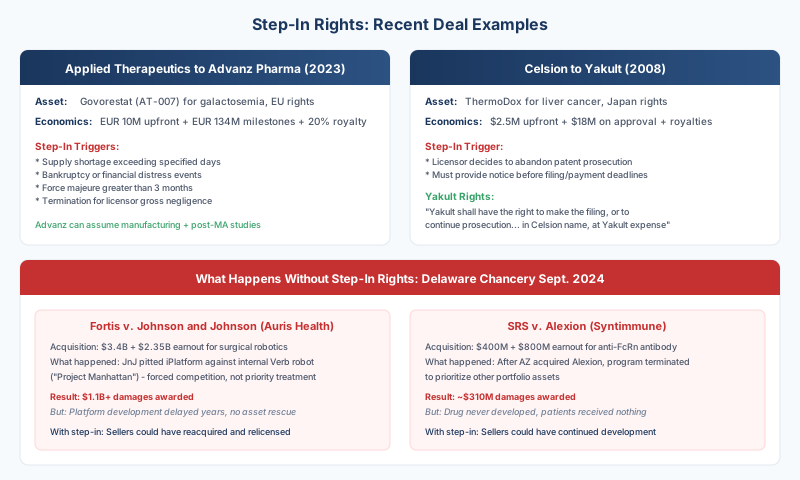
Two Delaware Chancery Court decisions issued within 24 hours in September 2024 awarded combined damages exceeding $1.3 billion for breaches of commercially reasonable efforts obligations. Both cases illustrate a structural limitation of damages remedies: they compensate for value destruction but don't prevent it.
Fortis Advisors v. Johnson & Johnson (Auris Health)
J&J acquired surgical robotics company Auris Health in 2019 for $3.4 billion upfront plus up to $2.35 billion in earnout payments tied to FDA regulatory milestones. The merger agreement required J&J to treat Auris's iPlatform as a "priority medical device" and use commercially reasonable efforts to achieve the milestones.
Shortly after closing, J&J initiated what internal documents called "Project Manhattan"—a competition between iPlatform and J&J's own Verb surgical robot platform. Vice Chancellor Lori Will found that J&J had "thrust iPlatform into a head-to-head faceoff against Verb," forcing the acquired platform to compete for internal resources rather than receiving the priority treatment promised in the merger agreement.
The court found J&J liable for breach of contract, breach of the implied covenant of good faith and fair dealing, and fraud (for concealing known problems with a catheter component that J&J knew would delay FDA approval). The court awarded over $1.1 billion in damages. The Delaware Supreme Court subsequently affirmed liability for several milestones while reversing on one milestone where the FDA changed the regulatory pathway.
SRS v. Alexion Pharmaceuticals (Syntimmune)
Alexion acquired Syntimmune in 2018 for $400 million upfront plus up to $800 million in earnout payments tied to development milestones for ALXN1830, an anti-FcRn antibody targeting autoimmune diseases. The merger agreement required Alexion to use commercially reasonable efforts defined with reference to "biopharmaceutical companies of size and resources similar to those of the [p]arent and its [s]ubsidiaries."
After AstraZeneca acquired Alexion in 2021, the combined company reviewed its pipeline and terminated the ALXN1830 program to focus resources on other assets. The court interpreted the CRE standard as "outward-facing"—requiring comparison to what a hypothetical similarly-situated company would do, not what Alexion/AstraZeneca subjectively chose to prioritize based on its own portfolio considerations.
Vice Chancellor Will found that Alexion breached this obligation by terminating development based on internal prioritization rather than the program's objective merits. The court awarded approximately $310 million in damages, including expectation damages for milestones that would likely have been achieved had development continued.
The Step-In Alternative
In both cases, the sellers received substantial monetary compensation. But the underlying assets—a surgical robotics platform and a promising antibody candidate—were never developed. Patients who might have benefited received nothing.
Had the Syntimmune sellers negotiated step-in rights triggered by program termination or CRE breach, they might have had the option to reacquire ALXN1830 and either continue development themselves, find an alternative pharma partner, or out-license to a company willing to prioritize the program. The monetary damages were significant, but the optionality to rescue the asset would have been more valuable still—both economically and for the patients the drug might have helped.
Deal Examples
Applied Therapeutics → Advanz Pharma (January 2023)
In January 2023, Applied Therapeutics licensed govorestat (AT-007), an aldose reductase inhibitor for rare metabolic diseases, to Advanz Pharma for exclusive European commercialization rights covering galactosemia and sorbitol dehydrogenase (SORD) deficiency.
Economics:
- €10 million upfront payment
- Up to €134 million in development and commercial milestones
- 20% royalty on net sales (reducing to 10% after initial term)
- Advanz responsible for European regulatory submissions and commercialization
Step-In Triggers (from the 8-K filing):
"In certain circumstances, including in the event of specified supply shortages, bankruptcy and certain other financial events, a force majeure event lasting more than three months, or termination as a result of the Company's gross negligence, ADVANZ PHARMA exercises certain step-in rights."
What Advanz Can Do Upon Step-In:
- Assume manufacturing operations (Applied is initially the exclusive supplier)
- Conduct development activities including post-marketing authorization studies
- Have certain third-party contracts assigned (CMO agreements, distribution arrangements)
- Deduct step-in establishment costs from ongoing milestone and royalty payments
The 10-K filing provides additional context: Applied retains primary development responsibility through marketing authorization, but "unless the Company provides ADVANZ PHARMA prior consent to conduct certain studies following marketing authorization, or ADVANZ PHARMA exercises certain step-in rights."
This structure addresses a common concern in regional licensing: the European partner depends on the U.S. licensor for supply and continued development, but has contractual mechanisms to ensure continuity if the licensor fails to perform.
Celsion → Yakult Honsha (December 2008)
The Celsion-Yakult agreement for ThermoDox (thermally sensitive liposomal doxorubicin) in Japan illustrates licensee step-in rights for patent prosecution—critical when the licensee's substantial investment depends on IP that the licensor controls.
Economics (from press release and 8-K):
- $2.5 million upfront payment
- $18 million payment conditioned on Japanese regulatory approval for primary liver cancer
- Additional milestone payments tied to sales thresholds and approval of other indications (including recurrent chest wall breast cancer)
- "Significant double-digit and escalating royalty rate" on Japanese sales
- Yakult responsible for all Japanese clinical development and regulatory costs
- Celsion remains exclusive manufacturer/supplier
The Patent Step-In Mechanism:
Celsion retained responsibility for global patent prosecution and maintenance. But Yakult—having committed to substantial Japanese clinical development—required protection against Celsion abandoning the patent portfolio. The agreement provides:
"Celsion will keep Yakult fully informed of the status of the Patent Portfolio Rights in the Territory that could reasonably affect a ThermoDox Product, and will provide Yakult with copies of all substantive documentation submitted to, or received from, any patent office in the Territory."
If Celsion decides to abandon prosecution or maintenance:
"Celsion will provide such written notice to Yakult upon the earlier of (i) its decision with respect to any of the foregoing, or (ii) [redacted] prior to any filing or payment due date, or any other due date that requires action, in connection with such Abandoned Patent Portfolio Rights. In such event, Yakult shall have the right to make the filing, or to continue the prosecution or maintenance of such Abandoned Patent Portfolio Rights in Celsion's name, if necessary, and at Yakult's expense."
Commercially Reasonable Efforts Definition:
The agreement also defined CRE with unusual specificity:
"the efforts, activities and resources, which a diligent Third Party company active in the same Field as the respective Party would use (including, without limitation, the promptness with which such efforts and resources would be applied) in Developing, manufacturing, promoting or Commercializing its own pharmaceutical products that are of comparable market potential to the ThermoDox Product, taking into account all relevant factors including product labeling or anticipated labeling, present and future market potential, past performance of the ThermoDox Product... financial return, medical and clinical considerations, present and future regulatory environment and competitive market conditions, and the nature and extent of market exclusivity (including patent coverage and regulatory exclusivity)."
This "outward-facing" standard—requiring comparison to what a similarly-situated third party would do—mirrors the interpretation the Delaware courts applied in the Alexion case 16 years later.
Royalty Pharma Standard Protective Provisions
Royalty Pharma's SEC filings from the risdiplam (Evrysdi) royalty purchase reveal the protective terms royalty investors typically require:
Representations and Warranties:
- No party has repudiated the underlying license
- No acts or omissions have occurred that would "reasonably be expected to result in a Reversionary Right" (i.e., reversion of rights to the licensor)
- Seller has not consented to assignment or material amendment of the license
- No claims, actions, or proceedings are pending that would materially affect the royalty stream
Consent Requirements:
- Investor consent required for any material amendment to the underlying license
- Investor consent required for any termination of the license
- Investor consent required for assignment of the license to a third party
Notice and Information Rights:
- Copies of all notices received under the underlying license
- Prompt notification of any communication that could result in a "Product MAE" (material adverse effect)
- Periodic reports on commercialization progress
These provisions create a monitoring framework rather than operational step-in rights. The investor can observe problems developing and intervene through consent rights, but doesn't assume development or commercialization responsibilities. For larger or higher-risk transactions, investors may negotiate additional protections including direct license provisions or backup licensee designations.
The Royalty Chain: Structural Exposure
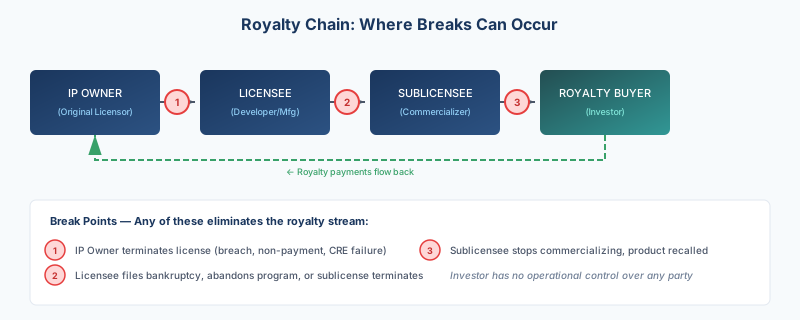
Royalty investors face a structural problem distinct from licensors or licensees: they own contractual payment rights but sit downstream from multiple parties they cannot control. Any break in the chain—license termination, counterparty bankruptcy, commercialization failure, regulatory withdrawal—can eliminate the royalty stream entirely.
According to Covington's 2024 analysis of royalty monetization transactions from 2019-2023:
- 95% were documented as true sales (rather than secured financings)
- 15% required special purpose vehicle structures
- 8% were secured by product assets including IP
- Transaction volume reached approximately $29.4 billion from 2020-2024—more than double the prior five-year period
Protective Mechanisms
Direct License Provisions. The IP owner commits to grant a replacement license directly to the royalty investor (or investor's designee) if the intermediate license terminates. This bypasses the licensee entirely and creates privity between investor and IP source. Requires the IP owner's active participation in the monetization transaction—typically through a consent agreement, direct agreement, or amendment to the underlying license.
Sublicense Survival Clauses. Standard language ensures sublicensees retain their rights if the head license terminates:
"Termination or expiration of this Agreement shall have no effect on the licenses then existing between [Licensor] and its sublicensees, provided such sublicensee is not in material breach."
This protects downstream commercialization arrangements (and any royalties tied to them) from disruption caused by upstream disputes.
Section 365(n) Protections. For U.S. transactions, Section 365(n) of the Bankruptcy Code permits IP licensees to retain their rights if the licensor rejects the license in bankruptcy—provided the licensee continues paying royalties. Agreements should explicitly invoke the statute:
"All rights and licenses granted under this Agreement are deemed to be, for purposes of Section 365(n) of the U.S. Bankruptcy Code, licenses of right to 'intellectual property' as defined in Section 101 of such Code."
However, Section 365(n) has limitations: it covers only patents, copyrights, and trade secrets (not trademarks); the licensee retains only rights existing at bankruptcy filing; and the licensor's affirmative obligations (maintenance, enforcement, technical assistance) typically terminate.
Bankruptcy-Remote SPV Structures. For large transactions, placing the license and royalty-generating assets into a special purpose vehicle that cannot file bankruptcy without investor consent isolates the royalty stream from counterparty financial distress. The SPV has independent directors with fiduciary duties to the vehicle itself, and bankruptcy-remote provisions prevent voluntary filing.
Covington's analysis of the Athenex bankruptcy illustrates the risk when adequate structural protection is absent—the debtor's ability to reject executory contracts can eliminate royalty obligations that investors assumed were secured.
Jurisdictional Frameworks
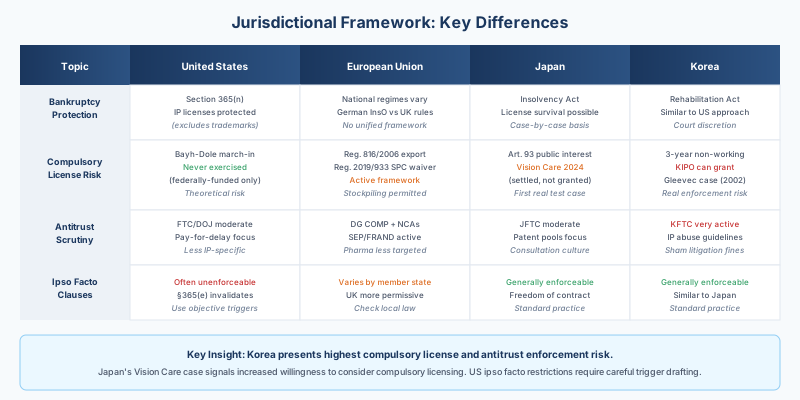
Step-in rights operate within distinct legal frameworks across major pharmaceutical markets. The differences affect both drafting and enforcement.
United States
Section 365(n) Protection. Section 365(n) of the Bankruptcy Code provides IP licensees with protection when a licensor files bankruptcy. If the debtor rejects an IP license, the licensee may elect to either (a) treat the rejection as termination and assert a damages claim (typically unsecured), or (b) retain its rights for the remaining license term plus extensions, provided it continues paying royalties.
The protection has significant limitations: it applies only to patents, copyrights, trade secrets, and mask works—trademarks are explicitly excluded. The licensee retains only rights existing at the bankruptcy filing date. And the licensor's affirmative obligations (technical assistance, maintenance, patent enforcement) typically terminate upon rejection—precisely when such support may be most needed.
Ipso Facto Limitations. Section 365(e) invalidates contract provisions that terminate or modify rights solely because of bankruptcy filing. Step-in provisions triggered only by bankruptcy (ipso facto clauses) are often unenforceable. Best practice: combine bankruptcy triggers with objective performance failures that independently justify step-in—supply shortage, missed milestones, failure to maintain manufacturing capability.
Bayh-Dole March-In Rights. For inventions arising from federally-funded research, the government retains march-in rights under the Bayh-Dole Act. Although never exercised in the Act's 45-year history, the 2024 NIST draft framework signals potential activation based on pricing considerations—a reversal from the prior administration's position that price alone cannot justify march-in. Step-in provisions for products with federal funding should address this contingency.
European Union
SPC Manufacturing Waiver. Regulation 2019/933, effective July 2019, permits generic manufacturers to produce SPC-protected products for (a) export to countries where protection has expired, throughout the SPC term, and (b) stockpiling for EU market entry, during the final 6 months before SPC expiry. This affects competitive dynamics during step-in transitions—a generic manufacturer can prepare to enter the market during any cure period.
Compulsory Licensing for Export. Regulation 816/2006 establishes an EU framework for compulsory licensing of pharmaceutical patents for manufacture and export to countries with public health problems. While primarily aimed at developing country access, the framework creates regulatory precedent for government intervention in patent rights.
Unified Patent Court. The UPC, operational since June 2023, has jurisdiction over European patents and unitary patents unless parties opt out. Step-in provisions for European territories should address: which forum (UPC or national courts) adjudicates disputes; how preliminary injunction procedures interact with step-in timelines; and whether the UPC's evolving case law on patent validity affects underlying rights.
National Variations. EU member states retain distinct contract law traditions. French law traditionally requires specificity in termination provisions; German courts may interpret "reasonable efforts" differently than English courts; choice of law and forum clauses require attention to ensure step-in provisions are enforceable as drafted.
Japan
Article 93 Compulsory Licensing. Japanese patent law permits compulsory licensing under Article 93 "where the working of a patented invention is particularly necessary for the public interest." A party seeking a compulsory license must first attempt to negotiate with the patent holder; if negotiations fail, the party may request an award from the Minister of Economy, Trade and Industry (METI).
The Vision Care Case (2021-2024). In July 2021, Vision Care and VC Cell Therapy filed Japan's first substantive compulsory license request under Article 93, seeking rights to a patent covering iPS cell-derived retinal pigment epithelium (RPE) technology co-owned by Helios, RIKEN, and Osaka University.
The case arose when Dr. Masayo Takahashi—one of the patent's inventors—left RIKEN and could no longer freely use the technology she had helped develop. Sumitomo Pharma, as exclusive sublicensee, was progressing slowly on clinical development. Vision Care argued that public interest required a compulsory license to enable faster development of treatments for patients with RPE deficiency diseases.
According to AIPPI's analysis, the JPO convened a special committee within the Industrial Property Council that held 22 meetings over nearly three years before the case settled in May 2024. The settlement allowed Vision Care to perform up to 30 treatments using the patented technology.
While no compulsory license was formally granted, the case signals that Article 93 can be invoked and will receive substantive consideration. Step-in provisions for Japanese territories should anticipate the possibility of compulsory licensing for products with significant public health implications.
Cultural Context. Japanese business relationships emphasize consultation, consensus-building, and long-term partnership. While step-in clauses may be contractually valid and enforceable, their exercise without substantial prior consultation may damage ongoing commercial relationships—and Japanese partners may expect more collaborative approaches to problem resolution than Western counterparties anticipate.
Korea
Compulsory Licensing Framework. Korean patent law permits compulsory licensing in several circumstances:
- Patent not worked for three consecutive years in Korea without justifiable reason
- Domestic demand not satisfied to an appropriate extent under reasonable conditions
- Working necessary for public interest
- Practice determined to be anticompetitive by the Korea Fair Trade Commission
The 2002 Gleevec compulsory license request—in which patient advocacy groups sought compulsory licensing of Novartis's leukemia drug—demonstrated that pharmaceutical patents face active compulsory licensing risk in Korea. While the request was ultimately unsuccessful, it established that the mechanism would be seriously considered.
KFTC Enforcement. The Korea Fair Trade Commission actively monitors pharmaceutical patent practices under the Guidelines for Fair Patent Licensing Agreements. The KFTC has sanctioned sham patent litigation—the first such sanctions in Korea—finding that a pharmaceutical company had filed infringement actions based on falsified data and manipulated bioequivalence tests.
Step-in provisions designed primarily to maintain market exclusivity beyond legitimate patent protection may face KFTC scrutiny. The commission has examined whether exclusive dealing provisions in distribution agreements exceed the exclusionary scope of underlying patents, and similar analysis could apply to step-in mechanisms used for anticompetitive purposes.
Cross-Border Considerations. Licensing deals with Chinese biotechs present distinct patterns: Chinese licensors often prioritize upfront payments and non-refundability over milestone structures, and may have fewer objections to step-in provisions than U.S. or European counterparts. However, geopolitical tensions affect enforcement mechanisms and dispute resolution, and governing law/forum selection requires careful attention.
Key Contract Language Examples
From the Merck-Threshold License Agreement
The Merck-Threshold agreement provides a representative step-in formulation:
"Merck has the right to assume responsibility for any Licensor Development activities if the joint Development is rightfully terminated by Merck pursuant to Article 4.14 or Article 4.15 or Threshold has opted out in accordance with Article 4.16."
This establishes the three core elements: specification of assumable activities (Licensor Development activities), trigger conditions (termination under specified articles or Threshold opt-out), and procedural framework (referenced articles define notice and process).
From the Pfizer-Iterum Agreement
The Pfizer-Iterum license addresses transition mechanics upon termination:
"Pfizer shall prepare and the Parties shall negotiate a transition plan"
The transition plan covers technology transfer, regulatory submission handover, manufacturing know-how transfer, and assumption of ongoing obligations including pharmacovigilance. Without such provisions, step-in rights may be hollow—the stepping-in party gains the legal right to continue but lacks the practical capability.
Section 365(n) Invocation
Standard Section 365(n) language from pharmaceutical license agreements:
"All rights and licenses granted under this Agreement are deemed to be, for purposes of Section 365(n) of the U.S. Bankruptcy Code, licenses of right to 'intellectual property' as defined in Section 101 of such Code. The Parties further agree that, in the event [Licensee] elects to retain its rights as a licensee under such Code, [Licensee] shall be entitled to complete access to any technology licensed to it hereunder and all embodiments of such technology."
Conclusion
Step-in rights address a fundamental limitation of contract damages: they compensate for value destruction but do not prevent it. The September 2024 Delaware decisions—totaling over $1.3 billion in awards for CRE breaches—demonstrate both courts' willingness to enforce efforts obligations and the inadequacy of monetary remedies when promising assets are abandoned or mismanaged.
Effective step-in provisions require attention to trigger definition (objective milestones generally provide clearer triggers than efforts standards), cure procedures (matching timelines to the nature of the breach), transition mechanics (ensuring the stepping-in party can actually continue operations), and jurisdictional variations (particularly ipso facto limitations in the U.S., compulsory licensing risk in Korea and increasingly Japan, and national law variations in the EU).
The deal structures examined here—from Applied Therapeutics-Advanz to Celsion-Yakult to Royalty Pharma's standard protections—illustrate various approaches. No single formulation suits all transactions, but the underlying principle remains consistent: step-in rights preserve optionality, protect investment, and keep promising science moving toward patients rather than languishing in legal disputes over damages for assets that were never developed.
This article is for informational purposes only and does not constitute legal or financial advice. The author is not a lawyer or licensed financial adviser.
Member discussion