The Licensor That Keeps: Hospitals and Universities as Royalty Owners
Hospitals and universities collected large royalty sums in 2025, yet no sale of an academic royalty has been disclosed since mid-2023. This piece asks what is left to buy.

On 23 November the Food and Drug Administration gave traditional approval to Welgemda (ribitol), BridgeBio's treatment for limb-girdle muscular dystrophy type 2I/R9 in patients weighing at least 30 kg. It came with a rare pediatric disease priority review voucher, and BridgeBio plans a European filing in the first half of 2028.
The patents behind it belong to the Charlotte-Mecklenburg Hospital Authority, which trades as Atrium Health. BridgeBio's annual report for 2025 lists eight issued US patents licensed from the authority to its subsidiary ML Bio Solutions, expiring in 2037 or 2040 before any extension. The licence has never been filed as an exhibit, and the royalty rate, milestones and upfront are not disclosed.
The science came from Qi Lu's work at Atrium's McColl-Lockwood Laboratory in Charlotte. In July 2019 BridgeBio paid $7.0M for preferred stock in ML Bio and took 50.5 per cent of it, with up to $24.5M more payable on milestones.
Atrium is a unit of local government and files no Form 990. When Welgemda starts selling, no public document is likely to show what the hospital receives.
Three days before the approval, Capricor Therapeutics received a second complete response letter for deramiocel, its cell therapy for Duchenne cardiomyopathy. Its third-quarter report describes licences from Johns Hopkins, signed in 2006, and from Cedars-Sinai, signed in 2010 and restated in 2013. Both carry low single-digit royalties on net sales and a low double-digit share of sublicence consideration.
Hopkins's milestones are capped at $1.85M, of which $1.0M falls due on full approval. The Cedars licence ends automatically if performance under it would put the hospital's tax exemption at risk. Neither royalty is payable until deramiocel is approved.
The two cases frame the question for a royalty buyer. Hospitals and universities sit at the bottom of many royalty stacks on approved drugs, and they seldom sell. p05 covered the university sales of 2000 to 2016, from Emory to UCLA, in November 2025, and the statutory limits on federal and university vaccine royalties in August 2026.
This piece uses the institutions' 2025 and 2026 accounts, the 2025 and 2026 filings of their licensees, and the record of hospital sales to estimate how much of that income could be bought.
What the institutions earned
AUTM's survey for fiscal 2025, published in June 2026, drew 206 respondents and reported gross licensing income up more than 7 per cent, driven in part by running royalties. AUTM no longer gives a dollar total. The Information Technology and Innovation Foundation put the total at about $2.7B for fiscal 2024, down from about $3.6B the year before.
The respondents include hospitals and research institutes, and gross income counts cashed-in equity and lump sums as well as royalties.
The University of Pennsylvania has led the universities for five years on its mRNA patents. Its licence income for the year to June 2026 was $197.5M net of distributions, after $560.9M a year earlier. The earlier figure included the BioNTech settlement, under which Penn received $400M of royalties for 2020 to 2023 and a low single-digit royalty from 2024.
Dartmouth booked $212.1M of royalties in fiscal 2025, of which $203.9M related to intellectual property used in COVID-19 vaccines. Duke reported $123.6M for fiscal 2026, its second record year in a row.
Other universities have seen their income fall as patents expire. Emory's licence income was $52.4M in fiscal 2025, against $279.2M in fiscal 2022. Northwestern, which sold half its Lyrica royalty in 2007, reported $7.5M for fiscal 2026.
Most licences earn little. The foundation cites an MIT study in which 4 of 605 royalty-bearing licences earned more than $1M, and a September 2026 report counted more than 45,000 active licences in 2025, fewer than 10,000 of them producing revenue.
Hospital income is harder to see. Form 990 has a royalty line, and several institutions book licensing elsewhere, so the line understates for some. Dana-Farber reported $88.9M of royalties for the year to September 2025 without naming the products.
The figure for fiscal 2023 was $328.2M. In April of that year Dana-Farber settled its dispute with Bristol-Myers Squibb and Ono over the Honjo-Freeman patents for a lump sum and possible later payments, with the amount and other terms kept confidential. Nationwide Children's Hospital reported $68.9M for 2024, and Sarepta's annual report for 2025 puts Elevidys sales at $898.7M with a low single-digit royalty payable to the hospital.
Sarepta reports royalties only as a combined line, $51.2M in 2025, which also covers BioMarin and the University of Western Australia on its exon-skipping drugs. The Cleveland Clinic Foundation reported $54.4M for 2024 without naming the products.
Below these sit Seattle Children's at $23.1M, Fred Hutch at $20.5M and the Beckman Research Institute of City of Hope at $19.3M, each for fiscal 2025. St. Jude's audited statements show $27.9M of technology licensing for fiscal 2024, net of payments to inventors.
City of Hope shows the end of a stream that was held to term. Its own return reported $442.1M of royalties in 2018 and $379.6M in 2019, and $12,854 for fiscal 2025. Cedars-Sinai's line fell from $31.8M in fiscal 2019 to $1.4M in fiscal 2025.
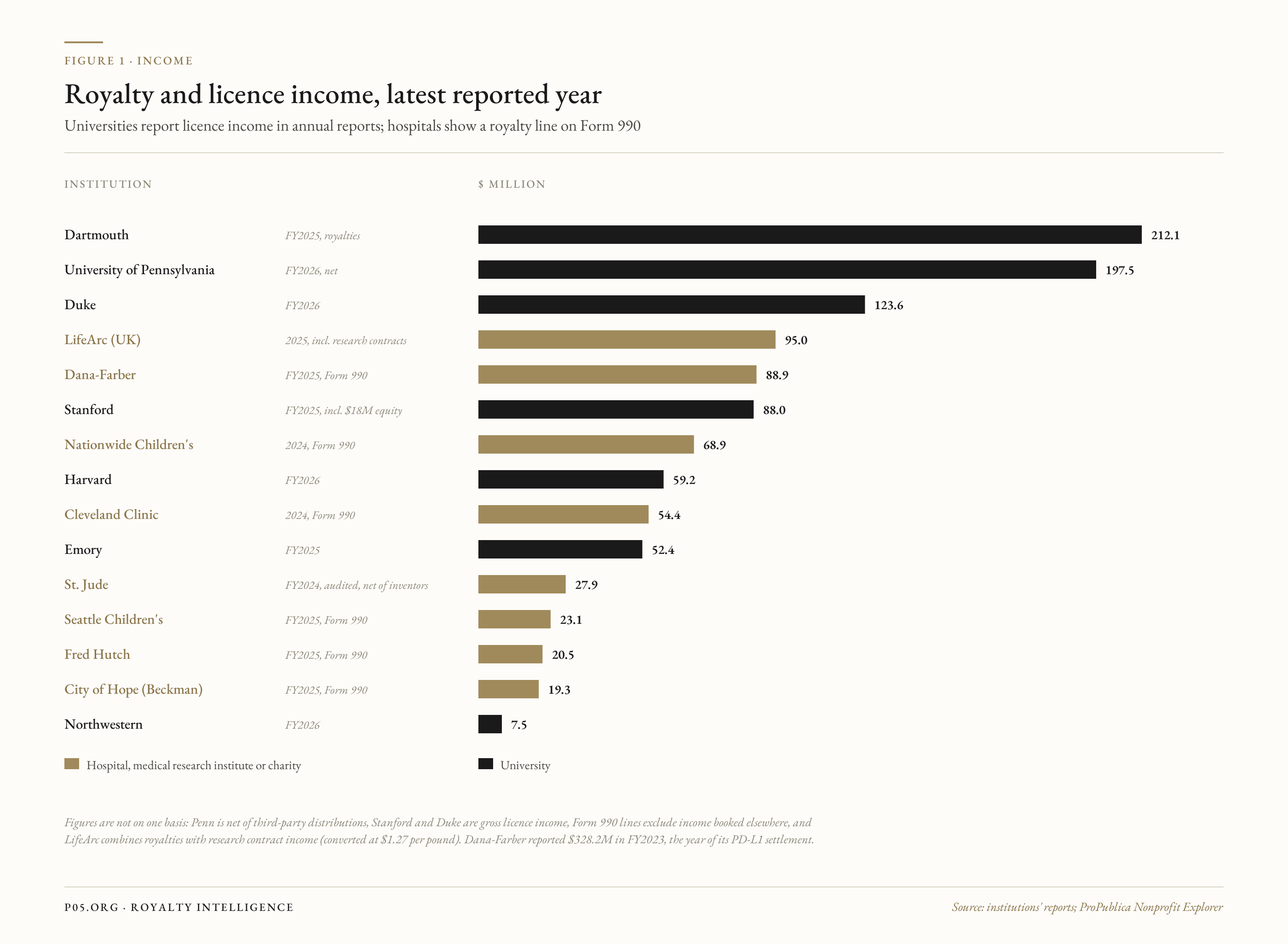
Royalty and licence income of selected institutions, latest reported year.
Outside the United States the same pattern holds at smaller scale. LifeArc, the charity that holds the humanisation royalty on Keytruda, reported research contract and royalty income of £74.6M ($95M) for 2025, against £182.6M ($232M) in 2024, and its accounts do not explain the drop. Cancer Research UK's income from abiraterone fell to £11M ($14M) in the year to March 2025.
The Institut Pasteur booked €9.5M ($10M) of brand and patent royalties in 2025. Japanese universities together earned about ¥7.26bn ($48M) from intellectual property in fiscal 2024, down 11.5 per cent, and only seven licences at five institutions earned more than ¥100M ($0.66M) each.
In Prague, the Institute of Organic Chemistry and Biochemistry was reported in 2023 to earn about $180M a year in licence income, about $80M of it from tenofovir.
What the licences say
The institutions seldom name their products. Their licensees do. p05 read the 2025 and 2026 annual and quarterly reports of companies selling approved drugs and found 31 licences from universities, hospitals and research institutes with royalty terms described. Most give the rate as a band such as "low single digit".
Four give a number: George Washington University's 6 per cent on Giapreza, Harvard's 5 per cent on US sales of Xerava, National Taiwan University's 10 to 15 per cent on Kebilidi, and Scripps Research's 1 per cent on Unituxin. Four give no rate, Atrium's licence for Welgemda among them.
| Drug | Licensee | Academic licensor | Royalty as disclosed | 2025 sales |
|---|---|---|---|---|
| Elevidys | Sarepta | Nationwide Children's | Low single digit | $898.7M |
| Syfovre | Apellis | University of Pennsylvania | Low single digit, quarterly minimum | $586.9M |
| Attruby | BridgeBio | Stanford | Low single digits | $362.4M (US) |
| Unituxin | United Therapeutics | Scripps Research | 1 per cent, no patent | $226.8M |
| Yutrepia | Liquidia | University of North Carolina | Low single digit | $148.3M |
| Empaveli | Apellis | University of Pennsylvania | Low single digit, quarterly minimum | $102.4M (US) |
| Aucatzyl | Autolus | UCL Business | Low to mid single digits | $74.3M |
| Giapreza | Innoviva | George Washington University | 6 per cent | $73.6M |
| Pedmark | Fennec | Oregon Health & Science University | Not disclosed | $44.6M |
| Xerava | Innoviva | Harvard | 5 per cent US, 4.5 to 7.5 per cent elsewhere | $23.5M |
| Komzifti | Kura | University of Michigan | Tiered low single digits | Launched November 2025 |
| Kebilidi | PTC | National Taiwan University | 10 to 15 per cent | Not disclosed |
| Welgemda | BridgeBio | Atrium Health | Not disclosed | Approved November 2026 |
Where a licensee reports royalty expense, the payment can be measured. Apellis recorded $19.1M of royalty expense to Penn on Syfovre in 2025, about 3.25 per cent of sales, and $7.3M on Empaveli. Innoviva's expense to George Washington University was $4.5M. Abeona accrued $43,000 for Stanford on the first $2.4M of Zevaskyn sales.
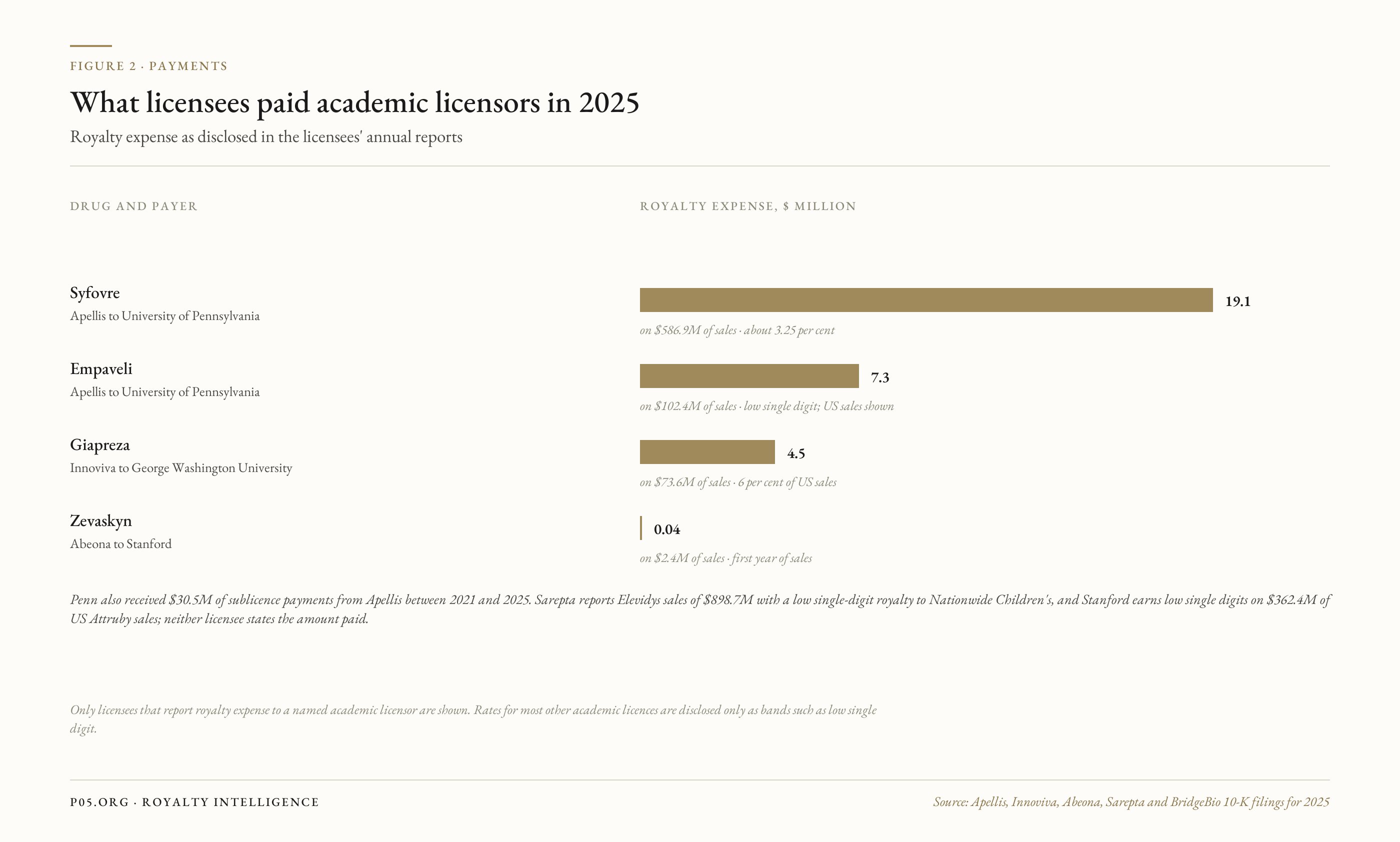
Royalties paid or accrued to academic licensors in 2025, from licensee filings.
The sublicence shares are larger than the royalties. Memorial Sloan Kettering takes a low double-digit share of sublicence consideration from Atara on Ebvallo, Harvard 20 per cent and George Washington 15 per cent from Innoviva, and National Taiwan University a share in the low to mid twenties from PTC.
Penn received $30.5M of sublicence payments from Apellis between 2021 and 2025. Several licences step the share down over time, and Emory and Georgia Tech cut theirs from low double digits to high single digits in a January 2024 amendment with Clearside.
Some royalties no longer rest on a live patent. Scripps's royalty on Unituxin is paid although no patent covers the product. Oregon Health & Science University's patent on Pedmark was invalidated by the Patent Trial and Appeal Board in 2023.
Humacyte's licence from Duke runs to the later of the last patent or four years after first sale of Symvess, and the main patent expired in 2021.
Autolus holds an option to buy out UCL Business's royalties and milestones once Aucatzyl sales pass a threshold, which caps what the licensor could sell.
In none of these 2025 and 2026 filings is an academic royalty payable to an assignee. The sales sit one level up. Ionis sold part of its Spinraza royalty to Royalty Pharma, and REGENXBIO's Zolgensma royalty went to HealthCare Royalty.
Editas sold its Casgevy licence fees to DRI Healthcare for $57M in October 2024. Clearside sold its Xipere royalties to HealthCare Royalty. Beneath each, the royalties to Cold Spring Harbor and UMass, Penn, the Broad Institute and Harvard, and Emory and Georgia Tech are still paid to the institutions.
Who has sold
Hospitals have sold royalty interests less often than universities. The Children's Hospital Foundation in Philadelphia sold its RotaTeq royalty to Royalty Pharma for $182M in April 2008.
Rush University Medical Center sold its Ampyra royalty to DRI for about $42M in August 2014. Dana-Farber sold a portion of its PD-L1 royalties to the Canada Pension Plan Investment Board in August 2016 for $100M upfront and up to $68M more.
Boston Children's sold its Vonvendi royalty to a Barings affiliate in 2018. The price was $51.5M, of which $15.0M went to the inventor under hospital policy. The hospital booked the sale as a financing, and the obligation stood at $30.7M at September 2025. Massachusetts General Hospital sold its Entyvio royalty to Royalty Pharma for $94M in March 2020. No later hospital sale has been disclosed.
The last two university sales on record came in 2023. The Purdue Research Foundation sold a portion of its Pluvicto royalty to Owl Rock, now Blue Owl, for more than $100M in April.
In June the Regents of the University of California sold Royalty Pharma an incremental interest in Erleada on undisclosed terms. Outside the United States, LifeArc sold slices of its Keytruda royalty to DRI for $150M in 2016 and to the Canadian pension fund for $1.297B in May 2019.
The Institute of Cancer Research sold a share of its abiraterone royalty to DRI in February 2016.
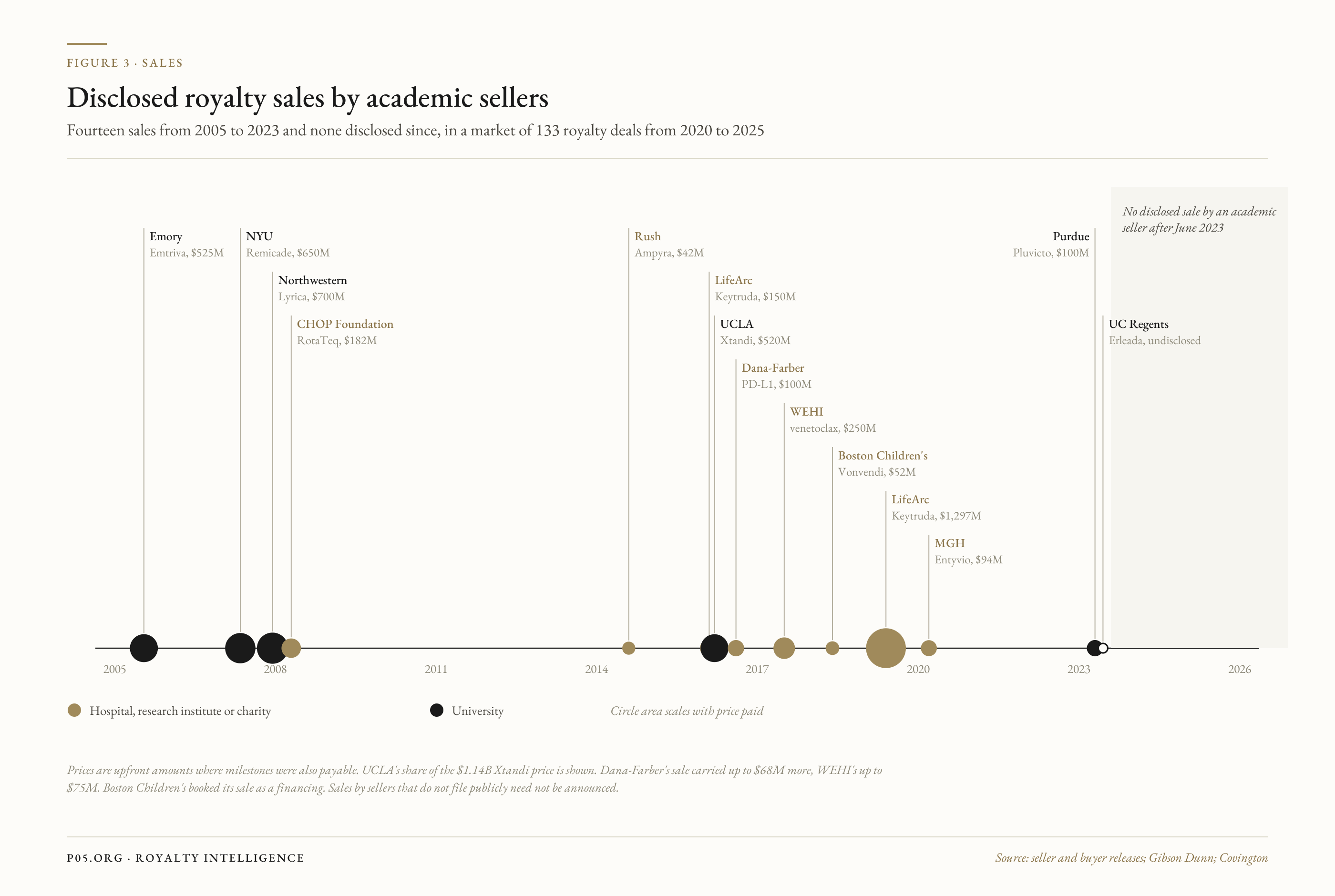
Disclosed sales of royalty interests by hospitals, universities and research institutes, 2005 to 2026.
The gap since 2023 may be one of disclosure. Gibson Dunn's 2026 report on royalty finance covers 133 deals worth $32.7B from 2020 to 2025 and does not mention a university. Covington's third annual monetisation study, published in June 2026, leaves out sellers that do not file publicly, naming universities and non-profit organisations.
An institution has no obligation to announce a sale, and the buyer has none unless the deal is material to it.
Why the institutions hold
The Bayh-Dole Act shapes any sale of a royalty on a federally funded invention. Section 202(c)(7) bars a non-profit from assigning rights without the funding agency's approval unless the assignee is an organisation that manages inventions. It requires the institution to share royalties with the inventor, and it directs the balance, after expenses, to scientific research or education. Past sellers handled the inventor in different ways.
NYU kept the inventors' portion of Remicade in 2007, UCLA's inventors and the Howard Hughes Medical Institute sold alongside the university in 2016, and Boston Children's paid its inventor 29 per cent of the price. St. Jude's policy gives inventors 30 to 50 per cent of net licensing income.
Federal tax does not favour holding over selling. Royalties and gains on the sale of property are both excluded from unrelated business taxable income under section 512(b), except for payments from controlled entities. Accounting can deter a sale.
Boston Children's carried its Vonvendi proceeds as debt, and a hospital that expects a sale to count as revenue may find it on the balance sheet as a liability instead.
The largest payments to hospitals over the past decade came from equity. The Children's Hospital of Philadelphia made about $741M from its stake in Spark Therapeutics after Roche bought the company in 2019. Cedars-Sinai received about $899M when Merck bought Prometheus Biosciences in 2023.
Its head of technology transfer told the publication that the hospital never enjoyed the true upside when it partnered too early, and that it now develops assets further before licensing. Several licences in the filings above gave the institution shares at signing, among them Memorial Sloan Kettering's with Y-mAbs, Dana-Farber's with Checkpoint and Michigan's with Kura, which issued the university 79,113 shares.
What changed in 2026
The One Big Beautiful Bill Act of 2025 added "federally-subsidized royalty income" to the net investment income on which the endowment excise tax is charged. The tax applies to private universities with at least 3,000 tuition-paying students, at 1.4, 4 or 8 per cent depending on endowment per student, for tax years beginning after 31 December 2025.
For a university with a June year-end the first year affected began on 1 July 2026. p05 found no guidance on whether the price received for a royalty is royalty income for this purpose or a gain. Hospitals and public universities fall outside the tax.
The federal government has also asked for a share of the income itself. In September 2025 the commerce secretary, Howard Lutnick, told Axios that the taxpayer should get half the benefit of university patents. A National Institute of Standards and Technology funding notice issued that month said awardees may have to share revenue with the department.
In August 2025 Commerce sent Harvard a Bayh-Dole compliance demand for a list of its federally funded patents. No rule taking a share of university licence income had been issued by the end of 2025, according to the Association of American Universities.
In February 2026 the Government Accountability Office found no interagency consensus on draft guidance for march-in based on price.
On the buyer side, Royalty Pharma named Memorial Sloan Kettering's former senior vice-president of technology development as its head of academic initiatives on 3 August 2026. Greg Raskin had led technology transfer and monetisation at the cancer centre, and his brief at Royalty Pharma is outreach to academic and non-profit institutions.
In Europe, the Commission's draft blueprint on academic licensing, put out for consultation in July, suggests royalties of 0 to 5 per cent for spin-offs in which the institution takes equity. It says nothing about selling royalties already held.
Implications for the royalty market
The income that could support a sale of institutional size is concentrated. On the 2025 filings, a handful of streams carry most of it: Nationwide Children's on Elevidys, Penn on Syfovre and Empaveli, Stanford on Attruby, and Dana-Farber on its PD-L1 licences. Cleveland Clinic's $54.4M has no named product in the public record.
The remaining licences in the dataset pay royalties in the low single digits on sales below $150M, and a 2 per cent royalty on $100M of sales comes to $2M a year before the inventor's share. Those are portfolio trades, and they would need a buyer willing to aggregate across institutions and licensees.
Diligence on these assets starts from the licensee's filing, since the institution publishes little. The term clause matters more than usual, since several of the royalties above run on contract after the patent has gone. Sublicence shares and minimum royalties can be worth more than the running royalty when a small licensee partners its product, as Penn's $30.5M from Apellis shows.
A licensee's option to buy out the royalty, such as Autolus holds, sets a ceiling on the price. Bayh-Dole consent and the inventor's share decide whether a sale can be structured as a true sale or as the debt-like financing Boston Children's recorded.
The endowment tax adds a cost to holding for the private universities it reaches, at up to 8 per cent of the royalty each year, while the treatment of sale proceeds is open. A university weighing that cost against Mr Lutnick's proposal faces two uncertainties at once. Neither reaches hospitals, whose reasons to hold are the inventor's claim and, since Spark and Prometheus, a preference for equity in licensees.
Conclusion
Welgemda will be sold under patents owned by a public hospital authority whose licence terms are not public. BridgeBio holds the priority review voucher, and whether Atrium shares in it, or in any sublicence income, depends on a contract no investor has seen. Of the 31 academic licences read for this piece, Atrium's is one of four that disclose no rate. It is also one of the few on a product approved in 2026, with patents running to 2040.
All information in this report was accurate as of the research date and is derived from publicly available sources including court opinions, regulatory guidance, academic literature, SEC filings, and financial news reporting. Information may have changed since publication. This content is for informational purposes only and does not constitute investment, legal, or financial advice. The author is not a lawyer or financial adviser.