
The Safety Tax: Modeling REMS Constraints in Pharmaceutical Royalty Valuation
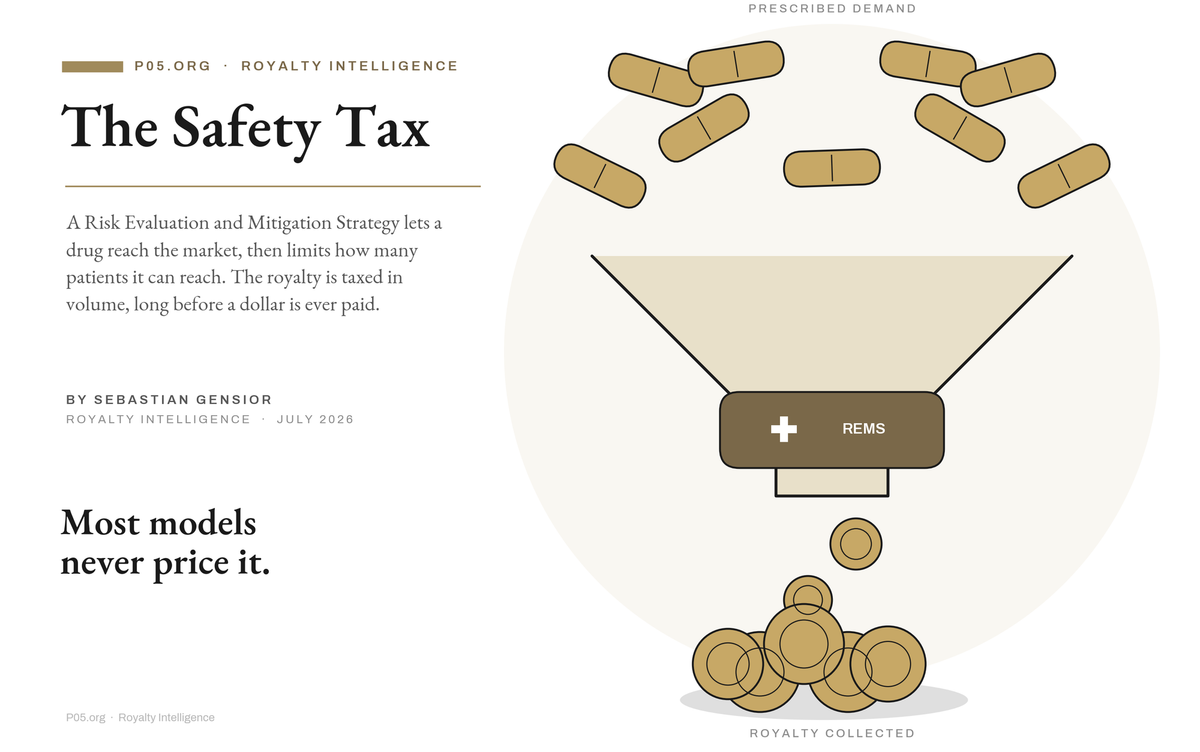
A REMS, the FDA's Risk Evaluation and Mitigation Strategy, does not touch the patent clock. It taxes the royalty base, throttling prescribing volume through prescriber certification, patient registries, and site-of-care rules, and it is mutable in a way patents are not. The 2025 wave of REMS removals has already repriced a cohort of royalty streams upward. A field guide to the constraint most royalty models never explicitly parameterise, and to the adjustments investors should make but usually do not.
The short version. A royalty is paid on net sales, and net sales are price times volume. A REMS acts on volume, inside the protected window, which is exactly where a duration model assumes cash flows are fullest. It is also mutable, so the constraint is really a two-sided option. And its old use as a generic-delay tool, once a quiet tailwind, is now largely foreclosed. Most models price none of this.
A companion piece on this platform, When Does the Money Stop?, treated a royalty as a window with two moving edges and asked how wide that window is. This article is about the height of the window rather than its width.
A royalty is calculated on net sales, and net sales are price multiplied by volume. A Risk Evaluation and Mitigation Strategy acts almost entirely on the volume term, and it does so inside the protected window, where a duration model assumes the cash flows are at their fullest.
The result is a systematic blind spot. Most royalty models parameterise the drug's safety profile as a binary that was resolved at approval: the product cleared the FDA, so the safety question is closed, and the model moves on to peak sales, uptake, and loss of exclusivity. A REMS is proof that the safety question was not closed. It is an ongoing, federally mandated set of conditions on how the drug may be prescribed, dispensed, and administered, and those conditions suppress the very volume the royalty is written on.
Worse for the modeller, the conditions are not fixed at the deal date. They can be tightened, loosened, or removed at any point in the product's life, which makes a REMS-encumbered royalty carry embedded optionality that a static discounted-cash-flow model prices at zero.
This article works through five things: what a REMS actually is and which kinds matter; the mechanism by which the restrictive kind compresses the royalty base; the mutability that turns a REMS into a two-sided option; the ex-US analogues that shape the worldwide base; and the contested use of REMS to delay generics, and why that lever no longer works the way it did. It closes with a modeling framework.
What a REMS is, and which ones move the royalty base
A Risk Evaluation and Mitigation Strategy is a safety program the FDA can require when a drug's risks need active management beyond ordinary labeling. It is the agency's tool for letting a dangerous-but-valuable product onto the market under conditions, rather than keeping it off. The authority comes from section 505-1 of the Federal Food, Drug, and Cosmetic Act (21 U.S.C. 355-1), added by the FDA Amendments Act of 2007.
The agency can impose a REMS as a condition of approval or at any time afterward, and the sponsor, meaning the party whose net sales generate the royalty, is responsible for building the program and for the compliance of prescribers, pharmacies, and patients.
REMS come in tiers, and the distinction between them is the whole modeling question.
At the light end, a REMS may consist only of a Medication Guide or a communication plan to prescribers. These impose essentially no volume friction. They are paperwork that travels with the product, and a royalty model can safely ignore them.
The restrictive tier is Elements to Assure Safe Use, or ETASU. The statute authorises six categories, each mapping to a different point in the prescribing-to-dispensing chain: prescriber certification and training; pharmacy or dispenser certification; dispensing only in certain healthcare settings; dispensing only with documentation of safe-use conditions such as a laboratory test; patient monitoring; and patient enrolment in a registry. ETASU are the elements that move volume, and the most restrictive combine several of them with a closed distribution network.
The proportions matter. As of May 2025 the FDA maintained on the order of 77 active REMS, of which roughly 71 carried ETASU, and the agency approves only a handful of new REMS in a typical year. Historically the majority of all REMS ever approved were Medication-Guide-only, many since released. The ETASU subset is smaller but commercially heavy: an analysis for the Association for Accessible Medicines counted 41 ETASU-restricted products with 2016 sales of 11.5 billion dollars, several individually above a billion a year. These are exactly the specialty assets the royalty monetisation market underwrites.
One precision point up front. Royalties are struck on net sales, so the sponsor's REMS compliance costs (hub services, specialty-pharmacy fees, registry operations, certification) reduce the sponsor's margin, not the royalty base. A REMS bites the base only through suppressed volume. The compliance cost is not irrelevant, because a heavy cost can dampen the sponsor's commercial commitment, but it does not enter the net-sales line directly. When a royalty sits on an ETASU drug, the tax is a volume tax.
The mechanism: how ETASU compresses the royalty base
An ETASU REMS suppresses net sales through four channels. A serious model treats them separately, because they act on different parts of the revenue curve.
Prescriber certification shrinks the funnel. When only certified prescribers may write the drug, the addressable prescriber population contracts to those willing to enrol and stay enrolled. The burden falls hardest on low-volume and generalist prescribers, who face the same fixed administrative cost as a specialist over far fewer patients. The documented pattern with isotretinoin is that participation concentrated among high-volume dermatologists while low-volume generalists exited.
Patient enrolment, registries, and testing raise dropout. Enrolment forms, comprehension attestations, pregnancy testing, and periodic monitoring insert friction between the prescribing decision and the filled prescription, and every friction point sheds patients. When iPLEDGE was first introduced, isotretinoin prescribing fell by roughly 30 percent for both male and female patients (Barbieri and colleagues, JAMA Dermatology), a volume shock driven by program friction rather than any change in clinical need. For a royalty, this is volume that never reaches the net-sales line despite an approved, prescribed product.
Site-of-care restrictions impose a hard capacity ceiling. The most binding ETASU is the requirement that a drug be administered only in a certified setting under observation. This converts a prescription into a scheduled clinical encounter and caps volume at the throughput of certified sites. Esketamine (Spravato), the Johnson and Johnson treatment-resistant-depression drug, carries a REMS that requires administration in a certified setting with at least two hours of post-dose monitoring at every session.
That two-hour observation is a physical limit on how many patients a site can treat per day, independent of demand, patents, or price. The same logic governed autologous CAR T-cell therapies, whose original REMS required certified sites and extended post-infusion monitoring.
Pharmacy certification and restricted distribution narrow dispensing. When only certified pharmacies in a closed network may dispense, and wholesalers must confirm certification before shipping, the dispensing chain becomes a filter. This channel also intersects with generic entry, discussed below.
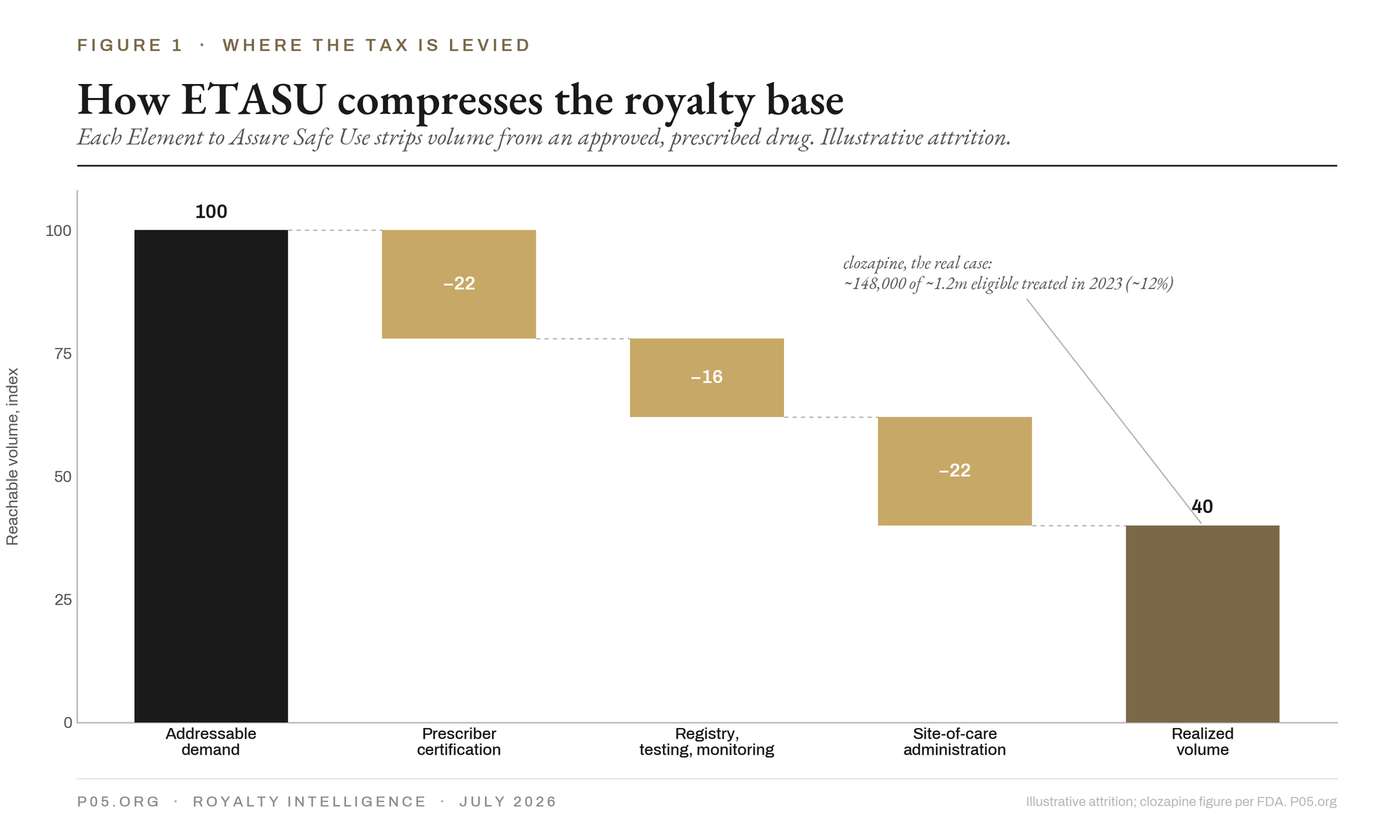
Each Element to Assure Safe Use removes volume from an approved, prescribed drug. The stages are illustrative; clozapine's real-world penetration of roughly 12 percent shows the compounded effect.
The unifying point: all four channels act on the near edge and the plateau, not the far edge. They slow the ramp, lower peak penetration, and lengthen the interval between funding and meaningful income. They do not shorten the contractual term. A REMS does not move the date the money stops. It lowers the whole curve between the date it starts and the date it stops, which is the region a duration model assumes is running at full revenue.
The clearest single data point on magnitude is clozapine. It is the only evidence-based therapy for treatment-refractory schizophrenia, yet under its REMS only about 148,000 of an estimated 1.2 million Americans with the condition received it in 2023, a penetration near 12 percent the FDA itself attributed in part to the program's administrative barrier. On a royalty, a gap that size is the difference between a marginal asset and a material one.
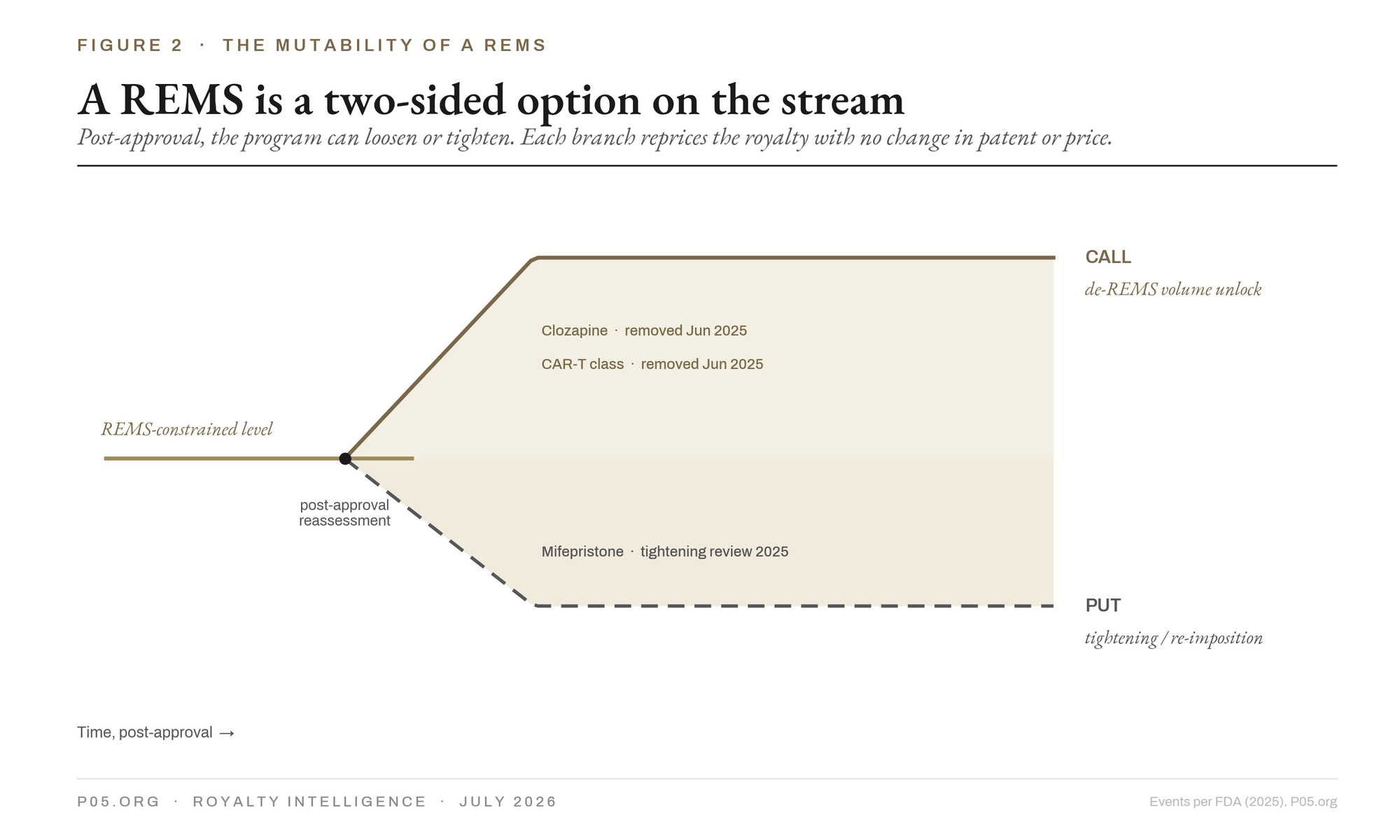
Two readings of the same tax. Clozapine reached about 12 percent of eligible patients under its REMS, and isotretinoin prescribing fell by roughly 30 percent when iPLEDGE was introduced.
The mutability problem: a REMS is a two-sided option
Patents expire on a schedule. A REMS does not. It is reassessed periodically and can be added, tightened, loosened, or eliminated at any point, and each direction is a repricing event for a royalty written on that product. This is the most underappreciated feature of REMS in royalty valuation, because a static model captures the current REMS as a fixed haircut and assigns no value to the probability that it changes.
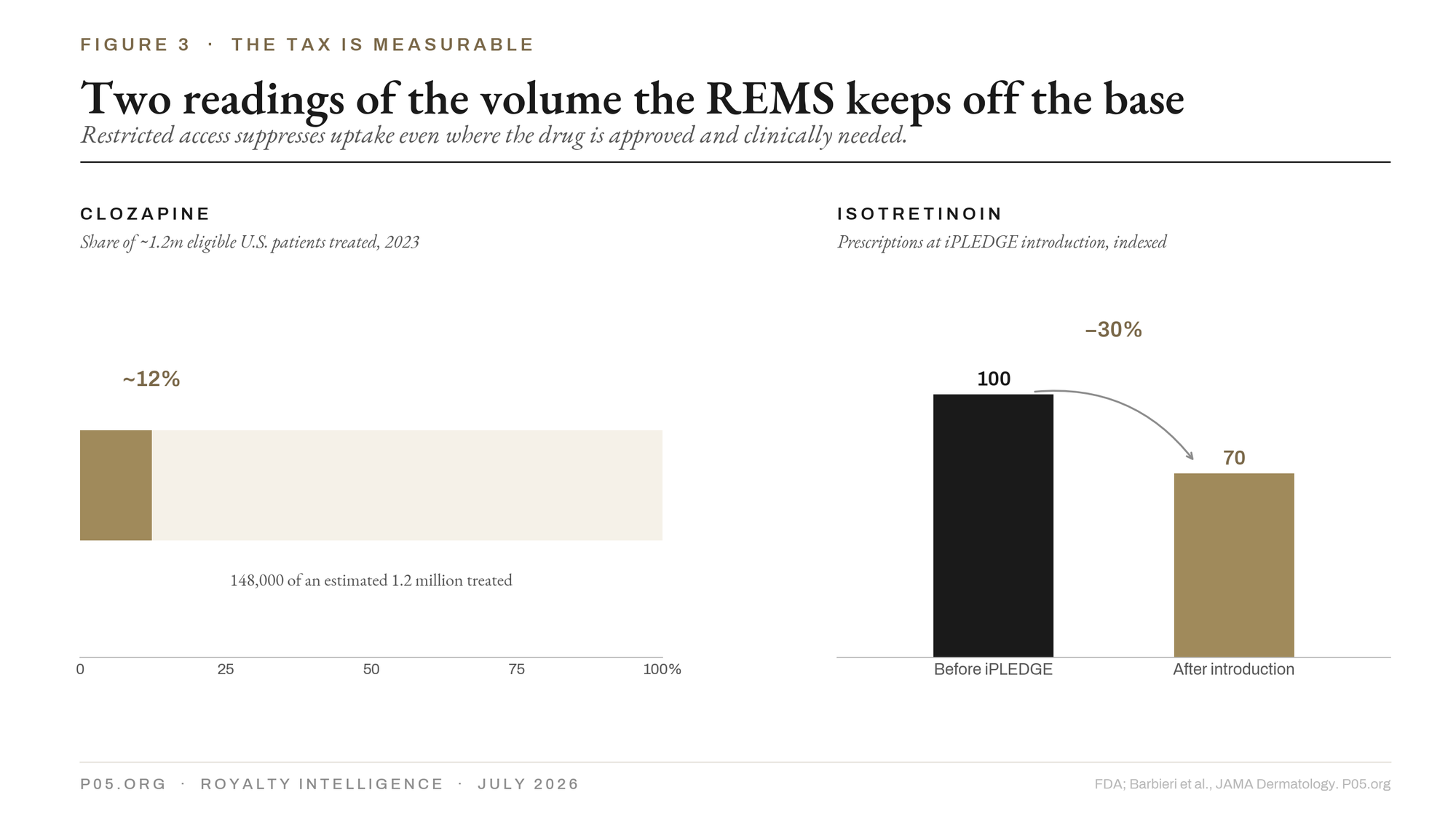
Post-approval, a REMS can loosen or tighten. The 2025 removals for clozapine and the CAR-T class paid out the call. The mifepristone review keeps the put live.
The upside case moved from theoretical to demonstrated in 2025. Under a deregulatory posture set from the top, with HHS and the FDA launching a 10-to-1 deregulatory initiative in May 2025, the agency removed several of the market's heaviest REMS in quick succession:
- Clozapine. After a November 2024 joint advisory committee voted overwhelmingly to eliminate the program, the FDA removed the clozapine REMS effective June 13, 2025, ending mandatory neutrophil-count reporting and prescriber, pharmacy, and patient enrolment, while keeping the monitoring recommendation in labeling.
- CAR T-cell therapies. On June 27, 2025 the FDA eliminated the REMS for all approved BCMA- and CD19-directed autologous CAR-T therapies, removing site certification and the tocilizumab-stocking mandate, cutting the post-infusion proximity period from four weeks to two and the driving restriction from eight weeks to two. Commissioner Makary framed it as the first of many such steps.
- Isotretinoin. The FDA approved iPLEDGE modifications on February 9, 2026 that remove the 19-day lockout, permit home pregnancy testing during and after treatment, and cut counselling and registry burdens. Implementation has been delayed to November 15, 2026, from an original August target.
For any residual royalty on the affected products, each of these is a volume-expansion event a pre-2025 model would not have priced. The effect is expected rather than yet measured: robust post-removal prescribing data was not available as of mid-2026, so the correct treatment is to model the direction, not a realised uplift.
The downside case is equally real. A REMS can be imposed or tightened after approval on new safety signals or shifting politics. In 2025 a group of state attorneys general asked the FDA to tighten controls on mifepristone, and HHS committed to a safety study, after the same product's REMS had been loosened in 2021 and 2023 to allow telehealth and mail dispensing. A relaxed REMS can be revisited. For a royalty holder, that is a genuine downside branch on volume.
How to treat it. Price the REMS as a two-sided option: a call on the volume a future de-REMS would unlock, a put on the volume a future tightening would remove. The call gains value as real-world safety experience accumulates, because the FDA's stated rationale for the clozapine and CAR-T removals was that clinicians had gained enough experience managing the risk that labeling now suffices. That gives a usable base rate. Risks that attenuate with time and provider familiarity (neutropenia monitoring, cytokine-release management) carry a higher removal probability than irreducible hazards such as teratogenicity, where the program is durable even as its mechanics are streamlined.
One caution on calibration: the 2025 cluster is an acceleration under a specific deregulatory FDA, not a stable long-run rate. An investor pricing the removal option should not extrapolate the 2025 cadence as a constant. If future removals revert to low single digits a year, the option is worth less than 2025 makes it look.
The ex-US edge: worldwide royalties meet foreign restriction regimes
Royalties are usually struck on worldwide net sales, so foreign access constraints compress the same base. A US-only view of a REMS misses the part of the window that opens outside the US.
The European analogue is the EMA's additional risk minimisation measures (aRMMs): educational materials for prescribers and patients, controlled access programmes conditional on testing or registry enrolment, pregnancy prevention programmes, and Direct Healthcare Professional Communications. For advanced therapy medicinal products, the category that includes CAR-T, the great majority were authorised with aRMMs and most carried a controlled distribution or controlled access programme.
The important contrast for a modeller is mutability. EU aRMMs change far more slowly than the US REMS did in 2025. For products authorised over 2006 to 2017, the probability of adding new aRMMs post-authorisation was low single digits within five years, and discontinuation was similarly slow. So relief on the same molecule is unlikely to arrive on the US timetable: a US de-REMS does not lift the European constraint, and the ex-US portion of the royalty base ramps on its own, slower schedule. Japan's Risk Management Plan framework is the third pillar to hold in view.
The practical instruction is to run the volume tax jurisdiction by jurisdiction, the same way the companion piece runs the duration matrix, rather than applying a single US-shaped haircut to a worldwide stream.
REMS as a generic barrier: a contested tailwind, now largely foreclosed
There is a second-order way a REMS touches royalty value, and it runs through the far edge rather than the plateau. A restricted-distribution REMS can be used, or misused, to delay generic entry, which extends the effective economic life of a branded royalty. For a decade this was a real tailwind. It is now largely closed off, and understanding why is essential to not mispricing older comparables.
The mechanism is the sample blockade. A generic developer needs quantities of the branded product to run the bioequivalence testing an abbreviated application requires. Where the product moves only through a closed REMS network, the brand can decline to sell samples, citing safety, and stall the generic before it can file.
The paradigm case is lenalidomide (Revlimid) and thalidomide (Thalomid). Mylan's 2014 antitrust suit against Celgene alleged that Celgene used the ETASU REMS as a pretext to refuse samples even after the FDA found Mylan's safety protocols acceptable. From a valuation standpoint, the strategy is credited with having extended Revlimid's effective exclusivity well beyond its compound-patent expiry. Compound patents began lapsing around 2019, but volume-limited generic entry was negotiated in settlements phasing in from March 2022 to unlimited entry from 31 January 2026, on a drug that peaked at 12.8 billion dollars in net sales in 2021, its final full year of exclusivity. For anyone holding economics on that product, the delay was worth years of tail cash flow.
That tailwind carried two liabilities, and both have grown. The first is antitrust and reputational exposure: the Revlimid and Thalomid conduct generated sustained class and opt-out litigation alleging monopoly maintenance, and the Federal Trade Commission has a documented interest in analogous abuse of FDA processes (its case against Shire ViroPharma over sham citizen petitions on Vancocin is the reference point, though the Third Circuit later narrowed the FTC's reach to ongoing or impending conduct).
The second, decisive change is statutory. The CREATES Act, enacted December 2019, created a private right of action letting a generic or biosimilar developer sue a brand that refuses samples on commercially reasonable terms, and added a Covered Product Authorization pathway that neutralises the safety-based refusal by letting the FDA authorise the developer to obtain product despite the REMS. Formal measurement of the effect is thin, but practitioners report that the sample blockade, once routine, has largely disappeared, and the Congressional analysis frames the private cause of action as the remedy that flipped the cost calculus.
Modeling implication, directional and time-dependent. For a legacy royalty whose observed durability reflects a pre-2019 blockade, that durability is a historical artifact and should not be extrapolated forward. For any deal underwritten today, do not build REMS-driven generic delay into the duration as tail value. It is foreclosed in its most effective forms, it invites antitrust liability, and it cuts against the prevailing posture. In the language of the companion piece, a REMS can shift the effective loss-of-exclusivity date, but post-CREATES the reliable shift is toward earlier competition, not later.
The IRA compounds the base compression
The companion piece treated Medicare price negotiation as a non-patent loss-of-exclusivity event on the price side. It compounds the REMS volume tax, because the two act on different terms of the same net-sales line at the same time.
Several restricted or REMS-adjacent drugs sit on the negotiation lists. The second negotiation cycle, with prices effective 2027, includes Pomalyst (pomalidomide, which carries its own REMS), Ibrance, Xtandi, and Calquence; the first cycle included Imbruvica, where negotiated prices landed well below list. For a drug that is both REMS-restricted and negotiation-eligible, the royalty base is squeezed on price and on volume simultaneously, and a model that captures only one of the two understates the compression.
Where REMS meets the royalty market
The royalty market already prices drugs whose volume is gated by administration setting, which is the same economic constraint a site-of-care ETASU imposes.
CAR-T, the cleanest de-REMS repricing. The June 2025 removal altered specific underlying royalty streams, not just the marketing sponsors' economics. Kymriah traces to the University of Pennsylvania and is licensed to Novartis. Yescarta and Tecartus were developed with the National Cancer Institute, giving NCI and NIH licensing interests. Breyanzi runs through Juno and its Seattle Children's and Memorial Sloan Kettering lineage. Carvykti reaches J&J through Legend Biotech. Any model of these underlying royalties written before June 2025 embedded a site-certification ceiling that no longer binds. The cash-flow stream is worth more after the de-REMS than before, and nothing about the patent, the price, or the label's efficacy changed.
Xyrem and Xywav, a royalty on a restricted-distribution REMS. Jazz Pharmaceuticals' sodium oxybate franchise is dispensed only through a restricted REMS built around a single central certified pharmacy, one of the tightest distribution ETASU in the market. Jazz's public filings also describe royalty economics on the authorized generic sold through that same channel, a direct example of a royalty whose base is defined by the REMS network it flows through.
TZIELD, the boxed-warning contrast. DRI Healthcare Trust's 2023 purchase of MacroGenics' single-digit royalty on TZIELD (100 million dollars upfront, up to 200 million with milestones, quarterly royalties on a one-quarter lag from January 2023) is a royalty on an in-clinic, multi-day intravenous biologic. TZIELD carries a boxed warning and a demanding administration protocol but no formal REMS, which is the point: the volume ceiling here comes from the site-of-care burden, not from an ETASU. The classification differs, the volume dynamics rhyme, and a model that conflates the two will misjudge both the haircut and the option.
Forward look: the next site-of-care cohort
The mutability lens applies to pipeline royalties too, and the clearest near-term category is psychedelics, where a Spravato-style site-of-care REMS is the expected condition of approval.
COMP360 (Compass Pathways, synthetic psilocybin for treatment-resistant depression) is under rolling FDA review with a national priority voucher, with approval realistic around early 2027 and an in-clinic supervised-administration REMS widely expected. Lykos's MDMA for PTSD drew a Complete Response Letter after an August 2024 advisory committee voted heavily against it, on trial-design grounds rather than category opposition.
An investor underwriting a pipeline royalty in this class should assume an ETASU on approval, price the site-throughput ceiling into peak penetration from day one, and then treat later loosening as the same call option the 2025 cohort just paid out on.
The modeling framework
These steps fold the REMS into a royalty model as an explicit input. They sit alongside the duration framework in the companion article.
Step 1: Classify the REMS from the actual program document. Pull the current program from the FDA's REMS database and read it. Establish whether it is Medication-Guide-only (immaterial), a communication plan (immaterial), or ETASU with an implementation system (material). Only the ETASU tier justifies a volume adjustment.
Step 2: Map each ETASU element to a volume channel. Site-of-care administration under observation is the hardest ceiling. Prescriber certification narrows the funnel and skews it to specialists. Registry, testing, and monitoring raise dropout. Pharmacy certification and closed distribution filter dispensing. A program stacking several of these warrants a deeper haircut than one resting on a single element.
Step 3: Adjust the uptake curve and the peak, not the terminal date. Translate the binding channels into a lower plateau, a slower ramp, and a longer front-end interval against the investor's economic clock. Calibrate to REMS-drug analogs (clozapine's near-12-percent penetration, isotretinoin's order-of-30-percent suppression, observed site-throughput limits), not to unrestricted comparables. Keep the adjustment visible as its own line, not buried in a blended peak-sales figure.
Step 4: Price the REMS as a two-sided option. Add explicit de-REMS and tightening scenarios. Anchor the removal probability to the nature of the underlying risk and to the current FDA posture, and do not extrapolate the 2025 removal cadence as constant. The weighted spread between the two scenarios is the option value a static model omits.
Step 5: Run it jurisdiction by jurisdiction. Apply the volume tax per major region. A US de-REMS does not lift EU aRMMs or a Japanese controlled-distribution measure, so the ex-US base ramps on its own schedule. Do not apply one US-shaped haircut to a worldwide stream.
Step 6: Do not underwrite REMS-driven generic delay as duration. Treat the effective loss-of-exclusivity date as CREATES-enabled: generics can obtain samples and file on the statutory schedule. Where a legacy asset's durability reflects a pre-2019 blockade, mark it non-recurring. Where a de-REMS enables outpatient migration, model that migration as its own upside to the plateau from Step 3.
Comparative summary
The safety tax varies by which ETASU element binds. Medication-Guide programs are immaterial to volume; the restrictive tier compresses the base inside the protected window, and its mutability is a two-sided option a static model ignores.
| ETASU element | How it constrains volume | Base impact | Illustrative product |
|---|---|---|---|
| Medication Guide only | None | Negligible | Many post-2007 programs |
| Prescriber certification | Funnel contraction, specialist skew | Moderate | Isotretinoin |
| Registry / testing / monitoring | Delayed starts, dropout | Moderate to high | Clozapine (removed 2025) |
| Site-of-care administration | Certified-site throughput ceiling | High, hard cap | Esketamine; CAR-T (removed 2025) |
| Restricted distribution | Dispensing filter; historic generic delay | High; tail now foreclosed | Lenalidomide; sodium oxybate |
Conclusion
A REMS is the safety question that approval did not close, expressed as an ongoing condition on prescribing that suppresses the volume a royalty is written on. It is not a patent input and it does not move the date the money stops. It lowers the curve between the date the money starts and the date it stops, in the region a duration model assumes is safest.
Three properties should change how a royalty on a REMS-encumbered drug is valued. First, the ETASU tier imposes a real and often large haircut on peak penetration and uptake speed, calibrated by REMS analogs, not by unrestricted comparables. Second, the REMS is mutable, which makes the stream a two-sided option: the 2025 removals for clozapine and the CAR-T class repriced those cash flows upward with no change in patent or price, while the mifepristone review shows the tightening branch is live. Third, the old habit of underwriting REMS-driven generic delay as tail value is now largely foreclosed by the CREATES Act, and any durability that relied on it belongs to a pre-2019 world.
The analytical edge, as with duration, lives in the gap between what the contract says and what the economics deliver. A royalty contract says net sales. A REMS quietly determines how large those net sales can be, whether that ceiling will rise or fall over the life of the stream, and it does so differently in each jurisdiction. Most models treat the safety profile as a binary settled at approval and never parameterise the tax or its optionality. Pricing both, as an explicit line and a probability-weighted scenario, is the difference between a model that describes the deal and one that describes the drug.
All information in this article was accurate as of the research date and is derived from publicly available sources including FDA regulatory and safety communications, court filings, SEC filings, company and trust press releases, EMA materials, congressional and government research materials, and academic and professional literature. Information may have changed since publication. This content is for informational purposes only and does not constitute investment, legal, or financial advice. The author is not a lawyer or financial adviser.