
The second document: what an intercreditor agreement gives a royalty holder
On 2 November Karyopharm Therapeutics filed a prepackaged Chapter 11 plan that sorts its secured creditors into four classes.

On 2 November Karyopharm Therapeutics filed a prepackaged Chapter 11 plan that sorts its secured creditors into four classes. The disclosure statement estimates that the first-lien term loan and the 2028 notes will recover 100 per cent and the 2029 notes 78.9 per cent.
Claims of $113.5M under the revenue interest financing agreement that HealthCare Royalty signed in 2019 are put at 16.5 per cent. All four classes hold liens on the same assets. For the term loan and for the revenue interest, the plan states that distributions "shall be made in accordance with the Intercreditor Agreement."
That agreement set the order long before the filing. The intercreditor agreement of May 2024 gave the revenue interest a lien of equal priority with the 2029 convertible notes. Its waterfall then paid the first $77.32M of any enforcement proceeds left after the term loan to the notes, and split the rest 60 per cent to the royalty and 40 per cent to the notes.
The amended and restated version of October 2025 put both note series ahead of the revenue interest in distributions of enforcement proceeds. Neither document changed the royalty rate. The November piece on rates set out the rate cuts and waivers along the way.
A royalty holder that shares a balance sheet with a secured lender has its claim written twice. The purchase agreement sets the rate, the cap and the remedies. A second document, signed with the lender, decides when those remedies can be used and who is paid first from the collateral.
We read the royalty and revenue interest agreements of seven companies that signed such arrangements between 2021 and 2025, nine intercreditor or subordination agreements in all. Every purchase agreement makes the holder's lien and remedies subject to the second document. The full text of that document is public in two of the nine.
What the purchase agreements hand over
The purchase agreements say in so many words which document prevails. Dermavant's 2021 revenue interest purchase and sale agreement carries a legend making it, "including without limitation any rights of enforcement hereunder," subject to a senior lender intercreditor agreement with XYQ Luxco and a parity intercreditor agreement with NovaQuest, and says the intercreditor terms "will govern and control" in any conflict.
Karyopharm's 2024 amendment added a section 12.14 with the same words, and made both the investor's remedies and the company's duty to pay the final payment amount subject to the intercreditor agreement "in all respects." Nuvation's 2025 agreement with Sagard has the investor acknowledge that it has reviewed the intercreditor agreement and "agrees to be bound by the terms thereof."
The second document is often missing from the filing. Phathom's revenue interest financing agreement of May 2022 lists a subordination agreement with Hercules as Exhibit A. When Phathom refiled the agreement with its 2025 annual report, the exhibit still read "[***]". Geron's purchase agreement with Royalty Pharma names a form of intercreditor agreement with BioPharma Credit as Exhibit D, and Allurion's 2023 agreement with RTW names one with Fortress as Exhibit E.
Neither form is attached to the copy on EDGAR. Karyopharm's 2024 agreement became public because it was attached to the indenture for its 2029 convertible notes.
The cap on senior debt sits in different places. Dermavant's purchase agreement limits senior secured debt to $40,000,000 outstanding at any time, and any refinancing lender must join the senior lender intercreditor agreement or one on substantially similar terms. Karyopharm's cap of $135,000,000 plus interest paid in kind sits in the intercreditor agreement, where raising it needs the consent of the junior creditors.
Allurion's agreement leaves the figure to the second document, permitting term loan debt "not to exceed the amount permitted under the Intercreditor Agreement." The caps in the Geron and Nuvation agreements are redacted. Nuvation's adds a test for any new lender, which must sign an intercreditor agreement "not less favorable to the Investor."
In October HealthCare Royalty wrote the cap into its own agreement with ADC Therapeutics, at $50.0M, as the buyout piece described. The October piece on Rocket showed a lender fixing the same terms from the other side, before any royalty buyer had been found.
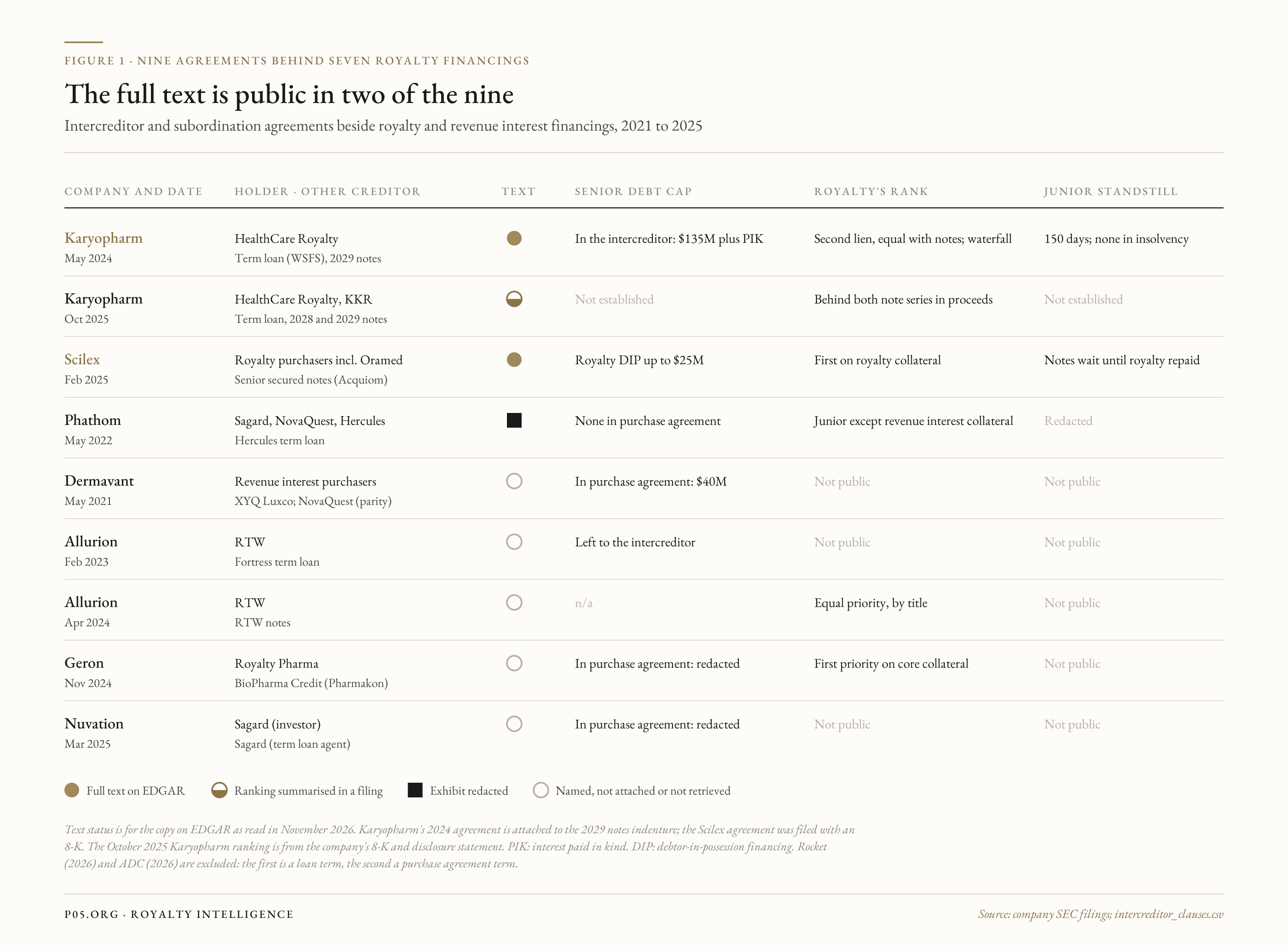
Nine intercreditor and subordination agreements beside royalty and revenue interest financings, 2021 to 2025, and what the public record shows of each.
Karyopharm, clause by clause
The 2024 agreement shows what a royalty holder accepts when it ranks behind a term loan. HealthCare Royalty's collateral agent signed it with Wilmington Savings Fund Society, as agent for the first-lien lenders, and the notes' collateral agent joined.
The "Second Lien Obligations" are defined as the notes and the royalty obligations together. Section 2.1 makes the first-lien liens "senior in all respects," and the junior liens "of equal priority" with each other, subject to the waterfall.
The subordination applies to liens and leaves payments alone. Section 3.1(f) lets the junior creditors receive scheduled payments unless they come from an enforcement that breaches the agreement. The quarterly royalty payments continued under that clause.
The waiver of October 2025 of four quarterly royalty payments came through an amendment to the revenue interest agreement, with the holder's own consent.
Enforcement was another matter. Until the term loan was repaid, the junior creditors could take no enforcement action until at least 150 days after they had declared a default and told the first-lien agent. They could take none at all while the first-lien agent was diligently enforcing, or while the company was in an insolvency proceeding.
The first-lien lenders could enforce "in such order and in such manner as they may determine in the exercise of their sole discretion." When they sold collateral, the junior liens were released automatically, and the same applied to a sale the loan documents allowed. Anything a junior creditor received in breach of the order had to be held in trust and paid over.
The insolvency terms cover the junior creditors' rights in a bankruptcy case. They could not oppose debtor-in-possession financing, the loan a company in Chapter 11 takes to keep operating, if the first-lien lenders backed it, and they had to subordinate their liens to it.
They could not object to the use of cash collateral or seek relief from the automatic stay without consent. Adequate protection for them was limited to replacement liens, additional collateral, an administrative claim, or cash interest at the junior rate. They could not credit bid unless the cash in the bid alone paid off the term loan. Section 6.9(b) required their claims to be classified separately from the term loan in any plan.
Karyopharm's plan follows that outline. It provides for $55M of new money in a superpriority facility that also rolls up part of the term loan, and the revenue interest votes as its own class. The forbearance agreement of 10 September bound the term lenders, the noteholders and the revenue interest together, and expired on 1 November.
Under a reorganisation the revenue interest is replaced by an unsecured royalty of 3.0 per cent of the reorganised company's net revenues for five years, with $18.75M of liquidated damages. Under a sale it receives at least $18.75M. Karyopharm had paid $149.8M against the cap of $263.3M by 30 September, and the claim stood at $113.5M.
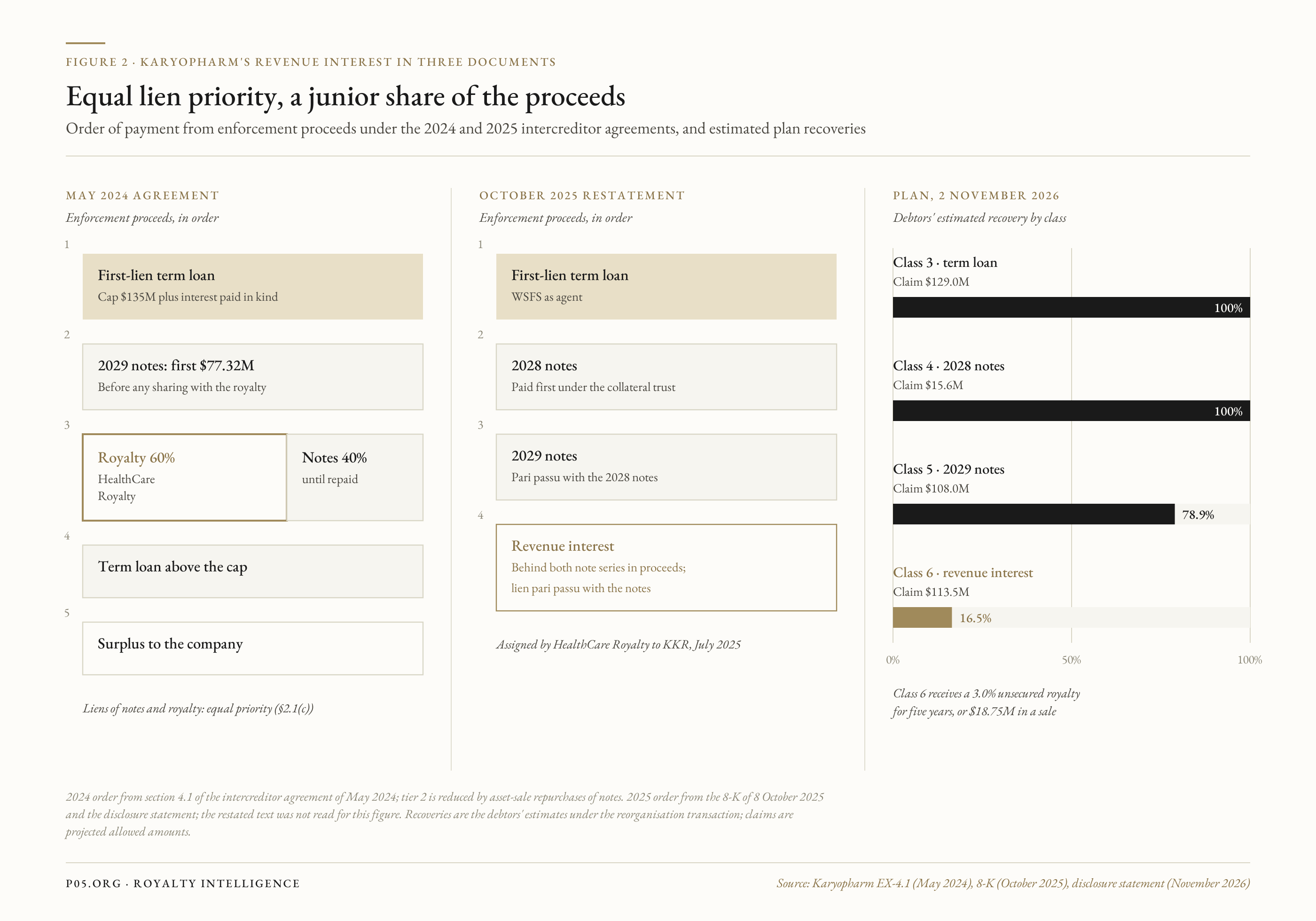
Order of payment from enforcement proceeds under the 2024 and 2025 intercreditor agreements, and the debtors' estimated recoveries by class.
The October 2025 restatement had moved the royalty further down. The 8-K describing it says the 2028 and 2029 notes will rank pari passu with each other, "ahead of indebtedness under the HCRx Financing Agreement," and behind the term loan in distributions of enforcement proceeds.
The disclosure statement describes the liens securing the notes as pari passu with those securing the revenue interest, "subject to the waterfall." The lien kept its rank, and the proceeds the royalty could receive from enforcement moved behind both note series. In July 2025 HealthCare Royalty assigned the agreement to KKR, which had bought a majority stake in the manager.
When the royalty is senior: Scilex
Scilex's subordination agreement of 28 February 2025 runs the other way. Scilex Pharma sold a royalty of 4 per cent of worldwide net sales of Gloperba and Elyxyb to a group that includes Oramed, which takes half of the receivables.
The consideration included a further deferral of Scilex's senior secured notes, which Oramed also holds. The noteholders' collateral agent, Acquiom, subordinated its lien on the royalty collateral to the royalty purchasers' agent, Efshar Hataya.
The noteholders gave up more than lien priority. They hold no security interest or claim of any kind in the purchased receivables. Until the royalty is paid in full, they may take no action against the royalty collateral, with one exception: after two consecutive missed royalty payments, they may act if the royalty agent has not begun to enforce within 90 days.
In a bankruptcy they may not seek financing secured on the royalty collateral, oppose a royalty-backed debtor-in-possession loan of up to $25,000,000, or object to adequate protection for the royalty purchasers. They waive marshaling, and anything they receive from the royalty collateral is held in trust for the royalty agent. The royalty purchasers in turn take no lien on the noteholders' collateral until the notes are repaid.
At Karyopharm the royalty holder waited at least 150 days and could not act at all during a bankruptcy. At Scilex the noteholders wait until the royalty is paid off, unless two payments are missed and the royalty agent does nothing for three months. The royalty purchase agreements in the two cases give their holders similar security interests.
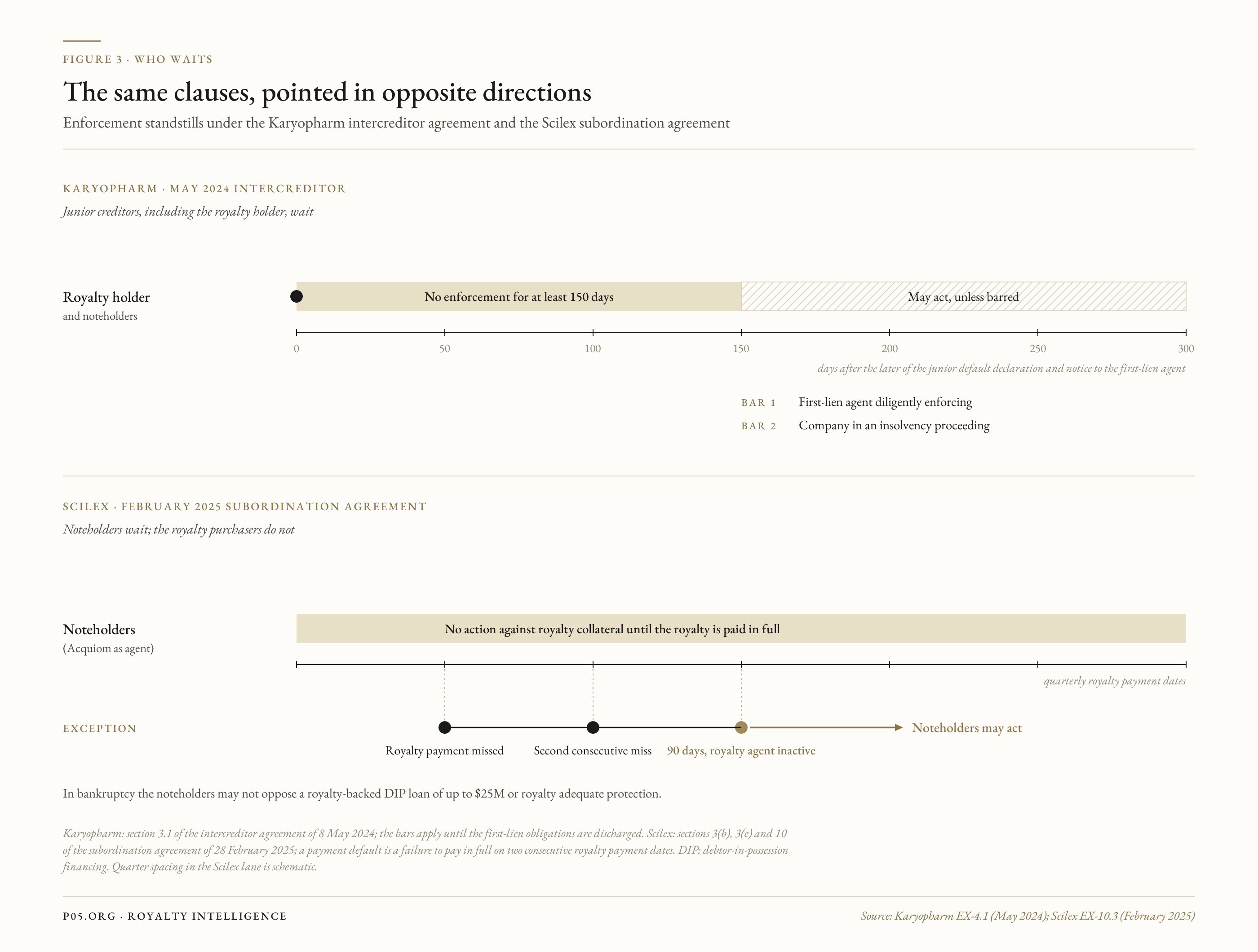
Who must wait, and for how long, under the Karyopharm intercreditor agreement and the Scilex subordination agreement.
Split collateral
Between those two positions sit agreements that divide the assets. Phathom's investors, Sagard, NovaQuest and Hercules, subordinated their claims and any security interests to the Hercules term loan, "other than the Revenue Interest Collateral," according to the joinder signed when a fourth investor came in during October 2022.
Hercules is the lender and one of the investors. The revenue interest collateral is the stream itself, its proceeds and a controlled account into which Phathom pays each quarter's royalty before the payment date. The terms that apply to everything else are in the redacted exhibit.
Geron's two lenders describe the same arrangement from opposite sides. Royalty Pharma's purchase agreement calls its back-up security interest "a first priority Lien" on the core collateral, and makes its lien on the product rights superior to others except liens permitted "subject to the Intercreditor Agreement."
The Pharmakon loan agreement bars any amendment of the royalty contract that would "adversely affect the payment or priority subordination set forth in the Intercreditor Agreement to the Obligations owed to Lenders." It restricts payments to Royalty Pharma subject to listed exceptions, and treats a missed payment to Royalty Pharma as an event of default. The intercreditor agreement itself is not on file.
Dermavant had three layers. A senior lender, XYQ Luxco, held the first claim up to the $40M cap. NovaQuest's funding agreement sat beside the revenue interest under a parity intercreditor agreement, signed by NovaQuest and the purchasers' collateral agent, U.S. Bank. Neither intercreditor agreement was filed with the purchase agreement.
When the lender leaves
An intercreditor agreement ends with the loan it serves. In June 2026 Nuvation planned to issue up to $300M of unsecured convertible notes. The first amendment to its revenue interest agreement, signed to permit the issue, made full repayment of the Sagard credit agreement and termination of the intercreditor agreement conditions of closing. It marked the form of intercreditor agreement "[Reserved]," and required the notes to be unsecured. The same manager held both the loan and the revenue interest.
Allurion's April 2024 omnibus amendment records the company's intention to refinance the Fortress term loan with notes and to terminate the existing intercreditor agreement. An "Equal Priority Intercreditor Agreement" between the notes' collateral agent and RTW, as agent for the revenue interest, was to take its place.
Organon took over Dermavant in October 2024 and kept the revenue interest. Its 2025 annual report shows $156M of principal remaining under the assumed agreement at the end of the year. Organon voluntarily repaid and terminated the NovaQuest funding agreement in the second quarter of 2025, when it was carried at $103M, and booked a $4M gain.
Implications for the Pharmaceutical Royalty Market
Companies file the purchase agreement, and investors price from it. In the nine arrangements read here, the terms that decided recovery at Karyopharm, the standstill, the waterfall and the bankruptcy waivers, sit in a second document.
The text of that document is public in two cases. Each of the two reached EDGAR attached to someone else's instrument: Karyopharm's indenture and Scilex's financing with Oramed. A buyer of a royalty on the secondary market, or a lender looking at a company's existing stack, works from the purchase agreement and whatever the parties choose to show.
Equal lien priority did not give Karyopharm's royalty holder equal recovery. The 2024 waterfall gave the noteholders their first $77.32M before any sharing, and the 2025 version put the notes ahead in full. A royalty holder reading only its own security agreement, and the legend that defers to the intercreditor, would have seen a second lien in both years.
The standstill and the bankruptcy waivers limit what the remedies in the purchase agreement are worth. Karyopharm's revenue interest agreement allowed acceleration of the full final payment amount on a default. Under the intercreditor agreement the holder could not act for 150 days after a default notice, nor at all once the first-lien lenders began enforcing or the company filed.
At Scilex the same clauses protected the royalty purchasers, and the noteholders took the waiting period.
Where the cap on senior debt is placed decides who must agree to change it. A cap in the purchase agreement, as at Dermavant and ADC, moves only with the royalty holder's consent.
A cap in the intercreditor agreement, as at Karyopharm, binds the lender to the holder directly, and a cap left to the intercreditor, as at Allurion, is as public as that document. Nuvation's test for later lenders, "not less favorable to the Investor," sets the existing intercreditor agreement as the floor for the next one.
Three of the arrangements changed when a lender left. At Nuvation the intercreditor agreement was to end with the loan, and the notes replacing it had to be unsecured. At Allurion the term loan was to give way to notes ranked equally with the revenue interest.
At Dermavant the acquirer repaid one funder and kept the revenue interest. In each case the royalty agreement survived and the agreement that ranked it was replaced or removed.
Conclusion
Karyopharm has asked the court for a combined hearing on its plan and disclosure statement on 11 January 2027. The holders of all the term loan, note and revenue interest claims have signed the restructuring support agreement. If the plan is confirmed, a claim that started as $135.0M paid for a capped share of XPOVIO sales ends as a five-year royalty of 3.0 per cent, unsecured, backed by $18.75M of liquidated damages.
The revenue interest agreement was amended six times after 2019. The royalty's place in the plan was set by the agreement HealthCare Royalty signed with the lenders in May 2024 and restated in October 2025.
All information in this report was accurate as of the research date and is derived from publicly available sources including court opinions, regulatory guidance, academic literature, SEC filings, and financial news reporting. Information may have changed since publication. This content is for informational purposes only and does not constitute investment, legal, or financial advice. The author is not a lawyer or financial adviser.