
The Weekly Term Sheet (2026-W36)
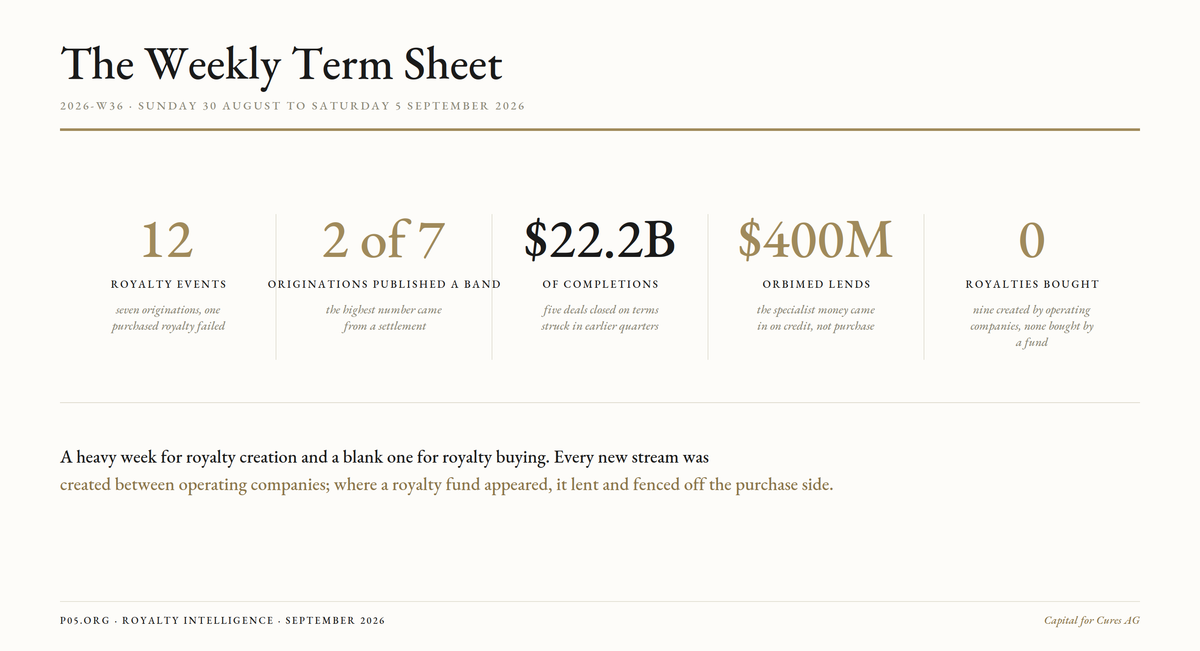
Operating companies created twelve royalties this week and no fund bought one. Alteogen granted Novartis multiple options over subcutaneous formulations on its ALT-B4 hyaluronidase, up to $3,223M (KRW 4.4165 trillion) with royalties on top. HUTCHMED took $110M upfront within $1.295B from GSK and kept the Phase I. Simcere Zaiming took $75M within $1.53B from Roche. None of the three published a band.
Pfizer did, and it was the licensee who paid. Medicus Pharma paid Pfizer $12M with $15M more due at the first anniversary for a discontinued Seagen ADC, and Pfizer takes low double-digit tiered royalties on annual net sales, over $1.0B of milestones and an option to fund from the first registrational trial. The band is public because a Nasdaq micro-cap files 8-Ks and the licensor does not.
Royalty Pharma published its own downside. Novartis's Lp(a) HORIZON trial of pelacarsen missed, and Royalty Pharma's release the same day set out that its $500M Ionis agreement ascribed $150M to pelacarsen and $350M to Spinraza, and that the Spinraza interest reverts to Ionis at $550M of payments, 1.1x on the whole outlay. Where a royalty fund otherwise appeared, it lent: OrbiMed wrote a $400M senior secured facility to Intellia on 4 September, $75M funded, with synthetic-royalty transactions restricted.
Five completions moved roughly $22.2B on terms struck in earlier quarters. AbbVie closed Apogee at $10.9B, Vertex closed Crinetics at $10.0B, AstraZeneca closed Dizal at $600M upfront, BioMarin closed Alesta at $275M, and Tarsus closed Alkeus at $450M with the sellers keeping a low single-digit descending royalty, the only completion that left a stream behind.
BioMarin and Ascendis published two accounts of the same settlement. Both agree Ascendis pays 20% of US net sales of Yuviwel retroactive to launch and 18% in the EU, Brazil and South Korea. BioMarin dates May 2030 to the ex-US legs; Ascendis dates 20 May 2030 to all four territories. Both are now on file at the SEC with the wording unchanged, and the definitive agreement is where it resolves.
Sun Pharma and eight other manufacturers extended most-favoured-nation pricing to state Medicaid programmes and to all future US launches in exchange for a two-year delay on Section 232 tariffs, taking the total to 26 manufacturers covering 89% of the US branded market. Every US royalty on this page is a percentage of net sales, and that is the denominator.
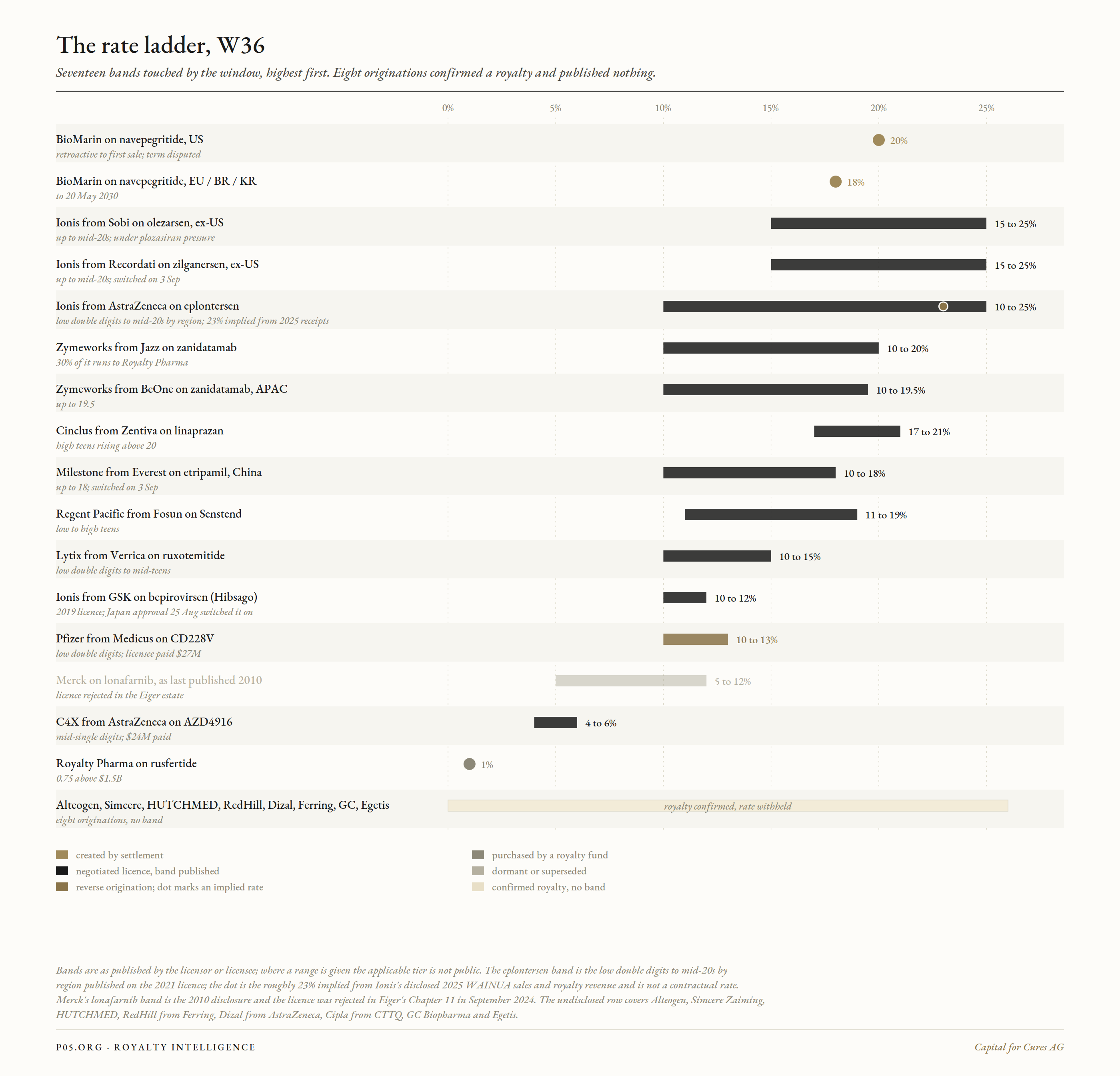
Seventeen bands on the ladder, highest first. Eight originations confirmed a royalty and published nothing. Eplontersen carries the band W35 published, low double digits to mid-20s by region, with the 23% implied from 2025 receipts marked on it; Hibsago carries the 10% to 12% from the 2019 licence. The Merck band on lonafarnib is the 2010 disclosure and the licence was rejected in Eiger's estate.
Currency note: figures are converted to US dollars with the original in brackets, at approximately EUR 0.86, SEK 9.50, NOK 10.30, CHF 0.885, DKK 6.40, GBP 0.74, JPY 146, KRW 1,370 and INR 88 per US dollar, being early September 2026 rates. Where a source published its own conversion, that figure is used.
Highlights
Royalty events: 12, and the only published rate band on a new origination came from a discontinued asset. One originated by an originator paying to take a shelved programme off a large-cap's hands at a low double-digit tiered royalty, one originated by platform option and licence to Novartis at $3.223B of headline with royalties on top, one originated by exclusive development and licence to GSK at $110M down against $1.295B, one originated on marketed product by a licensor exiting a category, one originated by exclusive global licence to Roche at a ceiling of double digits, one originated by litigation settlement at a published 20% US rate, one originated by vaccine collaboration at an undisclosed rate, one switched on by approval with three claimants above the payer, one collaboration signed that creates no royalty at all. No royalty was bought or sold in the window.
- AstraZeneca / Dizal / ZEGFROVY (agreed 14 Jul, completed 1 Sep): completion of the exclusive global licence to sunvozertinib. $600M upfront, up to $900M in milestones, tiered royalties on global sales, band undisclosed. Approved in the US and China in second-line EGFR exon 20 NSCLC; US launch planned Q4 2026. The largest payment to change hands in W36, on terms struck in July (completion 6-K, 14 July 6-K)
- Cipla / Sino Biopharmaceutical and CTTQ / TQB2102 (31 Aug): exclusive rights to the HER2 ADC rolditamig deuderuxtecan in India, South Africa and five emerging markets, CTTQ retaining manufacture and supply. Reported at up to $123M plus double-digit royalties; neither figure is in either company's release and both are carried as reported
- Alteogen / Novartis / ALT-B4 (2 Sep): an option and licence agreement giving Novartis multiple options over subcutaneous formulations of multiple Novartis products using ALT-B4, Alteogen's recombinant hyaluronidase. Up to $3,223M (KRW 4.4165 trillion) in option fees, milestones and royalties on net sales. Fourth ALT-B4 agreement of 2026 after MSD, Tesaro and Biogen. Upfront and band undisclosed
- Pfizer / Medicus Pharma / CD228V (effective 2 Sep): an exclusive, sublicensable, royalty-bearing worldwide licence to PF-08046031, a discontinued Seagen ADC, for all human diseases. Medicus paid Pfizer $12.0M with $15.0M due at the first anniversary; Pfizer paid $2.0M of development funding and takes over $1.0B in milestones, low double-digit tiered royalties on annual net sales, and an option to fund from the first registrational trial. MDCX fell 34.4% (Form 8-K, agreement)
- HUTCHMED / GSK / HMPL-A830 (3 Sep): exclusive rights worldwide excluding Greater China to a KRAS-payload anti-EGFR conjugate. $110M upfront, up to $1.185B in milestones, $1.295B total, tiered royalties on annual net sales, plus a right of first negotiation on a second ATTC candidate. HUTCHMED runs the global Phase I from H2 2026. Signed, not closed; upfront payable on antitrust clearance. BofA Securities advised HUTCHMED (release, Form 6-K)
- RedHill / Apotex / Talicia (31 Aug): RedHill sold its 70% interest in Talicia to a subsidiary of Apotex Health Corp. for $18M upfront plus up to $35M on worldwide net-sales milestones. Apotex already held Cumberland's 30%. Morningstar Law Group and Greenberg Traurig advised (release, Form 6-K)
- RedHill / Ferring / Rebyota and Clenpiq (1 Sep): an exclusive global commercialisation licence to Rebyota and a US licence to Clenpiq for $12M upfront plus tiered royalties and milestones. The pair did about $37.5M of US net sales in 2025. Ferring keeps the marketing authorisations, the manufacturing and the supply. KYBORA advised Ferring
- Simcere Zaiming / Roche / SIM0660 (1 Sep): an exclusive global licence to a preclinical CD79a x CD19 x CD3 tri-specific. $75M upfront, up to $1.530B total, tiered royalties of up to double digits. Simcere Pharmaceutical Group's sixth out-licence, aggregate potential above $6.1B. Rate disclosed as a ceiling only
- BioMarin / Ascendis (30 Aug): binding terms resolving all pending patent proceedings globally including the ITC Section 337 investigation. Ascendis pays BioMarin 20% of Yuviwel US net sales retroactive to first commercial sale and 18% in the EU, Brazil and South Korea. The two releases disagree on the term: BioMarin dates May 2030 to the ex-US legs, Ascendis dates 20 May 2030 to all four. Highest published rate in three windows
- Takeda / Protagonist / MIMRYLO (28 Aug, W35 window): FDA approval of rusfertide in polycythaemia vera releases $275M to Protagonist, a $200M opt-out fee and a $75M milestone, against up to $875M further and tiered royalties at an undisclosed rate. It switches on the 1% global royalty Royalty Pharma bought from Zealand for $100M sixteen days earlier
- Osivax / GC Biopharma (27 Aug, W35): carried for the structure. GC Biopharma supplies GC FLU long term and receives royalties on the OVX836 combination; Osivax takes a non-exclusive global licence excluding Japan and Korea. No rate. Block below
- Heidelberg Pharma / Huadong Medicine (28 Aug, W35 window): joint research across up to six ADC targets, candidates allocated by contribution. No upfront, milestone, royalty or term disclosed
Rate disclosure: two of seven originations published a band, and the highest number on the board came from a settlement. BioMarin publishes 20% and 18% against named territories and a named end date for the ex-US legs. Simcere publishes a ceiling of double digits on a preclinical asset. Osivax and GC Biopharma publish the existence of a royalty and nothing else. Protagonist publishes a ceiling and no band on an approved product.
Settlement-created sales participations: 2. Both instruments created in the window run off net sales and neither was negotiated as a licence. BioMarin takes 20% of a competitor's US revenue to end an ITC proceeding. The US Department of Justice takes 5% of Orexo's net sales above a threshold to end a criminal and civil investigation.
Licence-outs and collaborations without disclosed economics: 3.
- NewBiologix / Synastra Biotechnology (2 Sep): NewBiologix of Lausanne builds a stable research cell bank for Synastra's AAV micro-dystrophin candidate in DMD on its Xcell platform, with an option to transition to a commercial manufacturing licence. No economics disclosed. Synastra is a Türkiye vehicle of Üsküdar University and the Unifon-Biotech GSYF fund (release)
- EffRx / Androlabs / Testavan (31 Aug): EffRx Pharmaceuticals SA of Freienbach takes commercialisation and distribution of the transdermal testosterone gel in Switzerland only. No upfront, milestone, royalty, term or minimum disclosed, and the release does not say whether the economics run as a royalty or a margin. Testavan passed from Ferring to Simple Pharma, now Androlabs, in 2021 (release)
- Ono / Aitia (1 Sep): Aitia applies its causal AI platform to neurological disease targets; Ono takes an exclusive worldwide option to research, develop and commercialise candidates against them. No upfront, option fee, milestone or royalty disclosed. Ono ran the same termless structure with Congruence in 2024 and 2026 (release)
M&A and restructuring: 10, being nine prints of which five are completions, and one Chapter 11 carried from W35.
- Tarsus / Alkeus Pharmaceuticals (agreed 31 Jul, completed 4 Sep): $450M upfront, $270M cash and $180M stock at $61.38, then $250M on approval and $100M on first sale, plus low single-digit tiered descending royalties to former Alkeus holders on gildeuretinol, in Phase 3 for Stargardt disease. Alongside a $125M PIPE. The only completion in the window that leaves the sellers a royalty (completion release, Form 10-Q)
- AbbVie / Apogee Therapeutics (completed 3 Sep): $135.11 per share cash, approximately $10.9B. Zumilokibart, an extended-half-life anti-IL-13, and APG273. Dilutive by $0.14 in 2026 and about $0.46 in 2027, accretion from 2032. Morgan Stanley and Paul, Weiss for AbbVie; Jefferies, Goldman Sachs and Kirkland & Ellis for Apogee. The largest transaction of the window; no royalty (release, Form 8-K)
- BioMarin / Alesta Therapeutics (agreed 18 Aug, completed 1 Sep): $275M upfront plus up to $215M in development and regulatory milestones for ALE1, an oral small molecule in Phase 1/2a for hypophosphatasia. All non-ALE1 assets and every employee were spun out before closing. Morgan Stanley and Jones Day for BioMarin; J.P. Morgan, Goodwin and NautaDutilh for Alesta (closing release, 18 Aug release)
- Enovis / eCential Robotics (1 Sep): a binding offer at $180M (EUR 155M) enterprise value, about $205M (EUR 176M) cash to shareholders, plus up to $41M (EUR 35M) contingent on knee and shoulder product introductions. Definitive agreement follows the French works council process; closing Q4. Op.n is FDA-cleared for spine. No royalty (Enovis release, Form 8-K)
- Vertex / Crinetics (completed 1 Sep): $85.00 per share cash, approximately $10.0B, about $8.8B net of cash acquired, agreed 6 July at a 102% premium. Brings PALSONIFY, approved in acromegaly, and atumelnant in Phase 3. Combined peak revenue put above $5B, accretion expected 2029, $4.5B bridge from Bank of America and Morgan Stanley. All cash, no CVR, no milestone, no royalty
- Samsung Biologics / PolyPeptide (31 Aug): Samsung Peptide AG published the prospectus for its tender offer for PolyPeptide Group at $50 (CHF 44.31) net cash per share, about $1.83B (CHF 1.46B), a 40.0% premium to the unaffected close. Offer period 15 Sep to 12 Oct, minimum acceptance 66⅔%, board recommendation, 55.65% irrevocable. A peptide API CDMO; no royalty. Funded by the 28 Aug rights offering carried from W35
- Lilly / Merida Biosciences (31 Aug): definitive agreement at up to $2.875B in cash, inclusive of an upfront and contingent milestones, with the split withheld. MER511 is in Phase 1 for Graves' disease and thyroid eye disease. Merida launched in April 2025 on a $121M Series A. Close expected Q4 2026. Centerview and Goodwin for Merida; Ropes & Gray for Lilly
- Lifecare / Ocean TuniCell (31 Aug): 80% of the Bergen biomaterials company for $0.58M (NOK 6.0M), settled in shares at a 15-day VWAP with a nine-month lock-up, plus $0.58M (NOK 6.0M) contingent on a named clinical milestone within three years. Bought for a GMP Grade C cleanroom Lifecare puts at over $2.9M (NOK 30M) to build. Every term published
- Aqilion (31 Aug): an indicative offer for all shares, contingent on due diligence and adjustable either way, alongside separate diligence on AQ128 and AQ280. No bidder, no price. AQ280 was acquired from LEO Pharma against cash, equity and further payments from sales or licensing, so both exit routes reach an undisclosed upstream claim
- BioXcel / Teva (petition 27 Aug, stalking horse 28 Aug, W35): one correction to last week's record. The DIP is up to $77.25M from Oaktree and Qatar Investment Authority affiliates, about $19M new money and a $58.25M roll-up, at about 13% with a 4% exit fee. W35 carried the $19M figure alone. Teva's contingent consideration remains up to $67.5M on approval timing and sales
Enforcement and proceedings: 2, and one of them reaches the net-sales base under every US royalty on this page.
- Orexo / US Department of Justice (31 Aug): a non-binding agreement in principle. $4M in instalments plus a capped contingent payment of 5% of net sales if thresholds are met in 2030 to 2031. Non-prosecution agreement plus civil settlement, no admission. Thresholds and cap undisclosed. A sales participation held by a government, at a published rate
- Sun Pharma and eight others / US government (signed 31 Aug, announced 1 Sep): Sun extends most-favoured-nation pricing to state Medicaid programmes and to all future US launches against a two-year delay on Section 232 tariffs. The White House puts the total at 26 manufacturers covering 89% of the US branded market. Medicaid already carries best-price protection, so the exposure sits in future launches (Business Standard, Business Today)
Clinical: 14, of which seven reach a royalty, two erode one, one extinguishes a purchased one, and two are class-wide safety holds.
- Novartis / Ionis / Royalty Pharma / pelacarsen / Lp(a) HORIZON (4 Sep): the Phase 3 outcomes trial missed its primary endpoint on the composite of cardiovascular death, MI, stroke and urgent revascularisation. Royalty Pharma issued its own release the same day, which is the item. Block below (release)
- ApicHope / pozdeutinurad / China Phase III (4 Sep): the Phase II/III of AR882 against febuxostat in gout met its primary with an 86.0% response rate. The asset is Arthrosi's, acquired by Sobi on 9 February 2026 at $950M upfront plus $550M in milestones; ApicHope holds Greater China under a longstanding licence, terms undisclosed. Globally, REDUCE 2 read out positive on 21 May; REDUCE 1 reports Q4 (Sobi completion, REDUCE 2 topline)
- Ultragenyx / apazunersen / Aspire (2 Sep): the Phase 3 in Angelman syndrome missed the primary Bayley-4 cognitive endpoint and the key secondary, in about 129 participants. No figures disclosed. Shares fell 43%. Second cost review inside a year; the programme's disposition is undecided. Asset came through the July 2022 GeneTx acquisition, funded by FAST. Ionis, with obudanersen in Phase III, is the developer left standing (release)
- Alumis / envudeucitinib / LUMUS (1 Sep): the Phase 2b in SLE missed primary and secondary endpoints in 408 patients at 48 weeks; the IFNGS-high subgroup responded and the company will seek a Phase 3 in it. Psoriasis NDA still Q4 2026. Shares fell about 56%. No licensor named; wholly owned on the disclosed record (release)
- Novartis / remibrutinib / REMODEL-1 and REMODEL-2 (1 Sep): both Phase III trials met their primary on annualised relapse rate against teriflunomide in relapsing MS, about 2,000 patients, no liver signal. Data at MSToronto2026 in October. Discovered at Novartis, marketed as Rhapsido in CSU. Wholly owned, no royalty (release)
- Hengrui / trastuzumab rezetecan / HER2-positive breast cancer (dated 1 Sep by the digest; the HORIZON-Breast01 interim was published in The Lancet Oncology in August and no 1 September primary was located): the HER2 ADC improved BICR-assessed PFS against pyrotinib plus capecitabine in 287 patients. Out-licensed to Glenmark in September 2025, band undisclosed (Glenmark licence)
- PMV Pharmaceuticals / rezatapopt / PYNNACLE (31 Aug): updated interim ovarian data at a 14 May cutoff. 46% ORR, 35 of 76, four confirmed CRs, median DOR 10.0 months, 5% discontinuation on TRAEs. NDA planned Q1 2027 for accelerated approval. No licensor named; wholly owned on the disclosed record. A $50.8M offering priced the same afternoon (release)
- Jazz / BeOne / Ziihera / HERIZON-GEA-01 (31 Aug): second interim OS in first-line HER2-positive GEA, 914 patients. Ziihera plus chemotherapy improved OS against trastuzumab plus chemotherapy, statistically significant, no hazard ratios disclosed. Data held for Q4. Zymeworks holds 10% to 20% from Jazz and up to 19.5% from BeOne; Royalty Pharma holds 30% of those royalties under a $250M note. The 25 Aug approval and $250M milestone were recorded in W35
- Arrowhead / plozasiran / SHASTA-3 and SHASTA-4 (30 Aug, ESC Hot Line 9): both Phase 3 studies in severe hypertriglyceridaemia met primary and all secondaries, median triglyceride reductions of 79% and 81% at month 12 and fewer pancreatitis events, 757 patients. sNDA before end-2026 on a purchased Priority Review Voucher. Arrowhead owns it outright; the competing olezarsen carries Ionis's up-to-mid-20s royalty from Sobi ex-US (release)
- AstraZeneca / LUMINARA (30 Aug, ESC Hot Line 6, Circulation): the Phase 2b of the oral relaxin agonist AZD5462 in 375 heart-failure patients. The reduced-EF primary was a narrow miss at p=0.054; the 41 to 55% cohort met its vasodilation endpoint at p≤0.021. Wholly owned by AstraZeneca. No licensor, no royalty (ESC release)
- Novartis / pacibekitug / TRANQUILITY (29 Aug, ESC, W35 window): the Phase 2 IL-6 antibody in 143 CKD patients produced sustained biomarker reductions. Novartis acquired it with Tourmaline Bio for about $1.4B; Tourmaline had licensed it from Pfizer for $5M cash and 15% equity with up to $128M in milestones. No royalty on the public record
- Novartis / rapcabtagene autoleucel (holds placed 24 Aug, confirmed 31 Aug): eight early and mid-stage autoimmune trials halted after three deaths from serious IEC-HS, across lupus, myasthenia gravis and MS. Rap-cel uses the Kymriah construct modified for faster manufacture. The oncology programme continues. Confirmed by spokesperson statement, not by release (BioPharma Dive, Fierce)
- Bristol Myers Squibb / zolacabtagene autoleucel (31 Aug): BMS voluntarily paused enrolment in autoimmune trials of zola-cel after transient and reversible inflammatory events, calling the step precautionary. A systemic sclerosis trial had been due to start this month
- The royalty read. Both assets are wholly owned, so no stream stops. The exposure is to the CD19 autoimmune field around them: Autolus, Cabaletta, CRISPR Therapeutics, Kyverna and Allogene were named by the sell-side the same afternoon, and each carries somebody's royalty. A class-wide event moves all of them at once
- Ionis / AstraZeneca / eplontersen / CARDIO-TTRansform (28 Aug, ESC, W35): carried for the arithmetic. W35 recorded the failure and the low double digits to mid-20s band. WAINUA did $212M of 2025 sales against $49M of Ionis royalty revenue, roughly 23% implied, and the royalty keeps running on polyneuropathy (Ionis FY2025 10-K)
Regulatory: 6, of which five reach a stream, and one reaches a revenue interest already sold.
- Milestone Pharmaceuticals / Everest Medicines / etripamil (3 Sep): NMPA approval of CARDAMYST in PSVT, the first outside the US, triggers $2.0M to Milestone against up to $98.0M further and tiered royalties up to 18% on Greater China sales. Milestone separately holds a purchased royalty on US net sales of the same product (release)
- Liquidia / YUTREPIA (3 Sep): FDA Fast Track in systemic sclerosis-associated Raynaud's, a label expansion on an approved product. YUTREPIA is the collateral under a HealthCare Royalty revenue interest: up to $100M, tiered on net revenue, capped at 175% of advances with an 18% IRR true-up, $50.0M drawn June 2025. A new indication accelerates the cap rather than adding value. Liquidia also pays Pharmosa on L606 and reported $171.7M of Q2 revenue (release)
- Ionis / ZANVASTRO (3 Sep): FDA approval of zilganersen as the first disease-modifying treatment for Alexander disease, more than two weeks ahead of the PDUFA date, with a Rare Pediatric Disease Priority Review Voucher. 54 participants; 33.3% gait-speed difference at week 61. Ionis sells it itself in the US; Recordati holds ex-US for $30M upfront within $75M plus tiered royalties up to the mid-20s. IONS fell 5.2% (release)
- Juniper Biosciences / JBS-003 (1 Sep): FDA Breakthrough Therapy Designation for the 18F-FMISO hypoxia PET tracer in HPV-positive oropharyngeal carcinoma. In-licensed from Memorial Sloan Kettering in April 2026, terms undisclosed. Bedminster, New Jersey; $40M seed through parent Juniper Radiopharma. FDA filing targeted late 2029 (release)
- T-MAXIMUM / MT027 (31 Aug): FDA Fast Track for the allogeneic B7-H3 CAR-T in recurrent glioblastoma, on top of an Orphan designation and Phase II clearance. Beijing, no partner, no stream. The B7-H3 field already carries a rate: Hansoh licensed HS-20093 to GSK in 2023 at $185M upfront, up to $1.525B and royalties, and that asset met its Phase III primary in July (T-MAXIMUM release)
- Egetis / Fujimoto / tiratricol (31 Aug): orphan drug status in Japan for MCT8 deficiency. Japanese rights sit with Fujimoto under a 2023 licence at $4.1M (JPY 600M) in milestones, Egetis supplying semi-finished product and taking about one third of the income (release)
Milestones: 4, three of them on licences signed in earlier years and one inherited through an acquisition.
- AstraZeneca / Daiichi Sankyo / ENHERTU (1 Sep): EU approval in first-line HER2-positive metastatic breast cancer triggers a $100M milestone from AstraZeneca to Daiichi Sankyo. The largest single milestone in the window (release)
- C4X Discovery / AstraZeneca / AZD4916 (4 Sep): clinical entry of the oral NRF2 activator triggers $13M to C4X under a 2022 licence worth up to $402M with tiered mid-single-digit royalties. An $11M preclinical milestone was paid in January 2024, so $24M in two payments (release)
- Regent Pacific / Fosun Wanbang / Senstend (31 Aug): Regent Pacific, now Endurance RP, recognised a $4.5M net approval milestone, with $2M gross on first sale, up to $25M on annual net sales and tiered royalties in the low to high teens, per its HKEX filings
- Nxera Pharma / Centessa / OX2R (3 Sep): a late-stage milestone on an OX2R agonist triggers $8.6M to Nxera. Centessa is now a Lilly subsidiary, so the obligation travelled with the acquisition (release)
Public capital and debt: 10. Two convertible or loan facilities above $400M, two offerings priced off regulatory events, two licensors raising equity against streams that have not started paying, two listings.
- Intellia Therapeutics / OrbiMed (4 Sep): a $400M senior secured term loan from OrbiMed Royalty & Credit Opportunities IV and V, $75M funded, $225M in five milestone tranches primarily on lonvo-z, $100M by mutual agreement. Greater of 3% or SOFR plus 6.15%, maturity 2031, first-priority security including IP. The documents restrict synthetic-royalty transactions. TD Cowen, Goodwin and Covington (release, Form 8-K)
- Dimerix (4 Sep): loan facilities of up to $23M (A$34M), half drawn by 18 September, at 10% compounding to January 2028. The lenders take 30% of each DMX-200 commercial-licence milestone, capped at 2.0x drawn and expressly unsecured. Dimerix has taken $55M (A$81M) of upfronts from five partners and expects to repay from their milestones (release)
- Elekta / European Investment Bank (31 Aug): a loan of up to $117M (EUR 100M) under TechEU, covering half of a $234M (EUR 200M) R&D programme to 2029 across radiotherapy, radiosurgery and brachytherapy. Tenor and pricing undisclosed. Second EIB healthcare R&D financing in two months after Aiforia (report)
- Moderna (priced 28 Aug, W35; closed 1 Sep): $3.0B of 0.00% convertible senior notes due 2032 after the $400M option was taken in full. Conversion at about $210.58, a 47.5% premium; $328.8M spent on capped calls to a 175% strike; net proceeds about $2,957.3M. No coupon, no product, and the oncology growth it names is a Merck profit share
- PMV Pharmaceuticals (priced 31 Aug, closed 2 Sep): an oversubscribed $50.8M offering at $1.21 per share and warrant, announced the same afternoon as the PYNNACLE data. Warrants carry reset and mandatory-exercise provisions linked to the FDA's review of the rezatapopt NDA. TD Cowen sole bookrunner (release, Form 8-K)
- Kazia Therapeutics (priced 28 Aug, closed 31 Aug): $40M gross, up to $120M on full warrant exercise, at $15.50. Series A warrants expire 30 days after the TNBC readout and Series B 30 days after the HR+/HER2- readout. Leerink and Guggenheim bookrunners. Paxalisib carries royalties to Genentech and QIMR Berghofer and a downstream licence to Simcere
- Klaria Pharma Holding (1 Sep): a rights issue of units up to $15.5M (SEK 148M) at a 26% discount to TERP, with $4.2M (SEK 40M) committed and guarantees to 70 to 75%. Sumatriptan Alginate Film is approved in the EEA, UK and Switzerland and licensed to CNX Therapeutics for a Q4 launch; the raise bridges the licensor to the quarter its royalty starts. US rights retained (report)
- Nicox (2 Sep): cash of $9.8M (EUR 8.4M) at 31 August funds operations beyond Q1 2028; the NCX 470 approval milestone would fund into 2029 and royalties beyond. PDUFA 30 April 2027. Everything Nicox owns is licensed out: NCX 470 to Kowa and Ocumension, VYZULTA to Bausch + Lomb, ZERVIATE to Harrow and Ocumension. A Vester Finance equity line is the standing option (release)
- Symbiotec Pharmalab (listed 1 Sep): the $205M (Rs 1,757 crore) book closed 75.08x subscribed at Rs 988. Listed flat on the NSE and opened 1.0% down on the BSE. Market capitalisation about $714M (INR 6,285 crore)
- ABH Healthcare (listed 1 Sep): NSE Emerge SME. Listed at INR 99 against INR 102, down 2.9%, on a book 1.44 times covered. Secondary sources only
Private funding: 9, and one of them is the supply layer under every alpha-emitter royalty.
- EIT Pharma (31 Aug): an oversubscribed $35M Series A led by Propel Bio Partners for lonafarnib in hepatitis D, NDA under review. Bought out of Eiger's Chapter 11 in 2024 for $5.2M. Eiger's 2010 Merck licence carried mid-single to low double-digit royalties; the court rejected it and a non-public Side Letter replaced it, so whether Merck holds anything is unknown
- Thor Medical (4 Sep): $29M (NOK 300M) through an oversubscribed placement and retail offer at NOK 4.80, funding US entry and lead-212 capacity. Scatec Innovation took $2.4M (NOK 25M). Isotope supply, no licence, no royalty (report)
- NovaGo Therapeutics (closed August, announced 2 Sep): a $30M (CHF 24M) Series B co-led by Neurimmune and Pureos, plus non-dilutive funding from the Swiss Paraplegic Foundation and Wings for Life, for NG004 into a 120-patient proof-of-concept in spinal cord injury. NG004 was co-discovered with Neurimmune, which lists it on its own pipeline and supplies NovaGo's chief executive. Economics between them undisclosed (release)
- Convergen (31 Aug): a $15M Seed+ for the Suzhou TRIM21 degrader company, led by MPCi with LAV and BioTrack, on a $10M Qiming seed. No out-licence. Note the naming collision with TRIMTECH Therapeutics of the UK, which markets TRIMTAC on the same ligase (release)
- Superluminal Medicines (3 Sep): an oversubscribed $60M Series B led by BVF with Deep Track and Perceptive, for a wholly owned MC4R agonist into Phase 1. Eli Lilly is an investor, a collaboration partner on undisclosed GPCR targets, and the landlord at Lilly Gateway Labs. Cooley appears as an investor (release)
- Typewriter Therapeutics (2 Sep): a $56M Series A led by AN Venture Partners and RA Capital for an R2-retrotransposon gene-insertion platform toward in vivo CAR-T. Built on academic co-founders' discovery; no licence disclosed. Mikael Dolsten to the board (release)
- Amyl Therapeutics (1 Sep): a $9.4M (EUR 8.25M) Series A extension for the Liège pan-amyloid platform. Only $4.4M (EUR 3.85M) is equity; $5.0M (EUR 4.4M) is non-dilutive Walloon Region funding, per THM Capital Advisory's own announcement. No licensor disclosed
- Adaptyv Biosystems (about 26 Aug, W35): a $40M Series A led by Highland Europe for the Lausanne automated protein-validation lab. Tools and services, no licence, no royalty
- OncoZenge / Sichuan Yangtian (28 Aug, W35): the fourth tranche of a $3.2M (SEK 30.2M) directed share issue expired with $1.1M (SEK 10.1M) withheld by the investor. A staged equity default, not a licence default. Rights issue of $3.5M (SEK 33.3M) and a $0.2M bridge follow (tranche release, bridge release)
Animal health: 1 scheduled close, 0 confirmed.
- Innovad Group / Cinergis (close scheduled 31 Aug): Innovad's Brazilian subsidiary signed in early August to acquire the Cascavel probiotics company. Terms undisclosed; no closing confirmation on the record. Feed additives, no royalty
The KC Animal Health Summit runs 31 Aug to 1 Sep in Kansas City.
Fund formation: 3. One close with no size, one close with a size, one target.
- Cape Fear BioCapital / Fund I (3 Sep): final close of a North Carolina therapeutics seed fund, size undisclosed, anchored by Moore Strategic Ventures with Parexel as investor and incubator partner. Seven investments from 200; a second fund signalled (release)
- ARCH Venture Partners (Form D filed 31 Aug): $3.0B offering for Fund XIV, $0 sold at filing. Fund XIII closed above $3B in September 2024 seven months after its own filing. Ollin Biosciences, which holds VelaVigo's licence at undisclosed terms, is an ARCH company (Fund XIII close, report)
- Mitsui Fudosan / Axil Capital Group (31 Aug): the $48M (JPY 7bn) Mitsui Link-Fund, a life-science CVC from early stage to crossover, about ten investments, tied to Mitsui's lab-office estate (release)
InnoVen Healthcare Fund I remains in market at $200M with IFC in discussion as an LP, unchanged from W35.
Carried from W35.
- Osivax / GC Biopharma, GSK / Ionis on Hibsago, BioNTech / Genentech on BNT122-01, Revier Therapeutics, the Samsung Biologics rights offering and the 25 Aug Ziihera approval with its $250M Zymeworks milestone were all recorded in W35 and are not restated. Where this week adds structure to one of them it is noted in the block, not repeated in the count.
- Revolution Medicines, the compelled first $250M draw on the Royalty Pharma term loan. No draw or royalty-tranche 8-K filed through 31 Aug.
- Verastem / Oberland, $50.0M scheduled to fund 28 Aug at 4.50% stepping to 1.75%. No closing 8-K on the record.
- Amylyx, closing and any exercise of the 2,113,500-share option. Neither filed.
- Norwich v Kennedy, the scope of the remand and FDA's response. No docket movement located.
Open in the remainder of the window.
- HUTCHMED / GSK: closing, which is conditional on antitrust clearance, and whether GSK exercises its right of first negotiation on the second ATTC candidate.
- Simcere / Roche: the HKEX announcement, which should carry the milestone split and any near-term payment, and whether Simcere Zaiming's listing proceeds, since the prospectus is where the royalty band becomes public.
- The definitive agreement, which is where the conflict between the two accounts of the royalty term resolves. Ascendis states 20 May 2030 across all four territories; BioMarin states May 2030 for the ex-US legs only.
- Yuviwel is under EMA review with a decision anticipated in Q4 2026, which switches on the 18% European leg.
- Aqilion: the identity of the bidder, whether it is one of the parties already in due diligence on AQ128 or AQ280, and any price. The company states there is no finalised offer for shareholders to consider.
- Orexo: the sales thresholds that trigger the 5% payment, the base to which the rate applies, and whether the contingent payment survives a disposal of the US business. Full terms are to be disclosed only on a final agreement.
- Arrowhead: the sNDA before the end of 2026, and whether Ionis or Sobi respond on the ex-US royalty.
- Lilly / Merida: the upfront and milestone split, which will surface in Lilly's next 10-Q rather than in the release, and regulatory clearance ahead of a Q4 2026 close.
- Jazz / Zymeworks: the HERIZON-GEA-01 numbers, held for a Q4 2026 meeting, and whether Zymeworks comments on the first-line approval and the readout.
- Samsung / PolyPeptide: the offer period opens 15 September. Acceptance against the 66⅔% threshold, and regulatory clearances, run past the end of the window.
- Elekta / EIB: the loan terms. Tenor, pricing, drawdown conditions and whether the EIB takes warrants or a revenue-linked component, none of which is in the coverage. The EIB publishes project sheets, which is the route to it.
- ARCH: the Form D itself, the fund's legal name and whether any capital has closed. The Endpoints report is behind a paywall past the first line and the filing has not been read.
- Enovis / eCential: the definitive agreement, which follows the French works council process, and closing in Q4.
- Cape Fear BioCapital: the fund size, which the release omits entirely, and the Form D that should carry it.
- Superluminal and Lilly: the terms of the GPCR collaboration, which are undisclosed and would establish whether Lilly's position carries milestones and royalties on top of its equity.
- The MFN agreements: the identities of the other eight manufacturers in the 1 September tranche, the confidential terms, and whether any royalty holder or royalty fund has quantified the effect on its net-sales base. Nobody had commented as at the time of writing.
- Intellia / OrbiMed: the tranche triggers as drawn, the lonvo-z BLA timing that unlocks the second $75M, and whether the synthetic-royalty restriction is a prohibition or a consent right.
- Dimerix: whether the 30% milestone participation is disclosed in the facility agreement with a defined milestone schedule, and how the 2x cap interacts with a single large licence payment.
- Klaria: the CNX Therapeutics licence terms, which are undisclosed, and whether the Q4 launch holds. Also whether the retained US rights are licensed rather than self-developed.
- Nicox: the Kowa, Ocumension, Bausch + Lomb and Harrow rate bands, none of which is in this release, and whether the strategic discussions produce a monetisation rather than a combination.
- Novartis and BMS: whether either hold lifts, whether the FDA imposes a formal clinical hold, and whether the question extends to the rapid-manufacture platforms both assets use, which is one proposed explanation for why these two programmes and not others.
- NewBiologix / Synastra: whether the commercial licence option is exercised, and on what economics. Neither party is listed, so the terms surface only if one of them chooses to publish or raises against the programme.
- Androlabs / Testavan: how Androlabs came to hold the product, since a company founded to consolidate men's health assets is likely to have acquired it with terms attached. Nothing on that is public.
- EIT Pharma / Merck: whether the 2010 lonafarnib licence transferred through Eiger's bankruptcy. The answer sits in the Chapter 11 docket and in any assumption schedule attached to the 2024 sale, not in either company's announcements.
M&A and Restructuring
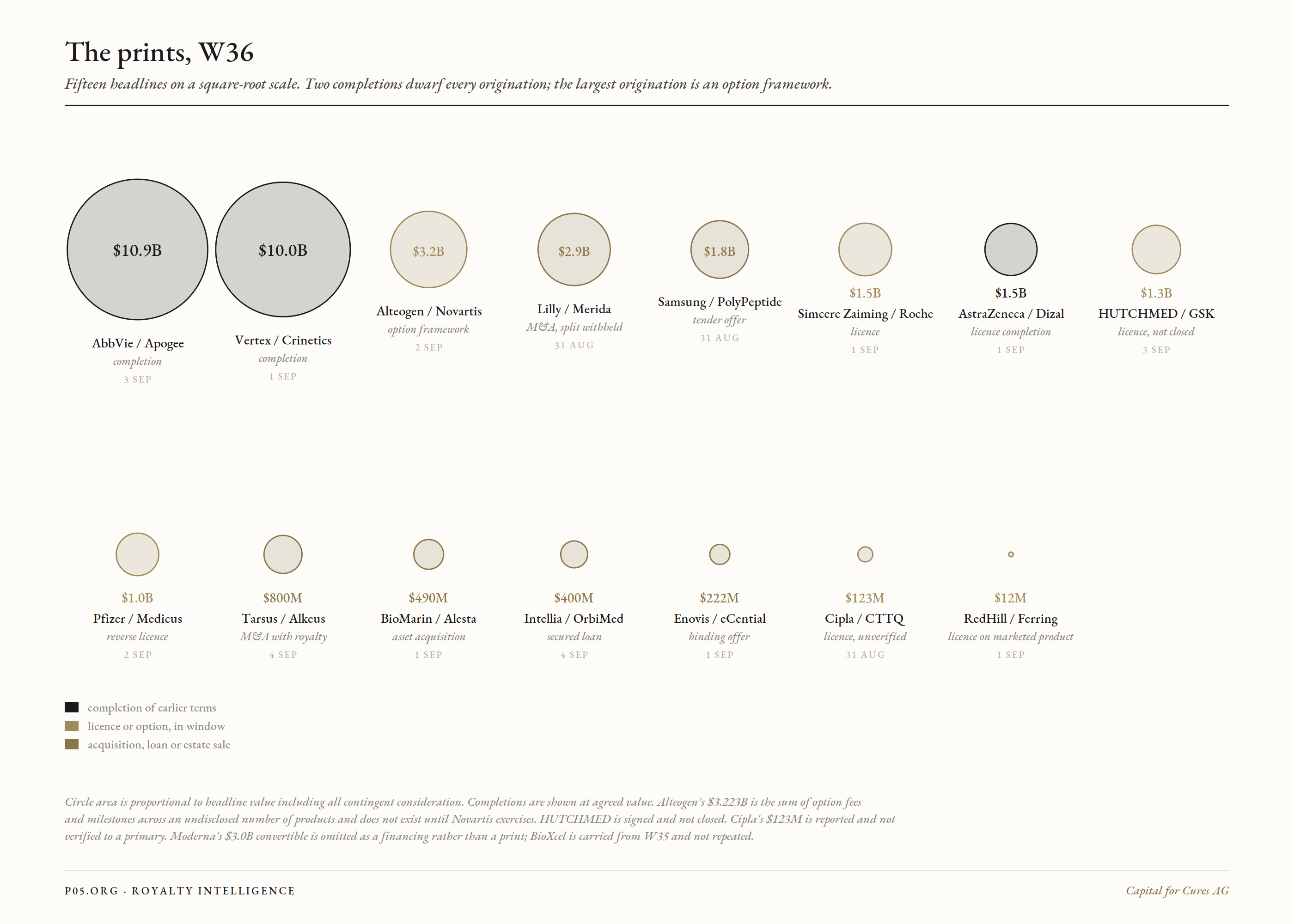
Fifteen headlines on a square-root scale, with BioXcel carried from W35 and not repeated. Two completions dwarf every origination; the largest origination is an option framework.
Vertex / Crinetics: $10.0B, All Cash, Completed, and Not a Contingent Dollar in It (Tue Sep 1)
Vertex Pharmaceuticals Incorporated (Nasdaq: VRTX) completed its acquisition of Crinetics Pharmaceuticals, Inc. (release).
- Terms: $85.00 per share in cash, a total equity value of approximately $10.0B, or about $8.8B net of estimated cash acquired. Agreed 6 July at a premium of roughly 102% to the prior close, anticipated then to close in Q3 and closed 1 September
- The assets: PALSONIFY (paltusotine), the first and only once-daily oral therapy for acromegaly, FDA-approved September 2025, launched in the US, approved in the EU and under review elsewhere; and atumelnant, a once-daily oral ACTH receptor antagonist in Phase 3 in congenital adrenal hyperplasia and Phase 2 in Cushing's syndrome. Vertex puts combined peak revenue above $5B and expects accretion to non-GAAP operating income in 2029
- Financing: cash on hand plus debt, supported by $4.5B of committed bridge financing from Bank of America and Morgan Stanley Senior Funding
- Structure: all cash, no contingent value right, no milestone, no earn-out, no royalty. Vertex paid the whole price at closing for a marketed product and a Phase 3 asset
- Comparable, and it is the one the issue needed: set against Lilly and Merida, where up to $2.875B is paid for a Phase 1 asset with the upfront undisclosed and most of the number behind events, this is what full certainty costs. $10.0B certain for an approved product and a Phase 3; up to $2.875B mostly contingent for a Phase 1. The window now brackets the range
- Royalty read-through: none created and none extinguished. Recorded as the window's largest transaction and as the clean end of the deferred-consideration spectrum that Lilly, Lifecare and BioXcel occupy
- Date: Completed Tue Sep 1, 2026
Samsung Biologics / PolyPeptide: $1.83B All Cash, Every Term Published, and Not a Royalty in Sight (Mon Aug 31)
Samsung Peptide AG, a direct Swiss subsidiary of Samsung Biologics (KRX: 207940), published the offer prospectus for its public tender offer for all publicly held registered shares of PolyPeptide Group AG (SIX: PPGN) (release).
- Price: $50 (CHF 44.31) net in cash per registered share, implying equity value of approximately $1.83B (CHF 1.46B)
- Premia: 40.0% to the last unaffected on-exchange close of $35.76 (CHF 31.65) on 10 April 2026, the trading day before the first media speculation, and 11.6% to the $44.88 (CHF 39.72) volume-weighted average over the sixty trading days before the pre-announcement
- Mechanics: main offer period 15 September to 12 October 2026, minimum acceptance threshold of 66⅔%, closing expected towards the end of 2026 subject to regulatory approvals. Pre-announcement was published 20 July
- Support: PolyPeptide's board recommends acceptance, and the largest shareholder has given an irrevocable undertaking over approximately 55.65% of outstanding shares excluding treasury
- The asset: a specialised global CDMO for peptide-based active pharmaceutical ingredients, with sites across the United States, Europe and India
- The funding leg, from the W35 window: on 28 August Samsung Biologics announced a rights offering of approximately $2.2B (KRW 3.0 trillion), about 2.27 million new shares at $965 (KRW 1,322,000), a discount of roughly 15%, with $2.0B (KRW 2.706 trillion) earmarked for the PolyPeptide acquisition and $215M (KRW 294.8 billion) for Bio Campus II. Registration effective 30 September, new shares listing around 30 November. Advisers on the Swiss side: O'Melveny & Myers and Schellenberg Wittmer for Samsung. Reported here as a rights issue three days before the prospectus, which is the order the third-party report had reversed
- Structure: the disclosure contrast of the window. Samsung publishes a per-share price, two premium references with their base dates, an offer period, an acceptance threshold, a board recommendation and a locked-up majority holder. Lilly publishes a ceiling and withholds the split on a transaction with a larger headline. The difference is Swiss takeover law, not deal size
- Royalty read-through: none. A CDMO is bought for capacity and process, and nothing in the consideration runs off product sales. It is recorded because it is the largest certain cash transaction in the window and because the peptide manufacturing base is where a large share of the obesity and metabolic pipeline is made
- Date: Announced Mon Aug 31, 2026
Lilly / Merida Biosciences: $2.875B on a Phase 1 Asset, All Cash, No Royalty and No Disclosed Split (Mon Aug 31)
Eli Lilly and Company (NYSE: LLY) and Merida Biosciences, Inc. of Cambridge, Massachusetts announced a definitive agreement for Lilly to acquire Merida (release).
- Terms: up to $2.875B in cash, inclusive of an upfront payment and contingent milestone payments. The upfront is not stated, the milestone schedule is not stated, and no royalty forms part of the consideration
- Conditions: customary closing conditions including regulatory approvals, with closing expected in the fourth quarter of 2026
- The assets: MER511, in Phase 1 for Graves' disease and thyroid eye disease, targeting the thyroid-stimulating immunoglobulins that activate the TSH receptor, with initial Phase 1 data reported as reductions in pathogenic thyroid-stimulating antibodies. MER769 is preclinical in food allergy, asthma and chronic spontaneous urticaria. Earlier programmes cover membranous nephropathy. The platform engineers Fc-based biologics that mark pathogenic autoantibodies for degradation
- The seller: Merida is private, founded in 2022 and launched publicly in April 2025 with a $121M Series A co-led by Bain Capital Life Sciences, BVF Partners and Third Rock Ventures, joined by GV and Perceptive Xontogeny Venture Funds. Sixteen months from launch to a $2.875B headline, with the lead asset in Phase 1
- Instrument: deferred consideration keyed to development and regulatory events, held by venture sellers rather than by an originator. There is no rate, no term and no revenue base anywhere in the structure. Advisers: Centerview Partners as exclusive financial adviser and Goodwin Procter as counsel to Merida; Ropes & Gray as counsel to Lilly
- Royalty read-through: none created and none extinguished. It is recorded because a $2.875B private-company acquisition on a Phase 1 asset is the price the equity route clears at in this therapeutic area, which is the number any synthetic royalty or development-funding proposal into a comparable asset is measured against
- Date: Announced Mon Aug 31, 2026
Lifecare / Ocean TuniCell: $0.6M Down and $0.6M on a Named Clinical Trigger (Mon Aug 31)
Lifecare ASA (Oslo Børs: LIFE) entered into a share purchase agreement to acquire 80% of Ocean TuniCell AS, a Bergen biomaterials company working on medical-grade tunicate nanofibrillar cellulose (release).
- Initial consideration: approximately $0.58M (NOK 6.0M) for the 80%, calculated on a $0.73M (NOK 7.5M) valuation of the whole. Settleable in cash, new Lifecare shares or a combination at Lifecare's discretion; Lifecare intends to issue shares, priced on the 15-day VWAP to the valuation date, with a nine-month lock-up
- Contingent consideration: a further $0.73M (NOK 7.5M) for 100%, approximately $0.58M (NOK 6.0M) for the acquired stake, on a defined clinical milestone, being successful demonstration of implant and use in humans without serious safety concerns, provable within three years
- Rationale: laboratory and production infrastructure at Espehaugen including a GMP Grade C cleanroom, quality processes and personnel. Lifecare puts the cost of building the equivalent at over $2.9M (NOK 30M) before qualification and regulatory work. The Ocean TuniCell platform is described as additional upside, with a clinical study planned at Sahlgrenska University Hospital at no cost to Ocean TuniCell
- Closing: subject to third-party consents and final Lifecare board approval. Lifecare intends to offer the remaining Ocean TuniCell shareholders the same terms
- Structure: the same instrument as the Lilly acquisition above, deferred consideration keyed to a development event, at roughly one two-thousandth of the size. Lifecare publishes the trigger, the ceiling, the deadline, the settlement currency and the pricing mechanic. Lilly publishes a headline and withholds the split. Disclosure here tracks the obligations of a $1.3M (NOK 13.5M) transaction under Norwegian continuing-obligation rules rather than the size of the cheque
- Royalty read-through: none. Recorded for the contrast in disclosure, and because the medtech pass has produced nothing else in the window
- Date: Announced Mon Aug 31, 2026, 07:00 CEST
Aqilion: An Indicative Offer for the Whole Company, and an Undisclosed Upstream Claim That Both Exit Routes Reach (Mon Aug 31)
AQILION AB (publ) (Nasdaq First North: AQIL) of Helsingborg announced that it has received an indicative offer for all shares in the company (release).
- Terms: none. No bidder named, no price, no consideration mix. The offer is contingent on a due diligence process being carried out and completed and may be adjusted upward or downward as a result. There is no finalised offer for shareholders to consider
- Context: through 2026 Aqilion has held parallel discussions aimed at securing continued development of its pipeline through partnership or divestment rather than in-house financing. Several due diligence processes are already running ahead of potential contract negotiations on AQ128 and AQ280, and the chairman states the company continues to pursue out-licensing of both in parallel with the offer
- The assets: AQ280, an oral selective JAK1 inhibitor in eosinophilic oesophagitis, with two completed Phase 1 studies (ARIA-1 and ARIA-2); AQ128, a topical treatment for psoriasis moving toward first-in-human
- The upstream: AQ280 is the Regulus programme, formerly LEO 142397, acquired in full from LEO Pharma against an upfront in cash and equity, with LEO becoming an Aqilion shareholder, and further payments to LEO out of either product sales or out-licensing revenues. The rate and the base are not published. Both routes now on the table, a sale of the company and a sale or licence of the asset, reach the same claim
- The dead layer: the February 2023 exclusive licence and research collaboration with Merck KGaA over the TAK1 programme carried $10.6M (EUR 10M) upfront, more than $1.0B (EUR 950M) in potential development and commercialisation milestones, and tiered royalties on worldwide net sales. Merck returned the programme and the agreement was terminated in June 2024
- Structure: the company's stated model is to develop to proof of concept and out-license, which is royalty origination as a business. A sale of the company substitutes an acquisition price for the rate. Second item in the window that ends with no royalty created, after Heidelberg / Huadong
- Royalty read-through: none created. The only stream reaching these assets is LEO Pharma's, it is undisclosed, and it is triggered by the exact events now under negotiation
- Date: Announced Mon Aug 31, 2026
Royalty-Bearing Licence-Outs and Collaborations
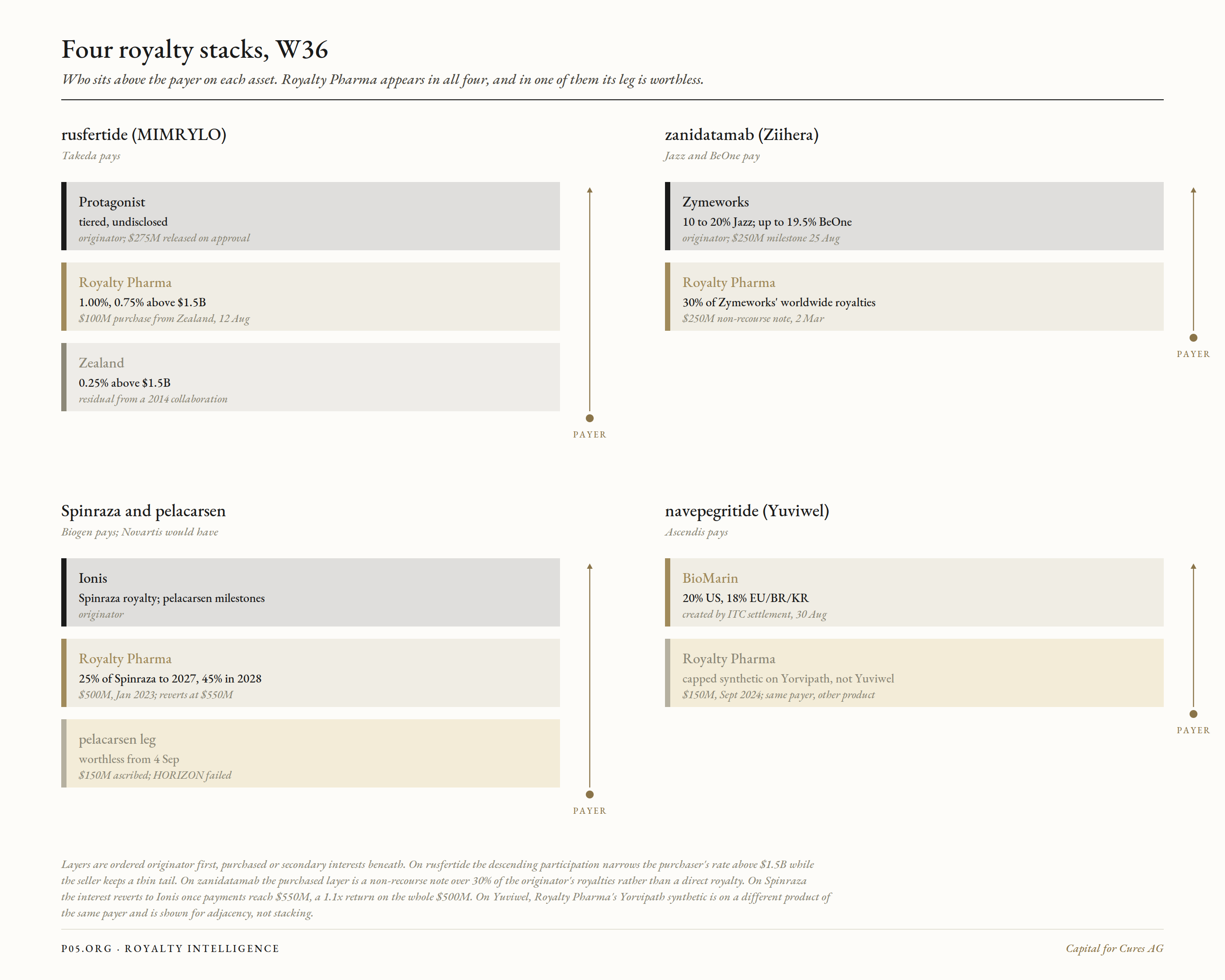
Four royalty stacks. Who sits above the payer on each asset. Royalty Pharma appears in all four, and in one of them its leg is worthless.
Alteogen / Novartis: A Fourth Option Licence on the Same Enzyme, $3.223B of Headline, and a Royalty on Top of All of It (Wed Sep 2)
Alteogen Inc. (KOSDAQ: 196170) of Daejeon entered an option and licence agreement with Novartis for the development and commercialisation of subcutaneous products using ALT-B4, powered by Alteogen's Hybrozyme technology (release).
- Structure: Novartis takes multiple options to obtain exclusive rights to develop and commercialise subcutaneous formulations for multiple Novartis products. It is not one licence but a framework under which each product taken forward triggers its own exercise
- Economics: if all options are exercised and all milestones achieved, Alteogen is eligible for up to $3,223M (KRW 4.4165 trillion), comprising option exercise fees, development and commercial milestone payments, and royalties on net sales of products commercialised under the agreement. The upfront is not separately disclosed, nor is the royalty band
- The asset: ALT-B4, berahyaluronidase alfa, a proprietary recombinant human hyaluronidase that temporarily depolymerises hyaluronan in the extracellular matrix, allowing biologics normally given by intravenous infusion to be dispersed and absorbed subcutaneously at high volume
- The book: Alteogen's fourth ALT-B4 agreement of 2026, after MSD, Tesaro and Biogen, and the second largest in its history. Cumulative maximum contract value across the four is put at roughly $4.452B. A separate August deal with an undisclosed global pharma ran to $365M with royalties on net sales; the Tesaro agreement on subcutaneous dostarlimab carried a $20M upfront in January
- Instrument: a platform enabling technology licensed repeatedly to different payers on the same enzyme. Every royalty in this issue but this one attaches to a molecule. This one attaches to a delivery component that rides on somebody else's molecule, which means the licensor's exposure is to the partner's franchise rather than to a single indication, and the same enzyme can carry four royalty streams from four payers at once
- Royalty read-through: a Korean listed licensor now holds contingent royalty positions across four large-cap partners on an undisclosed number of products, none of which it developed. Nothing about the rate is public on any of the four. The option structure also means the stream does not exist until Novartis exercises, so this is a portfolio of calls on future royalties rather than a royalty
- Date: Announced Wed Sep 2, 2026
Simcere Zaiming / Roche: $75M Down on a Preclinical Tri-Specific, a $1.53B Ceiling, and a Royalty Disclosed Only as Double Digits (Tue Sep 1)
Simcere Zaiming, a subsidiary of Simcere Pharmaceutical Group (HKEX: 2096) of Nanjing, entered an exclusive global licensing agreement with Roche for the development and commercialisation of SIM0660 (release).
- Terms: Roche takes exclusive global rights to develop, manufacture and commercialise. Simcere Zaiming is eligible for up to $1.530B in total payments including $75M upfront, and tiered royalties of up to double digits on future net sales. The milestone split between development, regulatory and commercial is not stated in the release; the HKEX filing is where it would be
- The asset: a tri-specific antibody combining a CD3-engaging arm with binding domains for the two B-cell antigens CD79a and CD19, built on Simcere Zaiming's T-cell engager poly-specific platform, designed for T-cell cytotoxicity with limited cytokine release. Positioned for patients previously treated with CD20- or CD19-directed therapies, with stated potential in B-cell autoimmune disease. A Simcere spokesperson told Reuters the product is preclinical
- The licensor's book: Simcere Pharmaceutical Group has now completed six out-licences with aggregate potential consideration above $6.1B. The most recent before this was SIM0613 to Ipsen in December 2025, a LRRC15 ADC, ex-Greater China, at $45M upfront within $1.06B plus tiered royalties. Simcere Zaiming itself filed for a Hong Kong listing in January 2026
- Upfront ratio: 4.9% of headline here, 4.2% on the Ipsen deal. Both sit at the low end of what a preclinical global exclusive earns, and both put more than 95% of the number behind events
- Rate disclosure: a ceiling and nothing else. "Up to double digits" is consistent with a top tier of 10% and with a top tier of 19%, and the difference is most of the royalty's value. Compare Protagonist, which published a ceiling on an approved product, and BioMarin, which published two rates and two territories on a settlement
- Comparable: the counterparty appears three times elsewhere in this issue. Roche is the Genentech in the BNT122-01 termination, the Genentech that licensed paxalisib to Kazia, and the counterparty on DualityBio's book. Simcere is Kazia's licensee for paxalisib in greater China. A company that pays a royalty to a Sydney micro-cap for one asset has just taken $75M from Roche on another
- Royalty read-through: a new China-origin stream, held by a Hong Kong-listed group with a subsidiary in the listing queue, payable by the largest pharmaceutical company by oncology revenue, at a rate the licensor has chosen to describe as a range with one bound. If Simcere Zaiming lists, its listing document is the place the band gets published, the same mechanic that put VelaVigo's band into a Delaware S-4
- Date: Announced Tue Sep 1, 2026, 14:40 CET on EQS; HKEX filing the same day
RedHill / Ferring: $12M Buys the Commercial Rights and Leaves Ferring a Royalty on Its Own Former Products (Tue Sep 1)
RedHill Biopharma Ltd. (Nasdaq: RDHL) of Raleigh and Tel Aviv acquired exclusive global and US commercialisation rights to Rebyota and Clenpiq from Ferring Pharmaceuticals (release, Form 6-K).
- Terms: an exclusive global commercialisation licence to Rebyota and an exclusive US commercialisation licence to Clenpiq, for $12M upfront plus tiered royalties on net sales and potential milestones. Neither the royalty band nor the milestone schedule is disclosed
- The products: Rebyota, a first-in-class microbiota-based therapy for prevention of recurrent Clostridioides difficile infection in adults following antibiotic treatment. Clenpiq, a ready-to-use low-volume bowel preparation, which generated $20.6M in US net sales in 2025 with minimal promotion and has unrestricted Medicare Part D access across 23 million lives. The pair generated approximately $37.5M in US net sales in 2025
- Ferring keeps more than the manufacturing. It remains the Marketing Authorization Holder for both products and continues to manufacture and supply, while RedHill takes commercialisation. So the seller retains the regulatory title, the manufacturing, the supply contract and a tiered royalty, and has transferred only the commercial function. Rights are limited to the currently approved indications
- The seller's framing: Ferring calls it the conclusion of a strategic review of Rebyota and an example of its Enterprise Model, realising product potential through partnerships while focusing its own resources elsewhere. Chairman and chief executive Jean-Frédéric Paulsen cites continued patient access as a criterion in partner selection
- The other half of the trade, announced the day before: RedHill funded this out of the Talicia divestiture to Apotex on 31 August, $18M upfront plus up to $35M on worldwide net sales milestones, selling its 70% interest into a structure where Apotex already held Cumberland's 30%. RedHill sold one sales-linked claim and bought another the next day, ending with a larger revenue base and a royalty obligation to Ferring instead of a milestone entitlement from Apotex. Advisers: Morningstar Law Group and Greenberg Traurig for RedHill on both legs. On the Ferring side, KYBORA acted as exclusive advisor, disclosed not in either principal's release but in its own announcement of 1 September. KYBORA Capital LLC is a FINRA and SIPC member; the firm announced a partnership with Clarivate on 13 August. No specialty financier or royalty fund on either leg
- Instrument, and it is the one the window was missing: a royalty originated on already-marketed product with real revenue behind it, by a seller that keeps everything except the sales force. Every other origination this week attaches to something preclinical, unapproved or unlaunched. Simcere's is preclinical, Alteogen's is contingent on option exercise, Osivax's is on a Phase 2 combination. Ferring has just created a running royalty over roughly $37.5M of current net sales by selling the commercial rights and keeping the economics
- Structure, and it echoes Osivax: the royalty holder is also the manufacturer. Third supply-bundled participation in the window, after GC Biopharma on the OVX836 combination and Egetis with Fujimoto on tiratricol. Three instances is a pattern worth naming in the issue
- Royalty read-through: a large private licensor exiting a category has converted an owned commercial franchise into a rate plus a supply contract, and taken $12M of cash on top. For a desk screening for streams on marketed product, the seller in a strategic refocusing is where they get created
- Date: Announced Tue Sep 1, 2026, 07:00 ET
BioMarin / Ascendis: A 20% US Royalty on a Competitor's Product, and Two Releases That Do Not Agree on When It Ends (Sun Aug 30 and Mon Aug 31)
BioMarin Pharmaceutical (Nasdaq: BMRN) entered into binding terms with Ascendis Pharma A/S (Nasdaq: ASND) resolving the patent and ancillary disputes pending between them globally, including the US International Trade Commission proceeding concerning Yuviwel (release).
- Terms: Ascendis pays BioMarin 20% of Yuviwel net sales in the United States, retroactive to first commercial sale, and 18% of net sales in the European Union, Brazil and South Korea until May 2030
- Scope: a licence to BioMarin's Yuviwel-related patents for all current and potential indications, named as achondroplasia and hypochondroplasia, and for use of Yuviwel in combination with other medicines
- What the settlement clears: BioMarin dismisses the pending Section 337 investigation before the ITC. The parties resolve all claims on the asserted intellectual property, including litigation in Brazil, Denmark, Germany, South Korea and the Northern District of California
- The term, on which the two releases conflict. BioMarin's release attaches the end date to the ex-US leg alone: 20% of US net sales retroactive to first commercial sale, and 18% in the European Union, Brazil and South Korea until May 2030. Ascendis's release attaches a single date to the whole royalty: 20% in the United States and 18% in the European Union, South Korea and Brazil, from first commercial sale in the specific country through May 20, 2030 (Ascendis release). On Ascendis's wording the US leg runs about three years and nine months from launch; on BioMarin's it has no stated end. Both accounts are now on file with the SEC, BioMarin's as an 8-K exhibit and Ascendis's as a 6-K, with the wording unchanged. This is a binding term sheet and not the definitive agreement, and the definitive agreement is where the point resolves
- Scope, on which they also differ in emphasis: BioMarin describes a licence to its Yuviwel-related patents for current and potential indications, named as achondroplasia and hypochondroplasia. Ascendis describes a non-exclusive, worldwide, royalty-bearing licence to continue researching, developing, manufacturing and commercialising navepegritide-related products without restriction, with BioMarin waiving certain regulatory rights and exclusivities and giving a covenant not to sue. The royalty base in both accounts is navepegritide-related products, not the Yuviwel trade name alone
- What neither discloses: the retroactive amount, whether it is payable as a lump sum or netted against future royalties, whether the 20% is flat or the top tier of a tiered structure, and any minimum or cap
- The asset: Yuviwel (navepegritide, developed as TransCon CNP) is a once-weekly prodrug of C-type natriuretic peptide, granted FDA accelerated approval on 27 Feb 2026 and launched in the US in April 2026 with orphan drug exclusivity. Q2 2026 revenue was $9M (EUR 8M), with more than 220 US patient enrollments through 31 July. The European marketing authorisation application is under EMA review with a decision anticipated in Q4 2026
- Instrument: a royalty created by litigation settlement rather than by licence or by purchase. The payer is buying the right to continue selling; the alternative on the table was an exclusion order
- Structure: BioMarin sells VOXZOGO (vosoritide) into the same indication. Every Yuviwel sale that displaces a Voxzogo sale now returns 20% of a competitor's US revenue to BioMarin. The position functions as a hedge on the erosion of its own franchise rather than as a licence out of a pipeline
- Comparable: the highest published rate in three windows. Biohaven's new agreement with SK Biopharmaceuticals runs mid-teens to low twenties on US net sales; Zymeworks holds 10% to 20% from Jazz; AnaptysBio's Jemperli royalty starts at 8%. Those are negotiated licences on unlaunched or partner-launched assets. This is a settlement rate on a launched, approved, competing product
- The other claim on the payer: Ascendis already carries a $150M capped synthetic royalty sold to Royalty Pharma in September 2024 on US net sales of Yorvipath, a different TransCon product. The two do not stack on the same revenue. They do mean Ascendis now services two sales-based claims across two of its three marketed products, one sold voluntarily and capped, one imposed by settlement with no cap disclosed
- Royalty read-through: BioMarin now holds a published-rate, retroactive royalty on a launched asset it does not control and cannot influence, across four named territories. The term is the variable that prices it, and the counterparties have published two different answers. A US leg ending 20 May 2030 and a US leg running past 2030 are different instruments
- Date: BioMarin announced Sun Aug 30, 2026, its newsroom page carrying a 31 August header against a 30 August PRNewswire dateline. Ascendis published its own account Mon Aug 31 at 07:00 ET
Jazz / BeOne / Zymeworks: An Overall Survival Win That Widens the Base Under a Third-Party Royalty (Mon Aug 31)
Jazz Pharmaceuticals plc (Nasdaq: JAZZ) announced second interim top-line overall survival results from the Phase 3 HERIZON-GEA-01 trial of Ziihera (zanidatamab-hrii) in first-line HER2-positive locally advanced or metastatic gastroesophageal adenocarcinoma (release).
- Result: Ziihera plus chemotherapy produced a statistically significant and clinically meaningful OS improvement against trastuzumab plus chemotherapy, with the hazard ratio improved on the first interim analysis. With longer follow-up the Ziihera plus tislelizumab plus chemotherapy OS hazard ratio also improved. Safety consistent with the known profile of each agent, no new signals
- What is not disclosed: every number. No hazard ratios, no medians, no confidence intervals and no event counts. The data have been submitted for presentation at a medical meeting in Q4 2026 and to global health authorities
- The trial: 914 patients randomised across roughly 225 sites in more than 30 countries, three arms, dual primary endpoints of PFS by blinded independent central review and OS, run jointly with BeOne Medicines, whose tislelizumab is the checkpoint inhibitor in the combination arm
- The licence: zanidatamab is developed by Jazz and BeOne under licence agreements from Zymeworks, which originated the molecule. Zymeworks holds tiered royalties of 10% to 20% on net sales in Jazz's territories per its FY2023 10-K (filing) and up to 19.5% from BeOne in Asia-Pacific, and is not a party to the trial, the approval or the commercialisation
- The layer above Zymeworks: on 2 March 2026 Royalty Pharma funded a $250M non-recourse royalty-backed note secured on 30% of Zymeworks' worldwide tiered royalties on zanidatamab (release). The 25 August approval also released a $250M milestone from Jazz to Zymeworks, with up to $1.3B in further milestones eligible (release). Sixth instance on the Royalty Pharma map, and the first this window where a base expansion on a readout flows through a purchased layer rather than an originator alone
- The approval underneath it: the FDA approved Ziihera in this indication on 25 Aug 2026, in both the tislelizumab-containing and chemotherapy-only combinations. Ziihera was already approved in previously treated HER2-positive biliary tract cancer, and in the European Union and other countries
- Structure: the royalty was already switched on by the biliary tract approval. What the GEA approval and this readout do is change the base it runs against, from a second-line indication in a rare cancer to first-line treatment in the fifth most common cancer worldwide, of which around 20% of patients are HER2-positive. A displacement claim against trastuzumab is the mechanism
- Royalty read-through: Zymeworks holds a published rate band on an asset it does not develop, does not manufacture and does not sell, across two licensees in separate territories. The value moved this window without Zymeworks doing anything, and it moved on an approval that landed six days before the data supporting it were released. The band is now pinned to the 10-K
- Date: Announced Mon Aug 31, 2026
Royalty Pharma / Ionis: A Purchased Royalty Fails, and the Buyer Publishes Its Own Downside Before the Market Does (Fri Sep 4)
Royalty Pharma plc (Nasdaq: RPRX) announced an update on Novartis's Phase 3 topline results for pelacarsen, in which the Lp(a) HORIZON outcomes trial missed its primary endpoint (release).
- The instrument: a $500M funding agreement with Ionis signed January 2023, under which $150M of value was ascribed to royalties acquired on pelacarsen and $350M to royalties acquired on Spinraza. Royalty Pharma acquired 25% of Ionis's Spinraza royalty payments through 2027, rising to 45% in 2028, on up to $1.5B in annual sales
- The reversion, which is the whole design: the Spinraza royalty interest reverts to Ionis once royalty payments reach $550M, representing a 1.1x return on the total amount funded. Royalty Pharma states it expects to recoup its total investment and earn a modest positive return despite the pelacarsen failure, and no longer anticipates making any milestone payments to Ionis
- Structure: the buyer paid $500M across two assets of opposite character. Spinraza is a marketed, predictable stream bought at a capped multiple to protect principal; pelacarsen was the option. The option expired worthless on 4 September and the floor held. This is a cross-collateralised purchase in which the stable leg is sized to return roughly 1.1x on the whole outlay, so the volatile leg is free upside rather than a source of loss
- Why the announcement exists: Royalty Pharma is listed, the failure is Novartis's news, and the market would otherwise price a $500M exposure without knowing how it was structured. The release exists to say that a failed asset inside the portfolio does not produce a loss, and it reiterates the 2030 Portfolio Receipts target of $4.7B or more in the same breath
- Royalty read-through, and it cuts both ways: for Royalty Pharma, a purchased royalty was extinguished with principal intact, which is the case for buying protection rather than exposure. For Ionis, the pelacarsen milestones are gone and the Spinraza royalty comes back after $550M, so the licensor loses the upside and recovers the asset. A reverting interest is a loan against a stream dressed as a sale, and both sides get what that structure is designed to give them
- Date: Announced Fri Sep 4, 2026
Orexo / Department of Justice: A 5% Sales Participation Held by a Government, Payable 2030 to 2031 (Mon Aug 31)
Orexo AB (STO: ORX) of Uppsala reached a non-binding agreement in principle on the key terms of a settlement with the US Department of Justice, closing out an investigation opened in 2020 (release).
- Terms: $4M payable in instalments, plus a limited contingent payment based on 5% of net sales should certain sales-related thresholds be met during 2030 to 2031
- Form: a Non-Prosecution Agreement together with a separate civil settlement. Neither Orexo nor any current or former employee admits wrongdoing. On completion the company states it would have no further exposure on the matters covered
- Separate track: two former employees of the US operations have reached their own agreements in principle with the DOJ resolving civil claims. Orexo intends to seek insurance cover for the full settlement amount relating to them
- Accounting: Orexo expects to recognise a provision of $4M for the anticipated obligation, with further financial impact disclosed once a final agreement is reached
- What is not disclosed: the sales thresholds, the products inside the net-sales base, the amount of the cap, and whether the 5% runs on gross or net-of-rebate revenue. The company's chief executive describes the contingent payment as capped and the $4M as payable in instalments over several years. The full terms are stated to follow only on a final agreement, and there is no guarantee one is reached on these terms
- Instrument: a sales participation created by enforcement. The holder is the US government, the rate is published, the base is not, and the exposure window is two calendar years opening more than four years out
- Structure: the second sales-linked instrument created by settlement in this window. The BioMarin claim is compensatory and comes out of an ITC proceeding; this one is punitive and comes out of a DOJ investigation. Neither was negotiated as a licence, and both price the right to keep selling rather than the right to develop
- Royalty read-through: anyone underwriting Orexo's US opioid dependence revenue now has a contingent 5% claim sitting ahead of the equity in 2030 and 2031, at a threshold nobody outside the negotiation can see. It would also rank above any royalty subsequently sold on the same revenue
- Date: Announced Mon Aug 31, 2026
Takeda / Protagonist: Approval Releases $275M and Switches On a 1% Royalty Bought Sixteen Days Earlier (Fri Aug 28, W35 window)
Takeda (TSE: 4502, NYSE: TAK) received FDA approval of the New Drug Application for MIMRYLO (rusfertide) for the treatment of erythrocytosis in adults with polycythemia vera (release).
- What the approval releases: $275M to Protagonist Therapeutics (Nasdaq: PTGX), being a $200M opt-out fee and a $75M approval milestone. Protagonist remains eligible for up to $875M in further milestones plus tiered worldwide royalties. The rate is not published
- The agreement: a worldwide licence and collaboration signed January 2024. Protagonist discovered rusfertide (PTG-300) and held primary responsibility for development through Phase 3. It elected to opt out in April 2026, after which Takeda took the NDA submission and global commercialisation
- The purchased layer: Royalty Pharma paid $100M to Zealand Pharma on 12 Aug for Zealand's rusfertide economics, $50M at closing and $50M on the first anniversary, acquiring a 1% royalty on global net sales plus regulatory and commercial milestones. Zealand retains 0.25% on annual global net sales above $1.5bn; Royalty Pharma retains 0.75% above the same threshold (release)
- Where Zealand's claim comes from: a research collaboration with Protagonist terminated in 2014, with Protagonist's payment obligations clarified in a settlement reached in 2021
- Stack: four layers on one asset. Protagonist as originator with milestones and an undisclosed tiered royalty; Zealand as residual claimant at 0.25% above $1.5bn; Royalty Pharma at 1% stepping down to 0.75% above $1.5bn; Takeda as licensee and payer of all of it
- Instrument: the descending-participation shape again, where the purchaser's rate narrows as the asset succeeds and the seller keeps a thin tail above the same threshold. Fifth instance on the Royalty Pharma map
- Comparable: W35 opened on RASONQUE, where a Royalty Pharma synthetic royalty funded in May switched from dormant to paying on a 26 Aug approval. MIMRYLO is the same event two days later on a purchased royalty rather than a funded synthetic. Two consecutive weeks in which the royalty event was a switch-on, not an origination
- Approval basis: the Phase 3 VERIFY study in 293 patients, with 76.9% achieving a clinical response during weeks 20 to 32 against 32.9% on placebo. Once-weekly subcutaneous injection
- Date: Announced Fri Aug 28, 2026. In the W35 window and not recorded there; recorded here
Heidelberg Pharma / Huadong Medicine: Six New ADC Targets, Split Ownership, and No Royalty (Fri Aug 28, W35 window)
Heidelberg Pharma (FSE: HPHA), through its wholly owned subsidiary Heidelberg Pharma Research GmbH, signed a new collaboration agreement with Huadong Medicine (SZ: 000963) of Hangzhou (release).
- Terms: none disclosed. No upfront, no milestones, no royalty, no term
- Scope: joint research and early-stage development of new antibody drug conjugates across up to six targets, combining Heidelberg's ATAC amanitin platform and other toxin payloads with Huadong's antibodies and R&D capability. Bispecific and multispecific ADCs are named, potentially carrying dual payloads
- Ownership: the agreement provides that ownership of the resulting development candidates is allocated between the partners according to their respective contributions
- The existing relationship: Huadong is Heidelberg Pharma's second-largest shareholder. The February 2022 licence granted exclusive Asian rights, excluding Japan and India, to HDP-101 (BCMA, INN pamlectabart tismanitin) and HDP-103 (PSMA) for $20M upfront, up to $449M in milestones and tiered royalties from single digit to low double digit percentages, with options over HDP-102 and HDP-104 taking stated deal value to $931M. Huadong invested $122M (EUR 105M) for 35% of the shares outstanding. A development milestone fell due in March 2026 on first patient dosing in China
- Structure: the 2022 agreement is a licence and creates a royalty. This one is a co-ownership agreement and, on the disclosed terms, creates none. A partner already holding a royalty-bearing licence and 35% of the equity has taken split ownership rather than a rate on the next tranche of assets
- Royalty read-through: none on the disclosed terms. The item is recorded for the structure and for the contrast with the 2022 licence sitting above the same partnership
- Date: Announced Fri Aug 28, 2026. In the W35 window and not recorded there; recorded here
Osivax / GC Biopharma: A Royalty to the Supplier of the Commodity Half, and No Rate on the Record (Thu Aug 27, W35 window)
Osivax, a private clinical-stage company in Lyon, and GC Biopharma (KRX: 006280) of Yongin announced a long-term collaboration to develop and commercialise a next-generation seasonal influenza vaccine combining OVX836 with GC FLU in a single injection (release).
- Terms: the agreement grants Osivax a non-exclusive, sublicensable, global licence excluding Japan and Korea to use GC FLU in combination with OVX836. GC Biopharma will receive royalties and provide long-term supply of GC FLU. No rate, no upfront, no milestones, no term and no financial terms of any kind disclosed
- Split: Osivax leads global development strategy and holds development and commercialisation responsibility outside the Republic of Korea. GC Biopharma retains exclusive Korean rights
- The assets: OVX836 is a first-in-class influenza A candidate against the conserved nucleoprotein, built on Osivax's oligoDOM self-assembling nanoparticle platform, in Phase 2b with over 4,000 participants dosed across seven trials. GC FLU is a WHO-prequalified standard-dose inactivated trivalent seasonal vaccine manufactured in Korea
- Structure: the royalty runs to the party supplying the established, commoditised half of the combination, while the party contributing the novel antigen leads development and pays. The usual direction in a combination licence is the reverse
- What is not disclosed: the rate, the base, whether the royalty attaches to the combination product or to the GC FLU component within it, and whether sublicensees pay through. Japan sits outside the licence with no arrangement stated on either side
- Royalty read-through: a new royalty on an unapproved Phase 2 combination, held by a listed Korean manufacturer that also supplies the product it earns on. The supply agreement and the royalty sit on the same counterparty, which means the stream cannot be assessed apart from the manufacturing relationship. Osivax is private, is funded in part by BARDA and NIH, and describes the deal as preserving its independence
- Not the only instance this window: Egetis takes approximately one third of the income from Fujimoto on tiratricol in Japan, also bundled with semi-finished supply, and Ferring keeps the Rebyota manufacturing facilities while taking tiered royalties from RedHill. Three participations in one window where the economics run through a supply relationship, and none of the three publishes a rate
- Date: Announced Thu Aug 27, 2026. Recorded in W35 as a highlights line; the block here adds the supply-bundled structure and the two further instances of it in this window
Funding
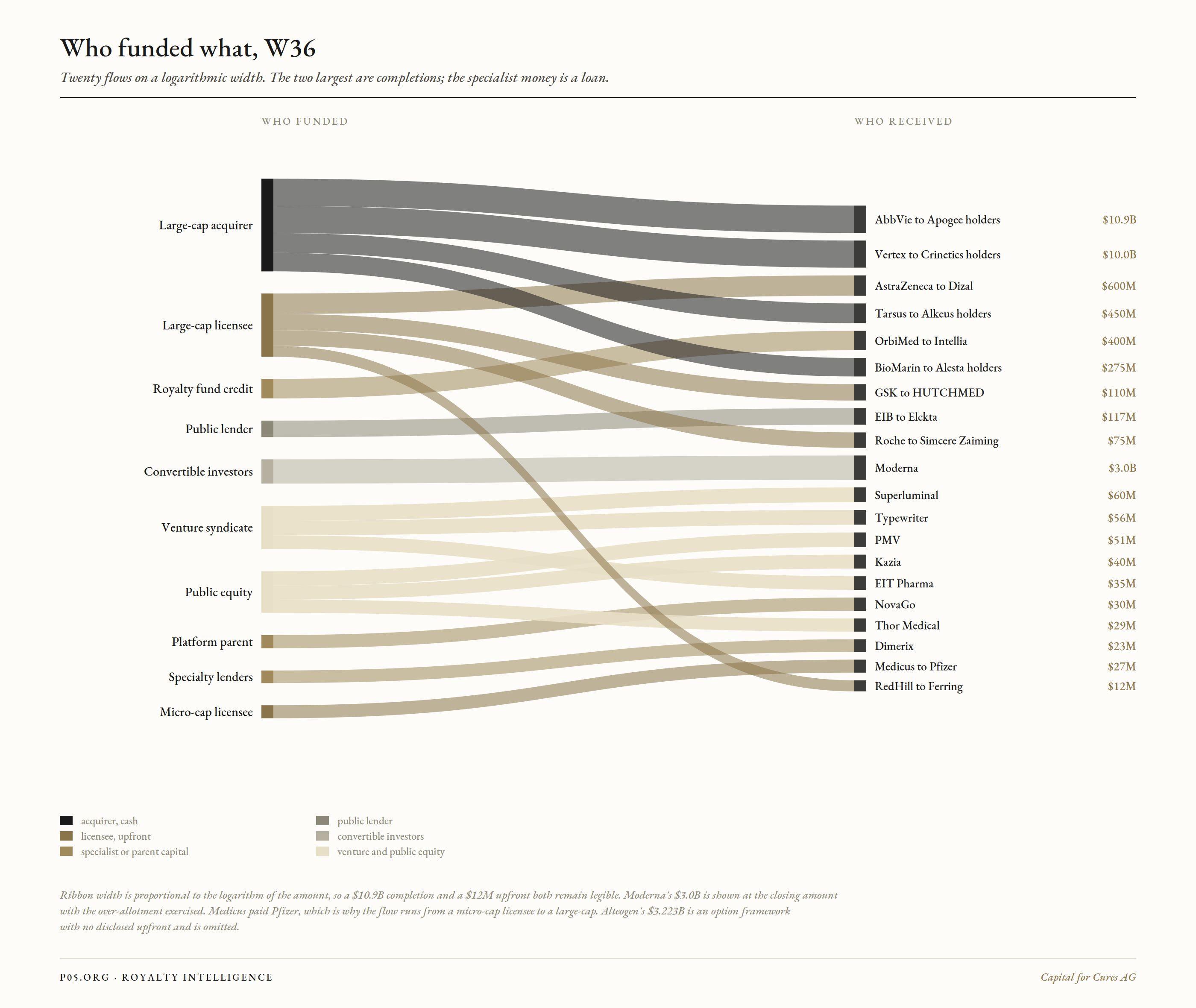
Twenty flows on a logarithmic width. The two largest are completions; the specialist money is a loan.
Moderna: $2.6B at a Zero Coupon, and What That Prices Against a Royalty (Fri Aug 28, W35 window; closing Tue Sep 1)
Moderna, Inc. (Nasdaq: MRNA) priced $2.6B aggregate principal amount of 0.00% Convertible Senior Notes due 2032 in a private placement to qualified institutional buyers under Rule 144A (release).
- Size: upsized from the announced $2.0B at pricing, with a further $400.0M available to the initial purchasers, which was taken up in full at closing for $3.0B total
- Terms: senior unsecured, no regular interest, maturing 1 March 2032. Initial conversion rate 4.7487 shares per $1,000 of principal, approximately $210.58 per share, a 47.5% conversion premium over the $142.77 reference price. Redemption and fundamental change repurchase features apply
- The overlay: approximately $285.0M spent on capped call transactions, with the cap initially at $392.6175, a 175.0% premium to the 27 August close. That is the issuer buying back the dilution up to a strike nearly three times spot
- Use of proceeds: general corporate purposes, which the company says may include the flexibility to invest in the growth of its oncology business and to repay debt
- What it costs: no coupon, and roughly 11% of principal paid out in cash at the front for the capped call. The economic price is the option value handed to noteholders plus that hedge premium, against a claim that ranks as senior unsecured debt and touches no product
- Instrument, and why it belongs here: this is the alternative a company of Moderna's size actually has to selling a royalty, and it is the number a synthetic royalty or development-funding proposal into the same balance sheet is measured against. The oncology programme the proceeds name is a Merck cost and profit share, not a royalty asset, so the financing funds an economics position rather than a rate
- Closed, and upsized again at closing. The sale completed on 1 September 2026 with the initial purchasers' option exercised in full, taking the issue to $3.0B in aggregate principal. Net proceeds approximately $2,957.3M, of which $328.8M went to the capped call transactions, up from the $285.0M indicated at pricing. Trustee U.S. Bank Trust Company, N.A. (closing 8-K)
- Timing: priced Friday 28 August, closed Tuesday 1 September. Pricing falls in the W35 window and the closing in this one
- Date: Announced Fri Aug 28, 2026
EIT Pharma: $35M Into a Bankruptcy-Estate Asset Carrying an Undischarged Merck Royalty (Mon Aug 31)
EIT Pharma, Inc. of Kirkland, Washington closed an oversubscribed $35M Series A led by Propel Bio Partners, with Good Ventures, Arrowtown and other private biopharma investors participating (release).
- Use of proceeds: FDA review activities for lonafarnib in chronic hepatitis D, commercial manufacturing preparation and pipeline expansion. The NDA has been accepted and is under review, supported by the Phase 3 D-LIVR study
- Provenance: Eiger BioPharmaceuticals filed Chapter 11 on 1 April 2024 in the Northern District of Texas, case 24-80040. The lonafarnib and lambda programmes were sold under Section 363 to Eiger InnoTherapeutics, since renamed EIT Pharma, with the sale order entered 20 August 2024 and closing in September 2024 at $5.2M for lonafarnib and $1.0M for lambda, $6.2M in total plus cure costs and assumed liabilities (sale announcement). SSG Capital Advisors ran the sale; Sidley Austin and Alvarez & Marsal advised Eiger, Goodwin Procter advised the buyer. An asset that carried a Phase 3 readout and an accepted NDA changed hands for $6.2M and is now being funded at $35M a round
- The upstream, as Eiger disclosed it: a September 2010 exclusive licence from Schering Corporation, subsequently acquired by Merck, granting the exclusive right to develop, manufacture and sell products containing lonafarnib for all human viruses except certain specified viruses such as hepatitis B and hepatitis C alone. Consideration was preferred stock with a fair value of $0.5M, plus up to $27.0M in development milestones and tiered royalties on aggregate annual net sales ranging from mid-single to low double digits. The obligation expires country by country and product by product on the later of the last-to-expire assigned patent, estimated at the tenth anniversary of first commercial sale. A $1.0M regulatory milestone was paid in May 2015; the next $1.0M triggers on positive Phase 3 data
- Field: hepatitis D sits inside the licensed field. The carve-out is hepatitis B and hepatitis C alone, and HDV is a separate human virus
- The Merck licence was rejected, not assigned. On 5 September 2024 the court entered an order authorising the debtors to reject the Merck licence, and a separate Side Letter among Merck, Eiger and the buyer was executed on 3 September 2024. So the 2010 agreement did not travel to EIT on its original terms through an assumption and assignment schedule; whatever governs lonafarnib now was negotiated bilaterally in that Side Letter. The Side Letter is not public, so the rate, the milestone ladder and even whether Merck retains a royalty at all are unknown. The disclosed 2010 band is the last published figure and may no longer be the operative one That single fact decides whether Merck holds a published rate band on a drug about to be approved or nothing at all
- Structure: an asset that failed at a listed company, passed through an estate, was refinanced privately and reached an accepted NDA. The royalty, if it survived, has been dormant through all of it
- Date: Announced Mon Aug 31, 2026
League tables
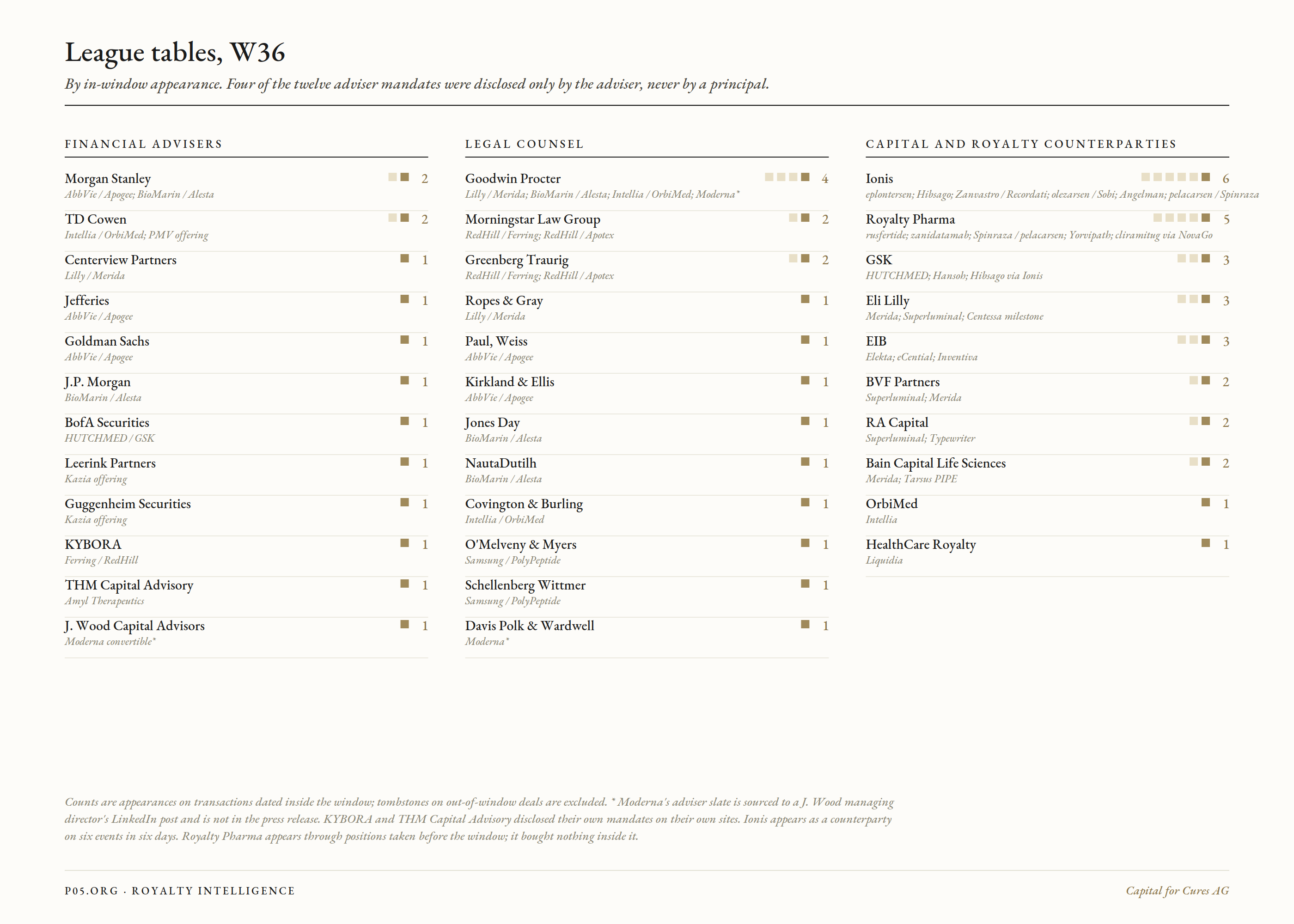
Advisers and counterparties by appearance on transactions dated 30 Aug to 5 Sep. Appearances, not fee rank.
Financial advisers. Two mandates each: Morgan Stanley (AbbVie on Apogee; BioMarin on Alesta) and TD Cowen (exclusive adviser to Intellia on the OrbiMed facility; sole bookrunner on PMV). One each: Centerview Partners (exclusive adviser to Merida), Jefferies and Goldman Sachs (Apogee), J.P. Morgan (Alesta), BofA Securities (exclusive adviser to HUTCHMED), Leerink Partners and Guggenheim Securities (joint bookrunners on Kazia, with BTIG and Needham as lead managers and Laidlaw as co-manager), KYBORA (exclusive adviser to Ferring, disclosed on its own site), THM Capital Advisory (Amyl, disclosed on its own page), J. Wood Capital Advisors (Moderna, sourced to a managing director's post and not to the release).
| Adviser | Mandates | On |
|---|---|---|
| Morgan Stanley | 2 | AbbVie / Apogee; BioMarin / Alesta |
| TD Cowen | 2 | Intellia / OrbiMed; PMV offering |
| Centerview Partners | 1 | Merida |
| BofA Securities | 1 | HUTCHMED |
| Leerink Partners | 1 | Kazia |
| Guggenheim Securities | 1 | Kazia |
| KYBORA | 1 | Ferring / RedHill |
Legal counsel. Goodwin Procter appears four times: Merida, Alesta, Intellia and Moderna. Morningstar Law Group and Greenberg Traurig appear twice each, on both RedHill legs. One each: Ropes & Gray (Lilly), Paul, Weiss (AbbVie), Kirkland & Ellis (Apogee), Jones Day (BioMarin), NautaDutilh (Alesta), Covington & Burling (OrbiMed), O'Melveny & Myers and Schellenberg Wittmer (Samsung on PolyPeptide), Davis Polk & Wardwell (Moderna), Allen Overy Shearman Sterling (Charterhouse on Animalcare, out of window).
| Counsel | Mandates | On |
|---|---|---|
| Goodwin Procter | 4 | Merida; Alesta; Intellia; Moderna |
| Morningstar Law Group | 2 | RedHill / Ferring; RedHill / Apotex |
| Greenberg Traurig | 2 | RedHill / Ferring; RedHill / Apotex |
| Ropes & Gray | 1 | Lilly on Merida |
| Paul, Weiss | 1 | AbbVie |
| Kirkland & Ellis | 1 | Apogee |
| Covington & Burling | 1 | OrbiMed |
Capital and royalty counterparties. Ionis appears on six events: the eplontersen failure at ESC, bepirovirsen's Japan approval carried from W35, Zanvastro's US approval with Recordati ex-US, olezarsen under competitive pressure from plozasiran, the Angelman field cleared by Ultragenyx, and the pelacarsen failure that reverts Spinraza.
Royalty Pharma appears on five instruments: rusfertide, zanidatamab, Spinraza and pelacarsen, Yorvipath, and behind Neurimmune's NovaGo investment through the cliramitug purchase; every position was taken before the window and it bought nothing inside it.
GSK appears three times and every one is China-origin: HUTCHMED, Hansoh and DualityBio. Eli Lilly three times: Merida as acquirer, Superluminal as investor and collaborator, Centessa as inherited payer. OrbiMed once, as lender to Intellia. HealthCare Royalty once, as holder of the capped revenue interest over Liquidia. EIB three times in three roles: lender to Elekta, equity holder exiting eCential and Inventiva, policy actor under the Biotech Act.
| Counterparty | Appearances | Role |
|---|---|---|
| Ionis | 6 | licensor on four streams; one failed, one reverting |
| Royalty Pharma | 5 | buyer and lender, all pre-window positions |
| GSK | 3 | licensee of China-origin assets |
| Eli Lilly | 3 | acquirer, investor, inherited payer |
| EIB | 3 | lender, shareholder, policy actor |
| BVF Partners | 2 | lead on Superluminal; Merida Series A |
| RA Capital | 2 | Superluminal; Typewriter |
| OrbiMed | 1 | lender to Intellia, synthetic royalties restricted |
| HealthCare Royalty | 1 | capped revenue interest on Liquidia |
Standard disclaimer
This Weekly Term Sheet is provided for informational purposes only. It does not constitute investment advice, an offer to sell or a solicitation of an offer to buy any security, or a recommendation regarding any investment. Data and disclosures are sourced from public company filings, press releases, and credible secondary reporting. Capital for Cures AG does not warrant the accuracy or completeness of information presented. Readers are advised to consult primary source documentation before making any investment, partnership, or commercial decision.