Who owns the voucher: the $200 million asset that royalty contracts leave out

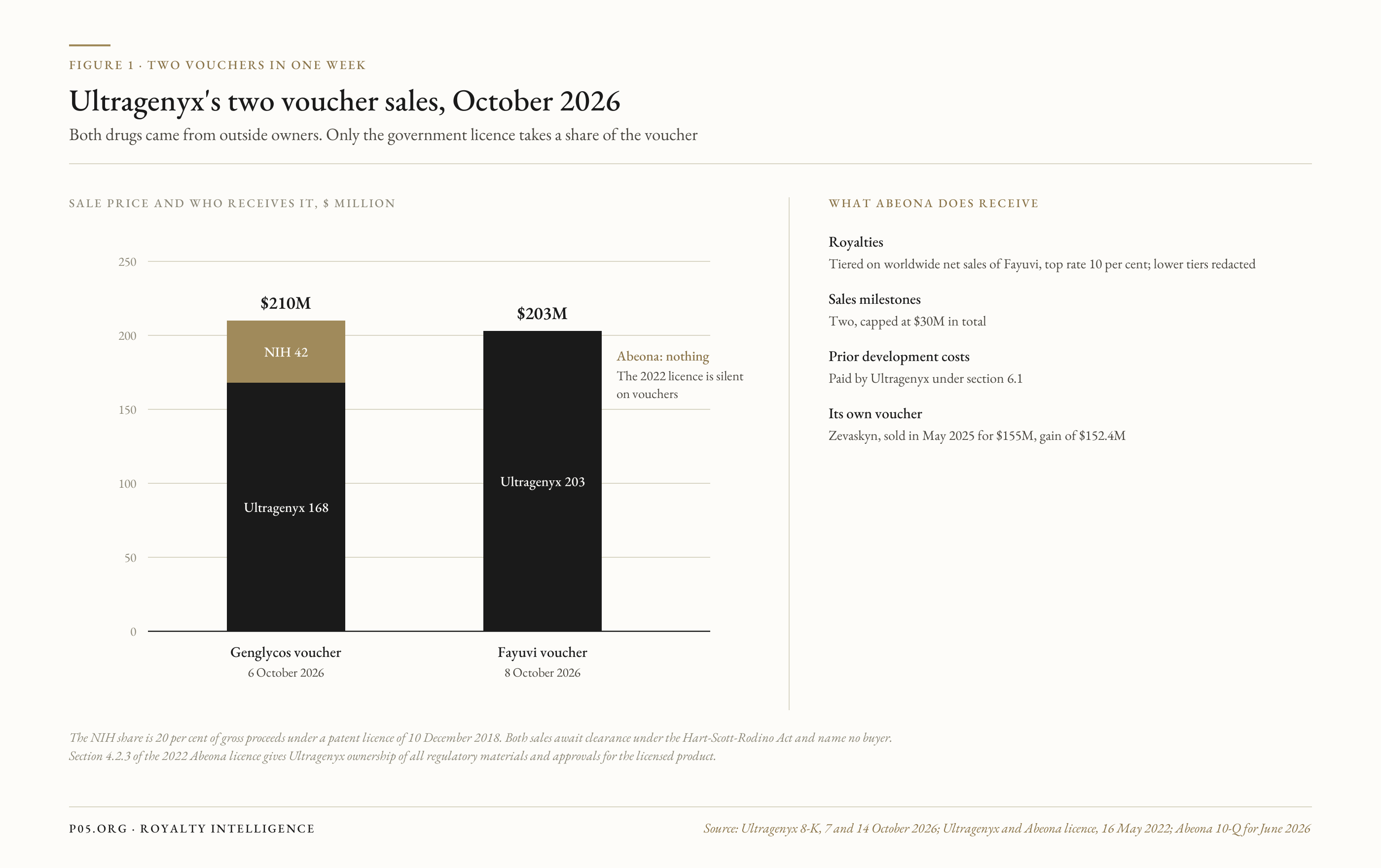
Ultragenyx sold two priority review vouchers in one week of October 2026, for a combined $413M. On 6 October it agreed to sell the voucher awarded with the approval of Genglycos, its gene therapy for glycogen storage disease type Ia, for $210M in cash.
The current report adds that under a 2018 patent licence "20% of the gross proceeds from the sale of the PRV will be payable by the Company to the NIH". That share comes to $42M. Two days later it agreed to sell the voucher awarded with Fayuvi, its gene therapy for Sanfilippo syndrome type A, for $203M. That report names no one else with a claim on the money.
Fayuvi, developed as UX111, came from Abeona Therapeutics. Ultragenyx licensed it in May 2022 for royalties of up to 10 per cent of net sales and up to $30M of sales milestones. The licence does not mention vouchers. Section 4.2.3 gives Ultragenyx "all Regulatory Materials ... and Regulatory Approvals" for the product, and the voucher came with the approval.
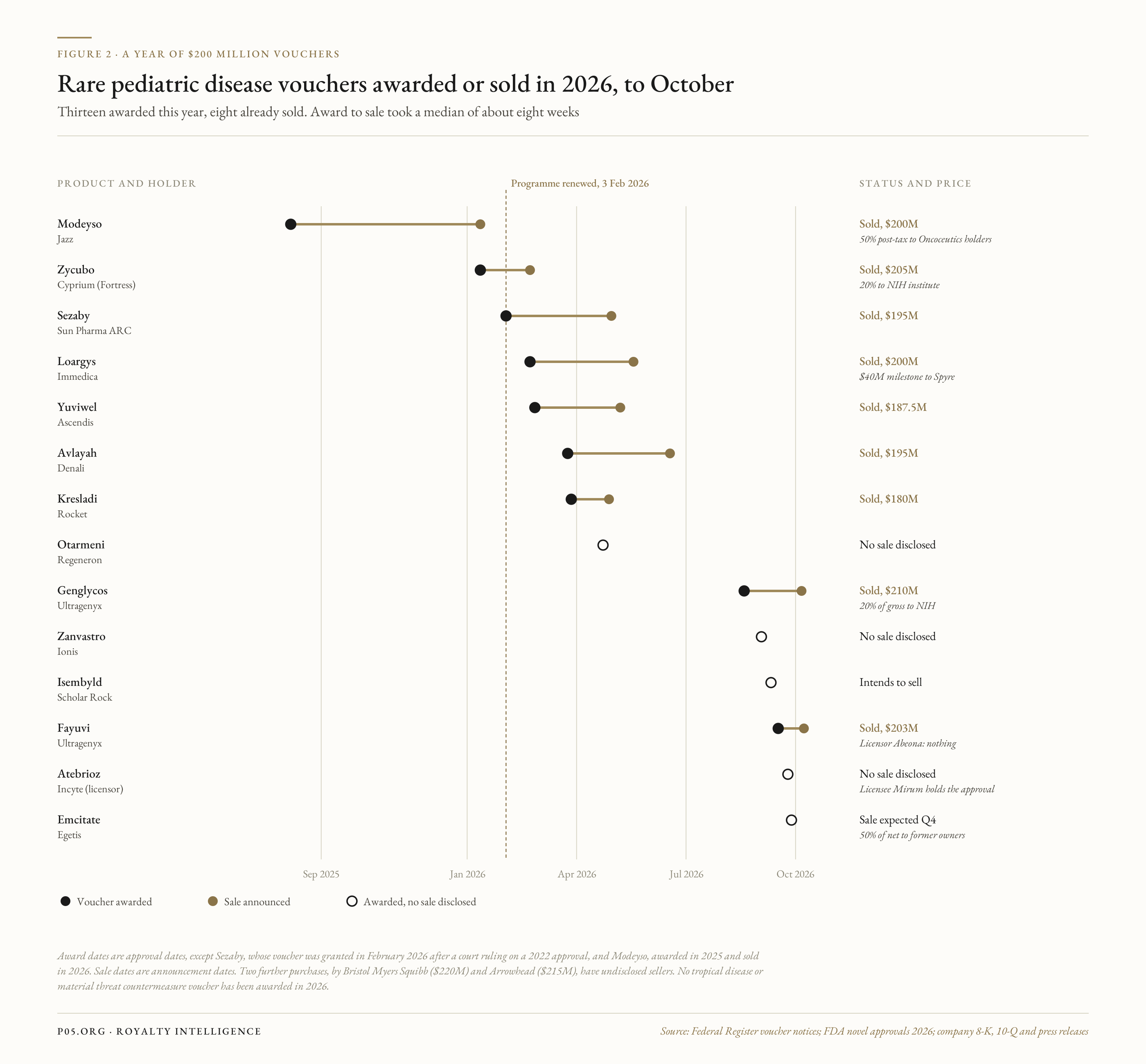
A voucher belongs to the sponsor whose application earned it. Licences, asset sales and mergers signed before the award decide whether anyone else shares the proceeds, and many say nothing. The sums have grown since Congress renewed the programme in February. The FDA has awarded 13 transferable vouchers this year, and eight have been sold at a median of about $200M, enough to exceed every milestone in many of the licences that produced them.
Royalty buyers and lenders with claims on the product have found the voucher outside their contracts, except where a lender wrote it in. On 9 October Atossa Therapeutics filed an agreement that gives its shareholders a claim on 25 per cent of a voucher it has not yet earned.
Two vouchers in one week
The FDA awards a rare pediatric disease voucher to the sponsor of an approved application for a drug that treats a serious rare disease mainly affecting children. The holder can use the voucher to obtain a six-month review of a later application, or sell it to another company. A buyer pays the seller once, and pays the FDA a user fee when it redeems the voucher.
Ultragenyx's two sales follow the same form. Each is an asset purchase agreement with an unnamed buyer, payable in cash at closing, conditional on clearance under the Hart-Scott-Rodino Act and to be filed with the annual report for 2026.
The Genglycos voucher was awarded on 19 August. Genglycos reached Ultragenyx through its 2017 acquisition of Dimension Therapeutics and rests on a patent licence from the National Institutes of Health dated 10 December 2018. The Fayuvi voucher was awarded on 17 September, with what the company called "the first-ever FDA-approved treatment for Sanfilippo syndrome Type A".
The two drugs came to Ultragenyx the same way, from an outside owner of the science. The vouchers they earned pay out differently. On the Genglycos voucher the NIH takes $42M of the $210M before costs. On the Fayuvi voucher Ultragenyx keeps the whole $203M.
What the Abeona licence says
The licence of 16 May 2022 is a standard exclusive licence of a clinical-stage gene therapy. Ultragenyx took over development, manufacturing and regulatory filings, paid Abeona's prior development costs, and owes royalties on worldwide net sales. The top tier is 10 per cent, with the lower tiers and thresholds redacted, and the rates fall if approval came after a redacted date. Section 6.2.1 caps the two sales milestones at $30M in total.
The licence uses the words Regulatory Exclusivity, Regulatory Materials and Regulatory Approval. It contains no reference to a priority review voucher. Section 4.2.3 settles ownership of the approval: "Ultragenyx will own all Regulatory Materials, including all submissions and applications for Regulatory Approvals, and Regulatory Approvals".
The royalty is calculated on net sales of the licensed product, and a voucher sale is not a sale of the product. Nothing in the contract routes the $203M to Abeona.
Abeona has sold a voucher of its own. It received one on the approval of Zevaskyn in April 2025 and sold it in May for $155M, recording a gain of $152.4M. Its quarterly report for June 2026 describes the Ultragenyx licence as a source of sales-based royalties and milestones, with no voucher entitlement.
A year of $200 million vouchers
The programme lapsed before it returned. Under the old law the FDA could award no new rare pediatric disease vouchers after 20 December 2024, except for drugs designated by that date and approved by 30 September 2026. Section 6604 of the Consolidated Appropriations Act, 2026, signed on 3 February 2026, replaced that date with 30 September 2029.
It moved the voucher user fee to the submission of the application that redeems it, and asked the Government Accountability Office to study the value of a voucher "if transferred".
The first sale of the year came before the renewal. On 12 January Jazz sold the voucher earned by Modeyso, which it had acquired with Chimerix, for $200M. Cyprium, a Fortress subsidiary, followed on 23 February with a $205M sale of the voucher from Zycubo, its copper treatment for Menkes disease, approved on 12 January.
Supply then arrived in a spring cluster. Between 23 February and 27 March the FDA approved Immedica's Loargys, Ascendis's Yuviwel, Denali's Avlayah and Rocket's Kresladi. Sun Pharma Advanced Research received a voucher in February for Sezaby, its treatment for neonatal seizures, after a court ruling in December 2025 on its 2022 approval.
All five vouchers were sold by 18 June. Rocket took the lowest price, $180M on 28 April, and Immedica the highest, $200M on 18 May.
Regeneron's Otarmeni, approved for otoferlin-related hearing loss in late April, earned a voucher that has not been reported sold. Two buyers paid more than any seller has disclosed. Bristol Myers Squibb recorded $220M for a voucher in the second quarter. Arrowhead agreed on 31 July to pay $215M for one to use on its plozasiran application in severe hypertriglyceridemia.
Neither names the seller. Otarmeni and the vouchers awarded in 2025 and still held, among them Stealth's Forzinity, UCB's Kygevvi and Fondazione Telethon's Waskyra, are the likely sources. No filing confirms a match.
A second cluster came after the summer. Between 19 August and 28 September six approvals earned vouchers. Ultragenyx had two of them. Ionis received one for Zanvastro, in Alexander disease, and Scholar Rock one for Isembyld, in spinal muscular atrophy. Mirum's Atebrioz earned a voucher that belongs to its licensor, Incyte.
Egetis received the last, for Emcitate, in a disorder of thyroid hormone transport. Ultragenyx sold both of its vouchers within seven weeks of the first award.
Scholar Rock says it intends to sell. Egetis expects a sale in the fourth quarter and owes the former owners of its asset 50 per cent of the net proceeds. Across the eight vouchers awarded and sold this year, award to sale took a median of about eight weeks.
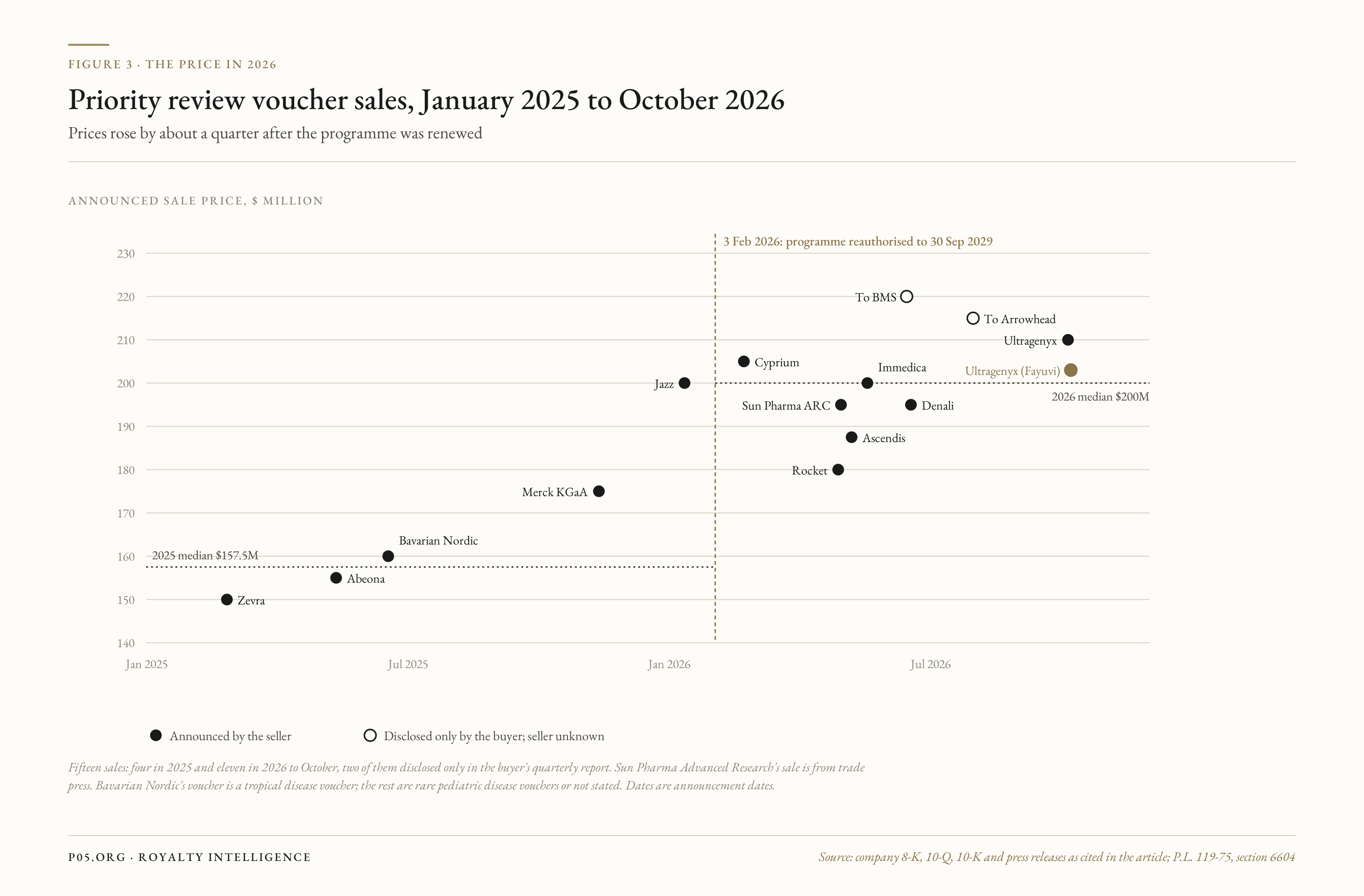
Prices rose with the renewal. Four vouchers sold in 2025: Zevra's for $150M, Abeona's for $155M, Bavarian Nordic's for $160M and Merck KGaA's, from SpringWorks, for $175M (EUR 153M). Their median was $157.5M. Eleven sales are on record in 2026, nine announced by sellers and two disclosed only in buyers' accounts.
Their median is $200M and their range $180M to $220M. Every seller-side agreement on file redacts the buyer.
The buyers redeem vouchers on large applications. Vertex used one on its povetacicept application early in the year. Regeneron charged $155M to research and development in the fourth quarter of 2025 for a voucher it had bought and decided to use.
Federal Register notices this year record approvals under vouchers for Novartis's Rhapsido, Regeneron's Eylea HD, GSK's Arexvy and Moderna's Mresvia and Mnexspike. The fee for redeeming a voucher fell from $1,962,472 in the 2026 fiscal year to $1,798,596 from 1 October, under 1 per cent of the median price.
| Award | Product | Voucher holder | Sale announced | Price | Owed to others |
|---|---|---|---|---|---|
| Aug 2025 | Modeyso | Jazz, from Chimerix | 12 Jan 2026 | $200M | 50 per cent of post-tax proceeds to former Oncoceutics holders |
| 12 Jan 2026 | Zycubo | Cyprium (Fortress) | 23 Feb | $205M | 20 per cent to the NIH child health institute |
| Feb 2026 | Sezaby | Sun Pharma Advanced Research | 30 Apr | $195M | Not disclosed |
| 23 Feb | Loargys | Immedica | 18 May | $200M | Sale triggered a $40M milestone to Spyre |
| 27 Feb | Yuviwel | Ascendis | 7 May | $187.5M | None stated |
| 24 Mar | Avlayah | Denali | 18 Jun | $195M | None stated |
| 27 Mar | Kresladi | Rocket | 28 Apr | $180M | None stated |
| Apr | Otarmeni | Regeneron | No sale disclosed | n/a | n/a |
| Not known | Not known | Undisclosed seller, to Bristol Myers Squibb | Q2 2026 | $220M | Not known |
| Not known | Not known | Undisclosed seller, to Arrowhead | 31 Jul | $215M | Not known |
| 19 Aug | Genglycos | Ultragenyx | 6 Oct, awaiting antitrust clearance | $210M | 20 per cent of gross to the NIH |
| 3 Sep | Zanvastro | Ionis | No sale disclosed | n/a | n/a |
| 11 Sep | Isembyld | Scholar Rock | Intends to sell | n/a | n/a |
| 17 Sep | Fayuvi | Ultragenyx | 8 Oct, awaiting antitrust clearance | $203M | None stated, licensed from Abeona |
| 25 Sep | Atebrioz | Incyte, the licensor, with Mirum holding the approval | No sale disclosed | n/a | n/a |
| 28 Sep | Emcitate | Egetis | Expected in Q4 | n/a | 50 per cent of net proceeds to former owners |
How contracts split the voucher
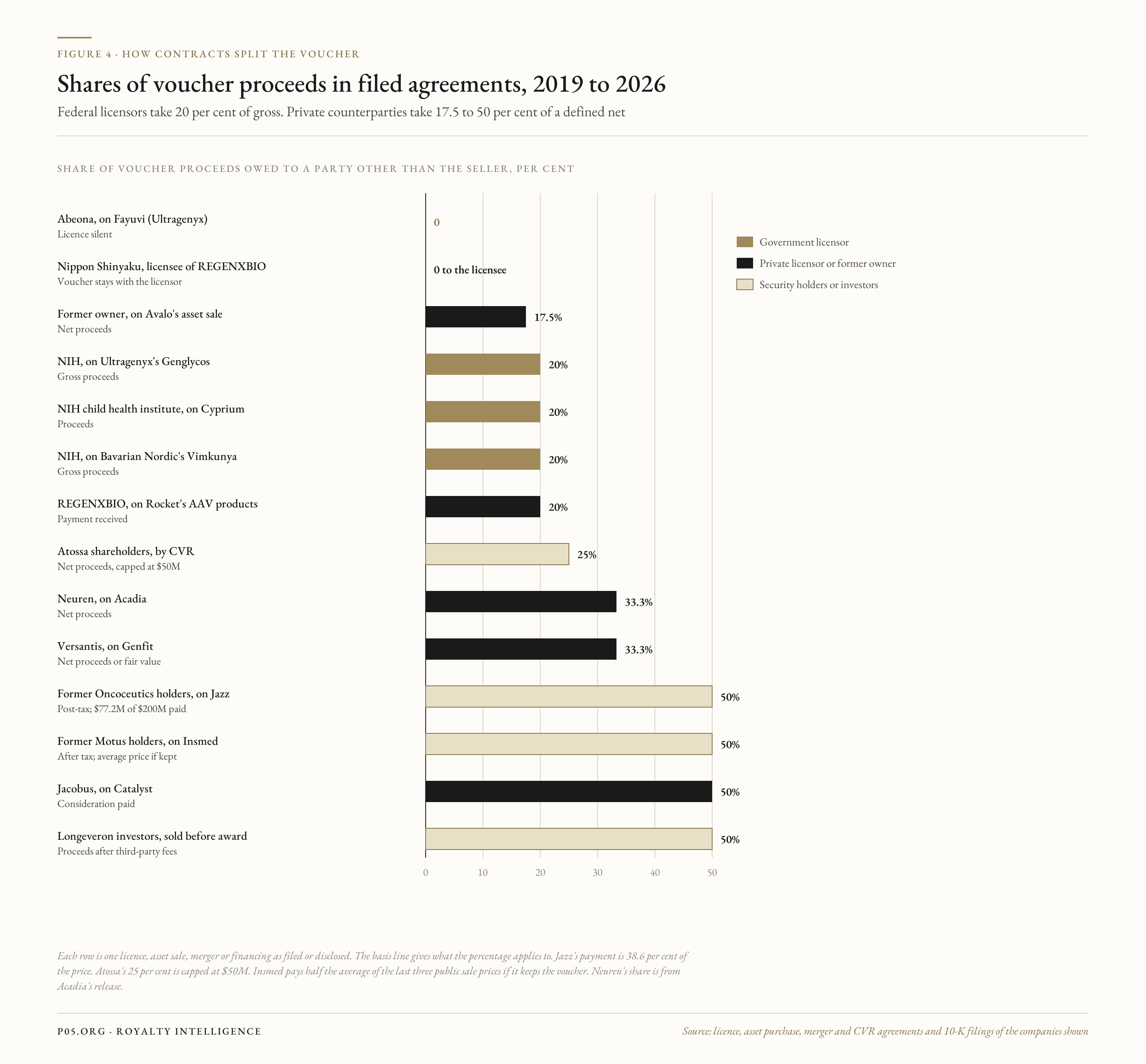
Where a contract does address the voucher, it uses one of a small number of designs. The originator can keep it outright. REGENXBIO's 2025 licence of RGX-121 to Nippon Shinyaku provides that "REGENX will retain any priority review voucher issued to REGENX, its Affiliates or its sublicensees, as well as one-hundred percent (100%) of the net" proceeds, and that the voucher is not consideration under the licence.
When Cyprium transferred its Menkes disease programme to Sentynl in 2023, it retained "100% ownership over any FDA priority review voucher". Cyprium sold that voucher for $205M in February.
The licensor can take a percentage. Federal agencies take a fixed 20 per cent of gross proceeds under their patent licences, as at Ultragenyx, Bavarian Nordic and Cyprium. Rocket owes REGENXBIO 20 per cent of voucher proceeds on products made under its AAV licence. Private licensors and former owners have negotiated more.
Neuren took one-third of Acadia's sale. Genfit owes Versantis "1/3 of the net proceeds". Catalyst owes Jacobus "50% of the consideration". Avalo's 2023 sale of an asset to AUG Therapeutics reserved 17.5 per cent of net proceeds from any voucher sale for the seller.
The licensor can hold an option instead. Sanofi's 2019 licence to Sling Therapeutics, now Sionna, gives Sanofi an exclusive right to buy the voucher at a fixed, redacted "PRV Value", and a share of the price if it passes. Novartis held a similar option in its 2019 licence to Pharming. Or the licensee can take the voucher and pay a fixed sum for it. Lilly's 2025 licence from MeiraGTx pays an AIPL1 PRV milestone once Lilly owns the voucher.
The closest contrast to Abeona came this year. Incyte licensed zilurgisertib, for fibrodysplasia ossificans progressiva, to Mirum in April 2026 for $16.0M upfront, up to $48.0M of regulatory milestones and up to $15.0M of commercial milestones, plus mid-to-high single-digit royalties. Incyte's quarterly report adds that it is "eligible to receive a Priority Review Voucher".
The FDA approved the drug as Atebrioz on 25 September, and Mirum holds the approval. At the 2026 median a sale would bring Incyte more than the $79M of upfront and milestone payments in the same licence. Incyte signed two months after the programme was renewed.
A voucher can also trigger a payment that is not a share. Immedica's sale of the Loargys voucher set off a $40M milestone under Immedica's 2023 purchase of the asset from Aeglea, now Spyre. Spyre passes the money to the holders of the contingent value rights issued in the Aeglea transaction.
What net means
A percentage means little until the contract defines what it is a percentage of. The NIH takes 20 per cent of gross proceeds, so bankers' fees and taxes fall entirely on the seller. The merger agreement of 2021 under which Chimerix bought Oncoceutics uses "Net Voucher Proceeds", net of capped advisory fees.
Jazz, which acquired Chimerix in 2025, describes the obligation in its annual report as 50 per cent of the post-tax proceeds and paid the former Oncoceutics holders $77.2M from the $200M sale. That is 38.6 per cent of the price.
Some contracts value a voucher that is never sold. Insmed must pay the former owners of Motus Therapeutics, if it keeps a voucher, "50% of the average of the sales prices for the last three publicly disclosed priority review voucher" sales. Genfit owes one-third of fair market value if it uses the voucher itself. Under those terms the public prices of 2026 become the payment.
Taxes are a material deduction. Zevra recorded $11.1M of tax payable on its $150M sale. Under a split after tax, the counterparty shares in whatever the seller's loss carryforwards save, and a seller that pays full tax hands over less.
Atossa: a share of a voucher that does not yet exist
Atossa Therapeutics has rare pediatric disease designations for (Z)-endoxifen in Duchenne muscular dystrophy and McCune-Albright syndrome. It has not filed for approval in either. On 8 October its board declared a dividend of one stapled contingent value right per share, to holders of record on 19 October.
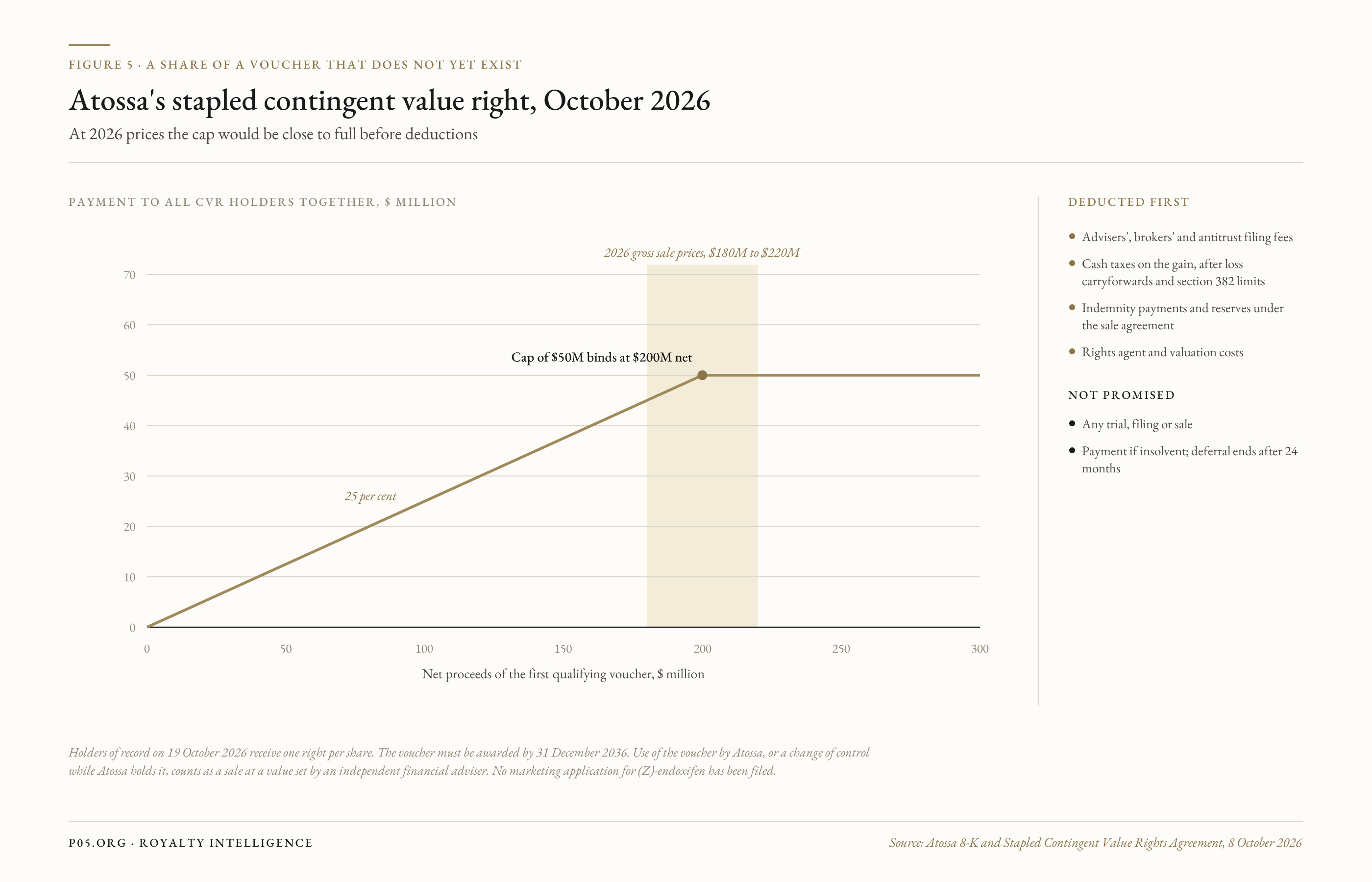
A contingent value right is a contract that pays its holder if a defined event occurs. This one pays "25% of the Net Proceeds" of the sale of the first voucher awarded to Atossa by 31 December 2036, capped at $50M.
The agreement sets out the deductions. Advisory and antitrust filing fees come off first. So do taxes on the gain, after loss carryforwards and the limits of section 382, indemnity payments and reserves, and the costs of administering the rights.
If Atossa uses the voucher itself, or is sold while holding it, an independent financial adviser sets a fair market value and the holders are paid on that. The rights cover a voucher for any of Atossa's current programmes, under any of the three transferable voucher statutes.
The cap binds at $200M of net proceeds, which is where the 2026 market sits before deductions. At the median price and with no tax payable, holders would receive close to $50M. The agreement gives them few protections beyond the formula.
Atossa has no duty to run a trial, file an application or sell a voucher, and it "owes no fiduciary duty to holders". A payment that would leave the company insolvent, or that Delaware law would not allow as a dividend, can be deferred without interest. If it is still unpaid after 24 months, the obligation ends. The rights trade with the shares until the board chooses to detach them.
Other companies have sold fractions of a voucher before earning it. In March 2026 Longeveron sold a "PRV Interest" of 50 per cent of future proceeds in a private placement, with an obligation that passes to anyone who acquires the programme.
Jasper's merger with Kira, in July 2026, carries a fixed $30M right payable if the FDA issues a voucher for briquilimab by the end of 2028. None of the records reviewed shows a whole voucher sold before it was awarded.
Royalty buyers and lenders
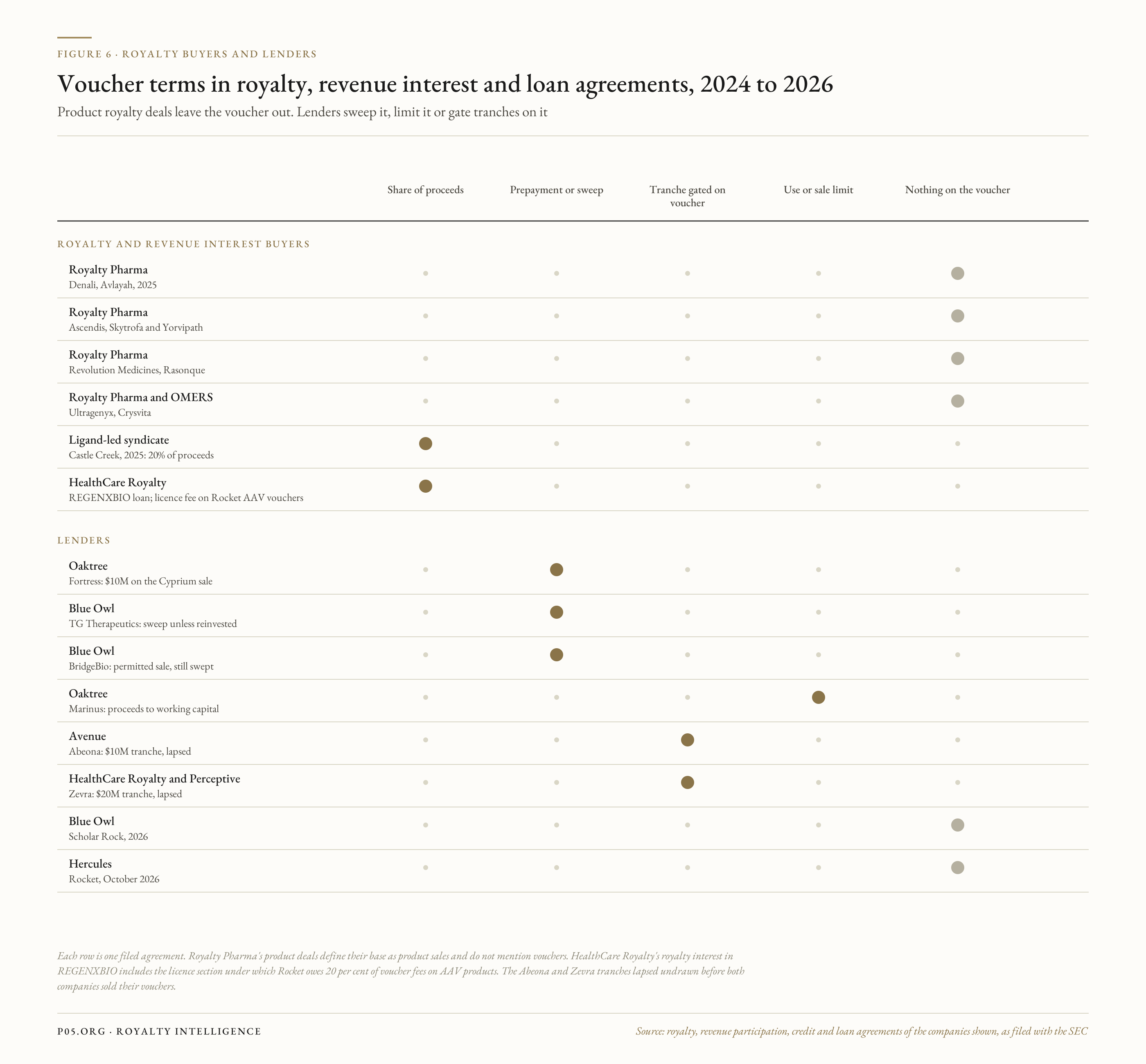
A royalty buyer's contract rarely mentions the voucher. Royalty Pharma bought a revenue participation in Denali's tividenofusp alfa in December 2025 for $200M at approval. The agreement covers payments on account of sales of the products and does not use the word voucher. The drug was approved as Avlayah in March, and Denali sold its voucher in June for $195M under a purchase agreement stating that no third party is entitled to any portion of the proceeds.
Royalty Pharma's synthetic royalties with Ascendis, its revenue participation with Revolution Medicines and its Spinraza and pelacarsen royalties from Ionis reach product sales only. So do the Crysvita royalties that Ultragenyx sold to Royalty Pharma and OMERS. Ascendis and Ultragenyx have sold vouchers this year, and Ionis holds one.
Lenders write the voucher terms. Oaktree's credit agreement with Fortress named a sale of any voucher by its subsidiary Cyprium as a monetisation event. A second amendment of 22 February 2026, signed the day Cyprium agreed its $205M sale, fixed a mandatory prepayment of $10,000,000 and cut the minimum liquidity test to $2,000,000 once the loan fell to $15,000,000.
Blue Owl's loan to TG Therapeutics sweeps asset-sale proceeds above a redacted threshold, "including, for the avoidance of doubt, any priority review voucher", unless they are reinvested. Oaktree's 2024 amendment for Marinus let the company sell its voucher only if the net cash proceeds went to working capital.
Tranches gated on a voucher have not been drawn. Avenue's 2024 loan to Abeona offered a $10M second tranche on approval of pz-cel "with the issuance of a Priority Review Voucher" by 30 September 2024.
HealthCare Royalty and Perceptive's 2024 loan to Zevra made a $20M Term C draw conditional on the voucher having been obtained, and excluded voucher proceeds from the net sales covenant. Both tranches lapsed. Both companies then sold their vouchers, for $155M and $150M, and neither lender took a share.
Voucher fees can reach a royalty holder through an upstream licence. Rocket's 2018 licence from REGENXBIO requires it to pay "twenty percent (20%) of the fees" from the sale of a voucher related to a licensed AAV product, or 20 per cent of the average of the last five public sale prices if Rocket uses it.
HealthCare Royalty's 2025 loan to REGENXBIO defines its royalty interest to include section 3.6 of a licence that REGENXBIO's filings describe as held by the assignee of Rocket. The Kresladi voucher, from a lentiviral product, fell outside that clause. A voucher on RP-A501, Rocket's AAV programme in Danon disease, would fall within it.
A small market now prices voucher interests directly. Ligand led a $75M purchase from Castle Creek in February 2025 that bought a royalty and 20 per cent of voucher proceeds, with a covenant to seek and sell the voucher. XOMA received $8.1M of Day One's 2024 sale through its Viracta royalty agreement. Ligand completed its acquisition of XOMA in July 2026 and holds both positions.
The voucher that cannot be sold
The FDA began issuing a second kind of voucher in October 2025. A Commissioner's National Priority Voucher aims at a review of about one to two months once a complete application is filed.
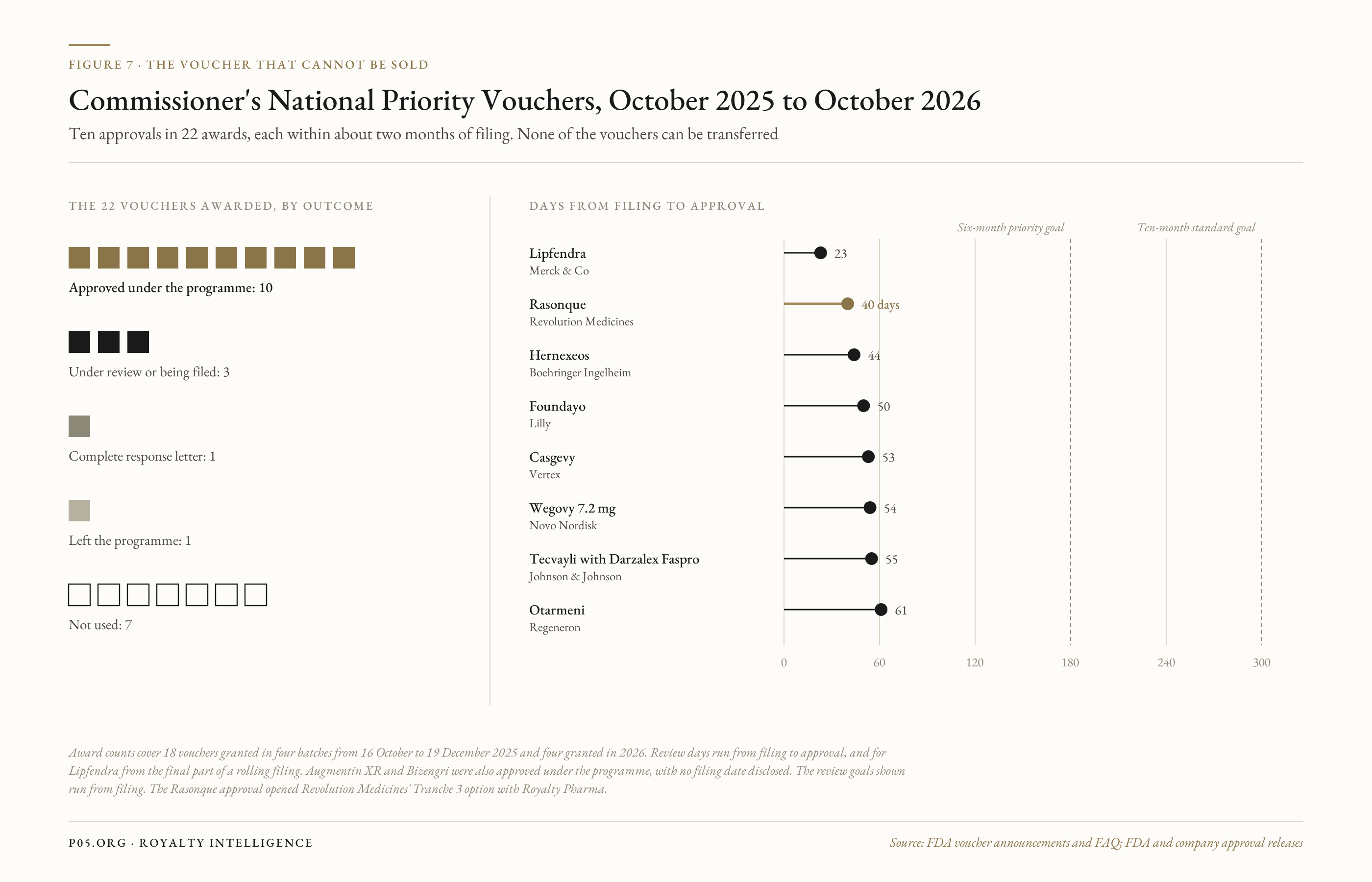
The FDA's FAQ says these vouchers are non-transferable, "remain valid through changes in company ownership" and must generally be put to use within two years. The commissioner chose 18 products in four batches before the end of 2025, starting with nine sponsors on 16 October, and added four more by May 2026, three of them on 24 April. No award has been found since.
Ten products have been approved under the programme, nine of them in 2026, with filing-to-approval times between 23 and 61 days. Disc Medicine's bitopertin received a complete response letter in February. Sanofi took Tzield out of the programme, and the FDA approved it on the ordinary path in June. Otarmeni was approved under a national priority voucher and earned a transferable one as well.
The faster clock reaches royalty contracts through their dates. Revolution Medicines' Rasonque was approved on 26 August 2026, 40 days after filing under a national priority voucher. The approval opened the Tranche 3 option in its Royalty Pharma revenue participation, which lapsed unused on 10 October, and forced a $250M loan draw from the same funder.
Terms keyed to approval before a fixed date, with short exercise windows, fell due months earlier than a standard review would have allowed. Royalty Pharma's interest in Rasonque gains nothing from the voucher itself, which cannot be sold.
| Award | Company | Product | Status, October 2026 |
|---|---|---|---|
| 16 Oct 2025 | USAntibiotics | Augmentin XR, domestic manufacture | Approved 9 Dec 2025 |
| 16 Oct 2025 | Sanofi | Tzield | Left the programme, approved 12 Jun 2026 |
| 16 Oct 2025 | Achieve | Cytisinicline, vaping cessation | Not used |
| 16 Oct 2025 | Regeneron | Otarmeni | Approved 23 Apr 2026, 61 days |
| 16 Oct 2025 | Dompé | Cenegermin, optic neuropathy | Not used |
| 16 Oct 2025 | Revolution Medicines | Rasonque | Approved 26 Aug 2026, 40 days |
| 16 Oct 2025 | Disc Medicine | Bitopertin | Complete response letter, 13 Feb 2026 |
| 16 Oct 2025 | Phlow | Ketamine, domestic ingredient | No approval found |
| 16 Oct 2025 | EMD Serono | Pergoveris | Filing reported, no decision found |
| 6 Nov 2025 | Boehringer Ingelheim | Hernexeos, first-line | Approved 26 Feb 2026, 44 days |
| 6 Nov 2025 | Johnson & Johnson | Sirturo, paediatric | Not used |
| 6 Nov 2025 | GSK | Jemperli, rectal cancer | Under review, decision due Feb 2027 |
| 6 Nov 2025 | Vertex | Casgevy, ages 2 and up | Approved 1 Jul 2026, 53 days |
| 6 Nov 2025 | Lilly | Foundayo | Approved 1 Apr 2026, 50 days |
| 6 Nov 2025 | Novo Nordisk | Wegovy 7.2 mg | Approved 19 Mar 2026, 54 days |
| 15 Dec 2025 | Johnson & Johnson | Tecvayli with Darzalex Faspro | Approved 5 Mar 2026, 55 days |
| 19 Dec 2025 | Merck & Co | Lipfendra | Approved 15 Jul 2026, 23 days from the final part of a rolling filing |
| 19 Dec 2025 | Merck & Co | Sacituzumab tirumotecan | Not used |
| 24 Apr 2026 | Compass Pathways | COMP360 | Rolling filing, due Q4 2026 |
| 24 Apr 2026 | Usona Institute | PSIL201 | Not used |
| 24 Apr 2026 | Transcend, now Otsuka | TSND-201 | Not used, voucher passed with the acquisition |
| May 2026 | Partner Therapeutics | Bizengri, cholangiocarcinoma | Approved 8 May 2026 |
Implications for the Pharmaceutical Royalty Market
A royalty calculated on net sales does not reach a voucher, whether the royalty was licensed or sold for cash. Abeona's royalty on Fayuvi pays on product sales and nothing else, and any buyer of that royalty buys the same base.
The $203M from Fayuvi's voucher went to the licensee and exceeds Abeona's total milestone entitlement of $30M several times over. Royalty Pharma's position at Denali shows the same gap from the buyer's side. It paid $200M for a share of Avlayah's sales and received none of the $195M voucher sale three months later.
For a licensor, the clause has to be written before approval. Federal licensors have a standard 20 per cent of gross. Private licensors in the filed agreements have taken between 17.5 and 50 per cent, held purchase options, or kept the voucher.
Abeona's 2022 licence ties its royalty rates to the date of approval and says nothing about the voucher that the approval would bring. Incyte's licence to Mirum, signed after the renewal, keeps the voucher with the licensor.
For a lender, the voucher is an asset sale to be swept, permitted or reserved, and an analyst should net licensor, earn-out and contingent value right shares from the price before counting it as collateral. Voucher claims also pass through acquisitions.
Jazz paid former Oncoceutics holders under a merger it was not party to. Immedica's sale paid a milestone to Spyre that passed to Aeglea's old shareholders. A seller's net receipts can sit well below the headline price.
The national priority programme adds speed without a tradable asset. Its approvals have come in under two months, so a royalty or loan term set on approval before a fixed date runs on a faster calendar, as it did at Revolution Medicines.
For pricing, the rare pediatric programme now has a fixed end. A drug must be approved by 30 September 2029 to earn a voucher. Five of this year's 13 were unsold in October, and the awards made before the deadline set the supply against which buyers will bid. Congress has ordered the GAO to study what transferred vouchers are worth.
Conclusion
Both Ultragenyx sales were awaiting antitrust clearance in October 2026. When they close, Ultragenyx will receive $413M, pay the NIH $42M and owe nothing to Abeona from the Fayuvi voucher. Abeona keeps its royalty of up to 10 per cent and its claim on $30M of sales milestones.
Atossa's record date falls on 19 October. From that day each Atossa share carries a right to a quarter of a voucher that the FDA has not awarded, for a drug not yet filed, under a cap that the 2026 market price would come close to filling.
All information in this report was accurate as of the research date and is derived from publicly available sources including court opinions, regulatory guidance, academic literature, SEC filings, and financial news reporting. Information may have changed since publication. This content is for informational purposes only and does not constitute investment, legal, or financial advice. The author is not a lawyer or financial adviser.