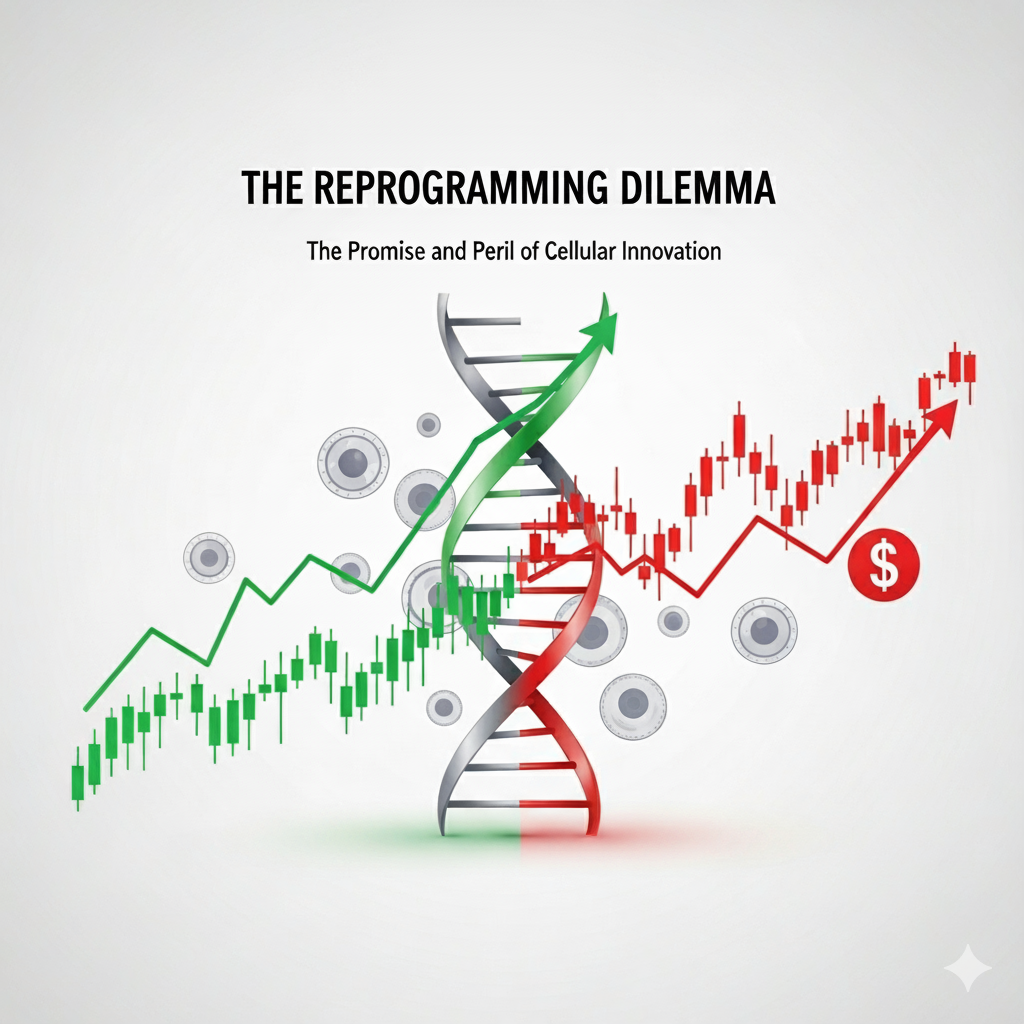
The molecular precision is remarkable: these factors orchestrate a three-stage process (initiation, maturation, stabilization) that converts aged cells back to a youthful state through systematic DNA demethylation, reducing CpG methylation from 70-80% to <15%.
The epigenetic reset follows an elegant pathway. TET enzymes oxidize methylated cytosines (5mC → 5hmC → 5fC → 5caC), while histone modifications shift from aged patterns to youthful chromatin states. The H3K4me3 active marks expand from narrow 200-500bp peaks to broad domains exceeding 4kb, fundamentally restructuring the cellular epigenome. This isn't mere theory—multiple epigenetic clocks confirm the reversal, with the Horvath clock (353 CpG sites, r=0.96 correlation with age) showing 30-year biological age reduction in human fibroblasts.
Yet this same molecular machinery harbors lethal potential. The c-Myc and Klf4 factors are known oncogenes that can trigger uncontrolled cell proliferation. Continuous OSKM expression for just 12 days proves lethal in mouse heart tissue, while 6 days shows benefits—a razor-thin therapeutic window. The fundamental paradox: "Even one fully reprogrammed cell is already too many cells at risk of teratoma," as researchers acknowledge, creating an essentially unsolvable safety threshold problem.
Investment flows mask fundamental efficiency crisis
But the efficiency data tells a starkly different story. Normal iPSC reprogramming achieves less than 1% success rate, with only about 25% of cells undergoing even partial reprogramming. Scaling up experiments causes efficiency to drop 50-fold. The enhanced Mbd3 depletion method claiming "100% efficiency" requires such specific conditions that it remains impractical for therapeutic use. Manufacturing costs range from $36,482-45,000 per batch for manual production, with projected treatment costs of $100,000-500,000 per patient—comparable to existing gene therapies like Libmeldy at $4.25 million.
Animal triumphs fail to translate to human complexity
Yet species translation remains a fundamental barrier. Human cells reprogram 2.5 times slower than mouse cells due to longer cell cycles and increased protein stability. The molecular targets differ significantly—only 3,919 of 15,789 orthologous genes are shared OSKM targets between species. More critically, what takes days in mice could require weeks or months in humans, exponentially increasing cancer risk. No Yamanaka reprogramming therapy has entered human clinical trials for aging, with only vision restoration studies progressing to early clinical stages.
Expert skepticism challenges the rejuvenation narrative
The late Judith Campisi's research on cellular senescence revealed aging interventions as a "double-edged sword"—protective against cancer but harmful with accumulation. Her work suggests cellular reprogramming may disrupt natural tumor suppression mechanisms, a concern validated by studies showing elevated coding point mutation rates during iPSC reprogramming and genomic instability that persists long-term.
Delivery mechanisms and dosing create unsolvable paradoxes
The technical bottlenecks compound at every level. AAV vectors, the most promising delivery system, face dose limitations and can cause hepatocarcinomas at therapeutic levels. Retroviral systems risk insertional mutagenesis, while humoral immune responses prevent repeated AAV administration—critical for a therapy requiring cyclic dosing. The mRNA delivery via lipid nanoparticles remains experimental, with tissue-specific targeting unsolved for systemic reprogramming.
The dosing paradox appears insurmountable. Researchers discovered that 2-day pulse, 5-day chase cycling prevents teratoma formation, but this protocol varies dramatically by tissue. The maturation phase requires 13 days continuous expression in vitro, but >2 days proves lethal in vivo for many tissues. Continuous OSKM expression causes liver and intestinal failure, with 60% mortality reduction achieved only by avoiding these organs entirely.
Chemical reprogramming offers hope with six cocktails reversing aging in less than a week, including CHIR99021 (GSK3β inhibitor) and E-616452 (TGF-β inhibitor). Yet these remain in early research stages with unknown long-term effects. The fundamental problem persists: how to achieve sufficient reprogramming for rejuvenation without triggering dedifferentiation and cancer.
Regulatory landscape offers no clear path forward
The FDA's position creates an existential challenge: aging is not recognized as a disease, eliminating any direct regulatory pathway for anti-aging therapies. Companies must target specific age-related conditions instead, fragmenting development efforts and increasing costs. The $1.943 billion average cost to bring a cell/gene therapy to market becomes prohibitive when multiple indications require separate trials.
Current FDA statistics reveal the scale of the challenge. Only 7 cell and gene therapies received approval in 2023, falling short of the predicted 10-20 annual approvals. The agency requires up to 15 years post-market surveillance, with frequent clinical holds for safety concerns. The 2023 CBER reorganization created a "super office" requiring 125 new staff members, indicating regulatory complexity that continues growing.
International harmonization remains absent, with varying requirements across jurisdictions. Japan requires facility replacement every 5 years, while Europe maintains different GMP standards. Without global coordination, development costs multiply and timelines extend indefinitely.
Comparative analysis exposes relative limitations
When evaluated against other anti-aging interventions, Yamanaka reprogramming shows both exceptional promise and unique risks. Metformin, with its 60+ year safety record, offers modest benefits with minimal side effects and costs under $1,000 annually. Rapamycin achieves 23-26% lifespan extension in mice with manageable immunosuppression at low doses. Senolytics like dasatinib plus quercetin show healthspan improvements in early trials without cancer risks.
Approach
Efficacy
Safety
Cost/Year
Availability
Risk/Reward
Yamanaka Factors
109% extension*
Lethal cancer risk
$100K-500K
Not available
🔥🔥🔥🔥🔥
Metformin
5-15% extension
60+ year record
<$1,000
Prescription
⭐⭐
Rapamycin
25% extension*
Immunosuppression
$1K-5K
Off-label
⭐⭐⭐
Senolytics
Healthspan only
Generally safe
$100-1,000
Clinical trials
⭐⭐
Caloric Restriction
20-40% extension*
Natural/safe
Free (saves money)
Immediate
⭐⭐⭐⭐
*Mouse studies. Human data limited or unavailable. Sources: NAD.com, Mayo Clinic
The efficiency comparison is stark. Senolytics achieve >90% senescent cell clearance in targeted tissues, while Yamanaka reprogramming struggles with <1% efficiency. NAD+ precursors like NMN reliably raise blood NAD+ levels and improve metabolic markers for $100-1,000 annually, versus $100,000-500,000 projected for reprogramming therapy. Even caloric restriction, free and immediately available, demonstrates proven lifespan extension across species.
Yet only Yamanaka factors theoretically offer true age reversal rather than slowing decline. The 109% lifespan extension in aged mice exceeds any other intervention. The comprehensive epigenetic reset addresses multiple aging hallmarks simultaneously, while other approaches target single pathways. This creates a high-risk, high-reward scenario that may justify the massive investment despite fundamental challenges.
The brutal mathematics of cellular reprogramming economics
The economic reality becomes clearer through quantitative analysis. With reprogramming efficiency below 1% and manufacturing costs of $36,482-45,000 per batch, achieving commercial viability requires ≥10^9 cells per therapeutic dose. At 70% medium usage reduction in optimized protocols, resource requirements remain massive. Full automation shows only 7% cost savings at scale, while requiring 2,000L single-use bioreactor batches for commercial production.
Market projections vary wildly, from $375.3 million by 2029 (conservative) to $760 million by 2034 (optimistic) specifically for reprogramming approaches. The broader cell and gene therapy market projects $7.79-25.03 billion by 2024, suggesting uncertainty exceeding 300%. With 83% of investment concentrated in the United States and limited global access due to costs, the patient population remains constrained to wealthy individuals in developed nations.
The comparison with successful gene therapies proves sobering. Zolgensma at $2.125 million treats a fatal childhood disease with clear medical necessity. Yamanaka reprogramming for aging—not recognized as a disease—faces impossible reimbursement hurdles at similar price points. Even with dramatic cost reductions, reaching the $10,000-50,000 range necessary for broad adoption appears decades away.
Conclusion: Revolution postponed, not cancelled
Yamanaka factor reprogramming embodies both the greatest promise and deepest challenges in longevity science. The molecular mechanisms are validated, the animal data unprecedented, and the investment overwhelming. Yet with <1% efficiency, lethal cancer risks, no clear regulatory pathway, and costs potentially exceeding $500,000 per treatment, the gap between laboratory triumph and clinical reality remains vast.
The technology may ultimately succeed, but not in its current form. Chemical alternatives avoiding genetic modification, improved delivery systems preventing immune responses, and precise dosing protocols balancing rejuvenation with safety all require fundamental breakthroughs. The $6 billion invested may yield critical insights, but Jay Olshansky's warning resonates: radical human life extension remains "implausible in this century" through current reprogramming approaches.
The field stands at a crossroads. Either researchers solve the efficiency-safety paradox through yet-unknown mechanisms, or Yamanaka reprogramming joins the graveyard of revolutionary technologies that worked perfectly in mice but failed the translation to human complexity. The smart money, paradoxically, may be betting on both outcomes simultaneously—hence the massive investment despite overwhelming technical challenges. In the brutal calculus of longevity research, even a 1% chance of reversing human aging justifies billion-dollar bets when the prize is defeating death itself.
Subscribe to P05.org
Don’t miss out on the latest issues. Sign up now to get access to the library of members-only issues.