
A royalty made in litigation: the settlement rate on a marketed competitor
A settlement royalty is paid by a party that was sued to the party that sued it, for the right to keep selling. At signing the payer's alternative was an order removing its product from the market. On a cash flow schedule it resembles a licence royalty. The contract behind it, the counterparty, the term and the holder's enforcement position are different.
BioMarin and Ascendis produced one of these on 30 August 2026. The Section 337 investigation BioMarin agreed to dismiss had been tried in April and was sitting in post-hearing briefing, three months short of its target date, with no initial determination on the record. The rate is the highest on a marketed competing drug in the disclosed record, a few points above the only jury rate on one to survive appeal. The two companies' disclosures differ on the term.
The compulsory licensing piece treated a rate set by a state on a base the state chooses. This one treats a rate set by a competitor holding an exclusion order it never had to use.
1. The print
BioMarin Pharmaceutical (Nasdaq: BMRN) and Ascendis Pharma A/S (Nasdaq: ASND) entered a binding term sheet resolving the patent and ancillary disputes pending between them globally. Ascendis pays 20 percent of Yuviwel net sales in the United States and 18 percent in the European Union, Brazil and South Korea. BioMarin grants a non-exclusive, worldwide, royalty-bearing licence covering all current and potential indications, named as achondroplasia and hypochondroplasia, and covering use of Yuviwel in combination with other medicines. BioMarin also waives certain regulatory rights and exclusivities and gives a covenant not to sue.
What goes away: the Section 337 investigation before the ITC, and litigation in Brazil, Denmark, Germany, South Korea and the Northern District of California (BioMarin 8-K exhibit 99.1, Ascendis release).
No upfront payment appears anywhere in either disclosure. Every other settlement in this category carried one, and in four of the five the upfront was the headline number. Here the whole consideration is the stream.
Yuviwel (navepegritide, developed as TransCon CNP) is a once-weekly prodrug of C-type natriuretic peptide approved by the FDA in February 2026 and launched in the United States in April with its own orphan exclusivity. Second-quarter revenue was $9M (EUR 8M), with more than 220 US patients through 31 July. The European marketing authorisation application is under EMA review with a decision expected in the fourth quarter of 2026.
BioMarin sells VOXZOGO (vosoritide) into the same indication, on $927M of 2025 revenue, about 73 percent of it outside the United States, with $253M in the second quarter of 2026, treated patients up more than 20 percent year on year, the United States at about a quarter of revenue, and guidance of $1bn to $1.05bn for the year. Displacement of Voxzogo now returns 20 percent of the displacing revenue to BioMarin, in the United States, on a product it does not control, cannot promote, and has no contractual ability to influence.
BioMarin is also developing BMN 333, its own long-acting CNP, with a Phase 2/3 study enrolling and data expected in 2027. The licence to Ascendis is worldwide and covers all current and potential indications; the royalty reaches four territories.
2. The two releases do not say the same thing about the term
BioMarin's sentence gives the 20 percent US rate, then gives 18 percent for the European Union, Brazil and South Korea "until May 2030". Read literally, the date bounds the second leg only, and the US royalty has no stated end.
Ascendis states the same rates and then closes with a single temporal clause covering both: from the first commercial sale in each country through 20 May 2030.
That date is not arbitrary. BioMarin's FY2025 annual report lists EP 2432489, the European Voxzogo composition and method-of-treatment patent, as expiring 20 May 2030, with SPCs granted in thirteen countries extending it to 20 May 2035. The US counterpart, US 8,198,242, expires 11 June 2030, with a patent term extension granted to 11 June 2035. The patent asserted at the ITC, US Reissue Patent RE48,267, takes the term of the original.
So the term sheet is anchored to unextended patent expiry in both blocs, and the two anchors are three weeks apart.
There is a ceiling above the anchor as well. Brulotte v Thys (1964), reaffirmed in Kimble v Marvel, 576 U.S. 446 (2015), makes a royalty for post-expiry use of a patent unlawful per se. A settlement licence therefore cannot run past the last patent it licenses without being redrafted as a hybrid with a know-how component and a step-down at expiry, and there is no sign of that here.
The last lawful end date is the expiry of the licensed patent, and the question is which patent.
The reason the extended dates do not appear is statutory. Rights during a 35 USC 156 extension run only to the approved product, its salts and esters, and its approved uses. In Biogen v Banner Life Sciences, 956 F.3d 1351 (Fed. Cir. 2020), the Federal Circuit held that where a patent claims more than the approved product, exclusive rights to everything else expire on the original date.
BioMarin's extension was earned on vosoritide. Navepegritide is a different molecule, so the extension to 2035 does not reach it and the enforceable term against Ascendis ends in 2030. On that reading the US royalty ends in June 2030 and the difference between the releases is one of drafting. Neither company has published the definitive agreement, and the binding term sheet is not the definitive agreement.
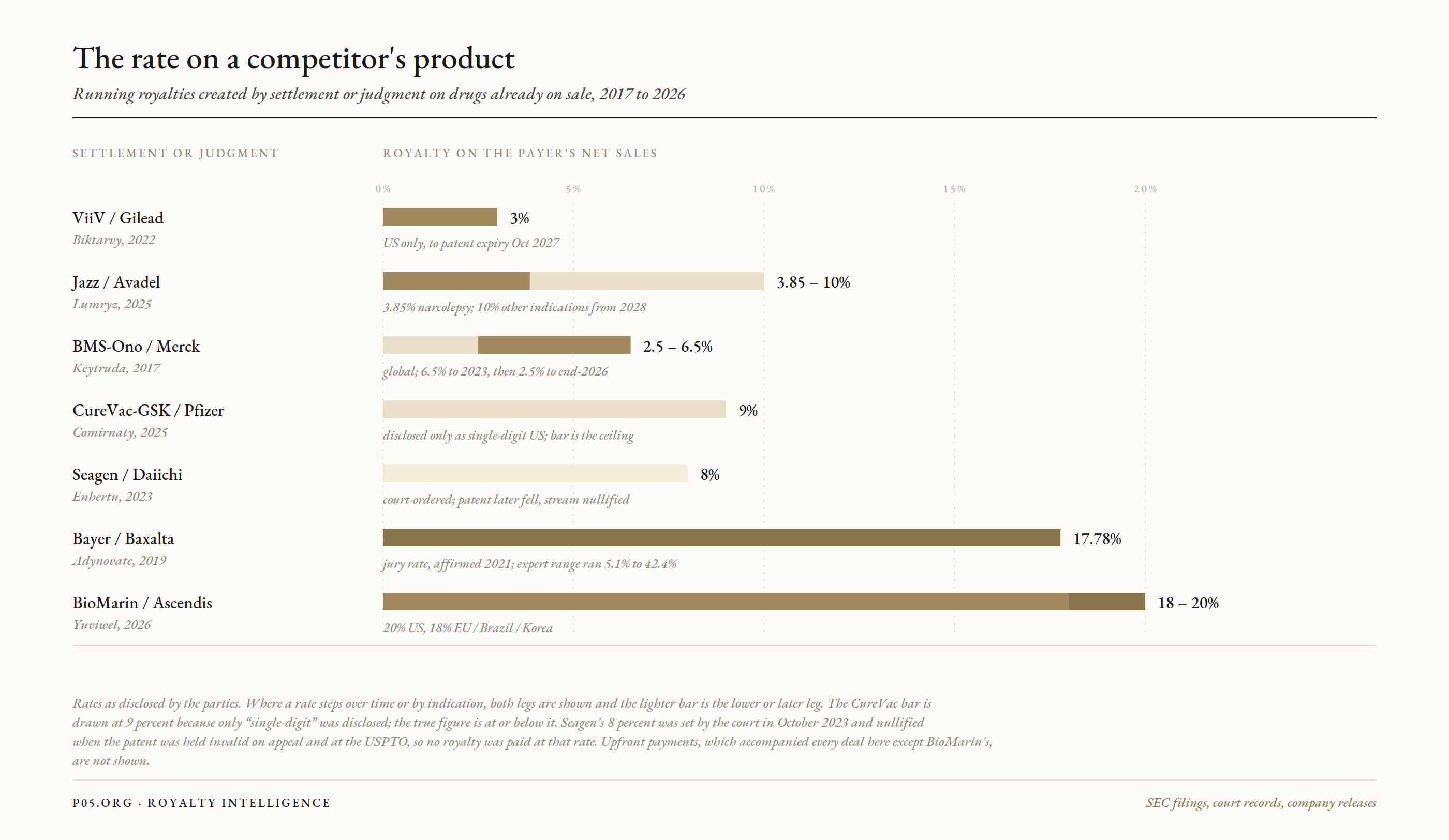
Figure 1. The extended term does not reach a competitor. Solid segments run to base expiry, pale segments are the term added by US patent term extension and by European SPCs. The two base expiries fall three weeks apart, and the parties' releases differ on whether the US leg is bounded at all.
Also unstated: the size of the retroactive amount, whether it is paid as a lump sum or netted against future royalties, whether 20 percent is flat or a top tier, whether any minimum or cap applies, and whether Ascendis has covenanted not to challenge the patents it was attacking in Korea and Brazil as recently as March 2026.
Until terminated treated streams with no bound at all, and made the point that the bound is what turns a royalty into a finite series. Here there is a bound, it is a patent date, and the two counterparties published different accounts of where it falls.
3. How often this happens
The category is brand against brand, both products marketed, and the settlement leaves the accused product on sale against a running royalty. Excluding Hatch-Waxman and BPCIA settlements, where the currency is an entry date rather than a rate, the disclosed record over the last decade is short.
| Date | Payer | Recipient | Product | Rate | Term |
|---|---|---|---|---|---|
| Jan 2017 | Merck | BMS / Ono | Keytruda | $625M upfront, then 6.5% of global net sales to end-2023, 2.5% 2024 to end-2026 | Fixed calendar end |
| Feb 2019 | Baxalta (Takeda) | Bayer | Adynovate | Jury rate of 17.78% on US net sales, past damages of $155M, court-set ongoing royalty; affirmed Fed. Cir. March 2021 | Patent life |
| Feb 2022 | Gilead | ViiV / Shionogi | Biktarvy | $1.25bn upfront, then 3% of US net sales | To patent expiry 5 Oct 2027, excluded from paediatric exclusivity |
| Aug 2025 | Pfizer / BioNTech | CureVac / GSK | Comirnaty | $740M, then single-digit US royalty; GSK takes 1% US | Ongoing |
| Oct 2025 | Avadel | Jazz | Lumryz | 3.85% narcolepsy, 10% other indications from Mar 2028 | To 18 Feb 2036 |
| Mar 2026 | Moderna | Genevant / Arbutus | Spikevax | $950M plus $1.3bn contingent, no royalty | Not applicable |
| Aug 2026 | Ascendis | BioMarin | Yuviwel | 20% US, 18% EU / BR / KR | 2030, subject to section 2 |
Sources: Merck, Bayer v Baxalta, ViiV, CureVac and GSK, Avadel, Arbutus.
Bayer v Baxalta is the one row that is a judgment rather than a settlement, and it is in the table because it is the only litigated rate on a marketed, competing biologic to survive appeal. The jury's 17.78 percent sat inside an expert range of 5.1 to 42.4 percent, and the Federal Circuit let it stand.
Seagen's 8 percent court-ordered royalty on Enhertu, entered in October 2023, did not: the patent fell on appeal and at the USPTO and the stream with it. Those two cases bracket what a court does when asked to set a rate on a rival's drug, and 20 percent sits just above the higher of them.
Outside pharmaceuticals and biologics the record adds four settlements with the same shape and less disclosure.
Medtronic paid Edwards $750M in May 2014 plus a royalty on CoreValve at an undisclosed percentage, collared between $40M and $60M a year, through April 2022. Evolus, after the ITC entered a 21-month exclusion order against Jeuveau in December 2020, settled with Medytox and Allergan in February 2021 for $35M in staged cash, 6.76 million shares to Medytox, a per-vial royalty converting to a mid-single-digit percentage of net sales, running to 16 September 2032; that was a trade-secret case rather than a patent case, and it is the one case on the record in which an exclusion order was in force before a running royalty replaced it.
Bio-Rad and 10x Genomics cross-licensed in July 2021 with mutual royalties through 2030 at undisclosed rates, and 10x settled with Bruker in May 2025 for $68M plus undisclosed royalties on spatial biology sales.
The following resolved without a stream, or have not resolved. Illumina and BGI resolved cross-judgments in July 2022 for a net $325M and fully paid-up licences, no stream. ResMed and Fisher & Paykel ended a five-jurisdiction dispute in February 2019 with no payment either way.
Halozyme's case against Merck over subcutaneous Keytruda has a Munich preliminary injunction from December 2025 and a refused one in The Hague from July 2026; Moderna's case against Pfizer and BioNTech has a Düsseldorf damages judgment from March 2025 with the amount still to be set. Neither has resolved.
Nothing was found in animal health, where the isoxazoline disputes among Zoetis, Elanco, Boehringer and Merck have produced no disclosed royalty on a marketed product. Undisclosed terms may exist in any of these.
Across pharmaceuticals and biologics that is six royalties on a marketed competitor in ten years, one of them court-set, four of them in the last fourteen months. The rate range runs from 3 percent to 20 percent, and the spread is explained by what the patent covered rather than by the size of the product. ViiV held a scaffold patent reaching a different molecule and took 3 percent of a franchise then running above $7bn a year.
Bayer held a conjugation patent the jury found Adynovate read on and got 17.78 percent from a jury. BioMarin holds a patent its competitor's entire product is alleged to read on, in a market with two participants, and took 20 percent of a product that has so far billed $9M in a quarter.
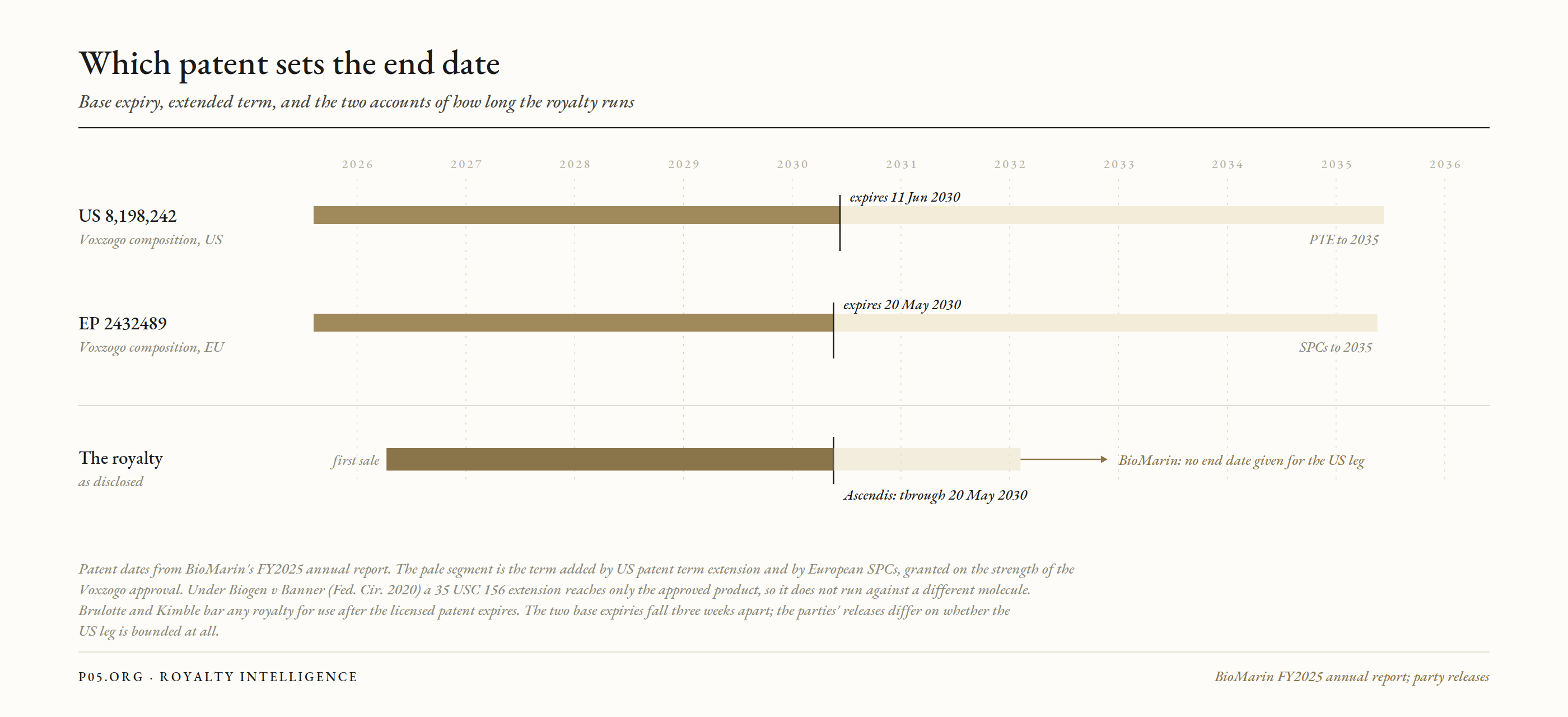
Figure 2. Seven rates on a competitor's marketed product. Where a rate steps over time or by indication both legs are shown, the lighter bar being the lower or later leg. The CureVac bar is drawn at the ceiling of the disclosed single-digit range. Seagen's 8 percent was nullified with the patent.
The Jazz and Avadel settlement is the closest structural analogue in the set, and it ran in the opposite direction on retroactivity. Jazz paid Avadel $90M and waived royalties and damages on all Lumryz sales through 30 September 2025, then took a forward rate. BioMarin waived nothing and took the period back to launch.
The scarcity follows from the remedies. Since eBay v MercExchange in 2006, ongoing royalties have become the standard substitute for an injunction the patentee could not get, which is mostly a non-practising entity problem.
Chien and Lemley's dataset put permanent injunctions at around 79 percent for practising patentees suing competitors against roughly 26 percent for non-practising entities.
A branded pharmaceutical company suing a rival is in the first group. It can normally exclude, so it rarely needs to accept a royalty, and the cases that produce one are cases where exclusion was available and traded away.
The same line of cases explains why the rate, when there is one, runs high. Paice v Toyota (Fed. Cir. 2007) and Amado v Microsoft (Fed. Cir. 2008) hold that a post-verdict royalty may exceed the jury's pre-verdict rate because the bargaining position has changed: the infringer is now adjudicated, and the hypothetical negotiation is no longer between a willing licensor and a party that might have won. Arctic Cat v Bombardier (2017) affirmed an ongoing royalty at twice the jury figure.
A settlement struck after a hearing and before a determination is negotiated against that doctrine: if the case is lost, the rate a court sets need not match an arm's-length licence.
4. The forum sets the shape
The ITC awards no damages. Its remedies are the limited exclusion order and the cease-and-desist order, so a complainant who wins receives the removal of the product and no money, and a respondent who loses receives no licence at any price.
BioMarin filed its complaint on 1 April 2025, the day after Ascendis submitted its NDA.
The Commission instituted investigation 337-TA-1447 on 8 May 2025 on claims 15 to 20 and 31 to 48 of RE48,267, naming the Ascendis entities and Wacker Biotech, with Bachem added later and the Office of Unfair Import Investigations participating. The target date, originally 8 October 2026, was extended to 30 November 2026.
Ascendis pleaded the section 271(e)(1) safe harbour, arguing its imports were for FDA-approval purposes. The Commission declined to put that question on the 100-day track, saying the analysis might be too complex to decide in the time.
The defence covers activity reasonably related to obtaining FDA approval; once Yuviwel was approved on 27 February 2026 and launched in April, the imports at issue were commercial. It also litigated a mandatory-stay question under 28 USC 1659 to the Federal Circuit and lost on 26 March 2026, the court holding that dismissing and refiling a declaratory judgment action to reset the thirty-day clock was not available to it.
In parallel it petitioned the Korean IPTAB to invalidate KR2033680 in October 2025 and filed revocation and non-infringement suits in Brazil in March 2026. BioMarin's June 2025 Citizen Petition asking the FDA to withhold approval of any CNP analogue until Voxzogo's orphan exclusivities expired was denied in February 2026.
The evidentiary hearing was set to begin on 20 April 2026. No initial determination issued before the term sheet. The rate was agreed sixteen months into the investigation, after trial, with the exclusion remedy still available.
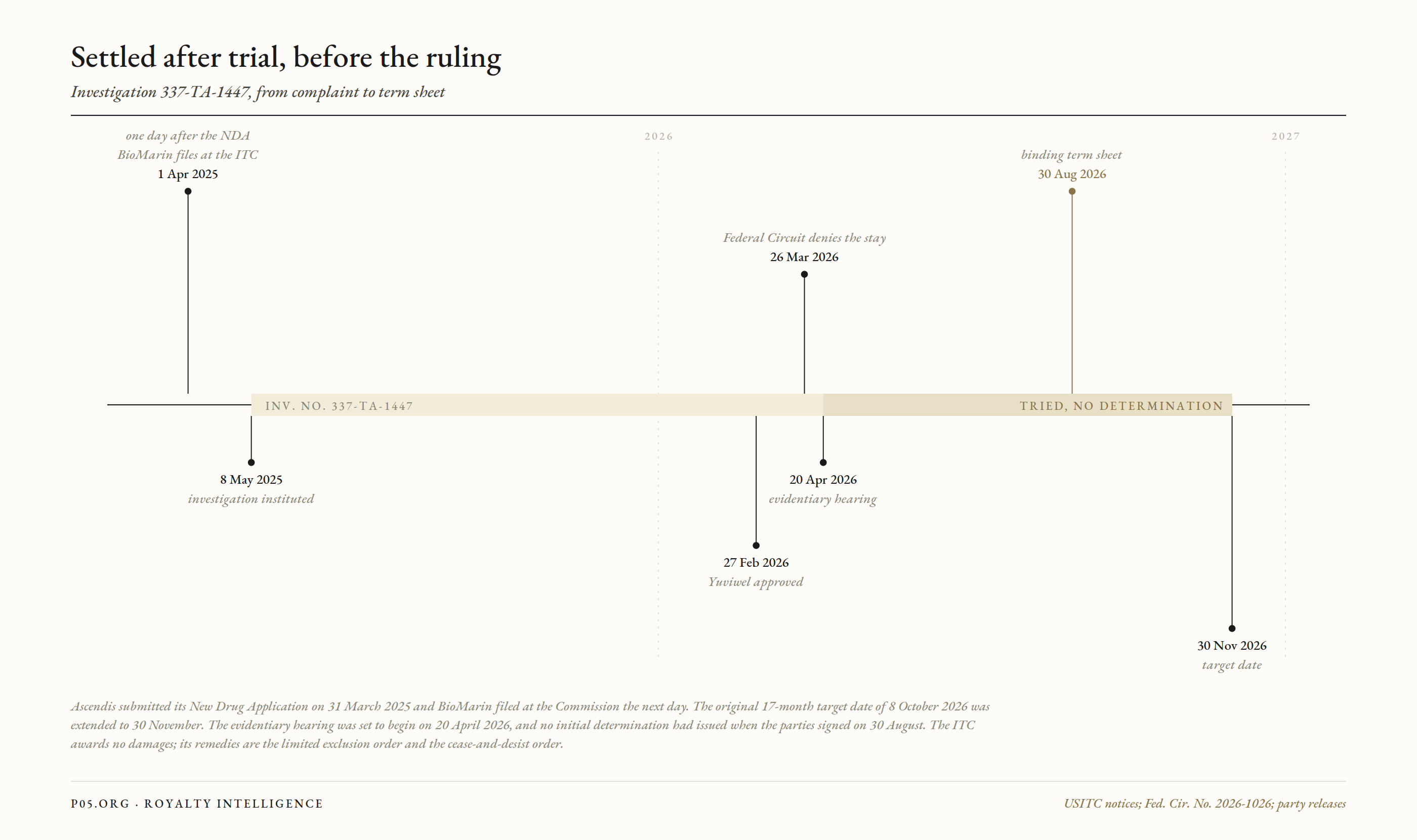
Figure 3. The investigation ran sixteen months and was tried. The term sheet was signed three months before the target date, with no initial determination on the record.
For scale, in fiscal 2025 the Commission terminated 39 percent of investigations by settlement or consent order and a further 4 percent by withdrawal, and found a violation in 15 of the 28 investigations decided on the merits. Pharmaceuticals and medical devices accounted for around a tenth of section 337 filings in 2025.
No leverage dealt with a seller negotiating against a clock the counterparty could see. Ascendis was in that position with a live product.
It had launched, it was booking revenue, its safe-harbour defence reached pre-approval imports and it was now importing to sell, and the remedy on the table took the product off the shelf rather than taxing it.
The litigation sales piece set out a five-position spectrum of claim maturity, from pre-suit demand at an 85 to 95 percent funder discount to final non-appealable judgment at 10 to 25 percent. BioMarin's claim settled between the last two positions. It had been tried, the record was closed, briefing was in, and nothing remained but the initial determination and Commission review.
On that spectrum it sat in the band that piece assigned to royalty funds and distressed credit rather than specialist litigation funders. It was converted rather than sold.
5. Cash or stream
Case strength does not decide whether a settlement takes cash or a stream. Genevant and Arbutus had a consent judgment of infringement and no invalidity on four patents and still took cash: $950M, paid in July 2026, plus up to $1.3bn contingent on the Federal Circuit holding that Section 1498 does not bar their claims.
The settlement agreement pro-rates the contingent amount over 493,757,200 disputed doses if the bar catches some and not others, and Moderna's 8-K provides for refund with interest if a payment is later overturned. Moderna owes no future royalties and has said a loss on the Section 1498 proceeding is not probable. CureVac and GSK took $740M and a single-digit royalty. Merck paid $625M and a declining royalty that expires at the end of this year.
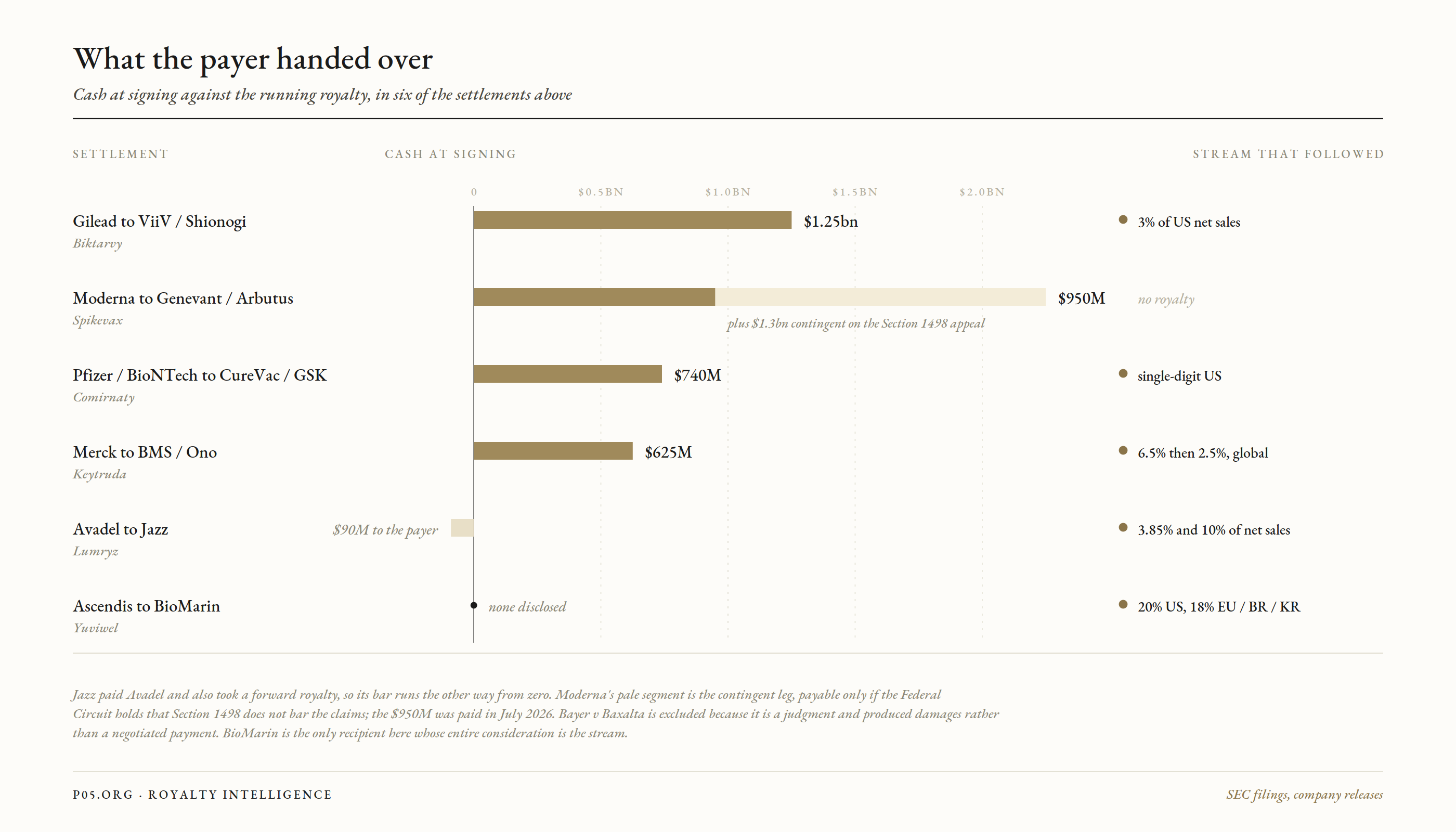
Figure 4. Cash at signing against the stream that followed. Jazz's bar runs the other way because it paid Avadel and took a forward royalty. Moderna's pale segment is the contingent leg. BioMarin is the only recipient whose entire consideration is the stream.
The recipients' businesses differ. Arbutus is clinical-stage and announced a return of capital alongside the settlement; Roivant lifted a buyback to $1bn. BMS, ViiV and BioMarin are commercial companies with a competing product in the same indication, and a running royalty on the displacing product is the only instrument that pays them more as their own franchise erodes.
For BioMarin the stream rises with Yuviwel's US sales, including the sales that displace Voxzogo.
Note or sale set out the ladder a company climbs when it chooses between a note and a sale, and the choice there is made by a payer trying to lower its cost of capital. The choice here is made by a recipient with no cost of capital at stake, deciding whether it would rather hold cash or hold a claim on its rival's growth.
In the cases above, the recipients with a competing product took a stream and the recipients without one took cash.
6. Where the royalty funds sit
They are not, on the public record, buyers of these streams. None of the six settlements above has produced a disclosed monetisation.
One constraint is standing. A purchased royalty is a payment right, not an exclusionary right, and the all-substantial-rights line running from Waterman v Mackenzie, 138 U.S. 252 (1891), keeps a bare payment holder out of court. Enforcement sits with the patent owner or an exclusive licensee.
A fund holding a royalty on a product facing a competitor has no forum of its own, and its recovery in the competitor's litigation is whatever its own agreement gives it, which in most vintages is nothing. The true-sale architecture described in Anatomy of Biopharma Royalty Deals isolates the buyer from the seller's balance sheet and gives it no rights in the seller's patents.
The other is diligence. The payer is adverse. There is no obligation to commercialise, no obligation to promote, no shared interest in the label, and the licence is non-exclusive. Goodwin's July 2026 database work, cited in the compulsory licensing piece, found generic entry operating as a reduction trigger in 100 percent of royalty-bearing deals in the trailing twelve months, up from 63 percent, with third-party IP payments at 95 percent and patent expiry at 95 percent.
Negotiated licences are acquiring more reduction architecture every vintage. A settlement royalty typically has none, because it was drafted to end a case rather than to run a partnership, and the fixed end date does the work the reduction clauses do elsewhere.
On the covenant not to challenge, a settlement royalty differs from a licence royalty in the holder's favour. Lear v Adkins, 395 U.S. 653 (1969), removed licensee estoppel, and MedImmune v Genentech, 549 U.S. 118 (2007), let a paying licensee sue for a declaration of invalidity without breaching first. Both cases are about ordinary licences.
Flex-Foot v CRP, 238 F.3d 1362 (Fed. Cir. 2001), and Rates Technology v Speakeasy, 685 F.3d 163 (2d Cir. 2012), draw the line the other way for settlements: a no-challenge clause agreed to end litigation, after the licensee has had its chance to attack the patent, is enforceable.
PDL's 2014 settlement with Genentech carried one covering the Queen patents and their European SPCs. Ascendis was attacking these patents in Korea and Brazil six months before it agreed to pay on them, and if the definitive agreement contains such a clause, those proceedings end. Whether it does has not been published.
XOMA is the one aggregator on the record as a plaintiff. XOMA sued Janssen Biotech and J&J Innovative Medicine in the Eastern District of Pennsylvania on 8 August 2025 (No. 2:25-cv-04484), pleading breach of contract and, alternatively, unjust enrichment, on the allegation that Janssen used XOMA's bacterial cell expression technology to develop TREMFYA without ever taking a commercial licence. The court denied Janssen's motion to dismiss on 30 December 2025.
When Ligand agreed to acquire XOMA in April 2026 at $39.00 per share, roughly $739M of equity value, the claim did not travel with the book.
Shareholders received a non-transferable contingent value right to a portion of 75 percent of net proceeds, and the deal closed on 14 July 2026. An aggregator buying more than 120 assets declined to price one live claim and severed it into a separate instrument. XOMA's own balance sheet carried CVR liabilities of about $15.5M at the end of 2025, the only published figure attached to the claim.
Fund participation to date consists of that: an aggregator as plaintiff and a CVR rather than a purchase.
The litigation sales piece put the pharmaceutical claim cohort into five buckets: royalty underpayment, CVR breach, licence scope, earnout breach, and royalty rejection in bankruptcy. Every one of those is a claim to money already owed under a contract.
A patent infringement claim against a marketed competitor is a claim to the right to sell, and its settlement currency is a rate rather than a recovery. That is the sixth bucket, and it is the only one whose successful resolution produces an asset a royalty fund could hold for years rather than a payment it collects once.
A litigation funder buys the claim before it resolves and exits at resolution. A royalty fund buys streams. Nobody has bought the thing in between: a stream that a claim turned into.
The piece noted that royalty funds through 2025 and 2026 have been building litigation underwriting in house on the view that probability-weighted valuation of contractual receivables is the same skill as royalty diligence. The disclosed flow is six pharmaceutical streams in ten years and four in devices and tools at undisclosed rates.
Royalty Pharma holds a 3 percent capped synthetic royalty on US Yorvipath net sales, funded at $150M in September 2024, capped at 2.0x or 1.65x if reached by 31 December 2029. Same payer, different product.
The BioMarin obligation is a cost at Ascendis, not an item in the Yorvipath waterfall. It does compete for the same cash, which is the only channel through which a settlement royalty on one product reaches a purchased royalty on another.
The Tanabe piece described a company converting itself into a royalty book asset by asset, by selling. BioMarin has added a royalty to its book by suing. Behind one is a negotiated contract and a counterparty with an interest in the product's sales; behind the other is a dismissed complaint and a counterparty that was contesting the patents.
7. Pricing a settlement royalty
Term. 2030 on one reading, undated on the other, with the divergence traced to two patents expiring three weeks apart and an extension whose statutory scope probably does not reach a competing product. The definitive agreement or the next 10-Q resolves it.
Base. Net sales of Yuviwel, in four named territories, out of a worldwide non-exclusive licence. Ascendis holds a European decision in the fourth quarter of 2026 and has told the market it believes it can reach EUR 5bn of revenue in 2030. Territory coverage is the difference between a royalty on a US orphan launch and a royalty on a global franchise.
Per patient, Yuviwel launched at a wholesale acquisition cost of $38,325 for four weekly injections, about $498,000 a year, which Ascendis and the sell side put at a 20 percent premium to Voxzogo's 2026 WAC, implying Voxzogo at around $415,000. On those list prices, ignoring gross-to-net on both sides, 20 percent of a Yuviwel patient-year is about $100,000, so a patient who moves from Voxzogo to Yuviwel returns BioMarin roughly a quarter of the list revenue it lost.
The same arithmetic run on a patient who was never on Voxzogo, a new start in a market growing more than 20 percent a year in treated patients, returns BioMarin $100,000 on revenue it never had.
BioMarin has said fewer than 100 US patients switched in the six months after launch, about 10 percent, and that US retention ran near 90 percent at the end of July. The royalty pays more on the second kind of patient than the first, and the market is producing more of the second kind.
Retroactive component. A receivable, not a stream, sized on sales from April 2026 forward, with the settlement method unstated.
Structure. Flat or tiered, floors, caps, and whether any reduction applies on a third entrant or on loss of a territory.
Validity. The term is patent-anchored, so the term is only as good as the patents and the covenant. Ascendis was challenging them in Korea and Brazil in the first half of 2026.
Payer. Single product, single molecule, two-player indication, orphan population, a payer with EUR 616M of cash at the end of 2025 and rising operating cash flow. The cash covers the obligation. The stream depends on one product in one paediatric indication, so a single clinical or regulatory event affects all of it.
Existing-royalty monetisations in the market trade at single-digit to low-teens rates, and the Covington sample behind the CFO guide put 95 percent of them as true sales with a median cap around 2.25x. A flat 20 percent on a launched product sits outside that distribution; it was agreed against an exclusion remedy rather than in a licence negotiation.
A rate that high in a two-player market raises the question FTC v Actavis, 570 U.S. 136 (2013), asks of any patent settlement between competitors. On the Actavis factors the accused product stays on the market, output is preserved, and the payment runs from the entrant to the incumbent rather than the reverse.
The concern the case law leaves open is a rate set high enough to fix the entrant's price floor, and a 20 percent royalty on a product listed a fifth above the incumbent has that arithmetic effect. No agency has raised it, and the FTC's settlement filings under the Medicare Modernization Act do not reach brand-against-brand deals.
BioMarin rose about 5 percent on the announcement. No sell-side note located by the research date put a dollar value on the stream for either side, and BioMarin has not said whether it will land in the royalty and other revenues line, which ran at $5.3M in the second quarter.
8. What each side should ask
Buyer. Does the definitive agreement bound the US leg, and to which patent? Is the retroactive amount an asset you are acquiring or one that stays behind? Does the covenant not to challenge survive assignment, and what happens to the stream if the anchor patent falls in a proceeding the payer did not bring?
And is the stream assignable at all, and does the settlement licence carry an anti-assignment clause?
Holder of a royalty on the displaced product. If you hold economics on Voxzogo, the settlement did not change your stream and did change the shape of the erosion curve underneath it. Does your agreement give you anything in respect of amounts the licensor receives from third parties in respect of the product's technology, however characterised, or only in respect of net sales invoiced by the licensee?
Fund. Is any position in the book exposed to an accused product at the ITC with a target date inside your holding period, and do you have any information right that would tell you before the press release does?
All information in this article was accurate as of the research date and is derived from publicly available sources including company press releases, SEC filings, USITC and Federal Circuit records, and legal and industry commentary. Information may have changed since publication. This content is for informational purposes only and does not constitute investment, legal, accounting, tax, or financial advice. The author is not a lawyer, accountant, tax adviser, or financial adviser.