
The compression trade: what AI discovery speed does to the royalty clock

This piece is speculative analysis rather than a research note. The transactions are real; most of the consequences have not happened yet.
In March 2026 Eli Lilly agreed to pay Insilico Medicine $115 million upfront, up to approximately $2.75 billion in development, regulatory and commercial milestones, and tiered royalties on future sales for access to a discovery engine and a preclinical portfolio.
Read as a royalty market event rather than a technology story, that agreement created a stack of contingent royalty streams on molecules that did not exist three years ago, designed by a company that says it moves from target identification to clinical candidate in roughly 18 to 30 months against a traditional 6 to 8 years. Every one of those streams, if any survives to market, is a monetisable asset. And every one of them raises a question this market prices in a single number and rarely examines: duration.
If AI shortens the time from discovery to approval, does it shorten the period over which a royalty pays, and therefore the period over which a royalty buyer recovers its money?
The answer that falls out of the patent mechanics is the opposite of the intuitive one, at least at first. The intuitive answer comes back through three other doors. What follows works both directions and then asks what a royalty underwriter should do about it in 2026, when the evidence base is one Phase III programme and a great deal of marketing.
1. How much compression has happened
Demonstrated: compression of the pre-clinical segment. Insilico's rentosertib, a TNIK inhibitor for idiopathic pulmonary fibrosis, went from programme start to clinical candidate in under 30 months, posted a mean forced vital capacity improvement of +98.4 mL at 12 weeks in the 60 mg arm of its Phase IIa against a decline on placebo, and has advanced into a 320-patient Phase III.
Projected: everything downstream of the IND. As of mid-2026 no AI-discovered drug holds full FDA approval. Of the ASCO cohort, 51.3 percent had completed Phase 1 and 6.8 percent had completed Phase 2. A 2026 structured review found clinical attrition unchanged at roughly 90 percent despite more than $100 billion of investment in the field since 2022.
Reported early-phase success rates for AI-designed molecules run higher, 80 to 90 percent at Phase 1 and around 40 percent at Phase 2 in published analyses, but the samples are small, survivorship-biased towards well-funded programmes, and concentrated in target classes chosen for tractability.
The distinction matters for everything below, because the two segments sit on opposite sides of the patent filing date, and the patent filing date is where the royalty clock starts.
2. The clock
A composition of matter patent runs 20 years from filing. It is filed during lead optimisation, years before the drug is approved, because it must be filed before the molecule is disclosed. Effective patent life, the interval in which the approved product sells under protection, is therefore 20 years minus the time from filing to approval.
On the historical numbers, research and development consumes 12 to 13 years from initial filing to approval, leaving an effective exclusivity of roughly 7 to 12 years.
The Hatch-Waxman restoration regime, codified at 35 U.S.C. § 156, exists to repair that: the extension credits half the testing period from IND effective date to NDA submission plus the full approval period, subject to a five-year maximum and a second cap under which remaining term after extension cannot exceed 14 years from approval.
The EU supplementary protection certificate under Regulation (EC) No 469/2009 runs the same repair by a different formula, filing-to-first-authorisation minus five years, capped at five years of certificate and fifteen years of combined protection from first authorisation. A programme that reaches authorisation within five years of filing earns no SPC at all, because the formula goes to zero, and needs none.
A second layer sits on top of the patents and behaves differently under compression. Regulatory exclusivities, the five-year new chemical entity period under the FDCA and the twelve-year reference product exclusivity for biologics under the BPCIA, run from approval, not from filing. Development speed does not stretch them and does not shrink them.
The consequence is a shift in which protection binds: for a conventionally slow small molecule, the NCE period expires long before the restored patent and is an afterthought; for a fast programme carrying 14 or more years of base term, the same is true with more room to spare; but for a biologic, the twelve-year clock is frequently the operative floor, and it is indifferent to everything AI does.
Any royalty diligence memo that models loss of exclusivity as a single date is collapsing two regimes that respond to compression in opposite ways, one stretching and one fixed.
Now place the compression against the clock, segment by segment.
| Segment | Traditional duration | AI compression to date | On which side of filing | Effect on effective patent life |
|---|---|---|---|---|
| Target ID to lead series | 2 to 4 years | Demonstrated, large | Before filing | None |
| Lead optimisation to candidate | 1 to 3 years | Demonstrated | Straddles filing | Small extension |
| Candidate to IND | 1 to 2 years | Partly demonstrated | After filing | Extension, year for year |
| Clinical phases | 6 to 9 years | Not demonstrated | After filing | The whole prize |
| Regulatory review | 0.5 to 2 years | Not AI-dependent | After filing | Extension, year for year |
The table reads badly for both camps. The demonstrated compression sits in the one segment that leaves the royalty clock alone, because time saved before the priority date neither extends nor shortens the term.
Clinical compression, which would move the clock, has not happened. A royalty on rentosertib, if it reaches market, will have an effective life determined almost entirely by how long its trials took, and its trials are proceeding at ordinary speed.
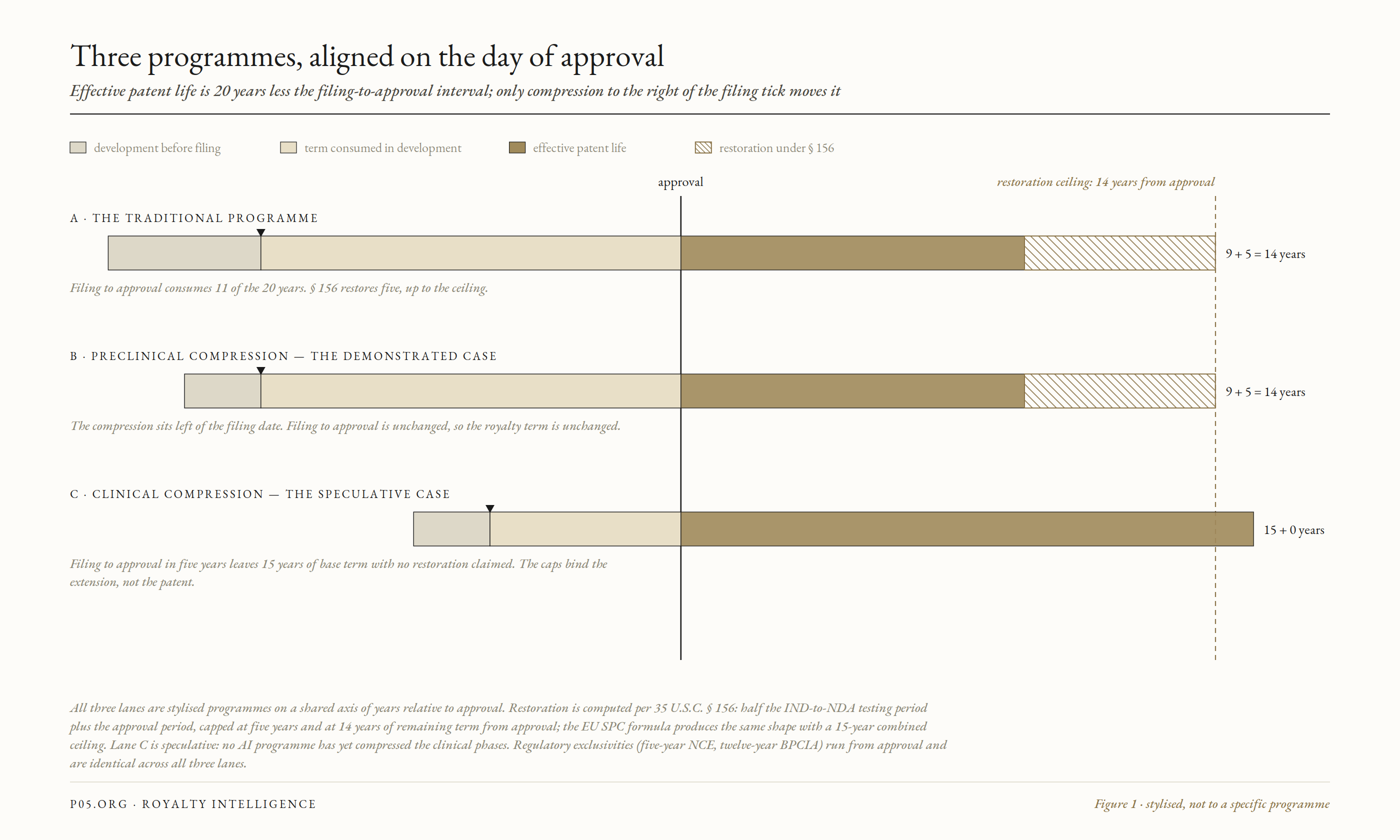
Figure 1. Three programmes aligned on the day of approval. The demonstrated preclinical compression leaves filing-to-approval, and so the royalty term, unchanged; clinical compression would carry the base term past the restoration ceilings without claiming a day of extension.
That said, the direction of any real post-filing compression is unambiguous, and it runs against the market's instinct. Faster development lengthens the royalty.
A programme that goes from filing to approval in eight years carries 12 years of base term at launch. One that does it in six carries 14, matching the restoration ceiling without claiming a day of extension.
One that did it in five would carry 15 years, and here the caps stop functioning as caps: the 14-year and 15-year limits apply to the extension mechanisms, not to the base term, so a sufficiently fast programme sails past the ceilings the slow regime was built around.
The 1984 bargain was priced on development consuming the term, and a programme that does not consume it arrives with more protected life than the statute contemplated.
For a royalty holder this is, mechanically, good news: longer duration, later cliff, fatter tail. The three doors below are how the shortening gets back in.
3. Where the shortening comes from
The policy door
The pharmaceutical exclusivity framework is a compensation scheme. Its stated justification, repeated in every industry submission for four decades, is that development is long, expensive and risky, and the monopoly period must be sized to let the investment recover. The argument reverses cleanly.
Medicines Law & Policy has published a discussion paper making the point directly: if AI reduces the cost, risk and time of development, the same logic that ratcheted protection up argues for scaling it back. Academic work has gone further, proposing recalibration of regulatory exclusivity periods specifically to accelerate generic and biosimilar entry in response to AI-driven efficiency.
Nothing has been legislated, and one constraint shapes where legislation could land. TRIPS Article 33 obliges members to provide a patent term of not less than 20 years from filing, so the patent term itself is treaty-protected and is the hardest element to shorten. The restoration mechanisms and the regulatory exclusivities are not.
Section 156, the SPC regulation, the NCE period and the BPCIA's twelve years are all domestic statute, amendable by ordinary process, and the twelve-year biologic period in particular has been a repeat target of US budget proposals for over a decade.
A recalibration driven by the compression argument would therefore most plausibly arrive as a trim to restoration and regulatory exclusivity, the layers a royalty on a biologic leans on hardest, while leaving the base term untouched.
The direction of travel in 2026 politics is towards drug price pressure through other instruments. But a royalty is a 10-to-15-year asset, and the relevant question for an underwriter is not whether exclusivity shortens this year but whether a stream bought today at a duration assumption of 2038 faces a regime change before then.
Royalty Pharma's own risk factors list changes to legal or regulatory regimes affecting intellectual property among the drivers that make royalty durations expire earlier than anticipated. The AI compression narrative, whatever its clinical substance, supplies the political argument for exactly that change.
The competition door
The second door does not need a statute. The same tools that design a first-in-class molecule design the fast follower, and they design it from the published structure of the leader. Design cycles measured in months rather than years shorten the plateau a royalty-bearing product enjoys before the second and third entrant arrive, even with every patent intact.
The mechanism already has a demonstration at the biosimilar end: Converge Bio has described an internally validated workflow that produced a candidate antibody against cetuximab's target in a single eight-hour run, repeated against four further targets, a result Forbes framed, reasonably, as a test of the royalty market itself.
An internal result on a well-characterised target is not a marketed competitor. The gap between the two is the entire clinical and regulatory apparatus, which is unchanged. But a royalty valuation runs on a sales curve as much as on an expiry date, and the sales curve responds to in-class competition years before any loss of exclusivity.
A royalty underwritten on five quiet years at peak is repriced by a fast follower without a single patent being touched.
The inventorship door
The third door is narrower and has a case name. In Thaler v. Vidal, 43 F.4th 1207 (Fed. Cir. 2022), the Federal Circuit held that an inventor under 35 U.S.C. § 100(f) must be a natural person, so an AI system cannot be named, on the reasoning that conception is the touchstone of inventorship and a mental act reserved to humans.
The court expressly left open whether inventions made by humans with AI assistance are patentable, and the USPTO has now answered that question twice, differently.
The February 2024 guidance, 89 Fed. Reg. 10043, allowed AI-assisted inventions where at least one natural person made a significant contribution, assessed claim by claim under the Pannu v. Iolab factors, a joint-inventorship test borrowed for a tool.
For a royalty underwriter the 2025 revision cuts both ways. It lowers prosecution risk, since examiners no longer apply an AI-specific contribution test. It does nothing to a district court, because guidance is not law and the conception standard it points back to is the standard a Paragraph IV challenger will litigate under.
The exposure is also narrower than the phrase "inventorship challenge" suggests. Misjoinder and nonjoinder among humans are correctable under 35 U.S.C. § 256 and rarely fatal. The incurable version is the claim to which no natural person contributed conception at all, because there is then no correct inventor to substitute, and Thaler forecloses naming the system.
A composition claim on a molecule generated by a model, where the named inventors' documented contribution was target selection and assay confirmation, presents that question in its incurable form, and there is no controlling authority on those facts. No challenge on that theory has yet been brought against an approved product, which means the risk is unpriced rather than absent, and it sits asymmetrically: it does not block a launch, but a successful challenge removes the composition patent from under the royalty.
Diligence on an AI-originated asset then has a short list: who is named, what the invention disclosure records and lab notebooks show about human contribution to each claim, what the prosecution history and any contemporaneous publications disclose about the design process, and whether inventorship declarations made under the rescinded 2024 framework read differently under the 2025 one.
Those documents deserve the attention a freedom-to-operate opinion usually gets, because the first generic challenger to run the theory will have read them first.
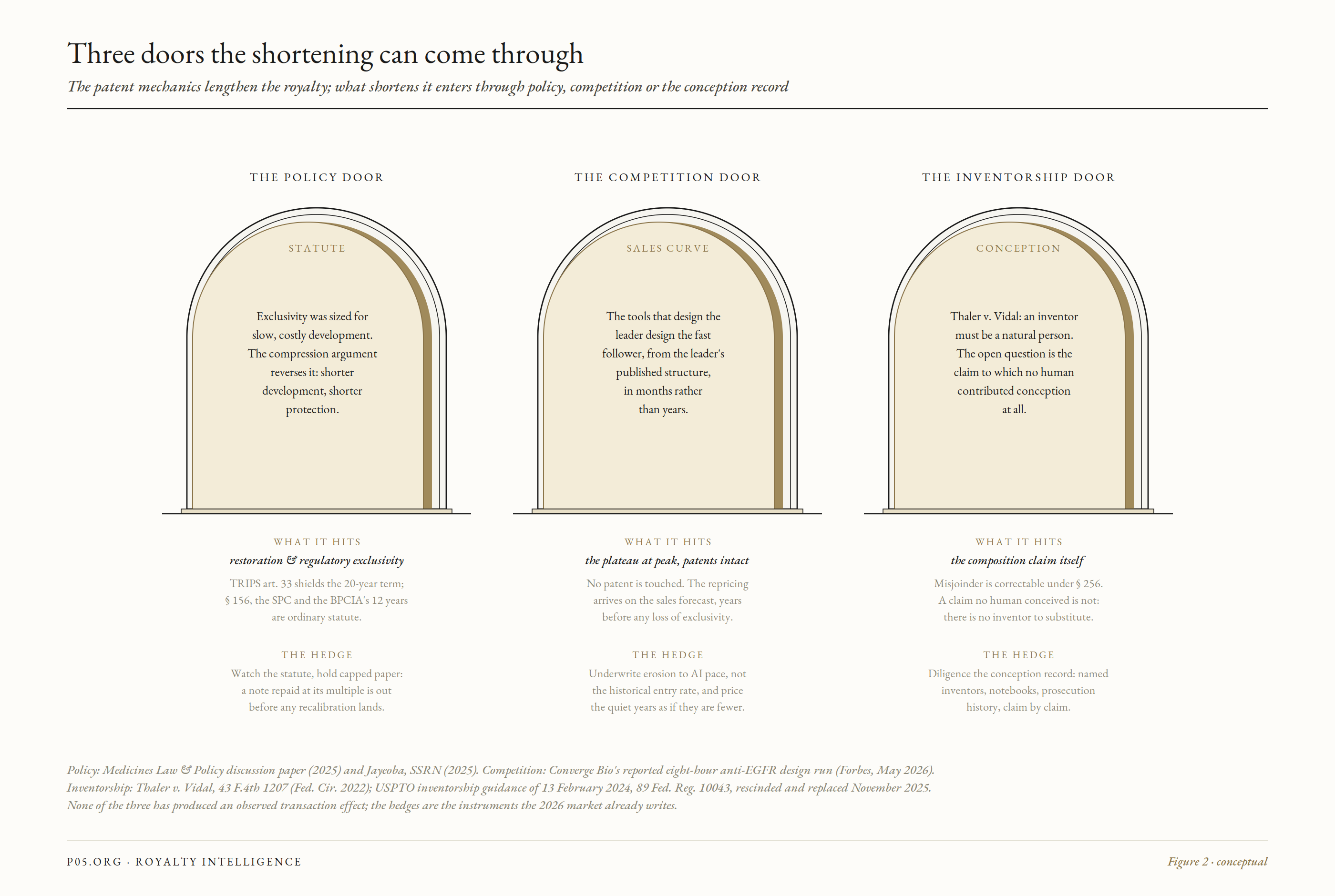
Figure 2. Three doors the shortening can come through: what opens each, what it hits, and the hedge the 2026 market already writes. None of the three has produced an observed transaction effect.
4. What duration does to the price
On the buy side, duration is the input the accounting is built around. Royalty Pharma measures most of its royalties at amortised cost under the effective interest method, calculating a yield from forecast cash flows over the expected life of the asset, and states that an unexpected shortening of a royalty term could reduce the effective interest rate, cut income, reduce receipts against expectations, or force a permanent impairment.
Every reported yield on a financial royalty asset carries a duration assumption inside it.
The sensitivity is easy to size. Take a stream paying a constant amount for its full life, which flatters the tail because real sales erode toward expiry, so treat the figures as an upper bound on what the last years are worth.
| Discount rate | PV of 14-year stream (multiple of annual payment) | PV of 10-year stream | Value in years 11 to 14 |
|---|---|---|---|
| 8% | 8.24x | 6.71x | 18.6% |
| 12% | 6.63x | 5.65x | 14.8% |
Three to four years of duration uncertainty moves the price of an uncapped stream by something in the mid-teens of percent, which is the entire fee load and expected excess return of most royalty vehicles. Risk of that size gets handled in structure rather than absorbed in price.
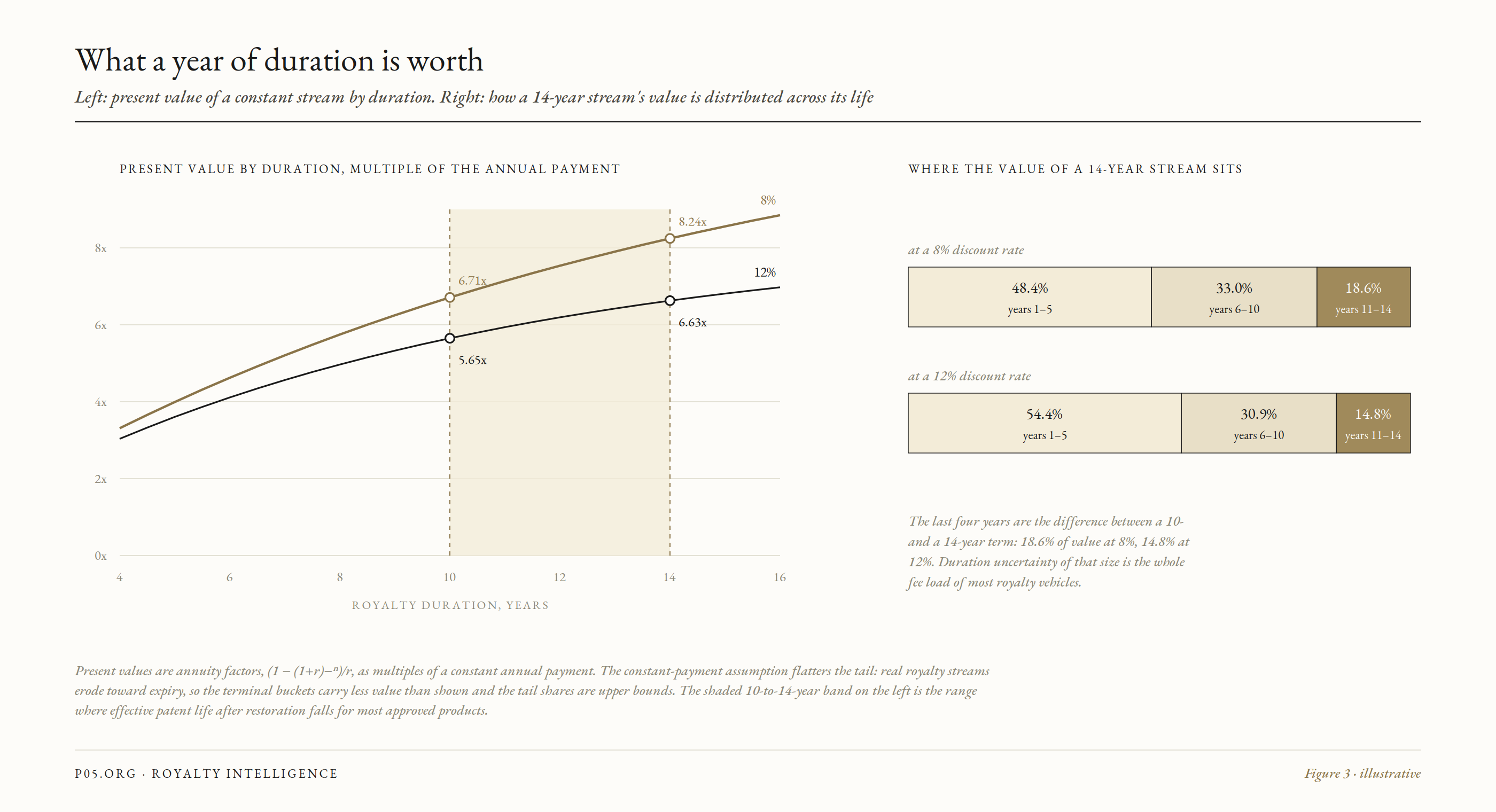
Figure 3. What a year of duration is worth. Left, present value of a constant stream by duration; right, where a 14-year stream's value sits across its life. Years 11 to 14 carry 18.6 percent of value at an 8 percent discount rate and 14.8 percent at 12, upper bounds given real sales erosion.
The 2026 market already contains the structural answers, because duration uncertainty from other sources (patent litigation, biosimilar timing, product life cycles) is old. The instruments that immunise against a shortened term are the ones the recourse ladder piece ordered by recourse: the capped royalty-backed note, which converts an open-ended duration bet into a dated multiple; the synthetic royalty, whose term is contractual rather than patent-linked; and the secured loan, which ignores the royalty clock entirely.
Covington's monetisation study puts 44 percent of monetisations capped and a median capped multiple of 2.13 times. If the compression narrative gains substance, the prediction that follows is a migration along the ladder: fewer uncapped perpetual purchases, more paper that pays back before the duration question can be asked.
The buyer of the uncapped tail becomes, even more than today, the buyer expressing a view that the clock runs long.
5. The supply side, which is not speculative
Whatever happens to duration, the volume effect is already in the deal record. An AI-originated molecule generates royalty-bearing contracts earlier and more often than a traditionally originated one, because the discovery platform's business model is licensing.
| Date | Licensor | Licensee | Scope | Disclosed economics | Source |
|---|---|---|---|---|---|
| Sep 2023 | Insilico | Exelixis | XL309 (USP1 inhibitor), worldwide | $80m upfront, up to $100m development and $775m commercial milestones, tiered royalties on net sales | Exelixis 10-K FY2023 |
| Ongoing | Recursion | Roche, Genentech | Up to 40 potential small molecule programmes | Over $300m per programme in development, commercialisation and net sales milestones; tiered royalties up to high single digits; $216m in upfront and milestones received to date | Recursion 10-K FY2025, Q2 2026 release |
| Ongoing | Recursion | Sanofi | Joint I&I and oncology portfolio | Up to $343m in milestones per programme, tiered royalties up to double digits; $134m received to date | Recursion 10-K FY2025 |
| Nov 2025 | Insilico | Eli Lilly | Joint discovery, Lilly-selected targets | Over $100m including upfront, milestones, tiered royalties on net sales | Insilico release |
| Mar 2026 | Insilico | Eli Lilly | Preclinical portfolio licence plus discovery engine | $115m upfront, up to ~$2.75bn milestones, tiered royalties | PharmExec |
Insilico is Hong Kong-listed, so its own economics reach the record through the counterparty's SEC filings where the counterparty is a US registrant, which is why the Exelixis 10-K is the source for a licence Insilico granted. Every row is future royalty supply.
The platform companies hold streams on out-licensed assets they will never commercialise, which is the seller profile the monetisation market exists to serve, and the profile most likely to achieve clean sale treatment because the holder has nothing to do with generating the sales.
Meanwhile the sector's equity funding, more than $11 billion across roughly 348 rounds in 2025 with no approved product yet, guarantees a cohort of clinical-stage companies that will need non-dilutive capital before their equity stories mature. Royalty capital is already the sector's counter-cyclical funder; commentary on Royalty Pharma frames the whole business as filling the gap left by collapsed biotech funding.
Cheaper discovery therefore widens the origination funnel regardless of what it does to duration. More assets, licensed earlier, held by natural sellers, in a funding environment that pushes issuers towards royalty structures.
A platform royalty portfolio also offers something the market has not had before: many shots on goal from a single counterparty, which is diversification at origination rather than at aggregation. Whether the funnel widens faster than the buyer base grows is the question that decides whether the extra supply shows up as volume or as price.
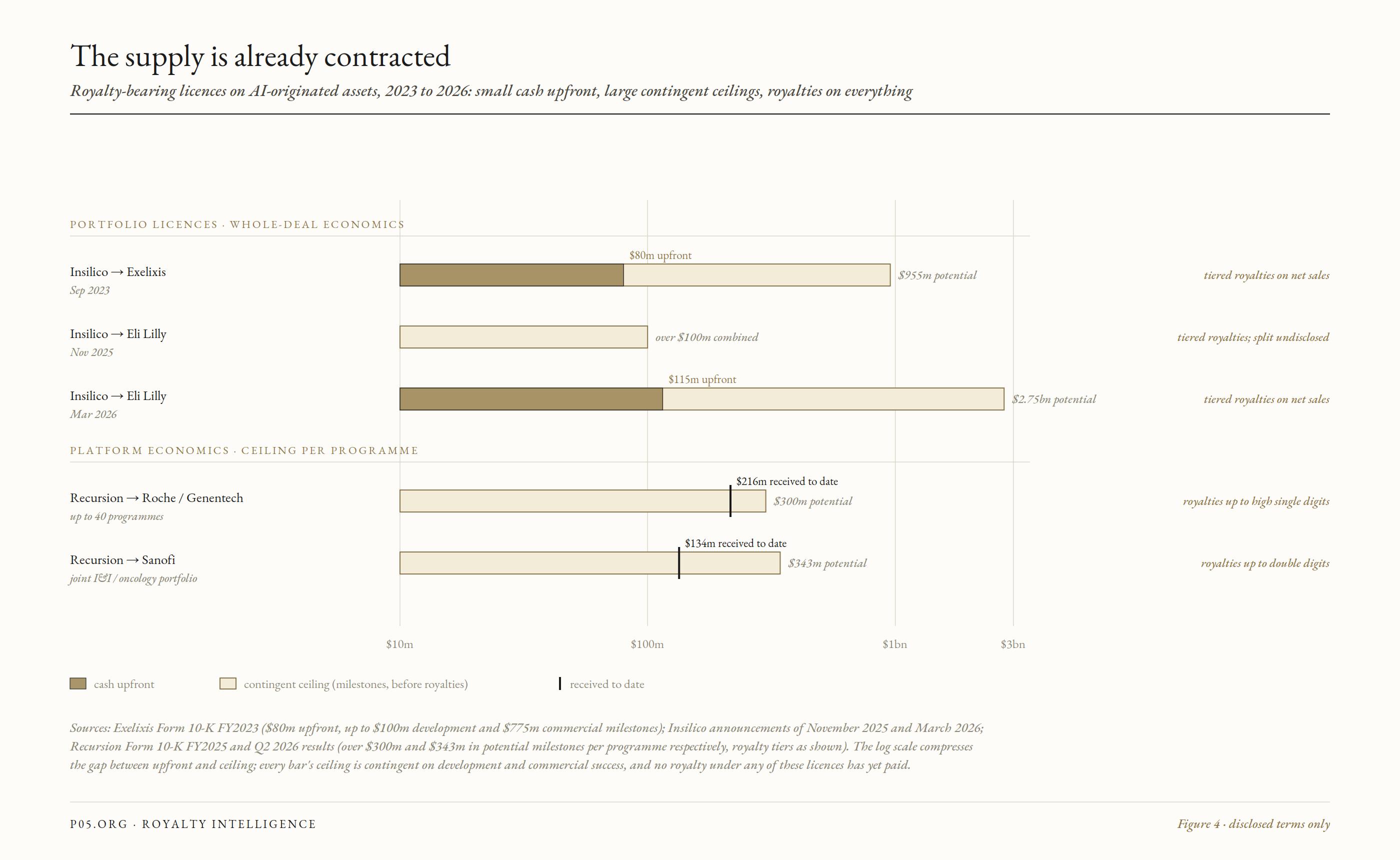
Figure 4. The supply is already contracted. Disclosed AI-origin licences, 2023 to 2026, on a log scale: small cash upfront, large contingent ceilings, royalties on every deal, and not one royalty yet paying.
6. What would make this reading wrong
The compression may never reach the clinic. Sections 2 and 3 both run through the clinical phases, in opposite directions, and the clinical phases have so far resisted. If AI's contribution stays preclinical, the royalty clock is untouched in both directions and this piece describes a non-event with good production values.
The early success-rate figures may not survive their sample. The 80 to 90 percent Phase 1 and 40 percent Phase 2 figures come from a young, small, self-selected cohort. Regression toward the industry's 90 percent attrition would remove the pricing argument for development-stage royalties on AI assets before it forms.
Policy may move on price, not term. Governments squeezing drug budgets through reference pricing and negotiation have less need to touch exclusivity periods. The recalibration argument may stay in the discussion papers for a decade, in which case the policy door stays shut for the life of any royalty bought today.
The fast-follower effect may already be priced. In-class competition is the oldest input in a sales forecast. If underwriters' erosion curves already assume competitor entry at the historical pace plus a margin, AI-accelerated followers change the forecast error, not the framework.
A single Phase III readout could invert the frame. Rentosertib failing would reprice the entire sector's claims. Rentosertib succeeding, and being approved on a compressed overall timeline, would hand the compression narrative its first complete data point from target to market, and the durations in section 2 would move from arithmetic to comparables.
7. The shape of the answer
The question was whether AI drug discovery shortens the period over which a royalty pays. The mechanics answer no: patents are filed early, the demonstrated compression sits before the filing date where it moves nothing, and any real compression of the filing-to-approval interval lengthens effective exclusivity, eventually past the ceilings the restoration regime was built around. A faster clinic would be a gift to royalty duration, not a threat.
The threat enters by other doors: a political argument that shorter, cheaper development deserves shorter protection, most plausibly landing on the statutory exclusivities TRIPS does not shield; the fast follower designed with the same tools as the leader, eroding the sales plateau inside an intact patent estate; and an unresolved conception question sitting under every composition claim on a model-generated molecule, waiting for its first well-funded challenger.
None of the three has bitten. All three grow with the technology whose success would trigger them, which is the property that makes this a trade rather than a forecast. A royalty buyer who believes the compression story should want the front of the curve, capped notes and contractual-term synthetics that return capital before the doors can open, and should sell the uncapped tail to whoever believes the clock. A buyer who believes the clinic will stay slow should buy the tail from the believers at the discount their caution creates.
The supply side does not wait for the argument to settle. The licences are signed, the streams exist, and the first monetisation of a royalty on an AI-originated molecule is a matter of when. The term sheet for that deal will contain a duration assumption, and someone will have to defend it.
Standard disclaimer
All information in this report was accurate as of the research date and is derived from publicly available sources including SEC filings, court opinions, Federal Register notices and agency guidance, issuer press releases, peer-reviewed and preprint academic literature, law firm and consultancy studies, and financial news reporting. Statutory and case citations are provided for orientation and have not been Shepardised; the November 2025 USPTO guidance is agency guidance, not law, and its treatment by courts is untested. This piece is explicitly speculative: the patent-life arithmetic is mechanical, but the policy, competitive and legal channels described have not produced observable transactions and are presented as scenarios rather than findings. Reported AI development timelines and clinical success rates are drawn from small, early samples, largely company-disclosed, and may not generalise. Present-value figures are illustrative, assume constant payments, and overstate the value of terminal years relative to real eroding sales curves. Information may have changed since publication. This content is for informational purposes only and does not constitute investment, legal, accounting, tax, or financial advice. The author is not a lawyer or financial adviser.