
Added to the cap, not the rate: what accretion does to a true sale

Karyopharm deferred payments on two instruments inside the same twelve-month window, and the two deferrals left the company in different places.
KKR, which took over HealthCare Royalty's position, waived the royalty due on revenue recognised between 1 April 2025 and 31 March 2026. Cash paid for interest on the deferred royalty obligation was nil in the first quarter of 2026, against $2.1 million a year earlier. The waived quarters accrued nothing. The holder's compensation falls due later, as the Applicable Tiered Percentage rises from 7.000 to 8.000 per cent of Annual Net Revenues of Included Products from 1 April 2026.
The term loan deferred by a different route. Interest incurred from 1 July 2025 through 30 June 2026 is payable in kind at the secured overnight financing rate plus 10.25 per cent against a 3.00 per cent floor, with cash interest resuming for interest incurred after 30 June 2026 and first payable on 30 September 2026. Each unpaid quarter was added to what Karyopharm owes.
The loan deferral increased the amount owed. The royalty deferral left it unchanged and raised the percentage applying to revenue from April 2026.
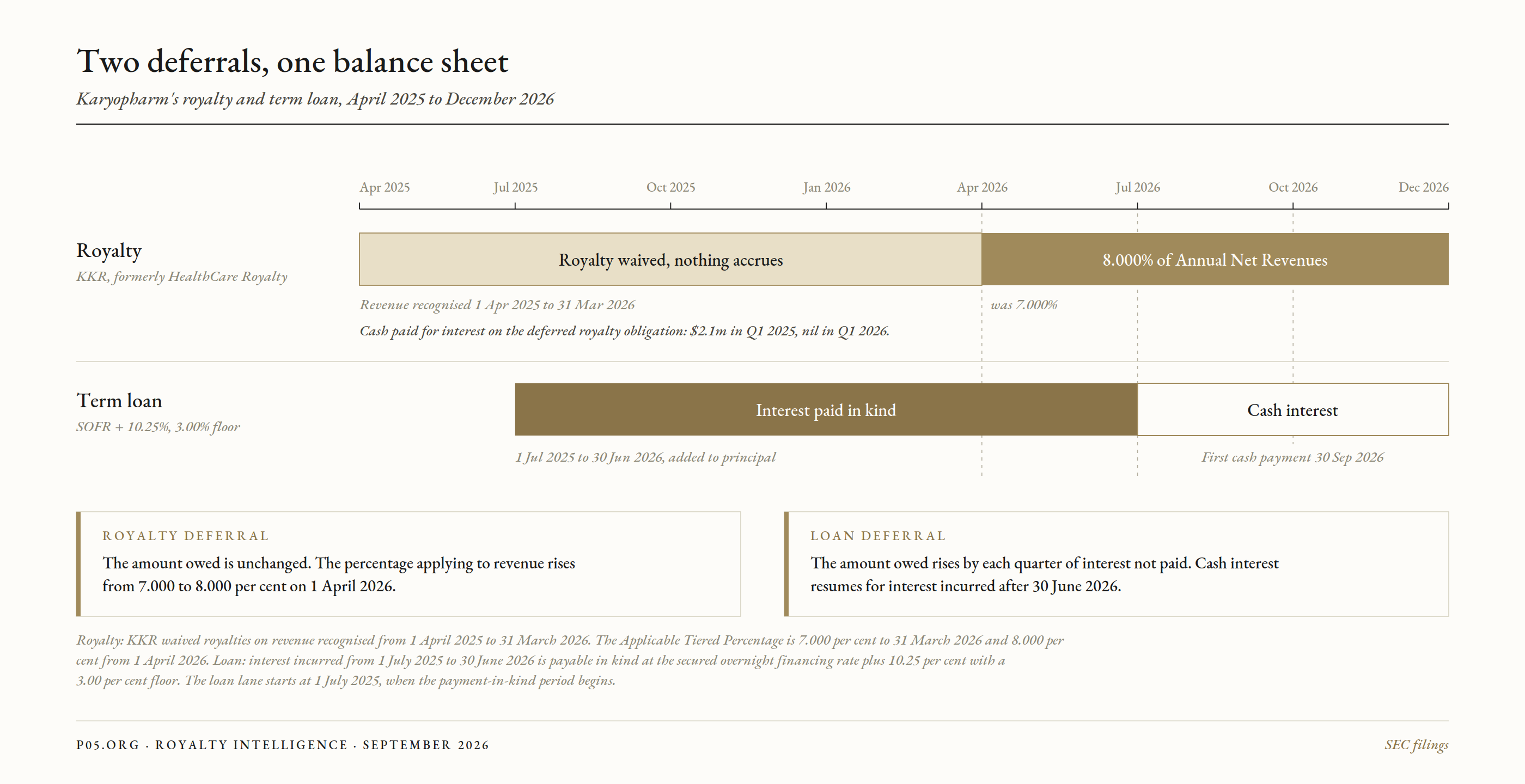
Figure 1. Karyopharm, April 2025 to December 2026. The royalty holder waived a year of payments and repriced the stream from 1 April 2026. The term loan capitalised interest at SOFR plus 10.25 per cent until 30 June 2026.
Waived, not litigated covered what a payment holiday bought with a rate step-up does to the characterisation of a revenue interest. This piece takes the other lever, the cap, and asks what a cap that moves does to a true sale opinion.
1. The distinction
A rate step-up changes the price. The buyer takes a larger percentage of revenue from a stated date, the total owed stays where it was, and the buyer receives more of the asset it already bought.
Cap accretion changes the quantum. The ceiling on aggregate payments rises, the seller owes more in total than before, and the asset underneath is untouched.
The two price against different variables. A step-up is priced against the revenue stream. An accreting cap is priced against elapsed time, the variable a lender uses. Caps are usually read as upper terminators, a limit that protects the seller, and that reading is why an accreting one draws less scrutiny than a rate step while carrying the greater characterisation risk.
The trigger decides which kind of cap a document contains. Where a cap rises because a date has passed, the escalation is a term of the deal. Where it rises because the seller has not paid, the seller's shortfall enlarges the buyer's entitlement.
2. How the escalation is drafted
uniQure sold the lowest royalty tier on CSL Behring's worldwide HEMGENIX net sales in May 2023, taking $375.0 million upfront and $370.1 million net of issuance costs. The purchaser of record is HemB SPV, L.P., funded by HealthCare Royalty and Sagard Healthcare. The cap runs at 1.85 times the upfront, or $693.8 million, until a First Hard Cap Date of 30 June 2032, then rises to 2.25 times, which works out at $843.8 million (derived), through a Second Hard Cap Date of 31 December 2038.
uniQure has no obligation to repay any amount received if the applicable cap is not reached during the term, and the agreement terminates automatically once royalties reach the cap. The step is keyed to the calendar alone. Carrying value stood at $439.9 million at 31 December 2024, $478.7 million a year later and $485.8 million at 31 March 2026, against royalty payments to the purchaser of $15.3 million in 2025.
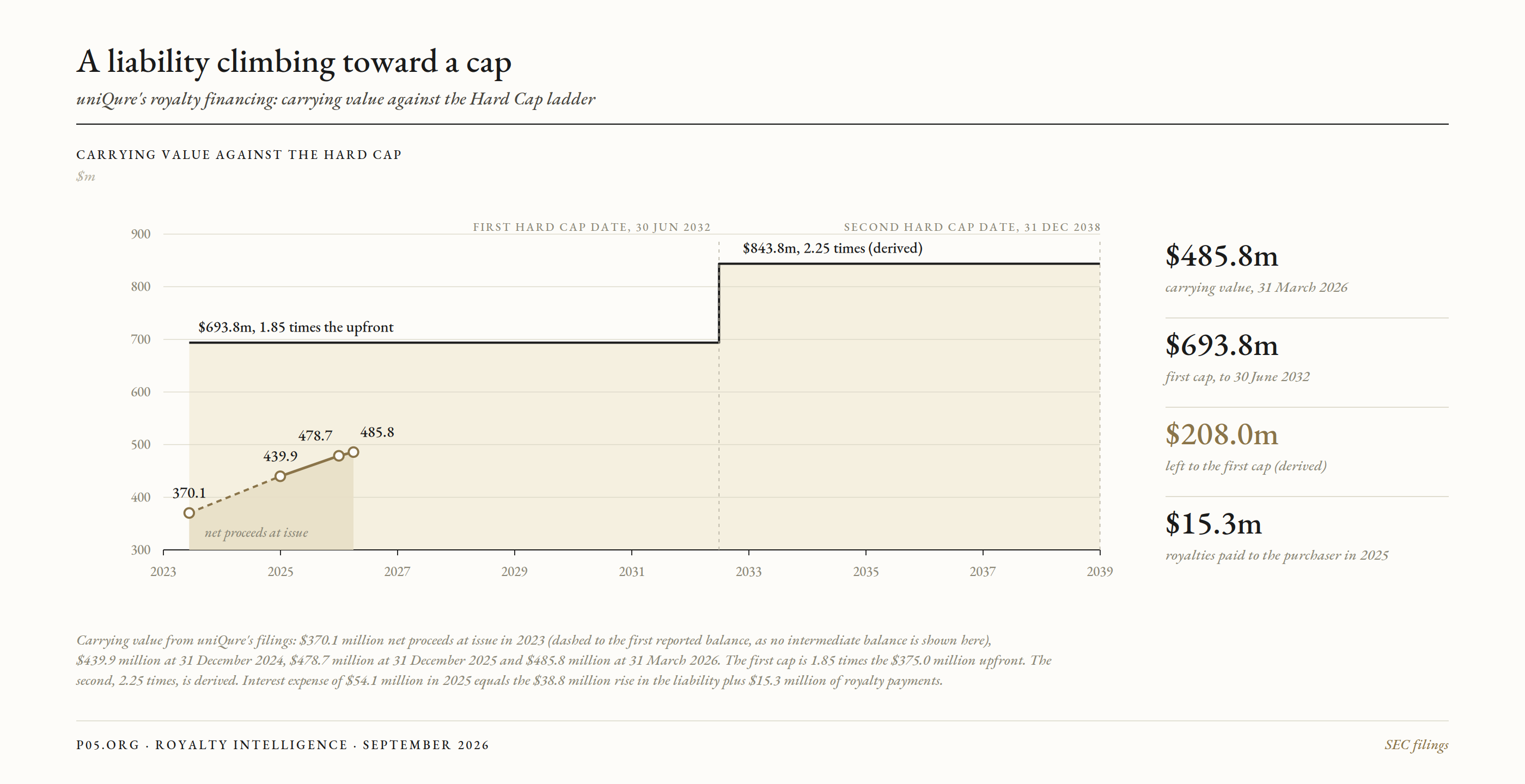
Figure 2. uniQure's royalty financing liability against the Hard Cap. Carrying value at 31 March 2026 was $485.8 million, against a first cap of $693.8 million to 30 June 2032 and a second of $843.8 million (derived, 2.25 times $375.0 million) to 31 December 2038.
Adaptive Biotechnologies drafted the same shape with a different condition. It sold a revenue interest to OrbiMed Royalty & Credit Opportunities IV, LP in September 2022, taking $125 million at closing, with the purchasers entitled to 5, 8 or 10 per cent of the Revenue Base depending on how many tranches were funded. The Revenue Base is the company's GAAP revenue rather than a product royalty. The Return Cap is 165 per cent of Cumulative Purchaser Payments, and increases to 175 per cent if full repayment has not been made by 12 September 2032.
uniQure's ladder moves when a date passes. Adaptive's moves when a date passes and repayment has not happened, which writes the seller's performance into the escalation clause.
Daré Bioscience dispensed with steps altogether. Its Royalty Interest Financing Agreement with United in Endeavour, LLC of December 2023 defines the Hard Cap as the point at which United has received aggregate payments equal to a 12 per cent internal rate of return on the Initial Investment Amount and the Total Supplemental Discretionary Investment Amount. Daré took $5 million at the effective date and up to $12 million in aggregate, against 50 per cent of remaining XACIATO royalties through 2025 and 75 per cent of Net Royalty Payments from 2026 to 2029.
A cap expressed as an internal rate of return accretes by construction. No multiple changes on a date, and the number owed grows every day the money is outstanding. Daré then adds catch-up obligations measured at 31 December 2029, 2033 and 2034. If the Hard Cap is unsatisfied by 31 December 2035 and the company has assets or income sources other than XACIATO, it must make quarterly payments spread evenly over two years until United obtains its return, which reaches past the royalty into the rest of the balance sheet.
Karyopharm's cap moved by negotiation. The Hard Cap stood at 185 per cent of the Investment Amount in the original 2019 agreement and stands at 195 per cent after the Sixth Amendment, which on a First Investment Amount of $135.0 million ties to the $263.3 million ceiling disclosed in the accounts. Payments to date stand at $147.1 million. The amendment anatomy piece maps cap resets as a negotiating lever.
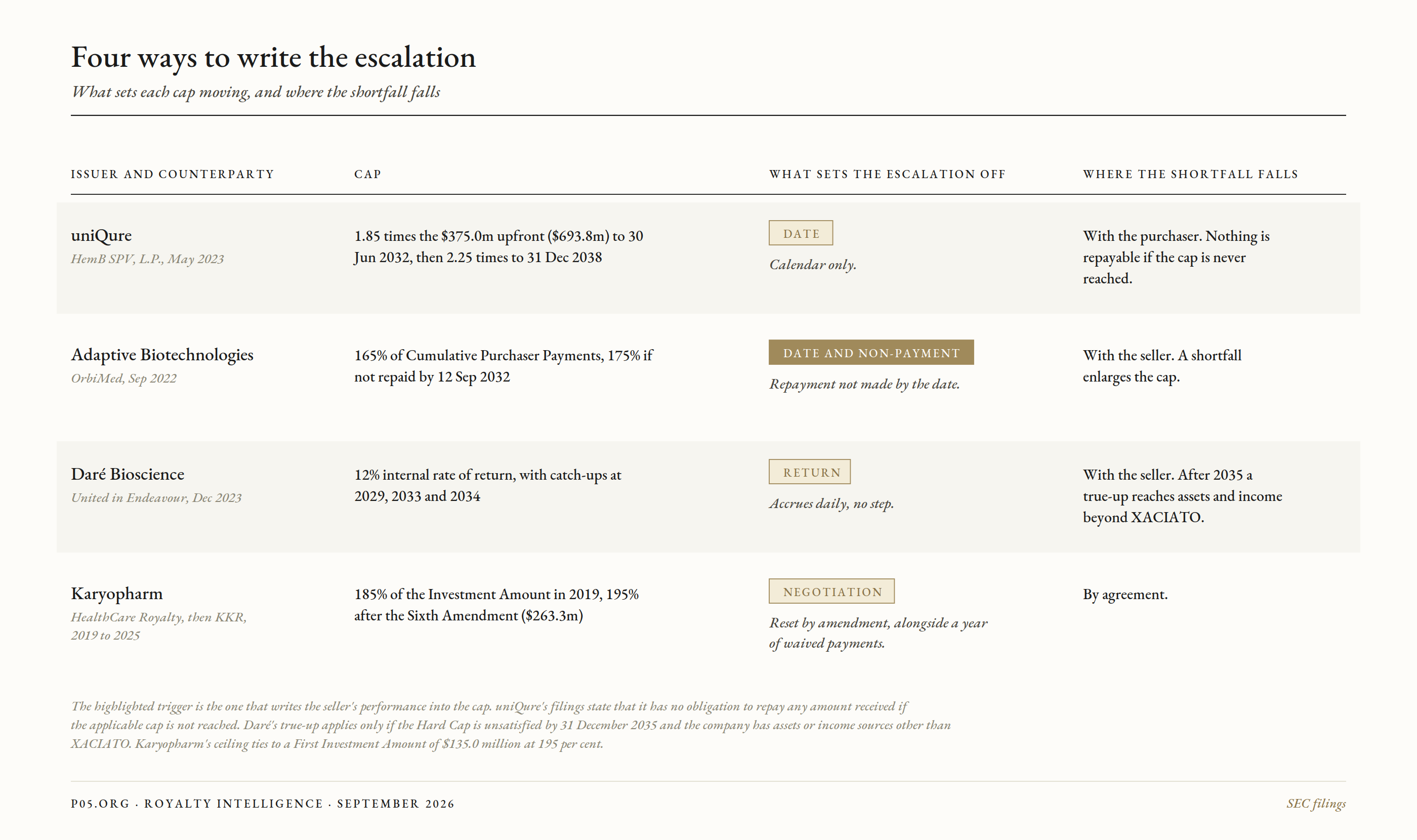
Figure 3. Four escalations compared by what sets them off. Only uniQure's is keyed to dates alone and carries an express provision that nothing is repayable if the cap is never reached.
3. What accretion does to the characterisation
Waived, not litigated sets out the factor tests and applies them to forbearance conduct across six positions. Two authorities from it bear on accretion.
In NGP Capital Resources Co. v. ATP Oil & Gas Corp., the bankruptcy court refused summary judgment that term overriding royalty interests were true conveyances, on facts where the interest terminated once cumulative payments reached a Total Sum built from a stated interest rate. The court reasoned that the purchaser's return had been decoupled from production, since better performance accelerated repayment and reduced the purchaser's total interest income, which inverts how an owner of a production interest behaves. Cap Call, LLC v. Foster (In re Shoot the Moon, LLC) organised the eight factors around risk allocation and held the advances to be disguised loans after trial.
A cap that increases because the seller has not paid leaves the risk with the seller, expressed as arithmetic instead of as a covenant. Adaptive's Return Cap moves from 165 to 175 per cent where repayment has not been made by a date, so a shortfall by the seller enlarges the buyer's entitlement.
Daré's true-up reaches other assets and income sources where the 12 per cent return has not arrived by 2035, which gives the buyer a claim beyond the royalty stream. In each the return is specified in advance and the seller's shortfall is what enlarges it. ATP turned on the first of those features, a return decoupled from performance.
uniQure escalates too, on a longer ladder, and is drafted so that none of this follows. The step is keyed to dates alone, the agreement provides that nothing is repayable if the cap is never reached, and the purchaser's outcome still turns on whether CSL Behring sells the product. An escalating cap does not by itself move risk back to the seller. Risk moves when the escalation is conditioned on the seller's failure to pay.
Neither authority reaches far. ATP was a denial of summary judgment on Louisiana oil and gas conveyances and holds nothing about whether a specified return defeats a sale. Shoot the Moon turned on guaranties, confessions of judgment and collateral extending well beyond the receivables, none of which appears in these agreements.
A cap multiple sitting above a stream that carries real commercial risk is the ordinary structure neither court disturbed. The exposure attaches to the escalation trigger.
4. The accretion rate is already published
An obligation carried at an effective interest rate accretes, and the rate appears in the accounts. Karyopharm's deferred royalty obligation ran at approximately 16 per cent at 31 March 2026, on a carrying value of $72.3 million that was flat over the quarter while payments were waived. uniQure disclosed an effective rate of 10.5 to 12.0 per cent for 2025, against 12.0 to 13.5 per cent for 2024 and 2023.
Modelling the cap as a fixed terminator and ignoring the rate at which the liability climbs toward it uses the wrong number. uniQure's liability rose $38.8 million across 2025 while $15.3 million of royalties went out to the purchaser. The two add to the $54.1 million of interest expense recognised for the year.
Because the rate is imputed from expected royalty cash flows under the interest method, a change in the disclosed range tracks a change in the forecast.
5. The exit
Adaptive retired the position six years before its escalation date. Under a Waiver Agreement of 15 June 2026, the purchasers waived the covenant restrictions blocking a notes offering, a capped call, a share repurchase and the buyout itself, so far as needed to let the transactions close. Adaptive repurchased the revenue interests and satisfied the obligations in full for $156,892,013.94.
The consent came with a clock. It becomes void ab initio if payment has not occurred by the earlier of promptly following the closing of the notes offering and the close of business on 23 June 2026, eight days after signing.
The buyout figure should not be read straight against the 165 per cent multiple, because the Return Cap is struck off Cumulative Purchaser Payments and the agreement contemplated three tranches.
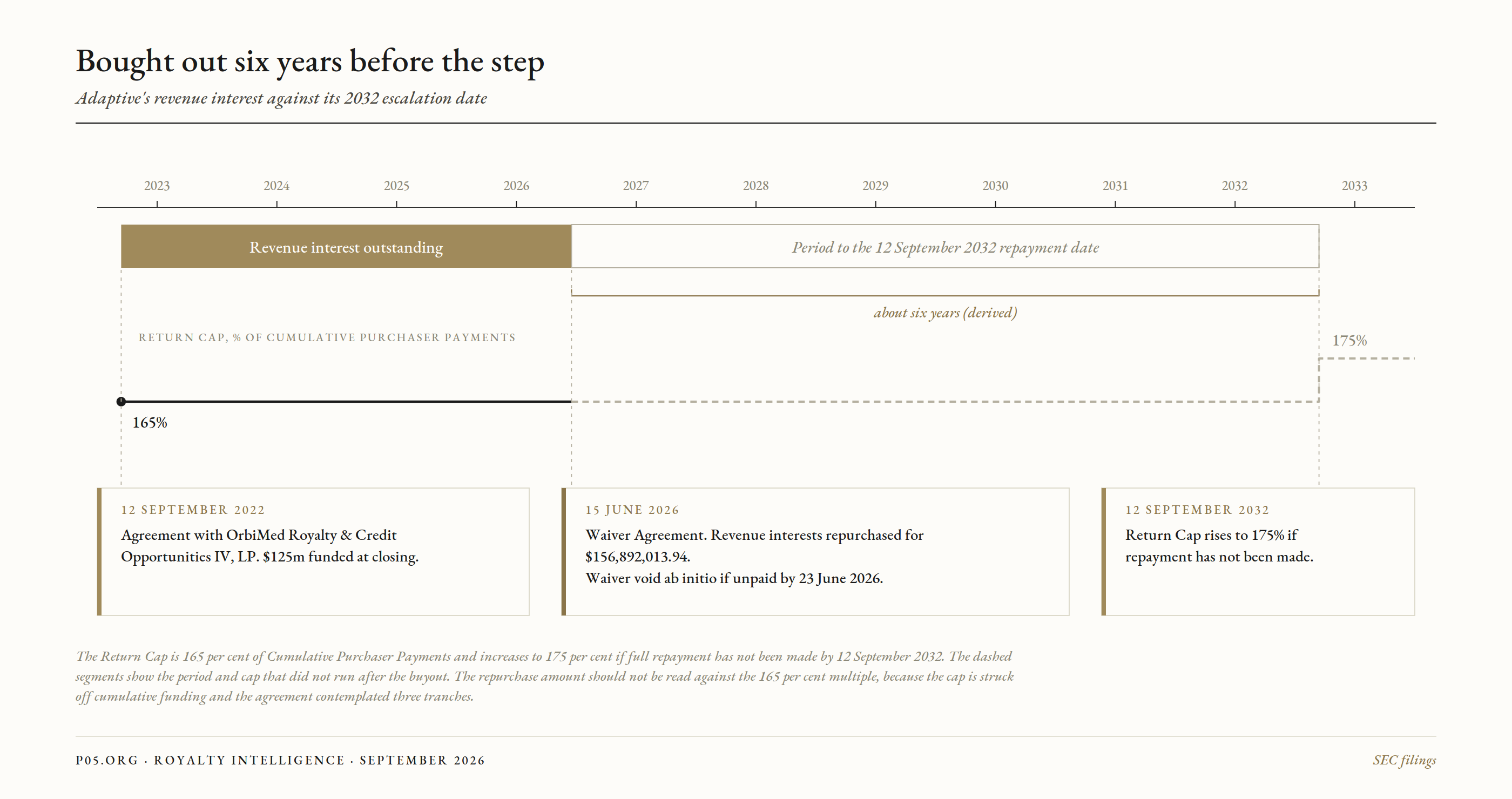
Figure 4. Adaptive's revenue interest, September 2022 to September 2032. The Return Cap would have risen from 165 to 175 per cent on 12 September 2032 if repayment had not been made. The position was bought out under a waiver agreement dated 15 June 2026.
What moves the position, and what only appears to
Terms that move it:
- The condition attached to the escalation. Where a cap steps on a date, the step is a term of the deal. Where it steps because repayment has not been made, the seller's shortfall sits inside the buyer's entitlement.
- An express provision that nothing is repayable if the cap is never reached, as uniQure's agreement has. It keeps a two-step ladder on the sale side of the line.
- A true-up reaching assets other than the royalty-bearing product, as Daré's does from 2035 where other income sources exist.
- The cap's history. Karyopharm's ran at 185 per cent in 2019 and 195 per cent from October 2025, and a single figure in a data room shows none of that.
- The disclosed effective interest rate and its direction, which is the rate at which the obligation climbs toward the cap.
- Whether the cap is denominated in a multiple or in a return. An internal rate of return accretes continuously, so no date arrives on which anything visibly changes.
Terms that only appear to:
- A cap expressed as a multiple of the upfront payment, which fixes the total and leaves open the period over which it is reached.
- A payment waiver, which removes cash without creating an accrual. Karyopharm's waived year was given up by the holder and added to nothing.
- A repurchase figure read against the cap multiple, where the multiple is struck off cumulative funding and the tranches drawn are undisclosed.
- The absence of a rate step-up, which leaves open whether the quantum moved.
What each side should ask
For the purchaser
- Is the escalation keyed to a date or to the fact of non-payment, and would you accept the second on the same pricing?
- Does the agreement provide that nothing is repayable if the cap is never reached, and does anything elsewhere in the document cut across that?
- Where the cap is an internal rate of return, what does the accretion look like against the seller's own revenue forecast, and when does the first catch-up obligation bite?
For the seller
- Has the cap moved since signing, and on what consideration each time?
- Does any true-up reach assets other than the product, and under what condition?
For a fund buying the position from someone else
- What was the cap at signing, and what is it now?
- Is the holder's entitlement growing because a date is approaching or because the obligor has not paid?
- Has the obligor's effective interest rate been revised, in which direction, and what did the obligor say about its forecast at the time?
uniQure's cap steps from 1.85 to 2.25 times in June 2032 on the calendar alone, and its filing provides that nothing is owed if the royalties never reach it. Adaptive's would have stepped from 165 to 175 per cent in September 2032 where repayment had not been made, and in June 2026 the company paid $156,892,013.94 instead.
All information in this article was accurate as of the research date and is derived from publicly available sources including SEC filings, issuer press releases, court opinions, and legal and financial commentary. Information may have changed since publication. This content is for informational purposes only and does not constitute investment, legal, accounting, tax, or financial advice. The author is not a lawyer, accountant, tax adviser, or financial adviser.