
Adequate remuneration: compulsory licensing and the pharmaceutical royalty

Article 31(h) requires adequate remuneration in the circumstances of each case, taking into account the economic value of the authorisation. It does not name a base. Every issued licence of the last twenty years has resolved that silence the same way, and the resolution, rather than the headline rate, decides what a compulsory licence does to a royalty. The remuneration is then paid to the patent proprietor, which in most agreements written before 2020 is not the party holding the royalty.
The bridge and take-out piece treated the interval between short paper and its replacement. This one treats the interval between a state authorising use of a patent and money reaching a royalty holder, if it reaches one at all.
1. What survives, what disappears, and who is paid
Three structural facts govern the transmission.
The patent survives. A compulsory licence is not an invalidation and not an expropriation, so it engages none of the clauses drafted for either. Patent-maintenance covenants are satisfied in full while the licence runs.
The licensed channel goes to zero. Where the grant covers public non-commercial use, the ministry stops buying the branded product. Net Sales in that channel collapse, and a royalty measured on the originator's Net Sales collects nothing from the substitute volume. Where the grant is confined to government use, as in Colombia, the private channel is untouched and the collapse is partial.
The remuneration is a different instrument from the royalty. It runs from a compulsory licensee or a ministry to the patent proprietor as right holder, in local currency, on a schedule the granting authority sets, reviewable under Article 31(j) in that authority's own courts. It is not a payment under the licence agreement and does not enter the contractual waterfall.
Two procedural facts are worth carrying as priors. The Article 31bis export route has been used once: Rwanda notified in July 2007, and Canada notified a licence to Apotex in October 2007, after which the paragraph 6 system fell dormant. And the MC12 vaccine decision was never widened; the TRIPS Council reported failure to reach consensus on therapeutics and diagnostics on 13 February 2024.
2. The base problem
The published methodologies anchor on the substitute, not the displaced product. Canada's export guidelines set 0.02 to 4 percent of the price of the generic, positioned on the scale by the destination's Human Development Index rank. Regulation (EC) No 816/2006 caps export remuneration at 4 percent of the total price paid by the importing country, with the recital offering that figure as a reference point elsewhere.
The 2005 WHO and UNDP Remuneration Guidelines proposed a Tiered Royalty Method keyed to income per capita. The industry objection, put most precisely in the JIPLP critique linked above, is that a generic-price anchor cannot satisfy the instruction to consider the economic value of the authorisation, since the authorisation's value is measured by what it displaced.
Issued rates cluster in a narrow band. Thailand's November 2006 government use order on efavirenz set 0.5 percent of the Government Pharmaceutical Organization's total sale value, repeated in the January 2007 lopinavir/ritonavir and clopidogrel orders. Brazil's Decree 6.108 set 1.5 percent of the price paid by the Ministry of Health. Malaysia's 2003 order was reported at 4 percent of the value delivered.
India's sole licence ran 6 percent, raised to 7 on appeal. Russia's October 2021 methodology set 0.5 percent of the licensee's revenues; in March 2022 it was amended to 0 percent for proprietors connected to 48 designated states, a list covering essentially every jurisdiction in which pharmaceutical patents are held.
The South Centre keeps a running inventory for anyone wanting the full set rather than the cases below.
3. Three awards, worked
Brazil, efavirenz, 2007. Merck was supplying at USD 1.59 per tablet, about USD 580 per patient-year and roughly USD 42.9 million in 2007, against Indian generic supply at USD 0.45 per tablet, or USD 163 to 166 per patient-year. Applying 1.5 percent to the post-decree ministry price gives about USD 2.49 per patient-year, or roughly USD 187,000 across the 75,000 patients on therapy. That is four tenths of one percent of the revenue line it replaced.
India, sorafenib, 2012 and 2013. Natco's price was about USD 175 per month against Bayer's USD 5,500. The appellate board raised the rate to 7 percent on net sales, which yields about USD 12 per patient-month against the USD 385 the same rate on branded sales would have produced. The rate rose by a sixth and the remuneration landed at three percent of the counterfactual. Onyx, holding economics through the Bayer collaboration, disclosed the licence and the rate change in its Form 10-Q, one of the few filings in which a downstream holder has put the exposure on the record.
Colombia, dolutegravir, 2023 to 2026. Resolution 20049 is the most fully reasoned remuneration decision in the modern record. The Superintendence built on Japan Patent Office guidance, defended a 4 percent base rate derived from expected profitability, and rejected the proprietors' argument that their sublicensing terms elsewhere should inform it. The award is not a percentage: COP 0.11 per milligram introduced or produced, payable annually to Shionogi and ViiV.
At a 50 mg daily dose that is COP 2,008 per patient-year, about USD 0.50 at roughly 4,000 pesos to the dollar, against a branded cost the government put at USD 1,224 and PAHO generic supply at USD 44.
Four percent of the generic price would have been USD 1.76, so the award sits below the rate the Superintendence defended applied to the base it chose. The licence carried an outside expiry of 28 April 2026 and no renewal appears on the public record, so it has run its stated course; the Andean Community secretariat had already ruled in Colombia's favour in November 2024 over ViiV's objections.
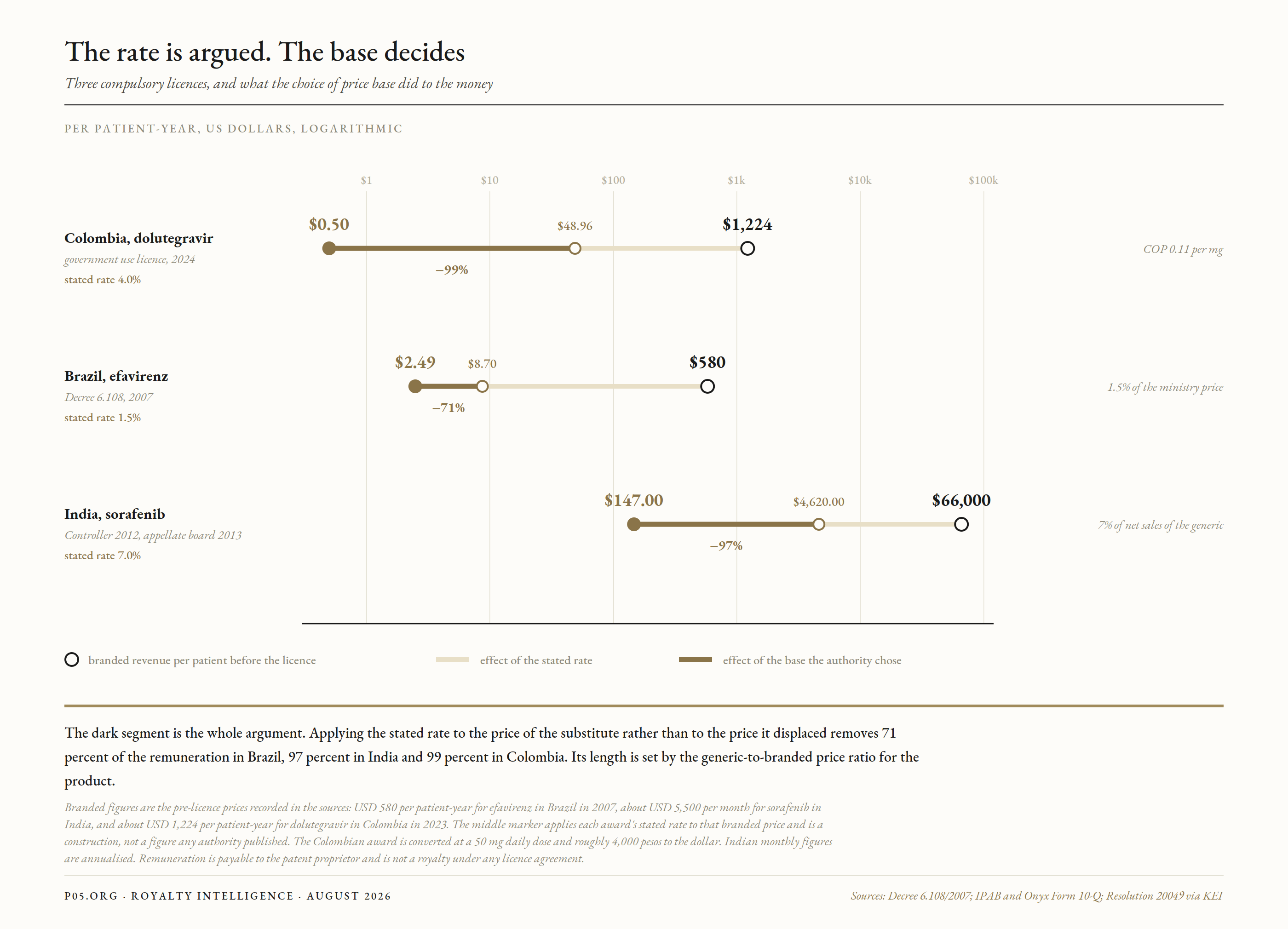
Figure 1. The rate is argued, the base decides. Each row runs from the branded revenue the licence displaced, through the stated rate applied to that price, to the remuneration actually awarded. The dark segment is the base substitution, and its length equals the generic-to-branded price ratio for the product: 71 percent in Brazil, 97 percent in India, 99 percent in Colombia. The middle marker is a construction and no authority published it.
The rate is the variable that gets litigated and the base is the variable that decides. A point on the rate moves remuneration by about fifteen percent. The base substitution moves it by the generic-to-branded ratio, which is a function of cost of goods and generic market structure rather than anything an authority chooses.
4. Two modes, wearing the same units
The precedents above sit in procurement markets carrying little of a royalty's discounted value. The channels available where the value actually sits resolve remuneration on a different standard.
Germany. The 2016 Federal Patent Court grant over Shionogi's patent, upheld in July 2017 and mooted when the EPO Board of Appeal revoked the patent, ran the other direction: it preserved Merck's raltegravir sales against an injunction rather than admitting a generic. A royalty holder on Isentress gained from it. Compulsory licensing out of a two-innovator dispute under section 24 PatG is a different economic event from compulsory licensing out of a pricing dispute, and in Europe it is the likelier of the two.
European Union. Regulation (EU) 2025/2645 entered into force on 19 January 2026. A Union compulsory licence is granted by the Commission with internal-market effect, gated on activation of a crisis mode under an Annex instrument, with no export outside the EU. The remuneration provision carries no percentage cap: the Commission sets an adequate amount against the economic value of the authorised activities and the circumstances, including any public support received to develop the invention.
The 4 percent figure survives only in the amended 816/2006 export regime. Nothing has been granted, and nothing can be until a listed instrument is activated. A Boston University assessment reads it partly as a signal to middle-income countries excluded from voluntary licences.
United States. Section 1498 is the operative authority, and its compensation standard is judicial. The Court of Federal Claims constructs a hypothetical negotiation on the Georgia-Pacific factors, and a review of the case record characterises the awards as conservative reasonable royalties on the market value of the invention, typically at or below ten percent of sales.
Ten percent of a domestic price is not the same instrument as 0.5 percent of a generic import price. Bayh-Dole march-in remains unexercised; the December 2023 NIST framework treating price as relevant was never finalised, and what carried across the administration change was narrower, an affordability requirement in NIH-owned patent licences adopted on 1 October 2025.
The multilateral layer. The Pandemic Agreement adopted in May 2025 cannot enter into force until the PABS annex completes.
The annex missed its May 2026 deadline, and on 23 May 2026 the Assembly extended negotiations toward a possible special session in 2026 or a return in May 2027, with a mandate covering legally binding access contracts. That route would sit upstream of any royalty, embedding access terms where a molecule originates rather than where a government reacts to its price. It is the development most likely to change the shape of this risk over a ten-year royalty term.
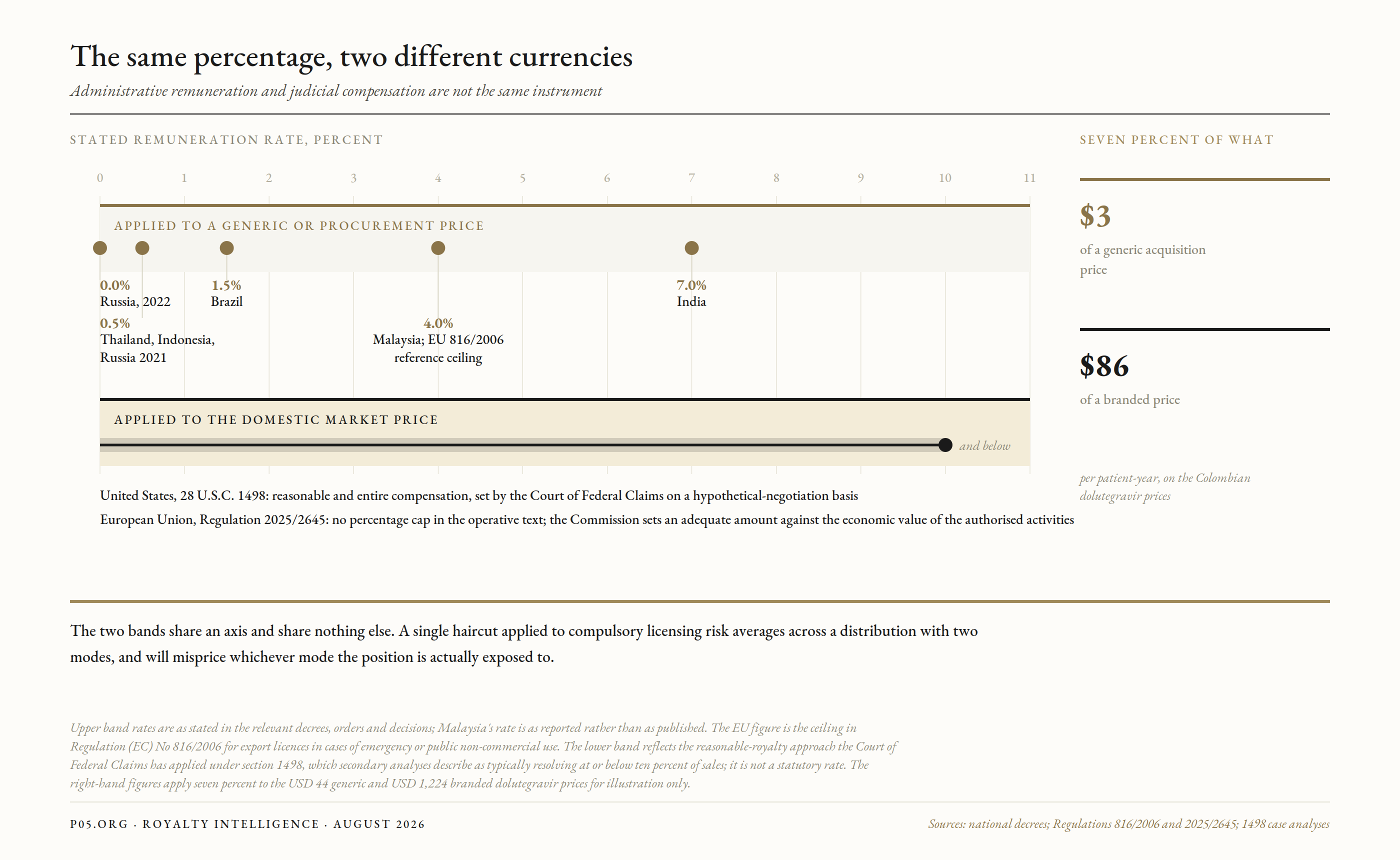
Figure 3. Administrative and judicial remuneration share an axis and share nothing else. The upper band applies its percentages to a generic or procurement price, the lower band to the domestic market price. Seven percent of the Colombian generic acquisition cost is about USD 3 per patient-year; seven percent of the branded price is about USD 86. The lower band reflects secondary analysis of section 1498 case law, not a statutory rate, and no pharmaceutical patent has produced a completed award.
5. The contract layer
Three questions resolve independently, and only the third is commonly unaddressed.
Territory revenue. Falls in the licensed channel, survives outside it.
Step-down. A compulsory licensee's product will usually satisfy the Generic Product definition, triggering the country-level reduction and in some agreements ending the Royalty Term there. This is where most of the value goes. Goodwin's July 2026 database analysis found generic entry as a reduction trigger in 100 percent of royalty-bearing deals in the trailing twelve months, patent expiration in 95 percent, and reductions tied to other events up from 44 to 74 percent, driven largely by government pricing. The clause layer that will decide compulsory licence outcomes is being rewritten now, for IRA and MFN reasons unconnected to compulsory licensing.
Remuneration. Absent express words, it does not reach the royalty holder. The statutory payment runs to the proprietor; the compulsory licensee is not a sublicensee; its volume is not Net Sales of Licensed Product by the licensee or its affiliates. The holder can lose the whole territory while the proprietor books a small positive receipt, with nothing in the standard definitions bridging them.
Zymeworks and Jazz drafted for it at Section 9.6(c)(iv) of the 2022 zanidatamab agreement. Where a compulsory licence issues in the Territory at a rate lower than the contract rate, the royalty on Net Sales made pursuant to that licence is reduced to a specified fraction of the rate payable by the compulsory licensee, with compulsory licence defined broadly as any government grant to sell without the party's authorisation.
The fraction is redacted; the architecture is not. Indexing the private rate to the state-set rate imports the authority's methodology and its choice of base wholesale.
The same document makes a second point unintentionally. Its Ex-Territory excludes the PRC, Hong Kong, Macau, Taiwan, South Korea, Mongolia, five Central Asian republics, Australia, New Zealand, and the whole of ASEAN. Several of the most active compulsory licensing jurisdictions fall outside the licensed territory. Exposure is a question about the territory definition before it is a question about country risk.
6. Why the discount rate is the wrong instrument
The base rate is low and the developed-market evidence is direct. Qunaj, Kaltenboeck and Bach catalogued 45 episodes across the United States and seventeen high-income comparators in the twenty years after Doha, 24 of them American, with 24 percent of non-US petitions price-motivated and three cases anywhere clearly associated with a price discount.
Attrition down the chain is steeper than the headline count suggests. Mexico strengthened its emergency provisions in 2020 and has issued nothing. Brazil enacted Statute 14.200/2021 and issued nothing.
The Spinraza negotiation ended in a risk-sharing agreement. The 2005 oseltamivir threats produced voluntary sublicensing and no compulsory production. CSIS, tracking through July 2026, finds the mechanism rarely converts legal authority into production, the binding constraints being manufacturing capacity, technology transfer and regulatory capability.
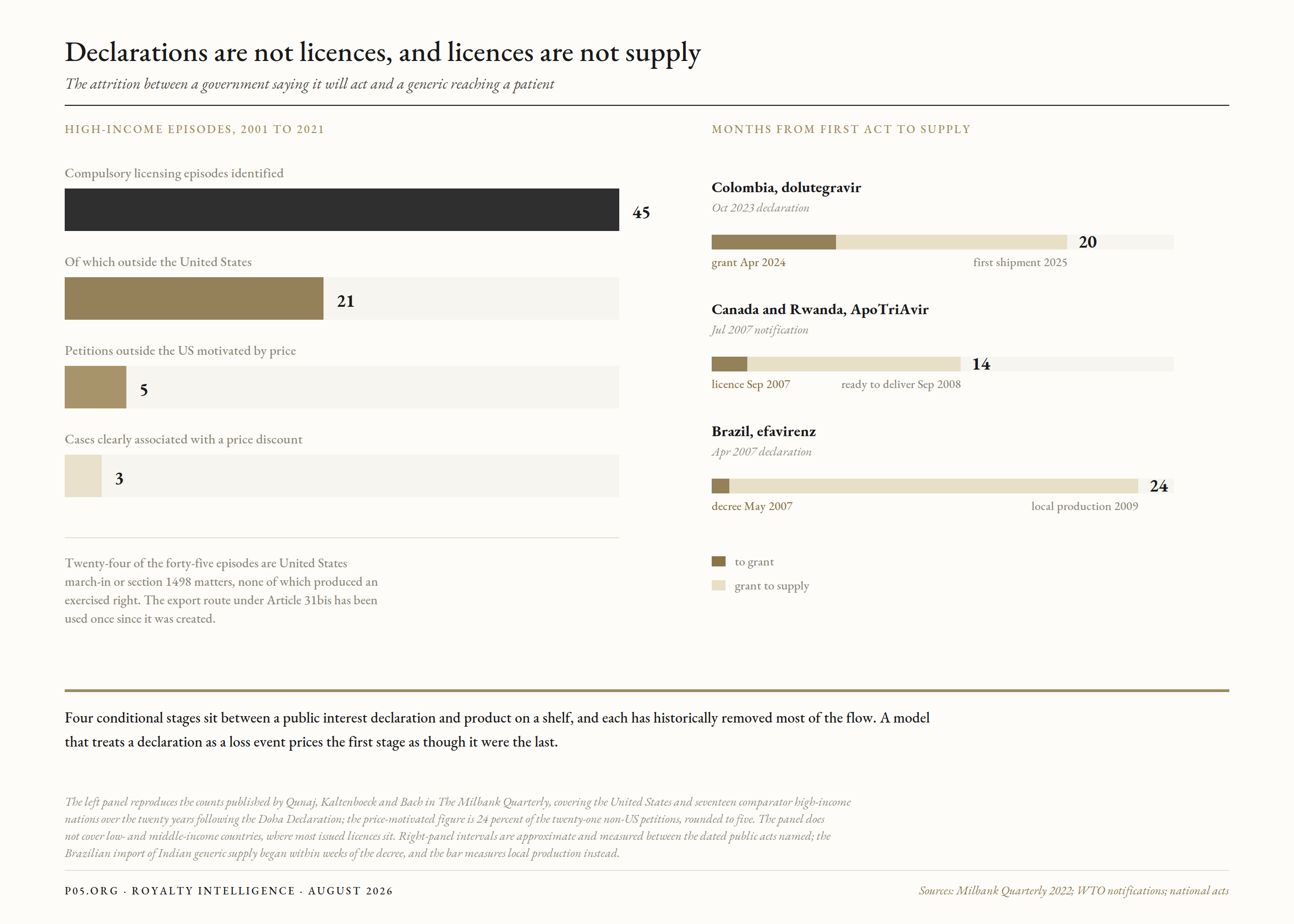
Figure 2. Declarations are not licences, and licences are not supply. The left panel is the high-income episode count; the right panel measures the interval from first public act to product moving, which ran 20 months in Colombia, 14 for the Rwanda export licence and 24 to Brazilian local production. The left panel excludes low- and middle-income countries, where most issued licences sit.
Against that, three reasons the discount-rate treatment fails on its own terms.
It is the wrong shape. Moving a twelve-year level stream from 9.0 to 9.5 percent removes about two and a half percent of value; writing off a territory contributing four percent of revenue removes about four percent. Same order of magnitude, and the bump spreads it evenly across every year and every geography while the loss is a step function in one or two named countries, arriving in a definable window and usually reversible.
It is correlated. The Russian move to zero came within days of the invasion and applied by proprietor nationality rather than by product. That is a portfolio event that a diversified book does not diversify away.
It is the tail of a distribution whose body is already repricing. Royalty Pharma's own risk factors list governmental regulation and policy, including price caps. A compulsory licence is the same risk at a more extreme quantile: a state deciding what it will pay. Pricing the body and ignoring the tail should be a decision rather than an omission.
The near-term test is the GLP-1 class. Semaglutide goes off patent in Brazil, India, Canada, China and Turkey from 2026. Brazilian Senate bills propose a compulsory licensing route for tirzepatide alongside a public-interest declaration bill, though the health minister has pointed to regulatory pathways and forthcoming class expiries, and the Vice President has opposed the bills. The shape is familiar: legislative noise around a high-visibility class in a market where the class is about to lose exclusivity anyway.
7. Decomposition
Four conditional stages, priced separately: declaration, grant, qualified supplier engaged, product delivered. The historical conditional probabilities fall away fast at each, and the lags run one to two years.
Exposure is territory revenue share off the build, adjusted for channel. A government use grant leaves private volume intact, which in several middle-income markets is a material fraction.
Loss given event is one minus remuneration recovery. Recovery is near zero where the agreement is silent, contractual where a Zymeworks-style indexing clause exists, and materially higher in a proceeding that sets compensation against a domestic price base.
Duration is bounded. Licences are terminable when circumstances cease; Colombia's expired on its own terms. A permanent territory write-off overstates the loss unless the patent is near expiry anyway, in which case the licence has pulled forward an erosion already in the model.
Run it as a scenario layer on territory rows. The output is auditable by country and can be tested against the contract to see whether the loss is mitigated or amplified there.
8. What moves the position, and what only appears to
Terms that move it:
- Indexing of the contractual royalty to the state-set remuneration, so the holder inherits a defined share of the award rather than nothing.
- A payment obligation reaching amounts received by the proprietor in respect of the Licensed Product however characterised, rather than only sales invoiced by the licensee and its sublicensees.
- A royalty floor surviving the generic-entry step-down, so that a compulsory licensee triggering the generic definition does not zero the territory.
- A territory definition that excludes or separately prices the exposed jurisdictions, which is a signing decision and cannot be made afterwards.
- An obligation to contest declarations and proceedings and to keep the holder informed, with participation rights in the remuneration phase where local procedure allows.
- For federally funded products, an allocation of section 1498 compensation or any march-in outcome, since the standard there is high enough to be worth allocating.
Terms that only appear to:
- A generic-entry step-down without a compulsory licensee carve-out, which converts a state action into an automatic reduction against the holder.
- Patent-maintenance covenants, satisfied in full while a licence runs.
- General force majeure or change-in-law language, which suspends performance rather than reallocating value and which a paying licensee has no reason to invoke.
- A country-risk premium in the discount rate, for the shape reasons above.
- Reliance on a voluntary licence programme, which lowers probability in the covered countries and does nothing for the excluded middle-income markets, which is where the recent grants have occurred.
9. What each side should ask
Purchaser. Which territory countries carry both an active record and a material revenue contribution, and what is the product of those numbers rather than the union of the lists? Does the agreement give any claim on the statutory remuneration, and if not, is the seller retaining a stream the buyer assumed it was acquiring? Does the generic definition capture a compulsory licensee, and is there a floor beneath the step-down?
Seller or licensor. Is the risk being priced into the discount on a territory-level basis or as a general country-risk assertion? Does the voluntary licence programme's country coverage align with the territory being sold, or does it leave the middle-income gap that has produced every recent grant? If the state channel is licensed and the private channel survives, does the agreement measure that, or treat the territory as binary?
Fund or portfolio holder. Is exposure correlated across the book by therapeutic area, public-payer share, or proprietor nationality, and does the framework capture correlation at all? Have the government-pricing triggers in recent vintages been diffed against the older ones? What happens if remuneration is set at zero rather than at a low percentage, which requires no change to TRIPS and has already happened once?
Thailand paid 0.5 percent of the price of a generic. Brazil paid 1.5 percent of what its ministry paid, roughly USD 187,000 a year against a branded line near USD 43 million. India raised the rate from 6 to 7 percent and the money still came to three percent of the counterfactual. Colombia awarded about USD 0.50 [COP 2,008] per patient-year against a branded cost it put at USD 1,224. Russia went from 0.5 percent to zero by decree in a fortnight. Germany granted a licence that preserved an incumbent's sales. The Court of Federal Claims would run a hypothetical negotiation. The Commission now holds an instrument it has never used and discretion over what adequate means.
The rate is argued and the base decides. For a royalty holder, one question decides everything downstream of that: whether the contract says anything at all about who receives the remuneration.
All information in this article was accurate as of the research date and is derived from publicly available sources including WTO and EU legal instruments, national decrees and regulatory decisions, SEC filings, peer-reviewed literature, and legal and policy commentary. Information may have changed since publication. This content is for informational purposes only and does not constitute investment, legal, accounting, tax, or financial advice. The author is not a lawyer, accountant, tax adviser, or financial adviser.