
The bridge and the take-out: short paper against the pharmaceutical royalty

Bridge financing is the shortest paper in the capital structure, and it is regularly written against some of the longest assets in it. The take-out provision is the machinery that governs how, when, and at whose cost the short paper is replaced. This is an account of both, worked from the investment grade M&A sequence down to the royalty deal level, where the same mechanics appear under different names.
A pharmaceutical royalty is a long asset. A commercial-stage stream runs to patent or regulatory expiry a decade or more out, and a synthetic royalty written on a newly approved product is underwritten on a sales curve that has not yet ramped.
Against that duration, the industry's transactional plumbing keeps producing instruments with tenors measured in months: the 364-day acquisition bridge, the approval-gated tranche, the warehouse line, the insider bridge note ahead of an IPO. Each of those instruments is designed around its own exit, and the exit terms are where much of the economics sit. The margin on a bridge is rarely the point; the fees that accrue if it is not taken out on schedule usually are.
The development funding bond piece treated one instrument that swapped product-level exposure for parent credit. This piece treats the layer around every such instrument: the tenor it is written for, and the provisions that move the position into its permanent home.
1. The anatomy of the acquisition bridge
The committed acquisition bridge solves a timing problem rather than a funding problem. A buyer signing a public M&A agreement needs certainty of funds at signing, months before it can sensibly price long-term debt. A bank syndicate therefore commits a bridge facility at signing that, in the standard design, no party intends to fund, or intends to fund only briefly.
Cleary Gottlieb's treatment of high yield bridge loans states the design principle: neither the borrower nor the underwriters want the bridge funded, and in the ideal sequence the bond take-out completes between signing and closing so the bridge commitment expires unused. Where the bridge does fund, the terms are built to make the stay short.
- Tenor. The standard bridge runs 364 days from funding. The tenor is short partly for bank regulatory capital treatment and partly as repayment discipline.
- Ticking and duration fees. A commitment fee accrues from signing on the undrawn amount. Once funded, duration fees apply at intervals, commonly at 90, 180, and 270 days, each adding basis points to the cost of remaining in the bridge. The margin itself typically steps up on the same schedule, subject to a cap agreed at commitment.
- The securities demand. In leveraged structures, the underwriters hold a demand right: they can require the borrower to issue the take-out securities on defined terms, within the caps set at signing, regardless of the borrower's view of the market. The interest rate cap and the structure flex negotiated at commitment are, in practice, the price of the bridge.
- The rollover. A bridge that reaches maturity without a take-out does not default into thin air. It converts into an extended term loan, typically with a tenor matching the intended bonds, and in high yield structures the extended loan is exchangeable into exchange notes the lenders can sell. The lender's exit is built into the document.
Investment grade bridges are simpler. They generally carry no securities demand and no exchange note apparatus, and rely instead on the depth of the investment grade bond market and mandatory prepayment from issuance proceeds. The underlying logic is the same: a short commitment priced to be refinanced, with fee mechanics that make lingering expensive.
Two features of the package recur at the royalty deal level in sections 5 and 6.
First, the take-out is triggered by events rather than dates: net proceeds of a qualifying debt or equity issuance prepay the bridge whenever they arrive.
Second, the cost of the position is a function of time in the instrument. The fee ladder can be read as a schedule of what each additional quarter in the bridge is worth to each side.
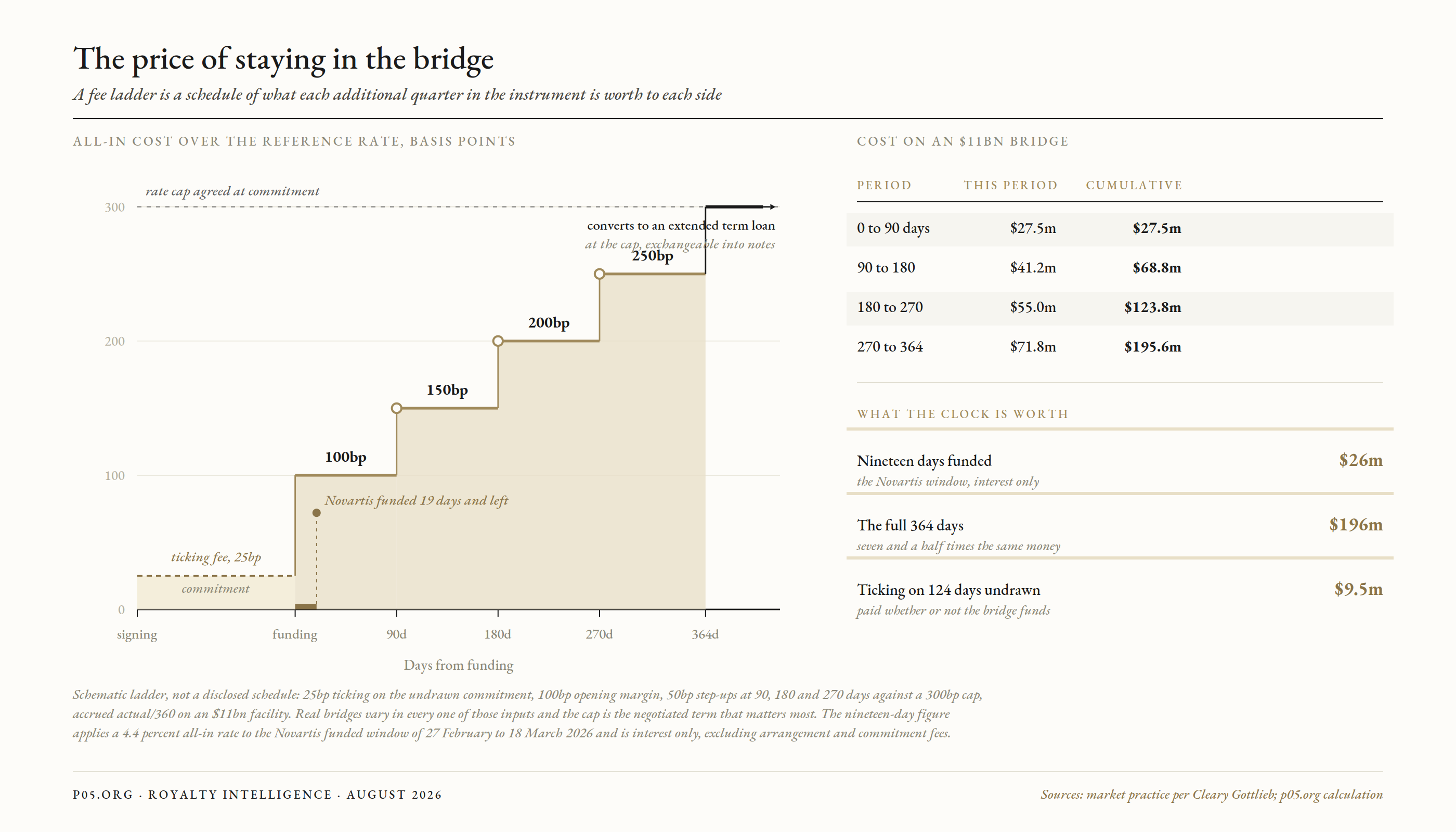
Figure 1. The price of staying in the bridge. A ticking fee runs on the undrawn commitment; once funded, duration fees and margin step-ups apply at intervals against a cap agreed at commitment; an unrefinanced bridge converts at maturity into an extended term loan. Priced on an $11 billion facility, the full 364 days costs roughly seven and a half times the nineteen days Novartis actually used. The ladder is schematic.
2. The funded bridge and the bond take-out
Novartis AG / Avidity Biosciences, Inc., October 2025 to March 2026
In October 2025 Novartis agreed to acquire Avidity Biosciences for $72 per share in cash, valuing the company at $12 billion, a 46 percent premium to the prior close, in the year's second-largest biopharmaceutical acquisition behind Johnson & Johnson's $14.6 billion purchase of Intra-Cellular Therapies. Avidity concurrently agreed to split off its early-stage cardiovascular work into a separate company, with Avidity holders receiving one share in the new entity for every ten Avidity shares.
The financing ran in three steps, each disclosed in the company's filings.
- The acquisition completed on 27 February 2026 and was initially financed through a $11.0 billion bridge loan carrying interest based on compounded SOFR.
- On 16 March 2026 a Novartis financing subsidiary, guaranteed by the parent, marketed SEC-registered US dollar bonds in eight announced tranches, with fixed-rate notes due 2029, 2031, 2033, 2036, 2046 and 2056 and floating rate notes due 2029 and 2031, with proceeds designated for general corporate purposes including repayment of the bridge. Initial price talk on the 2056 tranche was approximately 1.2 percentage points over Treasuries, with BNP Paribas, Citigroup, Deutsche Bank, J.P. Morgan and Mizuho managing the sale; the tranche ultimately priced inside that talk. The deal priced at $11 billion across seven tranches after a five-year floating rate note was dropped during syndication, the largest of eight investment grade offerings totalling roughly $26 billion that Monday.
- The bridge was fully repaid on 18 March 2026 from the bond proceeds. Linklaters' deal summary records the underwriting syndicate on the bond leg as Citigroup, J.P. Morgan, BNP Paribas, Deutsche Bank and Mizuho together with BofA Securities, HSBC, Societe Generale and UBS.
Read as a tenor transaction, the sequence converted roughly three weeks of SOFR-based bridge exposure into a ladder of fixed-rate paper reaching 2056. The bridge carried the closing; the bond ladder carries the asset. The asset itself, an RNA therapeutics pipeline whose lead programmes are years from peak revenue, sits at the far end of both instruments' duration. That is the general condition of pharmaceutical acquisition finance: the funding is termed out long, and still shorter than the cash flows being bought.
3. The pre-funded variant and the special mandatory redemption
Pfizer Inc. / Seagen Inc., March 2023 to December 2023
Pfizer ran the other standard design on its Seagen acquisition, agreed in March 2023 at $229 per share in cash. Rather than fund a bridge at closing and refinance it afterwards, Pfizer issued the permanent debt seven months before completion and built the conditionality into the bonds.
In May 2023 Pfizer priced $31 billion of senior notes in eight tranches, issued through a wholly-owned subsidiary and guaranteed on a senior unsecured basis by the parent:
- $3 billion of 4.650% notes due 2025
- $3 billion of 4.450% notes due 2026
- $4 billion of 4.450% notes due 2028
- $3 billion of 4.650% notes due 2030
- $5 billion of 4.750% notes due 2033
- $3 billion of 5.110% notes due 2043
- $6 billion of 5.300% notes due 2053
- $4 billion of 5.340% notes due 2063
Contemporary reporting placed the offering as the largest M&A debt financing of that year and the biggest US corporate bond sale since CVS's $40 billion Aetna issuance in 2018, with Bloomberg and deal counsel describing it as the fourth-largest US bond sale on record. BofA Securities, Citigroup, Goldman Sachs and J.P. Morgan acted as joint lead managers.
The instrument that made pre-funding workable is the special mandatory redemption. Each series other than the 10-year and 30-year notes was redeemable at 101 percent of principal if the merger terminated or failed to close by an agreed outside date. The SMR is a take-out provision running in reverse: instead of protecting a bridge lender against a slow refinancing, it protects a bondholder against a deal that never closes, returning the money at a fixed price if the asset does not arrive.
The completion accounts show the full stack. Pfizer closed Seagen on 14 December 2023 for total consideration of $44 billion ($43 billion net of cash acquired), funded by the $31 billion of May notes plus $8 billion of commercial paper issued in the fourth quarter.
The same filing notes that higher interest expense on the notes was more than offset, for the year, by interest income earned on the invested proceeds during the pre-closing period. The commercial paper is the residual bridge in the structure: the shortest instrument in the sequence, sized to the remaining gap, refinanced in the ordinary course.
The two designs in sections 2 and 3 differ in where the carry sits. Novartis paid bridge economics for three weeks and took syndication risk in March 2026. Pfizer carried $31 billion of pre-funded notes for seven months, partly offset by investment income, and obtained certainty of funds plus an unwind priced at one point over par. The choice between them turns on the rate path between signing and closing, the regulatory timetable, and the weight each buyer places on removing the take-out from the critical path.
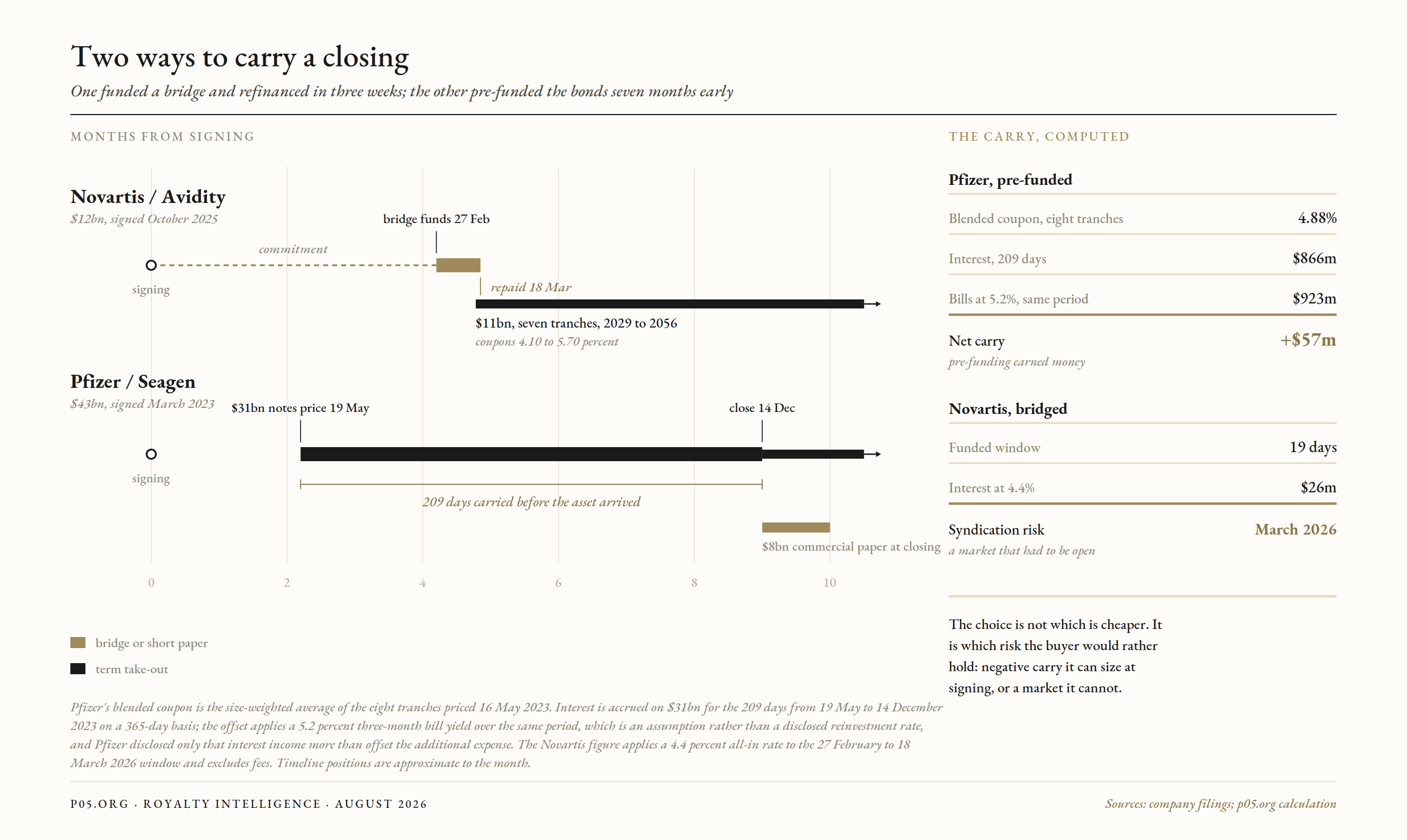
Figure 2. Two ways to carry a closing. Novartis funded a bridge for nineteen days at a cost of roughly $26 million and refinanced into a seven-tranche ladder. Pfizer carried $31 billion of notes for 209 days before the asset arrived, at a blended 4.88 percent coupon against bills yielding more, so the pre-funding was carry-positive. The choice is which risk the buyer would rather hold.
4. Royalty capital as the bridge
Collegium Pharmaceutical, Inc. / BioDelivery Sciences International, Inc., 2022 to 2025
Further down the size spectrum, the identity of the bridge lender changes. Where an investment grade acquirer bridges with banks and takes out with bonds, a specialty pharmaceutical acquirer has, in documented cases, bridged with royalty-fund credit and taken out with banks, once the acquired cash flows had a history.
Collegium's sequence is set out in its Form 10-K.
- In March 2022, in connection with closing its acquisition of BioDelivery Sciences, Collegium entered a $650 million secured term loan with BioPharma Credit PLC as collateral agent and funds managed by Pharmakon Advisors as lenders, the proceeds repaying the company's existing term notes and funding part of the acquisition consideration.
- The facility was restructured into a 2024 term loan, a modification with net proceeds of approximately $313 million.
- On 23 December 2025 Collegium entered a credit agreement with a bank syndicate and Truist Bank as administrative agent, providing a $580 million term loan, $300 million of delayed draw term loan commitments and a $100 million revolver, with the term loan repaying the 2024 loan in full.
The pattern is the acquisition bridge sequence stretched over three and a half years. Credit from a royalty-focused lender, the segment of the market mapped in the venture debt piece, funded an acquisition on a timetable and at a certainty the syndicated bank market does not typically offer a borrower of that size at announcement. Conventional bank capital refinanced it once the combined company's revenue record supported bank underwriting.
The tenor of this kind of bridge is not written in the document; it is discovered, and it equals the time the borrower takes to become bankable. On the lender side, prepayment premiums and make-whole provisions occupy the position duration fees occupy in the bank bridge: they price an exit both parties can foresee and protect the return on a holding period that may end early.
5. The take-out trigger at the deal level: approval-gated tranches
Inside individual royalty financings, the same event-driven logic appears with regulatory approval standing where the bond pricing date stands in the M&A sequence.
Nuvation Bio Inc. / Sagard, March to June 2025
Nuvation Bio closed a financing of up to $250 million with Sagard in March 2025, comprising a $150 million synthetic royalty purchase with Sagard Healthcare Partners and a $100 million senior secured term loan with Sagard Holdings Manager. The royalty investment amount and a $50 million tranche of the term loan funded on 25 June 2025, following FDA approval of IBTROZI. The term loan bears interest at SOFR plus 6.00 percent, subject to a 4.00 percent SOFR floor, with no scheduled amortisation and principal due at maturity.
The company carried the interval between signing and approval on a commitment rather than on funded cash. The approval is the take-out event of the commitment period: it converts contingent capital into funded exposure, in the way a bond pricing converts a bridge commitment into permanent capital. The cost of the unfunded interval is embedded in the deal's overall economics rather than paid as a separately stated ticking fee.
Revolution Medicines, Inc. / Royalty Pharma, 2025
Royalty Pharma's arrangement with Revolution Medicines scales the structure. The package provides up to $1.25 billion, including $250 million paid upfront, to purchase a synthetic royalty on daraxonrasib, together with a senior secured term loan of up to $750 million whose first tranche must be drawn following FDA approval of daraxonrasib.
As of 31 December 2025, $1 billion of the funding commitment remained unfunded. The same filing describes Royalty Pharma's staged arrangement with Cytokinetics, seven tranches of up to $525 million in commercial launch funding, of which $175 million remained available at year end.
The mandatory draw in the Revolution Medicines term loan is a securities demand in mirror image: the funder, having carried the commitment through a binary event, is assured the exposure it underwrote once the event resolves. That event remains pending. The FDA accepted the daraxonrasib new drug application for review on 22 July 2026 in previously treated metastatic pancreatic cancer, so as of August 2026 the approval that triggers the first term loan tranche has not yet occurred, and the commitment period described above is still running.
The section 365 piece covered the insolvency dimension of this architecture: a staged funding commitment with undrawn tranches risks treatment as a financial accommodation under section 365(c)(2), which can strand the undrawn money in the funder's insolvency-adjacent scenarios.
The tenor point and the bankruptcy point are one point seen from two sides. A commitment is short paper, and short paper depends on the obligor being present on the trigger date.
The smallest end of the market
The bridge also persists in its oldest form. Regentis Biomaterials' registration statement discloses bridge loans entered between October and November 2024, bearing 8 percent interest, repayable at the earlier of an IPO or a fixed maturity date, carrying for those loans an aggregate risk premium equal to 30 percent of the loan amount at maturity, plus warrants keyed to the IPO price, with the maturity date subsequently extended by amendment when the offering timetable moved.
Later loans carried different premiums, and the company withdrew the registration in June 2026, so the IPO take-out those terms were written against did not arrive.
The institutional bridge is present here in miniature: a short stated tenor, a take-out event (an IPO rather than a bond), an escalating cost of remaining in the instrument, and a renegotiation when the take-out misses its window.
6. The embedded take-out: caps, repurchases, and change of control
Royalty and revenue interest financings rarely use the word take-out. Most of them nonetheless contain one, written as a cap, a repayment discount, or a mandatory repurchase.
Zymeworks Inc. / Royalty Pharma, March 2026
Zymeworks documents the cap-as-schedule structure precisely. Following the transfer of a 30 percent interest in its Ziihera royalty to a newly formed subsidiary, that subsidiary entered a loan agreement dated 2 March 2026 with Royalty Pharma Development Funding, LLC for $250 million at a fixed rate, maturing 31 December 2042. Total amounts payable are approximately $481.3 million by maturity, reduced to $412.5 million if the loan is repaid in full on or before 31 December 2033, in each case inclusive of interest, yield protection premiums, early redemption fees and exit fees.
The loan is non-recourse to Zymeworks and secured on the subsidiary's assets, which is the bankruptcy-remote pattern section 9 of the section 365 piece sets out.
The $68.8 million difference between the two figures functions as a duration fee schedule expressed as a discount: early repayment is rewarded, and the funder's return is protected if the take-out never comes. The two levels correspond to 1.65 and roughly 1.925 times the amount advanced, though the filing states them as dollar amounts rather than as multiples.
The instrument has a sixteen-year legal tenor and a nine-year economic pivot, and the space between the two is where each side's base case sits. The royalty spin-off piece covered the same deal's servicing mechanics, with the loan repaid out of a 30 percent interest in the Ziihera royalty transferred to the borrowing subsidiary.
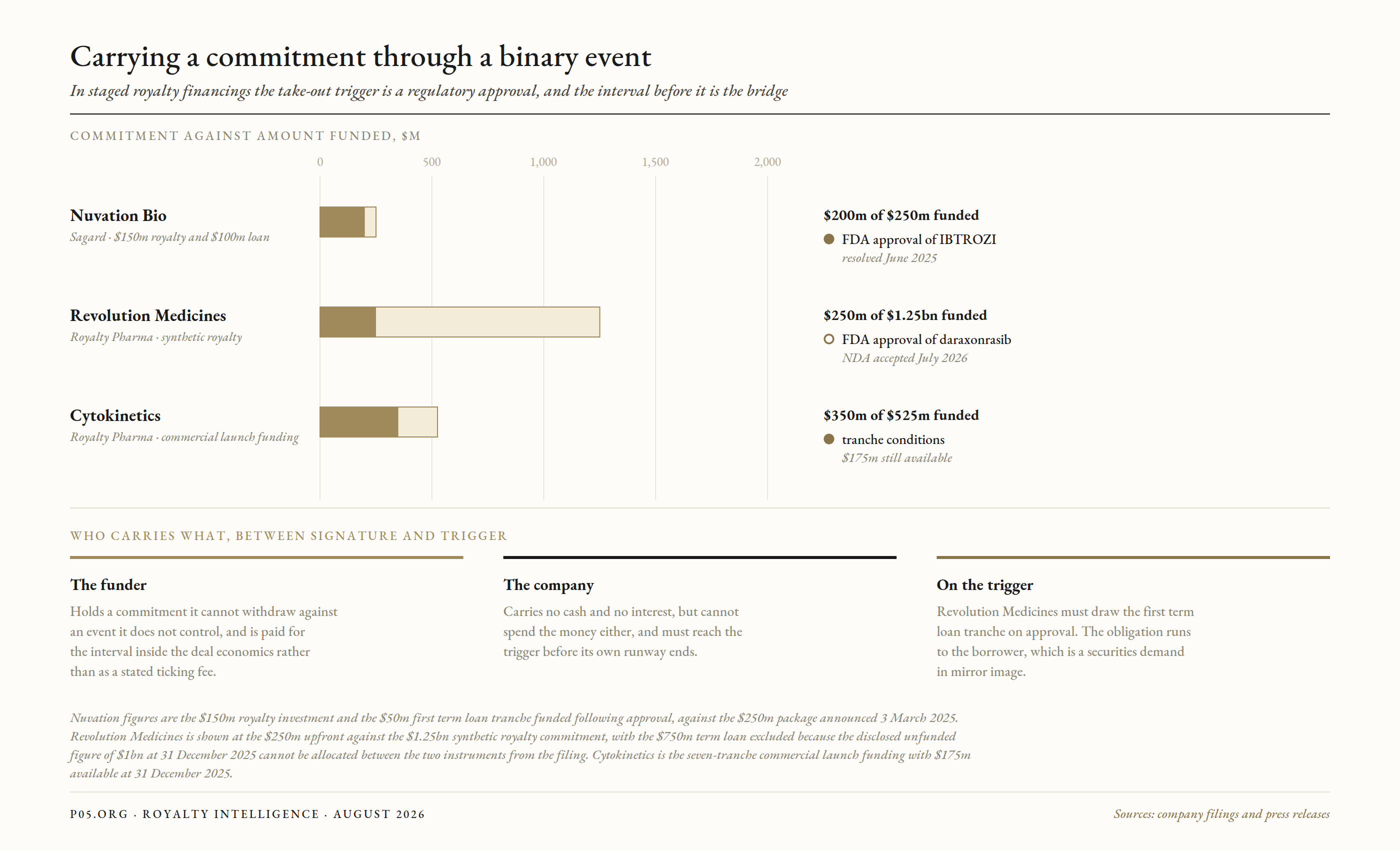
Figure 3. The discount for leaving early. Total payable under the Zymeworks subsidiary’s $250 million loan is $412.5 million if repaid by end-2033 and approximately $481.3 million by the 2042 maturity. On a terminal-value basis the early level implies roughly 6.6 percent annualised against 4.0 percent at maturity, so the discount is not only a concession to the borrower. Multiples and returns are derived from the disclosed dollar amounts.
Mandatory repurchase on triggers
Nuvation's Sagard financing shows the mandatory version. On defined events, including certain bankruptcy events, a change of control, expiration or termination of certain intellectual property rights or marketing authorisation, an out-licence or sale of the US rights to IBTROZI, and uncured covenant non-compliance, the company may be required to repurchase the synthetic royalty at 1.4 to 2.0 times the investment amount depending on timing, less royalty payments already made.
The provision converts events that change the underwritten credit into an exit at a pre-agreed multiple, collapsing a long royalty tail into a short, liquidated claim at the moment the original assumptions stop holding.
Change of control as the take-out: MorphoSys
The MorphoSys development funding bonds carried the change of control take-out to completion. The bonds were parent credit rather than a product royalty, part of the $2.025 billion 2021 package treated in full in the development funding bond piece.
When Novartis acquired MorphoSys in 2024 the instrument's obligor migrated to investment grade quality, and Royalty Pharma announced the sale of its MorphoSys development funding bonds in January 2025, a monetisation the cross-sector piece records at $511 million against $300 million funded, at a 5.35 percent discount rate. A long-dated development funding instrument was taken out not by a refinancing but by the credit migration of its obligor, a take-out route no fee schedule can compel.
7. The warehouse and the structural take-out
At portfolio scale, the take-out question in royalty finance concerns the refinancing of warehoused portfolios into rated term securitisation, and it is here that pharmaceutical royalties differ most visibly from their nearest analogue.
The template sits in music, and the cross-sector piece maps it in full. Catalogue aggregators accumulate assets on floating-rate bank warehouse lines and refinance into rated ABS once the pool seasons: Hipgnosis issued $222 million in 2022, scaled to the $1.47 billion Blackstone-led transaction of November 2024, and by 2025 the market had become programmatic, with Recognition Music and Concord issuing repeatedly under standing structures.
The warehouse-to-ABS sequence is the acquisition bridge pattern at portfolio scale.
- The warehouse is the bridge: short-tenor, floating rate, governed by a borrowing base, with step-downs and cash-trap triggers occupying the role duration fees occupy in the bank bridge.
- The rated notes are the bonds.
- The take-out provisions are the warehouse's eligibility criteria, concentration limits and clean-down terms, drafted so that the pool the warehouse accumulates matches the pool the rating criteria will term out.
Pharmaceutical royalties have run the sequence before, and the history is already on this site: the cross-sector piece covers the 2000 to 2018 securitisation record, from the single-asset BioPharma Royalty Trust of 2000 through DRI Capital's nine issuances totalling over $1.8 billion, the last in 2018, and the royalty bonds piece covers how the resulting paper trades. What that history contributes here is its take-out reading.
Royalty Pharma supplies the sector's one completed structural take-out ladder. Its 2004 facility, described in its Form S-1 as the first securitisation debt facility backed by pharmaceutical royalties and rated Aaa, was converted to a syndicated term loan in 2007 at a lower blended cost, followed by the 2020 IPO and successive unsecured investment grade bond issuances.
Each instrument was the take-out of the one before it, and each step broadened the investor base and cut the cost of capital: securitisation as on-ramp rather than destination.
What the sector does not have, as of August 2026, is an active rated take-out shelf: a repeat issuance programme into which a warehoused pharmaceutical royalty portfolio currently and predictably refinances. The historical programmes are dormant, fund-level leverage is an active market, and each recent term execution has been bespoke. The cross-sector piece listed the conditions a restart would require, and one of them is the subject of this article: a party willing to carry the warehouse during aggregation, which is a bridge position, priced by the credibility of its take-out.
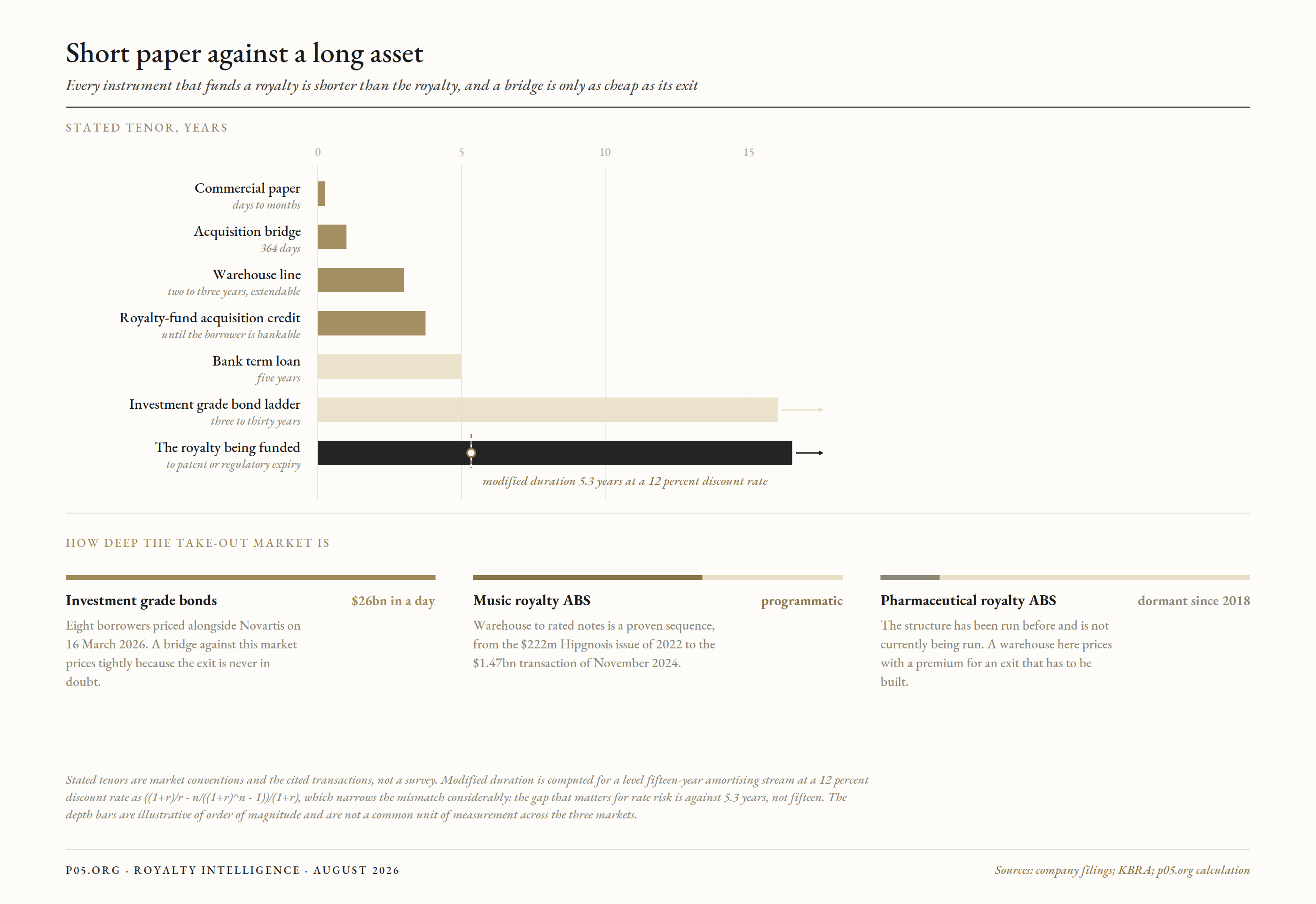
The consequence runs back through the earlier sections. A bridge prices tightly when its take-out market is deep. Bank M&A bridges price against the depth of the investment grade bond market; music warehouses price against a proven ABS take-out.
A pharmaceutical royalty warehouse prices with a premium for take-out uncertainty, and the tenor arithmetic gives that premium its size: a floating-rate warehouse against assets valued as a discounted fifteen-year curve leaves every quarter of delay, and every move in rates before the term paper prices, inside the structure's economics.
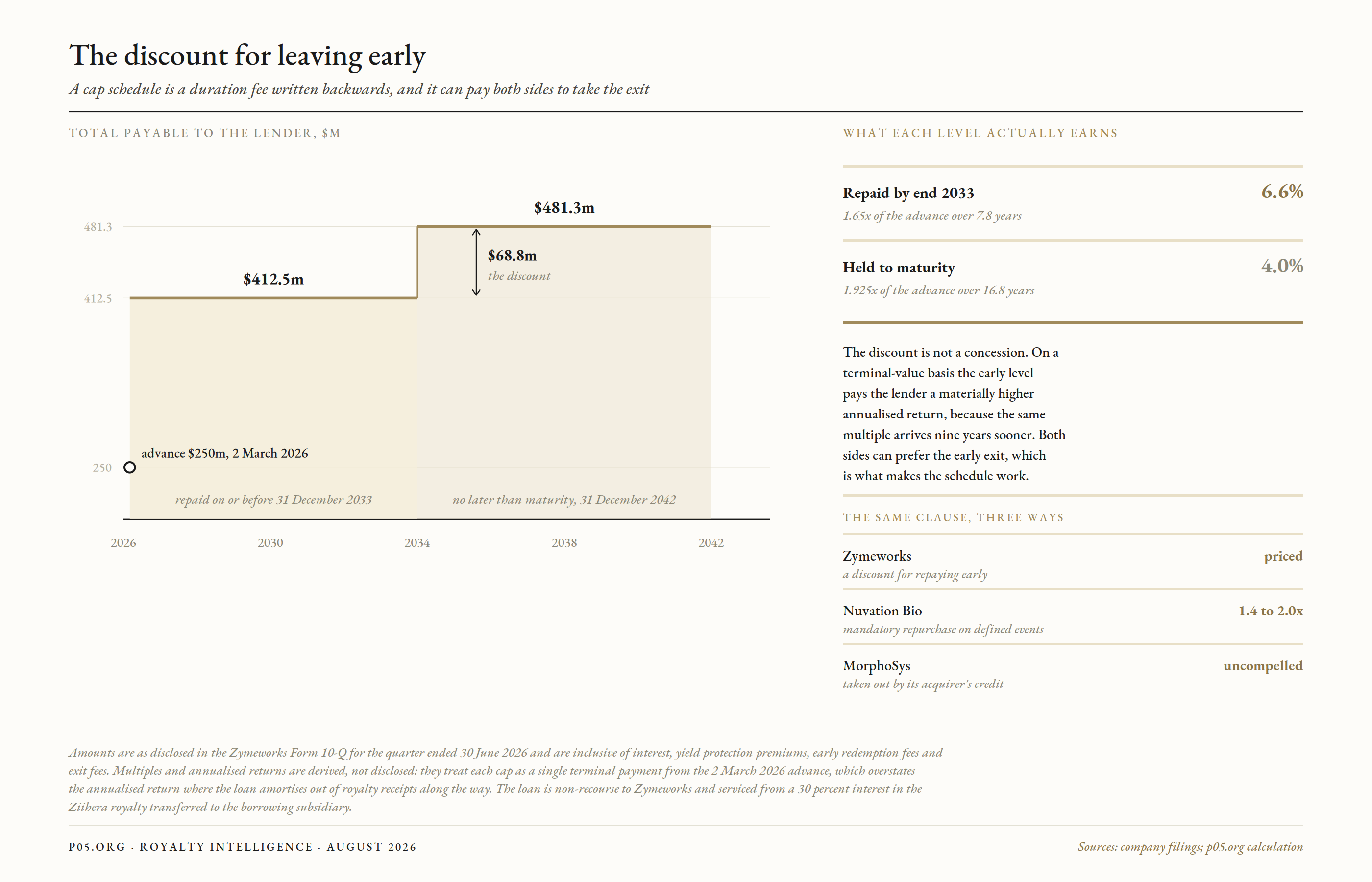
Figure 4. Short paper against a long asset. Every instrument that funds a royalty is shorter than the royalty, though on a modified duration basis the mismatch narrows to about 5.3 years rather than fifteen. The lower panel is the reason a pharmaceutical royalty warehouse prices wider than a music one: the depth of the market it must refinance into.
What moves a position on tenor and take-out, and what only appears to
Terms that move the position:
- A committed take-out or demand right, making the replacement of the short paper an obligation with a counterparty rather than an intention aimed at a market.
- A fee ladder, step-up schedule, or early-repayment discount of the Zymeworks kind, pricing time-in-instrument explicitly so both sides hold the same view of the exit date's value.
- An event trigger drafted on an observable fact, an FDA approval, a completed issuance, a change of control, rather than on a market condition requiring certification.
- A special mandatory redemption or repurchase multiple fixing the unwind price at signing, so a failed take-out returns the parties to a known position.
- Conversion mechanics at maturity, the extended term loan and exchange note apparatus, so the bridge's failure state is a longer instrument rather than a default.
- At portfolio scale, warehouse eligibility and concentration terms written against the rating criteria of the intended term take-out, so the pool being accumulated is the pool being sold.
Terms that only appear to:
- A short stated tenor with no priced consequence for exceeding it, which functions as a maturity date rather than a discipline.
- A refinancing intention recited in a use-of-proceeds clause without a demand right, commitment, or fee schedule behind it.
- An extension option priced at the original margin, which places the cost of a slow take-out on the lender and tends to be renegotiated at the borrower's weakest moment, as the smallest bridge notes illustrate.
- A take-out conditioned on a market being open, the condition least likely to hold when the provision is needed.
- A warehouse whose eligibility criteria describe the assets available rather than the take-out intended, producing a pool the term market re-underwrites from scratch.
What each side should ask
For the company raising against a bridge or staged commitment
- What does each additional month in the instrument cost, across fees, step-ups, and foregone discounts, and does that schedule match a realistic take-out timeline rather than the announcement-day one?
- If the take-out window is missed, does the instrument convert on terms known today, or does it mature into a renegotiation?
- Which take-out events are within the company's control, such as an issuance it can launch, and which are not, such as an approval, a market, or an acquirer, and is the cost of the uncontrollable interval priced or open-ended?
For the royalty investor or lender
- Is the position intended as permanent capital or as a bridge to another party's take-out, and do the prepayment premiums compensate the shortened holding period if the refinancing arrives early?
- On the defined triggers, does the repurchase multiple restore the underwritten return, net of royalties already received?
- If funding is staged, what stands behind the commitment through the trigger date, and how do the undrawn tranches fare in the counterparty scenarios between signing and funding?
For the fund or portfolio holder
- What is the tenor of the leverage against the duration of the pool, and who carries the refinancing gap if the term take-out prices late, wide, or not at all?
- Are the warehouse's eligibility criteria, concentration limits and clean-down provisions written against the rating criteria of the intended take-out, or will the pool be re-cut at term-out?
- Is the fund's own exit assumption, whether a sale, a securitisation, or a continuation vehicle, a committed take-out or a market expectation, and what is the carry cost of a two-year miss?
Bridge financing and the take-out provision are two halves of one design: paper written short on purpose, with its replacement engineered into the document.
Novartis ran the funded bridge and repaid it from an $11 billion bond ladder within three weeks. Pfizer pre-funded $31 billion seven months early and priced the unwind at 101. Collegium borrowed its acquisition bridge from a royalty-fund lender and took it out with a bank syndicate three years later. Nuvation Bio and Revolution Medicines wrote the take-out trigger as an FDA approval. Zymeworks priced its own early exit as a $68.8 million discount.
MorphoSys' development funding bonds were taken out by the credit of their acquirer. Royalty Pharma took out its own securitisation with a syndicated loan, its loan with equity, and its equity with investment grade bonds. The music securitisations show what an active programmatic term take-out does for warehouse economics, and pharmaceutical royalty finance has been without one since 2018.
Drug performance is decided in the clinic. What a financing costs is decided in the interval between the short paper and its take-out, and the provisions above are where that interval is priced.
All information in this article was accurate as of the research date and is derived from publicly available sources including SEC filings, issuer press releases, and legal and financial commentary. Information may have changed since publication. This content is for informational purposes only and does not constitute investment, legal, accounting, tax, or financial advice. The author is not a lawyer, accountant, tax adviser, or financial adviser.