
Buy the manager: how sovereign capital would enter pharmaceutical royalties
In May 2025 Royalty Pharma completed the acquisition of its own external manager, RP Management, for approximately $1.1 billion, ending an arrangement under which it paid a quarterly fee of 6.5 per cent of portfolio receipts plus 0.25 per cent of security investments to a manager whose employees were the only people running the business.
Two months later KKR acquired majority control of HealthCare Royalty. In March 2026 Blackstone closed the largest private fund ever raised for life sciences at a $6.3 billion hard cap.
Control of royalty origination capability has been changing hands, and sovereign investors have been on none of it as principals. They are not on the deal side of the market either. As of September 2026 no sovereign wealth fund appears on the public record as the named purchaser under a pharmaceutical royalty purchase agreement or a revenue interest financing.
The conventional explanation is that sovereign capital participates as a limited partner instead, and that ticket sizes here are too small to justify anything more. That explanation stops one layer short. Sovereign investors are no longer only allocators of capital to managers; several of them now own managers. Mubadala Capital, the wholly owned asset management subsidiary of Mubadala Investment Company, controls Fortress Investment Group.
Global SWF made partnerships and platforms its theme of the year for 2026, observing that the line between limited partners and general partners has blurred and that more sovereign asset managers may follow.
The question is therefore not whether a sovereign fund will buy a royalty. It is whether one will buy or build the platform that buys royalties. The rules that close the first route do very little to close the second.
One appearance, then nothing
The documented direct purchases by state-backed institutions come from pension investment managers, and from one country.
| Purchaser | Counterparty | Asset | Structure | Date | Evidence |
|---|---|---|---|---|---|
| CPP Investments | LifeArc | pembrolizumab | Partial royalty interest, $1.297 billion | May 2019 | CPP Investments |
| CPP Investments | Walter and Eliza Hall Institute | venetoclax | Partial royalty rights, $250 million upfront, $75 million of milestones | July 2017 | CPP Investments |
| CPPIB Credit Investments, with Blue Owl | BridgeBio Pharma | acoramidis | Revenue interest, 5 per cent of net sales, capped, funded on approval | January 2024 | BridgeBio |
| OCM IP Healthcare Holdings (OMERS) | BioCryst Pharmaceuticals | Orladeyo | Synthetic royalty sale, consented to under an existing credit agreement | 19 November 2021 | EX-10.101 |
Two Canadian pension investment managers, four transactions, and no sovereign wealth fund. The CPP programme has its own profile on this site.
Acoramidis shows what happens when the same asset returns to market. BridgeBio sold 60 per cent of its European royalty on the first $500 million of annual net sales for $300 million in June 2025 at a 1.45 times cap, $200 million of it from HealthCare Royalty and the balance from Blue Owl funds, through vehicles that appear in the filings as Acoramidis Royalty SPV, LP and LSI Financing Fund, LP. State capital funded the pre-approval risk in 2024 and was absent when the approved asset was monetised.
The record is incomplete in a specific way. Nobody announced the OMERS purchase. It is visible because BioCryst had lenders who had to consent, and the amendment recording their consent reached EDGAR with the economics bracketed out. An institution with no filing obligation, buying from a seller with no debt, leaves nothing behind.
Size is the first thing anyone reaches for to explain the gap, and the numbers support it as far as they go.
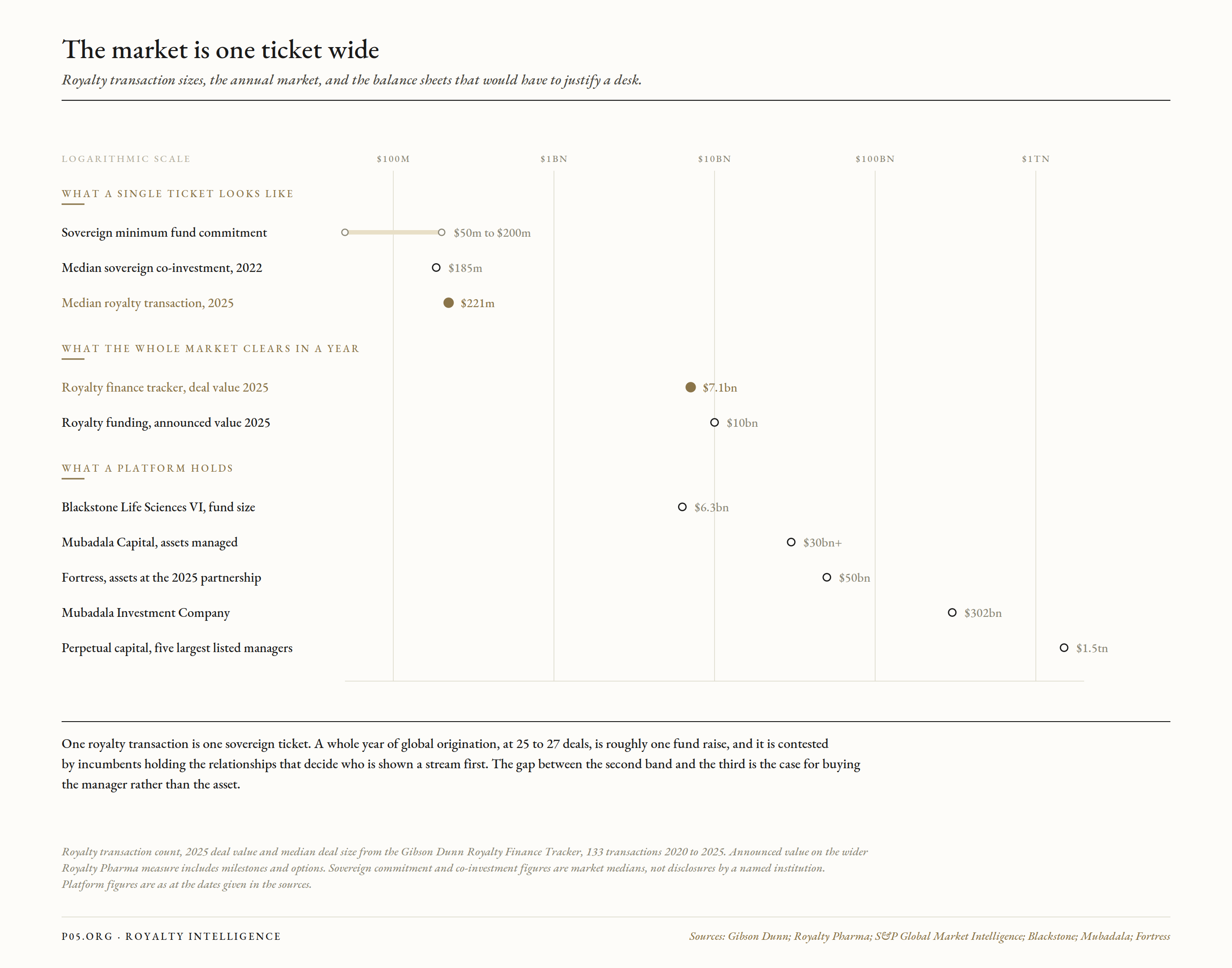
Gibson Dunn's March 2026 market update, built from a tracker of 133 transactions, puts the market at 25 to 27 deals a year since 2023, annual value of $7.1 billion in 2025 and a median deal size of $221 million. Royalty Pharma counts the same market at a record $10 billion of announced value in 2025 on a measure that includes milestones and options.
Against that, sovereign minimum commitments run from $50 million to $200 million, and S&P Global Market Intelligence put the median sovereign co-investment at $185 million in 2022.
One transaction is one ticket. A year of global origination is thirty or so of them, underwritten by teams carrying clinical, regulatory, commercial, contractual and insolvency risk in the same file, and contested by incumbents with fifteen years of relationships into charities, universities, research institutes and biotech treasurers.
That explains why no sovereign has built a desk. It does not explain the second absence, which is that none of them has bought one either, in a period when they have been buying managers in every other private asset class. For that, the tax code is the better guide.
What closes the direct route
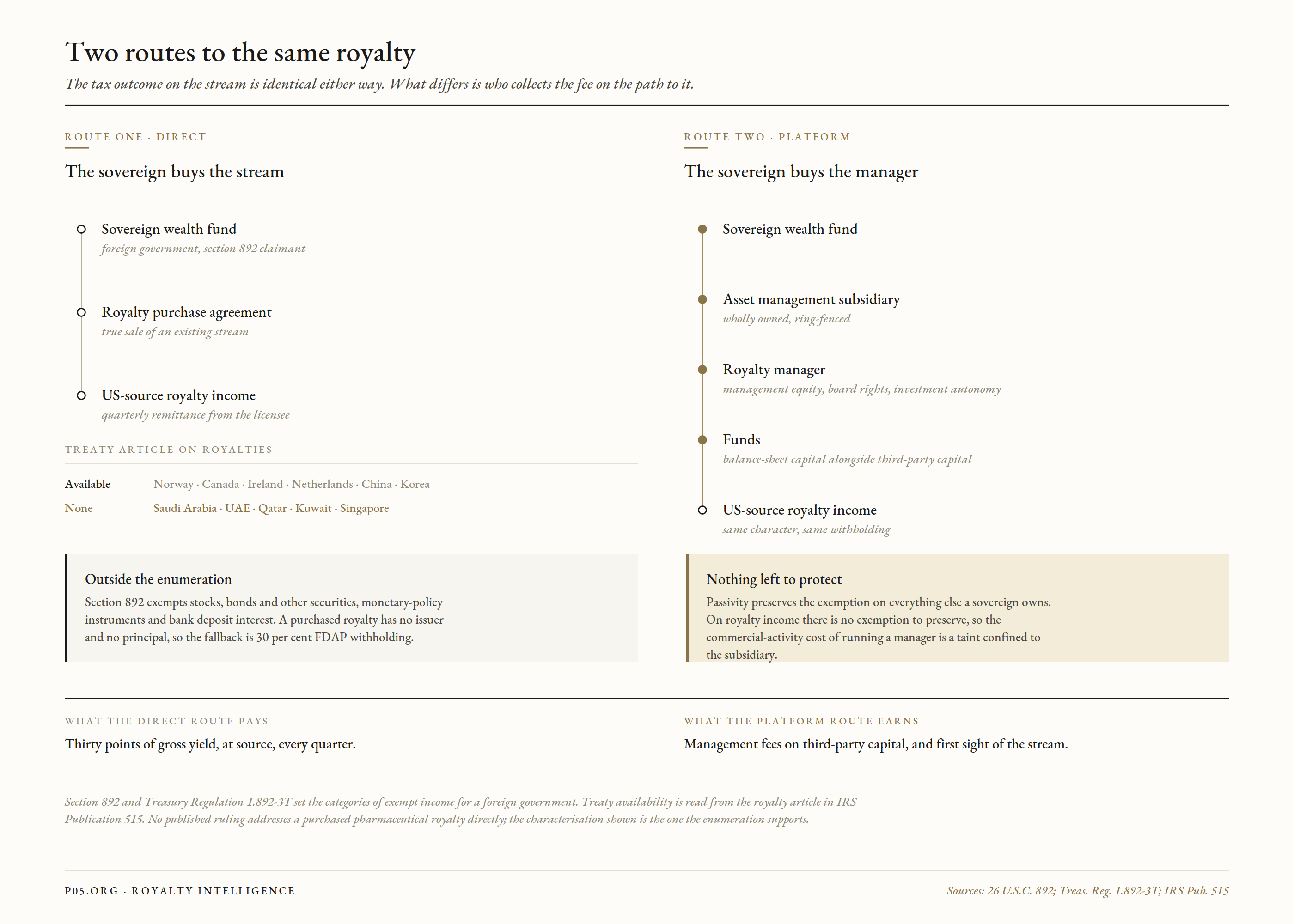
Section 892 exempts foreign governments from US tax on income from investments in stocks, bonds or other domestic securities, on financial instruments held in the execution of governmental financial or monetary policy, and on interest from US bank deposits. It is an enumeration rather than a general exemption for passive income.
Treasury Regulation 1.892-3T sets the perimeter. Income from stocks, bonds and other securities includes gain on disposition. "Other securities" reaches any note or other evidence of indebtedness, so a mortgage, an annuity contract, a banker's acceptance and a loan all qualify. Partnership and trust interests are excluded, along with gain on their disposal.
A purchased royalty has no issuer, no principal, no maturity and no instrument of indebtedness behind it. It is an assigned contractual right to a share of net sales, and what it pays is a royalty in the sense the code uses everywhere else. On the face of the enumeration the exemption does not reach it. No published ruling addresses a purchased pharmaceutical royalty, and the preamble to the December 2025 final regulations restates the three statutory categories without enlarging them.
The fallback is the ordinary FDAP regime. US-source royalties paid to a foreign person are subject to 30 per cent withholding on the gross amount unless a treaty reduces it, and treaty access is where the largest sovereign investors have the least. The rate tables in Publication 515 carry Norway, Canada, Ireland, the Netherlands, China and Korea. They carry neither Saudi Arabia, the United Arab Emirates, Qatar, Kuwait nor Singapore.
A Gulf balance sheet buying a US-marketed royalty loses thirty points of gross yield at source, quarter after quarter, collected by a licensee with its own withholding agent liability under sections 1441 and 1442.
Instrument form is the only lever, and the market has been pulling it the wrong way. A royalty-backed note produces interest on an evidence of indebtedness, as in Royalty Pharma's $250 million non-recourse funding to Zymeworks in March 2026. A true sale produces royalties. Gibson Dunn records true-sale structures rising from about half of synthetic royalty deals in 2020 and 2021 to 71 per cent of deals and 91 per cent of value in 2024 and 2025.
So the direct route is expensive for reasons that have nothing to do with royalty underwriting. What matters for the platform question is that the same body of rules, applied one level up, produces the opposite answer.
The constraint that does not apply
Everything a sovereign investor does in private markets is shaped by protecting the exemption, and the commercial activity rules are why sovereign limited partners accept passivity. As O'Melveny records, an integral part loses the exemption only on income derived from the commercial activity, while a controlled entity tainted as a controlled commercial entity loses the exemption on all of its income, and commercial activities are defined more widely than a trade or business elsewhere in the code.
Arnold & Porter records the preamble's position that a sponsor's commercial activities are attributed to a foreign government investor through the partnership or on agency principles unless the qualified partnership interest exception applies, and Mayer Brown notes that effective control is found in veto rights over distributions, material capital expenditures and sales of equity.
Apply that logic to royalties and it collapses. The exemption those rules protect does not extend to royalty income in the first place.
A sovereign that stays scrupulously passive in a royalty fund still receives, through that fund, income of a character section 892 never covered. The passivity protects the rest of the portfolio, which is worth having, and it buys nothing on the asset itself.
That changes what the commercial side costs. In most asset classes a sovereign crossing into operating a business trades an exemption for a fee stream. Here there is no exemption on the underlying income to trade away.
What remains is the ordinary discipline of ring-fencing: the manager sits in its own controlled entity, that entity is a controlled commercial entity and pays tax accordingly, and the rest of the sovereign's structures are tested separately. Income received by or from a controlled commercial entity falls outside the exemption by statute, which is the price of the strategy and a known one.
Abu Dhabi already runs that structure.
The template already exists
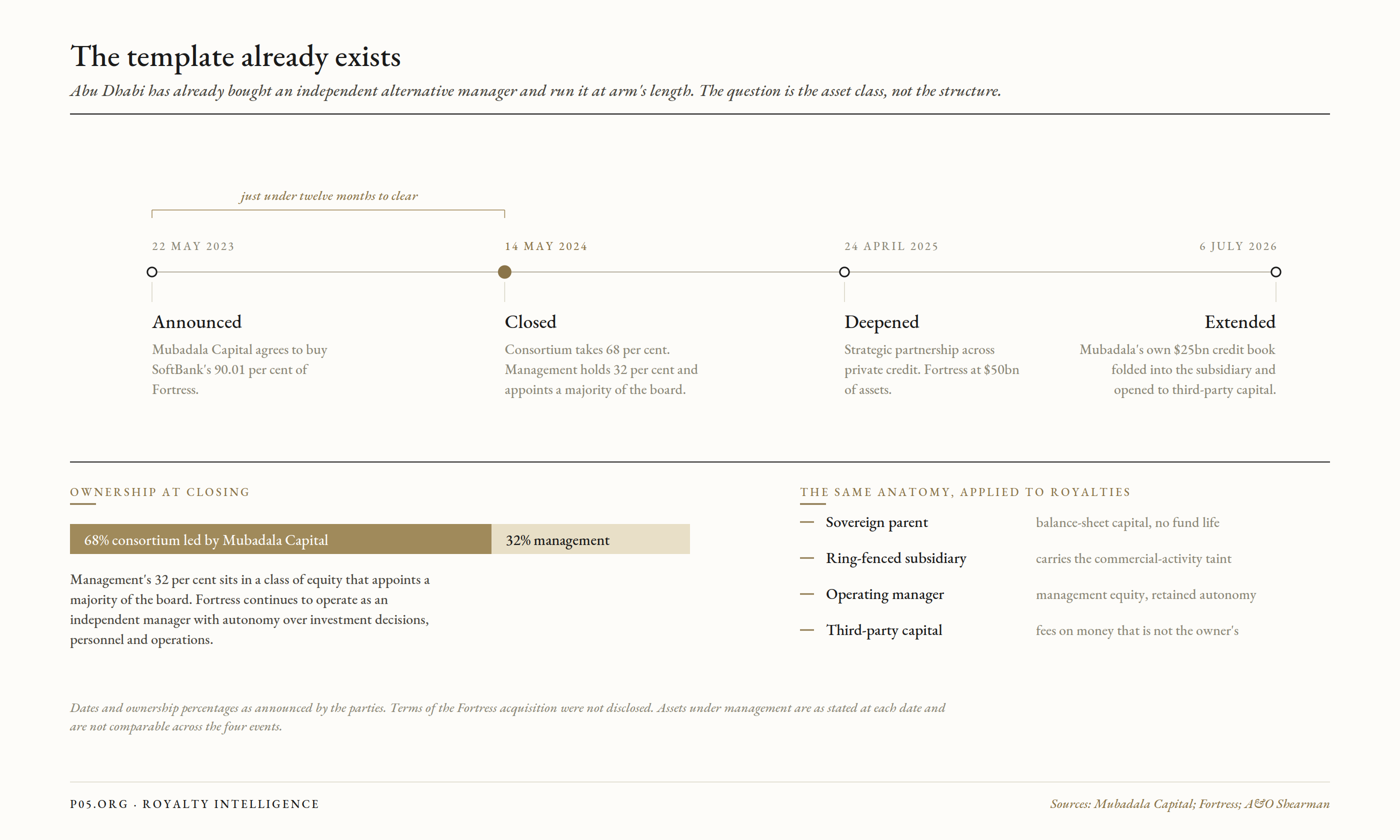
In May 2024 Fortress management and Mubadala, through Mubadala Capital, completed the acquisition of the 90.01 per cent of Fortress equity held by SoftBank. A consortium led by Mubadala Capital took 68 per cent, Fortress management took 32 per cent in a class of equity entitling it to appoint a majority of the board, and Fortress continues to operate as an independent manager with autonomy over investment decisions, personnel and operations.
At closing it managed over $48 billion for approximately 2,000 institutional clients and private investors across credit, real estate, private equity and permanent capital. The transaction was announced on 22 May 2023 and closed on 14 May 2024, which is a reasonable estimate of how long a foreign-government acquisition of a US manager takes to clear.
The relationship deepened after ownership. In April 2025 Mubadala and Fortress entered a strategic partnership across private credit, with Fortress at $50 billion of assets as of 31 December 2024, the announcement describing Mubadala Capital as managing over $30 billion across four investment businesses within a roughly $302 billion parent.
In July 2026 Mubadala Capital completed the integration of Mubadala's $25 billion credit business, committing incremental capital and opening the platform to third-party investors.
Every structural feature a royalty platform needs is present in that arrangement. A sovereign parent. A ring-fenced asset management subsidiary. An operating manager whose own management holds real governance rights. Third-party capital sitting alongside balance sheet capital. Nothing in the model is specific to credit or real estate.
What the capability costs
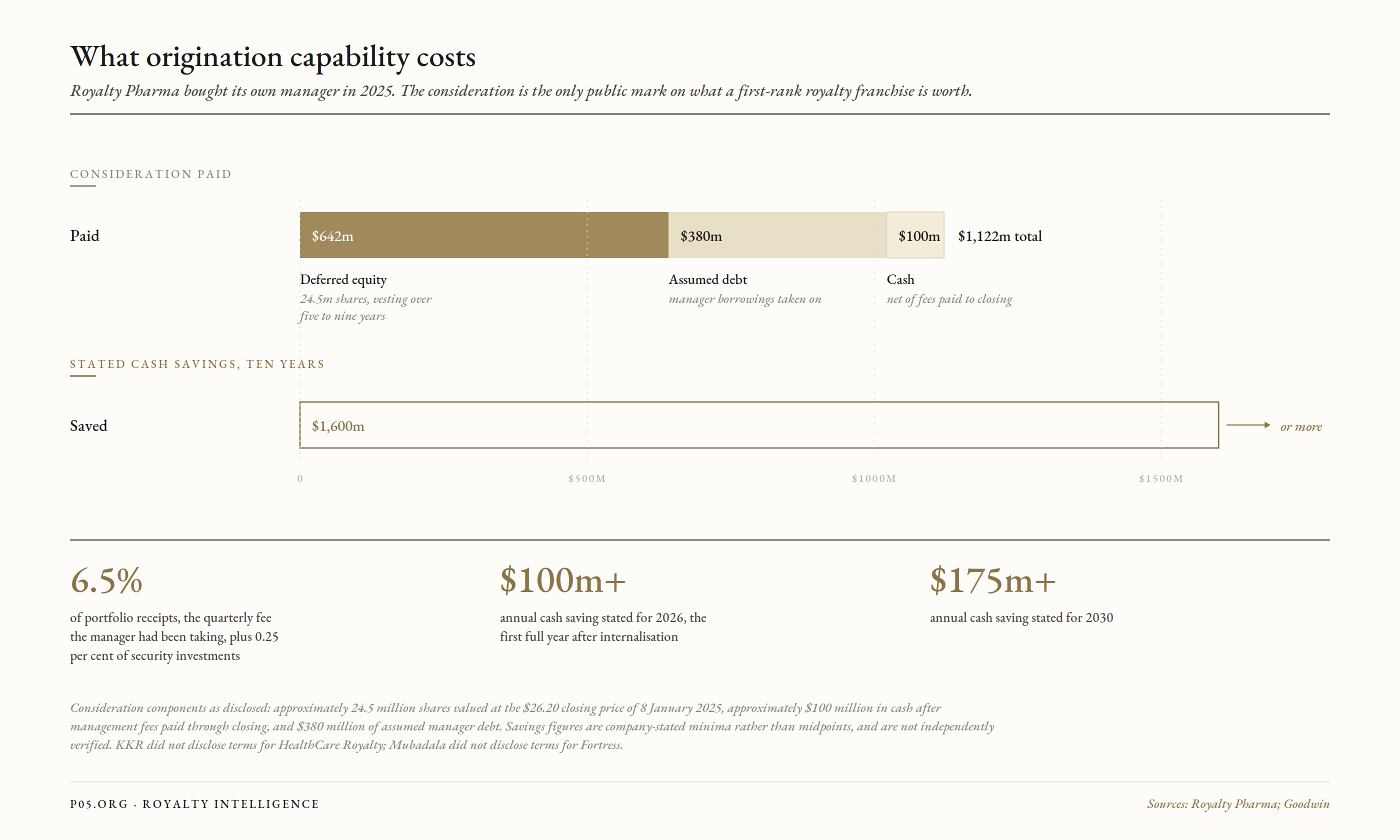
Two royalty vehicles have now bought their own origination, which makes the price observable.
Royalty Pharma paid approximately 24.5 million shares vesting over five to nine years, roughly $100 million in cash and the assumption of $380 million of manager debt, a total of about $1.1 billion, for a manager that had been taking 6.5 per cent of portfolio receipts.
It expects cash savings above $100 million in 2026, above $175 million in 2030, and more than $1.6 billion cumulatively over ten years. Read from the other direction, that is what a first-rank royalty origination franchise was worth to the vehicle it managed, set against a fee stream a buyer would inherit. KKR did not disclose terms for HealthCare Royalty, and Mubadala did not disclose terms for Fortress.
The scale problem changes shape once the platform is the unit of analysis. A sovereign buying streams directly absorbs a few hundred million dollars a year before concentration binds. A sovereign owning a manager deploys its own capital, earns fees on other people's, and holds the relationships that determine who sees a stream first.
The comparison with the limited partner route is not close on economics. A sovereign limited partner pays management fees and carry to reach the same assets, and ILPA's guidance of 13 May 2026 documents the pressure on organisational expenses sitting outside those fees. An owner collects them.
Buy, build, or wait
A platform assembled from scratch can be domiciled and structured for the owner's tax position from the first day, which matters when the underlying income is taxable and the vehicle's residence drives the treaty analysis. Deal flow is the obstacle. In a market of roughly twenty-five transactions a year an unknown buyer with no track record sees the streams the incumbents have already declined, and the first three years of a new royalty book determine whether there is a fourth.
Buying solves sourcing and buys a track record that cannot be assembled any other way, at the cost of paying for relationships that walk out of the building each evening. KKR and Mubadala both paid for teams and then wrote independence into the announcement, which is the consistent price.
The third option is the one the market is already running, and it is why sovereign capital has not needed to decide. Managers are consolidating into platforms that sovereign investors already own pieces of.
When KKR acquired HealthCare Royalty, every sovereign investor with an existing KKR relationship acquired exposure to a dedicated royalty book without a transaction, a negotiation or a name on a purchase agreement. Ownership of royalty origination is changing hands at the platform level, and sovereign capital is acquiring it as a by-product rather than by decision.
What ownership does not fix
Ownership does not convert the income. Royalties earned by the platform's funds remain outside section 892 and the withholding analysis on a US-source stream is unchanged. What ownership stops is paying twice, once in tax that cannot be avoided and once in fees to a manager that could have been bought.
It does not buy control of the people either. The Fortress structure gave management 32 per cent and majority board appointment rights, with independence over investment decisions written into the announcement. A royalty manager's value is a team with fifteen years of relationships, and that team prices its autonomy. A sovereign buyer expecting to direct allocation from the parent would be buying a shell.
Disposal stays hard. Norges Bank Investment Management publishes its exclusion decisions and runs temporary ethical guidelines while its framework is reviewed. A listed position exits in days. A royalty book exits into a short list of buyers who know why it is for sale, and a manager with a brand exits more slowly still.
The mandate question also stands. Sovereign pharmaceutical capital has mostly gone to domestic capability. PIF built Lifera as a wholly owned CDMO, which contracted with Novo Nordisk to localise more than half of Saudi insulin supply, and ADQ assembled an operating pharmaceutical platform before agreeing to buy Acino. A royalty manager employs forty people in New York or Stamford and builds nothing at home. It earns fees, which is an argument a finance ministry understands, and it is a different argument from the one Lifera makes.
Where it lands
For an originator the practical consequence is about where decisions now sit. A royalty that clears through HealthCare Royalty in 2027 is underwritten inside a platform whose economics belong partly to institutions that have never read a royalty agreement.
If a sovereign fund moves deliberately, the transaction to watch is not a stream. It will be a manager with $2 billion to $5 billion of assets, a named team and a five-year retention package, and the first question about it will be which entity in the sovereign's structure signs.
All information in this report was accurate as of the research date and is derived from publicly available sources including court opinions, regulatory guidance, academic literature, SEC filings, and financial news reporting. Information may have changed since publication. This content is for informational purposes only and does not constitute investment, legal, or financial advice. The author is not a lawyer or financial adviser.