
The consent gate: who has to say yes before a royalty is sold

Where a royalty seller carries secured debt, the lender controls whether the sale closes, on what timetable, and how much of the upfront the seller retains. The licensor may hold a consent right over the assignment. An earlier buyer of the same stream may hold another. The payer has to be instructed where to remit. A single-asset issuer may need a stockholder vote.
The governing documents predate the transaction. Credit agreements restrict dispositions, liens and indebtedness, and a sale of a revenue interest in the borrower's own product can fall within any of the three, depending on how it is papered. Facilities written since about 2016 name the transaction in a defined term that fixes a minimum upfront, a maximum rate, a product, a collateral treatment and a maturity spacing.
Purchase agreements from an earlier monetisation restrict what the seller may do with the retained interest. Licences drafted before royalty finance existed determine whether counterparty consent is required.
This piece sets out which covenant catches the transaction, the legal standard governing refusal, the four filed consents where the price is visible, the remaining consents and their voting thresholds, the position on partial interests and multiple holders, and a worked sequence from a 2025 recapitalisation in which every signature is on file.
It extends the consent gate section of the side letters piece. After the cap covers the same clearing exercise on a second sale of a reverted stream. The position is stated as of 15 September 2026.
Which covenant catches it
The disposition covenant is the usual entry point, because a revenue interest is a right to receive future cash and the defined term reaches it.
BioCryst's credit agreement defines "Disposition" as the sale, transfer, licence, lease or other disposition of any property by any loan party, expressly including a sale or assignment of notes or accounts receivable with or without recourse. The November 2021 amendment added an exclusion for sales of the Revenue Participation Rights under the royalty financing documents.
A sale excluded from "Disposition" generates no disposition proceeds. The mandatory prepayment waterfall keyed to Net Cash Proceeds does not engage, and the cash stays with the seller.
Where no exclusion exists, the transaction runs through a defined permission. Acorda's 2016 facility defines a "Permitted Royalty Transaction" covering royalty monetisation transactions on licensed intellectual property, including sales of royalty streams, royalty bonds, synthetic royalty and revenue interest transactions. It pairs the definition with "Permitted Royalty Transaction Liens" and a "Royalty Transaction Subsidiary" through which the monetisation is ring-fenced from the loan collateral.
Later drafting is asset-specific.
Savara's Hercules facility permits a true or synthetic royalty financing on molgramostim, requires minimum upfront net cash proceeds of 100 million dollars, and caps the sold rate at ten per cent of worldwide net sales. Any synthetic participation is subject to an intercreditor agreement satisfactory to the agent in its sole discretion. Any grant of security is limited to molgramostim.
The same definition bars a scheduled maturity, guaranteed minimum return or true-up payment falling earlier than 180 days after the term loan maturity date, and permits one such transaction at a time.
Dyne Therapeutics uses the same structure across DYNE-101 and DYNE-251, with the figures redacted, and provides that any granted security is subordinated to the agent's first priority lien. Viridian's Hercules facility defines the permission by reference to a named purchase and sale agreement with DRI Healthcare Acquisitions LP, permitting transfers of the Revenue Participation Right as defined in that document.
Apellis permits a royalty transaction only where it is structured as a true sale. No lien on any asset is permitted except a Back-Up Security Interest in the royalties or revenues sold, with the negative pledge confined to the sold royalties, their proceeds, and the segregated accounts holding them. The term lender requires the back-up lien in the buyer's favour as a condition of its own collateral package.
Valneva prohibits. Its loan agreement bars any direct or indirect synthetic royalty or similar financing involving the sale of revenues or royalties based on net sales of any product, other than a Permitted Royalty Financing, without the prior written consent of the collateral agent or the required lenders. The synthetic royalty is treated as indebtedness as well as a transfer, so the limitation on debt applies alongside the disposition covenant.
Restricted payments are not engaged, because a royalty sale is not a distribution to equity. The general negative pledge is engaged only where the buyer takes a lien, which the permitted-transaction definitions address by authorising a narrow security interest over the sold stream while preserving the lender's first priority elsewhere.
Whether a lien arises depends on the structure. Gibson Dunn's survey of 102 life sciences royalty transactions from 2020 to 2024 records that eighty-nine per cent of traditional royalty financings carry no lien on product-related assets and that eighty-six per cent of synthetic financings do. The anatomy piece sets out the covenant package that accompanies a lien.
A traditional royalty bought from an unlevered holder raises neither a lender consent nor an intercreditor negotiation. A synthetic royalty bought from a levered issuer ordinarily raises both. Neuren carries no debt and owes nothing upstream, so a sale of its Trofinetide royalty would require a board resolution alone.
| Facility | Drafting approach | Operative constraint |
|---|---|---|
| BioCryst / Athyrium | Royalty sales excluded from "Disposition" by amendment | Proceeds never reach the prepayment waterfall |
| Acorda | Generic "Permitted Royalty Transaction" plus Royalty Transaction Subsidiary | Monetisation ring-fenced in an SPV |
| Savara / Hercules | Product-specific permission, molgramostim | Minimum upfront, rate cap, intercreditor at agent's sole discretion, 180-day maturity spacing, one at a time |
| Dyne / Hercules | Product-specific permission, figures redacted | Any buyer security subordinated to agent's first lien |
| Viridian / Hercules | Permission by reference to the named DRI agreement | Only that transaction is permitted |
| Apellis | True-sale requirement plus Back-Up Security Interest | Characterisation fixed in the credit agreement |
| Valneva | Flat prohibition outside a Permitted Royalty Financing | Consent of collateral agent or required lenders |
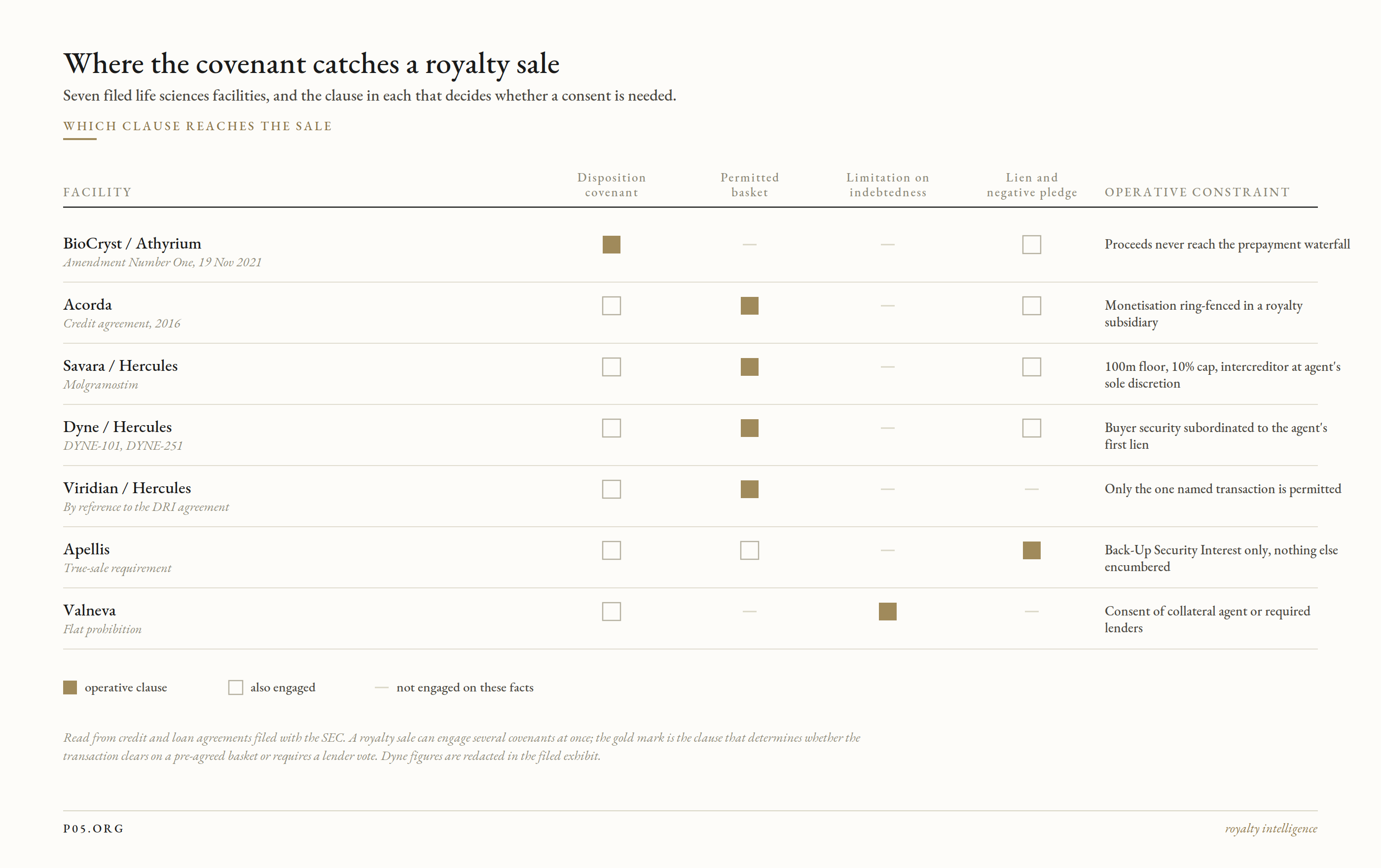
Figure 1. Seven filed facilities against the four covenants a royalty sale can engage. The gold mark is the clause that determines whether a consent is required.
The standard governing refusal
A consent right carrying no reasonableness qualifier is close to absolute in New York.
The Second Circuit in State Street Bank & Trust Co. v. Inversiones Errazuriz Limitada held that where a contract allows a bank to withhold consent for particular conduct and sets no express restriction on that right, the bank is not prohibited from unreasonably or arbitrarily withholding it.
The implied covenant of good faith limits the exercise. The First Department has held that an explicitly discretionary contract right may not be exercised in bad faith, and a New York trial court in 55 Eckford Realty LLC v. Bank of East Asia held that a lender with "sole and absolute discretion" could not impose requirements not expressed in the contract. The residual discretion remains broad.
The drafting response is the "not to be unreasonably withheld" qualifier, which imports a higher standard of scrutiny and leads lenders to document the analysis supporting a denial against later challenge.
English law reached the question in 2025. In MacDonald Hotels Ltd v Bank of Scotland [2025] EWHC 32 (Comm) the High Court considered a lender's ability to withhold consent under a Permitted Disposals definition and held that the words "with prior written consent" do not confer an unqualified right to refuse, and that a withholding must be commercially justifiable.
A consent right can also sit inside a permission. The Savara basket permits the royalty sale and conditions it on an intercreditor agreement satisfactory to the agent in its sole discretion, so the agent retains a veto over a transaction the covenant already allows.
An encumbered stream cannot be sold at all. Where a royalty has been pledged into a royalty-backed facility, the lenders hold a first priority lien and security interest in all of the borrowing SPV's assets, including its right, title and interest in the royalty payments, which is the structure Halozyme describes for Halozyme Royalty. The stream is unavailable until the loan is discharged.
A prior royalty sale can encumber a later transaction on the same terms. Coherus sold a hard-capped interest in Udenyca and Loqtorzi royalties to Coduet for 37.5 million dollars in May 2024 and paid 49.1 million dollars seven months later to extinguish it, the Udenyca divestiture to Intas being unable to close over the encumbrance. The exit ran at 1.31 times inside a year, priced by the blocked divestiture.
Small-cap borrowers face the gate most often. Bilateral lenders to that segment commonly include only limited exceptions to the negative covenants and require a consent or amendment each time the borrower proposes a restricted action. That describes most synthetic royalty sellers.
BioCryst and Athyrium: consent at cost
BioCryst drew 125 million dollars from an Athyrium fund on 7 December 2020 under a 200 million dollar facility, at LIBOR plus 8.25 per cent with a 1.75 per cent floor, interest only for five years, subject to a 15 million dollar minimum liquidity covenant and no other financial covenant unless the third tranche was drawn. On the same day it sold Royalty Pharma a synthetic royalty on Orladeyo and BCX9930 for 125 million dollars.
Amendment Number One to Credit Agreement, dated 19 November 2021 and filed as Exhibit 10.101 to the FY2021 Form 10-K on 28 February 2022, recites three transactions: a synthetic royalty on Orladeyo annual net sales to OCM IP Healthcare Holdings Limited, a further synthetic royalty on Orladeyo, BCX9930 and the Complement Inhibitor to RPI 2019 Intermediate Finance Trust, and a sale of Royalty Pharma common stock under a stock purchase agreement.
The OMERS upfront was 150 million dollars. The 2021 Royalty Pharma purchase was a further 150 million dollars.
Effectiveness is conditioned on delivery of the OMERS and Royalty Pharma documents in form satisfactory to the agent, an intercreditor agreement, legal opinions and lien searches, together with a covenant that no royalty financing document be amended without the written consent of the agent and the lenders.
The fee provision reaches reasonable out-of-pocket costs and expenses under section 12.04, including attorneys' fees. No consent fee is stated. The minimum liquidity covenant remained at 15 million dollars. The proceeds remained with BioCryst, the amendment having placed the sale outside "Disposition". BioCryst drew the remaining Athyrium capacity the following year, funding a 25 million dollar Term B loan and a 50 million dollar Term C loan on 29 July 2022.
The exhibit is redacted. The header states that information marked [***] is both immaterial and likely to cause competitive harm if disclosed. The redactions fall on royalty participation rates and thresholds within the Royalty Financing Restrictions definition, leaving the covenant architecture legible and the economics masked.
The facility was refinanced rather than repaid from royalty proceeds. On 17 April 2023 BioCryst drew a 300 million dollar Tranche A term loan from Pharmakon-managed funds under a 450 million dollar commitment, at three-month SOFR plus 7.00 per cent with a 1.75 per cent floor, and repaid the Athyrium debt of 241.8 million dollars in principal and interest.
Prepayment and final payment fees were 17.3 million dollars. With the write-off of unamortised deferred financing costs, the loss on extinguishment was 29.0 million dollars. Those amounts were consideration for exiting the loan, eighteen months after the royalty consent and unconnected to it.
Coherus, Apellis and PTC: consent at a price
Coherus BioSciences borrowed under a January 2022 loan agreement with BioPharma Credit PLC, a 250 million dollar senior secured facility.
Divesting the CIMERLI ophthalmology franchise to Sandoz required release of the assets and the borrowing subsidiary. On 5 February 2024 Coherus executed a Consent, Partial Release and Third Amendment to Loan Agreement under which the lenders consented, released, and required a 175 million dollar partial prepayment of principal on consummation, together with an adjustment to the minimum net sales covenant.
The subsequent Form 10-Q states that the lenders and the collateral agent required the company to make a 175.0 million dollar partial prepayment on closing of the CIMERLI purchase.
The accompanying release records a residual balance of 75 million dollars, the revenue covenant reduced to 125 million dollars, and projected annual term loan interest expense reduced by approximately 70 per cent. The residual 75 million dollars was replaced in May 2024 with new debt and royalty financing.
CIMERLI was a franchise divestiture, so it ran through the disposition covenant and the asset sale sweep in the ordinary way. Pharmakon's funds took 175 million dollars where the transaction fell within the covenant. Athyrium took expenses where the transaction had been drafted outside it. The classification determines the price.
Apellis entered a Royalty Buy-Down Agreement with Sobi on 1 July 2025 under which Sobi pays 275 million dollars upfront and up to 25 million dollars on EMA approval of Aspaveli for C3G and IC-MPGN, against a 90 per cent reduction in Sobi's royalty obligations under the parties' collaboration agreement of 27 October 2020. The reduction is subject to an initial cap of 1.45 times the amounts paid by Sobi, after which the royalty obligations revert to 100 per cent.
The same Form 8-K records that the lenders under the financing agreement with Sixth Street Lending Partners dated 13 May 2024 consented to the Royalty Agreement, and that in connection with that consent the company agreed to extend by one year the periods in which certain prepayment premiums would be owing on prepayments under the credit facility.
The Form 10-Q quantifies the extension: the premium period ran from one year after the initial draw on 13 May 2024 to one year after the effective date of the Sixth Street Consent on 1 July 2025. Prepayment premiums under the facility run up to three per cent depending on timing.
Extended call protection imposes no cash cost at signing and takes effect on a later refinancing or change of control. The put options piece covers the contractual form of the same exit, exercised against a strike fixed at signing rather than negotiated.
PTC Therapeutics sold Royalty Pharma approximately 67 per cent of its Evrysdi royalty for 1.0 billion dollars upfront on 19 October 2023 and applied the proceeds to retire its Blackstone Life Sciences debt, paying 302.1 million dollars of principal and interest plus 82.1 million dollars in prepayment premiums, expenses and exit fees, with all liens released. The premium over principal and interest outstanding was approximately 27 per cent.
| Seller | Lender or agent | Buyer | Asset | Date | Filing | What the lender took |
|---|---|---|---|---|---|---|
| BioCryst | Athyrium Opportunities III Co-Invest 1 LP, agent and sole lender | OCM IP Healthcare Holdings; RPI 2019 Intermediate Finance Trust | Orladeyo, BCX9930, Complement Inhibitor | 19 Nov 2021 | EX-10.101 to Form 10-K, redacted | Out-of-pocket expenses; intercreditor and document consent rights; no fee, no sweep |
| Coherus | BioPharma Credit PLC as collateral agent and lenders | Sandoz, as franchise buyer | CIMERLI | 5 Feb 2024 | EX-10.1 to Form 8-K, Item 1.01 | 175 million dollar mandatory prepayment; minimum net sales covenant reset to 125 million dollars |
| Apellis | Sixth Street Lending Partners, financing agreement dated 13 May 2024 | Sobi | Aspaveli ex-US royalties | 1 Jul 2025 | Form 8-K, Item 1.01 | Prepayment premium periods extended one year, from 13 May 2024 to 1 July 2025 |
| PTC Therapeutics | Blackstone Life Sciences | Royalty Pharma | Evrysdi | 19 Oct 2023 | Company announcement | Full payoff: 302.1 million dollars principal and interest, 82.1 million dollars premiums, expenses and exit fees |
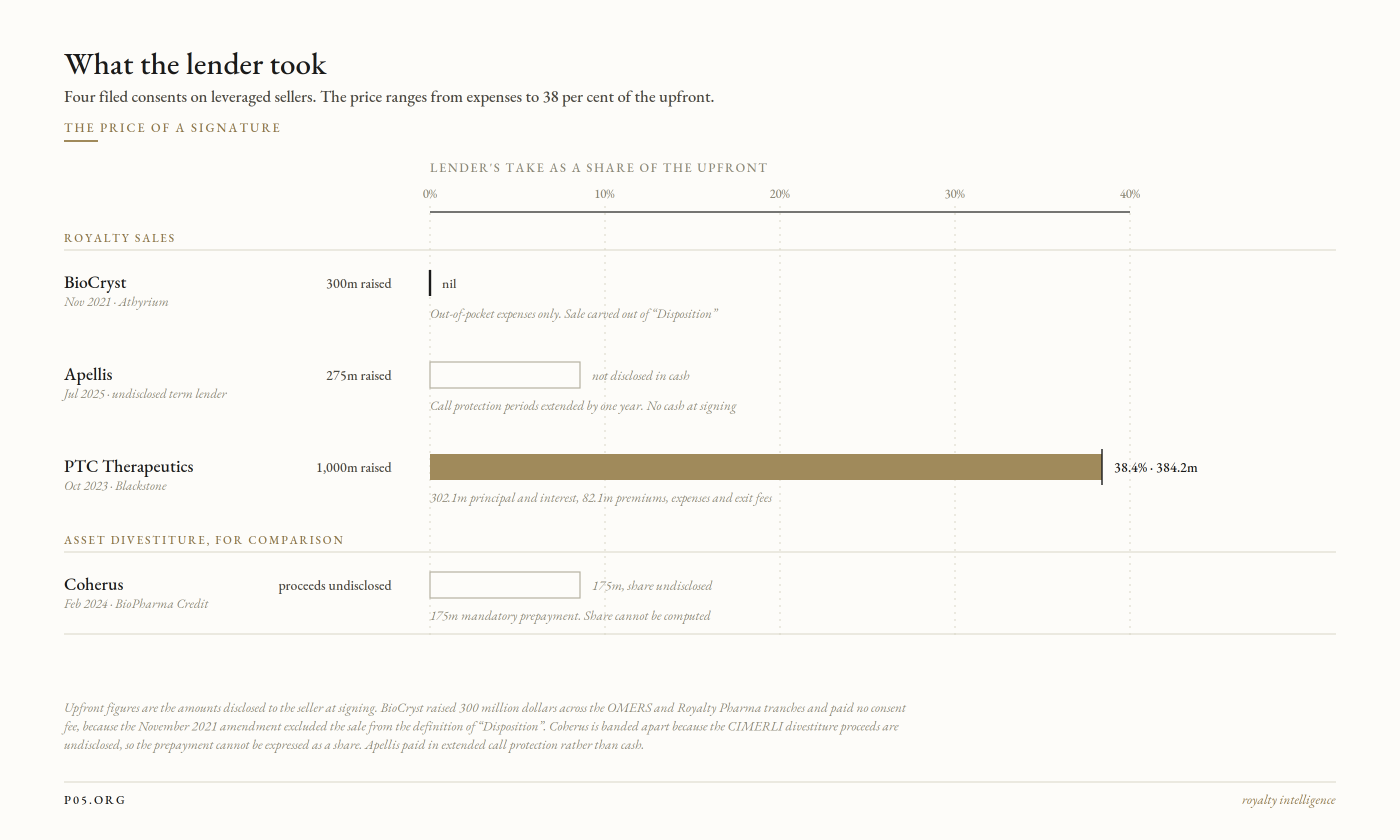
Figure 2. What the lender took, as a share of the upfront. Expenses at BioCryst, extended call protection at Apellis, 38.4 per cent at PTC.
The remaining consents
Revolving and ABL lenders
Where a working-capital facility sits alongside the term debt, its disposition covenant and its agent have to be cleared separately. The facilities may share a collateral agent or run through separate agents under an intercreditor agreement, in which case the release passes through both.
Convertible noteholders and indenture trustees
Gibson Dunn's issuer guide states that convertible notes generally do not include any significant operating or financial covenants. An unsecured convert with no asset-sale covenant imposes no consent requirement, and the fundamental-change repurchase right does not reach a sale short of a whole-company disposition.
A secured note, or one carrying a high-yield-style limitation on asset sales, does. That covenant requires net proceeds to be applied to debt, reinvested or spent within a defined window. Protalix's 2021 indenture requires the company to apply a portion of the proceeds from certain asset sales or licensing arrangements to redeem the notes.
Where the covenants and events of default run only to the issuer and any Significant Subsidiary, a sale by a bankruptcy-remote royalty SPV falling below that threshold sits outside the covenant perimeter.
The licensor or licensee
Innoviva's FY2025 annual report records that GSK believes its consent may be required before Innoviva can engage in certain royalty monetisation transactions with third parties, and that GSK believes certain covenants included in these types of transactions might violate provisions of the GSK agreements.
The same disclosure records that Innoviva has obtained GSK's agreement that it may grant certain pre-agreed covenants and that GSK will not unreasonably withhold consent to others, subject to the condition that covenants not be granted to a company developing or commercialising a respiratory product. It further records that proceeding without consent could lead GSK to seek to enjoin or otherwise challenge the transaction as violating or allowing it to terminate the agreements.
The risk factor has run since the Theravance Biopharma spin-off discussions and appears in the FY2021 Form 10-K in the same terms. The asserted right runs to the covenants a buyer demands, not to the assignment of the payment stream.
Prior buyers of overlapping economics
The Agenus sale to Ligand in 2024 defines a XOMA Consent as a named deliverable, filed as an exhibit to the purchase and sale agreement, XOMA having acquired part of the same Incyte and Merck royalties in 2018.
The payer
The Agenus and Ligand agreement carries payment direction letters and an account control agreement under which the purchaser has control over the lockbox and collection accounts within the meaning of section 9-104 of the UCC. The buyer has no privity with the payer, and royalty agreements routinely disclaim third-party beneficiaries, so direction or account control is the only route to the cash.
Upstream licensors, universities and foundations
Where the intellectual property is in-licensed, the in-licence anti-assignment and consent terms apply on their own terms. The Agenus and Ligand agreement carries a separate In-Licenses representation and covenant for that reason.
Federal overlays
Where the invention was made with federal funding, a nonprofit contractor cannot assign rights to a subject invention without the funding agency's approval except to an invention-management organisation under 35 U.S.C. 202. The agency retains march-in rights under 35 U.S.C. 203.
A monetisation of a bare royalty transfers no patent title, so the assignment restriction ordinarily does not apply to the sale. The licence chain above the royalty requires separate diligence.
CFIUS may have jurisdiction where a non-US buyer acquires rights in a US-developed asset, with mandatory filings in defined cases and self-initiated reviews available under FIRRMA. A purchase of a cash flow carrying no rights over the technology and no controlling stake sits outside the covered-transaction perimeter. A buyer taking board rights, intellectual property control or access to sensitive data does not.
Shareholders
Under section 271 of the Delaware General Corporation Law the test for a sale of all or substantially all assets is quantitative and qualitative.
Vice Chancellor Strine in Hollinger Inc. v. Hollinger International, Inc., 858 A.2d 342 (Del. Ch. 2004), held that the Telegraph Group sale fell outside section 271 because what remained was a substantial, viable, ongoing component of the corporation.
Katz v. Bregman, 431 A.2d 1274 (Del. Ch. 1981), is generally cited as the only decision holding assets worth less than sixty per cent of value to be substantially all, on a disposition of approximately fifty-one per cent of assets and just over half of pre-tax operating income.
Section 909 of the New York Business Corporation Law requires a two-thirds vote of all outstanding shares, against Delaware's majority.
A single-product issuer selling the whole royalty on its only marketed product should run the analysis. A diversified issuer selling one stream will not reach the threshold.
The board
Every monetisation requires a board resolution. Where the buyer is an existing shareholder or an affiliate, the transaction attracts conflicted-transaction review, a fairness opinion and disinterested or special-committee approval.
Consent map
| Consent | Who holds the veto | Source document | Threshold | Closing evidence |
|---|---|---|---|---|
| Term lenders and collateral agent | Required Lenders and agent | Disposition covenant; amendment section | Basket: none. Amendment: Required Lenders. All-or-substantially-all release: all or all affected | Officer's certificate that the sale is a Permitted Royalty Transaction, or executed amendment with required-lender certification; collateral release and UCC-3 |
| Revolver or ABL lender | Separate agent and lenders | That facility's covenants | Per its amendment section | Separate consent or basket confirmation; intercreditor confirmation |
| Convertible noteholders | Trustee, rarely holders | Indenture asset-sale and restricted-payment covenants | Covenant-light: none. Secured or high-yield style: as specified | Opinion that no covenant is breached, or trustee acknowledgement |
| Licensor or licensee | Counterparty | Licence anti-assignment and consent clauses | Per clause | Signed consent, or reasoned opinion that a payment-right assignment needs none |
| Prior royalty buyer | Earlier purchaser | First purchase agreement covenants | Per that agreement | Signed consent and acknowledgement; revised payment direction |
| Payer | Licensee | Payment direction or account control | Instruction, not veto | Payment direction letter or section 9-104 control agreement |
| Upstream licensor, university, agency | In-licensor; funding agency | In-licence; 35 U.S.C. 202 | Per in-licence; agency approval for nonprofit assignments | In-licence consent; agency clearance where federally funded |
| CFIUS | US government | FIRRMA | Mandatory or voluntary filing | Clearance or reasoned no-filing memo where the buyer is non-US |
| Shareholders | Stockholders | DGCL 271; NY BCL 909 | Delaware majority of outstanding; New York two-thirds | Stockholder resolution where the sale is of substantially all assets |
| Board | Directors | Charter and bylaws | Board majority; special committee if conflicted | Resolutions; fairness opinion where the buyer is an affiliate |
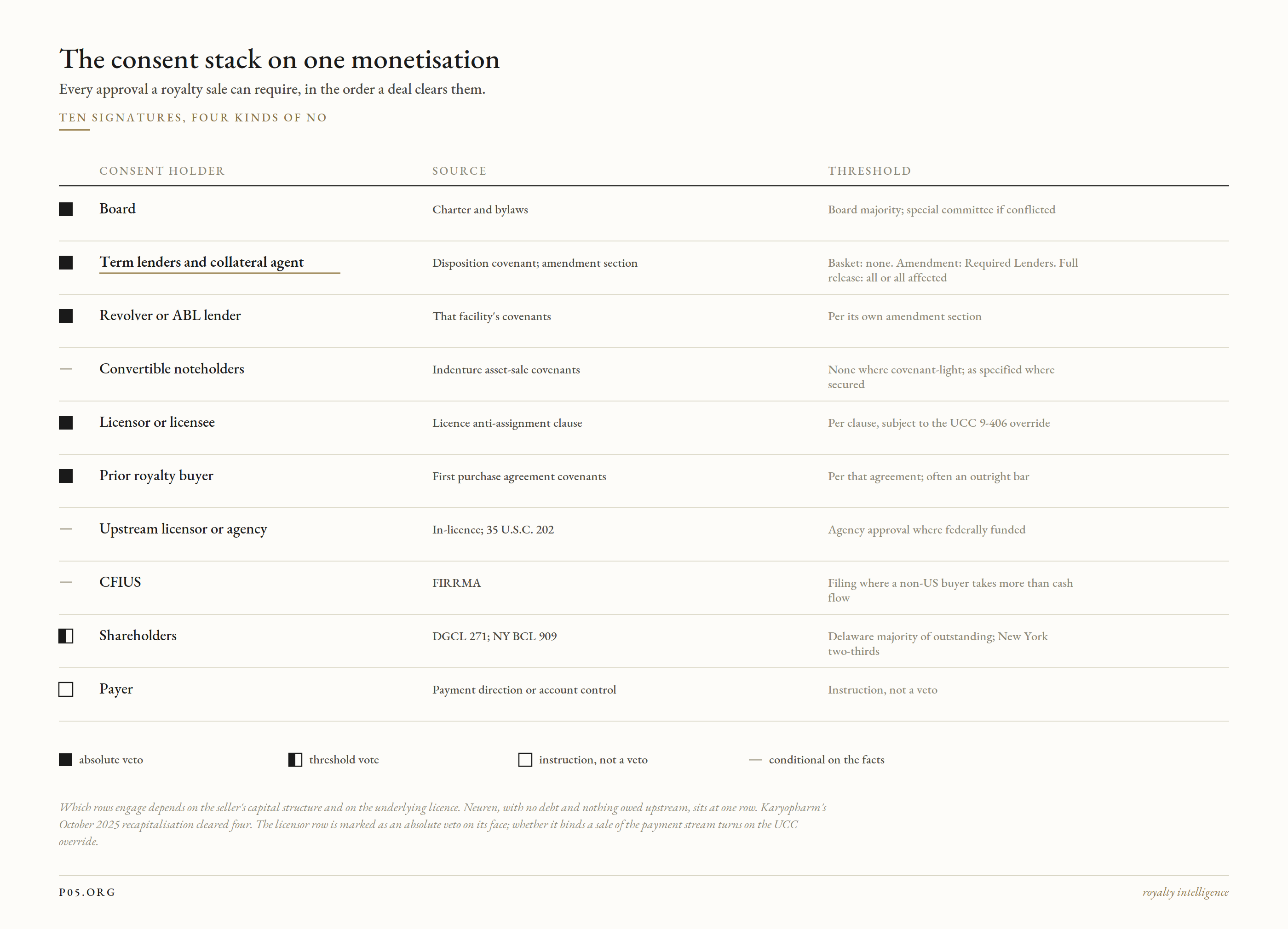
Figure 3. The same stack as a ledger, ordered as a deal clears it, with the strength of each veto in the left gutter.
Voting thresholds
The Required Lenders definition is a majority in interest of the loans and commitments, set in market practice at either a simple majority or two-thirds. 50.1 per cent is the common formulation in credit documents, with two-thirds appearing more often in indentures. Bilateral and small club facilities collapse the distinction, since one lender or a lead with an affiliated agent controls the vote.
Matters requiring all lenders or all affected lenders include extending maturity, delaying scheduled payments and reducing interest margins, changing pro rata sharing of distributions and payments, releasing all or substantially all of the collateral or the guarantors, and amending the sacred-rights provision itself.
Vorys divides these into security rights, being the right to release all or substantially all of the collateral or of the guaranties, and voting rights, being changes to the amendment provisions and to threshold definitions including Required Lenders.
The question on a monetisation is whether the release freeing the stream is a release of all or substantially all collateral, and so a sacred right, or a partial release available at the Required Lenders threshold. One product's royalty on a multi-product issuer is a partial release. The royalty on a single-asset issuer's only meaningful collateral approaches the line, and a single holdout can block it. The test follows section 271: quantitative against the whole package, qualitative against the remainder.
Proskauer's review of approximately fifty representative middle-market credits records that in sixty-three per cent of deals the agent may exercise rights and remedies in its sole discretion without Required Lenders direction, and that fewer than five per cent of credit agreements permit lenders to remove the agent under any circumstance. Where the agent is an affiliate of lenders constituting Required Lenders, an approval running through the agent is largely form over substance and may expedite approvals through a single entity.
The same review records a sacred right against lien subordination in under a third of club deals, so a majority can ordinarily approve a priming or subordination affecting a royalty buyer's intercreditor position.
The mechanics available against a holdout are replacement or yank-a-bank of a non-consenting lender, snooze-and-lose provisions counting non-responders out, and amend-and-extend. They operate against a partial release at the Required Lenders threshold. They do not reach a sacred right, since a lender whose own consent is required cannot be replaced out of it.
On the bond side the constraint is statutory.
In Marblegate Asset Management, LLC v. Education Management Finance Corp., 846 F.3d 1 (2d Cir. 2017), decided 17 January 2017 by a two-to-one panel, the Second Circuit held that amendments to an indenture's core payment terms violate section 316(b) of the Trust Indenture Act absent unanimous consent, and that amendments to other provisions do not, even where a dissenter's practical ability to be paid is affected.
An exit consent may therefore strip covenants and release guarantees or collateral at the indenture's stated majority, and may not touch principal, interest or maturity without unanimity.
| Action | Bilateral or small club | Syndicated term loan | Indenture |
|---|---|---|---|
| Covenant waiver, partial collateral release | Single lender or lead | Required Lenders (50.1 or 66 2/3 per cent) | Majority of notes |
| Release of all or substantially all collateral | All or all affected lenders | All or all affected lenders | Often two-thirds; not a section 316(b) core term |
| Release of all or substantially all guarantors | All or all affected lenders | All or all affected lenders | Per indenture, often two-thirds |
| Change to pro rata sharing or waterfall | All affected lenders | All affected lenders | Per indenture |
| Extend maturity, reduce principal or interest | Affected lender | Each affected lender | 100 per cent under section 316(b) |
| Amend the Required Lenders definition | All lenders | All lenders | Not applicable |
| Lien subordination or priming | Lead consent, or all affected where a sacred right exists | Required Lenders unless a sacred right applies | Majority or super-majority |
Anti-assignment and the UCC override
Whether a licensor consent is legally required, as distinct from commercially advisable, turns on settled doctrine.
The New York rule comes from Allhusen v. Caristo Construction Corp., in which the clause provided that an assignment made without consent would be void as against the obligor. The Court of Appeals held that where clear language is used, and the plainest words chosen, parties may limit the freedom of alienation of rights and prohibit assignment.
The court distinguished the Manchester line, under which words such as "this contract not to be assigned" operate as a covenant whose breach sounds in damages and leaves the assignment effective.
The Court of Appeals restated the position in 2023: an anti-assignment clause voids an assignment only where it includes clear language and the plainest words stating that an assignment in contravention of the contract is void, failing which the clause is a personal covenant justifying only an award of damages.
Section 9-406 of the UCC renders ineffective any term that prohibits, restricts or requires the consent of the account debtor to the assignment of an account, chattel paper or payment intangible. Section 9-408 extends comparable treatment to a sale of a payment intangible. "Ineffective" carries its full force: the clause does not prevent the assignment taking effect between the parties, and the prohibited assignment does not constitute a default.
The override does not reach a transfer of governance rights or of an ownership interest that is not a payment intangible. Being state law, it cannot invalidate anti-assignment provisions of federal law, which is why Bayh-Dole restrictions survive it.
A monetisation structured as an assignment of the payment stream, rather than of the licence, falls inside the override. A seller advised accordingly can proceed over an asserted consent right. The GSK position presses the covenant argument rather than the payment-right argument.
Partial interests and multiple holders
The carve-out
Agenus sold Ligand an Applicable Percentage stepping down on a defined event. Before the step-down it comprises 31.875 per cent of development, regulatory and commercial milestones, 18.75 per cent of the covered royalties, and a 2.625 per cent synthetic royalty on botensilimab and balstilimab net sales. Those figures halve afterwards, and the whole is subject to a fifty per cent reduction once total payments to Ligand exceed a return hurdle.
Restrictions on the retained interest
The Agenus and Ligand agreement carries Additional Sales and Liens and Syndication covenants. Agenus disclosed that the agreement permits additional sales of the purchased assets to third parties on substantially similar terms on a pro rata basis up to a maximum of 200 million dollars, with Ligand holding a time-limited option to invest a further 25 million dollars pro rata.
The Titan and Deerfield royalty purchase agreement provides that for so long as the facility agreement is in effect Titan shall not transfer or consent to the transfer of any portion of its Fanapt rights or its rights under the licence agreements, including any right to receive all or any portion of the royalty. The covenant reaches the retained interest as well as the interest sold.
Stacked sales on one stream
In September 2018 an Agenus subsidiary sold XOMA thirty-three per cent of future royalties and ten per cent of future milestones from Incyte and Merck for 15 million dollars. Agenus booked the proceeds as a liability rather than a sale, on grounds of significant continued involvement in the generation of the potential royalties and milestones.
In May 2024 it sold Ligand a further slice of the same economics. 63.9 million dollars of those proceeds were recorded as a liability on the same grounds.
The second sale was conditioned on the XOMA Consent. The documents provide that if the parties could not amend the XOMA escrow arrangement among XOMA, the royalty fund and The Bank of New York Mellon by 1 October 2024, they would work in good faith to secure alternative direct payment mechanics to the purchaser.
Two sales on one stream produced two sets of direction letters, one inter-buyer consent, a bespoke escrow amendment, and liability treatment on both tranches.
Form of the interest
A slice is a contractual claim to a defined percentage of collections. The Agios agreement records that the parties intend the transaction to constitute a sale of the royalty and not a financing, and that the seller will treat it as a sale of an account or a payment intangible as appropriate in accordance with the UCC.
Relations between co-holders are governed by contract rather than by co-ownership law. The purchase agreement allocates audit rights, enforcement against the payer, control over amendments to the underlying licence, and waterfall priority.
Syndication
Where several funds take one position, the documents contemplate a lead and additional co-investors. The Agenus and Ligand agreement defines an Additional Co-Investor. The lead holds and enforces the position, takes collections through the controlled account and distributes pro rata, performing the function an administrative and collateral agent performs on the debt side. The royalty interest agent piece sets out the role and its consent mechanics.
Secondary transfers
Whether the first buyer may resell without the seller's consent turns on the assignment provision, which commonly restricts transfers to competitors of the seller and grants pre-emptive rights to the seller or to other holders. Tag-along and drag-along terms allocate the ability to force or join a sale between co-holders. These provisions are frequently redacted, so their existence is on the record and their terms are not.
After the cap sets out the clearing exercise on a second sale: the assignment prohibition backed by a security interest, the licensor consent running twice, and the Cystic Fibrosis Foundation Kalydeco agreement in which the earlier purchasers waived their assignment prohibitions at section 3.15 and Vertex waived its sixty-day negotiation right at section 3.14. The party granting the waiver is ordinarily also the party best placed to bid for what the waiver releases.
Where the lender and the buyer are the same firm
Sagard, Deerfield, Sixth Street, Blue Owl, OrbiMed and Oaktree each run credit and royalty strategies out of the same house. The buyer taxonomy piece sets out where each enters a product's life.
A borrower seeking consent from one of them for a sale to a third party is seeking it from a competitor of that buyer. The lender may consent on terms or bid for the stream.
Apellis is the filed instance of the first branch. Sixth Street runs both credit and royalty strategies, and its lending arm consented to a buy-down by the licensee rather than to a sale into the royalty market.
The filed record contains no instance of a lender exercising that option explicitly. An alternative bid appears as a completed transaction, and a refused consent produces no filing. Concessions of this kind are recorded in side letters rather than in the amendment, and the filed population of those letters is limited for the reasons set out in the side letters piece.
Immunocore borrowed up to 100 million dollars from Pharmakon-managed funds in November 2022, drawing 50 million dollars to refinance an Oxford Finance facility under covenants limiting asset disposals, mergers and additional debt. It repaid the loan in full in early 2024 from a 402.5 million dollar convertible note offering, extinguishing the consent question before a monetisation raised it.
Intercreditor terms and true sale
Where a synthetic royalty and a term loan are secured by the same product assets, the parties require an intercreditor agreement allocating rights and must fix in advance what the royalty purchaser recovers on a foreclosure or a section 363 sale. The Savara and Dyne definitions make that agreement a condition of the permission, placing it on the critical path.
Who holds the collateral for the royalty purchaser is a drafting question with several answers. The royalty interest agent piece sets out the defined terms in use, including the Insmed and OrbiMed structure under which BioPharma Credit acts as gratuitous bailee and non-fiduciary agent on behalf of the purchaser, the non-fiduciary qualifier negating any duty of loyalty where the agent's primary relationship is with the term lenders.
A review of 39 royalty monetisations from 2019 to 2023 records ninety-five per cent structured as true sales with no fixed repayment obligation, fifty-four per cent carrying a limitation on liens, five per cent limiting additional debt, none carrying financial covenants, and a median capped return of 2.25 times on a range of 1.3 to 3.4 times.
A buyer holding no financial covenants and a lien limitation has limited enforcement rights, and the term lender's consent conditions operate as the effective restrictions on the seller for both parties.
Courts recharacterise by intent rather than label. The absence of a fixed maturity or repayment schedule is one factor among several, the analysis applied in the SDNY decision in In re Live Primary, LLC. The recourse ladder piece sets out where a given structure sits between a sale and a note, and the extinguishment piece covers the factors engaged when a protection migrates out of the credit stack into the royalty documents.
Zymeworks grants its purchaser, as a precaution to address the possibility that the sale is recharacterised as other than a true sale, a continuing first-priority security interest in the transferred royalty interest, which on the filing of a financing statement is perfected and prior to all other liens.
In Mallinckrodt a party holding future milestone and royalty payments found those rights treated as an unsecured claim subject to reduction in the Chapter 11. Covington reads the outcome across to any transaction where consideration takes the form of a future payment stream, and develops it into rejection risk under section 365.
Athenex sold Sagard a 50 million dollar revenue interest on oral paclitaxel in June 2022 through ATNX SPV, LLC, entered a limited waiver under that agreement in August 2022, and filed in the Southern District of Texas on 14 May 2023, case number 23-90295, selling its pharmaceutical assets to Oaktree and Sagent.
Rockley Photonics filed a prepackaged Chapter 11 in the Southern District of New York on 23 January 2023, eliminating more than 120 million dollars of secured debt and confirming in 46 days. Neither case produced a reported opinion recharacterising a revenue interest purchase agreement.
True sale and non-consolidation opinions are delivered where the structure is bankruptcy-remote through an SPV. Theravance's 2014 non-recourse notes required counsel to furnish a reasoned opinion as to the sale constituting a true sale and not a secured loan, and as to the non-consolidation of the issuer in a bankruptcy of Theravance.
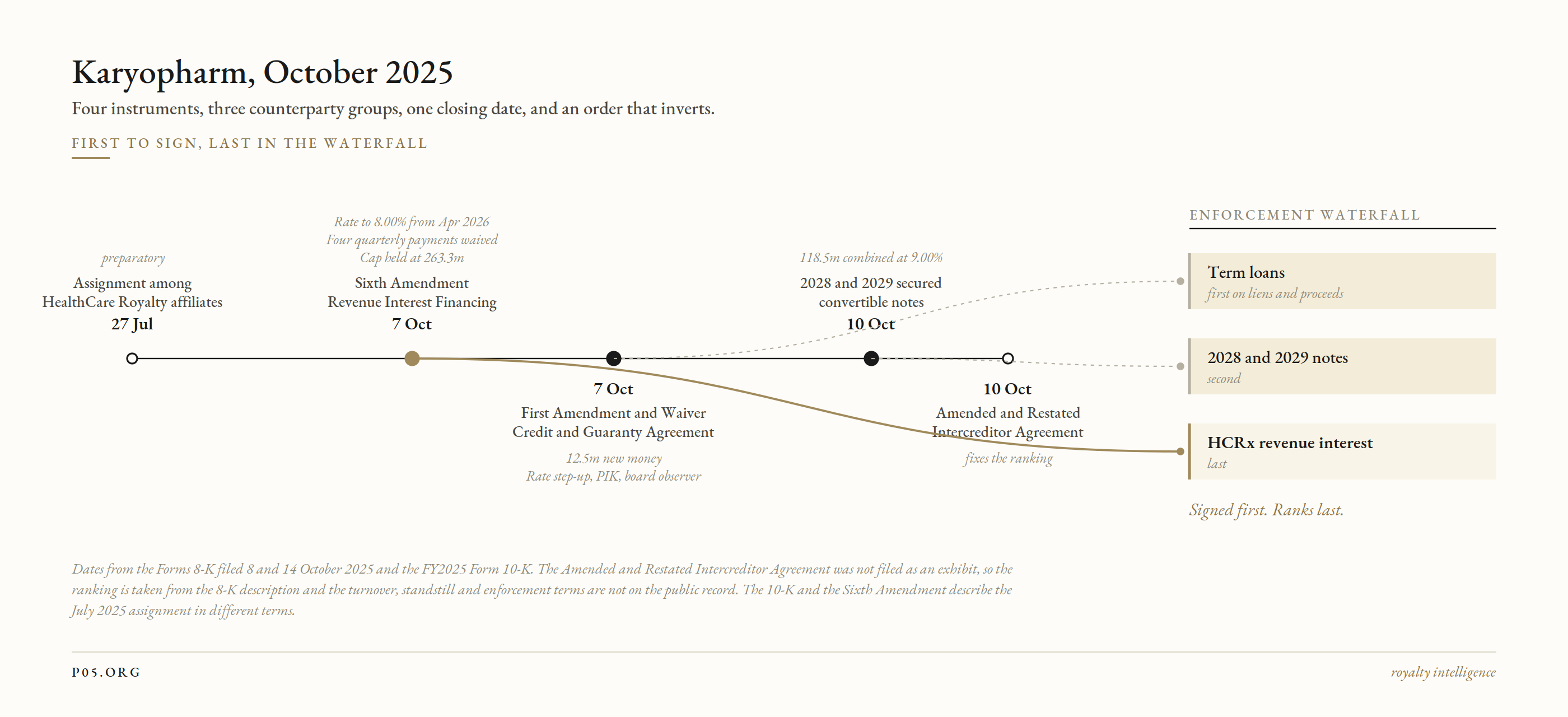
Figure 4. Karyopharm, October 2025. The royalty holder signed first and ranks last in the enforcement waterfall.
Worked sequence: Karyopharm, October 2025
Three layers of capital claimed the same product economics: a revenue interest financing agreement with HealthCare Royalty dating to September 2019, a senior secured term loan under a credit and guaranty agreement dated 8 May 2024, and two vintages of convertible notes. The consents were filed rather than summarised.
The FY2025 annual report records that the revenue interest agreement was assigned in July 2025 by HCRx to KKR in connection with its acquisition of a majority ownership stake in HCRx, and that the total payable under the agreement remains capped at 263.3 million dollars.
The filed Sixth Amendment recites that on 27 July 2025 Healthcare Royalty Partners III, L.P. assigned its interests in the revenue interest financing, the term loan notes and the existing 2029 convertible notes to its affiliates HCRS Investments Holdco LLC and GARx I, L.P. The two accounts are consistent with KKR-controlled HealthCare Royalty entities transferring among themselves. KKR is not a named signatory to either instrument.
On 7 October 2025 Karyopharm and the HealthCare Royalty entities executed the Sixth Amendment to the Revenue Interest Financing Agreement, with Healthcare Royalty Management, LLC as investor representative and HCR Karyopharm SPV, LLC as collateral agent. The investors permitted the financing transactions, agreed that they would not constitute a change of control, waived revenue interest payments across four quarterly payment dates, and raised the Applicable Tiered Percentage.
The FY2025 Form 10-K records the waiver as covering royalties on revenue recognised between 1 April 2025 and 31 March 2026, and the rate increase as taking the Applicable Tiered Percentage to 8.00 per cent from 1 April 2026. The consideration was a one-year payment holiday against a permanent rate step-up.
The term lenders executed the First Amendment and Waiver to the Credit and Guaranty Agreement on the same date, with Wilmington Savings Fund Society, FSB as administrative and collateral agent. The amendment waived specified defaults and added 12.5 million dollars of new term loans fungible and pari passu with the existing debt. The lenders took a rate step-up, PIK interest and a board observer.
On 10 October 2025 the company issued 15.0 million dollars aggregate principal amount of 9.00 per cent senior secured convertible notes due 2028 and 103.5 million dollars of 9.00 per cent senior secured convertible notes due 2029, under indentures with WSFS as trustee and collateral agent.
At closing the parties entered an Amended and Restated Intercreditor Agreement under which the term loans rank ahead of the 2028 notes, the 2029 notes and the indebtedness under the HCRx financing agreement as to liens and distributions of enforcement proceeds, and the notes rank ahead of the HCRx indebtedness and behind the credit agreement. The royalty holder signed first and ranks last.
| Order | Party | Instrument and date | Basis | What it extracted |
|---|---|---|---|---|
| 1 | HealthCare Royalty entities, investor representative, collateral agent | Sixth Amendment to Revenue Interest Financing Agreement, 7 Oct 2025 | Investor and investor representative consent | Applicable Tiered Percentage to 8.00 per cent from 1 Apr 2026; consent fee; change-of-control carve-out |
| 2 | Term lenders and WSFS as agent | First Amendment and Waiver to Credit and Guaranty Agreement, 7 Oct 2025 | Lender consent under the amendment section | Rate step-up, PIK interest, board observer, against 12.5 million dollars of new money and a default waiver |
| 3 | Convertible noteholders | Exchanges and new 2028 and 2029 notes, 10 Oct 2025 | Exchange agreements and indentures | Equity and new secured notes for old notes; new-money notes at 9.00 per cent |
| 4 | All secured parties | Amended and Restated Intercreditor Agreement, 10 Oct 2025 | Agreement among agents and the investor representative | Term loans first, notes second, HCRx last on enforcement proceeds |
Limits of the filed record
A granted consent produces an Item 1.01 exhibit. A refused consent produces no filing, the transaction never having been signed. The frequency of refusal is not recoverable from EDGAR.
A consent fee, where one exists, ordinarily sits in a clause covered by the filer's competitive harm certification. The BioCryst expense clause is legible because it contained nothing to mask. Consents are also summarised in debt footnotes, filed as conformed amendments without recitals, or folded into refinancings in which the royalty consent is one change among several.
Intercreditor terms are frequently unfiled. The Karyopharm Amended and Restated Intercreditor Agreement and the related collateral trust arrangements do not appear as exhibits in the October 2025 accessions, so the turnover, standstill and enforcement-control terms are public only at the level of the priority ranking. The same filing set does not state the Required Lenders percentage under the credit agreement.
The denominator for a frequency claim is undefined. Monetisations are executed by sellers with no secured debt, by licensors selling third-party streams they never pledged, and by funds trading positions in the secondary market. No filed life sciences royalty sale in the reviewed record was put to a section 271 stockholder vote.
The record supports a conditional statement. Where the transaction falls within the disposition or indebtedness covenants, the price ordinarily takes the form of a mandatory partial prepayment. Where it falls within a pre-negotiated permission, the cost is expenses. The drafting separating those outcomes is in a credit agreement already on EDGAR.
Diligence
The "Disposition" definition and its exclusions. These determine whether a consent is required. A facility excluding revenue participation rights from disposition, as BioCryst's does, permits signature without a lender vote.
The size of the permission. A product-specific basket carries a minimum upfront, a rate cap and a maturity constraint. The Savara definition permits one transaction at a time and bars a true-up within 180 days of loan maturity.
The prepayment waterfall and its definition of Net Cash Proceeds. Where royalty proceeds are disposition proceeds, the lender takes a share under the existing contract. Model the upfront net of the sweep or negotiate the exclusion.
The consent standard. A bare consent right carrying no reasonableness qualifier is close to absolute in New York. A basket conditioned on an intercreditor agreement satisfactory to the agent in its sole discretion reserves a veto over a permitted transaction.
Existing encumbrances on the stream. A royalty pledged into a royalty-backed facility is unavailable until the loan is discharged.
The anti-assignment analysis, run on the payment right. A sale of the payment stream falls inside the UCC 9-406 and 9-408 override unless federal law applies. The covenant objection is separate and is where a GSK-style dispute arises.
The first purchase agreement, where a residual is being bought. The seller's freedom to sell the retained interest is set by the earlier buyer's covenants, which range from a permission to syndicate up to a cap to the flat Titan prohibition.
The applicable amendment threshold. A bilateral facility clears in the time required to satisfy conditions precedent. A syndicated facility requiring a collateral release may need affected-lender consent, on the agent's timetable. Where the agent is an affiliate of the majority lender, the syndicate vote may be a single decision.
The intercreditor agreement, on the critical path. Where the product intellectual property is collateral, the buyer's security is subordinated or back-up, and its terms are negotiated between the lender and the buyer.
The treatment of an unobtained consent. Closing on an indemnified post-closing covenant rather than a condition precedent transfers the litigation risk to the seller's balance sheet.
The payoff alternative. PTC's Blackstone payoff cost 82.1 million dollars in premiums and fees on 302.1 million dollars of principal and interest, which is the benchmark against which consent demands are measured.
The incumbent lender as a bidder. Where the lender runs a royalty strategy, the consent request and the third-party purchase should run in parallel.
All information in this report was accurate as of the research date and is derived from publicly available sources including court opinions, regulatory guidance, academic literature, SEC filings, and financial news reporting. Information may have changed since publication. This content is for informational purposes only and does not constitute investment, legal, or financial advice. The author is not a lawyer or financial adviser.