Buying out the licensor: What a pre-approval royalty costs to buy back

On 5 October Immunome filed a Form 8-K that carried no press release. It reported that three days earlier the company had paid Bristol Myers Squibb $20.0M in cash and 4,425,487 new shares. In return Bristol gave up every royalty and milestone it was owed on varegacestat, a gamma secretase inhibitor for desmoid tumours, and assigned Immunome the patents on which the licence rested.
The drug has passed its Phase 3 trial and awaits an FDA decision due on 28 April 2027. No royalty fund took part. The licensor and the licensee set the price between them, and working back from it gives the sales and the discount rate that the two companies must have accepted. At the market price on the day of signing the consideration came to about $112.5M.
On the assumptions below it is consistent with peak worldwide sales of $120M to $215M, a range that straddles what Ogsiveo, the first drug approved for the disease, sold in America in its first full year.
The trade
Bristol licensed varegacestat, then called AL102, and a sister compound, AL101, to Ayala Pharmaceuticals in November 2017. Immunome bought Ayala's programmes in March 2024 and took over the licence. Under it, Immunome owed Bristol tiered royalties from the high single digits to the low teens on worldwide net sales, development and regulatory milestones of up to about $142.0M across both compounds and several indications, and commercial milestones of up to $50.0M for each product.
The 2017 licence sets the royalty in three tiers with redacted thresholds and runs it, country by country, until the later of ten years after first sale and the expiry of the last valid claim. It allows reductions for third-party licences and generic competition. It contains no option for the licensee to buy the royalty out.
Amendment No. 4 removes all of it. The section that set the milestones now provides for the $20.0M cash payment, and the section that set the royalties now provides for the share issue. Bristol assigns the patents listed in an exhibit, whose contents Immunome redacted.
It keeps a non-exclusive, fully paid licence under those patents for any molecule other than the licensed compounds. Patents it does not assign revert to it, and Immunome may not use them.
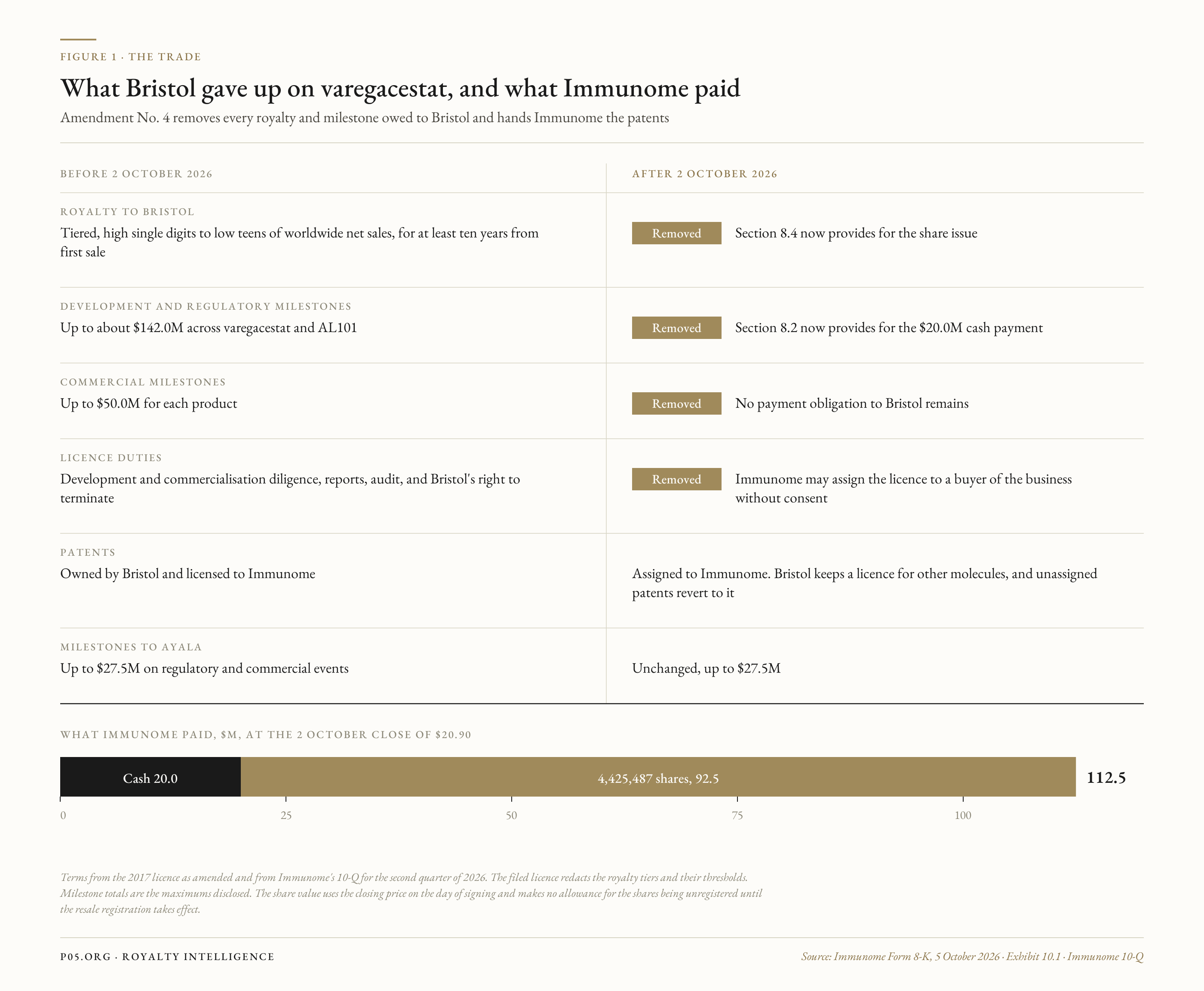
The amendment also strips out the machinery of a licence. It deletes Immunome's development and commercialisation duties, its development and sales reports, Bristol's audit right, and the clauses on prosecuting and enforcing Bristol's patents. Bristol loses its right to terminate the agreement.
Immunome may assign the licence to a buyer of the business without Bristol's consent, and the agreement now ends on the expiry of the last valid claim of the patents Immunome owns.
The buy-out came in stages. In August 2024 a second amendment replaced Bristol's share of sublicence revenue with redacted terms, for 230,415 shares then worth $2.7M. In March 2026 a third amendment required Immunome to give Bristol a good-faith forecast of sales and royalties ahead of the first commercial sale. Six months later Bristol sold the royalties outright.
The calendar
Immunome filed its new drug application in April 2026, and the FDA accepted it in July with an action date of 28 April 2027. The Phase 3 RINGSIDE trial cut the risk of progression or death by 84 per cent against placebo, with an objective response rate of 56 per cent against 9 per cent. Immunome plans to file in Europe by the end of 2026.
Bristol's shares carry a deadline of their own. Under the stock issuance agreement Immunome must use commercially reasonable efforts to file a resale registration by 16 November 2026 and to have it declared effective within 60 days of filing. The 4,425,487 shares equal about 3.9 per cent of the 113,577,629 outstanding on 6 August.
One obligation survives. Immunome may still owe Ayala up to $27.5M on regulatory and commercial milestones under the 2024 asset purchase, having paid a $10.0M development milestone in December 2025.
The implied price
Immunome's shares closed at $20.90 on 2 October, which values the stock at $92.5M and the whole consideration at $112.5M. They closed at $21.17 on 5 October, the day of the filing, and at $19.31 the day after. A discount for the shares being unregistered for a few weeks would lower the figure a little. The analysis below uses $112.5M.
That sum bought out three streams: a royalty that would start in 2027, regulatory milestones due on approvals that were months away, and commercial milestones due once sales passed thresholds that the filings do not disclose.
The model values them as follows. Varegacestat launches in America in the second half of 2027 and reaches 25, 55, 80, and 95 per cent of peak sales in its first four years, then holds flat until the royalty ends in 2040. The royalty is 11 per cent of worldwide net sales, the middle of the disclosed range.
Regulatory milestones of $40M on American approval and $20M on European approval stand in for the part of the $142.0M that falls on varegacestat's first indication. The $50.0M commercial milestones fall in two equal payments when annual sales first pass $250M and $500M.
The model multiplies every payment by an 85 per cent chance of approval. These are p05.org assumptions. Neither company has published a sales forecast.
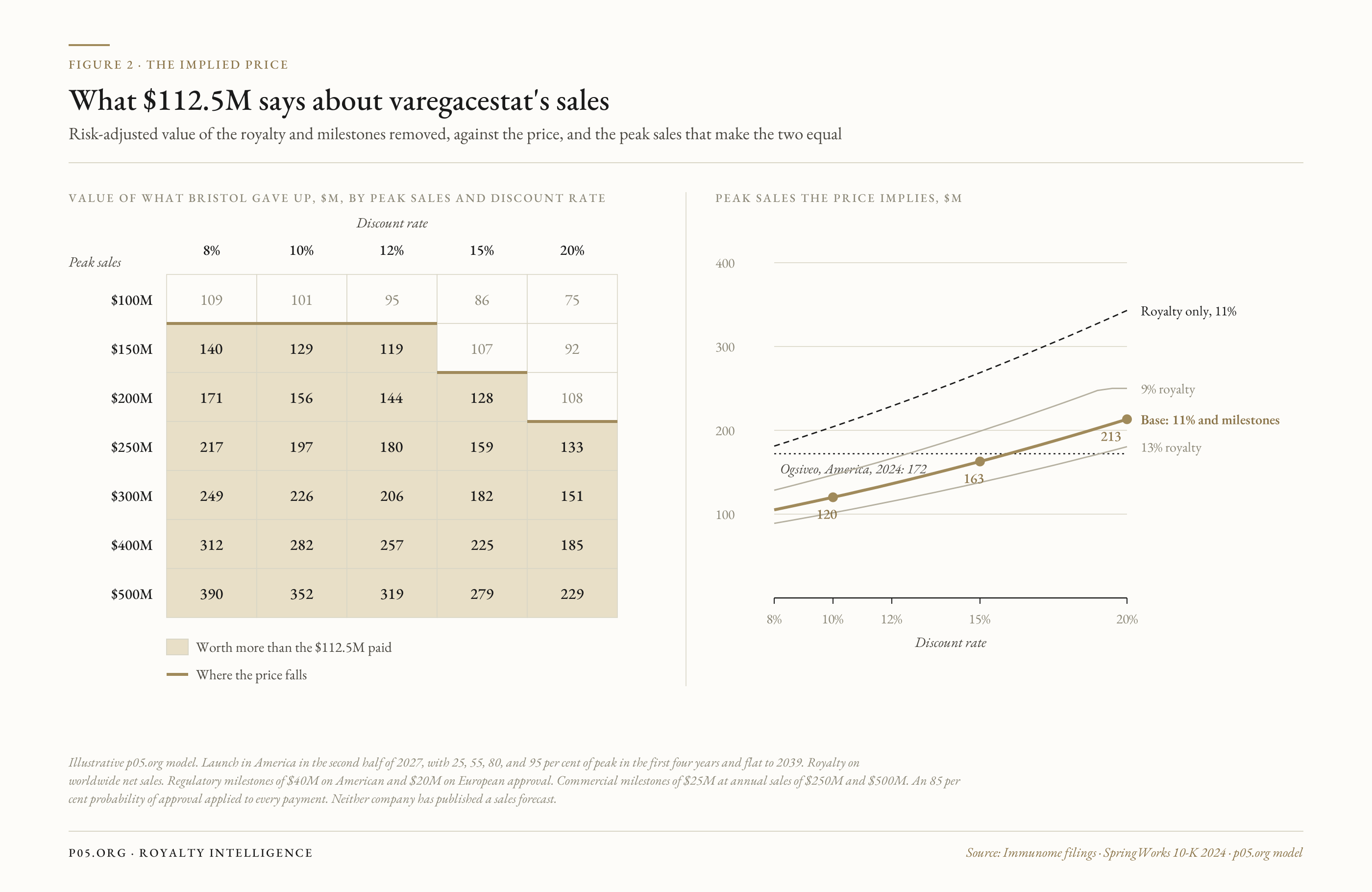
On those assumptions the price matches peak worldwide sales of about $120M at a 10 per cent discount rate, $163M at 15 per cent, and $213M at 20 per cent. If Bristol gave the milestones no value, the royalty alone would have to support peak sales of $204M, $269M, and $343M at the same rates. Moving the royalty to 9 per cent or 13 per cent shifts the figure at 15 per cent to $199M or $138M.
The nearest benchmark is the first drug of the class. SpringWorks recorded $172.0M of American net sales of Ogsiveo, nirogacestat, in 2024, its first full year on the market, and $44.1M in the first quarter of 2025. SpringWorks pays Pfizer royalties from the mid-single digits to the low 20s on that drug. Varegacestat would launch second, into a market that Ogsiveo opened.
At any discount rate between 10 and 15 per cent, the price implies worldwide peak sales for varegacestat below what Ogsiveo, the first therapy approved for desmoid tumours, sold in America alone in its first full year.
Measured another way, Immunome paid $8.7M to $12.5M for each point of royalty, depending on where in the range the rate sits, and the milestones came with it.
Why Bristol sold
Bristol granted the licence to a small company nine years ago. Each amendment since 2024 has taken something off it: the share of sublicence revenue first, then the terms of the sales forecast, then the royalty itself.
Amendment No. 4 hands Immunome the patent work, the enforcement, and the reporting that Bristol would otherwise have had to monitor for more than a decade.
Equity makes up most of the consideration. Of the $112.5M, about 82 per cent is Immunome stock, so Bristol keeps a stake in varegacestat's success through the share price.
With the 230,415 shares from 2024, it has taken 4,655,902 Immunome shares for amending the licence, worth about $97.3M at the 2 October close. It also keeps a stake in its own Notch research, through the licence back to the assigned patents for other molecules and through the patents that reverted to it.
Why Immunome bought
Immunome had the money. It held $217.7M of cash and $302.3M of marketable securities at 30 June 2026 and says it has funded itself mainly through sales of equity. Its filings disclose no term loan, no revenue interest, and no royalty sale. After the amendment its lead product carries only the Ayala milestones.
The company lost $127.0M in the first half of 2026, and it also runs antibody-drug conjugate programmes, so the cash has other calls on it. At $20.90 a share, the buy-out cost about 4.6 per cent of Immunome's market value, counting the new shares.
That leaves the full royalty capacity of varegacestat free. A royalty fund or a lender that funds Immunome after approval would take the first claim on sales, where until 2 October it would have stood behind Bristol's royalty. Immunome now owns the patents outright. It can grant security over them, and Bristol can no longer terminate the licence on which a buyer's claim would depend.
Mineralys Therapeutics shows the financing motive in a single filing. On 2 June 2026 it paid Tanabe Pharma $200.0M in cash to end the royalties on lorundrostat, which ran from the mid-single digits to 10 per cent, and agreed new commercial milestones of up to $100.0M. The same day it signed a loan of up to $500.0M from BioPharma Credit and drew $100.0M.
The loan agreement caps any future royalty financing on lorundrostat at a redacted share of sales, and that cap rises once the royalty to Tanabe has been repurchased. The lender gave Mineralys more room to sell a royalty after the licensor's royalty was gone.
Other buy-outs
Few licensee buy-outs appear in the filed record, and most of those found are small. Context Therapeutics paid BioAtla $6.5M in cash in May 2026 to remove up to $122.5M of milestones and royalties from the mid-single digits to the low double digits on CT-202, a preclinical asset.
Moderna paid Carisma $4.0M in September 2025 to make its licences royalty-free. Vistagen removed the royalties and milestones on fasedienol, then in Phase 3, by buying its licensor, Pherin, for about 12.4 million shares in 2022.
Large pharmaceutical companies have bought out royalties as licensees too. In December 2025 AstraZeneca agreed to buy part of Compugen's royalty on rilvegostomig, then in eleven Phase 3 trials, for $65M upfront and $25M on acceptance of a biologics licence application. AstraZeneca's annual report also records $170M paid to Bristol to reduce its royalties on Saphnelo outside America to zero, after approval. The re-rate sets out two earlier buy-downs, by Apellis with Sobi and by Candel.
Royalty funds price the same risk in their own deals. In pre-approval synthetic royalties signed since 2024, the upfront money paid for each point of first-tier royalty varies widely. DRI Healthcare paid KalVista $100.0M for 5.00 per cent of worldwide sales of sebetralstat while its application was under review, or $20.0M a point.
Royalty Pharma committed $200M for 9.25 per cent of Denali's tividenofusp alfa, payable on accelerated approval, or about $21.6M a point. Sagard agreed $150M for 5.5 per cent of American sales of Nuvation's taletrectinib, also on approval, or about $27.3M a point. Royalty Pharma paid Zenas $75M for 5.5 per cent of obexelimab during Phase 3, about $13.6M a point.
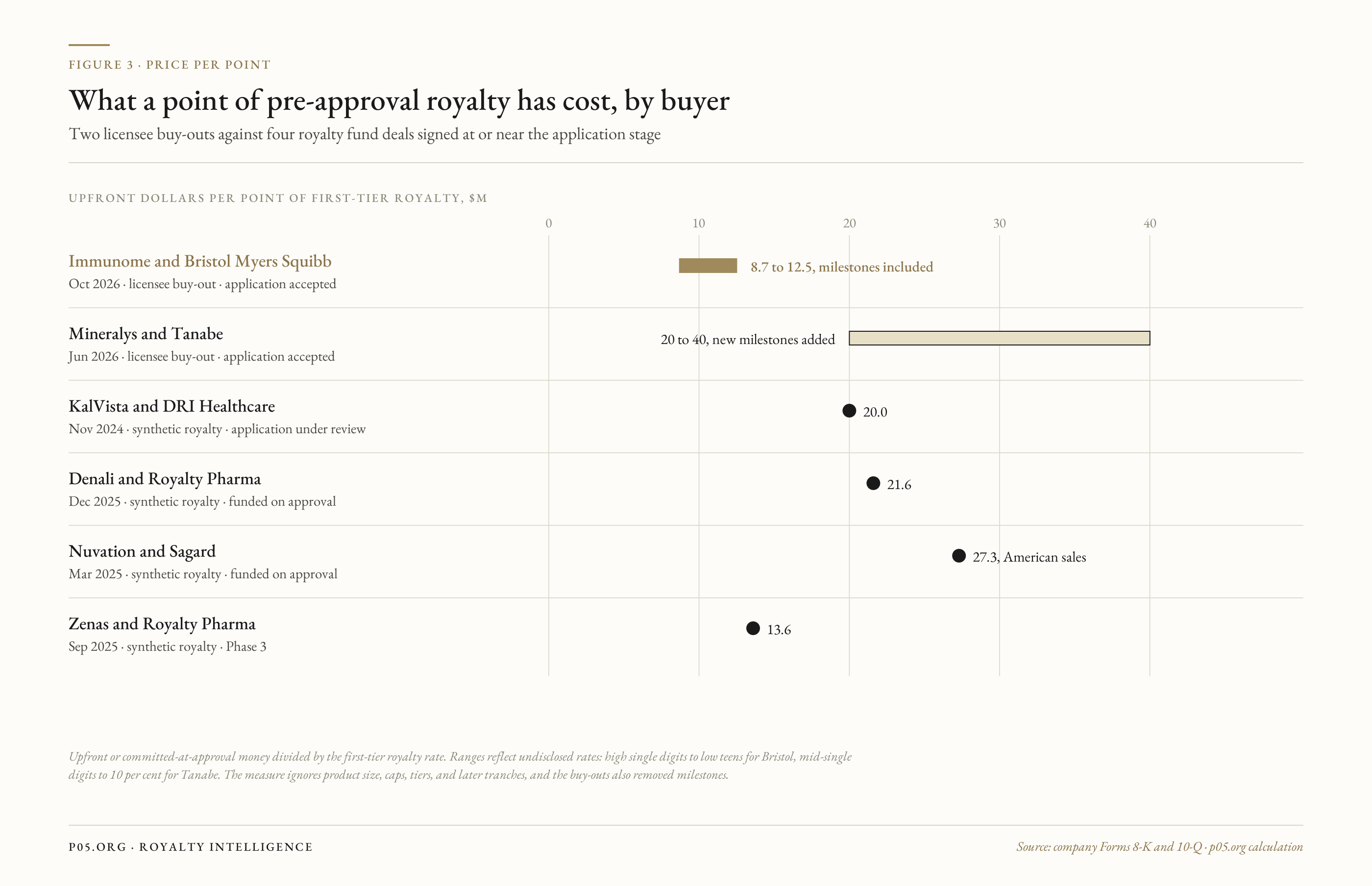
These numbers compare products of different sizes, and the fund deals carry caps, tiers, and further tranches that the per-point figure ignores. They do show that Bristol accepted less per point than each of these funds paid, at the same stage as KalVista and a later one than Zenas, and that it gave up its milestones as well.
| Deal | Date | Stage at signing | Paid | Removed or bought | Per royalty point |
|---|---|---|---|---|---|
| Immunome and Bristol Myers Squibb | 2 Oct 2026 | Application accepted, decision due 28 Apr 2027 | $20.0M cash and stock worth $92.5M | All royalties, high single digits to low teens; all milestones | $8.7M to $12.5M |
| Mineralys and Tanabe | 2 Jun 2026 | Application accepted, decision due 22 Dec 2026 | $200.0M cash, plus new milestones of up to $100.0M | All royalties, mid-single digits to 10 per cent | $20M to $40M |
| AstraZeneca and Compugen | Dec 2025 | Phase 3 | $65M, plus $25M on filing acceptance | Part of a royalty of up to mid-single digits | Not disclosed |
| Context and BioAtla | May 2026 | Preclinical | $6.5M cash | All royalties and up to $122.5M of milestones | Not meaningful |
| KalVista and DRI Healthcare | Nov 2024 | Application under review | $100.0M | 5.00 per cent of worldwide sales, first tier | $20.0M |
| Denali and Royalty Pharma | Dec 2025 | Application under review, funded on approval | $200M | 9.25 per cent of worldwide sales | $21.6M |
| Nuvation and Sagard | Mar 2025 | Application under review, funded on approval | $150M | 5.5 per cent of American sales, first tier | $27.3M |
| Zenas and Royalty Pharma | Sep 2025 | Phase 3 | $75M | 5.5 per cent of worldwide sales | $13.6M |
The buy-out right as a competing bid
Immunome had no contractual right to the buy-out. The 2017 licence gives it none, so the two companies negotiated the price. Where a licence does give the licensee an option to buy down or buy out the royalty, the exercise price sets a ceiling on what any other buyer of that royalty can expect to recover early.
For a fund that buys an upstream licensor's royalty, the licensee is a second bidder for the same stream. It holds the sales forecast, and Amendment No. 3 obliged Immunome to share one with Bristol ahead of launch, six months before Bristol sold. The licensee also gains more than the cash flows, because it can remove diligence duties, reporting, and termination rights that no fund can release.
A fund bidding for Bristol's royalty could have bought only the payments. Immunome also bought a cleaner asset to finance.
That gives a buyer of a pre-approval licensor royalty several clauses to read first: any buy-down or buy-out option in the licence, the licensee's right to assign without consent, the forecast and information rights that tell the licensor what the licensee knows, and the licensee's balance sheet. A licensee with $520.0M of cash and no debt, as Immunome had in June, can pay for its own royalty when it chooses.
Immunome is due to file the resale registration for Bristol's 4,425,487 shares by 16 November. The FDA's decision on varegacestat is due on 28 April 2027. From the first sale after it, the royalties that Bristol sold for $112.5M will stay with Immunome.
All information in this report was accurate as of the research date and is derived from publicly available sources including court opinions, regulatory guidance, academic literature, SEC filings, and financial news reporting. Information may have changed since publication. This content is for informational purposes only and does not constitute investment, legal, or financial advice. The author is not a lawyer or financial adviser.