
Fund of the Week: Perceptive Advisors

Perceptive has lent to at least 38 drug and device companies since 2014 and has raised about $3.5B to do it. One of those loans came with a royalty. It lasted fourteen months. In 2026 royalty and credit funds have refinanced three of Perceptive's borrowers.
On 1 October 2026 DocGo, a mobile healthcare company, entered an amended credit agreement with Perceptive Credit Holdings IV. It took over $52M that Perceptive had lent in 2022 to Hicuity Health, a remote intensive-care provider that DocGo is buying, and added up to $50M more. The loan pays the SOFR benchmark, with a floor of 3.50 percent, plus 7.50 percent. Perceptive also received a warrant over 4,000,000 DocGo shares at $0.5039 each.
That is the firm's usual instrument. Of 34 Perceptive loans whose terms are public, every one pays a margin over a floored reference rate, and on each the two together have come to between 10 and 12.25 percent. Most carried warrants.
A royalty appears once. In August 2024 Perceptive lent scPharmaceuticals $50M and paid a further $25M for a share of the sales of Furoscix, a heart-failure diuretic. Fourteen months later MannKind bought the company and paid about $82.6M to retire both.
The record shows a lender that prices its risk with a floored rate and a margin, and takes equity warrants beside them. It has written one royalty in public view. That royalty was bought out within the first call period, and in 2026 Blackstone and Pharmakon have refinanced its borrowers, as in one case has a royalty fund.
At a Glance
- What it is: the private credit business of a life sciences investment firm, lending $20M to $300M at a time to drug, device, diagnostics and digital health companies, almost always against a senior lien and with warrants
- Manager: Perceptive Advisors LLC, founded in 1999 by Joseph Edelman and based at 51 Astor Place, New York
- Assets under management: about $11B across its strategies at 30 June 2026, most of it in the Perceptive Life Sciences hedge fund
- Credit strategy: begun with a first closed-end fund in 2014; about $3.5B raised for private credit
- Funds: Credit Opportunities Fund I, $323M in 2016; Fund II, $675M in 2018; Fund III, $1.1B in 2020; Fund IV, formed in 2022, size not announced; Fund V, notified to the SEC on 29 October 2025
- Lending entities: Perceptive Credit Holdings II, III, IV and V, LP, one for each fund from the second onward
- Portfolio manager: Sam Chawla, with the firm since 2013; Sandeep Dixit is chief credit officer
- Loans with public documents: 38 borrowers found, from VBI Vaccines in July 2014 to DocGo in October 2026
- Outstanding on public borrowers: about $735M across twelve companies, on the latest figure each has filed
- New in 2026: AVITA Medical, Pulmonx, Autolus and DocGo, with $420M committed and $177.5M paid at signing
- Royalty interests written: one, on Furoscix, bought out in October 2025; no purchase of a third party's royalty has been found
A Note on Scope
Perceptive is best known for a hedge fund that gained 82 percent in 2025. This profile leaves that fund out, along with the firm's venture funds and its blank-cheque companies, except where they own shares in a company to which the credit funds have lent.
No portfolio and no returns are published for the credit funds, so what follows comes from borrowers' filings and press releases and, in two bankruptcies, from court papers. Private borrowers file nothing. Kindbody, Cerapedics, Thriveworks and ITM are known to have Perceptive debt on terms that are not public, and they are missing from the counts.
Behind the list of 38 is a search of SEC filings that name a Perceptive Credit Holdings entity, and for the years before 2018 it is unlikely to be complete.
scPharmaceuticals appeared in an earlier issue as an Oaktree borrower. The Perceptive financing described here is the one that repaid Oaktree.
Investment Thesis and Mandate
Mr Chawla came to Perceptive from healthcare investment banking at UBS and Credit Suisse and has been a portfolio manager there since 2013. When the first fund closed in October 2016 the firm said it would make direct secured loans, royalties and convertible structures of $10M to $50M each, with money from endowments and family offices among others.
The first three funds grew from $323M to $1.1B, and the cheques grew with them. Fund II would lend up to $100M to one company and Fund III up to $200M. The firm's website now gives a range of $20M to $300M. It describes the product as debt that is less dilutive than equity, or that takes the place of a crossover round, the last private financing before a listing.
Many borrowers fit that description. Zymeworks, Aquestive, Vapotherm, Zymergen, Pear and C4 Therapeutics all borrowed from Perceptive while private and listed afterwards. Most of the others were small listed companies with a product on sale and a loan from a bank or another fund that needed replacing. At Pulmonx the loan repaid CIBC, at AVITA OrbiMed, at TELA Bio MidCap, and at Neuronetics and Outset Medical SLR.
Royalties have dropped out of the firm's own account of itself, and the credit page of its website does not use the word. In another direction the mandate has widened. In 2018 Institutional Investor reported that the strategy avoided healthcare services. Hicuity, DocGo, Kindbody and Thriveworks are all service businesses.
How Capital Enters and Returns
Each fund is a Delaware partnership with a Cayman feeder, run by a general partner of which Mr Edelman is managing member. Investor counts are public in the Form D filings and nowhere else. Fund II reported $675M sold to 76 investors. Fund III reported $899.9M sold to 123 investors two months before its final close.
Fund IV and Fund V have filed notices and announced no close. The firm's Form ADV for 2025, as transcribed by a filings aggregator, puts the gross assets of Fund IV at about $1.5B and of Fund V at about $678M, with 285 and 95 investors. Fund V was lending by November 2025.
What goes out is a first-lien term loan of four or five years, usually released in tranches, the later ones when sales pass a stated level. Borrowers pay interest monthly and repay the principal at maturity. That interest is a margin over one-month SOFR, or over LIBOR before 2022, with a floor under the reference rate.
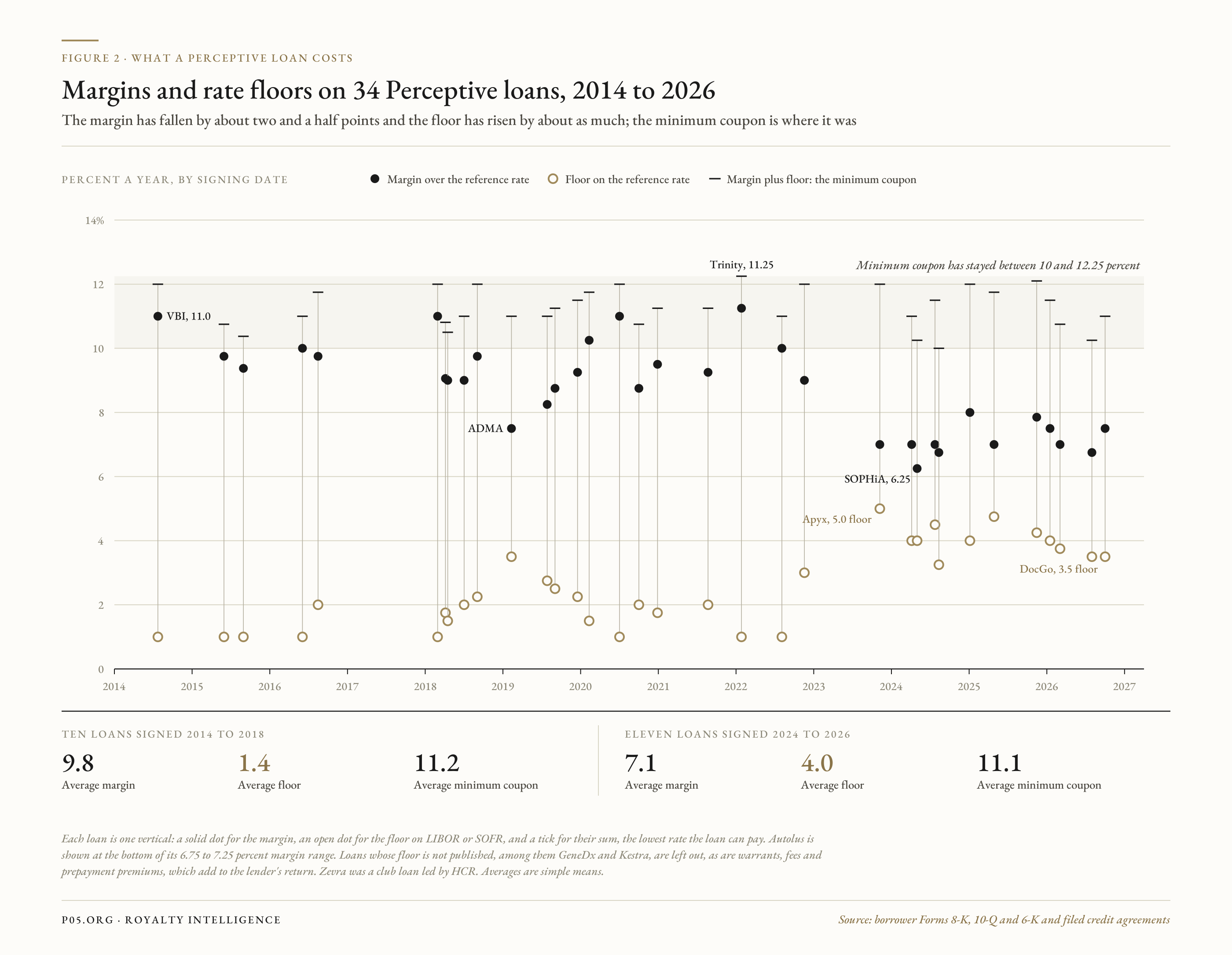
Margin, rate floor and minimum coupon on each of 34 Perceptive loans, by signing date
Over twelve years the balance between margin and floor has shifted. Ten loans signed between 2014 and 2018 carried an average margin of 9.8 points over a floor of 1.4 percent. Eleven signed since the start of 2024 carry a margin of 7.1 points over a floor of 4.0 percent. Add the two and the lowest rate a loan can pay averaged 11.2 percent in the first group and 11.1 percent in the second.
Fees and equity come on top. Pulmonx paid 1.25 percent upfront and owes 1.50 percent on exit, with a charge for early repayment that starts at 10 percent and falls to 2 percent. TELA Bio, Exagen and Biodesix agreed the same range. Warrants came with every recent loan. Autolus granted them over 3,500,000 American depositary shares, struck 25 percent above the market price.
Each borrower promises to keep a minimum of cash, between $2.5M and $10M on most loans, and to meet a schedule of trailing revenue. Amendments usually concern the revenue schedule: Neuronetics has reset its test five times and Biodesix six.
Most loans end in a refinancing. Of 25 that have ended, 19 were repaid or refinanced and three more were settled when the borrower was bought. The other three ended in a default or a bankruptcy. The status of one further loan, to Sonendo, has not been public since early 2025.
Financial Profile and Assets
| Item | Amount | Source and Date |
|---|---|---|
| Perceptive assets under management | about $11B | Firm website, 30 Jun 2026 |
| Capital raised for private credit | about $3.5B | Firm website, Oct 2026 |
| Credit Opportunities Fund I | $323M | Firm release, 25 Oct 2016 |
| Credit Opportunities Fund II | $675M, at its hard cap | Firm release, 5 Nov 2018 |
| Credit Opportunities Fund III | $1.1B, at its hard cap | Firm release, 30 Oct 2020 |
| Fund IV and Fund V, gross assets | about $1.5B and about $678M | Form ADV, via formds, 31 Dec 2025 |
| Autolus notes facility | up to $250M; $75M issued | 8-K, 30 Jul 2026 |
| Outset Medical facility | up to $125M; $102.3M outstanding | 10-Q, 30 Jun 2026 |
| Trinity Biotech term loan | about $115M outstanding | Annual report, 31 Aug 2026 |
| DocGo and Hicuity facility | up to $102M; $64.5M outstanding | 8-K, 1 Oct 2026 |
| Neuronetics facility | up to $90M; $65.0M outstanding | 10-Q, 30 Jun 2026 |
| TELA Bio facility | up to $70M; $60.0M outstanding | 10-Q, 30 Jun 2026 |
| AVITA Medical facility | up to $60M; $50.0M outstanding | 10-Q, 30 Jun 2026 |
| Pulmonx facility | up to $60M; $40.3M outstanding | 10-Q, 30 Jun 2026 |
| Biodesix facility | $50.0M, fully drawn | 10-Q, 30 Jun 2026 |
| SOPHiA Genetics facility | up to $75M; $50M drawn | 6-K, 30 Jun 2026 |
| Apyx Medical facility | $37.5M outstanding | 10-Q, 30 Jun 2026 |
| Exagen facility | up to $65M after amendment; $25.0M drawn | 10-Q, 30 Jun 2026 |
| scPharmaceuticals loan and royalty, at exit | about $82.6M paid | MannKind 8-K, 7 Oct 2025 |
| Synthego secured loan, at bankruptcy | not less than $73.4M | First-day declaration, 5 May 2025 |
Portfolio Book
Royalty interest, with outcome: scPharmaceuticals, on Furoscix (bought out at the company's sale to MannKind, October 2025)
Loans outstanding at public borrowers: Autolus Therapeutics (Nasdaq: AUTL); DocGo (Nasdaq: DCGO), with Hicuity Health; Pulmonx (Nasdaq: LUNG); AVITA Medical (Nasdaq: RCEL); TELA Bio (Nasdaq: TELA); Exagen (Nasdaq: XGN); Outset Medical (Nasdaq: OM); Neuronetics (Nasdaq: STIM); SOPHiA Genetics (Nasdaq: SOPH); Apyx Medical (Nasdaq: APYX); Biodesix (Nasdaq: BDSX); Trinity Biotech (Nasdaq: TRIB)
Private borrowers named in public sources: ITM Isotope Technologies Munich; Cerapedics; Thriveworks; Kindbody
Repaid or refinanced, 2024 to 2026: Kestra Medical (July 2026); MeiraGTx (June 2026); Zevra Therapeutics, with HCR (March 2026); GeneDx (February 2026); Agile Therapeutics (March 2024)
Borrower acquired: scPharmaceuticals, by MannKind (October 2025); Chembio Diagnostics, by Biosynex (April 2023); IsoPlexis, by Berkeley Lights (March 2023)
Default or Chapter 11: Synthego (filed May 2025; assets bought by the lenders); Pear Therapeutics (settled, then filed, April 2023); Icagen (default 2019; assets sold to Ligand, April 2020)
Earlier loans, repaid: VBI Vaccines; Alliqua BioMedical; Kadmon; Zymeworks; Aquestive Therapeutics; Molecular Templates; Vapotherm; CareDx; Athenex; ADMA Biologics; Foamix; Zymergen; C4 Therapeutics; Invitae
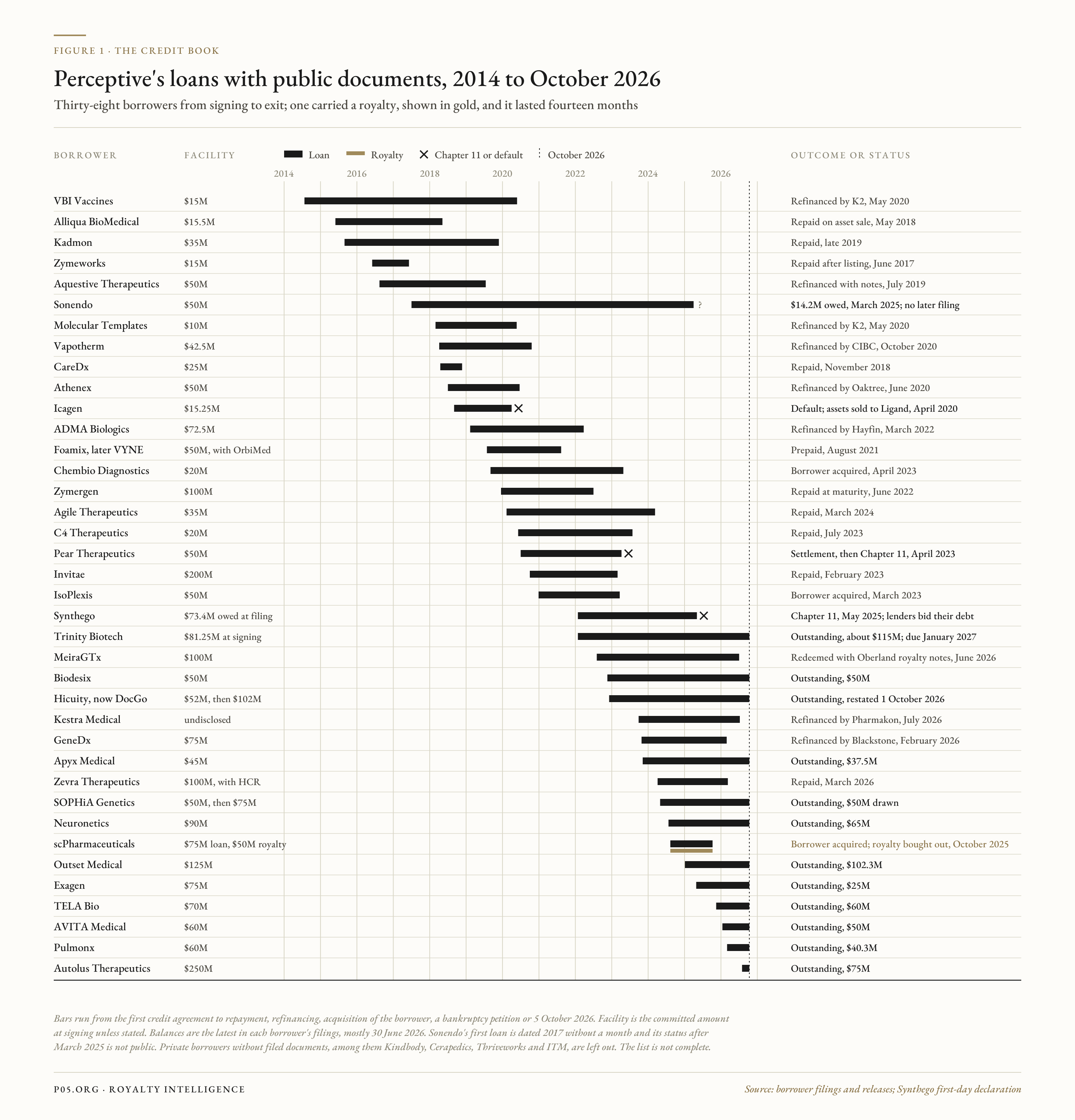
Thirty-eight borrowers with public documents, from signing to exit, with the outcome of each
Investors
Who backs the credit funds is not public. Perceptive has named types of investor and no names: foundations, endowments, pension funds, insurers, family offices and financial institutions. No pension board paper or annual report reviewed for this profile records a commitment to any of the five funds.
The Form ADV figures, as copied by aggregators, give some shape. Fund II's gross assets fell from about $540M at the end of 2023 to about $122M a year later. A vehicle named PCOF Phoenix II Fund, with four investors, appears in the same filing with about $135M, and no source explains the connection, if there is one. Perceptive and its affiliates hold about a quarter of Fund V and less than a tenth of Fund IV.
Fund V is the only one of the five to report an outside marketer, BTG Pactual. The earlier Form D filings name no placement agent after the first fund, which used Jefferies and three smaller firms.
Co-lenders are rare. OrbiMed shared the Foamix loan in 2019 and HCR led the Zevra loan in 2024. On most other loans in the list a Perceptive entity is sole lender and agent.
Governance and Team
Mr Edelman owns more than three-quarters of the firm and Adam Stone, the chief investment officer, between a tenth and a quarter, according to an aggregator's copy of the Form ADV. The credit group on the firm's team page lists ten people. Mr Chawla and Mr Dixit lead it, with Sean Mansoory as managing director and Samuel Cohn as chief financial officer for credit and venture. No change in its leadership has been reported since 2024.
Often the credit funds lend to companies in which Perceptive's other funds own shares. At MeiraGTx its affiliates held more than 10 percent of the equity and a board seat while the credit fund held the notes. Agile Therapeutics described its lender as a related party. When Outset Medical borrowed $100M in January 2025 it also sold $172.7M of preferred stock, in a placement that Perceptive led. In June 2024 it backed the take-private of Vapotherm, which had been a borrower from 2018 to 2020.
Regulatory note: On 6 September 2022 the SEC fined Perceptive Advisors $1.5M. The agency found that the firm had been late to tell a private fund's investors about conflicts in blank-cheque companies sponsored by its own staff, and late with a shareholding notice. Perceptive neither admitted nor denied the findings. The order concerned the hedge fund. No SEC action against the credit funds has been found.
Litigation note: The founder of Kindbody, a fertility clinic group, sued Perceptive in New York in May 2025. She alleged that she was coerced into resigning during a financing led by Perceptive in late 2024, and later added Credit Opportunities Fund IV as a defendant. In October 2025 the Delaware Court of Chancery granted Perceptive an injunction against part of the New York suit. The New York court has since sealed parts of the record. No outcome has been published.
IP, Royalties and Return Economics
scPharmaceuticals and the Furoscix Interest
scPharmaceuticals sold one product, a pump that delivers furosemide under the skin, and on 9 August 2024 it signed two contracts with Perceptive Credit Holdings IV. The first was a term loan of up to $75M, of which $50M was paid at once. It cost one-month SOFR, floored at 3.25 percent, plus 6.75 percent, and it came with warrants over 300,000 shares.
The second was a Revenue Participation Right Purchase and Sale Agreement. Perceptive agreed to pay up to $50M for a share of Furoscix sales. Half was funded. The company's later reports record $25.0M paid at closing. Under the filed agreement the rest depended on trailing sales of $50M and then $110M.
The rate was tiered by annual net sales: 8 percent on the first $150M, 3 percent on the next $150M and 1 percent above $300M. Each rate would rise by four points if Perceptive had not received half its money by 30 June 2028, and by four more if it had not received all of it two years later. Payments would stop at a cap of 2.0 times the purchase price. The cap fell to 1.6 times if half the money came back by September 2027.
scPharmaceuticals could buy the interest back at 1.4 times the purchase price until 30 September 2026, less royalties already paid, after which the multiple rose in steps to 2.0. A change of control was one of seven events that gave Perceptive a put, and the agreement's table sets one schedule for put and call alike. The interest was backed by a security interest, and an intercreditor agreement tied it to the loan, where Perceptive was also the agent.
Together the two contracts repaid about $54.2M owed to Oaktree, prepayment penalty and exit fee included.
Furoscix sales grew. Net revenue was $27.8M in the first half of 2025, almost twice the figure a year earlier. Perceptive received $1.9M of royalties in those six months. scPharmaceuticals carried the interest on its books at $30.2M, valued with a discount rate of 21.2 percent.
MannKind then bid $5.35 a share in cash, with a contingent right to as much as $1.00 more. Its takeover closed on 7 October 2025. MannKind repaid the loan and bought back the revenue right for about $82.6M together, and both agreements ended.
How the $82.6M divides is not published. On the contract's schedule the royalty would have cost 1.4 times $25M, or $35.0M, less what had already been paid, a sum which assumes that the first $25M was all Perceptive ever funded. No filing read for this profile confirms or contradicts that. As for the loan, it stood at $50M and its charge for early repayment in the second year was 3 percent.
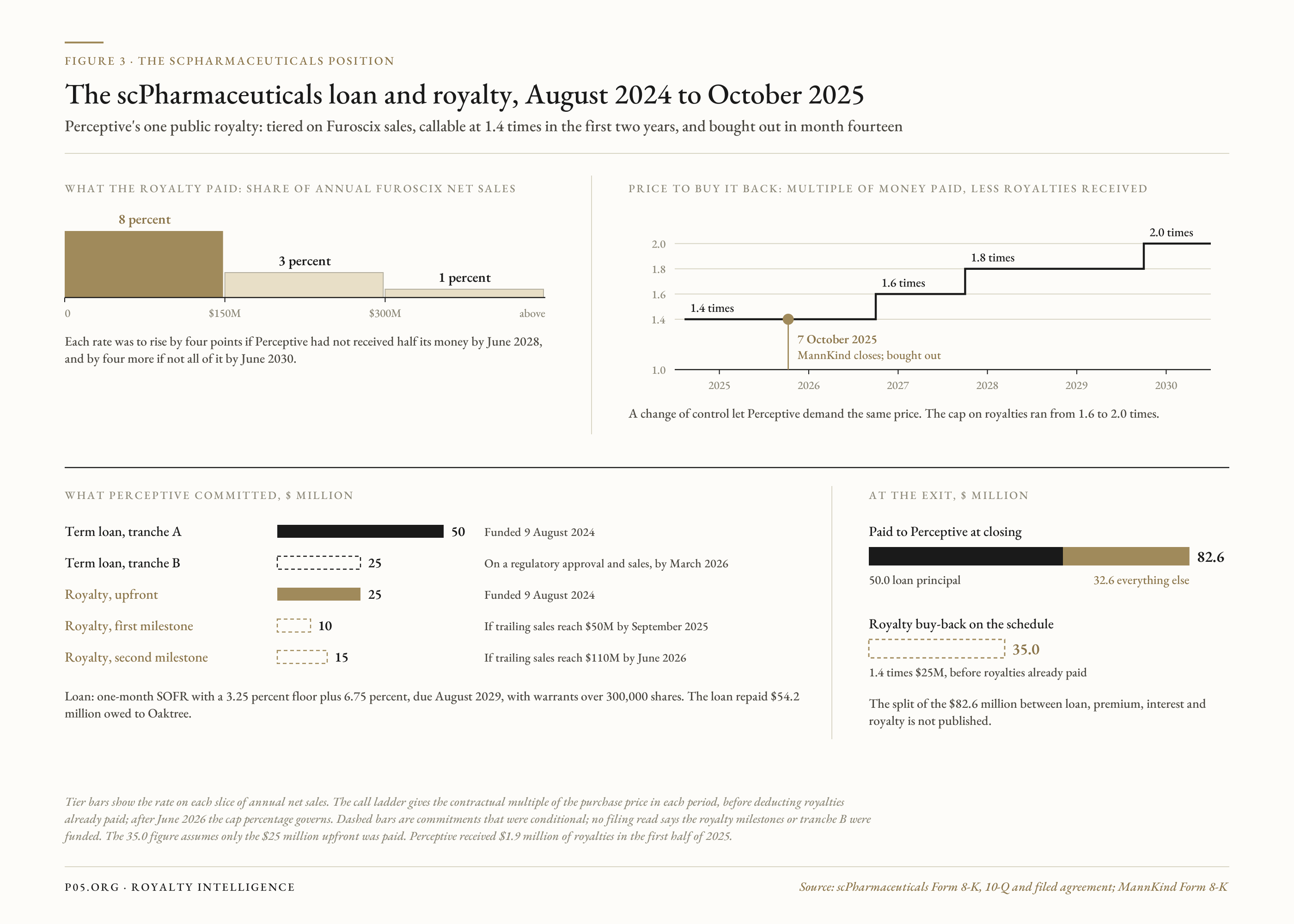
The Furoscix royalty tiers, the buy-back schedule, what Perceptive committed and what it was paid at the sale to MannKind
MeiraGTx and the Oberland Notes
A royalty took the place of Perceptive's loan at MeiraGTx. In August 2022 Perceptive Credit Holdings III lent the gene therapy company $75M against its factories in London and Shannon, at 10 percent over SOFR with a 1 percent floor. Its security left out the company's intellectual property.
The notes were due on 2 August 2026. In March the lender extended them to May 2027 in return for $25M of principal by the end of June and a lower strike on its warrants. MeiraGTx found the money elsewhere, and on 30 June 2026 it redeemed the notes in full and paid no penalty.
Funds managed by Oberland Capital supplied the cash. They agreed to buy up to $375M of royalty notes, paid $100M that day, and will earn 1.95 percent of global net sales of three gene therapy candidates up to a cap.
Trinity Biotech and the Conversion Right
Of the loans still outstanding, Trinity Biotech's is the largest. Perceptive lent the Irish diagnostics company $81.25M in January 2022 at 11.25 percent over SOFR, under an agreement that has been amended and restated six times since, most recently in December 2025. By 31 August 2026 about $115M was outstanding.
Trinity's revenue fell short of its covenant in the last quarter of 2025 and the lender waived the breach. From February 2026 interest was paid in kind, meaning that it was added to the principal, and two amendments, in April and August, lent a further $2.5M each.
Since December 2025 Perceptive has held a right to convert part of the loan into shares, at 97 percent of the market price with a floor. In April the convertible portion rose from $60.0M to $72.5M. Maturity is 15 January 2027. Trinity's directors wrote on 8 September that no extension had been agreed and that the maturity was the main judgment in their going-concern assessment.
Nothing in the loan is paid as a share of sales. A second Perceptive fund is owed a contingent payment of up to $15M that came from Trinity's purchase of a glucose-monitoring business in 2024. Payment depends on partnering proceeds from that business.
Pear Therapeutics and Synthego
Two borrowers reached bankruptcy court with Perceptive as their senior lender. One was Pear Therapeutics, a seller of prescription software, which had borrowed $30M of a $50M facility from 2020. On 6 April 2023, the day before it filed for Chapter 11, it settled with the lender. Perceptive took $18.66M in cash, including a prepayment fee of $3.6M, and the right to a tax refund of up to $4.7M. It kept an unsecured claim of up to $10.4M.
Synthego, a private maker of gene-editing reagents, had borrowed under a January 2022 agreement. When it filed on 5 May 2025 it owed not less than $73.4M on the secured loan. The lenders offered $12.5M of new money and a roll-up of $37.5M, which moves earlier debt into the new loan so that it ranks ahead of other claims. As well as lending, they bid their debt for the business. A published case summary puts the bid at $85M and the closing on 18 July 2025.
Neither loan carried a royalty. At Icagen, a third case, the lender refused to waive defaults in January 2020, and the company sold its North Carolina business to Ligand for $15M three months later.
Absent Royalties
So far as their filings show, the other 37 borrowers pay Perceptive no share of sales, and that includes the seven loans signed after scPharmaceuticals: Outset, Exagen, TELA Bio, AVITA, Pulmonx, Autolus and DocGo. Autolus sells a cell therapy and Pulmonx a lung valve. On both loans the lender earns a coupon and fees, with warrants on top.
Revenue enters these contracts as a test. Autolus can draw its third and fourth tranches, $75M each, only if net revenue reaches set levels by July 2028 and January 2030. Pulmonx's later tranches need trailing revenue of $92.5M and $100M.
In June 2026 ITM, a private German radiopharmaceutical company, said that its debt financing of up to $262.5M had been transferred from Blue Owl funds to Perceptive. No terms were given.
Blue Team
- Twelve years in one strategy under one portfolio manager, and five funds, each larger than the last up to the $1.1B third
- Most loans have been repaid. Of 25 that have ended, 22 were repaid, refinanced or settled at a sale of the borrower
- A coupon that has held between 10 and 12.25 percent at its minimum through a decade in which reference rates went from near zero to above 5 percent
- Capacity to lend alone at size: up to $250M to Autolus in July 2026, with no co-lender
- Equity returns on top of interest. Perceptive exercised its Exagen warrants in November 2025 without paying cash, and every loan it has led since 2024 carries them
- New lending through 2026, with $420M committed to four companies and a fifth fund already deployed
- A house that can also buy shares. At Outset and Foamix a Perceptive fund bought equity on the day the loan was signed
- The one royalty ended early and in cash: it was bought out inside the first call period when the borrower was sold
Red Team
- Four of the twelve public borrowers report doubt about their ability to continue as going concerns: TELA Bio, AVITA, Neuronetics and Trinity Biotech. The warnings are the companies' own, made under accounting rules, and none of the four reports a default
- Revenue covenants are reset often. Neuronetics has amended five times in two years, Biodesix six times in four, and TELA Bio had its test suspended for two quarters ten months after signing
- The Trinity loan has grown from $81.25M to about $115M through new advances and interest paid in kind, and it matures on 15 January 2027 with no extension agreed
- Three loans ended in default or bankruptcy. At Synthego the lenders now own the business, so that position has not been realised. Recovery on the Pear unsecured claim is not public
- No fund return is published, and the size of Fund IV has never been announced. The reason for the fall in Fund II's reported assets during 2024 is not documented
- Lender and shareholder are often the same house. That can align interests, and it was the subject of the Kindbody founder's suit, which is unresolved
- The SEC's 2022 order concerned undisclosed conflicts at the firm, though in a different business
- Payoff amounts for Kestra, GeneDx and MeiraGTx are not disclosed, so the realised return on three of the four loans repaid in 2026 cannot be computed from the public record
- The list of loans is drawn from filings and is incomplete. Private positions such as Kindbody and ITM may be larger than any public one
Implications for the Pharmaceutical Royalty and Biotech Capital Markets
Perceptive competes with royalty funds for the same borrowers and offers them a different contract. A company with a product on sale and a need for $50M to $250M can sell a share of revenue or borrow against all its assets. Perceptive's answer has been the loan in 37 cases out of 38.
Pricing explains part of that. A loan at a minimum of 11 percent, with warrants and a revenue covenant, pays the lender whether or not the product grows quickly. It also carries a claim on everything the company owns and a right to renegotiate when the covenant is missed. A capped royalty pays more slowly when sales disappoint and gives its holder no such right.
The one royalty shared its main features with the loans around it. It was secured, a schedule fixed its buy-back price, and a sale of the company let the holder demand that price. If sales were slow the rate stepped up. An interest on those terms, held by the borrower's own senior lender, has both a floor and a ceiling on its return, each written into the contract.
The result matched what the Oaktree profile found. There, Verona bought back its revenue interest after nine months at 1.17 times. Here the interest ended after fourteen months, when the scheduled price was 1.4 times. In both cases the product sold well and an acquirer arrived, and the call price for the first period set the return. Neither interest paid royalties for long enough to test the tiers.
At MeiraGTx the sequence ran the other way. Perceptive's loan was secured on factories and left the intellectual property free. When the loan came due, the company raised up to $375M of royalty notes from Oberland on three gene therapy candidates, and the lender was repaid without penalty. A narrow security package on a Perceptive loan can leave room for a royalty behind it or after it.
Other exits in 2026 show who is taking these borrowers on. Blackstone refinanced GeneDx at 4.50 percent over SOFR, three points inside Perceptive's margin. Pharmakon refinanced Kestra at 5.50 percent over SOFR. Zevra repaid a loan that Perceptive had shared with HCR. On this evidence Perceptive lends when a company is small and its revenue unproven, and larger funds lend more cheaply once the revenue has arrived.
Some borrowers have not reached that point. Four of the twelve public borrowers carry going-concern warnings, and three of them have had a covenant waived or reset. A royalty fund looking at TELA Bio, AVITA or Neuronetics would find a first lien over all assets held by a lender that also owns warrants. Any revenue interest there would need Perceptive's consent and an intercreditor agreement with it.
Recent Developments
- DocGo signs an amended and restated credit agreement with Perceptive Credit Holdings IV for $52M of continued loans and up to $50M of new ones on 1 October 2026
- TELA Bio gets a limited consent suspending its revenue covenant for the third and fourth quarters of 2026 on 28 September 2026
- Trinity Biotech amends its Perceptive loan for a further $2.5M and interest in kind on 12 August 2026, as its annual report records
- Outset Medical amends its revenue covenant and reprices the lender's warrant on 5 August 2026
- Autolus closes a notes facility of up to $250M with Perceptive Credit Holdings V on 30 July 2026
- Kestra Medical repays Perceptive from a Pharmakon facility on 10 July 2026
- MeiraGTx redeems its Perceptive notes with proceeds of Oberland royalty notes on 30 June 2026
- ITM announces the transfer of its debt financing from Blue Owl funds to Perceptive on 12 June 2026
- Zevra repays its HCR and Perceptive loan, about $63.0M, on 12 March 2026
- Pulmonx closes a facility of up to $60M on 2 March 2026
- GeneDx repays Perceptive from a $100M Blackstone loan on 27 February 2026
- AVITA Medical closes a facility of up to $60M on 13 January 2026
- No new Perceptive royalty, revenue interest or purchased royalty has been identified since August 2024
Financial History and Recent Developments
| Date | Event |
|---|---|
| 1999 | Perceptive Advisors founded |
| 25 Jul 2014 | First loan found: VBI Vaccines, later enlarged to $15M |
| 10 Nov 2014 | Credit Opportunities Fund I files its first Form D |
| 25 Oct 2016 | Fund I closes at $323M |
| 5 Nov 2018 | Fund II closes at $675M |
| 11 Feb 2019 | ADMA Biologics facility, up to $72.5M |
| 19 Dec 2019 | Zymergen facility, $100M |
| 2 Apr 2020 | Icagen sells its North Carolina business to Ligand after a default |
| 2 Oct 2020 | Invitae facility, up to $200M; $135M drawn |
| 30 Oct 2020 | Fund III closes at $1.1B |
| 27 Jan 2022 | Trinity Biotech term loan, $81.25M |
| 21 Jul 2022 | Fund IV files its Form D |
| 2 Aug 2022 | MeiraGTx financing, $75M at closing |
| 6 Sep 2022 | SEC order against Perceptive Advisors; $1.5M penalty |
| 28 Feb 2023 | Invitae repays $85.0M and a $5.1M fee |
| 6 Apr 2023 | Pear Therapeutics settles with Perceptive; files for Chapter 11 the next day |
| 25 Jul 2024 | Neuronetics facility, up to $90M |
| 9 Aug 2024 | scPharmaceuticals: $75M term loan and $50M revenue participation right |
| 3 Jan 2025 | Outset Medical facility, up to $125M |
| 25 Apr 2025 | Exagen facility, up to $75M |
| 5 May 2025 | Synthego files for Chapter 11 with Perceptive as senior lender |
| 7 Oct 2025 | MannKind closes its takeover of scPharmaceuticals; loan and royalty retired for about $82.6M |
| 29 Oct 2025 | Fund V files its Form D |
| 13 Nov 2025 | TELA Bio facility, up to $70M |
| 22 Dec 2025 | Trinity Biotech loan restated with a conversion right |
| 13 Jan 2026 | AVITA Medical facility, up to $60M |
| 27 Feb 2026 | GeneDx repays Perceptive |
| 2 Mar 2026 | Pulmonx facility, up to $60M |
| 12 Mar 2026 | Zevra repays its HCR and Perceptive loan |
| 12 Jun 2026 | ITM debt financing transferred to Perceptive |
| 30 Jun 2026 | MeiraGTx redeems its Perceptive notes |
| 10 Jul 2026 | Kestra Medical repays Perceptive |
| 30 Jul 2026 | Autolus notes facility, up to $250M |
| 1 Oct 2026 | DocGo and Hicuity credit agreement restated |
| 15 Jan 2027 | Trinity Biotech term loan matures |
Conclusion
Perceptive's credit business has raised about $3.5B across five funds and has lent to at least 38 companies since 2014. Its loans cost a floored rate plus a margin, at a minimum that has stayed near 11 percent, and they come with warrants. Most have been repaid by a larger lender or an acquirer, three ended in default or in court, and one large loan is being carried on interest in kind.
A royalty was a single addition to that business. The Furoscix interest was written in August 2024 beside a loan and was bought out in October 2025 on its own schedule. Since then royalty money has reached Perceptive's borrowers from other funds. Oberland's notes repaid the loan at MeiraGTx.
The DocGo agreement of 1 October is the newest entry in the book, and it has no revenue leg. A further $12.5M waits on the closing of DocGo's takeover of Hicuity, agreed in August. On 15 January 2027 the Trinity loan falls due.
All information in this report was accurate as of the research date and is derived from publicly available sources including court opinions, regulatory guidance, academic literature, SEC filings, and financial news reporting. Information may have changed since publication. This content is for informational purposes only and does not constitute investment, legal, or financial advice. The author is not a lawyer or financial adviser.