Commercially reasonable efforts: what a royalty holder can enforce when the licensee stops trying

In January Johnson & Johnson paid a judgment of $0.8B, including interest, to the former stockholders of Auris Health. Their representative had sued in October 2020.
The claim rested on a promise in the 2019 merger agreement to use commercially reasonable efforts to win clearance for a surgical robot, and on a definition that measured those efforts against the company's own priority devices.
Auris was an earn-out. The same promise appears in exclusive licences and in royalty purchase agreements, and the decisions since 2024 show what it is worth when the payer loses interest in a product. A court asks whether the payer met the yardstick the contract names.
If it did not, the court awards the payments the holder had a chance of receiving, weighted by that chance, and the money arrives years after the effort stopped.
The record from 2024 to 2026 suggests that an efforts clause gives a royalty holder a claim for money, valued at the odds the product had when the work stopped. What the claim is worth depends on the yardstick the clause names and on whether the payer may count the cost of paying.
A licensee that may end the licence on notice can leave without breaching it, and then the holder has no claim to price.
A priority device
Section 2.07(e) of the Auris agreement sets the obligation in three parts. Johnson & Johnson had to use commercially reasonable efforts to achieve each regulatory milestone. The definition tied those efforts to its usual practice for priority medical device products of similar commercial potential, and listed ten factors it could take into account, among them regulatory difficulty and profitability.
A third clause barred it from acting with the intention of avoiding a payment. The only comparator both sides identified was Velys, the company's orthopaedic robot.
The Court of Chancery found in September 2024 that the company had fallen short on iPlatform, the Auris system for general surgery. Project Manhattan had set iPlatform against Verb, Johnson & Johnson's own surgical robot, in a contest for resources, and the two programmes were later combined.
The company also dropped the plan to bring a minimum viable product to market first. The trial court called this conduct "the antithesis of the commercially reasonable efforts expected for a 'priority' device".
On appeal Johnson & Johnson argued that the ten factors qualified the priority standard and preserved its judgment on profit and return. The Supreme Court disagreed on 12 January. To read the factors first, it held, would place them above the definition they follow and leave the word priority with little work to do. The factors gave the company some discretion inside the priority baseline.
They did not permit steps that predictably undermined the milestones. Where the company counted the savings from not paying the earn-out, the court treated that as the avoidance that the third clause forbade.
The damages followed the probabilities. The trial court valued the missed iPlatform milestones at $1.15B and multiplied each by the chance of success the parties had estimated at signing, 75 per cent for the first and 80 per cent for the rest. That gave $900M of contract damages. With $60.9M for fraud and $42.4M of interest, the award passed $1.0B.
The Supreme Court upheld the method and struck the first milestone on other grounds, which on the trial court's figures removed $300M. A stipulated judgment of nearly $811M followed on 26 January, five years and three months after the complaint. The fraud finding and the reversal on the implied covenant were set out in an October piece on earn-outs and are not repeated here.
Peers and self-interest
Auris measured Johnson & Johnson against its own priority products. Other Delaware decisions show what happens when the yardstick moves.
Alexion's 2018 purchase of Syntimmune measured efforts against peers: the efforts and resources typically used by biopharmaceutical companies of similar size and scope for similar products at similar stages. Alexion ended the antibody programme in December 2021, by then as a unit of AstraZeneca.
Vice Chancellor Zurn found the decision driven by the pursuit of merger synergies, and treated a corporate goal of ten approvals by 2023 as particular to Alexion. She held that neither belonged in a comparison with peers.
The damages opinion of 11 June 2025 priced a programme that no longer existed. The court took Alexion's own estimates of the probability of technical and regulatory success, made before a later study, as its starting point. The second milestone carried a probability of 0.715 and the seventh one of 0.0256. Each payment was weighted by its probability and dated from Alexion's timeline of December 2021. The court then discounted it to the breach date.
For the development milestones it used 3.58 per cent, the Moody's seasoned Baa yield, on the view that their risk was diversifiable. For the one milestone measured on net sales it used 9 per cent. The total came to $180.9M. A theory that the breach had prevented the milestones outright would have produced about $755M, and the court rejected it as a windfall.
A narrower yardstick measures the payer against its own interest. Cephalon bought Ception in 2010 and promised up to $200M on each of two approvals for reslizumab. The definition referred to a company with substantially the same resources and expertise as Cephalon, with due regard to the efforts and costs required, and left the buyer complete discretion otherwise.
The asthma milestone was paid. Work on eosinophilic oesophagitis stopped after a failed trial, and an internal email speculated that the $200M payment might be the "killer". Vice Chancellor Glasscock held on 30 April 2024 that the costs Cephalon could weigh included the milestone payments, and found no breach. He described the definition as unusual and said it protected sellers only against decisions contrary to the buyer's own interest.
The three definitions give different answers to one question, whether the payer may count the payment. A peer company owes no earn-out, so the Syntimmune text kept Alexion's payment out of the comparison. In the Auris agreement a separate anti-avoidance clause had that effect. The Cephalon text put the payment among the costs.
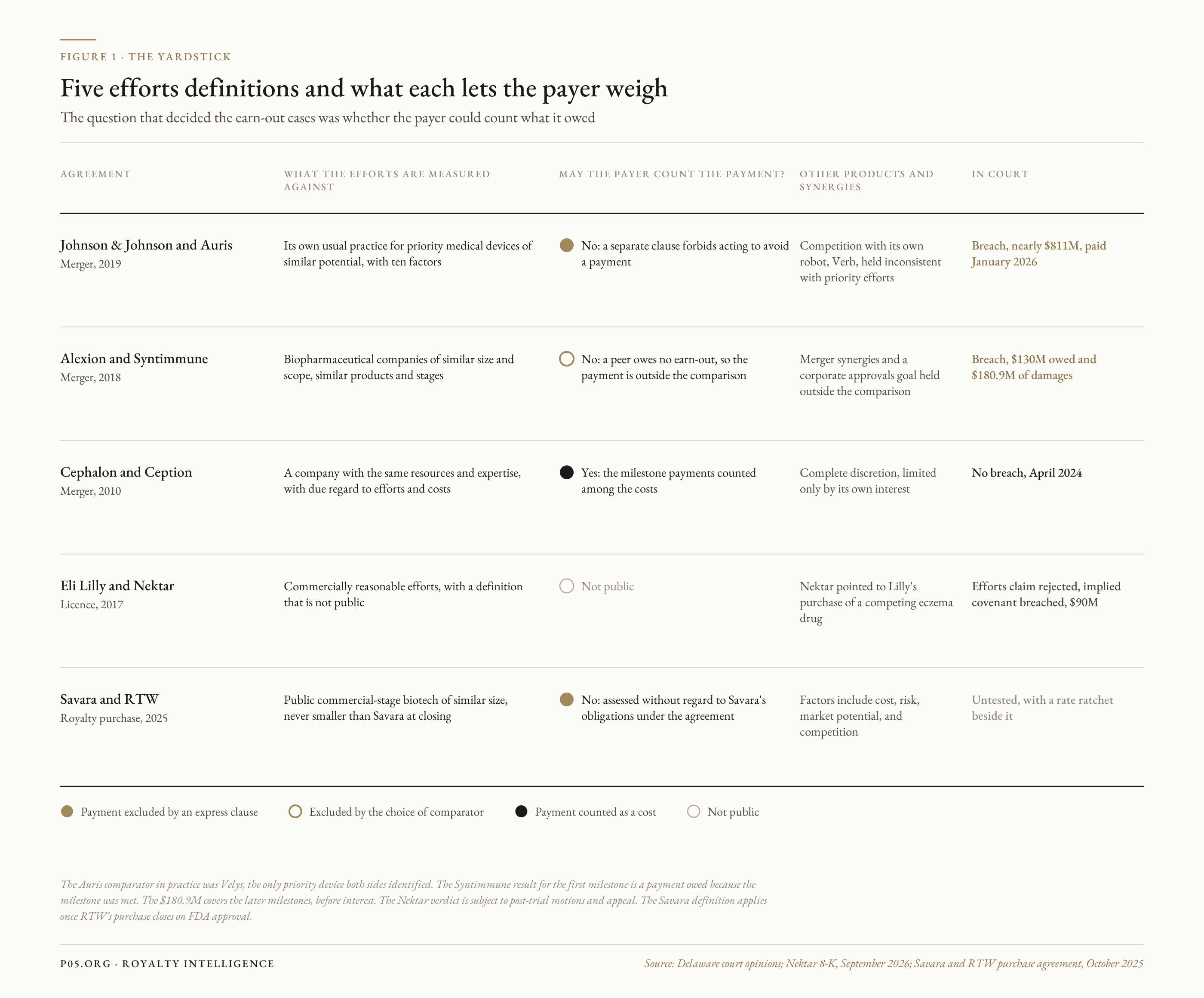
Five efforts definitions from merger agreements, a licence, and a royalty purchase, set against the benchmark each names, whether the payer may count the payment, and how each has fared in court.
The licence cases
The first licence dispute of the period to reach a jury was decided in San Francisco on 24 September. Eli Lilly took a licence to rezpegaldesleukin, a regulatory T-cell stimulator, from Nektar in July 2017 for $150M up front and up to $250M in milestones. In 2020 Lilly bought Dermira for about $1.1B, and with it lebrikizumab, an eczema antibody now sold as Ebglyss.
Nektar's complaint said that Lilly's interest in rezpeg waned after the purchase and that Lilly miscalculated eczema data it presented in 2022. Rezpeg failed a lupus trial in February 2023. Lilly says Nektar demanded the drug back in March and that it gave up its rights in April without payment.
The jury found that Lilly had breached the implied covenant of good faith and fair dealing, and awarded $90M plus interest. It rejected the claim that Lilly had failed to use commercially reasonable efforts. Nektar had asked for $1B.
The award is 9 per cent of that, and remains open to post-trial motions and appeal. Nektar has since taken rezpeg into pivotal trials in atopic dermatitis and plans to file for approval in 2029.
The verdict separates the two claims Nektar pleaded together. On the written clause the jury sided with Lilly. On the duty of good faith that the law implies into the contract, it sided with Nektar.
Under Delaware law, as the Supreme Court restated it in Auris, that implied duty fills only gaps the parties left open, and the court reversed the finding on the first iPlatform milestone that rested on it.
A licensor can also ask for the product back. In July Ventis Pharma sued Balanced Pharma in the Court of Chancery over Enduracaine, a dental anaesthetic it had licensed exclusively in October 2024. According to a summary of the complaint, Balanced built no dental delivery system or adequate sales network and missed milestones and reports.
Ventis says its default notices went uncured and the licence ended under its own terms. Ventis asks for a declaration to that effect and the return of the intellectual property. It also seeks an order that stops Balanced from claiming exclusivity.
For a licensor that wants to relicense, the asset may be worth more than damages. For an investor that has bought the licensor's royalty, reversion ends the payments it bought unless its documents reach the royalties of a later licensee.
Walking away
The holder's weakest position is a licensee that leaves on terms the licence allows. Biogen licensed aducanumab from Neurimmune in 2007. In October 2017 it paid $150M to cut the royalty rates by 15 per cent.
In May 2018 it paid $50M more for a further reduction, which left the rates between the high single digits and the low teens. The drug, sold as Aduhelm, won accelerated approval in June 2021.
On 31 January 2024 Biogen stopped developing and selling it. It ended the confirmatory study and terminated the licence, and the rights reverted to Neurimmune. Biogen had looked for partners or outside financing for the drug and found none.
It took a $60M charge to close the programme and moved the resources to Leqembi, the Alzheimer's antibody it sells with Eisai.
The royalty ended with the licence. Neurimmune received the antibody back, together with an approval whose confirmatory study Biogen had stopped. Where an efforts covenant runs for the term of the licence, a licensee that ends the term as the contract permits leaves the covenant behind with the product.
Who can sue
A royalty fund that buys a licensor's stream is not a party to the licence, and the efforts promise runs to the licensor.
What the buyer can enforce depends on what the purchase agreement makes the seller do. In a synthetic royalty the seller is itself the party that must make the efforts, and the covenant runs straight to the buyer.
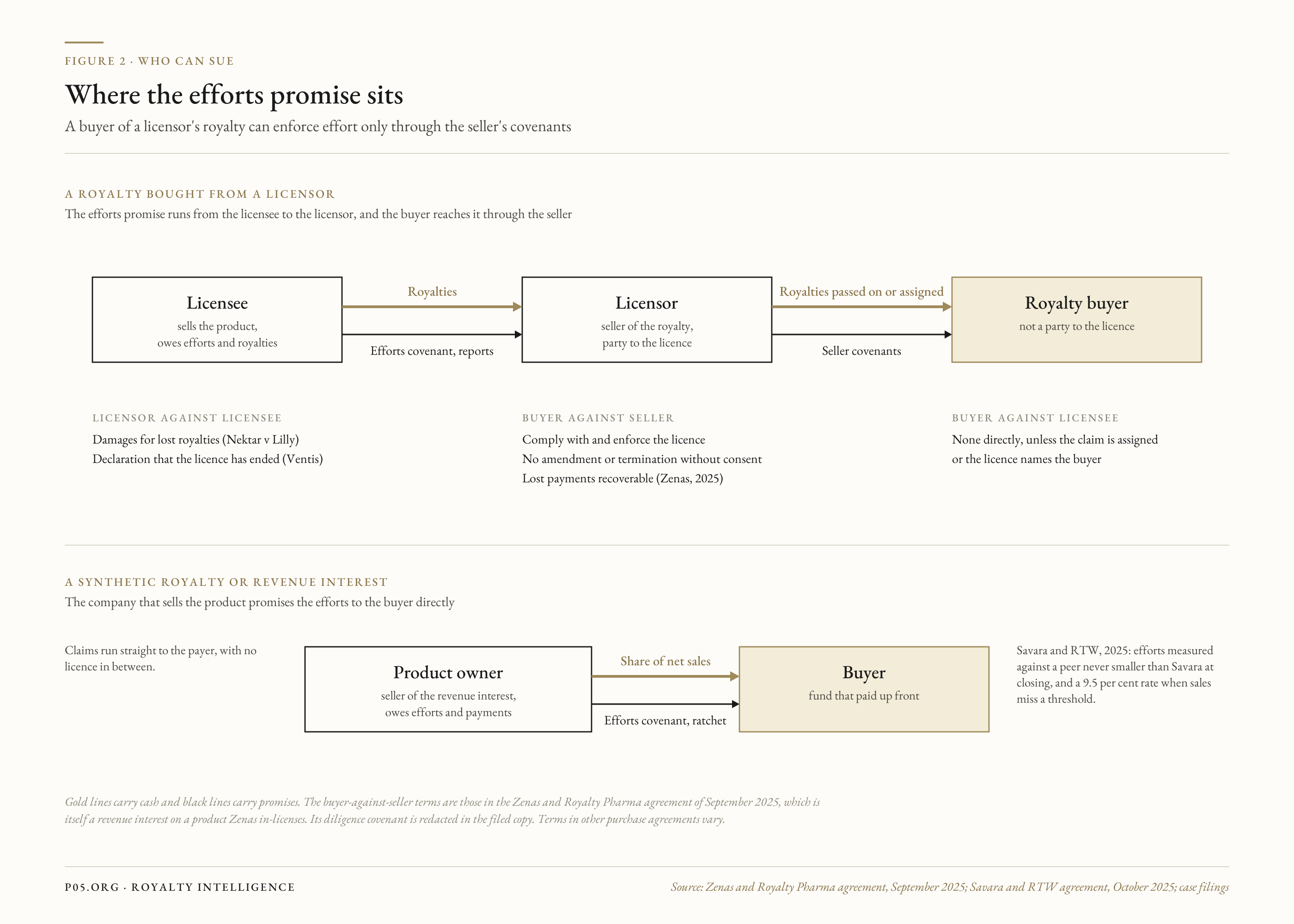
Where the efforts promise sits in a licence royalty and in a synthetic royalty, and the claims each holder can bring.
The revenue participation agreement that Zenas BioPharma signed with Royalty Pharma on 2 September 2025, on the antibody obexelimab, shows the parts. Zenas must comply with each in-licence and use commercially reasonable efforts to cure its own breaches.
It must tell the buyer when a licensor breaches, and it may not change or end its Xencor in-licence without the buyer's consent. The indemnity excludes consequential damages and then lists lost revenue payments as recoverable losses. It is the buyer's exclusive remedy, apart from specific performance and fraud.
The diligence covenant itself, in section 7.1, is blacked out in the filed copy.
The Celgene contingent value rights show how long a fight over standing can last. Each right paid $9 if three drugs won FDA approval by set dates. Breyanzi was approved on 5 February 2021, five weeks after its deadline, and Bristol Myers Squibb owed nothing on a potential $6.4B obligation.
UMB Bank, appointed trustee by holders of the rights, sued in June 2021 for failure to use diligent efforts.
In September 2024 Judge Furman dismissed the suit because the Depository Trust Company, the registered holder of more than 99 per cent of the rights, had not approved UMB's appointment. On 13 August 2026 the Second Circuit reversed. Bristol Myers Squibb, the former trustee, and a majority of beneficial owners had approved the change, and the court held that the conduct of the company and the former trustee barred the challenge.
Almost six years after the deadline, the efforts claim is still untried. A royalty buyer whose purchase agreement leaves the right to sue with the seller must settle who may bring the claim before any court reaches the merits.
Written around the argument
The newer contracts price the risk in advance. On 29 October 2025 Savara agreed to sell a royalty on Molbreevi, an inhaled treatment for autoimmune pulmonary alveolar proteinosis, to funds managed by RTW Investments. RTW pays $75M if the FDA approves the drug by 31 March 2027, and payments stop at $187.5M.
The purchase agreement measures Savara's efforts against a commercial-stage public biotechnology company of similar size and resources. That size may never be taken as smaller than Savara's at closing.
The factors include cost, risk, market potential, and competition, assessed without regard to what Savara owes under the agreement. The last phrase settles the Cephalon question for the buyer.
The rate carries a second protection. Royalties run at 7.0 per cent of net sales up to a redacted level and fall to 1.0 per cent at the top. In any year that net sales miss a set threshold, the first-tier rate rises to 9.5 per cent, and it returns to 7.0 per cent after a year back above it.
If approval comes after 30 September 2026, the test for 2027 falls away. The FDA's target date is 22 November 2026.
The ratchet pays on a figure in a royalty report. A buyer that collects it need not show what a comparable company would have done, or wait for a court to say so. The higher rate also applies when sales fall short for reasons unrelated to effort.
What a buyer models
The cases supply the inputs for a model. Take a royalty of 8 per cent on a marketed product whose sales rise from $300M to $500M and end after ten years, valued at a discount rate of 11 per cent. If the licensee keeps trying, the stream is worth $200.2M.
Suppose instead the licensee loses interest at the start of the third year and sales fall by 30 per cent a year. The royalties are then worth $83.9M, 42 per cent of the first figure. The holder sues. Assume an even chance of winning, a court that accepts 70 per cent of the lost royalties, judgment five years after the first lost year, and interest at 7.5 per cent until then.
The expected award is $89.8M in the eighth year, worth $38.9M today, and the total rises to $122.9M, or 61 per cent. If the licensee had terminated on notice at the end of the third year, the stream would be worth $69.0M, 34 per cent, with no claim behind it.
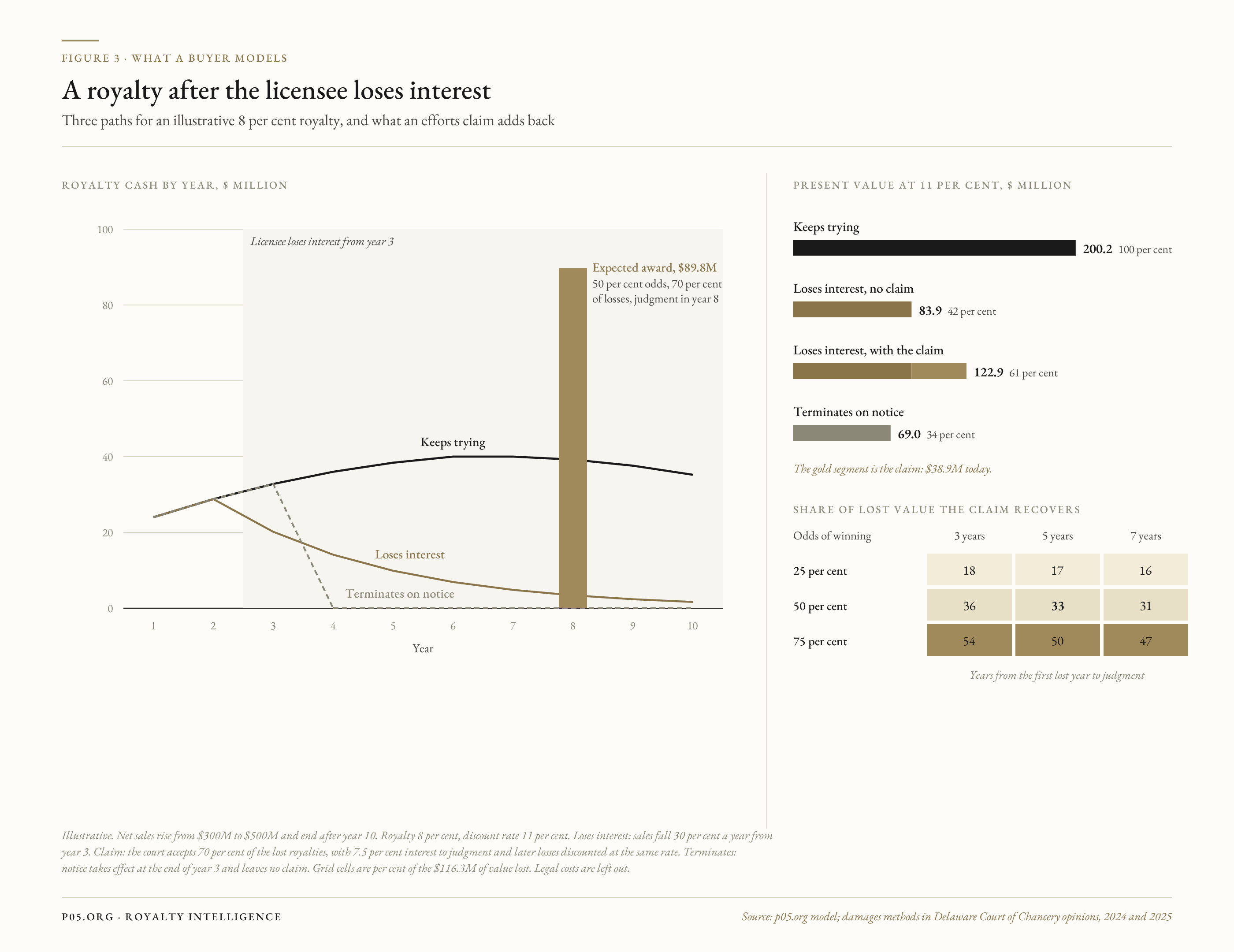
An illustrative royalty under three paths after the licensee loses interest, with the expected value of an efforts claim and the share of lost value it recovers at different odds and delays.
On these assumptions the odds matter more than the wait. At a 25 per cent chance of winning, the claim recovers 16 to 18 per cent of the lost value, depending on whether judgment comes after three years or seven.
At 75 per cent it recovers 47 to 54 per cent. Interest at 7.5 per cent runs while the buyer discounts at 11 per cent, so each two years of delay costs two to three points. A full win on all the lost royalties after five years returns 96 per cent.
The court's own discount rate points the same way. In the Syntimmune damages opinion the development milestones were discounted at 3.58 per cent. A buyer that values the same payments at a double-digit rate would put a lower present value on them than the court did.
For a marketed product, the court's question becomes what sales would have been. The Auris court took its probabilities from the parties' estimates at signing, and the Syntimmune court took them from the payer's own forecasts. A licensor's evidence of lost sales is likely to be the licensee's plans for the product from before it lost interest, which the holder sees only in discovery.
| Dispute | Instrument and year | Yardstick | Filed | Result | At stake | Awarded | Status at 4 November 2026 | Source |
|---|---|---|---|---|---|---|---|---|
| Himawan v Cephalon | merger, 2010 | a company with the same resources, with regard to costs | 2018 | no breach, 30 April 2024 | $200M | nothing | decided | Gibson Dunn |
| Fortis v Johnson & Johnson (Auris) | merger, 2019 | own priority devices | October 2020 | breach, 4 September 2024, affirmed in part 12 January 2026 | up to $2.35B | nearly $811M, with fraud damages and interest | paid January 2026 | Delaware Supreme Court |
| Shareholder Representative Services v Alexion (Syntimmune) | merger, 2018 | peers of similar size and scope | 2020 | breach, 5 September 2024 | up to $800M | $130M owed and $180.9M of damages, before interest | final order pending | Court of Chancery |
| UMB Bank v Bristol Myers Squibb | contingent value rights, 2019 | diligent efforts | June 2021 | dismissed September 2024, revived 13 August 2026 | $6.4B | nothing yet | pending | Second Circuit |
| Nektar v Eli Lilly | licence, 2017 | commercially reasonable efforts, definition not public | August 2023 | efforts claim rejected, implied covenant breached, 24 September 2026 | $1B sought | $90M plus interest | post-trial | Nektar 8-K |
| Ventis v Balanced Pharma | licence, 2024 | commercially reasonable efforts | July 2026 | pending | return of the licence | no damages figure reported | pending | Law360 |
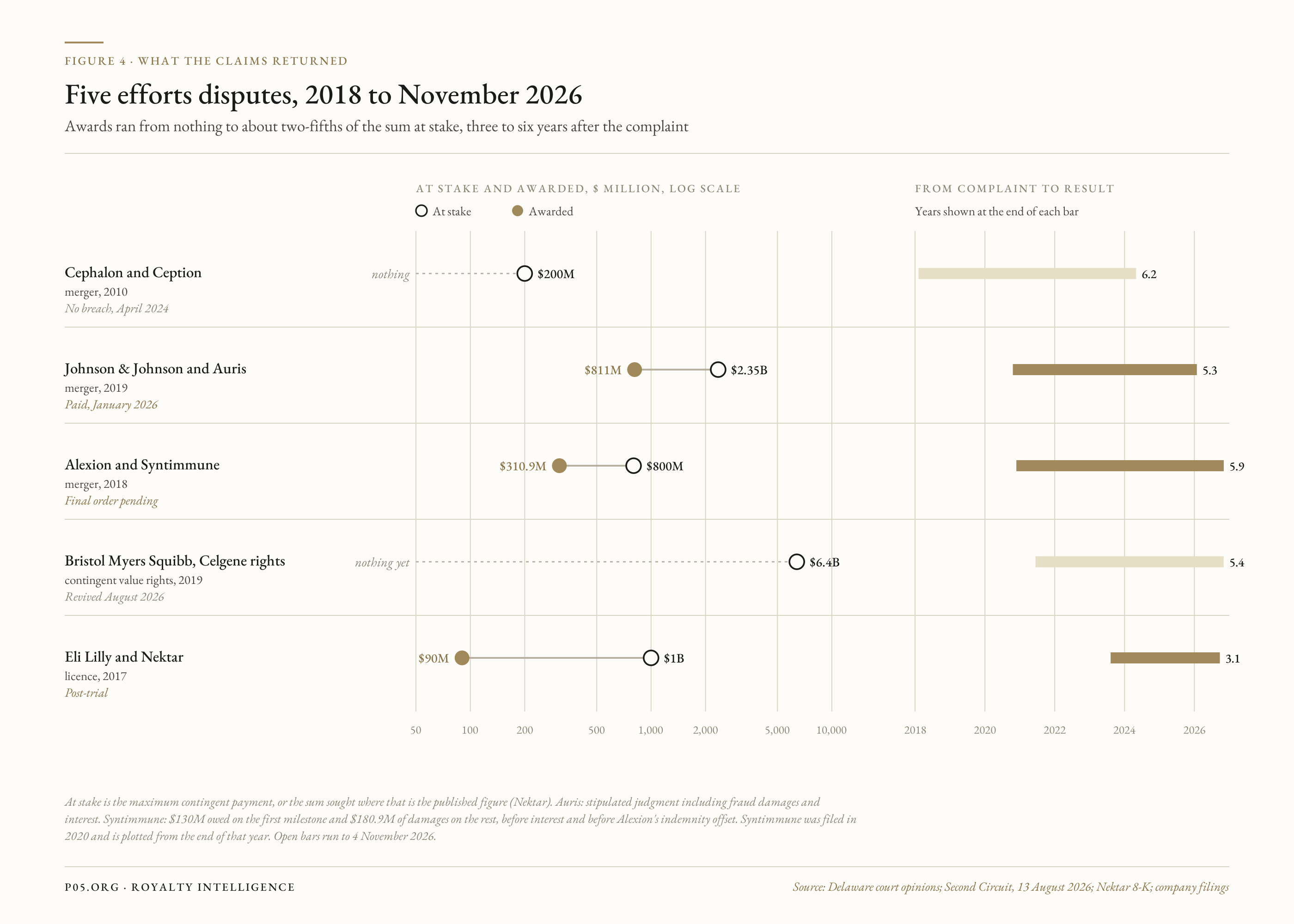
Five efforts disputes, the sum at stake against the sum awarded, and the years from complaint to judgment or to November 2026.
Implications for the Pharmaceutical Royalty Market
The definition is the first line of the model. A royalty holder whose licence measures the licensee against peers, or against its own priority products, holds the kind of claim that Delaware courts enforced for $811M at Auris and for $310.9M before interest at Syntimmune.
A holder whose licence measures the licensee against its own interest, with regard to cost, holds a covenant that on the Cephalon reading the licensee breaches only by acting against itself.
The payment question follows. The royalty is one of the costs a licensee bears by continuing to sell a product. The Syntimmune and Auris texts kept that cost out of the comparison, by the choice of comparator in one and by an anti-avoidance clause in the other. The Savara text says so in terms.
Where a licence is silent on the point, a buyer reading it should expect the licensee to argue for the Cephalon reading.
Termination rights cap the analysis. A licence that lets the licensee walk away on notice turns a decision to stop into the exercise of a right, as at Aduhelm. A buyer pricing such a licence models the termination path at full weight, since the efforts clause yields no award on it.
What remains is the asset, which returns to the licensor and may or may not be licensed again. The purchase agreement decides whether the buyer's royalty reaches a new licensee's payments.
Enforcement also needs a plaintiff. Where the licensor keeps the right to sue, the buyer depends on a seller that may lack the money or the will to litigate for half a decade, and that may prefer to take the product back.
The Zenas agreement shows a buyer protecting itself against changes to the underlying licence and naming lost payments as recoverable. The Celgene rights show how much time can pass before anyone reaches the merits when a contract leaves the right to sue open to dispute.
The ratchet in the Savara royalty shows effort risk priced at signing. A higher rate on low sales compensates the buyer for weak sales without a finding on why they were weak. It also puts on the seller the risk of a poor market, which no efforts clause would cover.
Whether other funds adopt the structure on approved products will be visible in the purchase agreements filed with annual reports for 2026.
Conclusion
Johnson & Johnson's payment in January settled a dispute over a promise made in 2019 and a robot it effectively shelved. Counting fraud damages and interest, the holders received about a third of the earn-out's maximum, five years after they sued. A court had found that iPlatform did not receive the efforts due to a priority device, and priced the shortfall at the odds of 2019.
RTW's agreement with Savara takes a shorter route. If the FDA approves Molbreevi by its target date of 22 November, the first ratchet test will fall on sales for 2028, and the rate will move on the figure in the royalty report.
All information in this report was accurate as of the research date and is derived from publicly available sources including court opinions, regulatory guidance, academic literature, SEC filings, and financial news reporting. Information may have changed since publication. This content is for informational purposes only and does not constitute investment, legal, or financial advice. The author is not a lawyer or financial adviser.