The unbranded royalty: buying an earn-out on a marketed product

On 14 October Labcorp agreed to buy the clinical testing businesses of BioReference Health, a subsidiary of OPKO Health, for $722M in cash at closing. The asset purchase agreement sets a second price. For up to ten years after closing, Labcorp will pay OPKO 15 per cent of the cash it collects on the 4Kscore prostate cancer test, net of discounts and rebates, above a yearly threshold that the filed copy blacks out. The payments stop at $150M.
Read clause by clause, the promise has the parts of a capped royalty: a rate, a base, a threshold, a cap, and a term. The agreement calls it a 4Kscore Payment and nowhere describes it as a royalty. Section 11.4 of the same document bars OPKO from transferring any of its rights without Labcorp's prior written approval, and makes void any transfer attempted without it.
The earn-outs signed and litigated in 2025 and 2026 suggest that a sales-based earn-out on a marketed product can be underwritten as a capped royalty owed by the acquirer. Whether an outside investor can buy one depends on four clauses at the back of the purchase agreement, covering assignment, set-off, efforts, and reporting. How the examples have paid in practice shows where the value sits.
Fifteen per cent above a threshold
The formula applies to each 12-month period on its own. At 15 per cent, OPKO collects $15M in a year only if net receipts clear the threshold by $100M. To reach the $150M cap within the ten-year term, the excess would have to average $100M a year. A year below the threshold pays nothing.
The test is smaller than the cap. OPKO's annual report for 2025 says 4Kscore revenue rose by about 13 per cent, or $3.2M, which puts it near $28M for the year. At that level, and with a threshold of zero, the payment would be about $4.2M a year and $42M over ten years. The cap would bind only if collections grew to several times their 2025 level. Labcorp's own projection of about $250M of revenue in the first year covers all the businesses it is buying, and gives no figure for the test.
For a buyer of the stream, then, the $150M is a ceiling on a growth case. The price would turn on the threshold, which is redacted, and on how far Labcorp's sales force can lift a test that BioReference sold on its own.
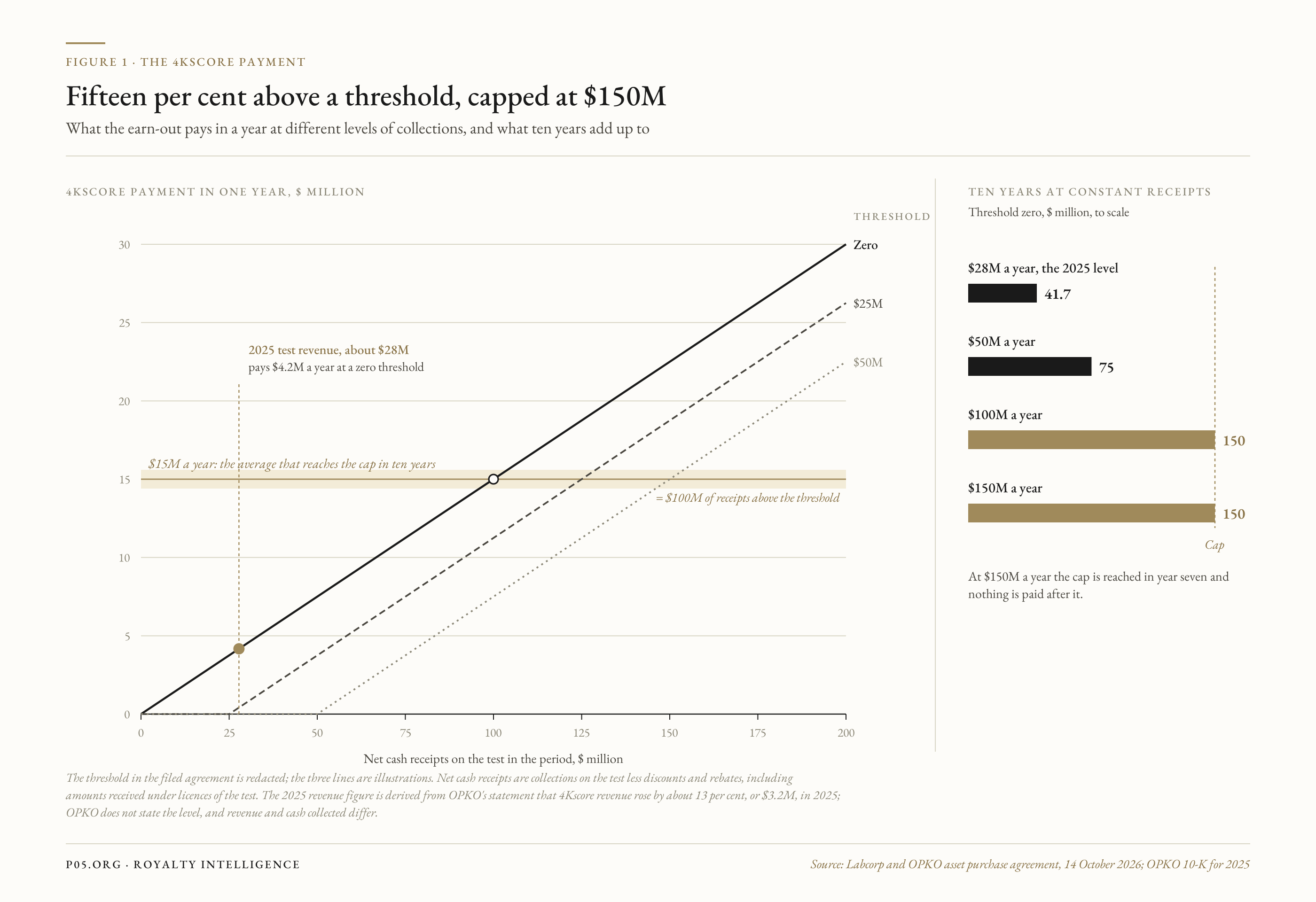
The 4Kscore Payment in one year against net cash receipts, at 15 per cent, for three illustrative thresholds, since the real one is redacted. The shaded line marks the $15M a year needed on average to reach the cap in ten years, and the marker the test's revenue in 2025 as derived from OPKO's annual report.
Labcorp keeps control of the product. The agreement preserves its freedom to run the business "as Buyer sees fit in its sole discretion", including any decision to modify or discontinue the test. Two promises sit against that. While it offers 4Kscore, Labcorp must list it in its test directory and treat it as a "focus test", which means tracking it against performance indicators and paying its clinical specialty sales representatives on its sales.
If Labcorp stops offering the test, OPKO may ask for the test assets back at book value, with a price for the intellectual property to be agreed.
From collection to payment
The 4Kscore Payment is computed on cash. Cash receipts are amounts Labcorp collects on the test during the period, so a claim billed in one year and paid by an insurer in the next falls into the later one. Receivables for tests run before closing stay with OPKO as excluded assets, and the first period starts with none.
The base reaches past Labcorp's own sales. It includes amounts Labcorp receives under any licensing, royalty, or similar arrangement for the test, so a sublicence of 4Kscore would feed the stream. OPKO represents that, apart from what its disclosure schedules list, it neither pays nor receives a royalty on the test.
Each 4Kscore Period runs for 12 months from the first day of the month after closing. Within 60 days of its end, Labcorp must deliver a statement showing net cash receipts and the payment due. OPKO then has 60 days to check it, with access to the books and to the staff who prepared it.
If OPKO raises no objection, the figure is final when the 60 days run out, and Labcorp must pay within ten business days. An undisputed late payment carries interest at 8 per cent a year.
A dispute adds a 30-day negotiation and then an accounting firm, which sits as an expert and has 60 days to decide. Its remit is confined to whether the arithmetic follows the contract. A quarrel about how Labcorp has run the business goes to the Court of Chancery instead.
The cash therefore arrives about four and a half months after a period closes when nobody objects, and three months later still when someone does. Between payments, Labcorp owes a quarterly statement of the number of tests run and the reimbursement received for them, within 30 days of each quarter's end. A holder of the stream would see volume four times a year and cash once.
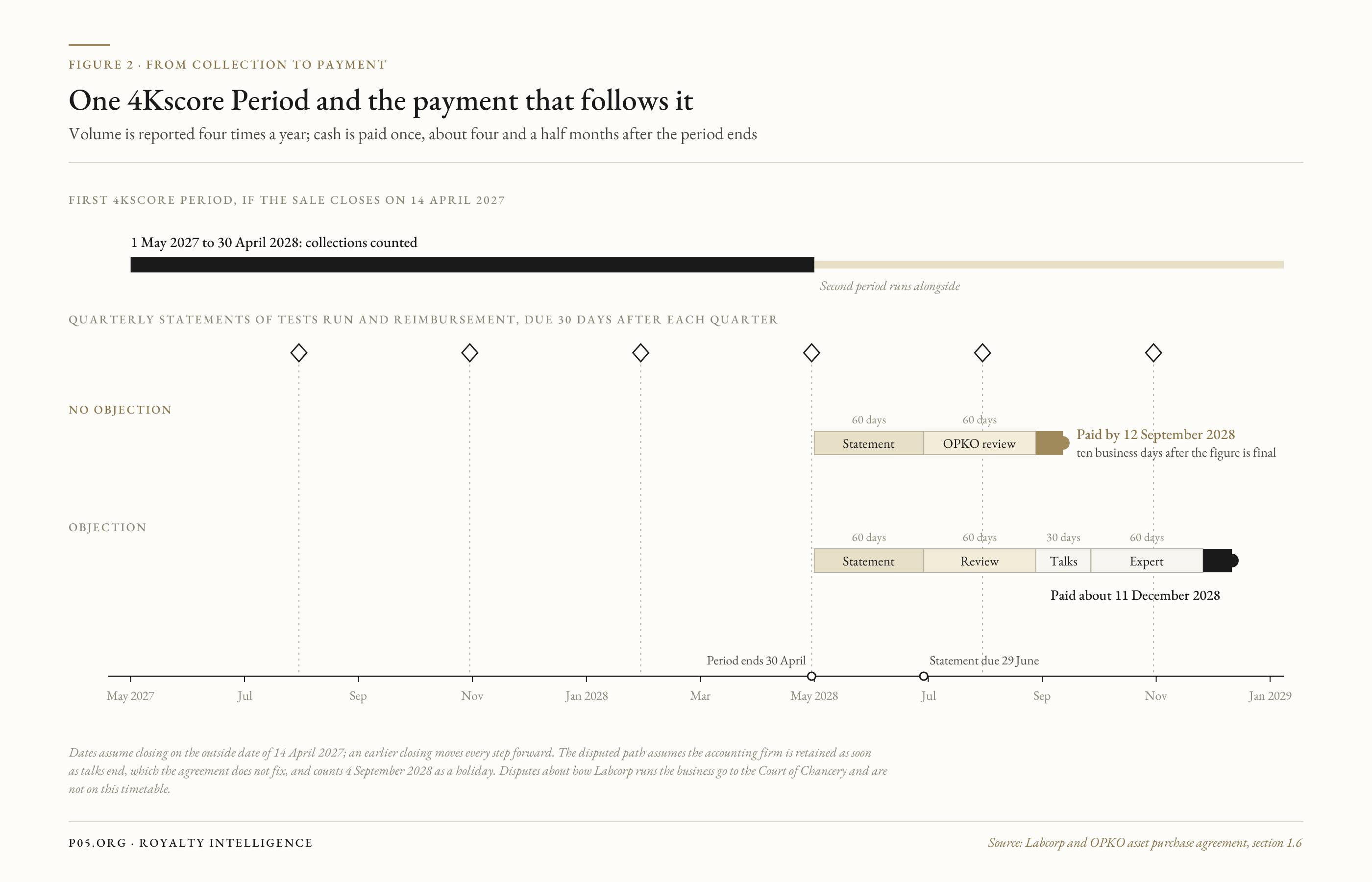
One 4Kscore Period and the steps that follow it, dated on the assumption that the sale closes on the outside date of 14 April 2027, with the undisputed and disputed paths to payment and the quarterly volume statements.
OPKO has been paid under a Labcorp earn-out before. In March 2025 it sold BioReference's oncology testing assets for $192.5M at closing and up to $32.5M later. That earn-out was set at 1.94 times the annualised revenue that a schedule of customer accounts generated for Labcorp over six months after closing, less the annualised revenue Labcorp had already earned from the same accounts in the six months before.
During those six months Labcorp promised not to act with the primary intent of avoiding the payment, or in bad faith.
The oncology sale closed on 15 September 2025, and the six months began on 1 October. In the second quarter of 2026 OPKO received $18.4M, 57 per cent of the maximum, and it expects nothing further. Divided by the multiple, the payment implies about $9.5M of annualised net revenue from the scheduled accounts. The cash came about nine months after closing, in a single payment.
The same sales under another label
In August Harrow agreed to buy Tyrvaya, a nasal spray for dry eye disease, from Viatris. It would pay $30M in cash at closing and up to $70M more if annual net sales passed set thresholds. An amendment of 1 October left Japan with Viatris and fixed the cash at $30.0M. It set the measurement periods for the contingent payments at 12 months, the last of them ending on or before 31 December 2029.
The deal closed on 5 October. Viatris kept the right to sell Tyrvaya in Japan and agreed to pay Harrow royalties on Japanese net sales.
One product now carries two sales-linked streams. The payment from Harrow to Viatris on sales outside Japan is called a contingent milestone payment. The payment from Viatris to Harrow on sales in Japan is called a royalty. Seventy per cent of the headline price of $100M is contingent.
Harrow intends to file the purchase agreement with its quarterly report for the period to 30 September 2026, and until then the thresholds and the transfer and set-off terms are unpublished.
The price sits against what Viatris paid. Its annual report for 2025 records the purchase of Oyster Point, which brought Tyrvaya, for about $427.4M in cash in the first quarter of 2023, and $41.7M of Oyster Point revenue from then to the end of that year.
The same report says a first generic filer has a licence to launch in October 2034, or earlier in some circumstances. A suit against a second filer, brought in January 2026 on patents expiring in October 2035, stays approval of its product until June 2028 unless a court rules against the patents first. The contingent payments run out at the end of 2029, inside that protection.
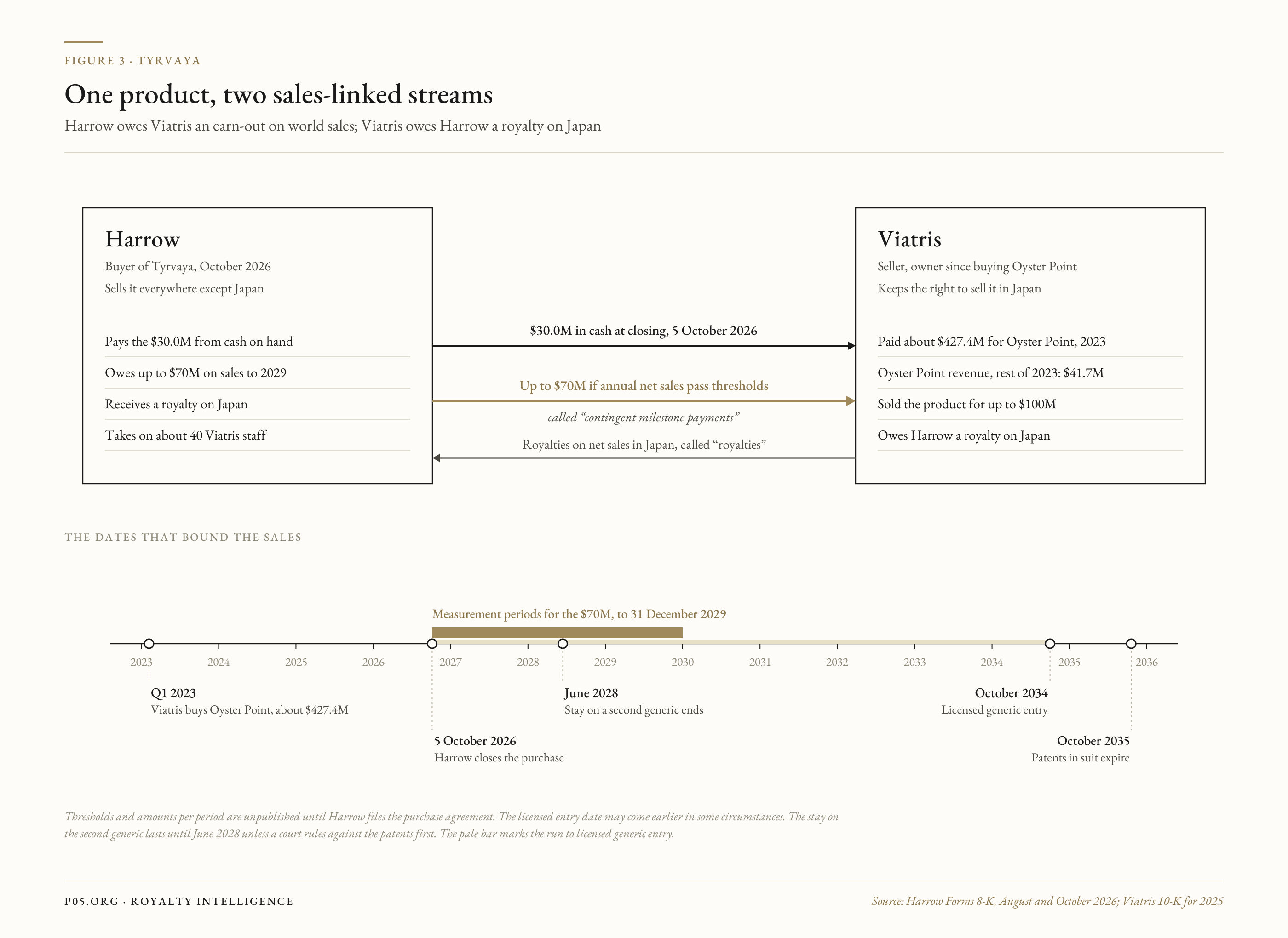
Tyrvaya after the sale: the payments between Harrow and Viatris and what each is called, set against the dates that bound the product's sales.
On 11 October STERIS agreed to buy Xodus Medical, a private maker of surgical patient-positioning products near Pittsburgh, from the Kaforey family and their trusts, for $2.1B at closing. Its release adds up to $150M on "specified post-closing performance targets in calendar 2028". It expects Xodus to earn about $245M of revenue and $135M of adjusted operating income in 2026.
The release does not say whether the targets are graduated. If they are not, the earn-out pays in full or not at all on the results of one year, two years after STERIS has folded the business into its own. A buyer would price it as a milestone, on the probability of that outcome, and would be betting on decisions STERIS takes in 2027.
| Acquisition | Signed | Paid at closing | Contingent, maximum | Contingent share of headline price | What the contingent part measures | Status at 18 October 2026 | Source |
|---|---|---|---|---|---|---|---|
| Alexion and Syntimmune | 2018 | $400M | $800M | 66.7 per cent | development milestones | $130M owed on the first milestone, more than $180.9M awarded on the rest, final order pending | Court of Chancery, 3 Aug 2026 |
| Johnson & Johnson and Auris Health | 2019 | $3.4B | $2.35B | 40.9 per cent | regulatory milestones | stipulated judgment of nearly $811M, Jan 2026 | Delaware Supreme Court, 12 Jan 2026 |
| Labcorp and BioReference, oncology | Mar 2025 | $192.5M | $32.5M | 14.4 per cent | six months of revenue from named customers | $18.4M paid in the second quarter of 2026 | OPKO 10-Q |
| Harrow and Viatris, Tyrvaya | Aug 2026 | $30.0M | $70M | 70.0 per cent | annual net sales thresholds to 2029 | closed 5 Oct 2026 | Harrow 8-K |
| STERIS and Xodus Medical | Oct 2026 | $2.1B | $150M | 6.7 per cent | performance targets in 2028 | closing expected by 31 Dec 2026 | STERIS 8-K |
| Labcorp and BioReference, 4Kscore | Oct 2026 | $722M | $150M | 17.2 per cent | 15 per cent of net cash receipts above a threshold, up to ten years | awaiting antitrust clearance, outside date 14 Apr 2027 | OPKO 8-K |
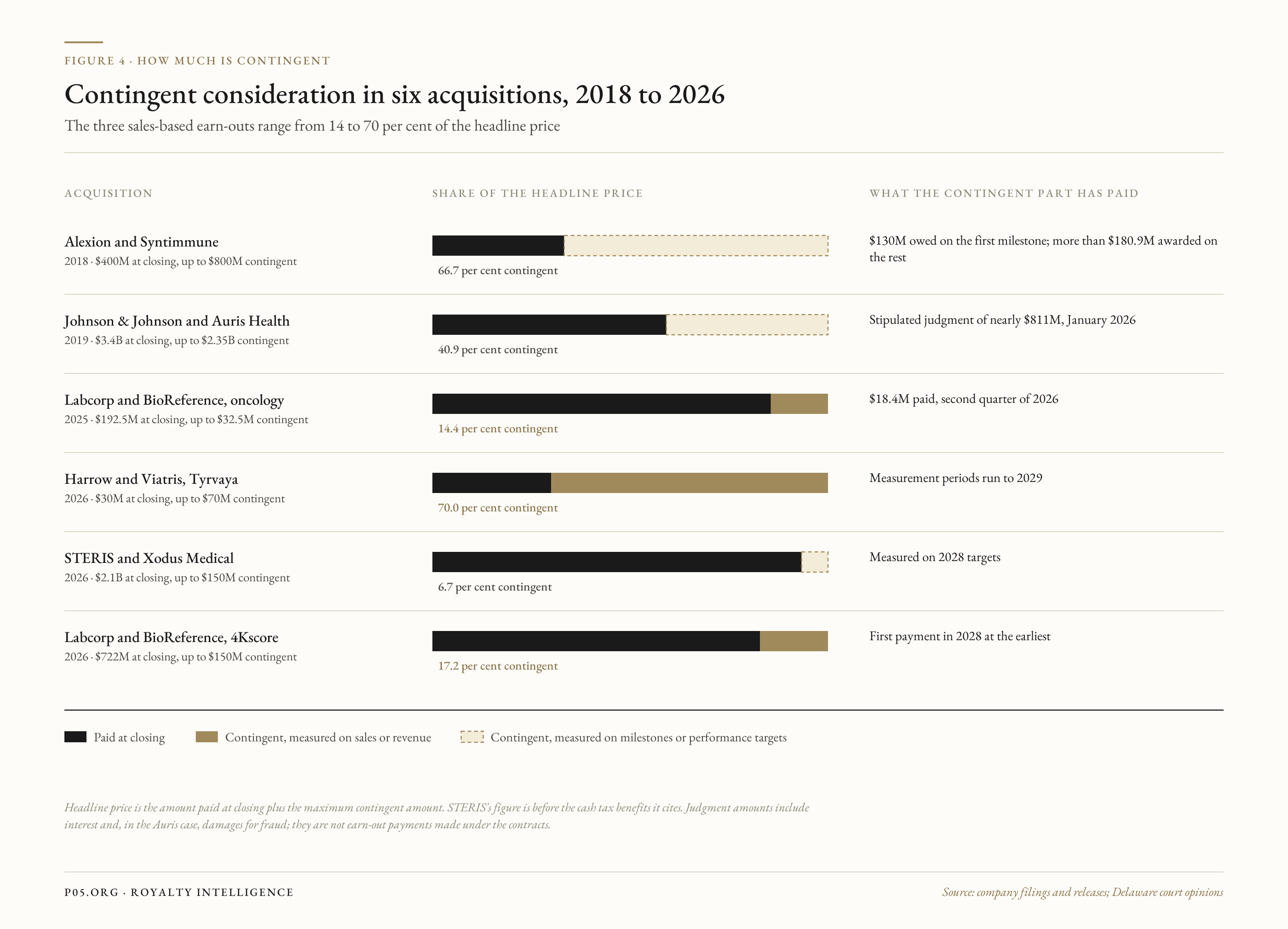
Contingent consideration as a share of the headline price in the six acquisitions in the table, split by what the contingent part measures, with what has been paid so far.
Bought before
Royalty buyers have bought claims of this kind, from small sellers and on small payers, and their accounts show how the streams have paid. On 29 March 2023 XOMA paid Aptevo Therapeutics $9.6M for all of the deferred payments based on net sales of IXINITY, a haemophilia B treatment, and for parts of two sets of milestones. Aptevo had earned those payments when it sold IXINITY to Medexus Pharma in February 2020, so the stream XOMA bought was a sales-based earn-out from a product divestiture.
XOMA's annual report for 2025 describes it as a mid-single-digit percentage of all IXINITY sales from 1 January 2023 to the first quarter of 2035. XOMA received $1.7M in 2023, $1.6M in 2024, and $1.7M in 2025. Over three years that is $5.0M, about 52 per cent of the $9.65M it paid, including a $50,000 bonus to Aptevo when the first payment passed $0.5M. On 2020 sales, the first year after the divestiture, Medexus paid Aptevo about $0.6M.
Three months after the Aptevo deal, XOMA took an assignment of LadRx's whole position under a 2011 asset purchase agreement, by which LadRx, then called CytRx, had sold arimoclomol to Orphazyme. Orphazyme had passed the agreement to Zevra in June 2022. The position carried milestones of $52.6M, net of LadRx's own obligations, and a royalty.
Across that assignment and a second agreement signed the same day, XOMA paid LadRx $5M up front and $2.0M more on milestones, the last in November 2024. The drug was approved as MIPLYFFA in September 2024. XOMA earned a net milestone of $2.2M on the approval and received $2.9M in 2025, so by the end of 2025 it had taken in about 73 per cent of the $7.0M it paid. In the second agreement, a purchase of LadRx's aldoxorubicin royalty, the parties also agreed to share the right to sue for the payments.
A third purchase shows the risk on the other side. In January 2024 XOMA paid Talphera $8.0M for an economic interest in DSUVIA, a sublingual painkiller that Talphera had sold to Alora Pharmaceuticals in April 2023 for an upfront payment and royalties of 15 per cent on commercial sales and 75 per cent on sales to the Department of Defense, according to XOMA's annual report for 2023.
XOMA wrote off the $7.9M left on its books in 2024. Alora withdrew DSUVIA from the market in the first quarter of 2025 because of manufacturing constraints, and XOMA received $0.1M in 2024 and $28,000 in 2025.
The three streams share a structure. Each was consideration for a product sale, payable by the buyer of the product and bought from the seller. The IXINITY and MIPLYFFA streams are still paying, and the DSUVIA stream ended when the buyer of the product stopped selling it.
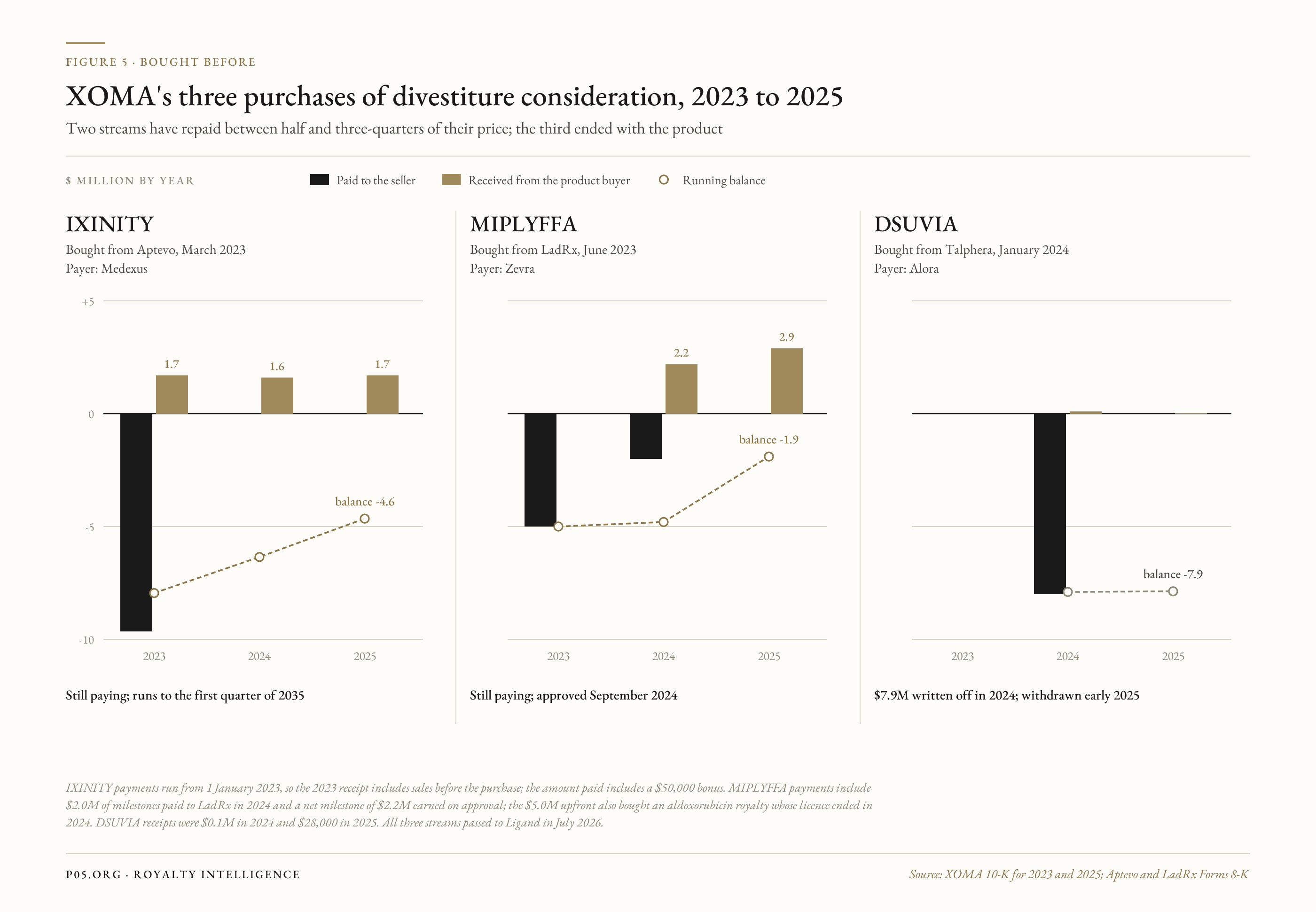
XOMA's three purchases of divestiture consideration, 2023 to 2025: cash paid to the sellers, cash received from the product buyers, and the running balance.
All three streams now belong to Ligand, which completed its purchase of XOMA Royalty on 14 July 2026 for $39.00 a share in cash. In each, the payer was a small commercial company: Medexus, Zevra, or Alora.
In 2026 the obligors are the acquirers themselves. Labcorp has agreed to pay $722M with no financing condition. STERIS is paying $2.1B primarily with debt, backed by a bridge commitment of up to $2.0B from JPMorgan Chase and Goldman Sachs.
The 4Kscore promise is made by Laboratory Corporation of America Holdings, the operating company. The agreement contains a guarantee in one direction only, from OPKO for the obligations of its own subsidiary. It names Labcorp Holdings, the listed parent, only as the source of the accounting policies that govern the calculation.
Consent
Section 11.4 decides how OPKO could sell the stream. No party may assign or otherwise transfer the agreement or any of its rights without the prior written approval of the others. Labcorp may assign its rights to an affiliate without asking, and OPKO has no such carve-out.
The question of who must consent before a royalty changes hands was traced through licence agreements in a piece in September. An earn-out adds a statutory layer. Delaware law governs the Labcorp agreement, and the Uniform Commercial Code as enacted in Delaware limits clauses of this kind.
If the right to the 4Kscore Payments counts as a payment intangible under Article 9, section 9-408 makes the ban ineffective to stop a buyer's interest from attaching where that interest arises from a sale. The same section says such an interest is not enforceable against the party that owes the payment.
A sale made without Labcorp's approval would therefore bind OPKO and its creditors, while Labcorp went on paying OPKO and owed the buyer nothing. The buyer would hold a participation in substance. It would depend on OPKO to pass the cash through and would carry OPKO's credit next to Labcorp's. Labcorp's written approval would turn the purchase into a direct claim on the payer.
XOMA's LadRx deal took the first route. LadRx assigned its whole position under the 2011 agreement, which Orphazyme had already passed to Zevra, and XOMA stepped into the seller's place.
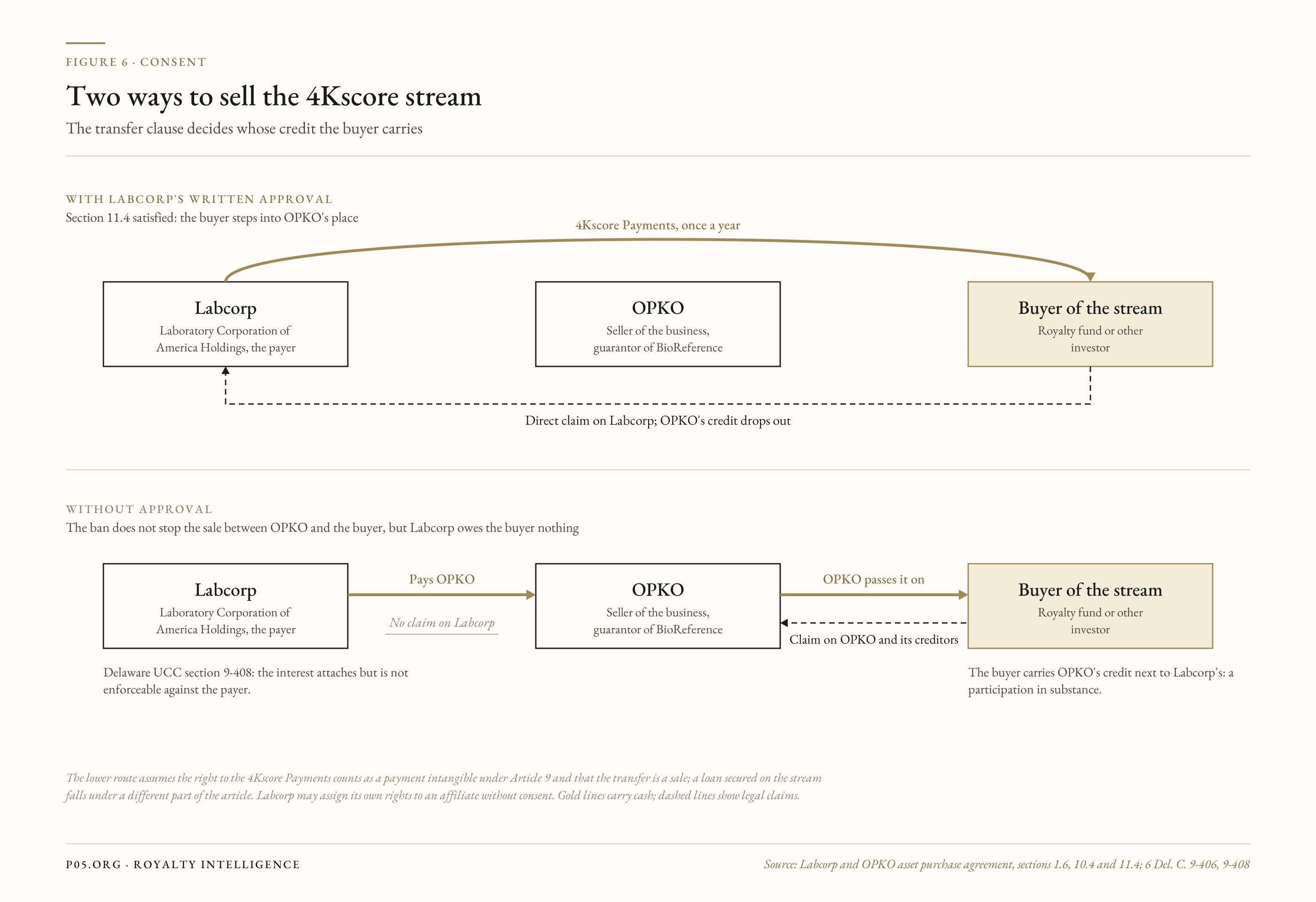
Two ways to sell the 4Kscore stream, and where the cash and the legal claim run in each.
A loan secured on the stream falls under a different part of the same article. Here, as across royalty finance, the line between a sale and a secured loan moves the risk between the parties.
The set-off that was never made
The Syntimmune case shows what set-off does to the money. Alexion bought Syntimmune in 2018 for $400M up front and up to $800M on the development of an antibody later called ALXN1830. In September 2024 the Court of Chancery found that Alexion had met the first milestone and owed $130M it had not paid.
Alexion counterclaimed. It said Syntimmune had sold it lots of drug substance and drug product that were not made to the promised standard. On 27 May 2026 the court agreed, and in July it fixed Alexion's indemnity at $11,996,157.33.
The parties then asked how to net the two claims. The letter opinion of 3 August turned on section 8.9 of the merger agreement. If Alexion held a good-faith indemnity claim larger than the escrow balance when an earn-out payment fell due, it could hold back that part of the payment in a reserve escrow, with written notice, within fifteen business days.
Alexion had estimated its claim at $8,392,892 by May 2020, and that sum stayed in escrow. When the first milestone payment fell due on 6 October 2022, Alexion did not use the holdback. It denied that the milestone had been reached and paid nothing.
Vice Chancellor Zurn applied two interest rules in turn. Shareholder Representative Services (SRS), acting for the former shareholders, receives interest on the full $130M from 6 October 2022 to 5 September 2024, the date of the first post-trial opinion. Alexion may then offset the part of its indemnity that exceeds the escrow as it stood on 6 September 2024, and interest runs on the balance from there.
About $8.3M of the $11.9M award comes out of escrow. The letter restates the Delaware rule that a possible, unliquidated liability cannot be set off against a liquidated claim that is due, unless the contract provides for it.
In money terms the escrow did the work. Of the $11.9M Alexion recovered, about 70 per cent was already held aside, and the remainder came off a judgment that had carried interest on the gross amount for almost two years.
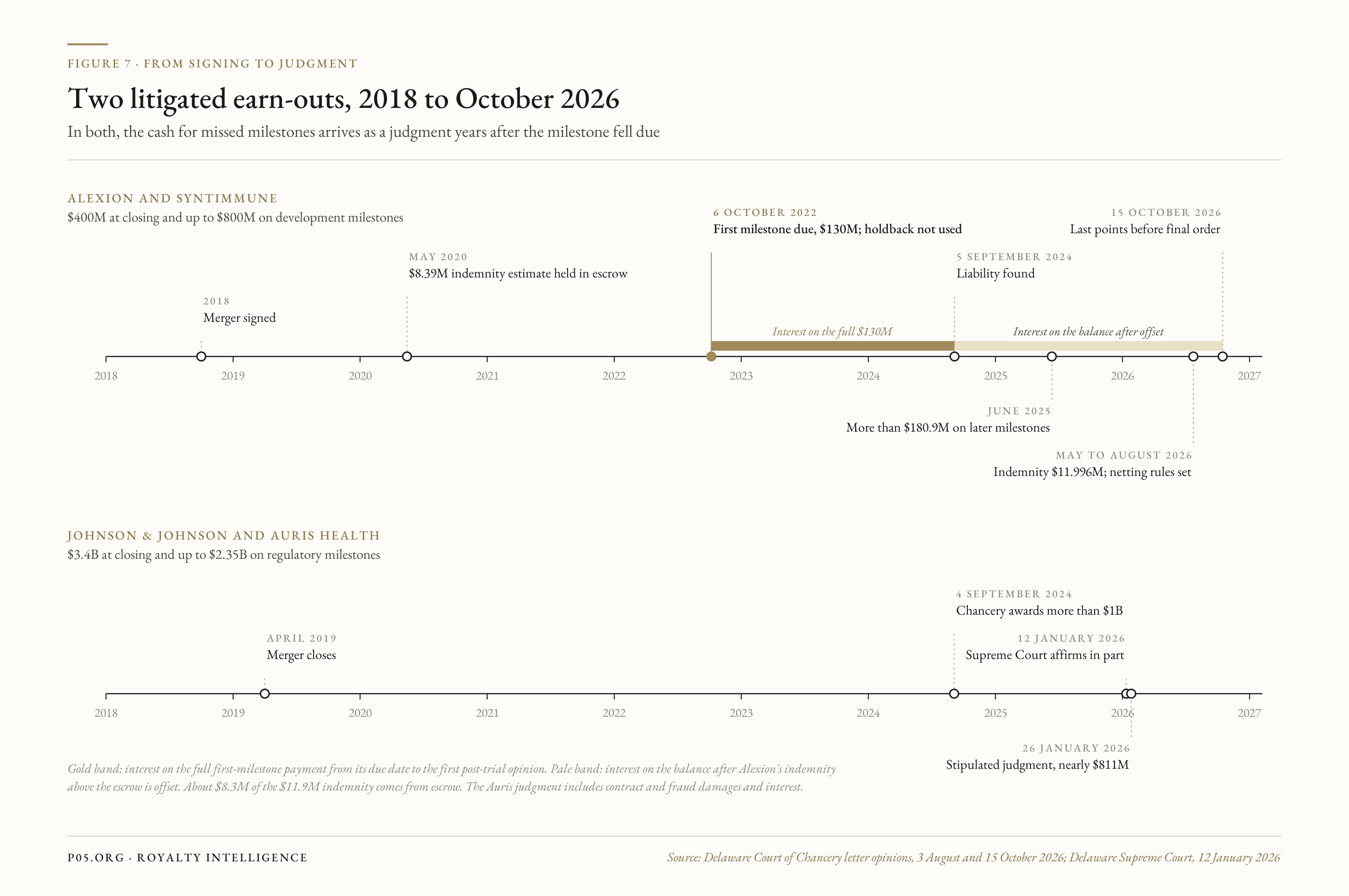
The Syntimmune and Auris earn-outs from signing to judgment, with the milestone due date, the indemnity estimate held in escrow, and the two interest periods in the Syntimmune case.
The Labcorp agreement routes indemnity elsewhere. Claims are paid first from an escrow of 10 per cent of the closing price, and then by BioReference and OPKO, jointly and severally. Ordinary warranty claims carry a deductible of 1 per cent and a cap of 10 per cent of the purchase price, and claims on fundamental warranties are capped at the price itself. The escrow is released after 12 months, less unresolved claims.
The filed text contains no clause that lets Labcorp reduce a 4Kscore Payment by an indemnity claim. On the reasoning of the August letter, Labcorp could not net an unliquidated claim against a 4Kscore Payment that had fallen due.
Efforts and discretion
The same dispute turned on the second risk, the acquirer's control of the asset. The 2018 agreement used an outward-facing efforts standard, measured against similar pharmaceutical companies.
The court held that Alexion fell short when it deprioritised and then ended the ALXN1830 programme for corporate reasons of its own. In June 2025 it awarded more than $180.9M for the later milestones.
On 15 October 2026 the court entered judgment for Alexion on the efforts claim as it concerned the first milestone. It set post-judgment interest at the contract rate on the date of judgment and said that ruling should settle the size of the bond for a stay pending appeal. The parties were told to file a stipulated final order with the numbers filled in.
Johnson & Johnson bought Auris Health in 2019 for $3.4B in cash and up to $2.35B in earn-outs tied to regulatory milestones for two robotic systems. On 12 January 2026 the Delaware Supreme Court reversed the finding that an implied covenant obliged Johnson & Johnson to pursue a harder route to clearance for the first milestone.
It upheld the rest, including the finding of fraud, and sent the case back for the damages to be recalculated. A stipulated judgment of nearly $811M followed on 26 January.
Labcorp's 2026 agreement takes another route. It gives Labcorp sole discretion over the business and the test, then adds two named covenants, on the directory listing and on the sales focus, and an exit through the right of re-transfer.
Disputes about that discretion go to the Court of Chancery. A buyer of the stream could test compliance with those covenants against Labcorp's own records, where the holders in the Syntimmune and Auris cases had to prove at trial what a hypothetical company would have done.
The DSUVIA write-off shows a loss that efforts clauses do not address. When a product buyer withdraws a product for manufacturing reasons, a stream measured on its sales goes to zero, and the holder's remedy depends on what the purchase agreement promised about supply.
When the acquirer sells a royalty as well
An acquirer can pay for a product partly by selling a royalty or a synthetic royalty on it, a structure set out in April. If it also owes the seller a sales-based earn-out, both claims draw on the same net sales. The royalty buyer's rank depends on its own documents, as a true sale or a secured loan.
In the Labcorp agreement, the seller's claim is an unsecured promise, protected by the covenants and the re-transfer right.
The 4Kscore text raises one further point. Its definition of cash receipts includes amounts received under "any licensing, royalty, or similar arrangement relating to the 4Kscore Test". The definition does not separate a royalty that Labcorp earns as licensor from a price that Labcorp might receive for selling a royalty on the test. Whether such a price would count is a question the agreement leaves to argument.
Implications for the Pharmaceutical Royalty Market
In the Tyrvaya disclosures the word royalty appears only for the Japanese payments that Viatris owes Harrow. The larger sales-linked stream runs the other way and is called a milestone payment. In the Labcorp agreement the word appears twice, once in the definition of cash receipts and once in a warranty, and neither use describes the 4Kscore Payment. A search of filings for royalties would find the Japanese stream and neither of the two larger ones.
The pricing follows the shape. The 4Kscore Payment and the Tyrvaya payments would be underwritten from a sales forecast, a threshold, a cap, and a term, as a capped royalty is. The STERIS earn-out, measured over one year, sits closer to a milestone and turns on the probability of a single outcome. In both cases the obligor is the acquirer. For this year's deals that means Labcorp and STERIS, where the XOMA purchases of 2023 and 2024 rested on Medexus, Zevra, and Alora.
The XOMA record gives the first numbers on how such purchases perform. Two of the three had returned between half and three-quarters of their price within two to three years and still run, one to 2035. The third, bought on a product that its new owner then withdrew, returned almost nothing. The spread came from the product buyer's ability to keep selling, which a purchase agreement covers in its covenants and a sales forecast does not.
The sellers have reasons to want the cash early. OPKO has said that the Labcorp sale will let it focus on its biopharmaceutical business, and its 4Kscore Payments would arrive once a year over as long as a decade. The transfer clause shapes how that cash could be raised. An outright sale with Labcorp's approval gives the buyer a claim on Labcorp. A sale without it binds OPKO and leaves the buyer exposed to OPKO's credit.
The terms that decide value sit in the parts of a purchase agreement that a sales forecast does not reach. They are the routing of indemnity through escrow, the presence or absence of a holdback against earn-out payments, the discretion and covenants that govern the acquirer's conduct, and the transfer clause with any right to enforce. The Syntimmune letters show that a holdback written into the contract can be lost by not using it on time.
The litigated cases add a point on timing. In the Syntimmune and Auris disputes, the cash for missed milestones arrived, or will arrive, as a judgment several years after the milestone fell due. A buyer of the stream would inherit that claim only if the transfer carried the right to sue, as LadRx and XOMA arranged for aldoxorubicin.
Conclusion
Labcorp's purchase of the BioReference businesses needs antitrust clearance, and either side may walk away if it has not closed by 14 April 2027. If it closes on that date, the first 4Kscore Period will run from 1 May 2027 to 30 April 2028. The first statement would then be due by 29 June 2028, the review would end on 28 August, and an undisputed payment would follow by the middle of September.
An investor could value the stream that statement measures as a royalty on a diagnostic test. OPKO cannot transfer the right to receive it without Labcorp's written approval.
All information in this report was accurate as of the research date and is derived from publicly available sources including court opinions, regulatory guidance, academic literature, SEC filings, and financial news reporting. Information may have changed since publication. This content is for informational purposes only and does not constitute investment, legal, or financial advice. The author is not a lawyer or financial adviser.