
Company of the week: Assembly Biosciences
Assembly Bio read Gilead's development plan and budget for a herpes drug, then gave up its United States royalty in exchange for 40 per cent of United States profits. The royalty it declined was high single digits to low teens. Either party can switch it back on.

On 8 September 2026 Assembly Biosciences exercised its option to take 40 per cent of United States development costs and 40 per cent of United States profits on the HSV helicase-primase inhibitor programme with Gilead Sciences, in place of United States milestones and royalties. The election followed receipt and review of Gilead's complete development plan and budget.
What was declined is a tiered royalty in the high single digits to low teens on United States net sales, plus about $50m of United States milestones. What replaced it is a funded participation in another company's Phase 3 and a reversion right that both parties hold.
Licensors price their own royalties whenever they sign a term sheet. They rarely do it a second time, against the sponsor's actual spend, with the answer on the tape.
At a glance
| Item | Detail |
|---|---|
| Company | Assembly Biosciences, Inc., South San Francisco. Nasdaq: ASMB |
| Shares | 19,850,342 outstanding at 30 June 2026, after a 1-for-12 reverse split effective 9 February 2024 |
| Largest holder | Gilead Sciences, 4,977,089 shares, 25.1 per cent, plus warrants over 2,475,420 shares subject to a 19.99 per cent ownership limitation |
| Cash | $320.4m at 30 June 2026, against $226.6m at 31 March 2026 |
| Runway | Into 2029, including the first $75m extension fee due from Gilead in Q4 2026 |
| Q2 2026 | Collaboration revenue $13.4m, R&D $14.9m, G&A $4.8m, net loss $3.9m |
| The agreement | Option, License and Collaboration Agreement, 15 October 2023, 12-year term subject to extension fees |
| Consideration at signing | $85m upfront cash and a $15m equity investment, 13,073,668 pre-split shares at $1.16 |
| Extension fees | $75m in each of the third, fifth and seventh years of the collaboration |
| Opt-in fees to Gilead | $45m to $125m per programme, depending on programme type and timing |
| Milestones on opt-in | Up to $330m per programme, plus royalties from high single digits to high teens depending on stage at opt-in |
| HSV opt-in | Exercised by Gilead 22 December 2025 for $35m, being a $45m fee net of $10m of accelerated funding |
| The election | 40 per cent of US costs and profits, 8 September 2026, in lieu of US milestones and royalties |
| Retained | Up to $280m in regulatory and commercial milestones and tiered royalties on ex-US net sales, high single digits to low teens |
| Options exercised | HSV programme taken December 2025. ABI-4334 declined; rights returned to Assembly, partnering process under way |
| On reversion | Up to $330m in milestones and tiered royalties on net sales, high single digits to low teens |
| Lead asset | GS-1179, formerly ABI-1179, once-weekly oral helicase-primase inhibitor. Phase 2 in recurrent genital herpes expected by end 2026 |
| Also in the programme | GS-5366, formerly ABI-5366, weekly and potentially monthly oral dosing |
| Royalty posture | Holder outside the United States. Inside the United States, a profit participant with a reversion right |
Where the asset came from
The ownership history runs the opposite way to the intuition.
The October 2023 agreement is not a simple out-licence. Under it Gilead exclusively licensed to Assembly its own helicase-primase inhibitor programme and its non-nucleoside polymerase inhibitor programme, retaining opt-in rights over both, and took an option over every other current and future Assembly programme. Assembly ran the discovery and early development on both sets of assets. Gilead paid $85m in cash and $15m in equity for the arrangement and the option rights.
ABI-1179 was contributed by Gilead. ABI-5366 was Assembly's. Both went into Phase 1b, both worked, and the molecule Gilead has now selected to advance, renamed GS-1179, is the one Gilead contributed in the first place.
The economics Assembly is now trading are therefore economics on a compound it neither discovered nor owns, earned by taking it through the clinic under a structure where the originator retained the right to buy it back. That is a reasonably exotic thing for a stream to sit on.
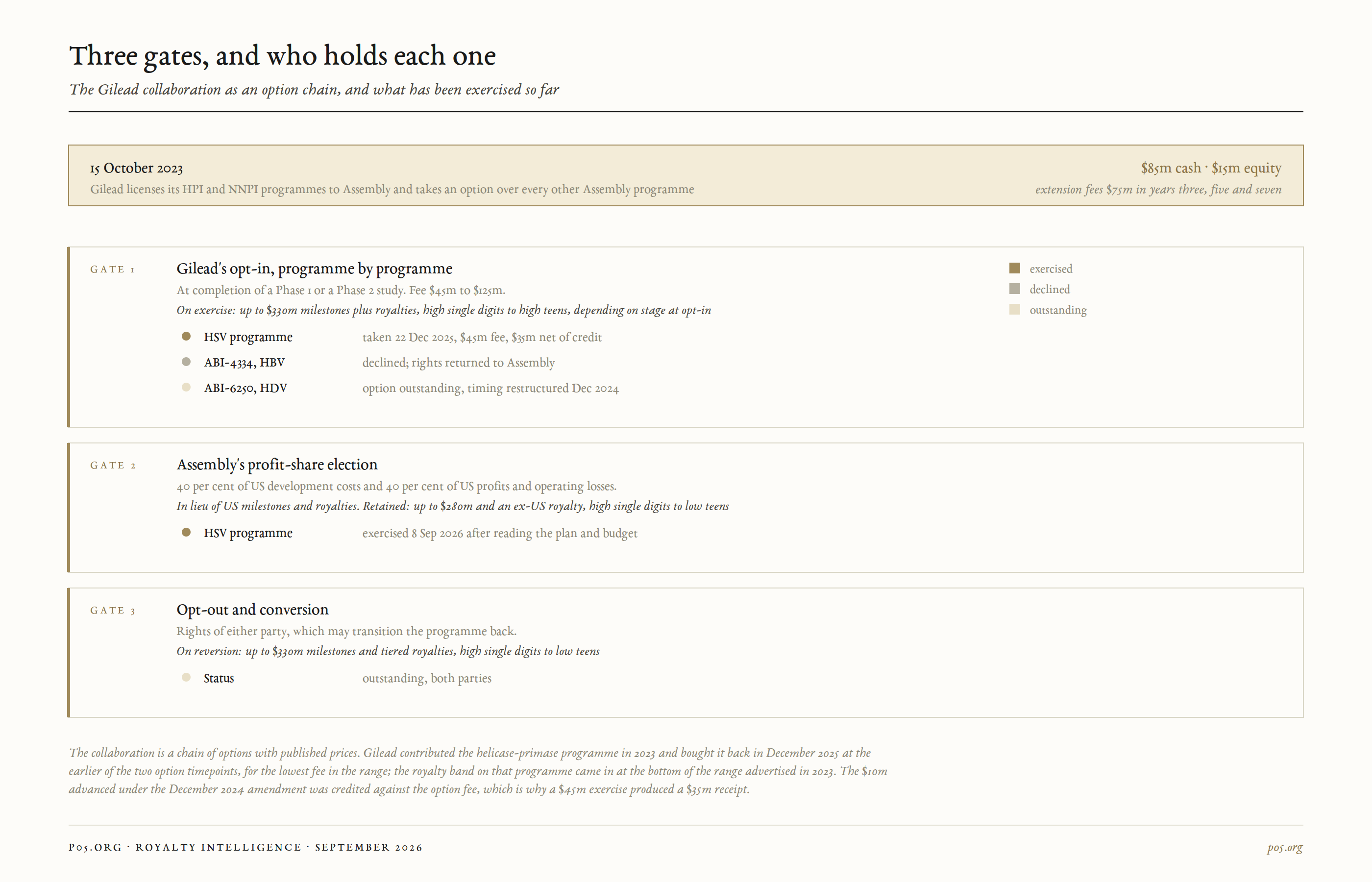
The collaboration as an option chain: three gates, their published prices, and what has been exercised so far
The 2023 architecture
The agreement is a chain of options, and each link has a published price.
Gilead may exercise its opt-in on a programme-by-programme basis at one of two timepoints, completion of a certain Phase 1 study or completion of a certain Phase 2 study for the first product in the programme, on payment of an opt-in fee of $45m to $125m depending on the type of programme and when the option is exercised. On exercise, Assembly becomes eligible for up to $330m in regulatory and commercial milestones on that programme plus royalties ranging from high single digits to high teens, again depending on the clinical stage at opt-in. Gilead then controls all further development and commercialisation.
Assembly's own option sits underneath Gilead's. Following each Gilead opt-in, Assembly may elect to cover 40 per cent of United States research and development costs and share 40 per cent of United States profits and operating losses, in lieu of United States milestones and royalties for that programme, unless it later opts out.
The schedule has already been renegotiated once. A First Amendment in December 2024 restructured the timing of specific options and the fees payable, to support an accelerated development plan for ABI-6250. Assembly took a non-refundable $10m creditable against future collaboration payments, and the 6250 opt-in fee was restructured while remaining inside the published range. That $10m credit was applied against the HPI opt-in fee a year later, which is why Gilead's $45m exercise produced a $35m receipt.
Gilead supports the collaboration through the term with extension fees of $75m in each of the third, fifth and seventh years. The first falls due in the fourth quarter of 2026, on the third anniversary of signing.
The equity leg runs alongside. Gilead's $15m purchase at $1.16 a share was followed by participation that maintained 19.9 per cent in June 2024, then a $20.1m purchase in December 2024 that took it to 29.9 per cent alongside $10m of accelerated funding creditable against future option payments. The investor rights agreement carried a three-year standstill, a two-year lock-up, registration rights and two board designees. Dilution from the May 2026 offering has since taken Gilead to 25.1 per cent, and Gilead bought 471,698 shares in that offering for approximately $12.5m.
Where the band came from
Gilead exercised the HSV option on 22 December 2025, paying $35m, which the parties described as a $45m option fee net of the $10m of accelerated funding advanced a year earlier.
$45m is the floor of the $45m to $125m range, and the exercise came at the earlier of the two timepoints, on the Phase 1b package rather than after a Phase 2. The 2023 agreement ties both the fee and the royalty band to that timing. The realised band on this programme is high single digits to low teens, against a headline range that reaches the high teens.
The public record therefore shows both ends of a trade that is normally invisible: Gilead paid the cheapest option fee available to it, and the royalty Assembly earned came in at the bottom of the published range. An option exercised early is an option exercised at the licensee's price.
What was given up
The 8 September release sets out the two states of the stream, and the difference between them is arithmetic.
Retained after the election: up to $280m in regulatory and commercial milestones, plus tiered royalties on net sales outside the United States, high single digits to low teens.
On a reversion out of the profit share: up to $330m in regulatory and commercial milestones, plus tiered royalties on net sales, high single digits to low teens.
$330m less $280m is $50m. On the face of the two sentences, the United States milestone content of this programme is around $50m, and what Assembly gave up on 8 September is that $50m plus a high-single-digit-to-low-teens royalty on United States net sales, in exchange for 40 per cent of United States profits and an obligation to fund 40 per cent of United States development costs. The release does not break the milestone figure out by territory, so the $50m is inference from the two totals rather than a disclosed number.
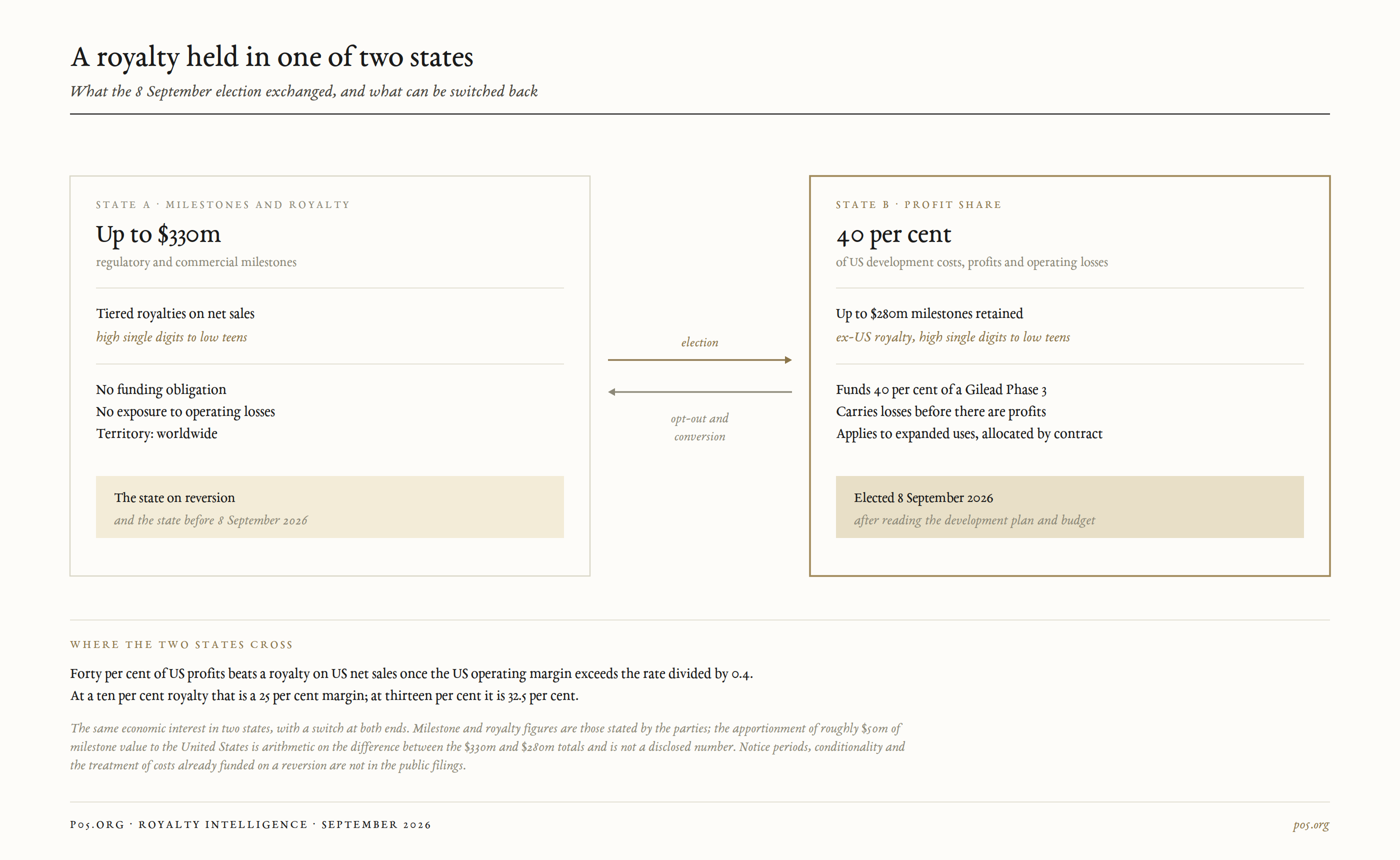
The same economic interest in two states, with the election one way and opt-out and conversion the other
The arithmetic the licensor did
The trade reduces to one ratio. Forty per cent of United States profits beats a royalty on United States net sales whenever the product's United States operating margin exceeds the royalty rate divided by 0.4.
At a ten per cent royalty, the breakeven margin is 25 per cent of net sales. At thirteen per cent, it is 32.5 per cent. Branded antivirals that reach any scale run well above both, which is why the profit share is the obvious answer on a clean margin assumption and why the interesting question is not the ratio but what else the election buys and costs.
What it costs is cash. A profit share is not a royalty with a bigger number attached. It carries 40 per cent of the operating loss before there is any profit, which means Assembly is now committed to funding 40 per cent of a Gilead Phase 3 programme in an indication Gilead intends to run into broader prevention settings. A royalty holder funds nothing and cannot lose money. A profit participant can.
What it buys is exposure to a commercial plan Assembly has read and the market has not, across whatever the programme becomes. The election applies to expanded uses, and the release states that economics for any combination approach are allocated under the collaboration agreement on the relative contribution of the applicable programme components. Gilead's plan contemplates evaluating GS-1179 alongside HIV pre-exposure prophylaxis, so the 40 per cent could end up attaching to a share of a combination determined by a contractual allocation nobody outside the parties has seen.
The instrument
For a royalty desk this file is not a monetisation and not a purchase. It is a convertible royalty, and the conversion right runs both ways.
The 2023 agreement gives Assembly the right to enter the profit share and to opt out of it later. The September release adds that participation is subject to opt-out and conversion rights of either party which may transition the programme back to milestones and royalties. The reverted royalty band is stated as high single digits to low teens, the same band that applied before, so the published terms do not show a penalty rate on reversion. Whether costs already funded are credited or reimbursed on a switch, on what notice a switch can be made, and whether either party's right is conditional are not determinable from the public filings; those mechanics sit in the unredacted agreement.
Three consequences follow for anyone who might one day buy or lend against this asset.
The retained ex-US royalty is clean in territory but not in context. It is a genuine royalty on net sales outside the United States, unaffected by the United States profit share on its face. It nonetheless sits inside a contract where the United States economics can flip between two structures at either party's election, and where the same counterparty controls development, commercialisation and 25.1 per cent of the licensor's equity.
The United States position is not a royalty at all right now. It is a share of profits in an unapproved product, contingent on Assembly continuing to fund its 40 per cent. Nothing about it looks like a purchasable stream until a switch is thrown.
And the optionality cuts against valuation in both directions. A buyer pricing the ex-US royalty has to price the possibility that the United States reverts to a royalty structure, which would restore up to $330m of milestones and a United States rate, and the possibility that it does not. Conversion rights held by the payer are the feature royalty purchase agreements are least comfortable with, because they move value without the holder's consent.
The balance sheet that permits the choice
A licensor that cannot fund 40 per cent of a Phase 3 budget does not get to make this election, whatever the arithmetic says.
Assembly held $320.4m in cash, cash equivalents and marketable securities at 30 June 2026, up from $226.6m three months earlier after a $115m gross financing completed in the second quarter. Runway is projected into 2029, and that projection includes the $75m due from Gilead in the fourth quarter of 2026. The company calls that payment a collaboration extension fee in one place in the same release and an option continuation payment in another; the 2023 agreement describes extension fees in the third, fifth and seventh years.
The runway moved because of the raise, not the election. At 31 December 2025 the company held $248.1m and guided to funding into 2028, on full-year collaboration revenue of $72.3m, research and development of $64.8m and general and administrative of $19.6m. The May 2026 offering and the scheduled Gilead payment took the guidance to 2029, and the election followed.
Full-year research and development of $64.8m is also the number to hold against the new obligation. Assembly has agreed to fund 40 per cent of a Gilead Phase 3 programme in an indication Gilead intends to widen, without knowing publicly what that programme costs.
The income statement shows how little of the company's cost base is exposed. Second-quarter research and development ran at $14.9m and general and administrative at $4.8m, against $13.4m of collaboration revenue from Gilead, for a net loss of $3.9m. Deferred revenue from the related party stood at $16.3m. A company burning at that rate with $320m in the bank and a $75m receipt scheduled has room to take a funded position in someone else's trial.
The comparison worth holding is with the ordinary reason a licensor sells a royalty. Monetisations are usually a liquidity event for a company that cannot otherwise fund itself. Assembly did the reverse trade. It declined a royalty, took a funding obligation, and paid for the privilege out of a balance sheet it had just recapitalised.
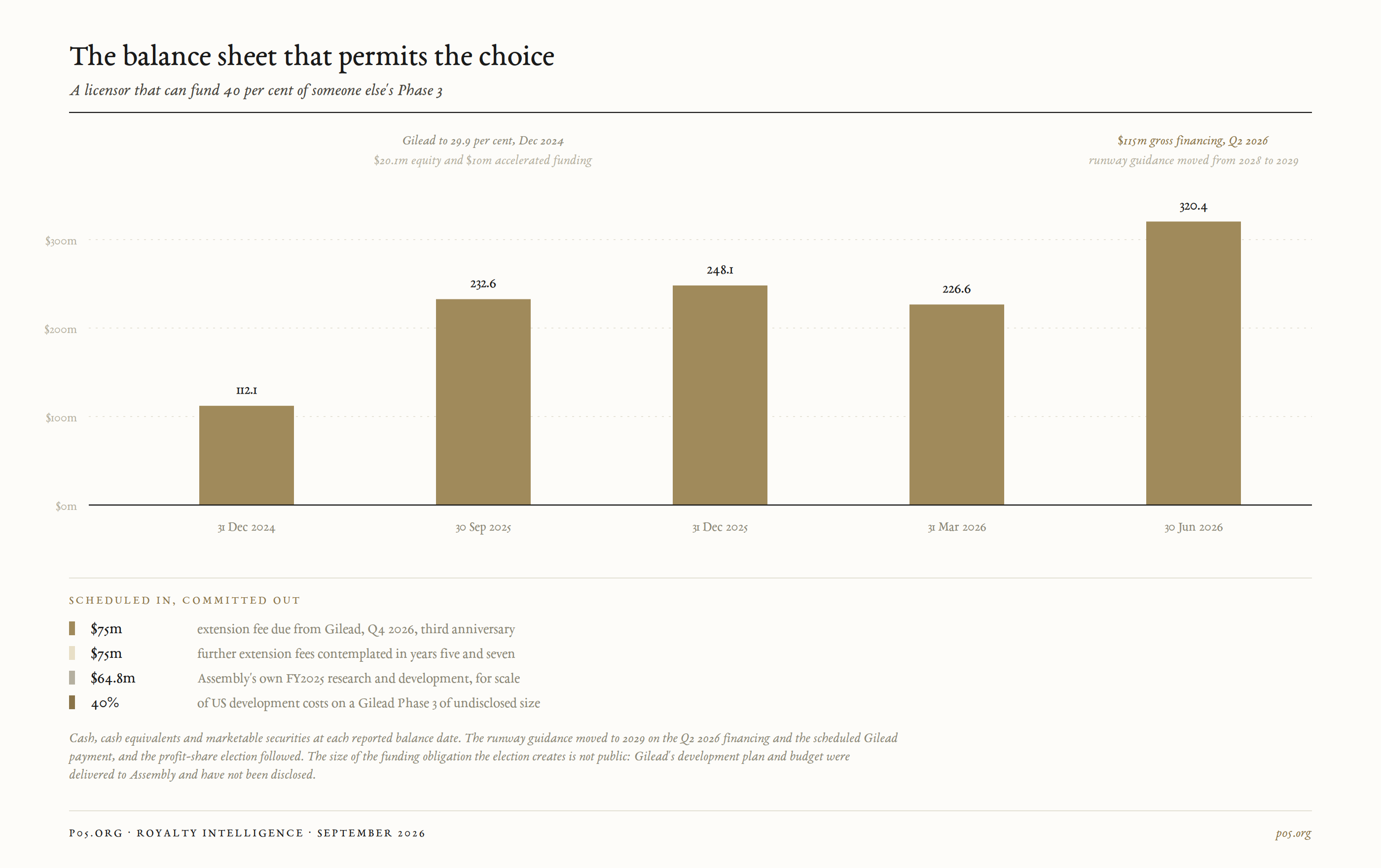
Cash at each reported balance date, against the scheduled Gilead payments and the obligation the election creates
The rest of the stack
Every other Assembly programme sits under the same option architecture, which means the company's entire pipeline is a series of contingent royalties with the same counterparty.
ABI-6250, an oral small-molecule entry inhibitor for chronic hepatitis delta, is the nearest. A Phase 2 in HDV is expected to start by the end of 2026, and in the second quarter Assembly expanded the candidate into cholestatic liver diseases, including primary biliary cholangitis and primary sclerosing cholangitis, with a Phase 2 planned for the first quarter of 2027. Gilead's option over it can be exercised at the Phase 1 or Phase 2 timepoint, at a fee inside the $45m to $125m band, and the royalty Assembly would earn depends on which timepoint Gilead chooses.
ABI-4334, a hepatitis B capsid assembly modulator, is the one asset that has already been through the machine and come out the other side. Gilead declined to exercise or defer its option on it, Assembly regained sole rights, and the company started a structured process to find a partner. It is the only programme on which Assembly is currently free to create a royalty with a counterparty other than Gilead, and the reason it is free is that Gilead passed.
There is no purchased royalty, no third-party stream, and no monetisation in Assembly's history. Every economic interest the company holds is an entitlement against one payer, created by one contract, and convertible under that contract.
The clinical record
The Phase 1b data are the reason any of this is happening.
For ABI-1179, now GS-1179, the 50 mg weekly cohort showed a 98 per cent reduction in HSV-2 shedding rate against placebo over a 29-day evaluation period, with a 91 per cent reduction in virologically confirmed genital lesion rate and a reduction of more than 99 per cent in samples carrying high viral load. Assembly's pre-specified target for the study had been an 80 to 85 per cent reduction in shedding. Fifty participants were enrolled across the 50 mg and 20 mg cohorts. No serious adverse events were reported.
ABI-5366, now GS-5366, had earlier shown a 94 per cent reduction in shedding at 350 mg weekly, and its monthly proof-of-concept cohort produced a 76 per cent reduction with most positive swabs falling in the final two weeks as drug levels declined.
The commercial thesis rests on dosing interval. Standard of care in recurrent genital herpes is daily nucleoside analogues, long since generic, which are partially effective at preventing recurrences and at reducing transmission. Assembly puts the recurrent genital herpes population at over four million people across the United States and five European markets, and notes that no new drug has been approved for genital herpes in the United States or Europe in more than 25 years.
Who else is in the mechanism
Helicase-primase inhibition is validated, and someone else is likely to get there first.
Aicuris's pritelivir holds FDA Breakthrough Therapy designation and received priority review with a PDUFA target date in the fourth quarter of 2026, on a pivotal Phase 3 in refractory HSV infection in immunocompromised patients. That is a different indication from chronic suppression in recurrent genital herpes, and a much smaller population, but it puts the mechanism in front of a review division first and it establishes a United States label for the class before GS-1179 has started Phase 2.
The class also has a regulatory history in the exact indication GS-1179 is entering. AiCuris ran pritelivir against valacyclovir in a Phase 2 crossover study in adults with four to nine annual genital HSV-2 recurrences. Pritelivir won on shedding, 2.4 per cent of swabs against 5.3 per cent, and on lesion days, 1.9 per cent against 3.9 per cent. The trial did not finish. The FDA placed it on clinical hold on findings in a concurrent nonclinical toxicity study and the sponsor terminated it, with 56 of 91 randomised participants having completed both periods. That was 2013, the molecule is different and pritelivir has since run a Phase 3 to a filing, but a desk underwriting a helicase-primase inhibitor in chronic suppressive dosing should know that the class has been stopped once in this population on tox.
The read-across runs both ways. A pritelivir approval validates helicase-primase inhibition and de-risks the class. It also gives prescribers a first experience of the mechanism that GS-1179 will inherit, good or bad, and it gives a competitor a head start on resistance surveillance and payer conversations.
Red team versus blue team
Risk analysis (red team)
There is no royalty in the United States any more. Assembly holds a share of profits in an unapproved product. Until there is a product and a profit, the position produces nothing, and until there is a switch, there is nothing in the United States for a royalty buyer to price.
The election converts a fee stream into a funding obligation. Forty per cent of United States development costs are now Assembly's, on a Phase 3 programme it does not control, in an indication Gilead intends to widen. A royalty holder cannot be called for cash. A profit participant can, and the budget belongs to the other party.
The counterparty controls the programme, the plan and the switch. Gilead has sole right and responsibility for development and commercialisation, wrote the plan and budget Assembly priced against, and holds its own opt-out and conversion rights. Assembly's information advantage came from the counterparty and can be revised by it.
The band came in at the bottom of the range. The 2023 agreement advertised royalties from high single digits to high teens depending on stage at opt-in. Gilead opted in at the earliest timepoint for the lowest fee, and the realised band is high single digits to low teens. The structure rewards the licensee for exercising early.
Reversion mechanics are not public. Notice periods, conditionality, and the treatment of costs already funded on a switch back are not determinable from the filings. A convertible economic interest whose conversion mechanics are redacted is difficult to underwrite.
Concentration is total. One counterparty holds every option over every programme, is the largest shareholder at 25.1 per cent with warrants over a further 2,475,420 shares, has board representation, and is the source of the collaboration revenue that covers most of the cost base.
The option architecture has already produced one refusal. Gilead declined to exercise or defer on ABI-4334 and the rights returned to Assembly. Every remaining programme carries the same binary, and a decline is both a loss of the opt-in fee and a signal to any third party Assembly then approaches.
A competitor reaches the market first. Pritelivir carries a Q4 2026 PDUFA date in refractory HSV. GS-1179 is expected to start Phase 2 by year end.
The class has been halted in this indication before. The FDA placed pritelivir's genital herpes Phase 2 on clinical hold in 2013 on a nonclinical toxicity finding and the sponsor terminated the study. GS-1179 is a different molecule with a clean Phase 1b to date, and chronic suppressive dosing in a non-life-threatening indication is where tolerability questions land hardest.
The standard of care is generic and cheap. Daily nucleoside analogues cost very little. A once-weekly oral suppressive therapy has to win on adherence, on recurrence rates and plausibly on transmission, and it has to win at a price that supports a profit share.
Opportunities and mitigants (blue team)
The licensor priced its own royalty with the budget in hand. Assembly saw the development plan and the commercial cost estimates before electing. For a market that spends its time estimating what a rate is worth, a counterparty declining a high-single-digit-to-low-teens United States royalty after reading the plan is a data point on what those rates are worth to someone who can see the numbers.
The arithmetic is not close on a normal margin. At a ten per cent royalty, the profit share wins above a 25 per cent United States operating margin. Branded antivirals at scale clear that comfortably.
The position is reversible. If the plan slips, if the budget grows, or if the funding obligation becomes unattractive, the structure contemplates a transition back to milestones and royalties at a band no worse than the one on offer today, with up to $330m of milestones restored.
The one declined asset came back clean. Gilead's refusal on ABI-4334 returned sole rights to Assembly, which is running a partnering process. A programme outside the Gilead architecture is the only place the company can write a royalty on its own terms.
Nothing was sold. Assembly has never monetised a royalty and did not do so here. The company still holds the ex-US stream, the milestone ladder, and the option architecture over its remaining pipeline.
The balance sheet supports the choice. $320.4m at 30 June 2026, a $115m financing completed in the quarter, a $75m extension fee scheduled for the fourth quarter, two further $75m fees contemplated in years five and seven, and runway into 2029 against a net loss of $3.9m in the quarter.
The clinical data cleared the company's own bar. A 98 per cent reduction in shedding against a pre-specified target of 80 to 85 per cent, a 91 per cent reduction in confirmed lesion rate, and no serious adverse events reported.
The indication has been static for a generation. No new drug approved for genital herpes in the United States or Europe in more than 25 years, against a recurrent population Assembly puts above four million across six markets.
Summary
| Risk | Concern |
|---|---|
| No US stream | Profit share in an unapproved product; nothing purchasable today |
| Funding obligation | 40 per cent of US development costs on a trial Assembly does not control |
| Control | Counterparty writes the plan, runs the programme and holds its own switch |
| Rate | Realised band at the bottom of the published range after an early opt-in |
| Disclosure | Reversion notice, conditionality and cost treatment not public |
| Concentration | One payer, 25.1 per cent holder, board seats, most of the revenue |
| Option risk | Gilead declined ABI-4334; every programme carries the same binary |
| Competition | Pritelivir PDUFA in Q4 2026 in refractory HSV |
| Class history | Pritelivir's genital herpes Phase 2 halted on tox in 2013 |
| Pricing | Standard of care is generic daily therapy |
| Opportunity | Observation |
|---|---|
| Information | Election made against the sponsor's actual plan and budget |
| Arithmetic | Profit share wins above a 25 per cent US margin at a ten per cent royalty |
| Reversibility | Transition back to up to $330m of milestones and the same band |
| Nothing sold | Ex-US royalty, milestone ladder and pipeline options all retained |
| Free asset | ABI-4334 rights returned after Gilead declined; partnering process open |
| Funding | $320.4m cash, $75m extension fee in Q4 2026, runway into 2029 |
| Data | 98 per cent shedding reduction against an 80 to 85 per cent target |
| Indication | No new approval in genital herpes in the United States or Europe for 25 years |
Conclusion
The BRAIN Biotech file this column looked at last week was a licensor selling a royalty because it needed the money. Assembly Biosciences is the same question answered by a company that does not.
Given a choice between a United States royalty in the high single digits to low teens and 40 per cent of United States profits, with the development plan and the commercial cost estimates in front of it, Assembly took the profits and accepted a funding obligation to get them. That is a licensor telling the market what it thinks a royalty on its own asset is worth relative to the equity-like alternative, and the answer was less.
The part a royalty desk should carry forward is the switch. Assembly's ex-US royalty is real and its United States economics are not a royalty at all this month, and either party can change that. Anyone who eventually looks at the ex-US stream as a purchase will be buying a contractual interest whose sibling economics can be converted by a counterparty that also controls the programme and owns a quarter of the licensor.
The dates are Gilead's now. Phase 2 in recurrent genital herpes by the end of 2026, a $75m extension fee in the fourth quarter, the second and third extension fees in years five and seven, and a PDUFA date at a competitor in the same mechanism before any of it starts.
All information in this article was accurate as of September 2026 and is derived from publicly available sources including Assembly Biosciences and Gilead Sciences press releases, Assembly Biosciences filings with the SEC including its Form 8-K of 17 October 2023, its Annual Report on Form 10-K for 2023 and its quarterly reporting for 2026, Aicuris press releases and ClinicalTrials.gov. The Option, License and Collaboration Agreement dated 15 October 2023 was filed in redacted form under Regulation S-K Item 601(b)(10); royalty rates are disclosed only as ranges, and the opt-out and conversion mechanics referred to in the 8 September 2026 announcement, including any notice period, conditionality, and the treatment on reversion of development costs already funded, are not determinable from public sources. The apportionment of approximately $50m of milestone value to the United States is arithmetic drawn from the difference between the $330m and $280m totals stated in that announcement and is not a figure either party has disclosed. The allocation of economics for any combination approach, including any evaluation alongside HIV pre-exposure prophylaxis, is stated by the parties to follow the relative contribution of the applicable programme components; the method is not public. The breakeven margin calculation is arithmetic on a stated royalty rate and assumes United States operating margin measured on net sales with no allocation differences between the profit-share and royalty bases; the actual definitions of shared costs and profits are in the unredacted agreement. Gilead's shareholding is taken from its most recent amended Schedule 13D as reported; readers should check the filing itself for the current position. Clinical results described are interim data from ongoing Phase 1b studies, blinded in part, with pooled placebo controls whose composition changes as further cohorts enrol, and are not predictive of Phase 2 or Phase 3 outcomes. The $75m payment due in the fourth quarter of 2026 is described by the company as both a collaboration extension fee and an option continuation payment; the 2023 agreement refers to extension fees payable in the third, fifth and seventh years of the collaboration. Trial timelines, the Phase 2 start, the extension fee schedule and the cash runway are company expectations rather than realised results. Information may have changed since publication. This content is for informational purposes only and does not constitute investment, legal, or financial advice. The author is not a lawyer or financial adviser.