
The toggle and the ratchet: deferred payment in royalty financing

In October 2022 Insmed borrowed $350 million from Pharmakon-managed funds. Over the next two years it paid $46.8 million of the interest by handing the lenders more debt in place of cash. That is payment in kind, or PIK. The loan grew instead of shrinking.
A PIK toggle is the switch that allows this. It lets a borrower choose, period by period, between paying interest in money and adding it to the principal to pay later, and then switch back. Elect it on a $100 million loan at ten per cent and a year later you owe $110 million, having paid nothing, with the next year's interest running on the bigger number.
Lenders charge for the privilege, usually a step-up in the margin, because they are funding a larger balance for longer and may never see the cash. Credit agreements fence the right in. How much of the interest qualifies, how many periods it covers, what it costs, and whether a default shuts it off.
Toggles came out of leveraged buy-outs, where they sat in holdco notes, and spread through private credit as rates rose. Royalty financings are now routinely described as carrying one. Very few of them do.
On the day Insmed signed that loan it also sold OrbiMed a $150 million revenue interest. The loan could toggle. The revenue interest could not, and nothing in it ever accrued. The same division shows up in almost every royalty financing on file. The toggle sits in the term loan or the note, while the royalty or revenue interest agreement beside it carries none. Verastem's January 2025 Note Purchase Agreement puts both in one document, and only one of them can be deferred.
When the royalty itself has to give, the market uses other tools. A rate that ratchets up, a minimum return the seller must top up in cash, a waiver of a few quarters, a cap on the total. Each carries different consequences for yield, for security and for a claim in bankruptcy.
Two deals collapse the distinction. In Paratek's R-Bridge loan a shortfall in royalty collections turns into principal inside one instrument. Impel's 2023 restructuring killed a revenue interest outright and rolled it into loan principal, which then accrued in kind.
A third route needs nothing drafted at all. Book a revenue interest financing as debt under ASC 470 and it accrues at an imputed rate. Early royalty payments usually fall short of that rate, so the liability grows. Nobody elected anything, and no PIK provision appears anywhere in the papers.
The recourse ladder piece covered where an instrument sits between note and sale, and the side letters piece what travels outside the principal agreement. This one is about an interest payment that is not made in cash, and about the three sets of rules that give three different answers to what happens next in the same deal.
1. Where the toggle is written
The Verastem agreement, signed with Oberland Capital affiliates on 13 January 2025, commits up to $150.0 million in three tranches: $75.0 million at closing, $25.0 million on FDA approval of avutometinib with defactinib in low-grade serous ovarian cancer, and up to $50.0 million on trailing six-month net sales of $55.0 million.
Each of the four fences is drawn tight. The issuer may elect PIK on up to 50 per cent of the interest owed on any payment date, for a maximum of eight payment dates, by irrevocable written notice to the Purchaser Agent by noon Eastern three business days before the date. A default or event of default switches it off. Elected amounts capitalise into outstanding principal and thereafter bear interest as principal.
The fence the agreement leaves down is price. Verastem's rate runs at the greater of Term SOFR and 4.29 per cent, plus 3.71 per cent, capped at 9.75 per cent all in, and electing PIK does not raise it. Most agreements charge. Proskauer's 2023 survey of the drafting puts the usual premium at something like 25 basis points for every 100 basis points of capitalised margin. It also has minimum cash pay expressed on the margin, never on the reference rate, which is where the money is won or lost when SOFR moves. White and Case put European minimum cash pay at three to four per cent annually, with duration limits such as six quarters and prohibitions on consecutive PIK periods.
Life sciences credit shows the full range of that price. Omeros's June 2024 facility with Athyrium and Highbridge allows up to 50 per cent of any quarterly payment in kind and charges 150 basis points for it, moving from SOFR plus 8.75 per cent to SOFR plus 10.25 per cent. BioCryst's 2020 Athyrium credit agreement charged 200 basis points, from LIBOR plus 8.25 to LIBOR plus 10.25, for the first eight quarters.
Esperion's December 2024 loan from Athyrium and three HealthCare Royalty vehicles posts the two rates side by side, 9.75 per cent in cash against 11.75 per cent in kind, with the option available for four quarters. ARS Pharmaceuticals' September 2025 facility from OMERS and RA Capital permits 100 per cent PIK for two years and 50 per cent for three more, at 100 basis points on the portion paid in kind.
None of those five instruments contains a royalty. Esperion's lenders are royalty funds writing credit. Omeros's collateral package excludes the OMIDRIA royalty interests it had already monetised.
The wider market has moved in one direction. The Financial Stability Board's May 2026 report on private credit puts PIK in roughly 12 per cent of loans, with toggles about half of those, rising since 2022 and more common in larger deals.
The Boston Fed's August 2026 study of 168 BDCs tracks the PIK share of portfolio investments from about six per cent in early 2022 to about ten in early 2026, spread across sectors and not concentrated in distressed ones. Lincoln International's Q1 2026 data puts 11 per cent of the loans it values on PIK during 2025. Of those, 56 per cent were agreed by amendment rather than at closing, and loan to value on that amended cohort moved from 42.7 per cent to 76.0 per cent over the year.
The direction is not uniform: PitchBook reported the quarterly PIK share of interest income at the largest listed BDCs falling for three consecutive quarters to 8.3 per cent by Q2 2025, while the trailing twelve-month dollar total still grew 13 per cent.
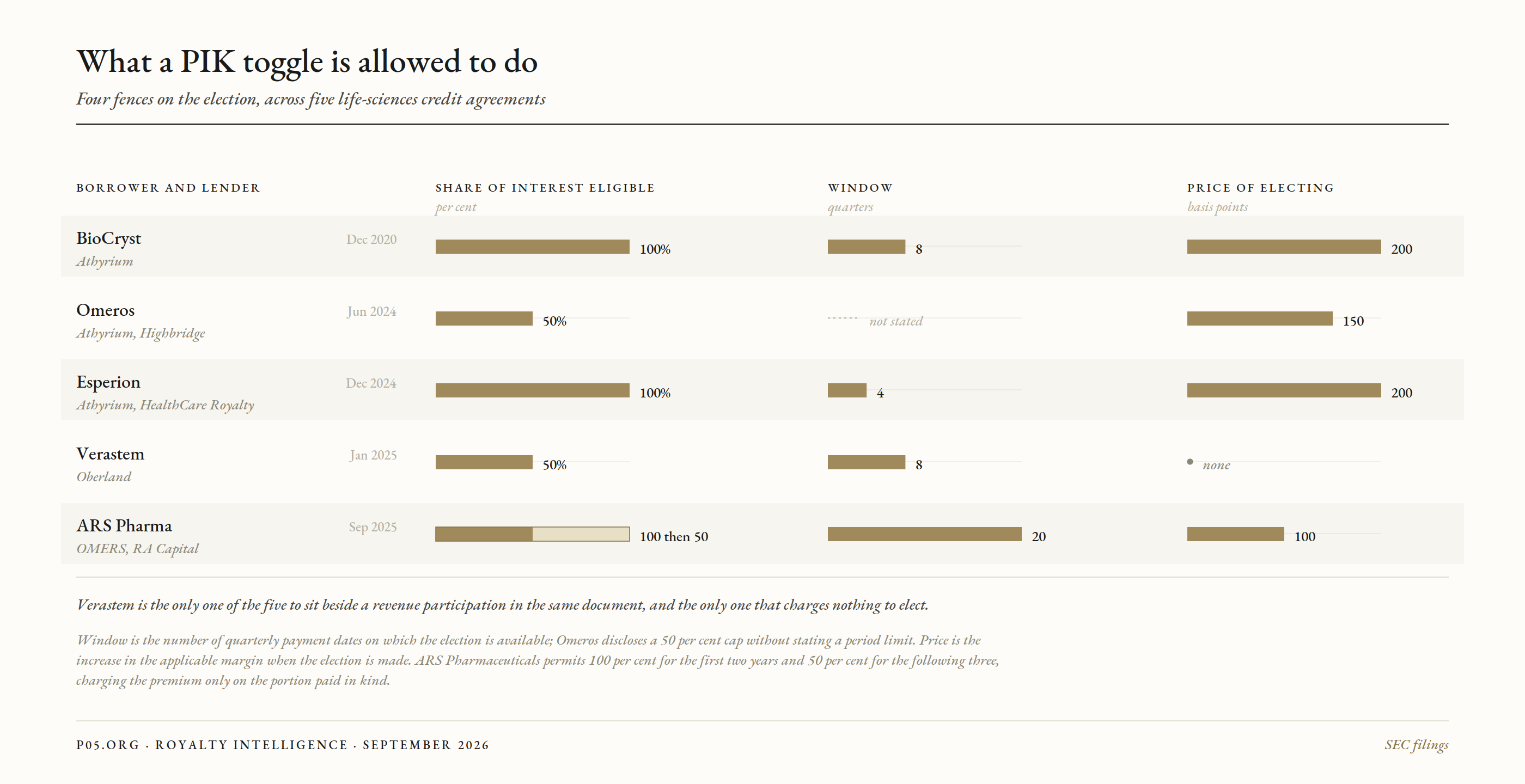
Figure 1. The bounds on the election across five life sciences credit agreements, 2020 to 2025: share of interest eligible, window in quarters, and the step-up charged for using it. Verastem is the only one of the five to sit beside a revenue participation in the same document, and the only one that charges nothing.
2. The royalty leg does not toggle
Verastem's Revenue Participation Payments run at 1.00 per cent of the first $100.0 million of annual net sales of each Included Product, scaling pro rata to 2.00 per cent if the full $150.0 million is drawn. They are estimated quarterly in good faith and reconciled against actual net sales, with overpayments credited forward and underpayments added to the next payment.
The issuer cannot defer them and cannot pay them in kind, so the loan beside them absorbs any strain on its own.
Insmed shows the same division across two counterparties. On 19 October 2022 the company took a $350 million term loan from Pharmakon-managed funds and sold a $150 million revenue interest to OrbiMed on the same day. The loan permitted up to 50 per cent of interest in kind at the company's election during the first 24 months, and the election was used: by the October 2024 amendment $46.8 million had capitalised into principal.
The royalty leg deferred nothing. Instead it carries a retroactive catch-up. If aggregate Revenue Interest Payments have not reached $150.0 million by the payment for the quarter ending 31 March 2028, the ARIKAYCE rate increases for every later quarter to the rate that would have produced $150.0 million had it applied throughout. Total payments are capped at 1.8 times the purchase price, and up to 1.9 times in certain conditions.
The catch-up and the toggle solve the same problem by different routes. A toggle moves cash out of the current period and prices the delay through a step-up. A catch-up leaves the current period alone and reprices the whole stream retrospectively once a threshold is missed. One raises a principal balance, the other a percentage, and the two land on different parts of the capital structure.
Phathom's revenue interest financing with NovaQuest, Sagard and Hercules uses floors in place of ratchets. Investors take ten per cent of vonoprazan net sales, stepping down at sales thresholds and on the non-erosive GERD approval received on 17 July 2024, with obligations terminating at 200 per cent of the investment amount.
If investors have not received 100 per cent of that amount by 31 December 2028 or 200 per cent by 31 December 2037, Phathom must gross them up in cash, and default multipliers of 1.30 times and 2.0 times apply in defined windows. The Hercules term loan alongside it accrues payment-in-kind interest at a stated rate, 2.15 per cent per annum in the 2025 filings, which is not an election at all.
Allurion's October 2024 Omnibus Amendment prices a missed milestone into the royalty rate directly: the first tier ratchets to 12.0 per cent if FDA marketing authorisation for the gastric balloon is not received by 30 June 2025, against a Hard Cap of 260 per cent of the investment amount. The convertible notes issued to RTW in April 2024 carry the PIK election, at the company's option for three years. The revenue interest financing agreement carries none.
Karyopharm bought a royalty holiday rather than an accrual. The Sixth Amendment of October 2025 waives revenue interest payments on four consecutive dates from 15 August 2025 to 15 May 2026, deliberately overlapping mandatory PIK periods on the term loan and the 2028 and 2029 notes.
The waived quarters do not accrete. The consideration is forward: the tiered percentage rises to 8.00 per cent from 1 April 2026, against a $263.3 million cap on aggregate payments.
| Deal | Debt-side deferral | Royalty-side mechanic | Cap on royalty leg |
|---|---|---|---|
| Verastem / Oberland, Jan 2025 | 50 per cent of interest, 8 dates, no step-up | None; cash-pay revenue participation | Rate scales 1.00 to 2.00 per cent |
| Insmed / Pharmakon and OrbiMed, Oct 2022 | 50 per cent, 24 months; $46.8m capitalised | Retroactive catch-up rate to $150m by Q1 2028 | 1.8x, up to 1.9x |
| Phathom / NovaQuest, Sagard, Hercules, 2022 | Non-elective PIK on the Hercules term loan | Minimum-payment gross-up; 1.30x and 2.0x default multipliers | 200 per cent of investment |
| Allurion / RTW, 2023 to 2024 | 6.0 per cent notes, issuer option, 3 years | Milestone-failure ratchet to 12.0 per cent | Hard Cap 260 per cent |
| Karyopharm / HealthCare Royalty, Oct 2025 | Mandatory PIK periods to Q1 2026 | Four-quarter waiver, no accrual | $263.3m; rate to 8.00 per cent |
| Paratek / R-Bridge, Dec 2020 | Automatic accretion of the interest shortfall | Same instrument: shortfall is the trigger | Aggregate Cap 190 per cent |
3. The instrument where the royalty drives the accretion
PRTK SPV2 LLC borrowed $60.0 million from R-Bridge Healthcare Cayman AIV on 31 December 2020, described in Paratek's 8-K as a royalty and revenue interest-backed loan. The Collection Amount that services it has two sources: quarterly royalties under section 9.4 of the Zai Lab licence, and a purchased revenue interest in United States NUZYRA net sales, initially 2.5 per cent and adjustable to five, subject to an annual cap of $10.0 million adjustable to $12.0 million.
Section 3.01(c) of the loan agreement works without any election. Where the quarterly distribution is insufficient to pay Fixed Interest at 7.0 per cent, the deficiency capitalises into the outstanding principal balance as Accreted Principal and accrues forward at the same rate. There is no election, no notice, no step-up and no limit on the number of periods.
The waterfall runs borrower fees, then replacement servicer fees, then Fixed Interest, then principal amortisation, then additional interest. Accretion happens when the third of those steps cannot be funded.
The bound is on total dollars rather than on time. The Aggregate Cap is 190 per cent of the loan commitment, or $114.0 million, and the Cap itself keys off a 13 per cent internal rate of return. That is a royalty-market instrument, borrowed straight from the multiple caps in Phathom and Allurion, doing the job that a period limit and a step-up do in a credit agreement.
The accretion happened. Paratek's cash flow statements record paid-in-kind interest of $1.8 million in 2021 and $3.0 million in 2022.
Impel got there by demolition. The Second Amendment of 5 September 2023 with Oaktree and KKR affiliates terminated the revenue interest financing agreement outright and exchanged $36 million of future payment rights into Tranche A principal, inside an aggregate of roughly $121.5 million.
Interest on both tranches then ran in kind at SOFR plus 10.75 per cent through the forbearance period, and the $5 million forbearance fee was itself paid in kind. What had been royalty economics became principal, and that principal accreted at SOFR plus 10.75 per cent.
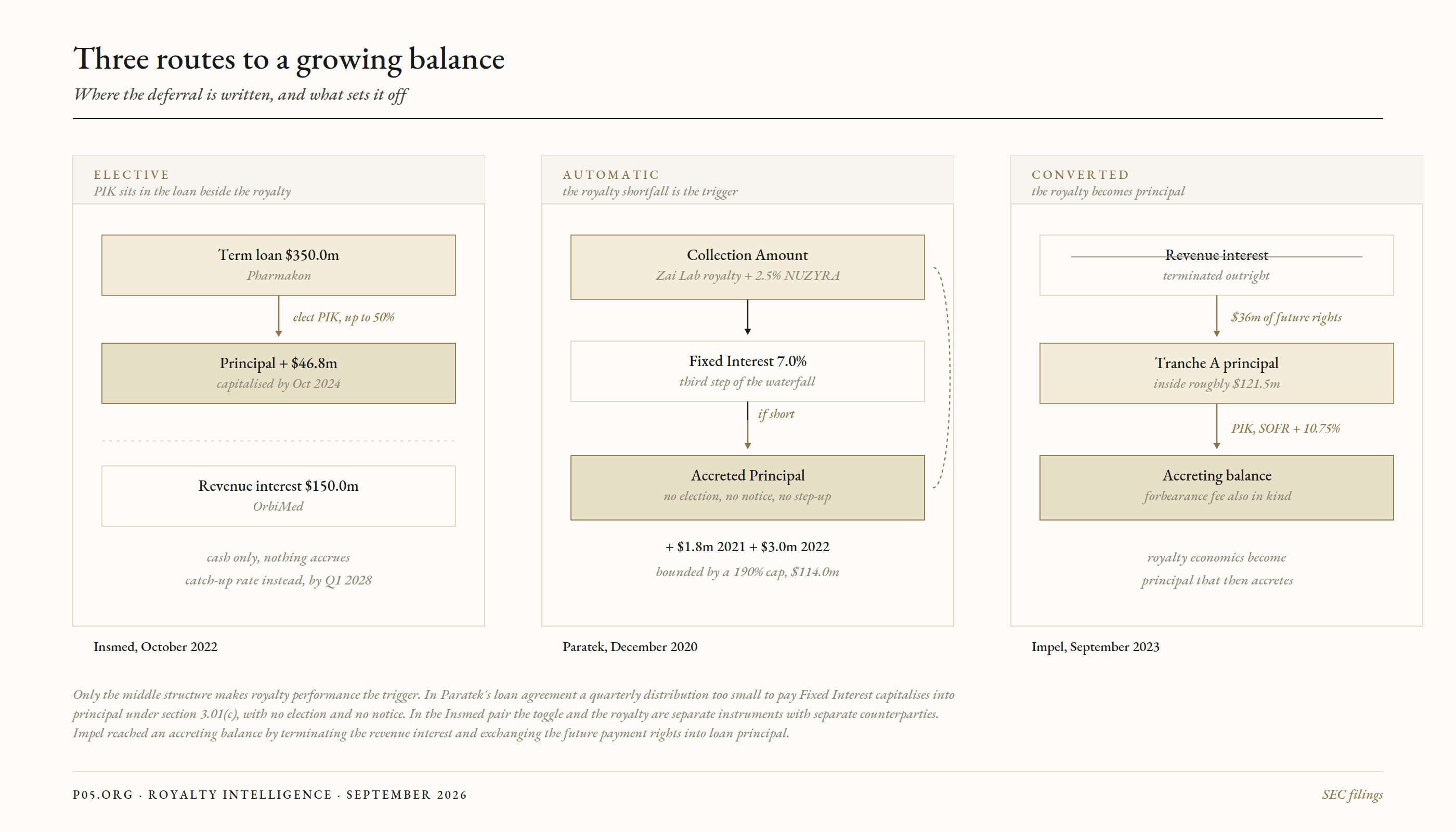
Figure 2. Three routes to a growing balance. Elective PIK on a separate loan (Verastem, Insmed), automatic accretion of a royalty shortfall inside one instrument (Paratek section 3.01(c)), and extinguishment of a revenue interest into PIK-bearing principal (Impel). Only the middle path makes royalty performance the trigger.
4. Accretion without a provision
Most royalty monetisations produce a growing liability with no PIK term in the documents, because of how they are classified on the balance sheet.
ASC 470-10-25-2 sets out six factors, each of which creates a rebuttable presumption that a sale of future revenues is debt: legal form of debt; significant continuing involvement by the seller in generating the cash flows; a cancellation right exercisable by either party; a return limited by the terms; variations in revenue having only a trifling effect on the investor's return; and recourse, whether by guarantee, collateral or otherwise.
A synthetic royalty with a hard cap, a change of control buyout, seller-run commercialisation and a security interest in product assets trips four of the six before anyone reads the covenants. Gibson Dunn's study of 102 royalty finance transactions from 2020 to 2024 records traditional royalties splitting 94 per cent true sale to six per cent debt, and synthetic royalties splitting 65 to 35.
Once the liability is on the balance sheet, ASC 835-30-35-2 requires amortisation at a constant rate applied to the amount outstanding at the start of each period. The issuer imputes the effective rate from expected royalty cash flows. In the early years those cash flows are smaller than the accruing interest, and the difference increases the carrying amount rather than reducing it.
The filings show it plainly. Karyopharm's deferred royalty obligation carried an effective rate of about 16 per cent through 2025. Phathom's revenue interest liability ran at 9.26 per cent at 30 June 2025, recalculated as revenue projections move. Insmed's royalty financing liability rose from $158.2 million to $163.7 million across 2024 on $20.0 million of interest expense against $14.5 million of revenue interest payments, and again to $165.9 million at 30 June 2025 on $10.2 million against $8.0 million.
The same pattern runs through the Editas receivables sale examined in the surrogate licence piece, where non-cash interest of $5.8 million exceeded the $5.0 million paid to DRI in 2025.
The difference from a contractual toggle matters in diligence. A negotiated PIK term increases the legal principal of the instrument. Imputed accretion moves the GAAP carrying amount and leaves what is legally owed untouched, and since it runs off a revenue forecast, the rate shifts whenever that forecast is revised. The tax position diverges too. PIK on a corporate instrument raises a deduction question, while accretion on a transaction that is a true sale for tax purposes raises none, because no debt exists to deduct interest on.
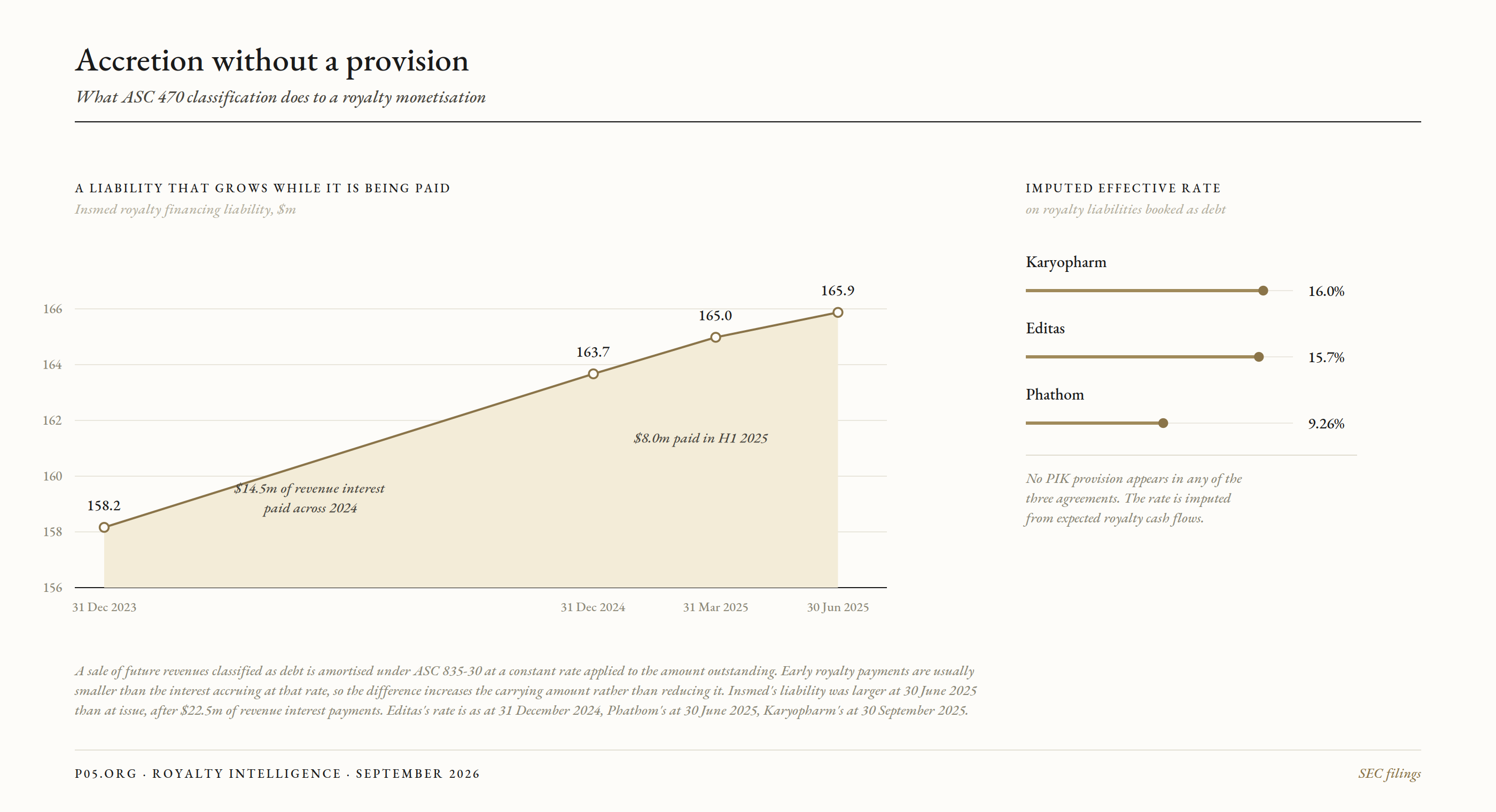
Figure 3. Insmed's royalty financing liability against the payments made on it. The liability was larger at 30 June 2025 than at issue, after $22.5 million of revenue interest payments, because interest accruing at the imputed effective rate exceeded the cash paid. None of the three agreements shown contains a PIK provision.
The fair value option under ASC 825 changes the presentation without removing the mechanics. The liability is remeasured each period, with instrument-specific credit risk in other comprehensive income, and separate presentation of interest expense is optional, not required. An entity that elects to present it uses the same interest method it would have applied without the election.
5. The line a toggle has to stay under
Section 163(i)(1) makes a debt instrument an applicable high yield discount obligation where three conditions hold together: maturity more than five years from issue, yield to maturity at or above the applicable federal rate plus five percentage points, and significant original issue discount.
The corporate issuer condition sits in section 163(e)(5) rather than in the definition, which matters when the borrower is a special purpose vehicle rather than the parent.
Significant OID under section 163(i)(2) is a test applied at the close of any accrual period ending more than five years after issue. Read practically, an issuer may not be more than about one year's yield behind in cash at the five-year mark.
Commentary often runs the consequences together. OID on an AHYDO is deductible only when paid in cash. Separately, the disqualified portion is never deductible at all, and section 163(e)(5)(C) sizes it by reference to yield above the applicable federal rate plus six points. A corporate holder may claim a dividends received deduction on that same disqualified portion.
The drafting answer is the AHYDO catch-up payment, described in Latham's Book of Jargon as a payment on or before the first payment date after the fifth anniversary, sized so the issuer is not more than a year's interest behind. Troutman set out the questions the Code leaves open for toggle debt: which yield to maturity applies, which issue price, and how the catch-up amount is computed at all. No regulation has addressed them since.
The rates move the analysis. Revenue Ruling 2026-19 puts the annual mid-term applicable federal rate at 4.61 per cent and the long-term rate at 5.22 per cent for October 2026, with the current series maintained by the IRS. On those figures the deferral threshold sits between about 9.6 and 10.2 per cent and the disallowance threshold between about 10.6 and 11.2 per cent, derived.
Verastem's 9.75 per cent all-in cap on a seven-year instrument is the kind of term that fixes the ceiling of the yield calculation rather than leaving it to float, which is what the test measures at issuance. Paratek's 7.0 per cent coupon sits far below, though the 190 per cent Aggregate Cap and the 13 per cent internal rate of return target are what a yield calculation measures, and the borrower is an LLC rather than a corporation.
The holder has a mirror problem. Under section 1272 the daily portions of OID accrue into income on a constant-yield basis whether or not any cash has been received, which PKF O'Connor Davies describes as phantom income in the private credit context. Mayer Brown adds that a significant modification can pull an instrument into AHYDO that was outside it when issued, which is the position an amendment adding a toggle creates.
6. What the accreted balance is in a claim
Section 502(b)(2) of the Bankruptcy Code disallows a claim to the extent it is for unmatured interest. No controlling appellate decision says whether PIK interest capitalised before the petition date is allowable principal or disallowed unmatured interest. The analysis runs by analogy from original issue discount, and the analogy is unfavourable.
In re Chateaugay Corp., 961 F.2d 378 (2d Cir. 1992). The Second Circuit held unamortised OID to be unmatured interest and disallowed it, reasoning that the discount compensates for the use and forbearance of money and is therefore interest, whatever the instrument calls it.
The court held at the same time that a face value debt-for-debt exchange in a consensual workout generates no new OID. The court adopted constant-interest accrual over straight-line as closer to economic reality. In re Pengo Industries, 962 F.2d 543 (5th Cir. 1992), reached the same result on face value exchanges on the ground that the contrary rule would reward holdouts.
In re Residential Capital, LLC, 501 B.R. 549 (Bankr. S.D.N.Y. 2013). Judge Glenn extended the exchange analysis to fair value exchanges and declined to reduce the Junior Secured Notes claim for unmatured OID of roughly $377 million to $386 million, noting that the tax treatment of OID does not govern the bankruptcy question.
Ultra Petroleum Corp. v. Ad Hoc Committee of OpCo Unsecured Creditors, 51 F.4th 138 (5th Cir. 2022). The Fifth Circuit treated a make-whole amount as the economic equivalent of unmatured interest and generally disallowed under section 502(b)(2), allowing recovery through the solvent-debtor exception at the contract rate rather than the federal judgment rate.
Across all three decisions the courts look at what a claim component compensates for, not at the label the instrument gives it. Capitalised interest called principal is exposed to that reasoning. The working practitioner position, that interest capitalised before the petition has matured and is allowable while interest accruing after is barred, rests on the Chateaugay logic rather than on a holding about PIK.
Recharacterisation runs in parallel, off the same terms. Covington's synthetic royalty guide notes that top-up payments and put rights weigh against true sale treatment, with caps of roughly 1.5 to 2.0 times invested capital on marketed products and 3.5 times or higher on unapproved ones.
Gibson Dunn makes risk allocation the controlling factor on a continuum and not a binary, using the Clovis Oncology structure with its 2.0 times return and $350 million acceleration cap as the worked example. The eight-factor test courts apply includes recourse, the seller's retention of servicing and commingling, and repurchase rights.
A fixed, capped, accreting return that is insensitive to product performance pushes hardest toward recharacterisation, because it removes the revenue risk that makes the transaction a sale. That same term trips ASC 470-10-25-2 factors four and five. The accounting presumption and the recharacterisation risk turn on identical terms.
Rejection risk is a separate question again. Covington's 2024 treatment of section 365 and royalty monetisations assumes a sale of economic rights and asks what happens when the licensor-seller rejects the underlying licence, with the buyer's resulting claim unsecured.
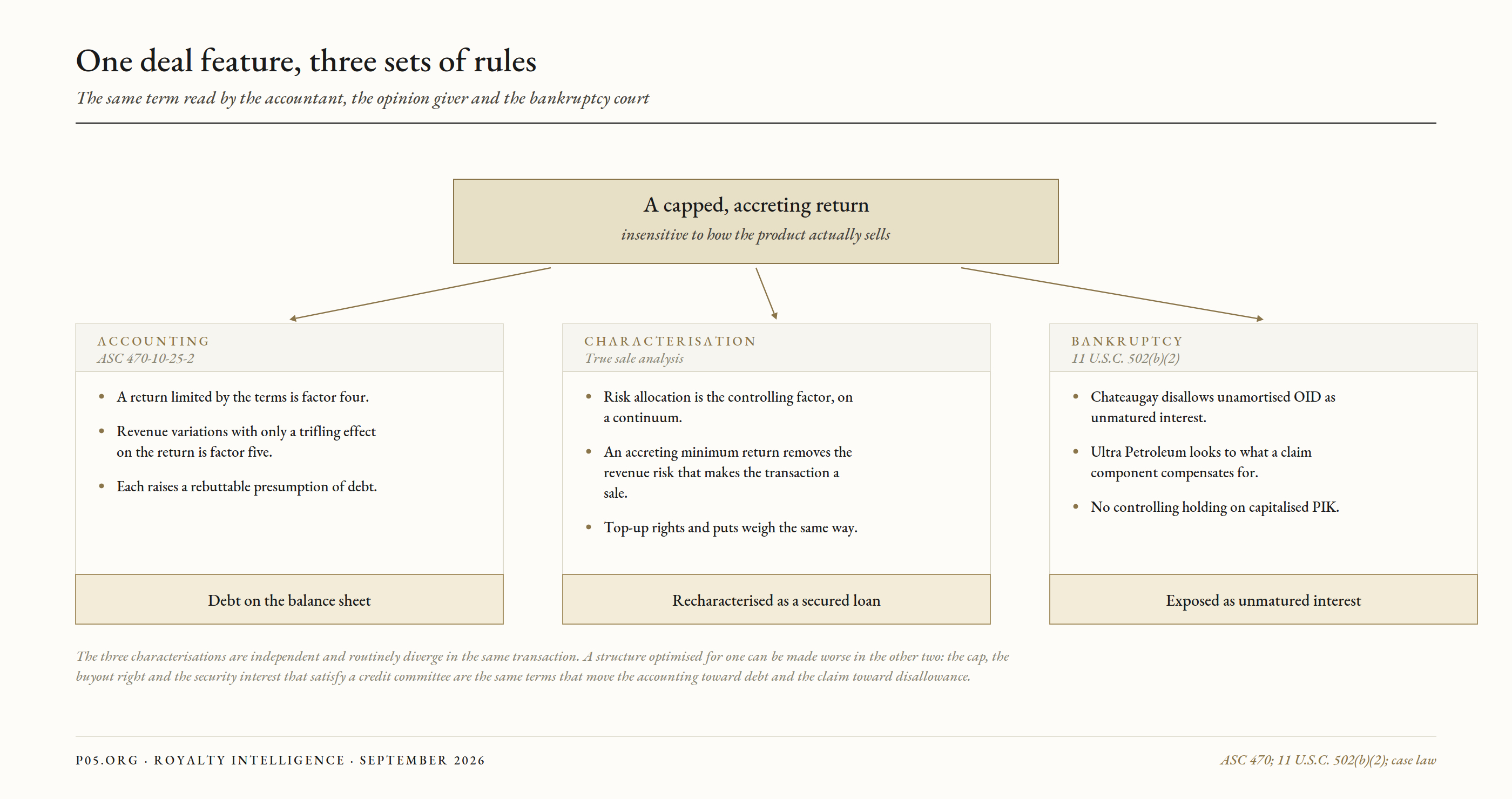
Figure 4. One deal feature, three sets of rules. A capped accreting return insensitive to product performance pushes the ASC 470 classification toward debt, the true sale analysis toward a secured loan, and a section 502(b)(2) claim toward disallowance. Optimising for one can worsen the other two.
What moves the position, and what only appears to
Terms that move it:
- Whether the deferral mechanic sits in the same instrument as the royalty. Paratek section 3.01(c) makes collections the trigger for accretion; every other structure in this set leaves the royalty leg cash-pay and puts the toggle in a separate agreement.
- The price of the election. A step-up of 150 to 200 basis points, as in Omeros, BioCryst and Esperion, changes the yield calculation that the AHYDO tests measure. Verastem's absence of a step-up, under a 9.75 per cent all-in cap, is a different instrument for tax purposes than the same toggle priced at 200 basis points.
- Whether the royalty leg carries a retroactive catch-up rate, a minimum-payment gross-up or a multiple cap, and what the base and the measurement date are. Insmed's catch-up measures at the quarter ending 31 March 2028 against $150.0 million; Phathom's gross-ups measure at 31 December 2028 and 31 December 2037.
- The entity classification of the borrower. Section 163(e)(5) reaches corporate issuers, and a single-purpose LLC vehicle changes whether the AHYDO analysis runs at all.
- Whether a PIK feature was agreed at closing or introduced by amendment. Lincoln's data puts the amended cohort at 56 per cent of PIK-paying loans, with loan to value on that cohort at 76.0 per cent.
- Whether the seller books the transaction as debt, and the effective rate it imputes. A 16 per cent rate against low single-digit early royalties produces a liability that grows for years without any contractual deferral.
Terms that only appear to:
- A cap expressed as a multiple, which fixes the total without fixing the timing, the yield or the period over which it is reached. Paratek's 190 per cent, Phathom's 200 per cent and Allurion's 260 per cent bound three different rates of accretion.
- True sale language in an agreement the seller books as debt under ASC 470, which resolves neither the tax characterisation nor the bankruptcy one.
- A waiver of royalty payments, which removes the cash obligation without creating an accrual. Karyopharm's four waived quarters are paid for by a forward rate rise, not by a balance that grows.
- Non-cash interest disclosed in a cash flow statement, which records an accounting outcome and says nothing about whether any party elected anything.
- The presence of a royalty fund on the lender side. Three of Esperion's four initial lenders are HealthCare Royalty vehicles funding a term loan with no royalty in it.
What each side should ask
For the fund providing the capital
- Does any provision let the royalty or revenue interest payment itself be deferred, and if not, what happens to the position when the borrower elects PIK on the loan beside it?
- What is the toggle priced at, how many periods does it cover, and is minimum cash pay expressed on the margin or on the reference rate?
- Is the election disabled on a default, and does it block distributions and other permitted payments while it is in use?
- Where does the accreted balance sit against any senior debt cap, and does the cap measure principal as originally advanced or as increased?
- Is there an AHYDO savings provision, and on which of the three open questions does its catch-up calculation depend?
- What OID will accrue into income before any cash is received, and over what period?
For the company raising it
- Does the toggle buy enough runway to be worth the step-up, measured against the number of periods it is available rather than the headline rate?
- Which classification is being optimised, and what does that do to the other two? A cap, a buyout right and a security interest together move the accounting toward debt and the bankruptcy analysis toward a secured loan.
- If the deferral is being added by amendment rather than agreed at closing, what does the modification do to the instrument's tax status?
For the counterparty already holding a royalty on the same product
- Does the new facility's collateral package reach the royalty-bearing asset, and was the royalty interest expressly excluded, as in Omeros?
- Were the debt incurrence restrictions in the existing royalty agreement amended to permit it, as Insmed's were in October 2024?
- Where do the revenue interests sit in the intercreditor arrangement while the senior tranche is accreting?
Verastem's PIK Option and its Revenue Participation Payments were signed in the same document on the same day. The first can be deferred for eight payment dates at no extra cost. The second is cash only, estimated quarterly and reconciled against actual sales.
Almost every financing in this set divides the same way, so the phrase PIK toggle names the loan beside the royalty and not the royalty.
Paratek shows what the alternative costs. Making royalty collections the trigger for accretion removes the election, the notice and the step-up, and replaces the period limit with a 190 per cent cap on the total. The balance grew by $1.8 million in 2021 and $3.0 million in 2022 without anyone deciding anything.
The accounting produces a growing balance for a much larger set of transactions, whether or not the papers mention payment in kind. Insmed's royalty financing liability was larger at 30 June 2025 than it was at issue, after three years of payments.
All information in this article was accurate as of the research date and is derived from publicly available sources including SEC filings, issuer press releases, court opinions, tax statutes and Internal Revenue Service guidance, accounting standards guidance, regulatory and central bank publications, and legal and financial commentary. Information may have changed since publication. This content is for informational purposes only and does not constitute investment, legal, accounting, tax, or financial advice. The author is not a lawyer, accountant, tax adviser, or financial adviser.