
Company of the week: BRAIN Biotech
BRAIN Biotech sold a royalty it had never collected, on a drug it does not own, to Royalty Pharma. The contract is on EDGAR. On 9 September it received $13.4m (€11.51m) because a Phase 3 study worked, and booked a non-cash charge of up to $32.6m (€28m) for the same event.

Company of the week: BRAIN Biotech
An enzyme company in Hesse holds one of the better-documented royalty origination stories in European small cap. BRAIN Biotech AG makes bakery enzymes, ingredients and microbial production strains, generated $57.7m (€49.6m) of revenue in its last financial year, and employs around 280 people. It also sat, until September 2024, at the top of the obligation stack on deucrictibant, an oral bradykinin B2 receptor antagonist that Pharvaris expects to launch in the United States in 2027.
The position came from a licence signed in 2016 for $291,000 (€250,000). Most write-ups of what followed stop at the press release. The document that matters is Amendment 2 to that licence, executed on the closing date and filed in full by Pharvaris as an exhibit to a Form 6-K, which sets out what was sold, to whom, with what security, and on what clock.
The accounting is the second half of the file. BRAIN did not derecognise the stream. It carries the arrangement as a financial liability remeasured under IFRS 9, so every improvement in the drug's prospects raises the carrying value of the obligation and runs through the financial result. The same event produces a receipt and a charge.
At a glance
| Item | Detail |
|---|---|
| Company | BRAIN Biotech AG, Zwingenberg, Germany. Around 280 employees |
| Listing | Frankfurt, Prime Standard, since 9 February 2016. Ticker BNN, ISIN DE0005203947 |
| Shares | 21,847,495 registered shares, free float 47.8 per cent |
| Ownership | MP Beteiligungs-GmbH 31.5 per cent and PBG Zweite GmbH 15.1 per cent, both Putsch; DAH Beteiligungs GmbH 5.6 per cent |
| Segments | BRAINBiocatalysts (enzymes, microorganisms, ingredients) and BRAINBioIncubator (research projects and pharmaceuticals), plus Holding |
| FY2024/25 | Revenue $57.7m (€49.6m) from $63.5m (€54.6m); adjusted EBITDA $-0.6m (€-0.5m); operating cash flow $-10.7m (€-9.2m) |
| Cash | $31.6m (€27.2m) at 30 September 2024, $7.2m (€6.2m) at 30 September 2025, $1.0m (€0.9m) at 30 June 2026 |
| 9M 2025/26 | Revenue $40.2m (€34.6m), down 10.5 per cent; adjusted group EBITDA $-0.8m (€-0.7m) |
| Licence of origin | Deucrictibant, licensed to Pharvaris under an agreement dated 31 March 2016, amended January 2021 and September 2024 |
| Royalty rate | Low to medium single-digit tiered on direct or indirect net sales |
| Buyer | Royalty Pharma |
| What was sold | BRAIN's right, title and interest in payments under Section 5.3 of the licence, secured by a security interest in the licence agreement |
| Headline terms | Up to $149.9m (€128.88m): $21.4m (€18.41m) upfront, $21.4m (€18.42m) regulatory, $107.0m (€92.05m) sales-related |
| Received to date | $21.4m (€18.41m) upfront and $13.4m (€11.51m) on 9 September 2026 |
| Outstanding | Up to $112.4m (€96.65m) from Royalty Pharma, plus up to $9.3m (€8.0m) retained against Pharvaris |
| Royalty term | Product by product, to expiry of the last Valid Claim of a Royalty-Bearing Patent. The family runs from an international application filed 23 November 2018 |
| Accounting | Presented as a financing transaction under IFRS, amortised on the effective interest method. Liability $29.6m (€25.453m) at 31 December 2025 |
| Implied cost | Finance cost of $1.13m (€0.970m) in the quarter to 31 December 2025 on an opening balance of €22.173m |
| Second position | Akribion Therapeutics, G-dase E, up to $107.3m (€92.3m) in milestones plus royalties |
| Third position | SolasCure, 35 per cent equity plus production rights to the API tarumase |
| Leadership | Dr Sven K. Weber becomes CEO on 1 October 2026. CFO Michael Schneiders |
| Royalty posture | Former holder. The stream is assigned; what remains is a contingent payment ladder |
Where the royalty came from
AnalytiCon Discovery GmbH, a natural products chemistry operation in Potsdam, joined the BRAIN group in 2013. On 31 March 2016 it signed a licence and a research agreement with Pharvaris covering a proprietary class of orally active bradykinin B2 receptor antagonists, described in the filings as OB2RA. AnalytiCon was merged into BRAIN Biotech AG with effect from 6 June 2024, three months before the sale.
Pharvaris's account of the terms is on EDGAR. The upfront consideration was €250,000, or about $291,000, the milestone schedule ran to $13.3m (€11.4m) across development, regulatory and sales events, and the running royalty was described as low to medium single-digit tiered on direct or indirect net sales, reducible country by country and product by product once a generic version reaches 1 per cent of the relevant market.
The chemistry was AnalytiCon's. Christoph Gibson, Joern Saupe, Horst-Dieter Ambrosi and Lars Ole Haustedt are named as inventors on the patent family, and the US assignment records run from AnalytiCon Discovery GmbH to Pharvaris B.V. and then to Pharvaris Netherlands B.V. The compounds were invented at the licensor and the patents are owned by the licensee.
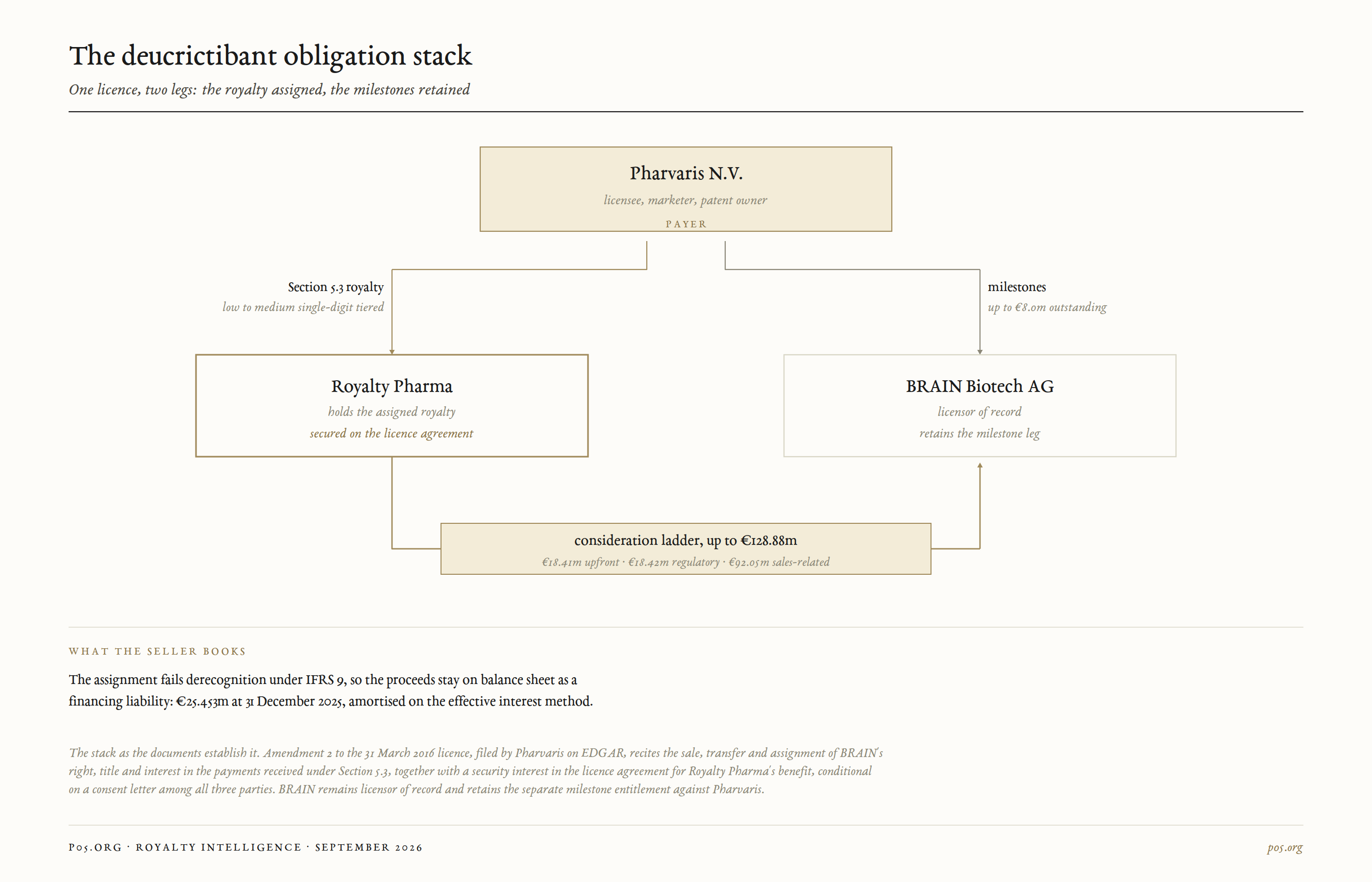
The deucrictibant obligation stack: payments under Section 5.3 assigned to Royalty Pharma, the milestone leg retained by BRAIN Biotech, and the consideration returning as its own ladder
What the amendment shows
Amendment 2 is dated 20 September 2024, signed for BRAIN by Adriaan Moelker and Michael Schneiders and for Pharvaris by Berndt Modig. Its recitals describe the transaction the press releases summarise.
BRAIN proposed to sell, transfer and assign its right, title and interest in the payments it receives from Pharvaris under Section 5.3 of the licence to Royalty Pharma, subject to reductions under Sections 5.5, 5.6, 6.4.4, 10.3.3 and 12.2.4, on terms including the grant for Royalty Pharma's benefit of a security interest in the licence agreement itself. The amendment takes effect only on execution of a consent letter, specified as Exhibit D-2 to a Royalty Purchase Agreement between BRAIN and Royalty Pharma, among all three parties.
So the licence counterparty did not change. Pharvaris's most recent annual report is correct when it says the company is required to pay BRAIN low to medium single-digit tiered royalties, because BRAIN remains the licensor of record. What moved is the payment right under one section, assigned away and collateralised by the contract that creates it.
The royalty base was narrowed
The amendment inserts a new definition. A Royalty-Bearing Product is any Licensed Product containing a compound within the scope of the Markush general formula (I) of claim 1 of US Patent No. 10,836,748, and deucrictibant, PHVS416 and PHVS719 are each named as one.
The phrase "Licensed Product" is then replaced by "Royalty-Bearing Product" throughout Sections 1.13, 1.17, 1.22, 5.2, 5.3, 5.6 and 6.1, which is to say throughout the payment machinery. Section 5.4 is recast so that the old distinction between "Product" and "Backup Product" becomes a distinction between a Royalty-Bearing Product containing deucrictibant and one that does not.
Before the amendment, the licence attached royalties to licensed products as a class. After it, royalties attach to one chemical genus defined by one patent claim. The buyer acquired a narrower and far more precisely bounded asset than the 2016 contract described, and the seller gave up any royalty on anything Pharvaris might later develop from the licensed class outside that formula.
The duration clock was rewritten
The original Section 10.1 ran the term to expiry of the last patent of the licensed intellectual property. The amendment replaces that with a product-by-product test: for each Royalty-Bearing Product, expiry of the last Valid Claim of a Royalty-Bearing Patent claiming that product.
A Royalty-Bearing Patent is US 10,836,748 and any patent or application sharing a common priority with it, listed on a new Schedule A running to roughly fifty jurisdictions, including EP 3713928 B1, granted 12 January 2022, and the US continuations 11,261,173 and 11,820,756.
The definition of Valid Claim carries the load. It includes patent term extensions and supplementary protection certificates, and it excludes any claim that has been cancelled, abandoned, waived, disclaimed, rejected, revoked or held invalid or unenforceable, expressly naming opposition, re-examination, reissue and inter partes review among the routes by which that can happen. A successful challenge to the family shortens the stream directly.
The European application was filed on 23 November 2018 with a priority date of 24 November 2017. A nominal twenty-year term from filing runs to 23 November 2038, before any extension and before any successful challenge.
The buyer therefore holds a stream whose duration depends on a patent estate owned, prosecuted and defended by the company that pays the royalty.
The structure
BRAIN sold the royalty and kept everything else. Only the future royalties were monetised, and contractual milestone payments of up to $10.5m (€9.0m) for nearer-term clinical progress stayed with BRAIN.
What came back was $21.4m (€18.41m) of cash and a contingent ladder: up to $21.4m (€18.42m) tied to regulatory events, and up to $107.0m (€92.05m) tied to sales. Royalty Pharma describes the same trade as an upfront of approximately $21m and up to €110.5m in milestone payments. Deucrictibant entered the buyer's development-stage portfolio.
The seller retained sales-linked exposure after selling a sales-linked asset. The economics that left the building came back as a schedule with defined ceilings, no duration risk beyond the last milestone, and no cash cost to service. Goodwin Procter advised Royalty Pharma with KPMG Law and KPMG advising BRAIN, and Fenwick acted for Royalty Pharma on intellectual property diligence.
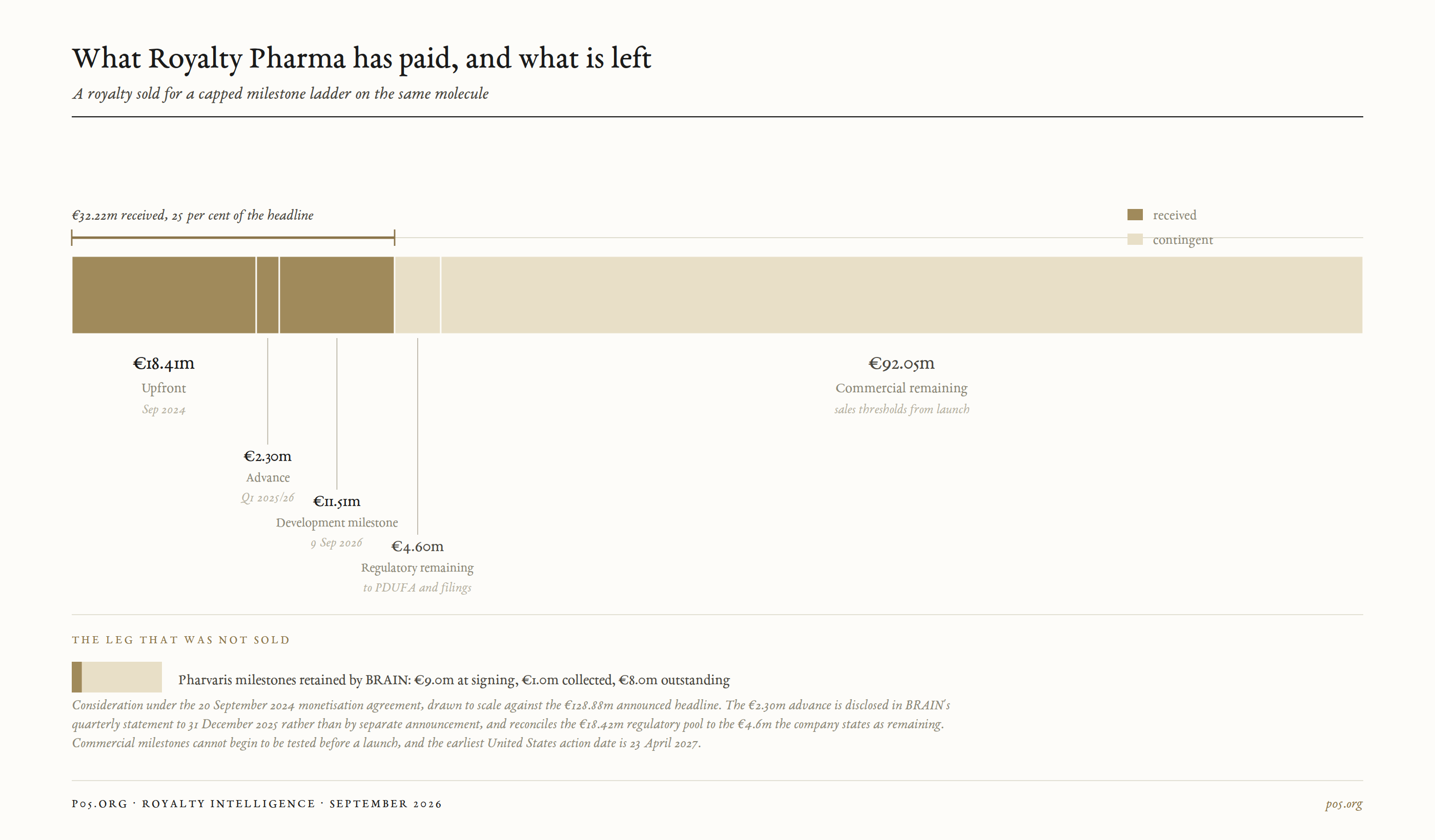
The €128.88m consideration ladder drawn to scale, received against contingent, as at 17 September 2026
The instrument: financing, not sale
BRAIN's quarterly statement to 31 December 2025 carries the transaction on the face of the balance sheet. Under non-current liabilities sits a separate line, "of which financial liability from the Royalty Pharma transaction", at $29.6m (€25.453m), against $25.8m (€22.173m) three months earlier. The same statement says in terms that in the IFRS accounts the Royalty Pharma transaction is presented as a financing transaction, and attributes the movement to the €2.3m advance received and to amortisation under the effective interest method.
The income statement is equally explicit. Finance costs carry their own sub-line, "of which in connection with the financial liability from the Royalty Pharma transaction", at $1.13m (€0.970m) for the quarter against $0.93m (€0.803m) in the same quarter a year earlier.
That figure is the price of the money. Finance cost of €0.970m on an opening balance of €22.173m is 4.4 per cent in a single quarter, and the prior-year quarter sits at almost the same ratio against the balance the upfront created. Annualised, the implied cost of the monetisation is in the high teens. For comparison, Ionis carries its 2023 Royalty Pharma monetisation as a liability related to the sale of future royalties, amortised using the effective interest rate method, and recorded interest expense of $37.2m over six months on an opening balance of $542.2m, an annualised rate around fourteen per cent. BRAIN raised dearer money than a Nasdaq-listed seller with a marketed product behind the stream.
The milestone receipts are not revenue. The €2.3m that arrived in the first quarter is described as an advance payment under the monetisation agreement and appears in cash flow from financing activities alongside scheduled debt repayments. Only the separate €1.0m from Pharvaris ran through BRAINBioIncubator revenue.
The equity line shows what the treatment costs. Group equity fell from $2.1m (€1.841m) at 30 September 2025 to $-0.85m (€-0.728m) at 31 December 2025, which the company attributes to the loss for the period and to accounting amortisation effects from the effective interest method on the Royalty Pharma transaction, adding that equity under the German HGB single-entity accounts remains positive. A further charge of up to $32.6m (€28m) is now scheduled to run through the same financial result in 2025/26.
Why it failed derecognition
Under IFRS 9 a transferor derecognises a financial asset only where it has transferred substantially all the risks and rewards, or transferred control. BRAIN did neither cleanly. It retained a milestone ladder payable by the buyer whose value is a direct function of the same molecule's regulatory and commercial progress, and the consideration is staged and success-contingent rather than fixed. That is continuing involvement, and the proceeds stay on balance sheet as a liability.
The shape is not unusual once you look for it. Arrowhead sold Royalty Pharma its olpasiran royalty for $250m upfront and up to $160m of milestones, and the accounting note records that Royalty Pharma receives all royalties otherwise payable by Amgen while Arrowhead remains eligible for the Amgen milestones, which is the BRAIN structure line for line: the royalty leg goes, the licensee milestone leg stays, and the consideration comes back as its own event ladder.
Legal sale and accounting sale are different questions
Failing derecognition does not mean BRAIN still owns the royalty. Amendment 2 recites a sale, transfer and assignment of the Section 5.3 payments, and German law recognises an assignment of future receivables that binds once the receivables arise, provided it was perfected beforehand and the claims are sufficiently determined. The security interest over the licence and the tripartite consent letter are the standard means of getting a German-law assignment closer to insolvency remoteness, by letting the buyer preserve the contract that generates the income rather than rank as one more creditor against it.
For a desk pricing BRAIN credit, the distinction decides where Royalty Pharma sits. If the assignment holds as a legal sale, the royalty simply is not in the estate and the buyer is not competing with BRAIN's other lenders. If it were recharacterised, a secured claim over the licence would rank ahead of the shareholder facilities. BRAIN's other debt is close in: the $10.5m (€9.0m) revolver and the matured $5.8m (€5.0m) convertible both sit with MP Beteiligungs-GmbH, a $5.8m (€5.0m) growth financing came from the Hessen state vehicle bmh in May 2024, and the first quarter of 2024/25 included repayment of a $5.8m (€5.0m) shareholder loan. Inter-creditor ranking, security and covenants are not disclosed for any of them.
What happened on 8 and 9 September
On 8 September 2026 Pharvaris reported topline results from CHAPTER-3, its Phase 3 study of deucrictibant extended-release tablets for prevention of hereditary angioedema attacks. The primary endpoint showed an 83 per cent reduction in attack rate against placebo, 87 per cent in patients with Type 1 or Type 2 disease, with all secondary efficacy endpoints met. Marketing authorisation applications begin in the first half of 2027.
On 9 September BRAIN announced receipt of $13.4m (€11.51m) from Royalty Pharma for achievement of a key development milestone, and restated the remaining ladder at up to $5.3m (€4.6m) of regulatory and up to $107.0m (€92.05m) of commercial milestones.
Those two figures reconcile once the quarterly reporting is read. The regulatory pool was €18.42m at signing. BRAIN received $2.7m (€2.3m) of advances under the monetisation agreement in the quarter to 31 December 2025, the quarter in which Pharvaris reported RAPIDe-3 on 3 December. Deducting that and the €11.51m leaves €4.61m, which is the €4.6m the company now states as remaining. The "another" in the September release refers to that earlier advance, which was disclosed in the quarterly statement rather than by separate announcement.
The retained leg reconciles cleanly by contrast. Pharvaris disclosed up to $10.5m (€9.0m) of outstanding milestone obligations at 31 December 2024 and $9.3m (€8.0m) a year later. BRAIN booked $1.2m (€1.0m) of deucrictibant milestone income in the quarter to 31 December 2025, the quarter in which Pharvaris reported RAPIDe-3.
The charge
Because the programme's prospects improved, the liabilities arising from the monetisation are remeasured under IFRS 9, producing a one-time non-cash charge to the financial result for 2025/26 of up to $32.6m (€28m). Over the full term the company states the effect will at minimum be fully offset. Adjusted group EBITDA guidance of around break-even was reaffirmed.
A monetisation that fails the derecognition test stays on the balance sheet as a liability measured at fair value. The better the drug performs, the larger the expected future payments to the seller, and the larger the obligation the structure is deemed to represent. A company capitalised at around $70m (€60m) will report a financial-result charge approaching half of that because its partner's Phase 3 study met its endpoint. The charge moves no cash and does not touch adjusted EBITDA, and it will sit in the statutory accounts published in January 2027.
Why the timing matters
Cash and cash equivalents ran from $31.6m (€27.2m) at 30 September 2024, the balance date immediately after the upfront, to $7.2m (€6.2m) a year later and $1.0m (€0.9m) at 30 June 2026. Operating cash flow in 2024/25 was $-10.7m (€-9.2m). The monetisation proceeds funded an enzyme business, a debt reduction programme and a capital expenditure cycle, and were substantially consumed within twenty-one months.
The $10.5m (€9.0m) revolving line available at that point was signed on 13 July 2026 with MP Beteiligungs-GmbH, the anchor shareholder. It runs to 31 December 2028 at six-month forward Euribor plus 233 basis points, for general corporate financing and scheduled debt service. The scheduled debt included a $5.8m (€5.0m) convertible bond placed with the same shareholder in February 2024 at 6.52 per cent, conversion price $5.86 (€5.04), maturing 5 September 2026.
The convertible matured four days before the milestone arrived, far out of the money against a share price under $3.50 (€3.00). The sequence across three months is a related-party facility in July, a maturity in early September, and a $13.4m (€11.51m) royalty-derived receipt on 9 September.
Operating performance is moving the other way. Nine-month revenue fell 10.5 per cent and BRAINBiocatalysts fell 13.3 per cent on weak bakery enzyme demand and a production relocation to a joint site in the Netherlands, with segment margin guidance cut to below 10 per cent. The BioIncubator forecast was raised to around $7.0m (€6.0m) of revenue and at least $1.2m (€1.0m) of adjusted EBITDA.
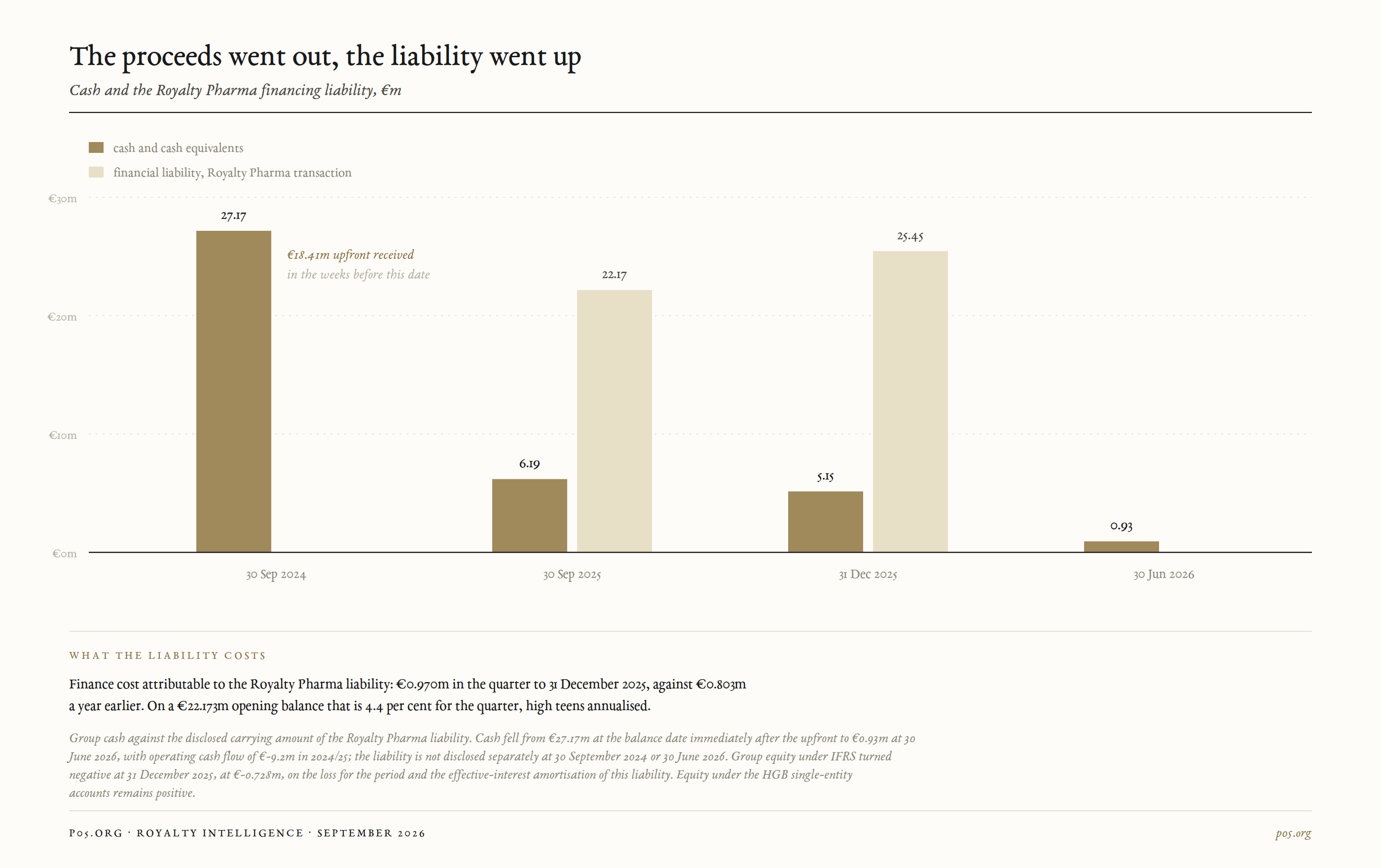
Group cash against the disclosed carrying amount of the Royalty Pharma financing liability, €m
The rest of the book
Akribion Therapeutics GmbH took an exclusive pharmaceutical licence to the G-dase E nuclease on 31 October 2024, against up to $107.3m (€92.3m) in R&D and commercial milestone fees plus royalties on net sales, with non-pharma rights to the same CRISPR portfolio retained in-house. Akribion is independently owned; its $9.3m (€8m) seed round was led by CARMA FUND and RV Invest with MP Beteiligungs GmbH, Hessen Kapital I, Bruker Invest and High-Tech Gründerfonds participating. The seed closed in February 2025. The structure repeats the deucrictibant pattern at an earlier stage.
The industrial side of the same estate is now licensable in its own right. BRAIN's European substance patent for the BMC nuclease, EP 4301852 B1, took effect on 18 March 2026 across the Unitary Patent territories, the United Kingdom and Switzerland, with applications pending elsewhere, and the company offers the technology for strain optimisation under licence. No counterparty or rate has been disclosed.
SolasCure is the nearer-term one. BRAIN holds 35 per cent of the equity and production rights to tarumase, the enzymatic API in Aurase Wound Gel. A Phase 2a extension study reported in February 2026 showed 22 times more effective debridement and 7 times faster healing than the control arm, against a US addressable market the company puts at around $4.3bn, and SolasCure is raising for Phase 2b/3.
An originator looking at BRAIN's own book today sees a preclinical nuclease licence, a minority stake in a private wound-care developer, and a production right. The saleable royalty has been sold.
The dated tests
The immediate-release capsule is under FDA review for on-demand treatment with a PDUFA target action date of 23 April 2027. The application covers more than 1,300 treated attacks and RAPIDe-3, which met its primary endpoint and all eleven secondary endpoints, with median time to onset of symptom relief of 1.28 hours. Deucrictibant holds orphan drug designation from the FDA, the European Commission and Swissmedic.
The extended-release tablet follows on the CHAPTER-3 data, with filings starting in the first half of 2027. Topline data from Part 1 of CREAATE, in acquired angioedema due to C1 inhibitor deficiency, are expected in the first quarter of 2027.
Commercial milestones of $107.0m (€92.05m), which represent 71 per cent of the announced headline value, depend on sales thresholds that cannot begin to be tested before a 2027 launch.
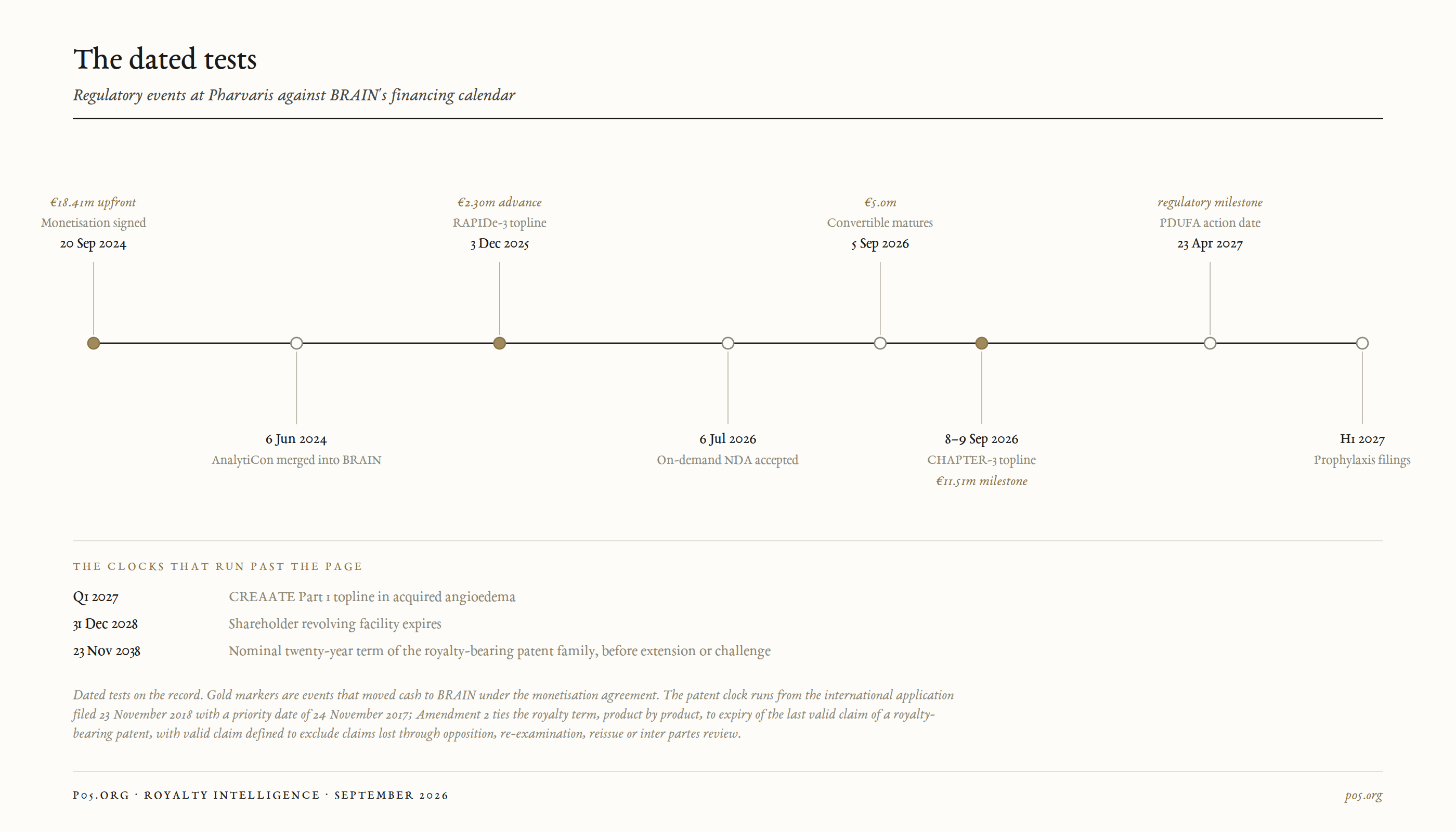
Regulatory events at Pharvaris against BRAIN's financing calendar, with the clocks that run past the page
Who else is in the indication
The indication filled up while BRAIN was selling. Garadacimab was approved in June 2025, sebetralstat on 7 July 2025 as the first oral on-demand treatment, and donidalorsen in August 2025, taking US approvals in the indication up by 38 per cent inside nine months. Sebetralstat reaches the same point in the pathway that the immediate-release capsule is filed for, and it changed hands while deucrictibant was in review: Chiesi agreed in April 2026 to buy KalVista at $27.00 a share, implying about $1.9bn, and completed the tender on 11 June 2026, with Ekterly already approved in the United States, United Kingdom, European Union and Japan. The commercial milestones in BRAIN's ladder are calculated on sales that have to be taken from that product.
Further out sits a different kind of threat to a royalty that runs to patent expiry. Intellia's NTLA-2002 is a single-dose in vivo CRISPR treatment whose HAELO Phase 3 study recorded actual primary completion on 10 February 2026, with the company having guided to a BLA in 2026 and a US launch in 2027. A one-time treatment that removes the need for chronic prophylaxis attacks the base on which the commercial milestones are calculated.
Red team versus blue team
Risk analysis (red team)
The operating business is contracting while the proceeds are being consumed. Cash fell from $31.6m (€27.2m) to $1.0m (€0.9m) across twenty-one months, with operating cash flow of $-10.7m (€-9.2m) in 2024/25. Nine-month revenue fell 10.5 per cent and the core segment fell 13.3 per cent, with margin guidance cut mid-year.
The company is a capped seller of its own upside. The royalty was assigned before a unit was made. If deucrictibant reaches the sales levels that support the full $107.0m (€92.05m) ladder, the running royalty foregone on a tiered single-digit rate to 2038 or later could exceed the capped consideration.
The reported liability moves against the shareholder on good news. A charge of up to $32.6m (€28m) in the 2025/26 financial result follows from a successful Phase 3. It is non-cash and stated to reverse, and it still lands in the statutory accounts of a company capitalised at around $70m (€60m).
The money was expensive. Finance cost attributable to the Royalty Pharma liability ran at €0.970m in the quarter to 31 December 2025 on an opening balance of €22.173m, an implied annualised cost in the high teens, against roughly fourteen per cent on the comparable Ionis liability.
Group equity has gone negative under IFRS. Equity fell to €-0.728m at 31 December 2025 from €1.841m three months earlier, on the loss and the effective-interest amortisation of the Royalty Pharma liability, before the up to €28m charge now scheduled for 2025/26. Equity under the HGB accounts remains positive, so the effect is presentational, and it is the presentation a covenant or an index screen reads.
The stream's duration sits inside the payer's patent estate. Royalties run product by product to expiry of the last Valid Claim of a patent family owned and prosecuted by Pharvaris. The amendment defines Valid Claim to exclude claims revoked through opposition, re-examination, reissue or inter partes review, so a successful third-party challenge shortens the stream directly.
The royalty base was narrowed at closing. Payments now attach only to products within the Markush formula of one claim, replacing a definition that covered licensed products as a class. Anything Pharvaris develops from the licensed class outside that formula carries nothing.
Financing runs through the anchor shareholder. The $10.5m (€9.0m) revolver, the matured $5.8m (€5.0m) convertible and part of the Akribion seed syndicate all involve MP Beteiligungs-GmbH, which with PBG Zweite GmbH holds 46.6 per cent of the share capital. Third-party terms at this size and cash position are untested.
The remaining value is concentrated in one compound at one counterparty. $112.4m (€96.65m) depends on Pharvaris obtaining approvals and reaching sales thresholds, in an indication that added three approved products in 2025 and faces a possible one-time gene-editing treatment from 2027.
Leadership changes on 1 October 2026. Dr Sven K. Weber arrives from BASF's feed enzymes business for a three-year term, replacing the chief executive who signed both monetisations and whose signature is on Amendment 2.
The retained pipeline is early. Akribion is preclinical and independently financed; SolasCure is raising for Phase 2b/3.
Opportunities and mitigants (blue team)
The origination economics are exceptional and documented. A $291,000 (€250,000) upfront in 2016 has produced $34.8m (€29.92m) of cash and a contingent ladder of up to $121.7m (€104.65m) across both counterparties, against a market capitalisation in the region of $70m (€60m). The transaction value exceeded four times the pre-announcement market capitalisation.
The contract is public and so is the liability. Amendment 2, the assignment recital, the security interest, the Royalty-Bearing Product definition and the Schedule A patent list are on EDGAR, and BRAIN discloses the Royalty Pharma liability and its finance cost as separate lines in its own quarterly statements. A European royalty monetisation at this size that can be diligenced from primary documents on both sides is rare.
The financing was non-dilutive. Both the upfront and the milestone were taken without issuing equity at a price four covering analysts put in a target range of $5.82 to $7.56 (€5.00 to €6.50) as at June 2026.
The seller kept the near-term leg and it is paying. Up to $9.3m (€8.0m) of Pharvaris milestones remain outside the sale, and $1.2m (€1.0m) of that was collected and booked as segment revenue in the quarter to 31 December 2025.
Probability has moved materially. CHAPTER-3 met its primary and all secondary endpoints, RAPIDe-3 met its primary and all eleven secondary endpoints, and the on-demand NDA is accepted with an action date of 23 April 2027.
The buyer is the reference counterparty and it bought carefully. Royalty Pharma priced the asset, ran its own intellectual property diligence, took a security interest in the licence agreement, required a tripartite consent letter as a condition of effectiveness, and tightened both the royalty base and the duration definition at closing.
The model is repeatable and has been repeated. Six weeks after closing, BRAIN licensed G-dase E to Akribion on the same shape: capped milestones plus royalties, clinical capital raised by an independent vehicle, non-pharma rights retained.
The charge is a measurement effect with a stated reversal. Break-even adjusted group EBITDA guidance was reaffirmed on the day the charge was announced.
Summary
| Risk | Concern |
|---|---|
| Core business | Revenue down 10.5 per cent over nine months, margin guidance cut |
| Liquidity | Cash $31.6m to $1.0m in twenty-one months; $10.5m related-party line |
| Sold upside | Capped consideration against a tiered royalty running to 2038 or later |
| Accounting | Up to $32.6m (€28m) non-cash charge to the 2025/26 financial result |
| Cost of funds | Implied annualised cost in the high teens against about fourteen per cent at Ionis |
| Equity | IFRS group equity €-0.728m at 31 December 2025 before the €28m charge |
| Duration | Term tied to Valid Claims of a family owned and prosecuted by the payer |
| Royalty base | Narrowed at closing to one Markush formula in one patent claim |
| Related party | Anchor shareholder is lender, convertible holder and co-investor |
| Concentration | $112.4m (€96.65m) rests on one compound at one counterparty |
| Competition | Three US approvals in 2025; single-dose gene editing filed from 2026 |
| Opportunity | Observation |
|---|---|
| Origination cost | $291,000 upfront in 2016 against $34.8m (€29.92m) received to date |
| Documentation | Assignment and patent schedule on EDGAR; liability and finance cost disclosed as separate lines |
| Non-dilutive | No equity issued; analyst targets $5.82 to $7.56 (€5.00 to €6.50) |
| Retained leg | Up to $9.3m (€8.0m) of Pharvaris milestones outside the sale, and paying |
| Probability | CHAPTER-3 and RAPIDe-3 met all endpoints; PDUFA 23 April 2027 |
| Counterparty | Royalty Pharma priced it, secured it and holds it |
| Repeatability | Akribion licence on the same structure six weeks later |
| Residual assets | 35 per cent of SolasCure plus tarumase production rights |
Conclusion
BRAIN Biotech is a seller-side file that can be read from primary documents at both ends, which is uncommon at this size. A natural products chemistry unit signed a licence in 2016 that cost the licensee $291,000 (€250,000). Nine years later it had become the most valuable asset in a listed enzyme company, and the company sold the part of it a specialist buyer wanted, at a headline value several times its own market capitalisation, without issuing a share.
The residual is where the structure shows. BRAIN exchanged a perpetual percentage for a capped schedule, kept a separate milestone leg against the licensee, and carries the whole arrangement as a liability that grows when the drug succeeds. The buyer, for its part, did not simply take an assignment. It took a security interest in the contract, narrowed the royalty base to a single chemical genus and rewrote the duration clause around Valid Claims, all on the closing date, all on the public record.
The dates from here belong to Pharvaris. 23 April 2027 for the on-demand capsule, the first half of 2027 for the prophylaxis filings, and the first quarter of 2027 for CREAATE. After that it is sales thresholds on a drug launching into an indication with four approved competitors and a gene-editing treatment behind them, and a patent family that has to survive to 2038 for the buyer to collect what it paid for.
All information in this article was accurate as of September 2026 and is derived from publicly available sources including BRAIN Biotech AG and Pharvaris N.V. press releases and regulatory announcements, SEC filings by Pharvaris N.V., Royalty Pharma plc and KalVista Pharmaceuticals, Royalty Pharma quarterly reporting, ClinicalTrials.gov, national patent register records, law firm transaction announcements, and financial and trade press reporting. The terms described as Amendment 2 are taken from the execution version of that amendment filed by Pharvaris as an exhibit to a Form 6-K on 23 September 2024; the underlying 2016 licence agreement, Amendment 1, the Royalty Purchase Agreement between BRAIN Biotech and Royalty Pharma and the consent letter referred to in Amendment 2 are not public, and the royalty rates, tier thresholds, reduction mechanics under Sections 5.5, 5.6, 6.4.4, 10.3.3 and 12.2.4, audit rights and change-of-control provisions are therefore not determinable. The royalty rate is described in Pharvaris filings only as low to medium single-digit tiered. The €2.31m reconciliation gap in the regulatory milestone pool is arithmetic drawn from the parties' own announcements and is not itself a disclosed figure; no inference is drawn as to its cause, and the reference to the FDA's acceptance of the on-demand NDA identifies a dated event in the relevant period rather than a payment trigger. The nominal patent term calculation is taken from the filing date of the European application as recorded in a national patent register and does not account for patent term extensions, supplementary protection certificates, terminal disclaimers or any pending or future validity challenge. The IFRS 9 charge of up to €28m is the company's own estimate as stated on 9 September 2026 and had not appeared in audited accounts as at the research date. The carrying amount of the Royalty Pharma liability, the attributable finance cost, the advance payments and the equity figures are taken from BRAIN Biotech's own unaudited quarterly statement to 31 December 2025; the implied cost of funds is arithmetic on those disclosed figures and is not a rate the company has published. The comparison to Ionis is arithmetic on figures disclosed in that company's own filings and the two arrangements are not identical in structure or stage. The discussion of German assignment and insolvency law is general and the governing law of the licence and of the Royalty Purchase Agreement is not disclosed in the EDGAR exhibit; nothing here is a legal opinion on whether a true sale would be upheld. Inter-creditor ranking, security and covenants for BRAIN's other facilities are not publicly disclosed. No proceeds-sharing obligation to a co-inventor, grant provider or public funding body has been disclosed, and no opposition, inter partes review or revocation action against the Royalty-Bearing Patent family was identified in public sources as at the research date; neither is stated as confirmation that none exists. Euro amounts are converted to US dollars at approximately 1.163 dollars per euro, the rate implied by the parties' own paired disclosures in September 2026, except where a party stated its own dollar figure at the time; counsel described the announced headline value as up to $140m at signing in September 2024, when the rate was materially different. Conversions are presentational and no amount has been paid or received in dollars. References to Royalty Pharma are to the group; the entity named in the recital to Amendment 2 is Royalty Pharma Investments 2019 ICAV, an Irish collective asset-management vehicle whose sole owner, RP Holdings, remains a consolidated subsidiary of Royalty Pharma plc as at its quarterly report for the period ended 30 June 2026. Share price, market capitalisation and analyst target figures are point-in-time. Trial timelines, PDUFA and filing dates, launch expectations and milestone ladders are company expectations and regulatory targets rather than realised results. Information may have changed since publication. This content is for informational purposes only and does not constitute investment, legal, or financial advice. The author is not a lawyer or financial adviser.