
The updated EU pharma package, read from the royalty side

The Council adopted its first-reading position on the two texts that replace Directive 2001/83/EC and Regulation 726/2004 on 17 and 18 September 2026, in Regulation ST 7105/26 and Directive ST 7106/26. These are not law yet. They carry the compromise reached with the Parliament in December 2025, but they still have to clear the Parliament's second-reading vote and publication in the Official Journal before they bind anyone, and they are in legal-linguistic revision, so wording, cross-references and numbering can still move.
The published commentary treats the residual risk as technical rather than substantive, which makes the architecture stable enough to model against while the final text is not fixed. On the current timetable the rules would apply around 2028, roughly 24 months after entry into force, under Article 222 of the Directive and Article 187 of the Regulation. The article numbers cited here track the Council documents, not the act as it will be published.
For a royalty book the operative change is not the headline exclusivity number. The ceiling on regulatory protection stays close to where it sits today. What moves is the composition of that protection: one year that was unconditional becomes conditional, and the conditions attach to launch behaviour, comparator choice and unmet-need status. A protection cliff that could be carried as a fixed input now has to be modelled per product.
The protection stack, recomposed
Article 83 of the Directive gives a new active substance eight years of regulatory data protection, running from the initial authorisation across the global marketing authorisation of Article 6(2), followed by one year of regulatory market protection. The figure rises to nine years of data protection only where an antimicrobial data-exclusivity voucher applies. The base case for an ordinary new substance is nine years of protection in total.
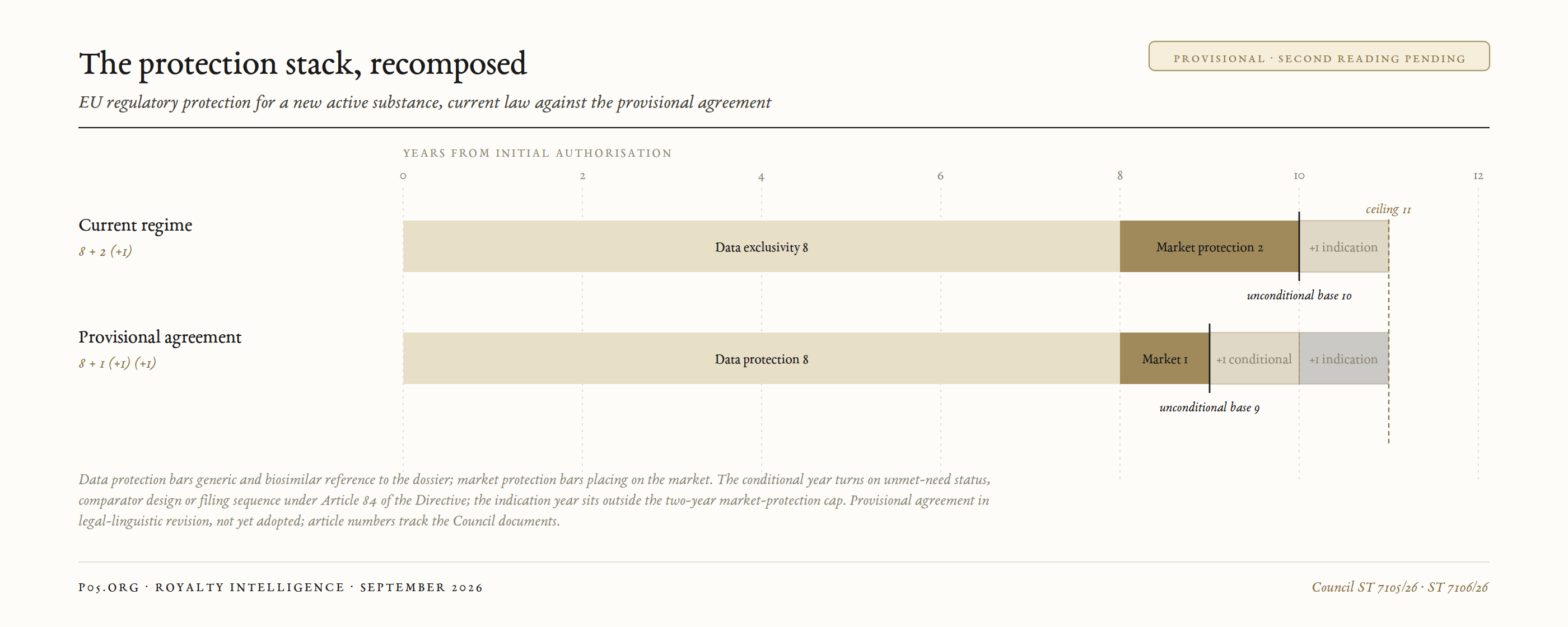
Article 84 supplies the conditional year. The market-protection period extends by twelve months where the product addresses an unmet medical need under Article 85, or where a new active substance is supported by comparative trials against an evidence-based comparator and either filed first in the Union (or within 90 days of the first filing outside it) or run across more than one Member State.
A separate twelve months attaches under Article 84(2) where the holder secures a new therapeutic indication of significant clinical benefit during the data-protection period, available once. Article 84(3) caps cumulative market protection at two years, with the indication year sitting outside that cap.
The comparison to the current regime needs its assumption stated. Directive 2001/83/EC gives eight years of data exclusivity and two years of market protection as an unconditional block, with a further year for a significant new indication authorised in the first eight years: the familiar 8+2+1, ten years before any indication reward.
The agreed text holds the ceiling at eleven years for a product that earns every element, and the base falls to nine. The tenth year, unconditional today, now turns on comparator design, filing sequence or the unmet-need determination the Agency controls through the scientific guidelines under Article 85 of the Directive and Article 85 of the Regulation.
The input that used to be a constant becomes a function of the development record. A stream on a new chemical or biological entity can no longer carry a flat ten-year assumption to loss of exclusivity without evidence that the product qualifies for the conditional year.
How the numbers moved across the drafts
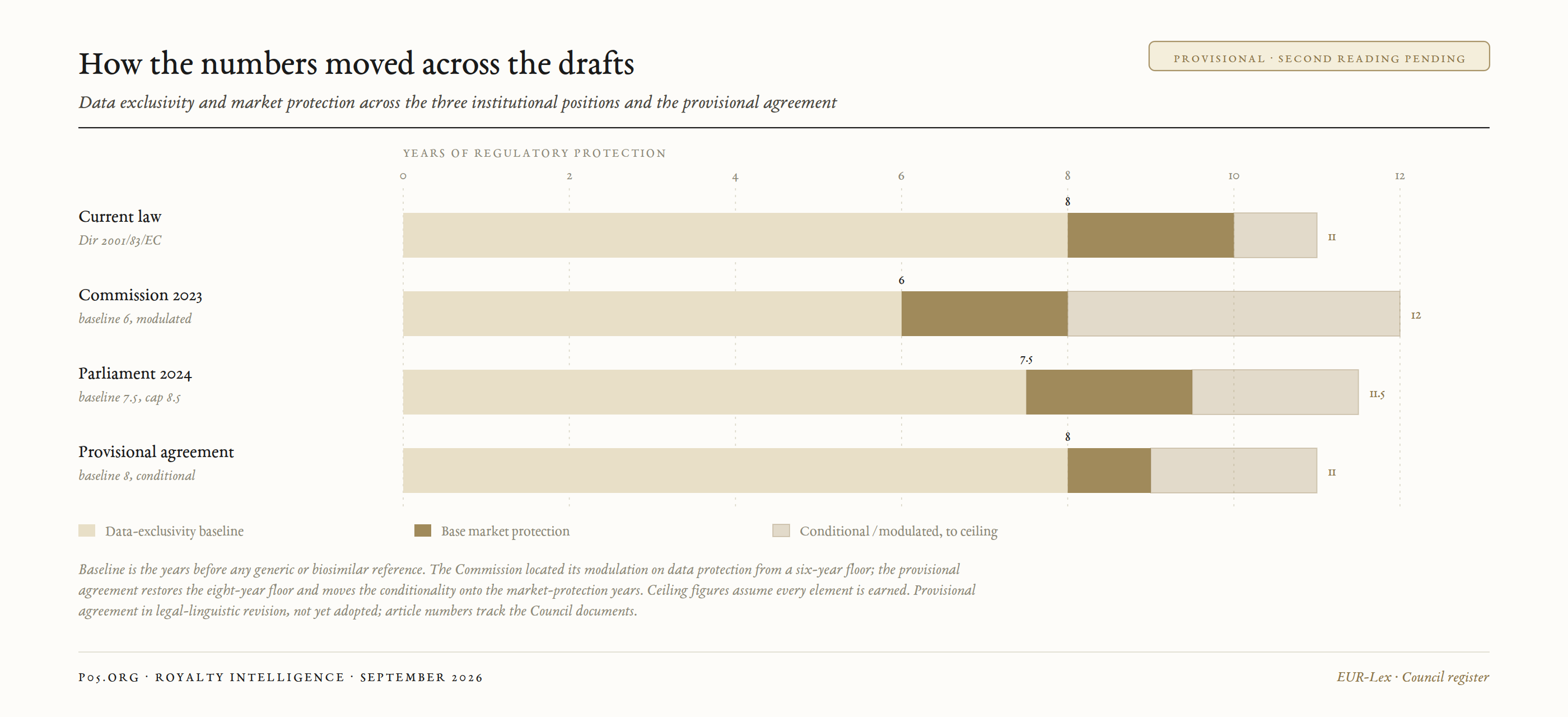
A desk that built its EU exclusivity assumptions off the Commission's April 2023 proposal was modelling a harsher regime than the one heading for adoption. The agreed text sits at the originator-favourable end of the three institutional positions on the levers that set royalty duration.
The Commission opened with a six-year data-exclusivity baseline and layered its modulations onto data protection, including two extra years tied to launching in every Member State.
The Parliament raised the baseline to seven and a half years under a hard cap of eight and a half, and decoupled the access conditions from the protection incentives. The agreed text restores the current eight-year data-exclusivity baseline, allows no data-exclusivity extension other than the antimicrobial voucher, and relocates the conditionality to market protection.
| Lever | Current law | Commission 2023 | Parliament 2024 | Agreed text |
|---|---|---|---|---|
| Data-exclusivity baseline | 8 yrs | 6 yrs | 7.5 yrs (cap 8.5) | 8 yrs |
| Market protection | 2 yrs (+1 indication) | 2 yrs (+1); modulation on data protection | 2 yrs (+1) | 1 yr; up to 2 conditional (+1 indication) |
| Maximum regulatory protection | 11 yrs | up to ~12 yrs, conditional | ~11.5 yrs | 11 yrs, conditional |
| Launch conditionality | none on protection | +2 data-protection yrs for launch in all Member States | decoupled from protection | market-protection year lost per non-launched Member State (Dir Art 59) |
| Antimicrobial voucher | none | 12 months, transferable | 6/9/12 months, under the 8.5-yr cap | 12 months, EUR 490m sales cap, max 5, 15-yr window |
| Orphan market exclusivity | 10 yrs (+2 paediatric) | 9 standard, tiered | 9 standard, +2 high-unmet-need | 9 standard, 11 breakthrough, 4 well-established-use; +1 per new indication (max +2) |
Three shifts across the drafts carry into the cash-flow model. The data-exclusivity baseline landed at eight rather than the Commission's six, which removes the two-year haircut a desk may have priced against new-substance streams. The launch trigger changed shape: the Commission tied two years of data protection to launch across all Member States, and the agreed text drops that in favour of the narrower loss of the market-protection year in a single requesting Member State under Article 59 of the Directive.
The antimicrobial voucher settled on the Council's design, a flat twelve months with the EUR 490 million sales cap, rather than the Parliament's version that graded the voucher by priority level and folded it under the eight-and-a-half-year cap. On orphans, the standard exclusivity fell from ten years to nine, the eleven-year breakthrough tier entered from the Parliament's text under a renamed heading, and the two-year paediatric extension for orphan products was removed and replaced by access to the six-month supplementary protection certificate extension.
The existing book is grandfathered
The change operates prospectively. Reference products whose marketing-authorisation application was submitted before the application date keep the data-protection rules of Article 10 of Directive 2001/83/EC under Article 221(5) of the new Directive.
Article 186(5) of the Regulation carries the same carve-out for the centralised route, preserving the old Article 14(11) of Regulation 726/2004. Orphan products filed before the application date keep the ten-year market exclusivity of Article 8(1) of Regulation 141/2000 under Article 186(10), limited to the initial authorisation.
A portfolio built on products already authorised, or filed before roughly 2028, runs off under the current exclusivity terms. The new architecture governs origination on substances entering the pipeline now. Streams already closed run off under the terms in force when they were authorised.
A sharper cliff at expiry
Article 87 of the Directive widens the research exemption. Studies, trials and activities to obtain a marketing authorisation, to run a health-technology assessment, to secure pricing and reimbursement, and to submit a procurement tender no longer infringe the reference product's patent or supplementary protection certificate.
The exemption is harmonised across Member States and does not reach commercial sale during the protection term, under Article 87(3). Recital 77 puts the aim as generic and biosimilar entry on the first day after expiry.
Terminal-value assumptions that lean on a ramp between loss of exclusivity and first generic sale lose ground here. A model that assumes gradual erosion after the cliff should test a steeper decline where the reference product is a standard-of-care target for generic or biosimilar development.
Orphan exclusivity, modulated
Article 73 of the Regulation replaces the flat ten-year orphan market exclusivity with a graded one: nine years for a standard orphan medicinal product, eleven years for a breakthrough orphan product under Article 72, and four years for a well-established-use orphan authorised under Article 14 of the Directive. Article 74 adds a year for a new orphan indication, available up to twice. A holder taking that orphan indication extension cannot also take the Article 84(2) market-protection year, under Article 74(2).
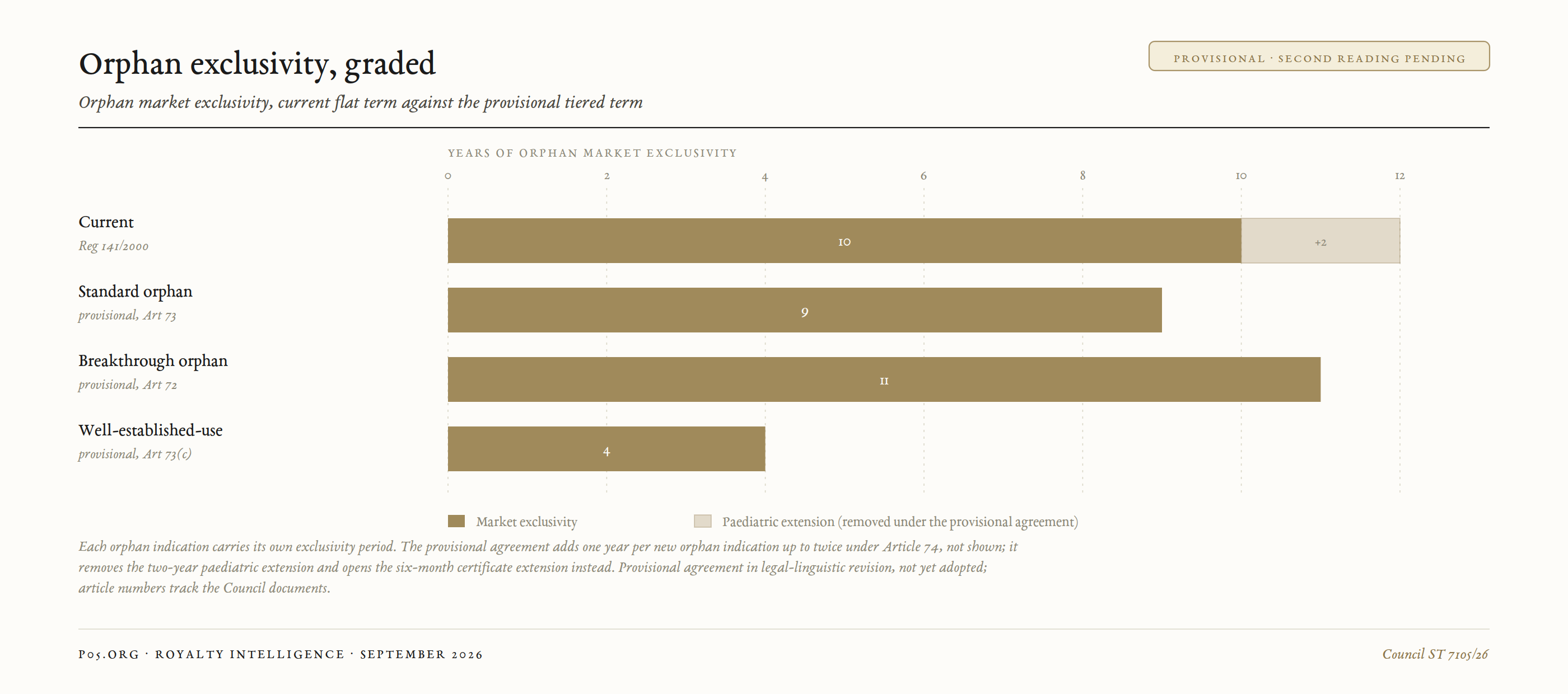
The breakthrough qualification under Article 72(1) requires no product authorised in the Union for the condition and a clinically relevant reduction in morbidity or mortality. Portfolios weighted to standard orphan indications lose a year against the current ten; breakthrough designations gain one; well-established-use orphans fall to four.
The paediatric route also changed: the two-year orphan-exclusivity extension for completing a paediatric investigation plan under Regulation 1901/2006 is gone, and orphan products instead reach the six-month certificate extension under Article 88 of the Directive, which cannot be combined with the Article 84(2) market-protection year. The six-year review that could cut orphan exclusivity under the current regime is removed, recorded at recital 120, which takes one contingency out of the orphan cash-flow model.
A tradeable exclusivity asset
The transferable data exclusivity voucher for priority antimicrobials is a new instrument in EU pharmaceutical law. A voucher extends the data-protection period of one authorised product by twelve months under Article 41(2) of the Regulation. It transfers once, and the transaction value is disclosed to the Agency under Article 42(4) and (5).
Used on a product other than the antimicrobial, it applies only in the fifth or sixth year of that product's data-protection period, and only where the product's annual gross Union sales stayed at or below EUR 490 million in each of its first four years, under Article 42(1). Article 44 caps the scheme at five vouchers, running for fifteen years or until the fifth grant.
The voucher is a year of exclusivity detached from the product that earned it, priced in a bilateral sale and recorded publicly. The sales cap keeps it off the largest products and channels it toward mid-sized streams. For a holder financing an antimicrobial developer, or a fund modelling the exclusivity tail of a mid-sized product, the voucher is a transferable line with a disclosed sale value.
Launch conditionality reaches the protection year
Article 59 of the Directive lets a Member State request the holder to place a product on its market and supply it. The same article lets the Member State require a pricing and reimbursement application, participation in procurement, or a roll-out plan.
Where the holder has not made the product available and supplied it continuously within three years of the request, the market protection of Article 83(2), and any orphan market-exclusivity extension under Article 74(1) of the Regulation, does not apply in that Member State, under Article 59(5).
The loss is local to the requesting Member State and falls on the market-protection year. The data-protection base is untouched. The Commission's original proposal tied a two-year block of protection to launch across all Member States; the agreed text narrows the sanction to the conditional year in the specific market where launch did not happen.
For a stream with concentrated geographic exposure, this is a diligence item on the holder's launch and supply commitments.
A financeable exclusivity for repurposing
Article 86 of the Directive grants four years of data protection to a new indication not previously authorised in the Union for the active substance, where adequate studies show significant clinical benefit, the product is authorised under Articles 10 to 13, and it has not held data protection before or twenty-five years have passed since its initial authorisation.
The reward is available once per product under Article 86(2). All three institutions carried this incentive through the drafting, so it is one of the more settled parts of the text.
This puts a defined, if short, exclusivity behind repurposed off-patent molecules, which opens an origination line for structures built around reformulation or new-indication development on established actives.
Durability tail risks
Provisions on environmental risk and on compulsory licensing bear on whether an authorised product stays on the market. An incomplete or insufficiently substantiated environmental risk assessment is a ground to refuse a marketing authorisation under Article 50(1)(e) and to suspend or revoke one under Articles 198(2) and 199(1)(g), and products authorised before 30 October 2005 face a risk-based ERA programme under Article 24.
Where a compulsory licence is granted in a crisis, data and market protection are suspended for the licensee under Article 83(4), limited to the licence's duration, territory and scope, and resume when the licence ends, as recitals 74 and 75 set out. The compromise text confined that suspension to the Member State where the licence was granted, so a centralised authorisation does not splinter its protection period across the Union.
Neither is a base-case assumption. Both sit in the tail of a durability model, the ERA exposure weighted toward older products and the compulsory-licence suspension toward crisis scenarios.
What happens next
Nothing in the package binds until the Official Journal carries it, and the steps that remain are procedural rather than negotiated.
The Council adopted its first-reading position on 17 and 18 September 2026. The texts are now with the jurist-linguists, who finalise all language versions and can still adjust wording, cross-references and article numbering. The Parliament takes the file at second reading, with the plenary vote expected in the autumn of 2026. If the Parliament approves the Council's position without amendment, the act is adopted; an amendment at this stage would reopen the file through conciliation, which the published commentary treats as unlikely and confines to technical or editorial changes.
Signature by the Presidents of the Parliament and the Council follows, then publication in the Official Journal, which on the current timetable could fall late in 2026 and would replace the procedure numbers 2023/0131 and 2023/0132 with the final numbers Regulation (EU) 2026/xxx and Directive (EU) 2026/xxx.
Entry into force is twenty days after publication, and application follows the transitional periods, most provisions running 24 months from entry into force with full application expected by 2028.
Two elements are settled in shape but not in detail, and both bear on the conditional year. The criteria for unmet medical need, and the comparator standard that qualifies a stream for the extra market-protection year, sit in scientific guidelines the Agency and the Commission have yet to write, alongside a body of implementing and delegated acts.
The Directive also requires national transposition, so the launch-and-supply mechanism of Article 59 will read slightly differently across Member States. A model can take the architecture as stable; the triggers that decide whether a given stream earns the conditional year cannot be read off the text yet.
The underwriting takeaway
The ceiling on EU regulatory protection survives the reform close to its current height. The floor drops by a year, and the year between floor and ceiling is now conditional on the sponsor's conduct. A model that treated loss of exclusivity as a fixed date now carries a conditional input, resolved by the sponsor's comparator design, filing sequence, launch footprint and indication strategy. Existing streams run off under the current terms. None of this is final while the file is at second reading, but the architecture is stable enough to underwrite against. The work is in origination on substances that will be authorised under the new regime from around 2028, tracking the conditional-year criteria as the guidelines that define them are written.
All information in this report was accurate as of the research date and is derived from publicly available sources including court opinions, regulatory guidance, academic literature, SEC filings, and financial news reporting. Information may have changed since publication. This content is for informational purposes only and does not constitute investment, legal, or financial advice. The author is not a lawyer or financial adviser.