
Company of the week: BrainChild Bio
BrainChild Bio collects no royalty. It owes one, upward, to a children's hospital, on terms nobody outside the parties has seen. On 8 September it closed $116m and dosed the first patient in a pivotal trial that decides whether the obligation ever pays.

BrainChild Bio sits at the opposite end of the same structure. Everything it owns, it licensed in, and the counterparty is a paediatric hospital in Seattle that also wrote the company's first equity cheque.
On 8 September 2026 BrainChild Bio closed a $116m Series A and, the same morning, announced initiation of ILLUMINATE, a single-arm registrational Phase 2 study of BCB-276 in diffuse intrinsic pontine glioma. Before that round the company had operated on Seattle Children's founding equity and a $300,000 manufacturing grant, according to reporting on the financing.
A royalty desk looking at this name is not underwriting a stream. It is underwriting the conditions under which a stream comes into existence, and pricing the claim of the party sitting above it. The licensor here is a Washington non-profit that has been through this before, with Juno Therapeutics, on paper that was filed with the SEC.
That filing is the most useful document available on BrainChild Bio, and it is not about BrainChild Bio.
At a glance
| Item | Detail |
|---|---|
| Company | BrainChild Bio, Inc. Seattle, Washington and Cambridge, Massachusetts. Approximately 50 employees on the chief executive's September 2026 figure; a private-market database records 54 as at July 2026 |
| Founded | Announced 5 December 2023 as a spin-out of Seattle Children's |
| Leadership | Chief Executive Steven Brugger; Founder and Chief Scientific Officer Michael Jensen; Vice President of Clinical Development Cori Abikoff |
| Ownership of the technology | None. Exclusive licence to CNS CAR T-cell technology developed at Seattle Children's |
| Licence terms | Not disclosed. Financial terms were not released at spin-out and have not been released since |
| Lead asset | BCB-276, autologous B7-H3-targeted CAR T cells, delivered intracerebroventricularly through an indwelling reservoir-catheter |
| Second asset | BCB-214, multiplexed CAR set for EGFR, B7-H3 and IL13Rα2 with a PD1-MyD88 potency transgene, preclinical, Phase 1 in glioblastoma planned for 2027 |
| Pivotal trial | ILLUMINATE, NCT07680439. Open label, single arm, 75 patients, six US sites, primary endpoint overall survival |
| Phase 1 result | Median overall survival 19.8 months from diagnosis in 21 treated patients, against a historical 11.2 months |
| Designations | Breakthrough Therapy, April 2025; RMAT, May 2025; Fast Track. Orphan drug and rare paediatric disease designations are not in the public record |
| Capital raised | $116m Series A, September 2026, led by an undisclosed private family fund and foundation, with Seattle Children's and WRF Capital participating |
| Prior funding | Seattle Children's founding equity, amount undisclosed, plus a $300,000 G-Rex grant from ScaleReady in January 2025 |
| Manufacturing | OmniaBio, Hamilton, Ontario, for the pivotal trial supply |
| Indication size | Roughly 300 US diagnoses a year |
| Topline expected | 2028 |
| Royalty posture | Net payer. Pre-revenue. Obligation runs upward to the licensor and, in unknown part, to component licensors |
What BrainChild Bio is
The company is the commercial vehicle for one laboratory's decade of work. Michael Jensen was recruited to Seattle Children's in 2010 on the condition that the institution build him a GMP facility, and the resulting production core has made more than 1,000 products for Phase 1 and Phase 2 trials.
Seattle Children's own account puts it at 17 CAR T-cell trials since 2012 and more than 500 patients treated, with FACT accreditation obtained in 2025. His earlier lab designed the CD19 CAR that became Breyanzi. He co-founded Juno Therapeutics, which Celgene bought in 2018 for $9bn.
Seattle Children's launched BrainChild Bio in December 2023 with an exclusive licence to the CNS CAR T-cell technology and the initial equity investment. Jensen left his role running Seattle Children's Therapeutics to become chief scientific officer. Steven Brugger, who had sold Affinivax to GSK the year before, took the chief executive seat.
The lead product is a second-generation 4-1BB costimulated CAR against B7-H3, known in the academic trials as SCRI-CARB7H3(s). It is not given intravenously. Patients receive it through a catheter into the lateral ventricle, which puts the cells into cerebrospinal fluid flowing past the pons, and they receive it repeatedly rather than once. The Phase 1 protocol used no lymphodepletion at all.
That delivery choice is the platform claim. If locoregional, repetitively dosed CAR T cells work in the brainstem, the same architecture is available for glioblastoma and for brain metastases, which is where BCB-214 points.
DIPG itself is small and uniformly fatal. Roughly 300 American children are diagnosed each year, most between five and ten years old, and standard care is palliative focal radiation producing a median overall survival near 11 months.
The licence, and why it runs the wrong way
Nothing about the BrainChild Bio licence has been published. The spin-out announcement described an exclusive licence to Seattle Children's CNS CAR T-cell technology and said the hospital had provided founding equity. Financial terms were withheld then and remain withheld now. The company is private, files nothing with the SEC, and its licensor is a hospital whose Form 990 reports royalties in aggregate rather than by counterparty.
So the rate is unknown, the milestone schedule is unknown, the sublicence revenue share is unknown, and the change-of-control treatment is unknown.
What is knowable is the form Seattle Children's uses.
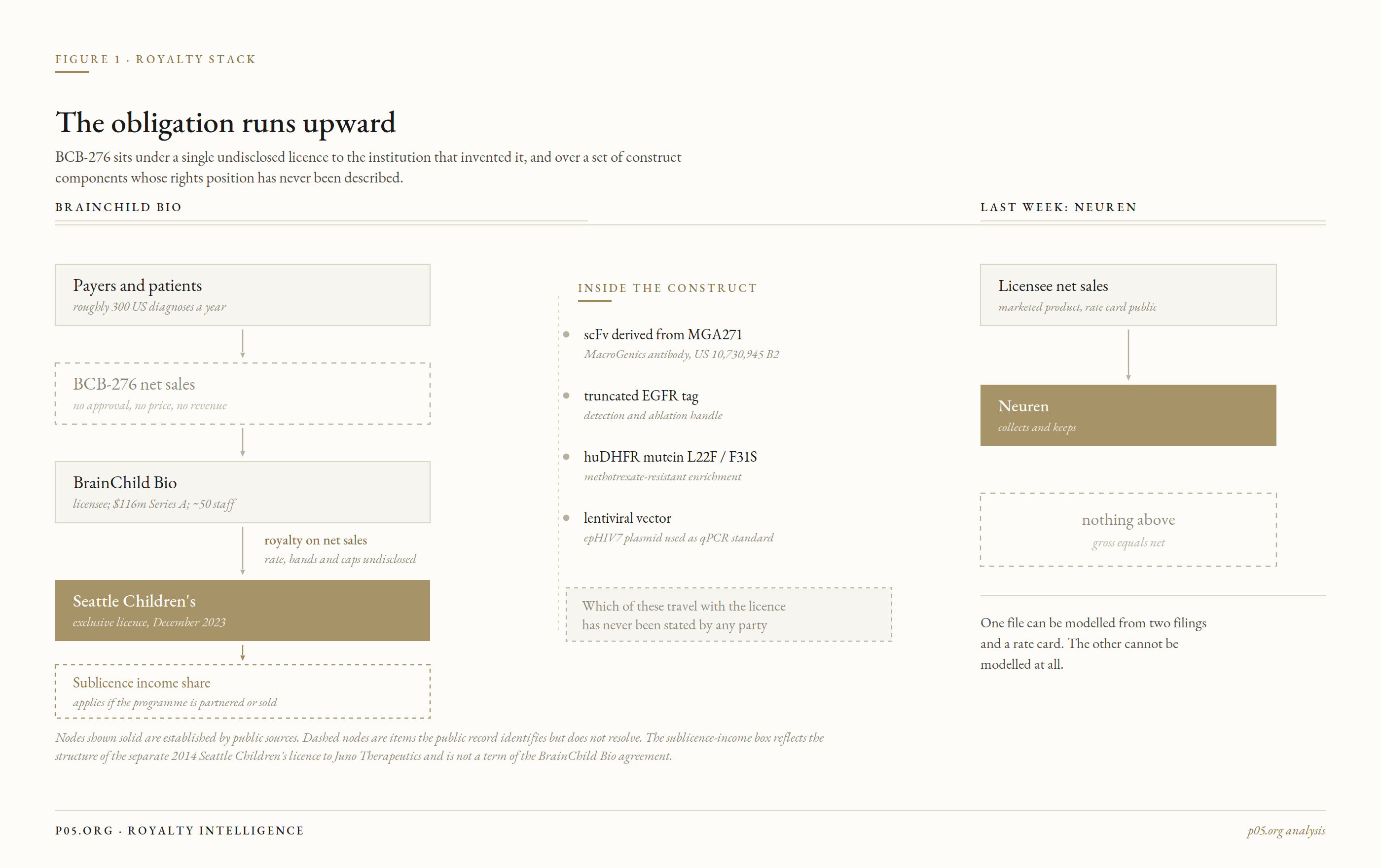
The BCB-276 obligation stack as far as the public record establishes it, against the Neuren contrast
The 2014 comparable
In February 2014 Seattle Children's Hospital, doing business as Seattle Children's Research Institute, granted Juno Therapeutics an exclusive worldwide licence to patents invented by Michael Jensen and others. Juno filed it as an exhibit to its S-1, and the executive version is on EDGAR, with the rate cells redacted and the architecture intact. A simultaneous sponsored research agreement gave Juno options over improvements.
Same licensor. Same named inventor. Adjacent technology family. It is a template, not the agreement in question, and the distinction matters. But it establishes what this institution's counsel asks for.
| Term | 2014 Juno licence |
|---|---|
| Grant | Exclusive, royalty-bearing, worldwide, all therapeutic, prophylactic and diagnostic uses, sublicensable through multiple tiers |
| Upfront | $200,000, one-time, non-refundable |
| Maintenance | $250,000 total, five annual instalments of $50,000, creditable against royalties and milestones in the same year |
| Development milestones | Capped at $9m per licensed product where the claim is not co-owned with Fred Hutchinson; individual amounts redacted |
| Royalty | Two bands on annual net sales, thresholds and rates redacted |
| Minimum annual royalty | $200,000 from the sixth anniversary, creditable against running royalties |
| Sublicence income | A percentage of "Other Consideration", capped at $15m in aggregate; equity in the licensee at fair market value is carved out |
| Stacking relief | Offset of a redacted share of third-party running royalties, with a floor expressed as a percentage of what would otherwise be owed |
| Diligence | Dated obligations to dose first patient in Phase 1, Phase 2 and a pivotal trial, extendable by paying a share of the milestone that was missed |
| Term | To expiry of the last valid claim, country by country |
| Government rights | Licensed patents developed under a US government funding agreement; substantial US manufacture required for subject inventions sold in the US |
| Termination | Immediate on a validity challenge by the licensee or any sublicensee |
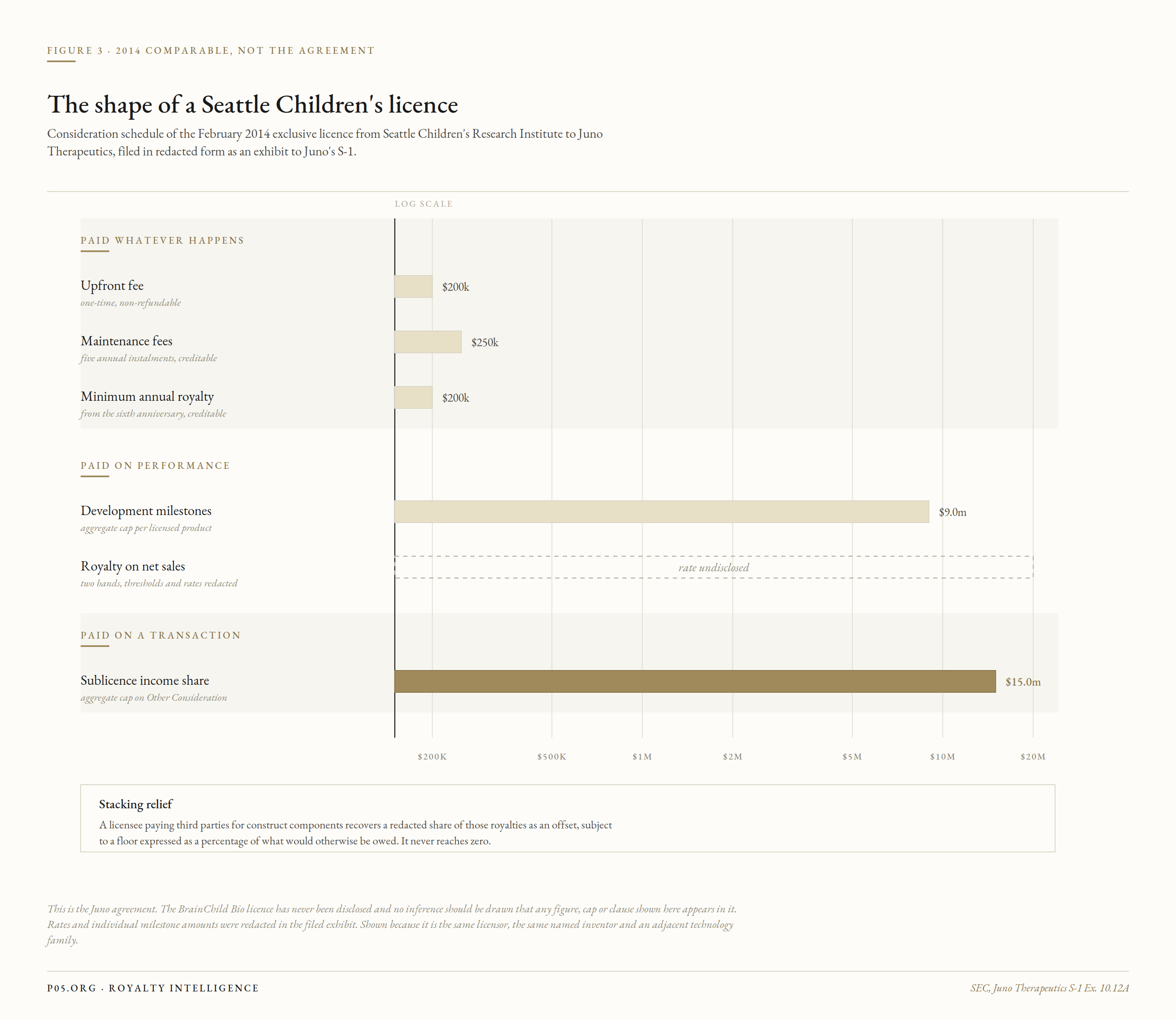
Consideration schedule of the 2014 Seattle Children's licence to Juno Therapeutics, shown as the licensor's contracting form and not as terms of the BrainChild Bio agreement
Several features of that schedule bear on how a BrainChild-shaped obligation would behave.
The economics are back-loaded almost entirely into royalties and sublicence income. Upfront and maintenance together come to $450,000 across five years, which is immaterial to a licensee and equally immaterial to the licensor. What the institution is buying is a percentage of eventual net sales and a percentage of what the licensee receives if it sells the programme on.
The sublicence income cap is the clause a royalty desk should read twice. Under the 2014 form, a share of upfronts and milestones received from a third party flows back to the licensor, capped in aggregate. Equity in the licensee is excluded. If BrainChild's agreement carries the same carve-out, then Seattle Children's participates in a partnering transaction in two separate ways, through its equity and through its licence, and the two are accounted for differently.
Stacking relief is partial and floored. A licensee that has to pay third parties for components does not get to offset those payments to zero; it recovers a redacted fraction, subject to a floor. That matters here because BCB-276 is built from parts.
What the licensor is
Seattle Children's occupies both sides. It is the founding shareholder, a participant in the Series A, the licensor, and the sponsor of the Phase 1 trial that generated the data. Its chief executive has been quoted in the company's designation announcements. That configuration is common in academic spin-outs and it compresses two claims, equity and royalty, into one counterparty with one set of incentives.
For an originator, a single counterparty above the asset is easier to diligence than five. It is also harder to buy out, because a hospital's licensing office is not usually a seller of its own royalty.
The licensor's royalty book
One number in this file is auditable. Seattle Children's Hospital, EIN 91-0564748, reports royalties as a line item on Form 990, and the filings are public back to 2011.
| Fiscal year ending September | Royalties reported |
|---|---|
| 2013 | $0 |
| 2014 | $225,291 |
| 2015 | $172,167 |
| 2016 | $419,453 |
| 2017 | $802,530 |
| 2018 | $1,232,685 |
| 2019 | $3,197,769 |
| 2020 | $1,853,436 |
| 2021 | $7,683,006 |
| 2022 | $16,623,588 |
| 2023 | $6,868,967 |
| 2024 | $8,981,319 |
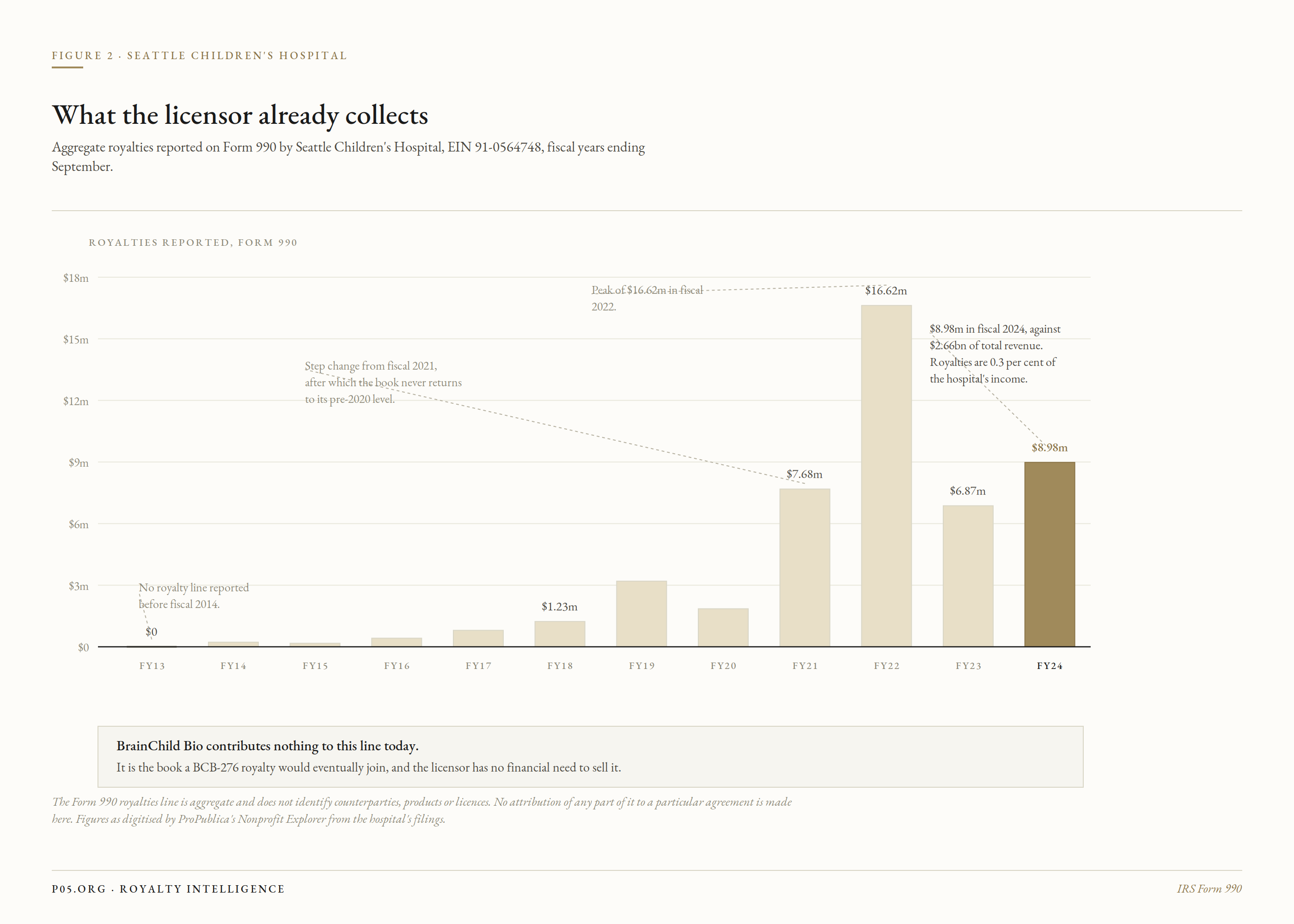
Aggregate royalties reported on Form 990 by Seattle Children's Hospital, fiscal years ending September
The line is aggregate. It does not break out counterparties, and BrainChild Bio pays nothing into it today. What it does show is the scale and the shape of the book that a BrainChild royalty would eventually join: nothing before 2014, a step change from fiscal 2021, a peak of $16.6m in fiscal 2022, and $8.98m in fiscal 2024 against $2.66bn of total revenue.
One development sits against that. In September 2025 Seattle Children's filed a WARN notice covering 154 layoffs effective 15 November and the elimination of 350 open positions, about 1.5 per cent of a workforce above 10,000. A spokesperson attributed it to hundreds of millions of dollars in anticipated state and federal funding cuts, of which 133 of the cuts were administrative roles.
Two readings follow. The institution has a functioning licensing operation with a real receipt history rather than a paper one, which supports the view that its contracting form is exercised rather than theoretical. And royalties are 0.3 per cent of its revenue, which means a hospital of this size has no financial pressure to sell or securitise a stream, and the licence sits with a counterparty that can wait.
Inside the product
Autologous CAR T constructs are assemblies. Each functional element can carry a separate provenance, and the published methods make the elements visible.
The antigen binder is derived from MGA271, the humanised B7-H3 antibody also known as huBRCA84D and as enoblituzumab. The Seattle team built its B7-H3 CARs using scFv binders derived from that antibody. MGA271 is MacroGenics' molecule, and a separate group working on canine B7-H3 CARs synthesised the same scFv from the sequence published in MacroGenics' patent, US 10,730,945 B2.
The Nature Medicine methods section describes the rest. A T2A ribosomal skip sequence is followed by a truncated EGFR cell-surface tag used both for detection and as an ablation handle. A methotrexate-resistant human DHFR mutein carrying the L22F and F31S substitutions allows ex vivo enrichment. The T cells are lentivirally transduced, and the qPCR standard curve for measuring transgene copies was built from the plasmid epHIV7.
None of those components originated with BrainChild Bio, and the ownership position on each is not disclosed. Some may sit inside the Seattle Children's estate and travel with the exclusive licence. Some may require separate rights. Publishing a sequence is not the same as licensing it, and none of the parties has said which components are covered by the December 2023 grant and which, if any, sit outside it.
This is the ordinary condition of a cell therapy stack and the reason stacking-relief clauses exist. It is also the reason a desk cannot price gross-to-net here the way it can with a small molecule paying one licensor.
What stayed behind
An exclusive licence to a hospital's technology does not empty the hospital. Under the 2014 form, Seattle Children's reserved the right to keep using the licensed patents for internal non-commercial research and for clinical activities including the development and use of paediatric oncology products, and to grant non-commercial licences to other non-profits. Whether the BrainChild grant carries the same reservation is not public. The institution's behaviour is consistent with one.
Seattle Children's remains the sponsor of BrainChild-04, a Phase 1 quadruple CAR T trial targeting B7-H3, EGFR806, HER2 and IL13-zetakine in DIPG, non-pontine DMG and other CNS tumours. It began in May 2023, is active and not recruiting, and carries an estimated primary completion of January 2028. The responsible party is a Seattle Children's Therapeutics medical director.
The next-generation work also stayed. Nicholas Vitanza, who holds equity in BrainChild Bio and chairs its scientific advisory board, runs a laboratory at Seattle Children's that has engineered CXCR3-enhanced B7-H3 CAR T cells for DIPG, and has separately published preclinical work combining B7-H3 CAR T cells with the imipridone ONC206. That laboratory is supported by an NIH R37 MERIT award.
Two consequences sit here for anyone pricing the asset.
Improvements are a contractual question with no public answer. Under the 2014 architecture, a licensee obtains improvements only by exercising options under a simultaneous sponsored research agreement.
No sponsored research agreement between BrainChild Bio and Seattle Children's has been announced. If BCB-276 is a fixed construct and the institution continues generating better ones, the licensed product can be superseded by something the licensee does not control.
Federal funding attaches somewhere in this estate. The 2014 licence recites that the licensed patents were developed under a US government funding agreement, which brings Bayh-Dole government use rights, march-in exposure and substantial US manufacture obligations.
The Nature Medicine acknowledgements for BrainChild-03 list philanthropic funders and no federal grant, while the laboratory generating the successor constructs is NIH-funded. Which of the two conditions applies to the patents actually licensed to BrainChild Bio is not determinable from public sources, and it bears directly on the Ontario manufacturing arrangement.
The capital, and who was absent
The Series A total is $116m. The lead is an undisclosed private family fund and foundation described as aligned with the company's mission. Seattle Children's participated. WRF Capital, the investment arm of the Washington Research Foundation, came in as a new investor.
The foundation is not a stranger to the licensor: in October 2025 it awarded $5.2m to Fred Hutch and Seattle Children's to move therapeutics into first-in-human studies, with both institutions providing matching funds.
The absence is the more informative part of the syndicate. Brugger told GEN that institutional investors were impressed by the Phase 1 data and did not participate, because at roughly 300 US diagnoses a year the indication did not fit their model. The round was assembled from philanthropic and mission-aligned capital instead.
Seattle Children's provided the initial equity funding at launch. The amount was not stated, the post-money valuation of the Series A was not stated, and the resulting ownership split is not public. Insiders hold equity directly: the Nature Medicine competing-interests statement records that Jensen holds equity and is chief scientific officer, that Nicholas Vitanza holds equity and chairs the scientific advisory board, and that Joshua Gustafson holds equity.
The same statement records that Jensen holds equity in Umoja Biopharma, is a board observer there and sits on its joint steering committee, and that Rebecca Gardner receives royalties on CAR T patents licensed to Juno.
Brugger has guided that spending will plateau across 2027 and 2028 and that the $116m is intended to carry the Phase 2 through completion, the BLA submission, and the start of the BCB-214 Phase 1. He described a Series B as a logical next step and said partnering options would be explored.
The organisation chart carries one detail relevant to the stack. Alongside the clinical, research and corporate development functions, the published team lists a dedicated intellectual property lead and a finance lead carrying no chief financial officer title. A fifty-person company that staffs intellectual property as a standing function, in a field where Jensen is named on more than 200 patents, is allocating headcount to the problem this article keeps running into.
The clinical record
BrainChild-03 was a single-centre dose-escalation study at Seattle Children's. Arm C, restricted to DIPG, was published in Nature Medicine in January 2025.
Twenty-three patients enrolled and 21 were treated, receiving 253 intracerebroventricular doses in total. The maximally tolerated dose regimen escalated to 10 × 10⁷ cells per dose. One dose-limiting toxicity occurred, a grade 4 intratumoral haemorrhage in a three-year-old with progressive disease between enrolment and first infusion.
Headache, nausea or vomiting, fatigue and fever were the common adverse events, mostly grade 1 or 2. No immune-effector-cell-associated neurotoxicity syndrome was seen, and the authors treated fever as local immune activation rather than systemic cytokine release.
Median survival from first infusion was 10.7 months. Median survival from diagnosis was 19.8 months, with three patients alive at 44.6, 45.6 and 52.5 months. Historical median survival in the International DIPG Registry series the authors cite is 11.2 months.
The subgroup analysis is what drove the pivotal design. Nine of the 21 began treatment before any progression and 12 after. All three long-term survivors came from the pre-progression group. Median survival after first infusion was 13.6 months in the pre-progression patients against 9.4 months in the post-progression patients.
Radiographic response was thin: one partial response among 18 evaluable patients, 15 stable disease, two progressive disease. The authors note that the pons diffusely expands in this disease and that resolution to normal size may not register as a mathematical response.
They also name the confounders themselves. Historical comparators may understate modern survival because supportive care improved and re-irradiation became standard. Patients could receive other therapy after leaving protocol. One long-term survivor had an IDH1-mutant high-grade glioma rather than confirmed DMG, a genotype associated with better survival. Enrolment at any point after radiation risks immortalisation bias, which is why the paper reports survival from enrolment and from infusion alongside survival from diagnosis.
A Stanford GD2 CAR T trial in the same period reported 17.6 months for treated DIPG patients, against 19.8 months here, on a different design with a median age of 15 rather than 6.
ILLUMINATE
The pivotal study is open label, single arm, and enrols 75 patients aged 1 to 26 at six US paediatric neuro-oncology centres. Patients must start within six weeks of completing standard radiation and must not have had prior anti-cancer therapy beyond radiation with or without temozolomide. Metastatic disease is an exclusion. Dosing runs approximately every 14 days for up to 15 doses across roughly 30 weeks.
The primary endpoint is overall survival. Secondary endpoints cover safety, progression-free survival, radiographic response and CSF pharmacokinetics. Follow-up runs to about two years from first treatment, with a 15-year long-term follow-up commitment.
There is no control arm. The FDA agreed against randomising children to palliative radiation alone, on the basis that a control arm in this disease would be expected to end in the death of every child assigned to it. Outcomes will instead be compared with registry data from similar patients.
An external registry control is the structural risk in this filing. The comparator is the same historical survival figure that the Phase 1 authors flagged as potentially understated, and the enrolment criteria select for the pre-progression population that did best in Phase 1. Both effects push in the same direction.
Topline is expected in 2028. Site activation was complete or under way across all six sites at announcement. Secondary reporting places the six in Seattle, Chicago, Atlanta, Philadelphia, Los Angeles and Columbus, Ohio, which the company has not itself listed.
The company announced the trial as initiated. Its chief executive told GEN on the same day that the first patient had been dosed, and the registry entry records the study as enrolling. The three statements are consistent with a first dose in early September 2026, and none of them puts a date on it.
The designations, and the voucher
BCB-276 holds Breakthrough Therapy designation, granted April 2025, RMAT designation granted the following month, and Fast Track. Orphan drug designation and rare paediatric disease designation do not appear in the public record, and neither company nor institutional announcements have claimed them.
That gap is the single most consequential unpriced item on this page, because of what happened in Washington in February.
The rare paediatric disease priority review voucher programme lapsed on 20 December 2024. On 3 February 2026 the Consolidated Appropriations Act, 2026 incorporated the Mikaela Naylon Give Kids a Chance Act and restored the FDA's authority to award vouchers through 30 September 2029. Sixty-three vouchers have been awarded since 2012 across 47 rare diseases. They are transferable and have sold above $100m.
The comparable is direct. When the FDA approved Jazz's Modeyso for H3 K27M-mutant diffuse midline glioma in August 2025, the approval came with a rare paediatric disease voucher.
For BCB-276 the sequence has to line up. The designation has to be granted, the BLA has to be filed on 2028 data, and approval has to land before the authority expires on 30 September 2029. A voucher is the one asset in this story capable of producing a nine-figure cash receipt that does not depend on selling a single dose, and under the 2014 licence template a share of non-royalty consideration flows back to the licensor.
Whether a voucher would count as "Other Consideration" under the BrainChild agreement is not determinable from public sources. The Acadia and Neuren arrangement resolved that question in favour of a defined split, one third to the originator, which produced a $48.8m receipt. Here the question is open.
What an approval would be worth
No price has been proposed and no revenue forecast exists. The available anchors are the patient count and the nearest approved product.
DIPG runs to roughly 300 US diagnoses a year. Diffuse midline glioma, the wider category, affects about 2,000 US patients a year. Modeyso, addressing that wider population, recorded $48m of net product sales in 2025 and $89.6m in the first half of 2026 with more than 600 patients treated since launch.
BCB-276 would address a population roughly one sixth that size at a per-patient price that is unknown but, for an autologous cell therapy requiring leukapheresis, bespoke manufacture, a neurosurgical device and fifteen administrations, will be an order of magnitude above an oral drug. Whether the product of a smaller number and a larger number clears the cost of the manufacturing network is the commercial question, and neither the company nor its investors have put a figure against it.
The platform extension is where the arithmetic changes. Glioblastoma runs to roughly 15,000 US cases a year, and brain metastases far more. BCB-214 is preclinical, with a Phase 1 planned for 2027.
Who else is in the pons
Dordaviprone is the approved comparator and the only one. Jazz is running BIOMEDE 2, a Phase 3 in DIPG comparing dordaviprone against everolimus with progression-free survival as the primary measure, and the confirmatory ACTION study in newly diagnosed H3 K27M-mutant diffuse glioma after radiotherapy. A GEN count of ClinicalTrials.gov in September 2026 found 36 recruiting studies covering DIPG, of which 20 were Phase 1, 15 Phase 2 and one Phase 3.
Among cell therapies the nearest programme is Stanford's. Majzner, Mackall and Monje reported GD2 CAR T cells for H3K27M-mutant diffuse midline glioma in Nature in 2022 and followed with intravenous and intracranial dosing in Nature in 2024, reporting 17.6 months for treated DIPG patients. The Phase 1 is registered as NCT04196413. The BrainChild-03 authors identify City of Hope, St. Jude, Stanford and Texas Children's as centres with clinical paediatric CNS CAR T programmes.
None of those has a pivotal trial running. BrainChild Bio is first into a registrational study with a locoregional CNS CAR T cell product, and the competitive question for the stream is not whether a rival reaches approval sooner but whether a differently engineered construct against the same antigen, or against GD2, produces a better number before a 2028 filing is reviewed.
Duration
There is no Orange Book here. BCB-276 would be licensed under a BLA, and biologics carry a different clock.
Reference product exclusivity under the BPCIA blocks approval of a biosimilar for twelve years from first licensure, with a four-year bar on filing. Orphan drug exclusivity, if the designation is obtained, runs seven years and operates concurrently rather than additively.
For a biologic orphan drug the twelve-year period is the binding constraint against follow-on entry, while the seven-year period does separate work by blocking competing brand approvals for the same drug and indication.
The royalty obligation itself runs on a different clock again. Under the 2014 template the term ends on expiry of the last valid claim, country by country, and royalties commence on first commercial sale in each country. Which patents sit in the BrainChild schedule, and when they expire, is not public.
Autologous cell therapies have also historically been poor biosimilar targets. The practical duration question for this asset is less about follow-on entry and more about whether a differently engineered CAR against the same antigen reaches the market first and takes the population.
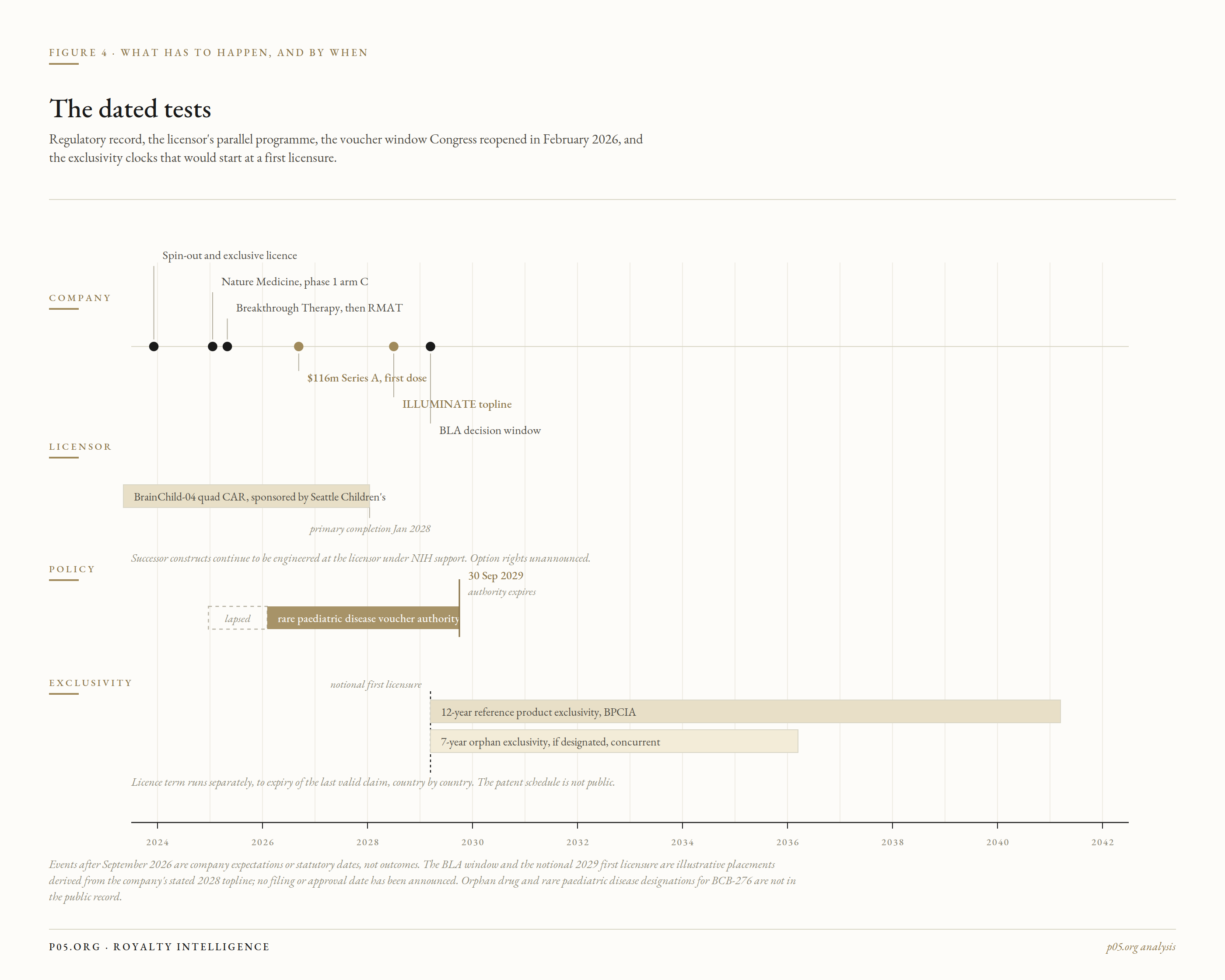
The dated tests: regulatory record, the licensor's parallel programme, the voucher window and the exclusivity clocks
Red team versus blue team
Risk analysis (red team)
The stream does not exist. There is no product, no approval and no revenue. Everything here is a claim on a 2028 readout in a disease where the historical failure rate of clinical trials is close to total, and where the paper reporting the supporting data lists its own confounders at length.
The licence terms are entirely undisclosed. Rate, milestones, sublicence share, stacking relief, change-of-control treatment and diligence obligations are all unavailable. The 2014 Juno agreement establishes the institution's form, not this agreement's numbers, and a template is not a term sheet. A desk cannot size the upstream obligation from public sources at any confidence.
The pivotal design carries an external control. Registry comparison against a historical 11-month median, in an enrolment window that selects the patients who did best in Phase 1, is a design the FDA agreed to rather than one that removes interpretive risk. Both the comparator choice and the selection criteria bias toward a favourable readout, which is a review risk as much as a scientific one.
The Phase 1 evidence base is 21 patients at one centre. One partial response. One patient with an IDH1-mutant tumour among the long survivors. No lymphodepletion, no randomisation, no blinded review. The Stanford GD2 programme produced a similar survival figure with a different construct and a different design, which cuts both ways on attribution.
Component provenance is unresolved. The binder derives from a MacroGenics antibody. The selection and detection elements come from earlier work. Which rights travel with the Seattle Children's licence and which require separate agreements has never been stated. Under a 2014-style stacking clause, third-party royalties are only partially offsettable and subject to a floor.
Improvements may not travel with the licence. The 2014 form conveys improvements only through options exercised under a simultaneous sponsored research agreement, and no such agreement with BrainChild Bio has been announced. The laboratory of the company's own scientific advisory board chair continues to publish better B7-H3 constructs at the licensor, including a CXCR3-enhanced version, under NIH support. A licensed product that is superseded inside the institution that licensed it is a specific and unpriced risk.
The licensor still runs its own trials in the same disease. BrainChild-04, a quadruple CAR T study in DIPG and DMG, is sponsored by Seattle Children's and estimated to complete its primary analysis in January 2028, the same year as ILLUMINATE's topline.
Bayh-Dole exposure is unresolved and the manufacturing is in Ontario. The 2014 licence recites government funding and the resulting substantial US manufacture obligation for subject inventions sold in the United States. Pivotal supply is made in Hamilton. Whether the BrainChild patents carry that obligation is not public.
The voucher is not secured. Rare paediatric disease designation is not in the public record, and the FDA's voucher authority expires on 30 September 2029. A 2028 topline leaves a narrow window for filing, review and approval, and the most monetisable near-term asset in this company depends on hitting it.
The licensor is under financial pressure. Seattle Children's cut 154 roles in November 2025 and eliminated 350 open positions, citing anticipated state and federal funding reductions in the hundreds of millions. A licensor managing a contraction is a licensor with reasons to look hard at its licensing income, and the counterparty running the Phase 1 infrastructure this programme was built on is the same institution.
The counterparty is also the shareholder and the trial sponsor. Seattle Children's licenses the technology, holds equity, participated in the Series A, sponsored the Phase 1 and comments publicly on the company's regulatory milestones. Concentration of that kind removes the arm's-length pricing signal a third-party licence would provide.
Institutional venture declined. The chief executive has said so directly. A syndicate of philanthropic and mission-aligned capital funds the current plan, and a Series B was described as the logical next step. That leaves the 2028 readout carrying both the clinical question and the financing question.
Manufacturing is outsourced and cross-border. Pivotal supply comes from a facility in Hamilton, Ontario. Autologous supply chains for a brainstem tumour with a short natural history have no slack, and two of the 23 Phase 1 enrollees progressed during manufacture and were never dosed.
The commercial base is 300 patients a year. Modeyso addresses six times that population and ran at roughly $180m annualised in the first half of 2026.
Opportunities and mitigants (blue team)
One licensor, one counterparty, one clean chain of title to diligence. Whatever the rate is, the inward side runs to a single institution with a documented licensing form and a track record of doing this at scale. That is a materially simpler diligence exercise than a spin-out assembled from three universities.
Regulatory posture is unusually complete for a Series A company. Breakthrough Therapy, RMAT and Fast Track all sit on the same product, a Type B meeting produced FDA alignment on a single-arm pivotal, and the agency itself declined a control arm.
The survival signal is the first of its kind in this disease. Fifty years of DIPG trials had not moved the 11-month figure. The Phase 1 median was 19.8 months from diagnosis with three multi-year survivors, and repeated intracranial dosing to 3 × 10⁹ cumulative cells in one patient proved tolerable.
The safety profile supports outpatient administration. No cytokine release syndrome of the systemic kind, no ICANS, one dose-limiting toxicity across 253 doses. For a cell therapy that changes the delivery economics and the site-of-care requirement.
The voucher is a real and dated opportunity, not a theoretical one. The programme was reauthorised on 3 February 2026 through September 2029, the direct comparator in this indication received one in August 2025, and vouchers have transacted above $100m.
The platform is the second asset and it points at a market a hundred times larger. BCB-214 carries multiplexed targeting against EGFR, B7-H3 and IL13Rα2 with a potency transgene, and CRISPR knockout work reported by the company found glioblastoma cells could survive loss of one or two of those antigens but not all three.
The company is funded through the readout. The $116m is intended to cover the pivotal to completion, the BLA and the start of the second programme, on management's own guidance.
The licensor's royalty book is visible and it works. Seattle Children's reported $8.98m of royalties in fiscal 2024 and $16.6m in fiscal 2022, against nothing before 2014. The counterparty above this asset has a receipt history a desk can read, and at 0.3 per cent of revenue it has no need to force a monetisation.
No competitor is in a pivotal trial. Stanford's GD2 programme reported 17.6 months in treated DIPG patients and remains in Phase 1. The only registrational activity in the wider disease belongs to an approved oral drug running a confirmatory study, which does not address the same patient at the same point in the pathway.
The founder has done the full arc before. The CD19 CAR from the same laboratory became Breyanzi, and the vehicle that carried it sold for $9bn.
Summary
| Risk | Concern |
|---|---|
| No stream | Pre-revenue, pre-approval, 2028 readout |
| Undisclosed licence | Rate, milestones and sublicence share all unavailable |
| Single-arm pivotal | Registry control against a contested historical median |
| Phase 1 base | 21 patients, one centre, one partial response |
| Component stack | Binder and selection elements not traced to a disclosed licence |
| Voucher timing | Designation unconfirmed; FDA authority expires 30 September 2029 |
| Improvements | Successor constructs generated at the licensor; option rights unannounced |
| Licensor competes | BrainChild-04 quad CAR sponsored by Seattle Children's, primary completion 2028 |
| Bayh-Dole | Government funding recited in the 2014 form; pivotal supply made in Ontario |
| Counterparty concentration | Licensor is also shareholder, co-investor and trial sponsor |
| Licensor condition | 154 layoffs November 2025 on anticipated federal and state funding cuts |
| Financing | Institutional venture absent; Series B contemplated |
| Commercial base | Roughly 300 US diagnoses a year |
| Opportunity | Observation |
|---|---|
| Clean inward chain | One licensor with a documented and filed licensing form |
| Regulatory stack | BTD, RMAT and Fast Track on one product, with FDA alignment on the pivotal |
| Survival signal | 19.8 months from diagnosis against a historical 11.2 |
| Tolerability | 253 intracranial doses, one DLT, no ICANS |
| Voucher | Programme live to September 2029; direct comparator received one in 2025 |
| Licensor book | $8.98m royalties in FY2024, visible on Form 990, 0.3 per cent of revenue |
| Competitive timing | No rival cell therapy in a registrational trial |
| Platform | BCB-214 into glioblastoma, Phase 1 planned 2027 |
| Runway | Funded to BLA on management guidance |
Conclusion
Neuren is a royalty position that can be modelled from two filings and a rate card. BrainChild Bio cannot be modelled at all, and that is the accurate description rather than a complaint. The company is fourteen months from a topline, holds no approved product, and owes an undisclosed percentage of hypothetical future net sales to the hospital that invented the technology and still sits on its cap table.
The dated tests are specific. ILLUMINATE has to enrol 75 children with a nine-month natural history at six centres and manufacture product for each of them before they progress. The registry control has to satisfy a review division that agreed to the design but has not seen the result. Rare paediatric disease designation has to be granted and a BLA has to clear before 30 September 2029 for the voucher to exist. BCB-214 has to reach the clinic in 2027 for the platform claim to be more than a slide.
For an originator the file has one durable feature. The obligation above this asset is single-name, held by an institution that has written this paper before and left a redacted copy of it on EDGAR, and any future transaction in the stream runs through one counterparty rather than a committee of them. The rest is a 2028 date.
All information in this article was accurate as of September 2026 and is derived from publicly available sources including BrainChild Bio and Seattle Children's press releases, ClinicalTrials.gov and mirrored trial registry records, peer-reviewed literature in Nature Medicine and Cancer Discovery, SEC filings by Juno Therapeutics, published law firm analysis of the Consolidated Appropriations Act, 2026, and financial and trade press reporting. Whether BrainChild Bio holds options over improvements generated at Seattle Children's, and whether the patents licensed to it carry Bayh-Dole obligations, are not determinable from public sources; the reserved-rights, improvements and government-rights discussion describes the 2014 Juno agreement and the licensor's observable conduct, not the BrainChild Bio licence. The financial terms of the December 2023 exclusive licence between Seattle Children's and BrainChild Bio have never been disclosed; the licence terms tabulated above are those of the separate February 2014 exclusive licence between Seattle Children's Research Institute and Juno Therapeutics, filed in redacted form as an exhibit to Juno's S-1, and are presented as an indication of the licensor's contracting form rather than as terms applicable to BrainChild Bio. No inference should be drawn that any specific rate, cap or clause in that agreement appears in the BrainChild Bio licence. The statement that Seattle Children's continues to sponsor its own CAR T trials and generate successor constructs describes publicly documented activity; no inference is drawn about that institution's intentions toward BrainChild Bio. The September 2025 layoff figures are from the company's WARN filing and contemporaneous local reporting and are stated as the record, not as a view on the institution's solvency. Seattle Children's Hospital royalty figures are the aggregate royalties line reported on Form 990 for the fiscal years ending September as digitised by ProPublica's Nonprofit Explorer; the line does not identify counterparties, BrainChild Bio contributes nothing to it, and no causal attribution to any particular licence is made here. The component provenance discussion is drawn from published methods sections and third-party literature identifying the antibody and selection elements used in the academic construct; it does not establish which rights are or are not covered by the BrainChild Bio licence, and no party has stated this publicly. Rare paediatric disease designation and orphan drug designation for BCB-276 were not identified in public sources as at the research date; their absence from the public record is not evidence that they have not been applied for or granted. Series A valuation, ownership percentages, the size of Seattle Children's founding equity investment and the identity of the lead investor are not public. Trial timelines, the 2028 topline expectation, the 2027 BCB-214 Phase 1 start and management's runway guidance are company expectations rather than realised results. Survival comparisons against historical controls are drawn from the published trial report, whose authors identify immortalisation bias, improved supportive care, re-irradiation and post-protocol therapy as confounders. Information may have changed since publication. This content is for informational purposes only and does not constitute investment, legal, or financial advice. The author is not a lawyer or financial adviser.