
Who holds the file: marketing authorisation transfer and the royalty that depends on it

A pharmaceutical royalty is a claim on net sales. Net sales require a live marketing authorisation, and someone has to keep that authorisation alive for the whole royalty term: filing variations, reporting adverse events, meeting post-approval commitments, renewing registrations in each territory.
Royalty purchase and revenue interest agreements police the rate, the patent estate and the definition of net sales with real precision. They are comparatively quiet on who holds that regulatory file and what happens if it moves.
The working example is a side letter Karyopharm Therapeutics and Antengene Therapeutics signed on 30 June 2025, filed as Exhibit 10.1 to Karyopharm's Form 10-Q. It reallocated responsibility for the China regulatory file on selinexor mid-term, and it did so by a two-page letter, not a restated licence.
Three months after this piece was researched, the same company's revenue interest financing and term loan both went into forbearance on a missed payment, which is the live version of the question this piece asks: what happens to a regulatory-maintenance obligation when the party who holds it is in distress. Research current to 13 September 2026.
The file is a duty, not an asset
A marketing authorisation is held by a named legal person, and that person carries the post-approval workload for as long as the product sells. Ownership can move, and the mechanics differ sharply by jurisdiction.
In the United States, 21 CFR 314.72 requires the outgoing owner of an approved New Drug Application to submit a letter stating that all rights have been transferred, while the new owner files a commitment to the agreements and conditions in the application and a statement that it holds a complete copy. The new owner then reports changes under 21 CFR 314.70.
A Biologics License Application vests under 21 CFR 601.2 in the manufacturer named on the licence, and a change of that ownership is a joint filing between outgoing and incoming holder. A distribution or promotion arrangement is a different structure: the original NDA or BLA holder keeps the FDA-facing duties and simply engages someone else to sell.
In the European Union, moving a centrally authorised marketing authorisation to a new legal entity is a transfer under Commission Regulation (EC) No 2141/96, which sets its own procedure separate from the ordinary variations regulation. The EMA's own guidance states the transfer "is a 30-calendar day procedure with no possibility for clock stops", running from the date a valid application is received.
The implementation date is proposed jointly by the outgoing and incoming holder and becomes legally binding once stated in the Commission decision. A name or address change at the same legal entity is an ordinary variation; a move to a different legal person is the transfer procedure, and the period between a commercial deal closing and the Commission decision is where responsibility for pharmacovigilance can be ambiguous.
China is the jurisdiction that produced the Karyopharm side letter, and it is the one where a foreign originator most often needs local capability it does not have. On 13 November 2024 the NMPA issued the Interim Provisions on the Administration of Domestic Responsible Persons Designated by Overseas Marketing Authorization Holders, effective from 1 July 2025.
Under the regime, a foreign marketing-authorisation holder of an imported drug keeps the authorisation but must designate a domestic responsible person, defined by Morgan Lewis's summary of the new rule as jointly and severally liable with the overseas holder for post-marketing change management, pharmacovigilance and quality complaints.
A drug manufactured inside China is generally held by a domestic entity; offshore holding of a locally made product is not the norm. The full Chinese-language text of the Interim Provisions sits on the NMPA site; the description here rests on the NMPA's own English-language announcement and on English secondary summaries, and the exact statutory wording should be treated as unverified in English.
Japan runs a related structure. A holder of record must be Japanese, but under the Foreign Special Approval System a foreign manufacturer can keep the underlying approval and appoint a Designated Marketing Authorization Holder as its in-country agent for quality and safety reporting, a route the PMDA documents for post-marketing safety obligations. Changing the designated agent is administratively lighter than changing the holder of record itself, which is one reason foreign originators favour it.
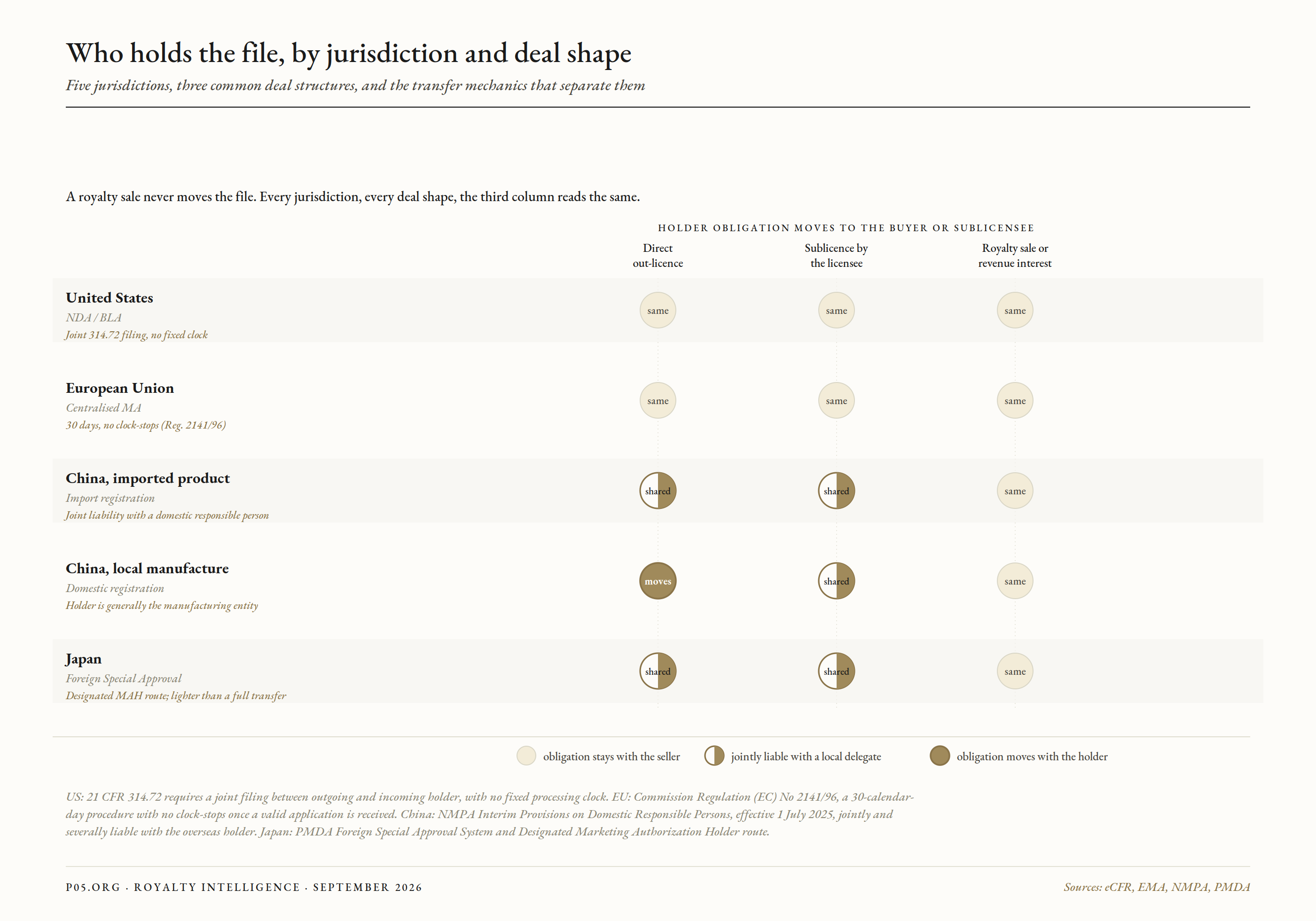
Who holds the file, by jurisdiction and deal shape: a royalty sale never moves it.
Table 1: who bears the regulatory obligation, by jurisdiction and structure
The comparison assumes a foreign originator licensing a product into the territory, manufactured abroad unless noted, and sets out who carries pharmacovigilance, variations, post-approval commitments and renewal under three common deal shapes.
| Jurisdiction | Direct out-licence | Sublicence by the licensee | Royalty sale or revenue interest financing |
|---|---|---|---|
| United States | NDA/BLA holder of record carries every FDA duty; a distribution deal leaves those duties with the original holder | Sublicensee sells; the holder of record is unchanged absent a 314.72 filing | Holder is unchanged; only the payment stream moves, so the seller keeps every FDA obligation after being paid |
| European Union | MA holder carries pharmacovigilance and variations; a move to a new entity needs the Regulation 2141/96 transfer | Sublicensee distributes; MA holder unchanged absent a formal transfer | MA holder unchanged; buyer acquires the payment stream, and the authorisation and its duties stay with the seller |
| China, imported product | Foreign holder retains the authorisation and must designate a domestic responsible person, jointly liable | Domestic partner commercialises; foreign holder remains on the file | Holder and domestic responsible person unchanged; royalty buyer has no direct relationship with either |
| China, local manufacture | Domestic entity is generally the holder, since cross-border holding of a locally made product is not the norm | Local holder can sublicense commercialisation while remaining on the file | Holder unchanged by a royalty sale; a later shift to local manufacture is itself a change of holder |
| Japan | Foreign Special Approval Holder owns the approval; a Designated MAH carries in-country quality and safety duties | Designated MAH unchanged; distribution can be reassigned without touching the approval | Approval and designated holder unchanged; buyer takes the payment stream only |
The pattern across every row is the same. A royalty sale moves money and leaves the file where it was. The seller who has already been paid keeps the obligation to maintain the authorisation, and the buyer who now depends on continued sales has no standing with the regulator at all.
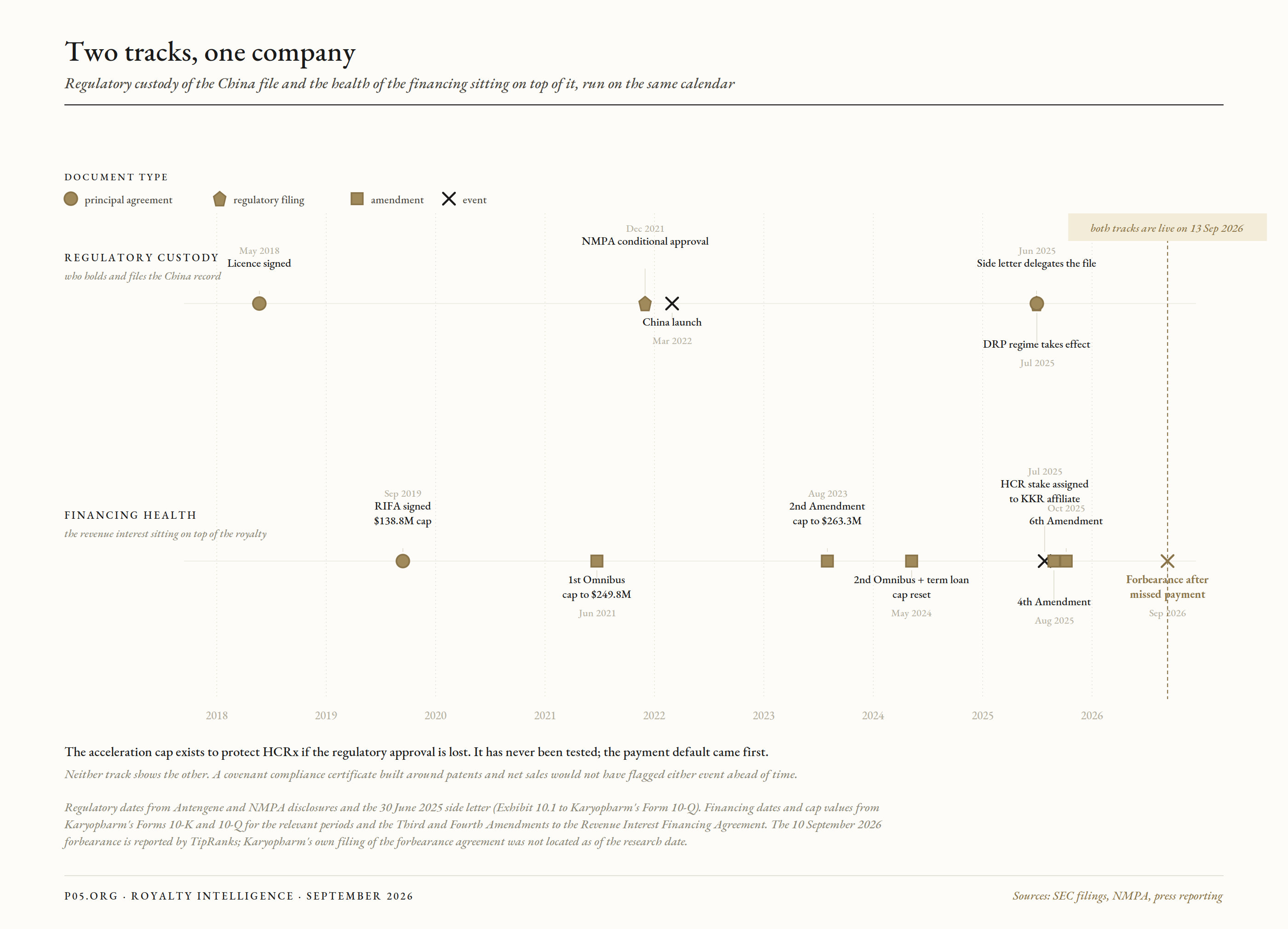
Regulatory custody of the China file and the health of the financing sitting on top of it, run on the same calendar.
What the Karyopharm and Antengene letter does
Karyopharm licensed selinexor and three other compounds to Antengene for China and other Asian territories under an exclusive licence agreement announced 23 May 2018, with an upfront reported at $12 million and up to $150 million in milestones. Antengene brought XPOVIO to conditional NMPA approval for relapsed or refractory multiple myeloma, and the product reached the mainland market in 2022.
The 30 June 2025 letter states plainly who holds the file: for products registered under China's import pathway, Karyopharm remains the marketing authorisation holder and has held the underlying approvals since the effective date. It reallocates the work. The title stays where it was.
Under the letter, Antengene "shall remain fully responsible for the performance of any China Regulatory Activities by Antengene or any of its Affiliates", and Antengene indemnifies Karyopharm against losses arising from those activities, from its own breach of the licence or the letter, or from its negligence in performing them.
The delegation is not permanent. The same clause states that if Antengene or an affiliate becomes the marketing authorisation holder itself, "including as a result of a local manufacturing arrangement or transfer of MAH status", the delegation falls away and the original allocation in the 2018 licence applies instead.
The letter is a duties delegation layered on top of a retained authorisation, matching the import-pathway rule and the domestic-responsible-person regime that took effect the following day. Karyopharm's royalty revenue from its China and other ex-US partners has grown alongside the arrangement: the company reported royalty revenue of $2.5 million in the second quarter of 2026, against $1.6 million a year earlier, with selinexor now approved in more than 50 ex-US countries and territories.
The distress case, three months later
The reason this matters beyond a single delegation letter is what happened to Karyopharm's own financing shortly after the research for this piece began. Under Karyopharm's Revenue Interest Financing Agreement, entered with HealthCare Royalty in September 2019 and amended repeatedly since, the events of default include specified revocations, withdrawals, suspensions or cancellations of regulatory approval for XPOVIO, alongside non-payment, covenant failure and insolvency.
On an event of default or a change of control, the investors may accelerate payments up to a contractual cap, stated in the most recent 10-Q at $128.3 million less amounts already paid. The agreement itself changed hands in July 2025, when it was assigned by HealthCare Royalty to an affiliate of KKR in connection with KKR's acquisition of a majority stake in the manager, a reminder that the royalty holder's own identity is not fixed either.
On 10 September 2026, three days before this research was finalised, Karyopharm entered a forbearance agreement and limited waiver with its lenders, convertible noteholders and royalty financing investors after failing to pay a $15.8 million term loan instalment and related interest.
The report states that payments are not waived, that default interest now accrues, and that the company's liquidity is projected to last only into mid-October 2026. None of this touches the selinexor marketing authorisation directly, and the public record does not show any regulatory-approval default triggering under the revenue interest agreement.
What it shows is a company simultaneously carrying the marketing-authorisation-holder role in China through a delegation structure and facing a payment default on the financing that its royalty investors hold. A royalty holder underwriting the China stream through this structure would be exposed to both events at once, and neither is visible from the selinexor approval record itself.
What the financing documents say about the file
A royalty holder that depended on a stream like the selinexor China royalty inherits the delegation structure above without having negotiated any part of it. Whether the documents that sit on top of such a stream protect the holder against loss of the file varies widely, from silence to a hard trigger.
The clearest maintenance covenant found in the filed record sits in a 2025 revenue-interest agreement, where the seller agrees to use commercially reasonable efforts to maintain the marketing approval and not to withdraw or abandon it, subject to defined carve-outs.
A licence can lock the authorisation in place through a consent gate instead: a 2016 pharmaceutical licence provides that the licensee may not assign or transfer the product marketing authorisation without the licensor's prior written consent, with breach deemed material.
Karyopharm's own revenue interest agreement shows the harder version: the event-of-default language quoted above ties acceleration directly to loss of the XPOVIO approval, and the agreement's change-of-control definition captures a transfer of the right to commercialise selinexor, which itself triggers accelerated payment.
The remedy that attaches varies with the instrument. A revenue-interest deal converts a lost approval or an unconsented transfer into an acceleration right up to a contractual cap, calculated against amounts already paid. A pure royalty sale more often acts through the underlying licence than through a direct maintenance covenant, with the seller agreeing not to exercise its rights under that licence in a way that would harm the royalty, and to enforce the licence at the buyer's direction.
A licence with only a consent gate and no financial remedy leaves the counterparty with contractual breach as its only lever, which is a weaker position than an acceleration trigger.
Table 2: how regulatory-file risk is treated across deal types
| Instrument | Typical protection | What triggers it | Remedy |
|---|---|---|---|
| Revenue interest financing (Karyopharm / HealthCare Royalty, as amended) | Event of default on revocation, withdrawal, suspension or cancellation of the named approval; change-of-control trigger on transfer of commercialisation rights | Loss of the approval, or an unconsented transfer of the right to commercialise | Acceleration of payments up to the contractual cap, less amounts already paid |
| Revenue interest financing, maintenance covenant | Affirmative covenant to use commercially reasonable efforts to maintain the approval and not to abandon it | Withdrawal or abandonment of the approval | Covenant breach feeding into the default framework |
| Direct licence with a consent gate | Licensee barred from assigning or transferring the marketing authorisation without the licensor's consent | Unconsented assignment or transfer | Breach of the licence deemed material |
| Royalty sale on top of an existing licence | Seller covenants not to exercise licence rights in a way that harms the royalty, and to enforce the licence at the buyer's request | Seller conduct under the underlying licence that damages the royalty | Contractual claim against the seller; buyer can direct enforcement but has no privity with the regulator |
| Delegation or agency letter (Karyopharm / Antengene) | Indemnity from the delegate to the originator; delegation lapses automatically if the delegate becomes the holder | Delegate's breach, negligence, or a change in who holds the authorisation | Indemnity claim; reversion of obligations under the original licence |
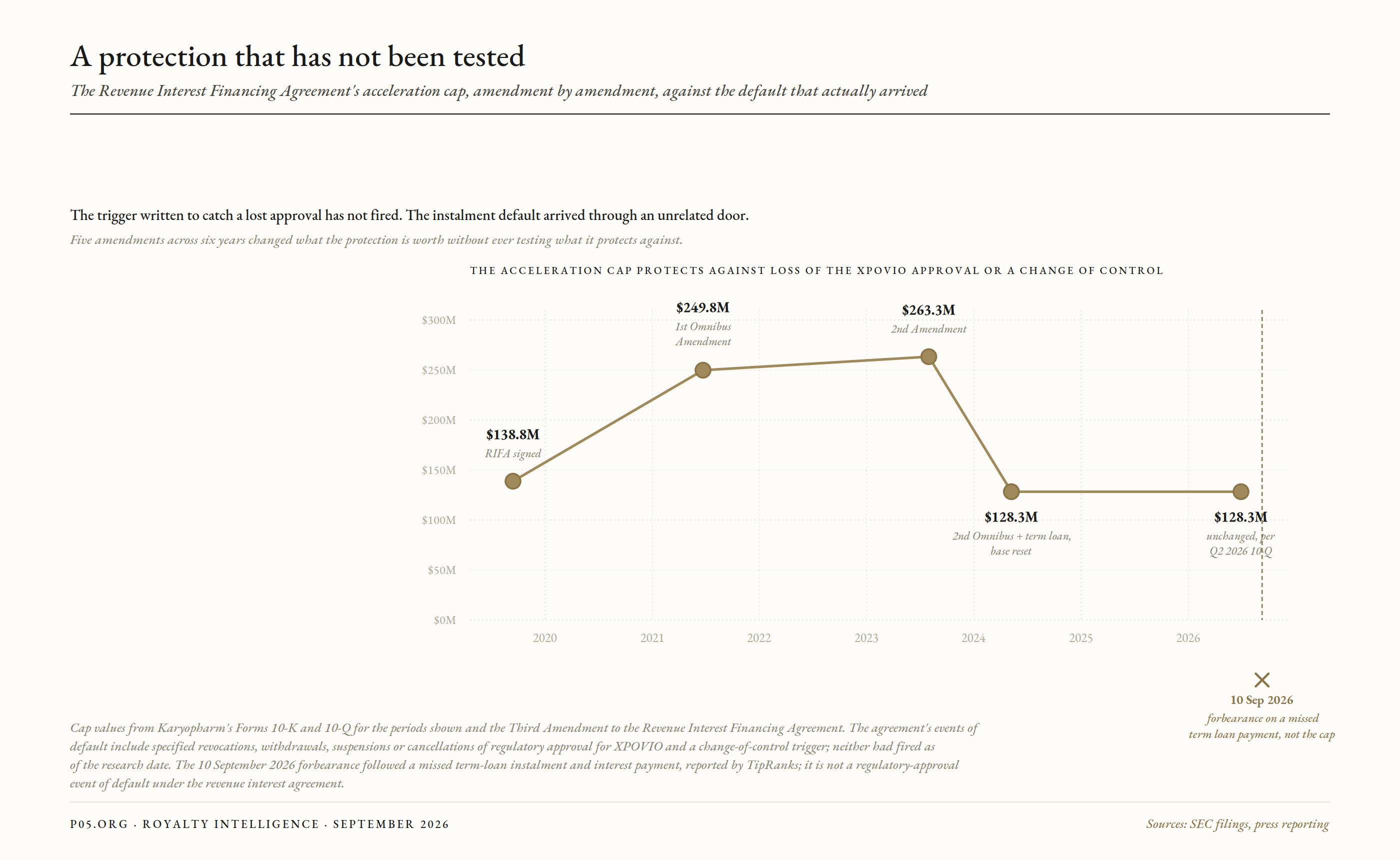
The Revenue Interest Financing Agreement's acceleration cap, amendment by amendment, against the default that actually arrived.
Why the exposure sits in the best deals
The structural point is narrow. A royalty is a claim on net sales, net sales require an active authorisation, and the royalty holder is exposed to a maintenance risk that most royalty documents do not price directly.
The regulatory file is the load-bearing element under the whole stream, and it draws less underwriting attention than the patent estate or the net sales definition sitting beside it.
That exposure clusters where royalty economics are most attractive. Cross-border licensing into large ex-US markets is where the upfront-plus-royalty model performs best, and it is where the licensee needs in-country holder capability the originator lacks. China's requirement that an imported drug's foreign holder appoint a domestic responsible person, and that a locally manufactured drug generally be held by a domestic company, means a serious China royalty deal is likely to produce a delegation or a holder change of the kind the Karyopharm letter documents. Japan's designated-holder route and the EU's transfer procedure create comparable hand-offs at comparable deal sizes.
The delegation letter is a feature of the transactions a royalty buyer would rank most highly, and it is also the document least likely to sit in the data room such a buyer reads, because it surfaces, if at all, as an exhibit to a periodic report, and deal summaries do not describe it.
Two incentive effects follow. In a royalty sale the seller keeps the authorisation and its costs after being paid, so the party obligated to fund pharmacovigilance, variations and renewals is the party that has already been cashed out. And a mid-term reallocation of regulatory duties can happen by side letter appended to a quarterly filing, so a change in who holds the file may never appear in a covenant compliance certificate built around patents and net sales.
Where this leaves a royalty desk
Establish who holds the file today, not just that an approval exists. Confirm the named holder of record in each territory, whether a delegation or agency letter is in force, and whether a local-manufacturing plan under negotiation would move the holder. The Karyopharm letter shows this can turn on a document filed as an exhibit that no deal announcement summarised.
Price the transfer mechanics and the gap window. A US transfer needs a joint filing under 21 CFR 314.72 that a demobilised seller can stall indefinitely. An EU transfer runs a binding 30-day procedure under Regulation 2141/96 with no clock-stops, but the period before the Commission decision is where duties can be ambiguous. A China holder change interacts with the domestic-responsible-person regime that took effect 1 July 2025.
Ask for a maintenance covenant with a defined remedy, not a bare consent gate. The revenue-interest template that ties loss or unconsented transfer of the approval to acceleration is a stronger protection than a licence clause that only deems an unconsented transfer a material breach. A covenant without a financial trigger leaves the holder with litigation as its only recourse.
Treat a delegation letter as a covenant event, and watch what makes it lapse. Where a stream depends on a licensee's in-country regulatory capability, the Karyopharm structure shows the automatic trigger to track: the delegation falls away the moment the delegate becomes the holder itself, whether through local manufacture or a formal transfer.
That is the event that should generate notice to the royalty holder, and it is not one that a patent-and-net-sales compliance certificate is built to catch.
Underwrite the counterparty's own solvency alongside the regulatory file. The Karyopharm forbearance of 10 September 2026 shows the two risks compounding: a company can be managing a China delegation structure correctly while simultaneously defaulting on the financing its royalty investors hold. A diligence process that stops at "does the approval exist" misses the second half of the question, which is whether the entity responsible for keeping it alive can still fund the obligation.
Standard disclaimer
All information in this report was accurate as of the research date and is derived from publicly available sources including court opinions, regulatory guidance, academic literature, SEC filings, and financial news reporting. Information may have changed since publication. This content is for informational purposes only and does not constitute investment, legal, or financial advice. The author is not a lawyer or financial adviser.