
Company of the week: Crescent Biopharma
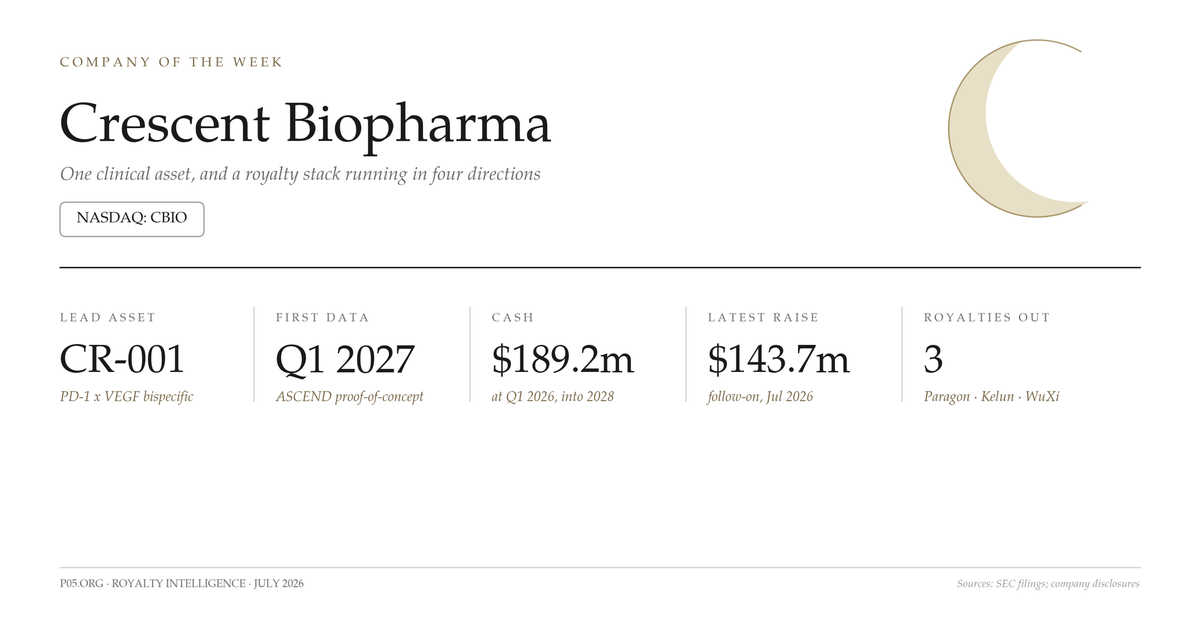
Crescent Biopharma carries an unusually dense set of royalty obligations for a company with a single lead asset. It pays a royalty to the incubator that originated its lead molecule, pays a second to the Chinese partner that supplied one of its ADCs, may owe a third to its manufacturer, and collects a royalty back from that same Chinese partner in one territory.
For a royalty desk, that structure is the reason Crescent is worth an hour of attention. The molecule will be judged in the clinic in early 2027. The paper wrapped around it can be read today.
Crescent (Nasdaq: CBIO) is a clinical-stage oncology company based in Waltham, Massachusetts and incorporated, since June 2025, in the Cayman Islands. It did not hold a conventional initial public offering. It was assembled inside an antibody incubator, taken public through the shell of a distressed biotech, and funded by a syndicate that priced it before the ticker changed.
Its corporate structure is closer to a financing vehicle than a conventional startup, and its lead asset is engineered to closely replicate an existing drug.
That last point is central to the case either way. Crescent's lead programme, CR-001, is a PD-1 x VEGF bispecific antibody designed to reproduce the targeting, binding, cooperativity and pharmacokinetics of ivonescimab, the Akeso and Summit Therapeutics molecule that became the most-watched asset in immuno-oncology.
The company states this openly in its filings. The rationale is that closely modelling a validated molecule reduces the biological risk that ends many oncology programmes.
This piece treats Crescent the way a royalty desk would: as a set of cash-flow claims layered on a single, closely modelled molecule, rather than as the molecule itself.
At a glance
| Item | Detail |
|---|---|
| Company | Crescent Biopharma, Inc. (Nasdaq: CBIO), Waltham, Massachusetts; incorporated in the Cayman Islands |
| Founded | Pre-merger Crescent incorporated in Delaware on 19 September 2024; public via reverse recapitalisation on 16 June 2025 |
| Origin | Fifth company launched on assets from Paragon Therapeutics, the antibody discovery engine founded by Fairmount Funds Management |
| Public listing | Reverse merger into GlycoMimetics, with a concurrent $200 million private placement; redomiciled to the Cayman Islands at closing |
| Leadership | Joshua Brumm, chief executive; Jonathan McNeill, president and COO; Ellie Im, chief medical officer; Rick Scalzo, chief financial officer |
| Board and sponsor | Peter Harwin, managing member of Fairmount; Jonathan Violin, Fairmount venture partner and former interim chief executive |
| Lead asset | CR-001 (also SKB118), a tetravalent PD-1 x VEGF bispecific engineered to reproduce ivonescimab; Phase 1/2 ASCEND trial, first patient dosed February 2026, data expected Q1 2027 |
| Other pipeline | CR-002, a PD-L1 ADC, clinic H2 2026; CR-003 (Kelun's SKB105), an ITGB6 ADC, Phase 1/2 in China; a CR-004 programme in evaluation |
| Defining deal | December 2025 arrangement with Kelun-Biotech: out-licensed CR-001 in Greater China, in-licensed SKB105 (CR-003) elsewhere |
| Newest event | Public follow-on priced 14 July 2026, roughly $143.7 million gross with the over-allotment |
| Cash | $189.2 million at 31 March 2026, guided into 2028, before the July raise |
| Shares | 27,556,767 outstanding at 23 February 2026, before roughly 9.9 million issued in July |
| Royalty items | Pays royalties to Paragon and Kelun, potentially to WuXi; collects a royalty from Kelun on CR-001 in China |
What Crescent is
Set the pipeline diagram aside and Crescent is a bet on one molecule.
CR-001 is the company. The two wholly owned antibody-drug conjugates, CR-002 and CR-003, function mainly as combination partners intended to be given alongside CR-001, and as evidence that the company is more than a single asset.
The stated strategy is to make CR-001 an immuno-oncology backbone, the drug given alongside others, and to sell that backbone into the market pembrolizumab currently leads. Pembrolizumab, marketed as Keytruda, recorded $31.7 billion in 2025 sales, and the wider PD-1 and PD-L1 class reached roughly $59 billion.
The gap Crescent is aiming at is real. Across ninety-one trials, the objective response rate to checkpoint inhibitors sits below twenty per cent. The industry's main answer has been combinations, and the PD-1 x VEGF bispecific is the combination that has drawn the most interest: one molecule releases the immune brake while cutting the tumour's blood supply, and blocking VEGF has an immune-activating effect of its own on top of the anti-angiogenic one.
That is the biology CR-001 rests on. How Crescent chose to build it is the more distinctive decision.
The origin: an incubator asset in a public shell
Most biotechs are built around a scientific founder. Crescent was built on a financing template that Fairmount has now run five times.
It is the fifth company launched on assets from Paragon Therapeutics, an antibody discovery engine that Fairmount Funds Management founded and controls. Paragon runs a hub-and-spoke model: the engine discovers the antibody, and each promising programme is spun into a separate company that licenses the asset and moves it toward the public market. Apogee, Oruka and Spyre came before Crescent.
The relationships are close. Fairmount owns more than five per cent of both Crescent and Paragon, appoints Paragon's board, and placed two of its own people, Peter Harwin and former interim chief executive Jonathan Violin, on Crescent's board.
Pre-merger Crescent was incorporated in Delaware on 19 September 2024. Rather than file for an IPO, it stepped into the listing of GlycoMimetics, a public developer whose pipeline had stalled, through a reverse recapitalisation that closed on 16 June 2025. At closing the company took the Crescent name and the CBIO ticker, and changed its jurisdiction of incorporation to the Cayman Islands.
Supporting the merger was a $200 million private placement led by Fairmount, Venrock Healthcare Capital Partners, BVF Partners and Fidelity, with a broad tail of crossover funds. It folded in $37.5 million of convertible notes Crescent had already issued. The capital was committed before the public could price the company.
The structural takeaway is that Crescent is an engineered vehicle. The originator (Paragon), the sponsor (Fairmount) and the operating company (Crescent) are related parties by the company's own description, and assets move between them on pre-negotiated option and licence terms rather than at arm's length. That is the architecture, and architecture is what gets underwritten.
CR-001, and the molecule it is modelled on
CR-001 is engineered to closely replicate ivonescimab, and the resemblance is the whole thesis.
Ivonescimab is the first PD-1 x VEGF bispecific to beat single-agent Keytruda head to head. In the HARMONi-2 trial in China, first-line NSCLC patients on ivonescimab had a median progression-free survival of 11.1 months against 5.8 months on pembrolizumab, with the benefit holding in the low PD-L1 and squamous subgroups where pembrolizumab historically underperforms.
The engineering is specific. CR-001's VEGF-binding domain is derived from bevacizumab, the same domain ivonescimab uses. Its PD-1-binding domain is a proprietary single-chain fragment tuned to match ivonescimab's affinity, with additional stability engineering by Paragon. Its Fc region is modified to reduce the same natural-killer-cell activity ivonescimab dampens, and its FcRn affinity is matched to give a comparable half-life.
In cell assays run by Paragon, CR-001's cooperative binding (a tighter grip on PD-1 in the presence of VEGF) tracked ivonescimab's closely. Crescent set out to build a molecule that behaves like ivonescimab, and describes it that way in its filings.
The logic is a strategy rather than a shortcut. If CR-001 behaves like ivonescimab, then the growing body of ivonescimab clinical data becomes a read-through for CR-001, allowing Crescent to move faster and with fewer patients into late-stage trials than a company carrying a genuinely novel molecule would. The company's own framing is that a highly differentiated design would carry more development risk, not less.
The test is ASCEND, a global Phase 1/2 study that dosed its first patient in February 2026. It will enrol up to 290 patients across as many as eight solid tumour types, spanning liver, biliary, gastric, colorectal, endometrial, cervical, ovarian and lung cancers, at sites in the United States, Europe and Asia Pacific. Proof-of-concept data is expected in the first quarter of 2027.
The ADCs
The two antibody-drug conjugates are the supporting cast, and one arrived by an unusual route.
CR-002 is a PD-L1-directed ADC carrying a DXd-class topoisomerase-inhibitor payload on a GGFG linker, the same linker chemistry used in Enhertu. Rather than blocking the PD-L1 checkpoint, it uses PD-L1 as an address to deliver a toxin into the tumour cell. Crescent licensed it from Paragon, exercised the option in September 2025, and plans an IND in mid-2026 and a Phase 1/2 trial in the second half of the year.
CR-003 is the ITGB6-directed ADC Crescent took from Kelun-Biotech, where it is known as SKB105. There is a wrinkle here worth noting: the CR-003 designation originally belonged to a separate, preclinical Paragon ADC programme covering three undisclosed targets. In February 2026 Crescent gave notice that it was terminating that Paragon ADC option agreement, and reassigned the CR-003 name to Kelun's SKB105.
The ADC now called CR-003 is therefore not a Paragon asset. It is in a Phase 1/2 trial in China, with initial data expected in the first quarter of 2027 and a CR-001 combination study to follow. The reassignment matters for the royalty map, because it changes who is owed money on CR-003: a Kelun royalty applies rather than a Paragon one.
The royalty stack
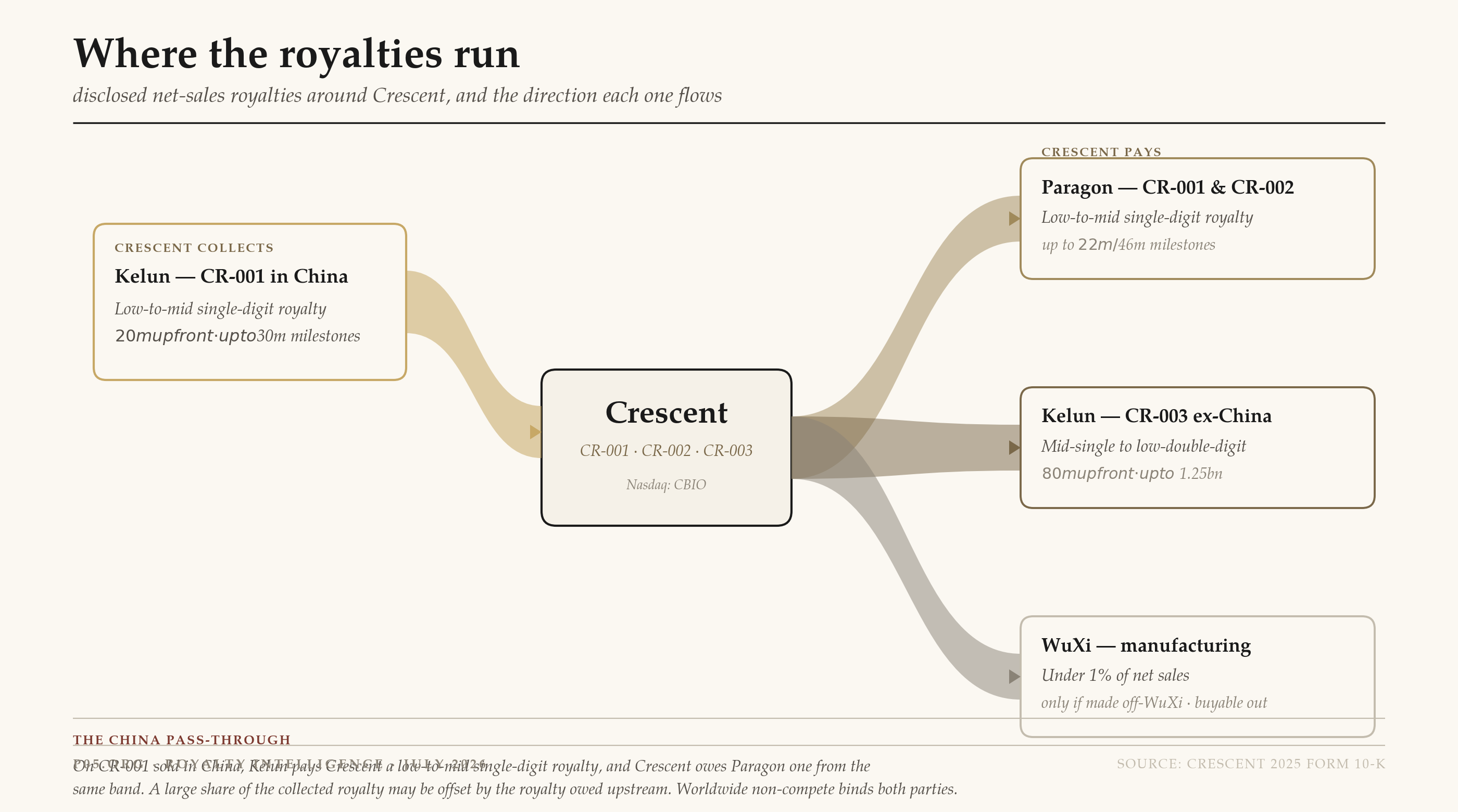
This is the centre of the company, and unusually for a business this early, the terms are disclosed rather than inferred. Read from the drug outward, Crescent sits beneath at least three royalty obligations and above one receivable.
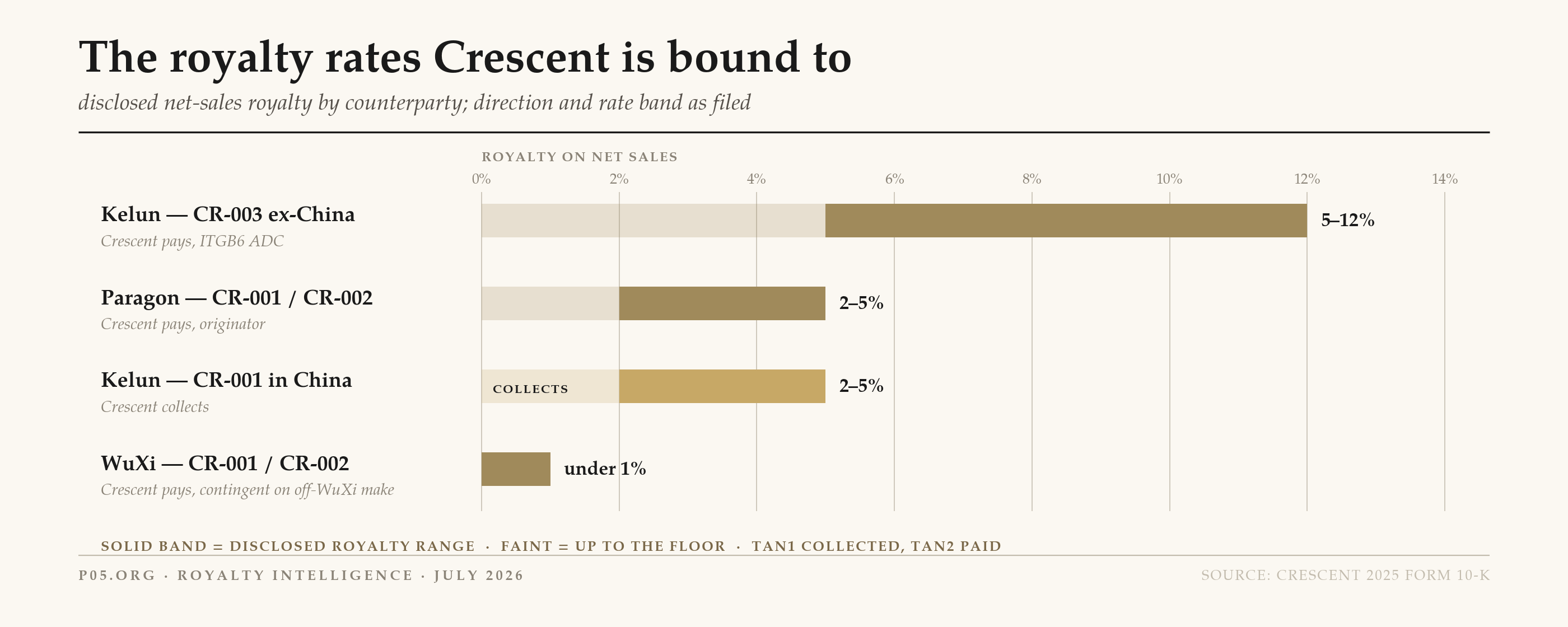
Paragon, the originator royalty. Under the CR-001 and CR-002 licence agreements, Crescent owes Paragon a low-to-mid single-digit royalty on net sales of each drug, plus milestone ladders of up to $22.0 million on CR-001 and up to $46.0 million on CR-002. The royalty runs for the later of twelve years from first commercial sale or the last covering patent, and falls by thirty per cent in any country with no valid patent. There is no payment on exercising the option itself.
Through the end of 2025, Crescent had reimbursed Paragon $16.7 million on CR-001, $13.9 million on CR-002 and $2.2 million on the terminated CR-003 programme, in development costs. For a royalty desk this is the most notable layer: a privately held, incubator-level royalty on a public company's lead asset, attached to an entity with no coverage of its own, sitting one level above the ticker most people watch.
Kelun, the ADC royalty paid out. For ex-China rights to CR-003, Crescent pays Kelun $80 million upfront, up to $345 million in clinical and regulatory milestones, up to $902.5 million in commercial milestones, and a tiered royalty from the mid single digits into the low double digits on net sales.
There is more. If Crescent sublicenses or divests CR-003, it owes Kelun a low-double-digit or mid-double-digit share of what it receives, depending on timing. If Crescent is itself acquired within a set window, it owes Kelun a portion of what its shareholders collect. On this asset Crescent is the payer, on a long ladder, for a molecule it did not originate.
Kelun, the CR-001 royalty collected. In the other direction, Crescent granted Kelun Greater China rights to CR-001 and receives $20 million upfront (paid January 2026), up to $30 million in development milestones, and a tiered royalty from the low to mid single digits on Chinese net sales. On its own lead molecule, in one territory, Crescent is the collector.
WuXi, the manufacturing royalty. Under its WuXi cell-line licence, if Crescent manufactures commercial supply of CR-001 or CR-002 anywhere other than WuXi, it owes WuXi a fraction of a single-digit per cent of global net sales, reducible pro rata and buyable out with a lump sum. It is small and contingent on a manufacturing choice, but it is a fourth claim on the same sales.
One observation follows from reading the agreements together, rather than from any single one. On CR-001 sales inside China, Kelun pays Crescent a low-to-mid single-digit royalty, and Crescent in turn owes Paragon a low-to-mid single-digit royalty on the same product, because it remains responsible for its Paragon obligations even on the sublicensed territory. The two rates are drawn from overlapping bands. On that basis, a meaningful share of the royalty Crescent collects in China may be offset by the royalty it owes Paragon. This is an inference from the disclosed terms, not a figure the company states.
The unpartnered asset, and the constraint on it
The most valuable item Crescent owns is a rights position it has not yet monetised, and it comes with a constraint that is easy to overlook.
Kelun took Greater China for CR-001. Everywhere else, the entire developed-market opportunity for the lead asset, Crescent owns outright and has not partnered. That is both the overhang and the potential prize.
If CR-001 differentiates in ASCEND, those ex-China rights are what a large pharma might pay a significant sum for, and the class has been transacting at those levels. AbbVie paid RemeGen $650 million upfront, with up to $4.95 billion in milestones, for a comparable asset.
The constraint is a non-compete. Under the CR-001 licence to Kelun, neither party may develop any other PD-1 x VEGF bispecific antibody anywhere in the world, other than the licensed product. That protects CR-001's position, but it also means Crescent cannot hold a second candidate in the same class as a hedge. Its exposure is tied to this single molecule within the class, which is a factor a desk would price.
The class it is entering
CR-001 is not first in its class. On current timelines it is a fast follower entering a crowded and closely watched field.
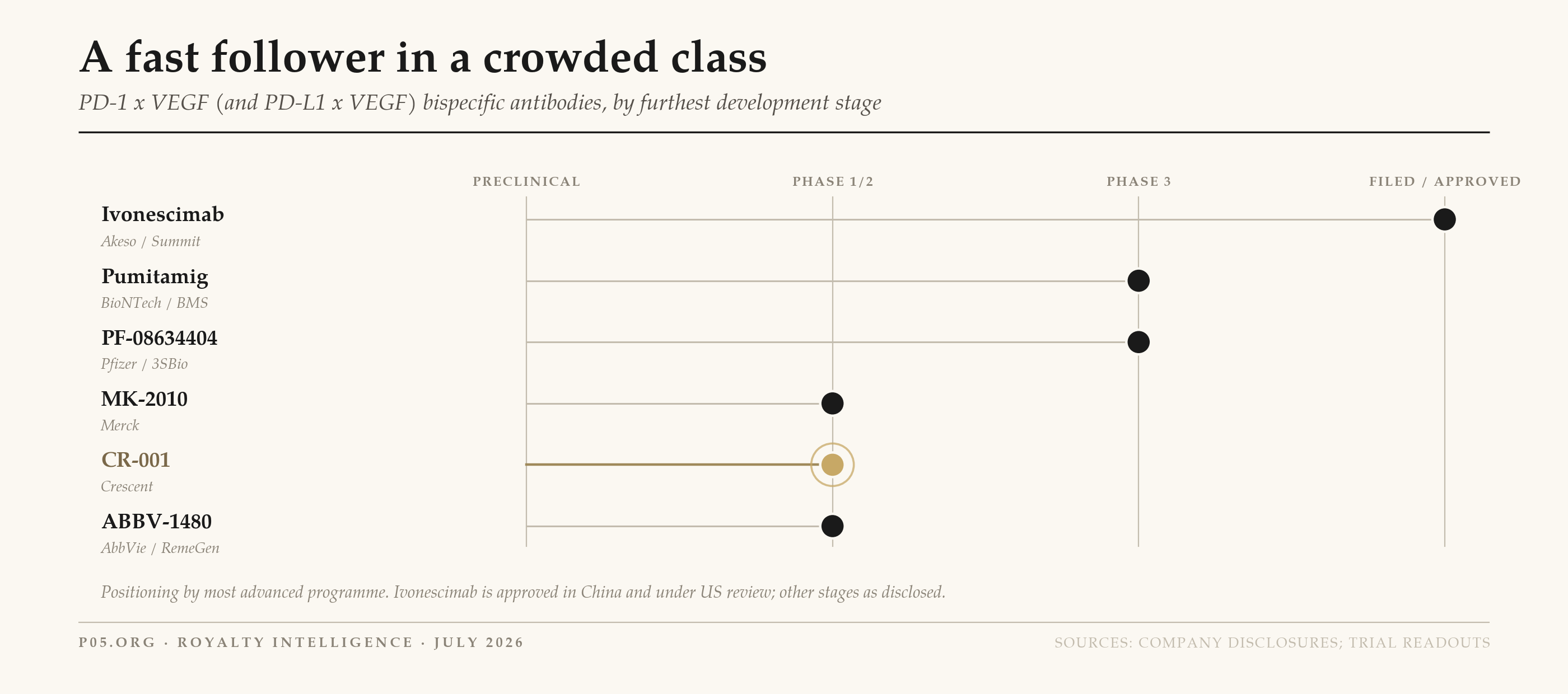
The leader, ivonescimab, has the HARMONi-2 win over Keytruda, Chinese approvals in two NSCLC settings, and a first-ever ASCO plenary slot for a China-developed asset, where it presented overall-survival data in 2026.
It also carries a cautionary example. When Summit reported the global HARMONi trial in later-line, EGFR-mutated lung cancer in 2025, the data were debated on design and execution and the stock fell about a quarter in a session. The class has been volatile even for its leader, and ivonescimab's US regulatory decision was still pending late in 2026.
Behind ivonescimab is a well-funded field. Pfizer and 3SBio are developing PF-08634404; BioNTech and Bristol Myers Squibb have the PD-L1 x VEGF bispecific pumitamig; Merck has MK-2010; AbbVie has the RemeGen-sourced ABBV-1480.
Chief executive Joshua Brumm frames Crescent's position behind the frontrunners as an advantage, arguing a fast follower can learn from the leaders' trial designs and differentiate through ADC combinations. It is a coherent argument, and it is one several competitors, some larger and better capitalised, are also making.
How it funds itself
Crescent has almost no product revenue, so its history is a sequence of financings that tracks its deal-making.
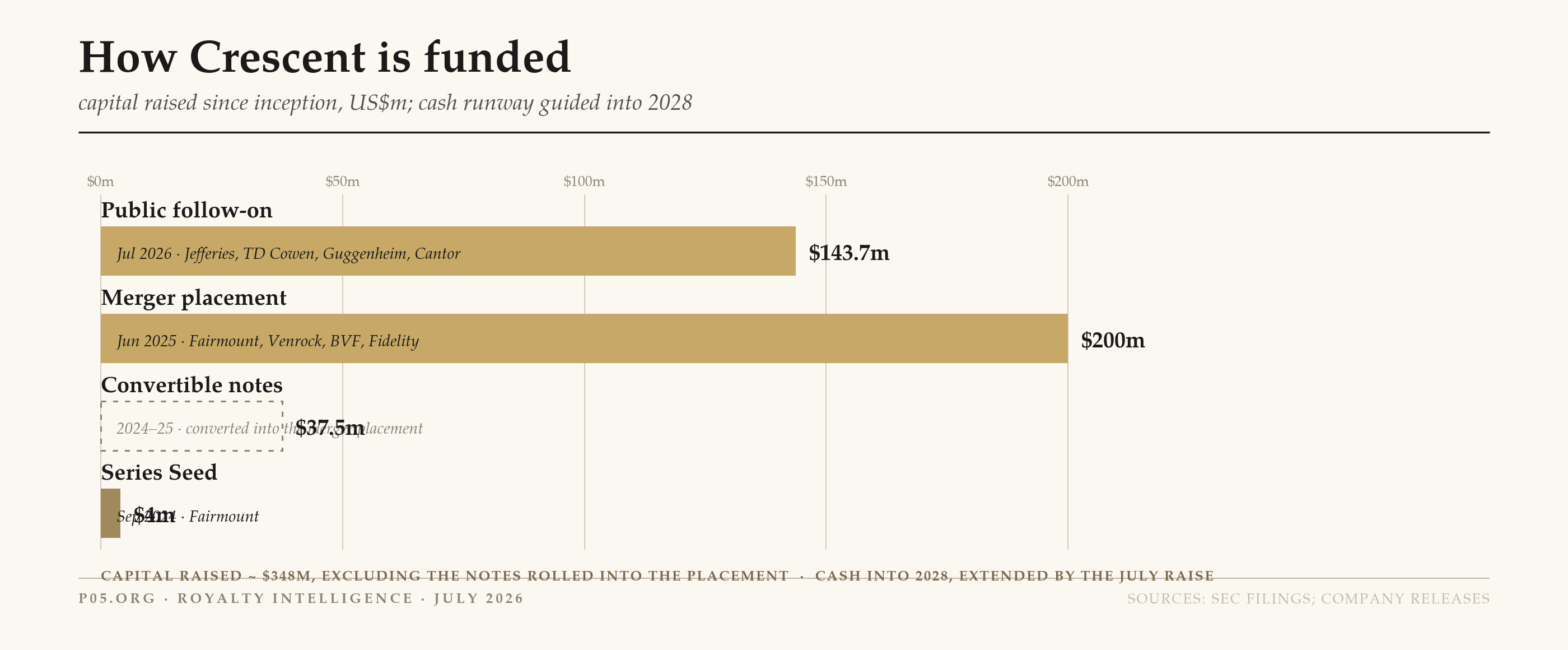
It began with a $4.0 million Series Seed from a Fairmount fund in September 2024, at twenty cents a share, plus $37.5 million of convertible notes. The $200 million placement that supported the June 2025 merger was the launch capital and rolled those notes in.
The first quarter of 2026 closed with $189.2 million in cash, guided to fund operations into 2028. On 14 July 2026, Crescent priced a public follow-on, selling shares to the public at $14.50 (the company receiving $13.63 after the discount) plus pre-funded warrants, and closed it two days later with the over-allotment exercised, for roughly $143.7 million gross. Jefferies, TD Cowen, Guggenheim Securities and Cantor ran the book.
The size and timing of the July raise are worth noting. Adding nine figures on top of cash already guided into 2028 points either to building a larger balance sheet ahead of the ASCEND readout, or to a preference for funding the ex-China CR-001 opportunity internally rather than partnering it early. Both readings centre on the same event: the Q1 2027 data.
| Round | Amount | Date | Backers |
|---|---|---|---|
| Series Seed | $4.0M | Sep 2024 | Fairmount |
| Convertible notes | $37.5M | 2024 to 2025 | Rolled into the merger placement |
| Merger placement | $200M | Jun 2025 | Fairmount, Venrock, BVF, Fidelity, syndicate |
| Public follow-on | ~$143.7M gross | Jul 2026 | Jefferies, TD Cowen, Guggenheim, Cantor |
The running cost is modest for the ambition. In the first quarter of 2026, Crescent reported $1.0 million of revenue (the Kelun licence), $17.9 million of R&D spend, $7.9 million of G&A, and a net loss of $23.3 million, or seventy cents a share. Share count grew from about 27.6 million in February to roughly 37 million after the July issuance, with the stock trading in the mid-to-high teens across the period.
Red team versus blue team
Risk analysis (red team)
The concentration is high. Crescent is one asset for practical purposes, and that asset delivers its first human efficacy data in a single window in early 2027. The worldwide PD-1 x VEGF non-compete with Kelun means Crescent cannot hold a second candidate in the same class as a hedge.
The molecule is closely modelled on another. That is a deliberate strategy, but it means CR-001 has limited independent differentiation to fall back on if the class leader stumbles or a better-funded competitor sets the bar. Crescent is following the category rather than defining it, into a field that already includes Pfizer, Merck, BioNTech, Bristol Myers Squibb and AbbVie.
The economics run in Crescent's favour unevenly. On CR-003 it is the payer, with an $80 million upfront and a ladder reaching roughly $1.25 billion plus a double-digit-capable royalty out to Kelun. On CR-001 in China its collectable royalty is only low-to-mid single digits, a share of which may be offset by the Paragon royalty. The most valuable item it owns, the ex-China CR-001 rights, is unpriced and contingent on the same readout, and the structure rests on related-party terms.
Opportunities and mitigants (blue team)
The close modelling is also the strongest mitigant. Because CR-001 is engineered to reproduce ivonescimab, the biological risk that ends many oncology programmes has, at the class level, already been reduced by another company's data. Crescent is a fast follower in a validated class, and can read across ivonescimab data to move faster with fewer patients.
The balance sheet is strong for the stage. Cash guided into 2028 plus roughly $143.7 million raised in July leaves Crescent funded through its key readouts and able to develop the ex-China opportunity on its own terms.
The Kelun arrangement is efficient on its face. It funds and de-risks the China programme through a local partner with approved ADCs, adds a combination-ready ADC, and enables parallel CR-001 data in Chinese and non-Chinese populations, which may limit the need for bridging studies. The prize is ownable: Crescent holds the entire developed-market CR-001 opportunity outright, against class comparators transacting at $650 million-plus upfronts.
The backing is deep. The Paragon and Fairmount model has produced repeat public companies, the leadership has run public biotechs before, and the syndicate is a strong bench of healthcare crossover capital.
Summary
| Risk | Concern |
|---|---|
| Single-asset concentration | Thesis rests on one Q1 2027 readout |
| Closely modelled molecule | Limited independent differentiation from ivonescimab |
| Class non-compete | Worldwide leash prevents an in-class hedge |
| Payer on CR-003 | $80M upfront, up to roughly $1.25B milestones, royalty out |
| China offset | Collected CR-001 royalty may be largely offset by Paragon royalty |
| Related-party structure | Assets held on pre-negotiated terms from Paragon and Fairmount |
| Opportunity | Observation |
|---|---|
| Validated class | Mechanism already beat Keytruda in a rival's trial |
| Read-through data | Ivonescimab data de-risk CR-001's path |
| Funded through readouts | Cash into 2028 plus roughly $143.7M raised in July 2026 |
| Ownable prize | Ex-China CR-001 rights unpartnered against $650M-plus comparators |
| Two-territory design | Kelun deal funds China and adds a combination-ready ADC |
Conclusion
Crescent Biopharma is a clear illustration of how a modern oncology asset is financed. It was originated inside an incubator, taken public through a shell, redomiciled offshore, split by territory across a Chinese partner, and layered with royalties running in several directions, all before its lead drug has been tested in a patient.
For a royalty desk, that density is the point. Crescent is not a stream to buy today. Its lead asset has no approved sales, its most valuable rights are contingent on a readout a year out, and a share of the one royalty it collects is pledged upstream.
But it lays out, in disclosed terms, the layers a desk usually has to reconstruct: an originator royalty held privately by an incubator, a partner royalty running both ways across a single molecule, and a manufacturing royalty inside a cell-line licence.
The tests ahead are concrete. Whether ASCEND shows CR-001 behaving like the molecule it is modelled on will determine whether the ex-China rights are worth a headline licence. Whether Crescent partners those rights or funds them alone will show how it reads its own data. And whether the milestone ladder to Kelun begins paying will indicate whether CR-003 was a well-judged in-licence.
Until those resolve, Crescent is best understood not as a drug company with deals attached, but as a set of royalty and milestone claims with a single, closely modelled molecule at the centre. That is precisely what a royalty desk is built to read.
All information in this article was accurate as of the research date, and is derived from publicly available sources including the company's SEC filings, press releases, and financial news reporting. Crescent Biopharma is a public company (Nasdaq: CBIO). The royalty rates, milestone amounts, and licence terms described for the Paragon, Kelun, and WuXi agreements are as disclosed in the company's 2025 Annual Report on Form 10-K and related filings; where a rate is described by band rather than a precise figure, that reflects the company's own disclosure. The observation that Crescent's collected CR-001 royalty in China may be substantially offset by the royalty it owes Paragon is an analytical inference from the disclosed terms, not a figure stated by the company. Deal figures cited for peers, including AbbVie and RemeGen, Summit and Akeso, Pfizer and 3SBio, BioNTech and Bristol Myers Squibb, and Merck, are as reported by those parties and are used here only for structural and class comparison. Clinical descriptions of CR-001 and ivonescimab derive from company statements, trial disclosures, and the peer-reviewed literature, and have not been independently verified. CR-001 had not been tested in humans as of the research date. Figures and relationships may have changed since publication. This content is for informational purposes only and does not constitute investment, legal, or financial advice. The author is not a lawyer or financial adviser.