
Pennies on the Dollar at Fund Scale: The Structure of Early-Royalty Aggregation
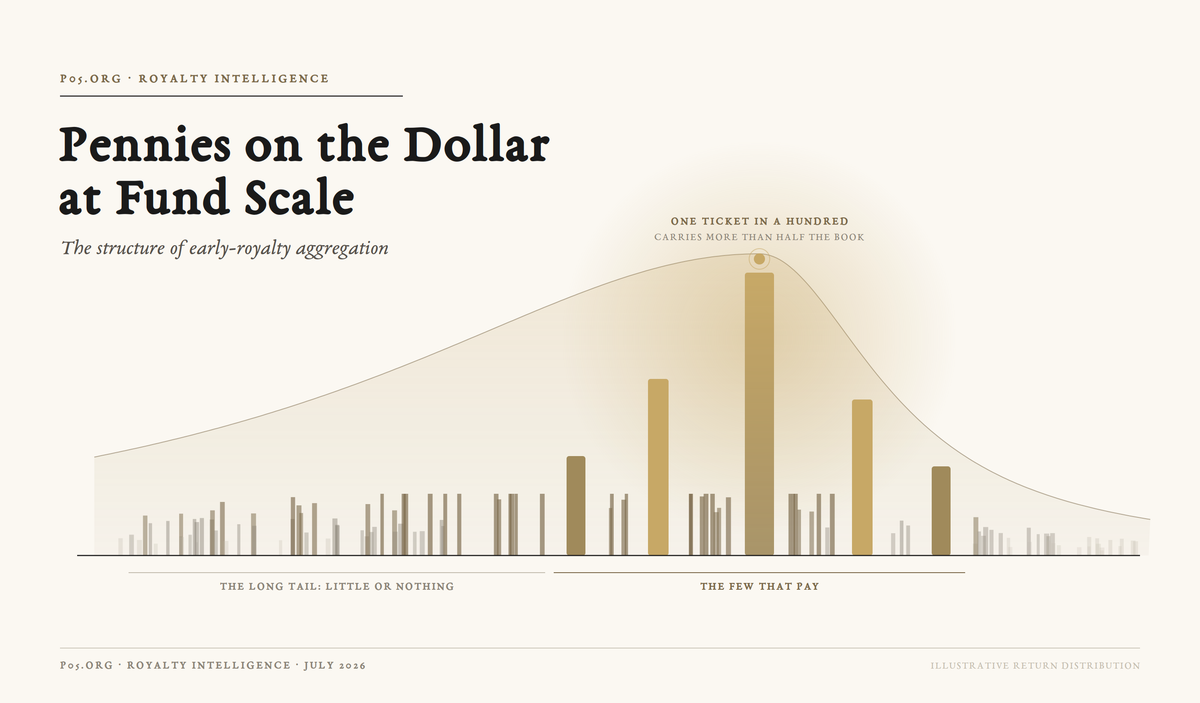
Acquire many royalty and milestone interests on Phase 1 and Phase 2 assets at deep discounts, on the order of one to three million dollars each. Assemble a diversified book of hundreds of them. Then either hold the book or recycle it.
The question is whether any version of that strategy clears an institutional return bar, and how the version chosen decides the answer. This piece treats it as a general structure with three design choices, works the financial mechanics, and reads the record against both. It follows "The Clinic Door", which set out why the early band is thin to begin with.
The strategy is not hypothetical. Versions have run in permanent-capital form, in closed-end fund form, as a corporate reinvention, and inside asset-based finance. The record spans the design space rather than settling it.
The three design choices
An implementation makes three near-independent choices:
- Capital permanence. Permanent public or insurance capital that never redeems, versus a finite-life fund with a defined harvest.
- Disposition. Hold each interest to expiry, versus originate to distribute, selling once an asset de-risks.
- Sourcing. Negotiated purchases from solvent but constrained sellers, versus distressed sourcing from estates and wind-downs.
Everything downstream follows from where an implementation sits in that cube: the return profile, the legal build, the exit, and the dominant risk.
The asset: an option you cannot hedge
At Phase 1 there is no product and no sales. There is only the right to a future royalty, a claim that pays nothing unless the molecule clears the clinic, clears a regulator, and then sells.
Formally it is a compound call option. Each clinical gate buys the right to attempt the next, and the terminal payoff is a fixed percentage of uncertain sales over a fixed patent life.
The option framing is descriptive, not a pricing tool. Option pricing assumes a replicating portfolio tradeable in a liquid market. The valuation literature is explicit that this is rarely satisfied for real options in corporate settings, because no liquid instrument replicates one molecule's clinical outcome.
The consequence runs through the whole strategy: the idiosyncratic risk cannot be hedged, only diversified. The instrument exists at the portfolio level or not at all.
The working valuation is rNPV. Risk-adjusted net present value weights each cash flow by the cumulative probability of success. Two inputs move as an asset advances: the probability of success, climbing from roughly 14 percent at Phase 2 entry toward certainty at approval, and the discount rate, compressing from 15 to 20 percent for pre-revenue biotech to 8 to 10 percent for commercial cash flows. The convergence of those two inputs is the entire source of value.
The base rate and the power law
Approval probability from Phase 1 is about 6.7 percent on recent data, and it varies by therapy area by a factor of seven. Peak sales among approved drugs are themselves fat-tailed: roughly half of approved drugs reach a billion dollars in peak sales, while most cluster far lower. A low, dispersed hit rate times a skewed payoff is a power law.
The venture literature has measured the same distribution. Large samples fit a power law where most positions return at or below cost and a small minority carry the result: the 0-to-1x cohort averages roughly negative 80 percent, and a top few percent of positions produce most returns.
Breadth is arithmetic, not ambition. At a six to ten percent hit rate, the chance of a book catching zero winners is roughly a coin flip across twenty names and only a genuine tail risk past fifty to a hundred. "Hundreds of interests" is the minimum scale at which the tail can express itself.
Two differences from venture, offsetting. The buyer pays once and the licensee funds the trials, so maximum loss per name is the ticket, with no follow-on into losers. Against that, the upside is capped: a royalty is a fixed percentage for a fixed life, so even a breakout returns a bounded multiple.
How it works financially
This is where the strategy lives or dies, so it is worth the arithmetic. The model below is illustrative, with every input stated so it can be changed.
One ticket, in expectation
Write the expected present value at entry as:
E[V] = −C + Σ(m·π) + p·ρ·S·κ·δ
C is the entry cost. Σ(m·π) sums each milestone times the probability of reaching its gate. The terminal term is the probability of approval (p), the royalty rate to the buyer (ρ), expected peak sales given approval (S), the ratio of royalty present value to peak-year royalty (κ), and the discount factor from entry to approval (δ).
Base case, per one-million-dollar ticket:
| Component | Weighted PV at entry |
|---|---|
| Entry cost, C | −$1.0m |
| Milestones, probability-weighted | +$0.6m |
| Terminal royalty (p 6.5%, ρ 4%, S $900m, κ 3.5, δ 0.45) | +$3.7m |
| Net expected value | ≈ +$3.3m |
| Gross multiple | ≈ 4.3x |
In expectation the ticket is worth several times its cost. But the expectation lies about any single outcome: the modal path is failure, returning a partial run of milestones well under the price. The mean is carried entirely by the roughly 6.5 percent that reach approval.
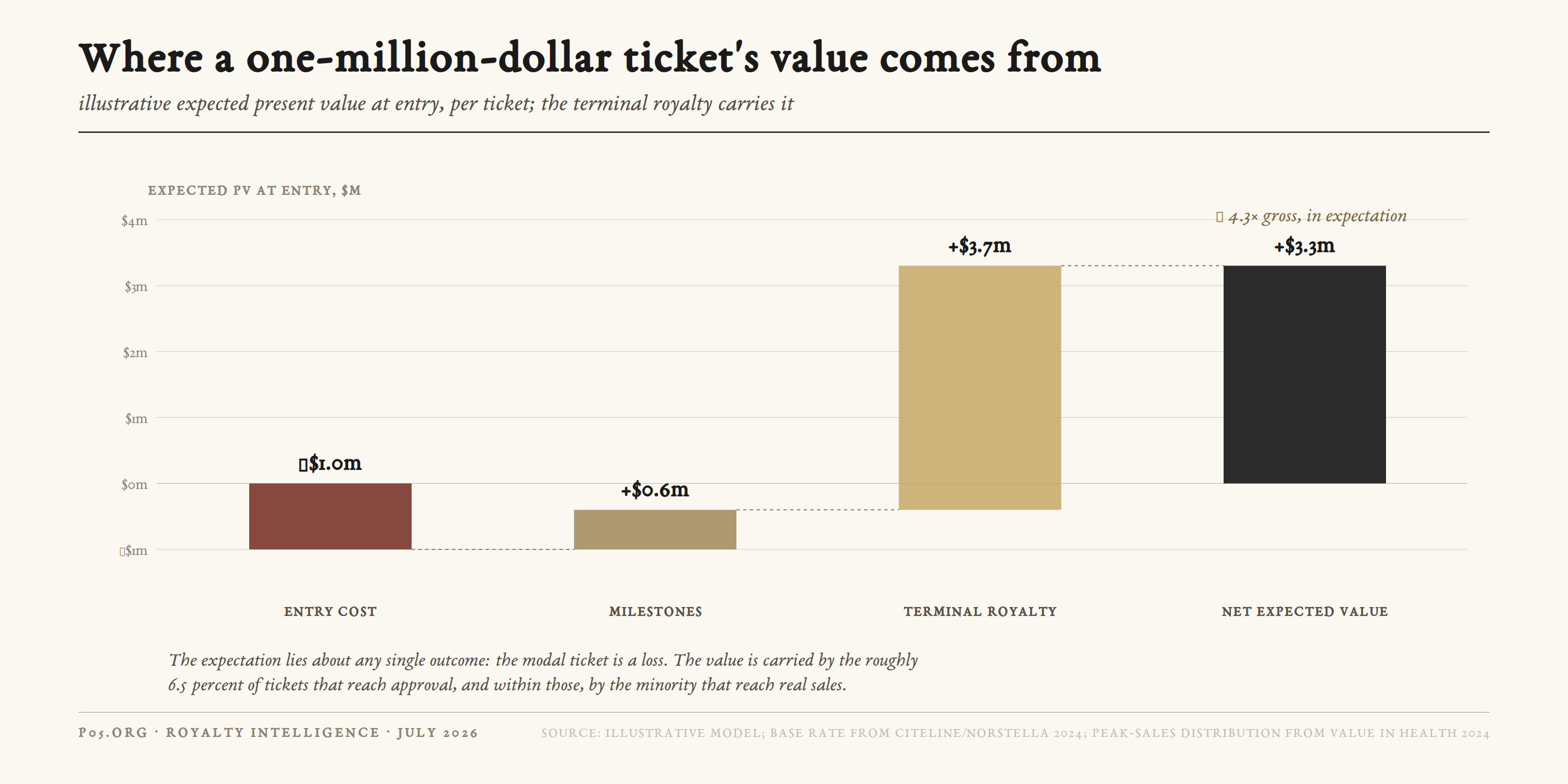
In expectation a single ticket is worth several times its cost, but the modal outcome is a loss; the value is carried by the few tickets that reach approval.
The multiple is not the return
A 4.3x gross multiple sounds like venture. As an annual number it is not, because it arrives late.
Approval is roughly seven years after Phase 1 entry, and the tail of receipts runs years beyond that. A 4.3x realised over about twelve years is close to a 13 percent internal rate of return. For reference, Cambridge Associates put the 2025 global buyout average near 1.7x net multiple, with top-quartile funds around 2.3x, and a 3x multiple realised over four years is roughly a 26 percent IRR. Duration is the enemy of the rate.
Milestones are what rescue the rate
Interim milestones pull cash forward and lift the IRR without changing the multiple.
The clearest disclosed example is a single survivor. XOMA paid 13.5 million dollars upfront, plus up to 20 million in milestones, for the DAY101 royalty now marketed as OJEMDA. Through the end of 2025 the position had returned 35.9 million dollars, a 2.7x multiple at a 33 percent internal rate of return.
The 33 percent, not the 2.7x, is the interesting number, and milestones produced it. A 9 million dollar approval milestone and an 8.1 million dollar priority-review-voucher milestone arrived within about three years, recouping most of the outlay long before the royalty tail. A book built only on terminal royalties waits a decade for cash; a book built on milestones plus royalties draws interim cash from winners and losers alike.
One caution: this is a survivor, not the book. It shows the shape of a hit, not the average outcome.
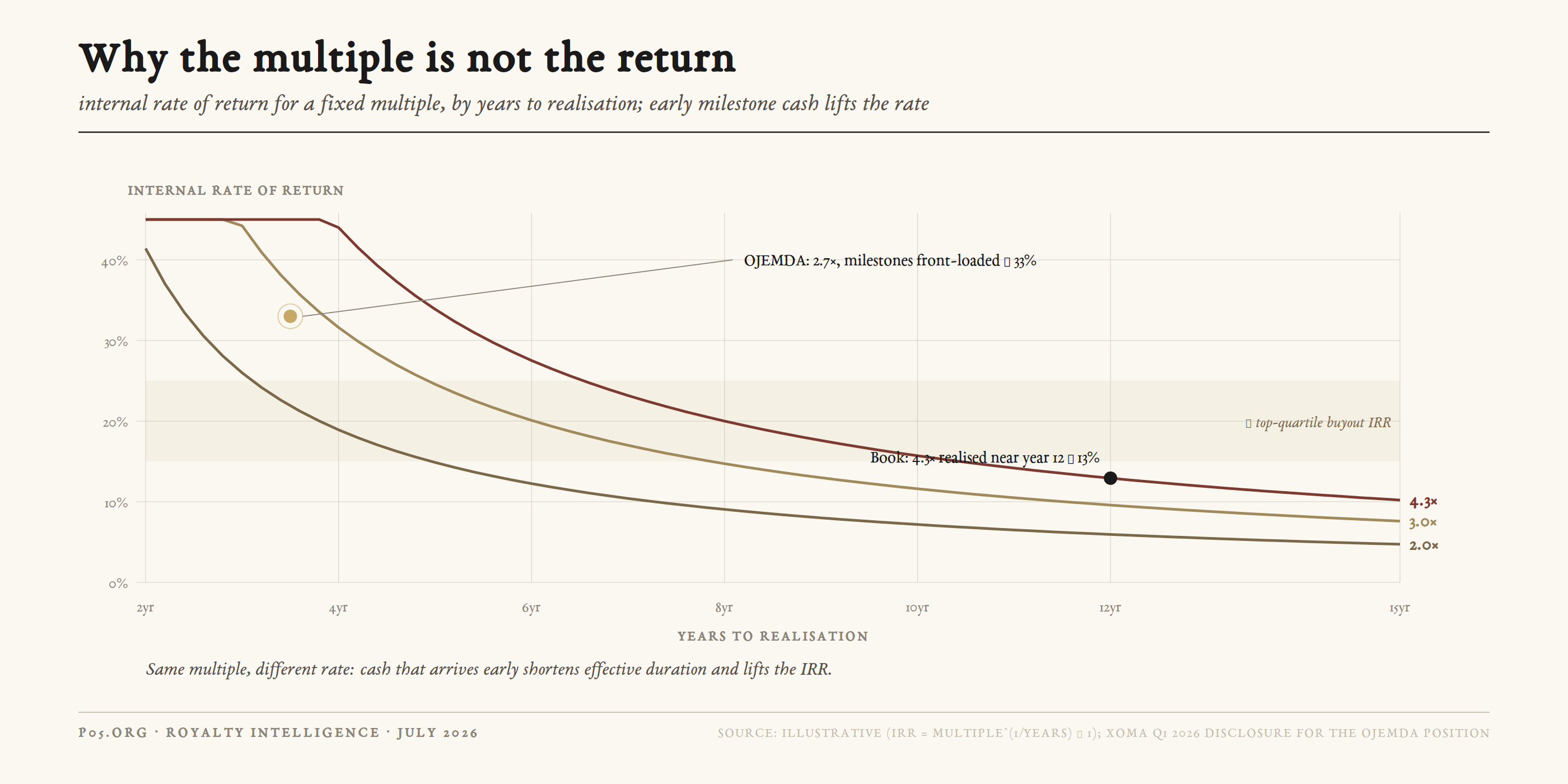
The same multiple produces very different rates depending on when the cash arrives; early milestone cash shortens effective duration and lifts the IRR.
The book
Now build it wide. Deploy just over 100 million dollars across 100 tickets at one million each (scale proportionally to 300 to 600 million for the proposal's hundreds of interests).
Assume a conservative five percent reach approval, and let the survivors fall along the fat-tailed peak-sales distribution rather than an average:
| Bucket | Tickets | Peak sales each | PV at entry |
|---|---|---|---|
| Fail to approve | 95 | none | milestones only, ~$25m |
| Modest winners | 2 | $300m | $38m |
| Solid winners | 2 | $1.2bn | $153m |
| Breakout | 1 | $4bn | $255m |
| Total | 100 | ~$470m |
The book deploys just over 100 million and carries an expected present value near 470 million, roughly 4.7x on a five percent hit rate. Read it the way a venture investor reads a fund: 95 tickets return scattered milestone cash, and the single breakout is worth about 255 million on its own, more than half the return.
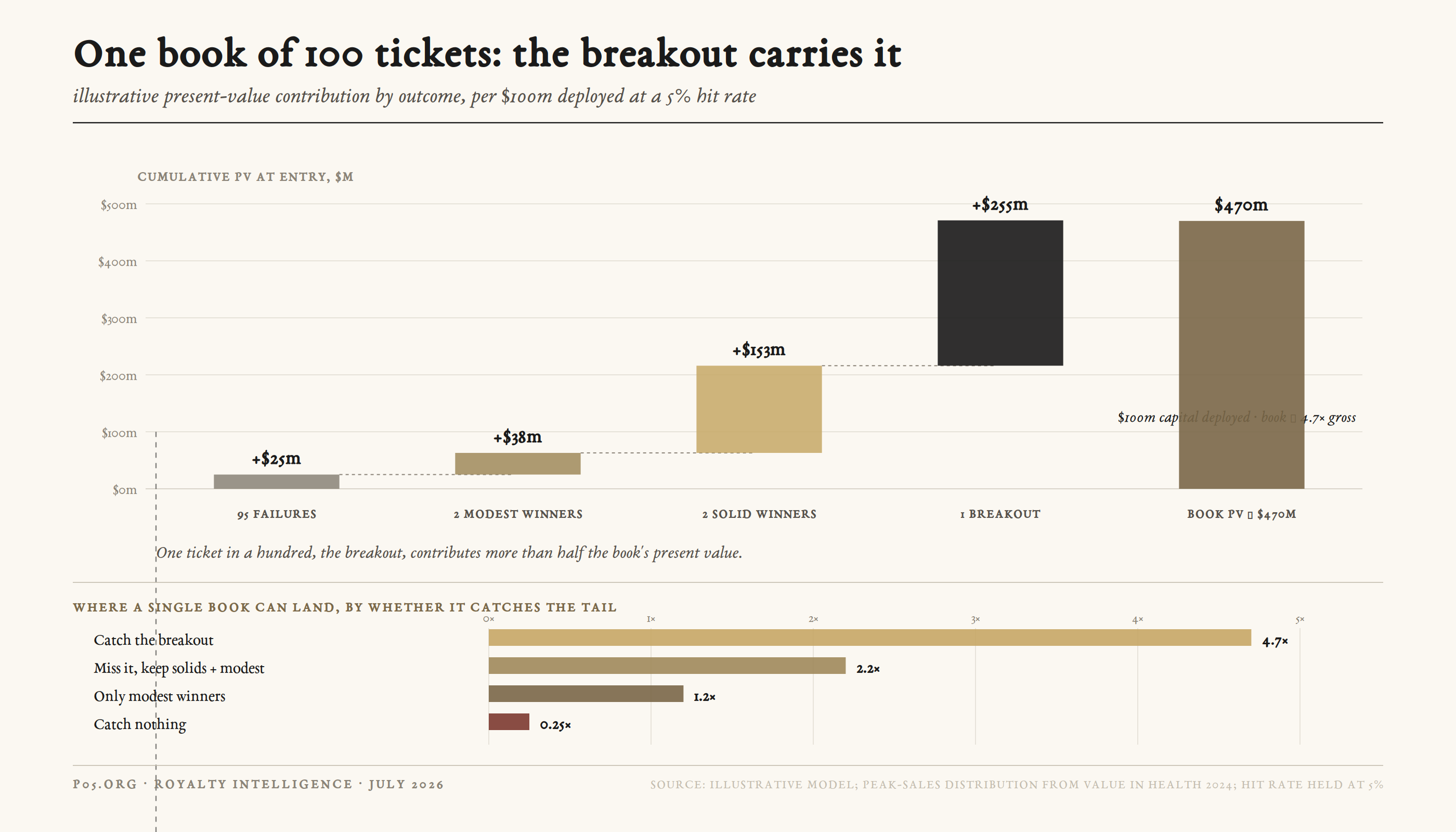
One book of 100 tickets: the single breakout contributes more than half the present value, and where any book lands depends almost entirely on whether it caught the tail.
The variance is the whole story
The mean hides an outcome range that runs from near-total loss to a double-digit multiple:
- Catch the breakout: about 4.7x.
- Miss it, keep the solids and modest winners: about 2.2x.
- Only modest winners: about 1.2x, barely above water despite hitting the expected number of approvals.
- Catch nothing: the book returns about a quarter of its capital in milestones.
Where any single book lands depends almost entirely on whether it caught one drug in the upper tail. That is the power law, and it is why width and entry price are the two non-negotiables.
Gross to net, and the fund hurdle
Two frictions sit between the gross multiple and what a limited partner sees.
Fees and carry. A 3x gross multiple typically nets 2.4 to 2.7x after management fees and carried interest. A 4.7x gross book lands lower net, and the carry is levied on a result driven by one or two names.
Duration. Net of fees, the multiple is respectable; the IRR is the problem, because the book is back-loaded. This is the mathematical case for either velocity (distribute and recycle) or duration-matched capital (hold without a clock). A buy-and-hold fund gets the mediocre IRR; the multiple alone will not carry it past a top-quartile buyout benchmark.
Disposition: hold, or distribute
Hold to expiry harvests each interest over its life. It maximises duration and treats the royalty as a long-dated, low-correlation cash flow, part of an asset class near two trillion dollars, credit-like in downside with retained upside. Most scaled practitioners hold.
Originate to distribute treats the early royalty as a mispriced option to buy cheap and sell once it de-risks. The return driver becomes the rNPV step-up, not the stream.
The de-risking arbitrage, quantified. rNPV scales with the product of the cumulative probability of success and the discount factor. Moving an asset from Phase 2 to approval multiplies the probability term several-fold and shortens the horizon, for a combined step-up that is comfortably an order of magnitude on the surviving asset. Buy at the Phase 2 mark, sell at the approval mark.
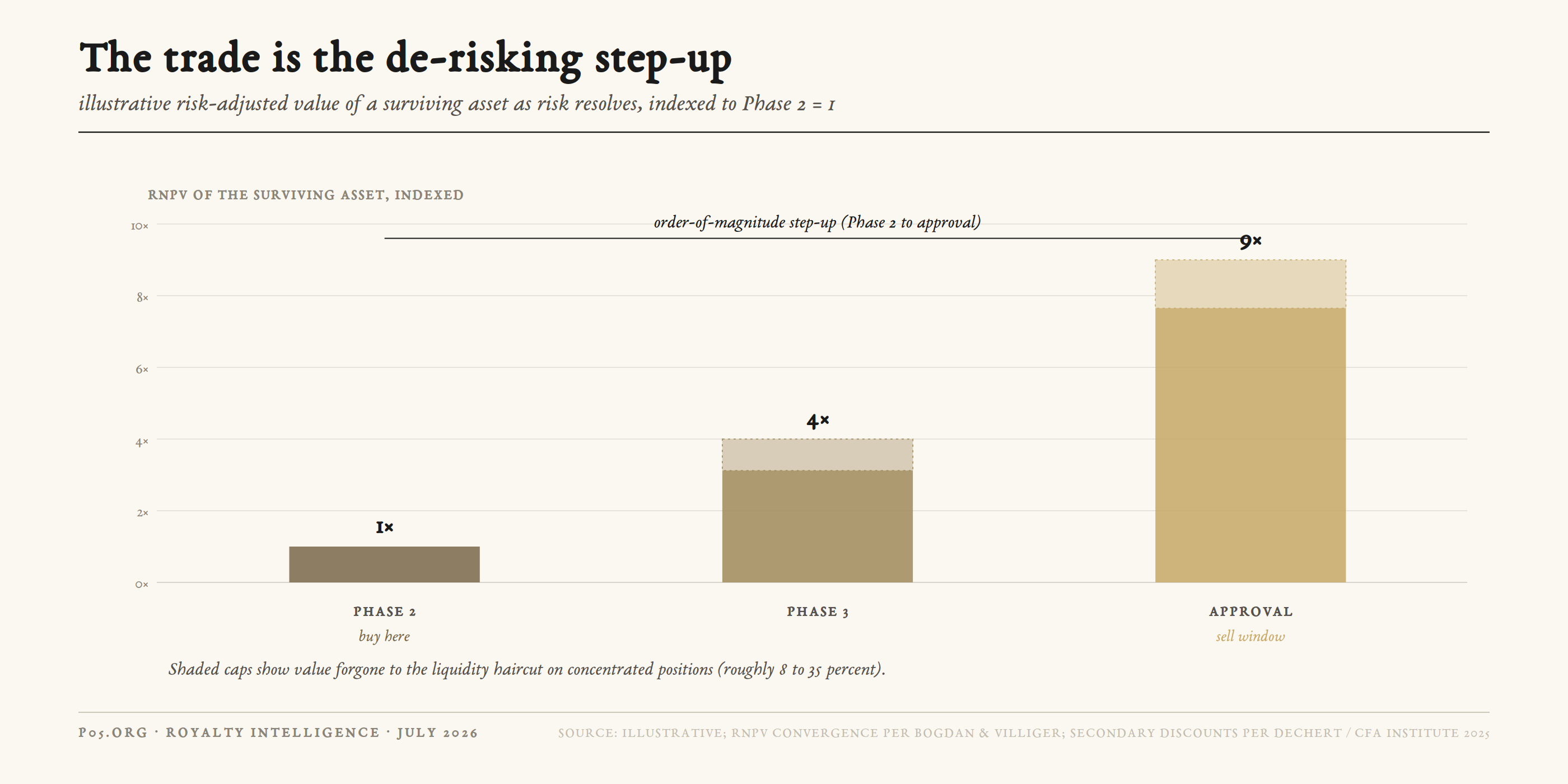
The trade in the distribute model is the order-of-magnitude rNPV step-up as risk resolves, less the liquidity haircut a concentrated position pays on exit.
The haircut it must clear. The exit bid is thin and discounted. Diversified, seasoned secondaries clear around 92 percent of net asset value, but discounts widen sharply for concentrated, single-asset positions. Even so, an order-of-magnitude step-up dominates a 15 to 35 percent liquidity haircut. Done at scale, distribution converts a slow 4.3x over twelve years into a faster multiple over five to seven years, with capital recycling more than once.
Why the instrument must be uncapped. De-risked buyers cap their return. Oberland's revenue-interest agreements pay a tiered royalty capped at a multiple of the investment, typically in the 1.75x to 2.25x range, because on a de-risked asset the downside is small. An early book is the inverse: nine names in ten are near-total losses, so the whole return is the tail, and a capped instrument cannot produce a power-law result. A capped 1.9x and an uncapped power law are two different instruments for two different risks.
The feasibility condition it does not control. Securitisation, the pooled exit, is an established asset-backed-finance category for pharma IP, but rating agencies require diversification and cash-flow predictability a Phase 2 asset cannot supply. The channel opens only after de-risking. The banking analogue is the caution: originate-to-distribute works while the distribution market clears and fails when it seizes, which is when a forced holder is least able to sell.
Capital permanence: the asset-liability problem
This axis is the crux, and where a private-equity or distressed fund differs most from the vehicles that have actually run the strategy.
The asset has a decade-long duration and a back-loaded, convex payoff. Matching it requires liabilities that are permanent or long-dated and non-redeemable.
Permanent public equity satisfies this: it never has to sell, so it tolerates a low realised rate and waits. Insurance and annuity capital satisfies it by matching long-dated liabilities to long-dated cash flows, which is the logic behind large credit platforms folding royalties into asset-based finance. When KKR acquired HealthCare Royalty in 2025, it positioned royalties as origination for exactly that kind of balance sheet.
A finite-life fund is a duration mismatch by construction. A ten-to-twelve-year vehicle holding decade-long assets must either distribute and securitise on schedule or face a forced sale into the concentration discount at the end of its life.
The one closed-end precedent, Paul Royalty Fund, wound down in the early 2010s, with the stated causes a duration mismatch between decade-long assets and investors seeking liquidity, capital deployed near a cycle peak, and fees. The corporate-reinvention version is related: PDL BioPharma attempted between roughly 2013 and 2016 to become an acquirer of new royalties and structured credit, before abandoning the effort as acquired positions were marked down against commercial erosion.
The implication is a corner solution. Buy-and-hold aligns with permanent or insurance capital. A finite-life fund aligns with originate-to-distribute. A finite-life fund that also holds combines slow maturation with a redemption deadline, which is the interior point the logic disfavours.
Sourcing: negotiation, distress, and two credit risks
Negotiated sourcing buys out-licensed rights from solvent but constrained developers.
Distressed sourcing reaches into the estate: Section 363 sales, assignments for the benefit of creditors, defaulted venture-debt collateral, and limited-partner secondaries, plus the negotiated wind-down of below-cash companies, now a named category. Gibson Dunn describes a wave of liquidation-as-a-service deals distributing net cash plus a contingent value right for legacy assets. Distress deepens the discount and, in a court-supervised sale, can deliver clean title.
Adverse selection is a property of the distressed corner. The cheapest early rights come from the most constrained sellers and least-contested assets, which is not the population most likely to succeed. The discount partly compensates for a lemons effect, and a distribute strategy inherits it, because the eventual buyer prices it in.
Two different credit risks, and conflating them is the central error:
- Buying from a distressed originator, where the seller owns the royalty. The risk is title, and Section 363 largely solves it.
- Buying a royalty on an asset a distressed licensee must still develop, where the counterparty that must keep spending is the weak party. The risk is payor credit, and clean title does not solve it.
The second is the material risk for a book sourced from stress. If the paying counterparty fails, a contingent royalty can become an unsecured claim. One clinical-funding arrangement became a creditor claim of roughly 350 million dollars in the counterparty's bankruptcy rather than a royalty. The rule that follows is general: underwrite the licensee's balance sheet as carefully as the molecule.
The legal-structural layer
Every implementation faces the same transfer doctrines, magnified by small ticket size.
True sale versus recharacterisation. Purchases are papered as true sales into bankruptcy-remote vehicles. Return guarantees such as caps, puts, or top-ups push the characterisation toward a disguised secured loan. In re Shoot the Moon is the caution.
Rejection risk. Contingent rights are generally non-executory and outside Section 365, so a licensee bankruptcy can strand the holder. The response is a bankruptcy-remote SPV holding the licence and patents, with a UCC-1 and a backup security interest.
Anti-assignment and change of control. Licences routinely condition assignment on consent, which a distribute strategy must clear on every name.
The fixed-cost floor. Non-consolidation opinions are typically priced only at balances at or above roughly 20 million dollars, and diligence spans corporate, IP, litigation, FDA, bankruptcy, licensing, tax, reimbursement, antitrust, and healthcare. On a five-million-dollar ticket that stack can exceed six percent of value, paid on every name including the losers. Deployment at one to three million dollars per interest is feasible only with a standardised template, which is itself the unsolved engineering problem.
The record, across the design space
The components have been executed. The specific configuration in the proposal, a finite-life fund aggregating hundreds of sub-three-million-dollar early interests, has not endured.
| Practitioner | Capital form | Disposition | Sourcing | Status |
|---|---|---|---|---|
| Royalty Pharma | Permanent public | Hold | Negotiated, late-stage and approved | Active |
| PDL BioPharma | Permanent public | Hold | Own platform, then acquired royalties | Dissolved 2021 |
| Paul Royalty Fund | Closed-end fund | Hold, securitised a book | Negotiated, diversified | Wound down early 2010s |
| DRI Healthcare | Permanent listed trust | Hold | Negotiated, registration-stage up | Active |
| XOMA Royalty | Permanent public | Hold royalties, sell pipelines | Negotiated bulk plus distressed wind-downs | Acquired by Ligand, Jul 2026 |
| HCRx (KKR) | Permanent, insurance-linked | Hold, asset-based finance | Negotiated, commercial | Active |
| CF Foundation | Endowment | Fund early, then sold | Single-asset venture philanthropy | Sold royalty, 2014 |
Reading the table. Every scaled practitioner that persisted used permanent or insurance-style capital and held. The one closed-end fund wound down. The one corporate reinvention was abandoned. The early-band specialist closest to the proposal, XOMA, ran as permanent public equity, sourced from both negotiation and distress, held royalties while selling operating pipelines, and realised liquidity by selling the whole vehicle. Its acquisition removed the only listed early-band pure-play as of July 2026.
The adjacent markets that scaled at small ticket solved the same two problems. Music royalties, litigation finance, and life settlements each built a standardised pricing input and a pooling-and-securitisation route before small-ticket volume followed. Early pharma royalties, pre-revenue and one-of-a-kind, have neither a comparable pricing input nor a rating methodology, which is why the pooled exit remains post-de-risking only.
Where the structure points
No verdict is needed to see the shape of the answer, because the axes interact in a way that favours the corners.

The two corners are coherent. The finite-life buy-and-hold interior, carrying both a duration mismatch and an exit dependence, is the configuration the record supports least.
Four conditions are common to every configuration: an entry discount deep enough that the price reflects the Phase 2 probability of success and not the de-risked value; breadth sufficient for the tail to express itself; capital duration-matched to the asset, or a disposition fast enough to escape the mismatch; and, for the distribute case, a take-out that clears above the concentration discount.
Distressed sourcing supplies the first condition and taxes the others. It deepens the discount and can deliver clean title, at the cost of sharper adverse selection and payor-credit risk on any asset whose distressed developer must still fund the work.
The coherent configurations are the corners. Permanent or insurance-backed capital that holds, matching duration and tolerating a modest realised rate. Or a finite-life vehicle built explicitly to originate and distribute, or to warehouse and securitise, escaping the mismatch by design.
The interior point the structure disfavours is the finite-life buy-and-hold fund, which carries the duration mismatch permanent capital avoids and the exit dependence a distribute design at least confronts. That is the configuration the proposal most naturally suggests, and the one the record, from the closed-end fund that wound down to the reinvention that was abandoned, supports least.
The material is abundant and the entry discounts are real. The financial engine works only if the multiple is either recycled fast enough to become a rate, or held by capital that does not need a rate. The question is not whether early royalties can be bought cheaply, which they demonstrably can, but which liability structure and which disposition an aggregator commits to before it starts buying. The strategy is coherent at the corners and mismatched in the middle.
All information in this article was accurate as of the research date and is derived from publicly available sources including SEC and bankruptcy filings, company press releases, academic and professional-services literature, and financial-news reporting. The worked model is illustrative and based on stated assumptions; it is not a forecast. Information may have changed since publication. This content is for informational purposes only and does not constitute investment, legal, or financial advice. The author is not a lawyer or financial adviser.