
Company of the Week: JCR Pharmaceuticals
JCR has licensed its Hunter syndrome drug outside Japan for the second time in five years. It has now signed twelve out-licences since 2021 and has never published a royalty rate. A rival drug built the same way has one: 9.25 percent, bought by Royalty Pharma.
On 2 October 2026 JCR Pharmaceuticals gave Italfarmaco, a Milanese drugmaker, the exclusive right to sell JR-141 in the United States, Europe and Latin America. JR-141 is pabinafusp alfa, an enzyme for Hunter syndrome that crosses into the brain. JCR will make the drug and ship it. In return it gets an upfront payment, milestones, a royalty and a price for supply. None of the four numbers was published.
JCR has sold these rights before. On 30 September 2021 Takeda took a licence to the same drug outside the United States, with an option on America. That deal also promised an upfront payment, milestones and tiered royalties, and it also gave no figures. Takeda handed everything back on 25 June 2024, 33 months after signing.
Between the two deals a competitor got to market. The FDA approved Denali Therapeutics' Avlayah on 25 March 2026. Avlayah is the same enzyme fused to a carrier that binds the same receptor. Four months earlier Royalty Pharma had agreed to pay up to $275M for 9.25 percent of its worldwide net sales.
The record shows a company that has licensed one drug twice and signed ten other out-licences, and that still holds every royalty they created. It also shows a balance sheet with $61.1M (¥9,661M) of cash against $341.4M (¥53,942M) of bank debt.
At a Glance
| Item | Detail |
|---|---|
| Company | JCR Pharmaceuticals Co., Ltd., Ashiya, Hyogo. Tokyo Stock Exchange Prime: 4552. Founded in September 1975 |
| Shares | 129,686,308 issued, of which 7,656,978 held in treasury, at 30 June 2026 |
| Largest holder | MEDIPAL HOLDINGS, a drug wholesaler, with 23.86 percent of the votes and one of its senior managing directors on JCR's board |
| Other holders | Future Brain 7.12 percent, Kissei Pharmaceutical 4.02 percent, Mochida Pharmaceutical 1.80 percent at 31 March 2026 |
| Market value | About $406M (¥64.1B) when first-quarter results were reported |
| Net sales | $255.2M (¥40,319M) in the year to March 2026, against $209.3M (¥33,072M) a year earlier |
| Contract revenue | $35.1M (¥5,549M) in the year to March 2026, against $3.3M (¥517M); forecast $51.3M (¥8,100M) |
| Operating result | Profit of $3.5M (¥555M) in the year to March 2026 after a loss of $39.4M (¥6,219M) |
| Latest quarter | To June 2026: net sales $61.4M (¥9,700M), operating loss $13.3M (¥2,103M), research and development $37.3M (¥5,888M) |
| Cash | $61.1M (¥9,661M) at 30 June 2026 |
| Borrowings | $266.4M (¥42,092M) short-term and $75.0M (¥11,850M) long-term at 30 June 2026 |
| Bank lines | Commitment lines of $313.3M (¥49,500M), of which $167.7M (¥26,500M) is for a new plant |
| Marketed products | Growject (growth hormone), Izcargo (pabinafusp alfa), Temcell (cell therapy), three biosimilars |
| Lead asset abroad | JR-141, Phase 3 against idursulfase in 86 patients, primary completion estimated for October 2027 |
| The new licence | Italfarmaco, 2 October 2026: United States, Europe and Latin America; terms undisclosed |
| The old licence | Takeda, 30 September 2021 to 25 June 2024 |
| Platforms licensed | J-Brain Cargo, which carries drugs across the blood-brain barrier, and JUST-AAV, a set of gene therapy capsids |
| Disclosed milestone ceilings | $505.5M (Angelini), $825M (Alexion capsids) and $555M (Acumen) |
| Royalties paid away | To Mesoblast on Temcell, at rates in the twenties |
| Royalty posture | Licensor and holder. No royalty sold, pledged or bought in the public record |
A Note on Scope
JCR reports under Japanese accounting standards and its year ends on 31 March. The company labels the year to March 2026 "FY2025". To avoid confusion, periods here are named by their end date. Dollar figures are converted at ¥158 to the dollar, the rate on 2 October 2026, including figures from earlier years. Sums that the parties announced in dollars are given as announced.
JCR files no contracts. Every licence term below comes from a press release, a results briefing or a counterparty's filing. Only one counterparty, Acumen Pharmaceuticals, has described its JCR terms in an SEC filing. It has also filed the agreement itself, with the royalty rates redacted.
What JCR Sells
JCR began in 1975 as Nippon Chemical Research, a purifier of urokinase. It now lives on a growth hormone. Growject brought in $113.5M (¥17,933M) in the year to March 2026, or 44 percent of net sales, and the company expects less this year. In the quarter to June 2026 Growject sales fell 16.7 percent from a year earlier.
Izcargo is the second product. It has been on sale in Japan since May 2021 and earned $42.8M (¥6,766M) last year, up 18 percent. Since April 2023 Sumitomo Pharma has co-promoted it. The rest of the product line is Temcell, a cell therapy, and biosimilars of epoetin, darbepoetin and agalsidase beta. The six core products together came to $205.4M (¥32,446M).
The line that moves the accounts is the one JCR calls income from contractual payment. It holds upfront fees and milestones from licensees. It was $3.3M (¥517M) in the year to March 2025, when JCR lost $39.4M (¥6,219M) at the operating level. It was $35.1M (¥5,549M) a year later, when JCR made $3.5M (¥555M).
The company has been here before. In the year to March 2022 net sales reached a record $323.3M (¥51,082M). Of that, $91.0M (¥14,375M) came from making vaccine stock solution for AstraZeneca and $66.9M (¥10,571M) from contracts, in the year the Takeda licence was signed. Sales fell by a third the next year, according to the five-year table in JCR's securities report.
The Licence Book
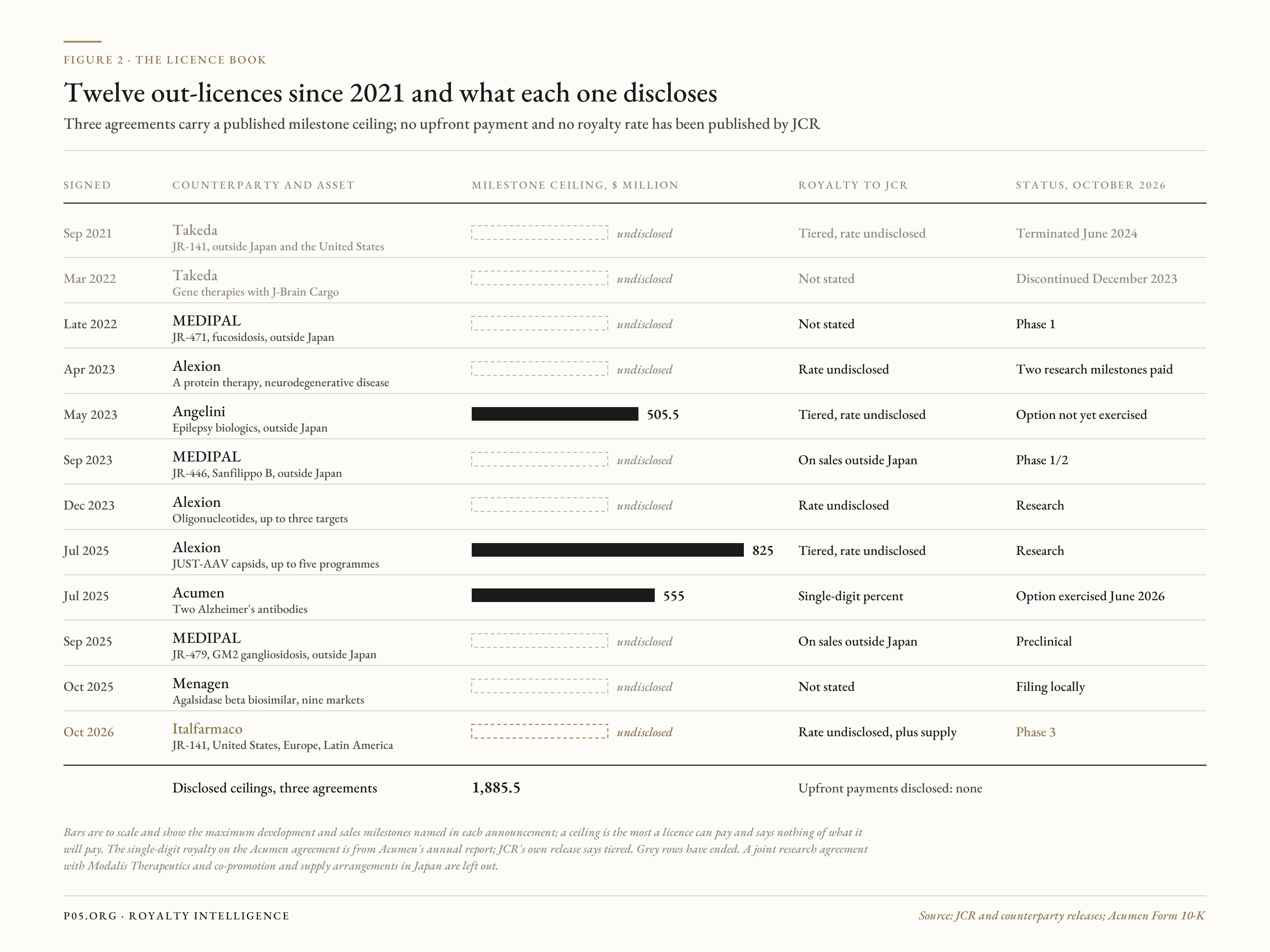
Twelve out-licences since 2021, with the milestone ceiling and royalty wording that each announcement gives
Takeda, 2021 to 2024
The first licence for JR-141 was signed six months after Japan approved the drug. Takeda received rights in Canada, Europe and other regions, with Japan and parts of Asia-Pacific kept by JCR. A separate agreement gave Takeda an option on the United States once the Phase 3 trial was done. JCR was to run that trial.
A second agreement followed in March 2022, on gene therapies that would use J-Brain Cargo. It earned JCR one proof-of-concept milestone. Takeda then left gene therapy research, and the collaboration was discontinued in December 2023 with the results and patents returned.
Six months later the JR-141 licence went the same way. The reason given was Takeda's strategic assessment of the alliance. All rights came back, the trial carried on under JCR, and the company called the effect on that year's results minor. The notice does not say whether any of Takeda's upfront payment was returned.
MEDIPAL, 2022 to 2025
JCR's largest shareholder is also its most frequent licensee. MEDIPAL bought GlaxoSmithKline's stake in September 2017, 22.46 percent for $133.5M (¥21.1B), and signed a business alliance on the same day. In October 2022 the two agreed a memorandum that gave MEDIPAL exclusive negotiating rights outside Japan to four candidates for ultra-rare lysosomal diseases.
Three licences have come out of it. The first, for the fucosidosis candidate JR-471, followed the memorandum. The second, in September 2023, covered JR-446 for Sanfilippo syndrome type B. MEDIPAL takes on development, manufacturing and marketing outside Japan and owes JCR upfront payments, milestones and royalties on sales there. Inside Japan the money runs the other way: JCR books the sales and MEDIPAL takes a share of the profit. The third, for JR-479 in GM2 gangliosidosis, followed in 2025 on similar lines.
No amount, royalty rate or profit share has been published for any of the three. JCR's governance filing on its dealings with MEDIPAL says there are no material matters to disclose.
Angelini and Alexion, 2023
The platform deals began in 2023. Alexion, AstraZeneca's rare disease arm, took an option and licence in April on a protein therapy for a neurodegenerative disease, carried by J-Brain Cargo. In December it took a second on oligonucleotides for up to three targets. Neither release states a sum. The first has since paid two research milestones, in March 2024 and in September 2025, of undisclosed size.
Angelini Pharma's deal, in May 2023, was the first to carry a number. The Italian company took an option on brain-penetrating biologics for epilepsy outside Japan. JCR became eligible for up to $505.5M in development and commercial milestones, tiered royalties and repayment of its research costs. No exercise of that option has been announced.
Alexion and Acumen, 2025 and 2026
Two more platform licences were signed in one week of July 2025. Alexion took a licence to JCR's JUST-AAV capsids for up to five gene therapy programmes. The ceiling is the largest in the book: $225M of research and development milestones and $600M of sales milestones, with tiered royalties on top.
The other was with Acumen Pharmaceuticals, a Nasdaq-listed developer of Alzheimer's antibodies. Acumen files with the SEC, and its filings are the only place where a JCR royalty is described by size. The agreement gave Acumen an option on two candidates that pair its antibodies with J-Brain Cargo. Acumen owes $9.25M on exercise, up to $40.0M in development milestones, up to $515.0M in sales milestones and single-digit percentage royalties. JCR's release calls the royalties tiered.
Acumen named its two candidates and exercised the option in June 2026. JCR confirmed an option payment without giving its size and said the sum was already in its forecast.
Italfarmaco, 2026
The newest licence runs in both directions. In December 2025 JCR took Japanese rights to givinostat, Italfarmaco's drug for Duchenne muscular dystrophy, and the two companies promised to look at more projects together. Nine months later Italfarmaco took JR-141.
The territory is narrower than Takeda's and includes America outright. Italfarmaco will sell and distribute. JCR keeps manufacturing after approval and is paid for supply, which gives it a second income from the drug beside the royalty. The parties named the FDA, the European Medicines Agency, Britain's MHRA and Brazil's ANVISA as the regulators they will approach.
JCR said the upfront payment was already counted in its forecast for the year to March 2027. That forecast was published on 13 May 2026, nearly five months before the licence was signed.
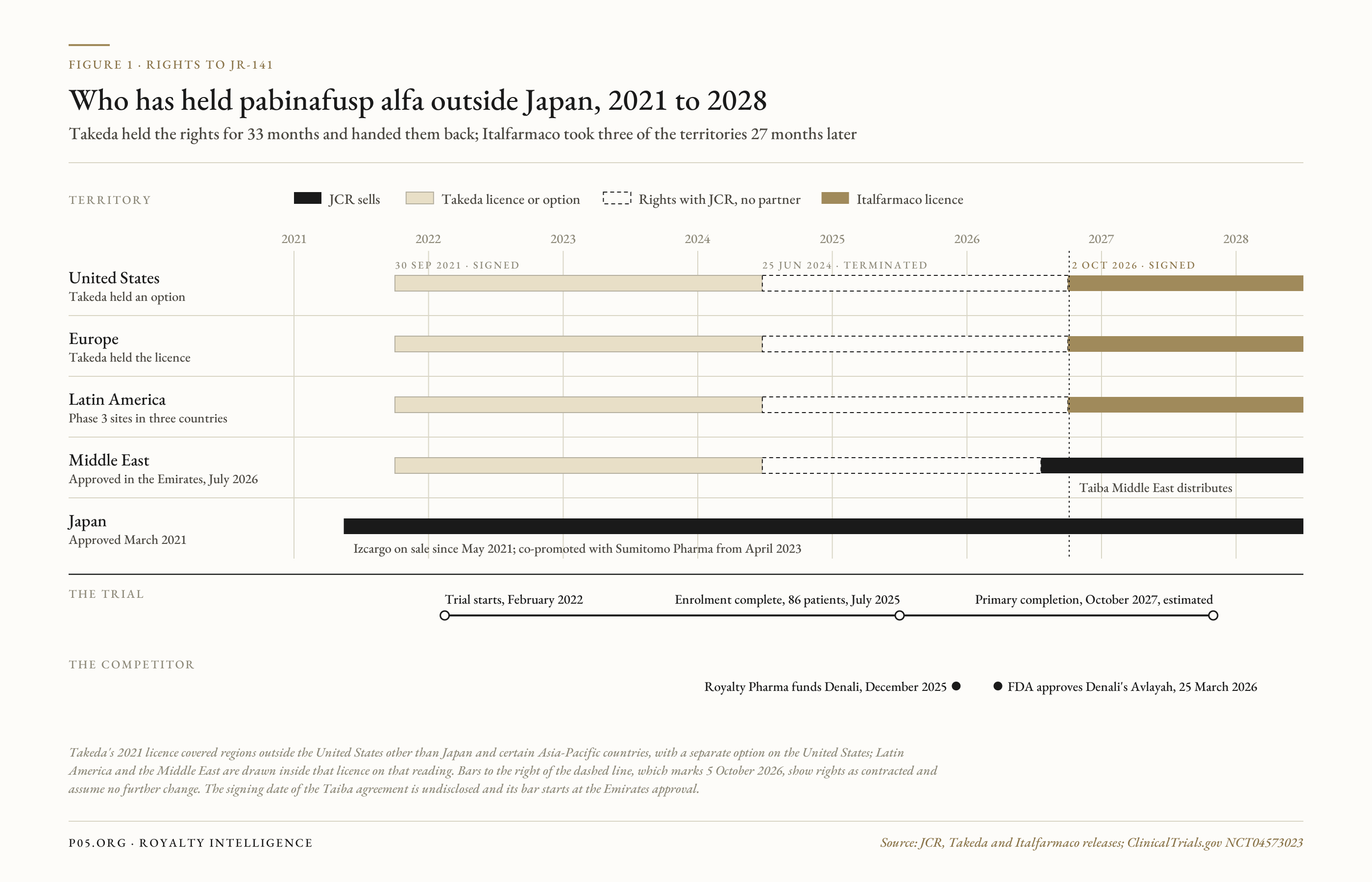
Rights to pabinafusp alfa by territory, with the Phase 3 trial and Denali's approval below
What JCR Pays
JCR owes royalties as well as collecting them. Temcell is made under licence from Mesoblast, which is due escalating royalties in the twenties on Japanese sales in blood cancers. Mesoblast booked $3.0M from Temcell in the six months to December 2024. JCR's Temcell sales were $17.9M (¥2,831M) in the year to March 2026.
For the patents under its own platform JCR chose to buy. In April 2020 it acquired ArmaGen, an American company with intellectual property in brain-penetrating enzymes, and said the purchase would hedge patent risk in global development. The price was not given.
A Priced Comparable
JCR's royalty on JR-141 has no public rate. The nearest one that does belongs to Denali.
Tividenofusp alfa, sold as Avlayah, joins the missing enzyme in Hunter syndrome to a fragment that binds the transferrin receptor, as JR-141 does. On 4 December 2025 Royalty Pharma agreed to pay Denali $200M at closing and $75M more if Europe approves the drug by the end of 2029. The deal was conditional on accelerated approval in America, which came four months later, and Denali received the first $200M on 27 March 2026. Royalty Pharma receives 9.25 percent of worldwide net sales. Payments stop at 3.0 times the money advanced, or at 2.5 times if that level is reached by the first quarter of 2039.
The cap gives a sense of what was underwritten. If the full $275M is paid, a return of 2.5 times is $687.5M of royalties, which at 9.25 percent takes $7.4B of cumulative net sales by early 2039. A return of 3.0 times takes $8.9B. These are sums on the published terms and assume no other adjustment in the contract.
Against that sits the early evidence of demand. Avlayah's label covers the neurological signs of the disease in children. In its first full quarter on sale it earned $3.6M. Izcargo, in Japan alone and in its fifth year, earns $42.8M (¥6,766M).
The comparison has limits. Denali granted a synthetic royalty on its own sales, and JCR will receive a licence royalty from a partner's sales plus a supply price. Royalty Pharma's 9.25 percent covers the world, while Italfarmaco's licence leaves out Japan, the Middle East and the rest of Asia. A rate for one says little about the rate for the other. It does show that a royalty buyer has put a value on a Hunter syndrome enzyme of this design within the past year.
The regulatory path that Denali took is also narrower for those behind it. Avlayah was approved on a biomarker, the fall in heparan sulfate in spinal fluid. Regenxbio asked for approval of a gene therapy for the same disease on the same marker and received a complete response letter in February 2026. JCR's Phase 3 trial measures the marker at one year and cognition at two. It compares JR-141 with idursulfase, the standard enzyme, as Denali's confirmatory trial does. JCR finished enrolling in July 2025, and the registry puts primary completion at October 2027. The company's own target is approval in America, Europe and Brazil in the year to March 2028.
The Balance Sheet
JCR has borrowed heavily from banks while its licence income grew.
At 31 March 2025 it owed $241.2M (¥38,105M), counting the current portion of long-term loans. Fifteen months later it owed $341.4M (¥53,942M), and $266.4M (¥42,092M) of that was short-term. Cash fell over the same period from $83.5M (¥13,196M) to $61.1M (¥9,661M). The equity ratio is 40.6 percent.
Much of the money has gone into a building. JCR is putting up a plant under a government scheme to expand vaccine manufacturing, and construction in progress stood at $122.9M (¥19,411M) in March 2026. The banks have granted commitment lines of $313.3M (¥49,500M), and $167.7M (¥26,500M) of that is tied to the plant.
The rest has gone into research. Subsidy income of $11.9M (¥1,882M) lifted net profit above ordinary profit last year. Operating cash flow was negative in each of the past two years. Research and development cost $106.1M (¥16,761M) in the year to March 2026 and is forecast at $122.2M (¥19,300M). The first quarter alone took $37.3M (¥5,888M), up 75.9 percent, and produced an operating loss of $13.3M (¥2,103M).
The forecast for the full year has not changed: net sales of $289.2M (¥45,700M) and an operating profit of $7.0M (¥1,100M). Contract revenue is to supply $51.3M (¥8,100M) of those sales, or 18 percent. The first quarter delivered $9.3M (¥1,474M) of it. The other $41.9M (¥6,626M) has to arrive in nine months, and the Italfarmaco upfront is part of that sum.
Take contract revenue out and the forecast operating profit becomes a loss of $44.3M (¥7,000M). That sum assumes licence income carries no cost of its own. JCR still plans to pay a dividend of $0.13 (¥20) a share.
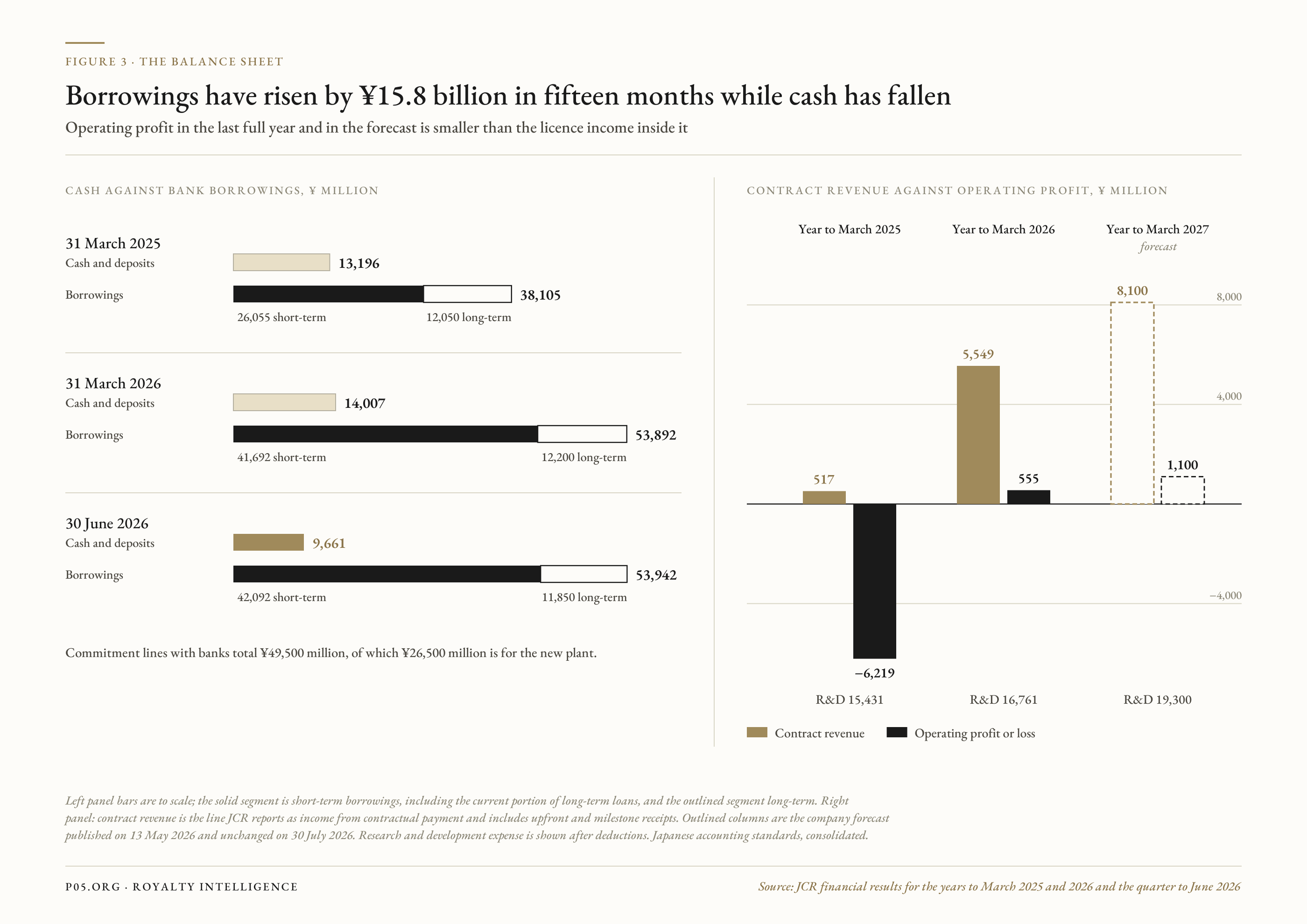
Cash and bank borrowings at three balance dates, and contract revenue beside operating profit
Financial Profile
| Item | Amount | Source and date |
|---|---|---|
| Net sales | $255.2M (¥40,319M) | Results briefing, year to March 2026 |
| Growject | $113.5M (¥17,933M) | same |
| Izcargo | $42.8M (¥6,766M) | same |
| Temcell | $17.9M (¥2,831M) | same |
| Contract revenue | $35.1M (¥5,549M) | same |
| Research and development | $106.1M (¥16,761M) | same |
| Operating profit | $3.5M (¥555M) | same |
| Net profit | $13.8M (¥2,178M) | same |
| Forecast net sales | $289.2M (¥45,700M) | same, year to March 2027 |
| Forecast contract revenue | $51.3M (¥8,100M) | same |
| Forecast operating profit | $7.0M (¥1,100M) | same |
| Cash and deposits | $61.1M (¥9,661M) | Quarterly report, 30 June 2026 |
| Short-term borrowings | $266.4M (¥42,092M) | same |
| Long-term borrowings | $75.0M (¥11,850M) | same |
| Net assets | $276.2M (¥43,632M) | same |
| Total assets | $673.4M (¥106,400M) | same |
| Commitment lines | $313.3M (¥49,500M) | same |
| Alexion capsid licence, milestone ceiling | $825M | JCR release, 8 July 2025 |
| Acumen licence, milestone ceiling | $555M, plus $9.25M on exercise | Acumen 10-K, 31 December 2025 |
| Angelini collaboration, milestone ceiling | $505.5M | Angelini release, 11 May 2023 |
| Royalty Pharma funding of Denali | $275M for 9.25 percent | Royalty Pharma release, 4 December 2025 |
Blue Team
- The lead drug is approved and selling. Izcargo has been on the Japanese market since May 2021 and earned $42.8M (¥6,766M) last year, and the United Arab Emirates approved it in July 2026
- The Phase 3 trial is enrolled and uses a clinical endpoint beside the biomarker: 86 patients, randomised against idursulfase, with cognition measured at two years
- The new partner already sells a rare disease drug in the licensed markets. Givinostat is approved in America, Europe and Britain, and the December 2025 agreement gives the two companies a stake in each other's products
- JCR keeps manufacturing. Supply revenue from Italfarmaco comes on top of the royalty and does not depend on the royalty tier reached
- A royalty buyer has priced the mechanism. Royalty Pharma committed up to $275M to a rival enzyme that uses the same receptor
- The platform has repeat customers. Alexion has signed three licences in 27 months and paid two milestones on the first
- One option has been exercised. Acumen took up its licence in June 2026, eleven months after signing
- Nothing has been sold. Every royalty and milestone that JCR has written since 2021 is still its own, with disclosed ceilings of $1,885.5M across three agreements; a ceiling is a maximum and no part of it is assured
Red Team
- No royalty rate, upfront payment or supply price has been published for JR-141 in either of its licences. The only description of any JCR royalty by size is Acumen's phrase, single-digit percentage
- The drug has been returned once. Takeda gave back the same rights after 33 months, and the notice cited its strategic assessment of the alliance
- A competitor is on the American market. Avlayah was approved 19 months before JR-141's trial is due to complete, and the two trials use the same comparator
- The FDA has refused a Hunter syndrome therapy on the biomarker since then. Regenxbio's rejection questioned heparan sulfate as a surrogate seven weeks before Avlayah was approved on it
- Bank debt is 5.6 times cash, and 78 percent of it is short-term. The commitment lines of $313.3M (¥49,500M) are the visible source of refinancing; their terms and covenants are not published
- The forecast rests on licence income. Contract revenue of $51.3M (¥8,100M) is more than seven times the forecast operating profit, and 82 percent of it was still to be booked after the first quarter
- The main product is shrinking. Growject fell 16.7 percent in the quarter to June 2026 and makes up more than two-fifths of sales
- The largest shareholder is the licensee for three pipeline drugs and sits on the board. Terms of those licences, including MEDIPAL's share of Japanese profit, are unpublished
- The platform book is early. No exercise of Angelini's option has been announced in the 41 months since signing, and Acumen targets a filing for human trials in mid-2027
- Licence income has spiked and fallen before. Contract revenue was $66.9M (¥10,571M) in the year to March 2022 and $3.3M (¥517M) three years later
Implications for the Pharmaceutical Royalty and Biotech Capital Markets
JCR finances itself with bank debt and upfront payments. It has never sold a royalty, and nothing in its filings suggests it has tried. Japanese banks have lent JCR $341.4M (¥53,942M), most of it repayable within a year, against a business that made $3.5M (¥555M) at the operating level.
That choice leaves the royalties unencumbered so far as the record shows. JCR will hold a licence royalty from Italfarmaco in three regions, royalties from MEDIPAL outside Japan on three rarer diseases, and contingent royalties from Alexion, Angelini and Acumen. A buyer would have little to read. JCR files no agreements, and Italfarmaco and Angelini are private. Alexion's releases give ceilings at most. The one agreement on file is Acumen's, and its royalty schedule is redacted.
The Denali transaction shows what the other route looks like. Denali sold 9.25 percent of its own product's sales four months before approval and received $200M two days after it. JCR, with a drug of the same design already selling in Japan, licensed the foreign rights for sums it will not state and kept the royalty. The results will be visible in a few years, when both drugs are selling in the same markets and one of them has a published royalty burden.
The Takeda episode matters to anyone valuing a licence royalty. A licensee with a competing product in the same disease can hand the rights back, and the royalty goes with them. Takeda makes idursulfase, the enzyme that JR-141 is being tested against. Italfarmaco's release lists no Hunter syndrome product among its programmes. The public documents do not show the termination terms of either licence.
Related-party licensing is the other feature a diligence team would stop on. MEDIPAL owns 23.86 percent of JCR, holds foreign rights to three of its candidates and shares profit on one of them in Japan. JCR says its independence is secured and that there are no material transactions to disclose. The royalty rates that MEDIPAL will pay were set between a company and its largest shareholder, and they have not been published.
Platform royalties of the J-Brain Cargo kind are several steps from cash. They attach to products that belong to someone else, most of which have not been named. The Acumen licence is the closest to a clinic, and Acumen expects to file to begin human trials in mid-2027. Milestone ceilings of $1,885.5M describe the outer edge of three contracts. JCR's contract revenue in the past two years, $38.4M (¥6,066M) in total, describes what such contracts have paid so far.
Recent Developments
- Italfarmaco takes JR-141 in the United States, Europe and Latin America on 2 October 2026; JCR keeps manufacturing
- First-quarter results on 30 July 2026 show an operating loss of $13.3M (¥2,103M) and an unchanged full-year forecast
- The United Arab Emirates approves Izcargo, the first approval outside Japan, on 21 July 2026; Taiba Middle East distributes
- Acumen exercises its option on two Alzheimer's candidates, announced by JCR on 17 June 2026
- Full-year results on 13 May 2026 return JCR to an operating profit of $3.5M (¥555M)
- The FDA approves Denali's Avlayah on 25 March 2026
- JCR takes Japanese rights to givinostat from Italfarmaco on 24 December 2025
- Royalty Pharma agrees to fund Denali with up to $275M on 4 December 2025
- Menagen licenses the agalsidase beta biosimilar for nine Middle Eastern and neighbouring markets on 1 October 2025
- No sale, pledge or purchase of a royalty by JCR has been identified
Financial History
| Date | Event |
|---|---|
| Sep 1975 | Nippon Chemical Research founded |
| 21 Sep 2017 | MEDIPAL buys GlaxoSmithKline's 22.46 percent stake and signs a business alliance |
| 28 Apr 2020 | JCR completes its acquisition of ArmaGen |
| Mar 2021 | Japan approves Izcargo; sales begin in May |
| 30 Sep 2021 | Takeda licenses JR-141 outside the United States, with an American option |
| Feb 2022 | JR-141 Phase 3 trial starts |
| Mar 2022 | Takeda and JCR agree to work on gene therapies; record net sales of $323.3M (¥51,082M) for the year |
| Oct 2022 | Memorandum with MEDIPAL on four candidates; a licence for JR-471 follows |
| 3 Apr 2023 | Alexion option and licence on a neurodegenerative disease protein announced |
| 11 May 2023 | Angelini collaboration in epilepsy, milestones up to $505.5M |
| 28 Sep 2023 | MEDIPAL licenses JR-446 outside Japan |
| 20 Dec 2023 | Alexion option and licence on oligonucleotides; Takeda gene therapy work discontinued the next day |
| 25 Jun 2024 | Takeda licence for JR-141 terminated |
| 2 Jul 2025 | JR-141 Phase 3 enrolment complete |
| 8 Jul 2025 | Alexion licenses JUST-AAV capsids, milestones up to $825M |
| 15 Jul 2025 | Acumen option and licence, milestones up to $555M |
| 2 Sep 2025 | MEDIPAL licence for JR-479 outside Japan announced |
| 1 Oct 2025 | Menagen licence for the agalsidase beta biosimilar |
| 4 Dec 2025 | Royalty Pharma and Denali sign their funding agreement |
| 24 Dec 2025 | JCR licenses givinostat for Japan from Italfarmaco |
| 25 Mar 2026 | FDA approves Avlayah |
| 13 May 2026 | Results for the year to March 2026; forecast published |
| Jun 2026 | Acumen exercises its option |
| 21 Jul 2026 | Emirates approval of Izcargo announced |
| 30 Jul 2026 | First-quarter results |
| 2 Oct 2026 | Italfarmaco licenses JR-141 |
| Oct 2027 | Estimated primary completion of the JR-141 Phase 3 trial |
Conclusion
JCR is a Japanese growth hormone company that has spent its profits, and then its banks' money, on a way to carry drugs into the brain. The technology has one approved product and a book of licences. Licence income turned an operating loss into a small profit last year, and the company's forecast needs it to do so again.
The royalties those licences created are all still on JCR's books. None has a published rate. The one comparable with a price, Royalty Pharma's 9.25 percent of Avlayah, belongs to a rival that reached America first.
The licence signed on 2 October gives JR-141 a seller in America, Europe and Latin America. Italfarmaco will pay JCR a royalty there if the drug is approved, which the trial timetable puts no earlier than late 2027. Takeda's licence ended before any such sales were made.
All information in this report was accurate as of the research date and is derived from publicly available sources including court opinions, regulatory guidance, academic literature, SEC filings, and financial news reporting. Information may have changed since publication. This content is for informational purposes only and does not constitute investment, legal, or financial advice. The author is not a lawyer or financial adviser.