
The missing page: chain of title under a pharmaceutical royalty

On 9 January 2026 HealthCare Royalty Partners told a Delaware bankruptcy court that Clearside Biomedical was trying to sell something it did not own. Clearside had filed for Chapter 11 seven weeks earlier with no funded debt and one approved product, the eye drug XIPERE. Its sale papers offered bidders the royalties that XIPERE would pay once HealthCare Royalty had been repaid. The fund's objection said those royalties belonged to someone else.
The someone else was Clearside's own subsidiary. On 8 August 2022 the company had moved its rights to XIPERE royalties and milestones into Clearside Royalty LLC under a contribution agreement. The subsidiary then sold them to HealthCare Royalty, up to a cap that Clearside's bankruptcy filing put at $106.5 million. Clearside pledged all of the subsidiary's equity to the fund, which recorded the pledge in a financing statement that September. After those three documents the parent held shares in a company, and the company held whatever would be left after the cap.
The consent gate piece ended on the point that selling a bare royalty moves no patent title and that the licences above it need separate diligence. This piece does that diligence on seven disputes that surfaced between 2021 and 2026, starting with the royalty and working back to the inventor, as the record stood on 4 October 2026. Each file broke where an event in one set of papers was never carried into the next.
What Clearside could sell
The structure HealthCare Royalty relied on is the standard one. A royalty is dropped into a special-purpose company so that the seller's insolvency cannot reach it, and the buyer takes a pledge over that company's shares. It worked as designed, and the trouble came from the debtor's description of its own estate.
Clearside's stalking horse, the bidder whose offer sets the floor at a bankruptcy auction, was Health Ocean Pharma, which ElevenFlo's account of the case says bid $2.7 million. The fund called it "a newly formed Hong Kong entity" with no financial record. Its objection made two further points. The purchase agreement proposed to transfer the subsidiary's shares free of all encumbrances, and the fund had not agreed to release its pledge. The agreement also treated the post-cap royalties as the debtor's, when the debtor's only interest was indirect, through the shares.
Shareholders had a complaint of their own. HealthCare Royalty had paid $32.5 million at signing in 2022, with further sums due on milestones, and an amendment of 4 September 2025 had changed the terms shortly before the filing. An ad hoc group of equity holders alleged that management had used it to waive a $12.5 million payment from the fund.
The dispute ended in a settlement signed on 11 March 2026 and approved 12 days later, according to Bondoro's summary of the plan. The sale was then split. On 9 June the court approved the sale of the subsidiary's shares, together with a pipeline drug, to Health Ocean for $4.0 million. The post-cap royalties were auctioned separately and won by Aura Biosciences, which declined to close. HealthCare Royalty, the back-up bidder, took them for $6.0 million under an order of 12 June.
The fund that bought the capped stream in 2022 therefore owns the uncapped remainder as well, the position that After the cap examines from the seller's side. It paid more for that remainder than Health Ocean had first bid for substantially all of the company's assets.
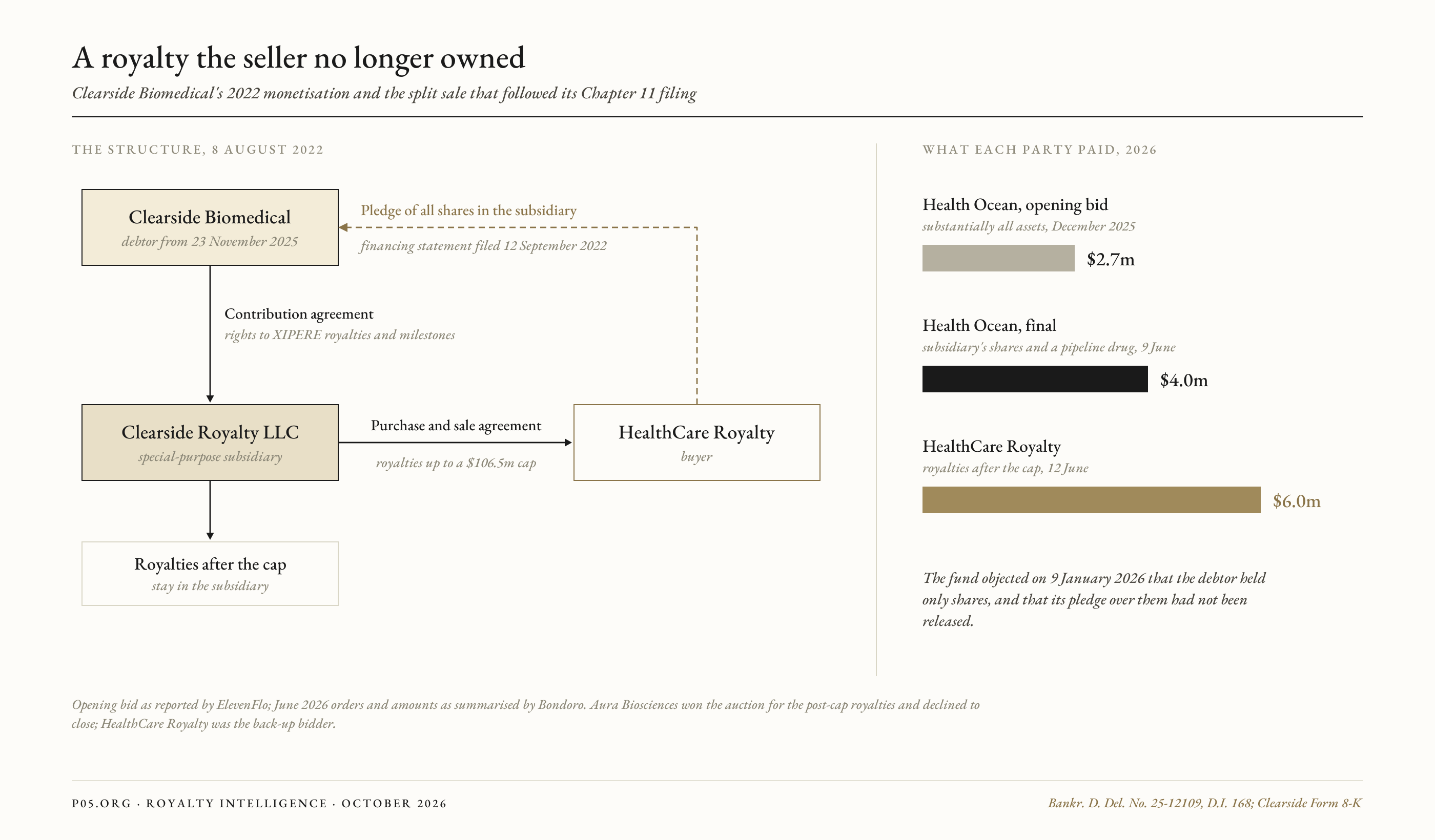
Figure 1. Clearside's 2022 structure and what each party took in June 2026.
The price of Reedy Creek's signature
A royalty buyer without a special-purpose company depends on the next owner of the product agreeing to honour the contract. Novan's bankruptcy shows what that agreement can cost.
Novan had financed its skin drug berdazimer twice in the spring of 2019. Reedy Creek Investments signed a royalty and milestone purchase agreement on 29 April. Ligand Pharmaceuticals signed a development funding and royalties agreement five days later. When Novan filed in Delaware on 17 July 2023, Ligand became the lender to the bankrupt estate and then its buyer. Under the amended asset purchase agreement of 1 September 2023 it bid $12.15 million, payable by setting off the bankruptcy loan and assuming liabilities.
Both 2019 royalty agreements were listed as permitted liens, which meant the sale would not wipe them out. Reedy Creek's contract still had to be assigned to the new owner, and the assignment needed its consent. That consent is recorded in an Amendment, Assignment and Assumption Agreement dated 11 September 2023, signed by Novan, Reedy Creek and LNHC, the company that took the assets.
Two terms came with it. Amounts that Novan already owed Reedy Creek stayed behind with the estate. A new section 2.9 provides that Reedy Creek's future payments are calculated net of whatever royalties are owed to Ligand under the other 2019 agreement. Before the sale Novan owed royalties to both financiers. Afterwards one of the two controlled the product, and the other's payments were measured after its own.
A pledge that counted as a sale
Title to a royalty can also be disturbed by the seller's lenders, as Zevra Therapeutics learned from its own licensee.
Zevra licensed its attention-deficit drug AZSTARYS to Commave Therapeutics under an agreement dated 3 September 2019. Section 15.5(c) dealt with what it called Payment Assignments. If Zevra decided to "sell, assign, contribute, convey, grant or otherwise transfer" its right to be paid, Commave had to be told and had a right to negotiate first and to match any offer. The clause protected a licensee that did not want its royalty cheques going to a stranger.
On 5 April 2024 Zevra borrowed. Its quarterly report for March 2026 describes a $100 million term loan facility from two HealthCare Royalty funds and a Perceptive credit fund, with $60 million drawn at closing, secured by a first lien on substantially all of the company's assets. The licence agreements were among those assets, and Commave was given no chance to match.
Commave sued in the Delaware Court of Chancery, and on 31 December 2025 the court gave it partial summary judgment. Mayer Brown's note on the decision quotes the reasoning: "By pledging all license agreements as collateral, Zevra necessarily transferred an interest in the rights arising from those contracts." Granting security was a transfer within section 15.5(c), and Commave's rights had been triggered and ignored. Damages were left for later.
They were never assessed. In the first quarter of 2026 Zevra sold Commave the whole serdexmethylphenidate portfolio, AZSTARYS included, for $50 million and the two sides ended the licence. Aquestive Therapeutics took 10 per cent of the price under a 2012 agreement, and Zevra recorded a gain of $43.3 million.
A first-refusal clause written for outright sales had caught an all-asset lien. The lenders' collateral included a payment right that the licensee was entitled to buy.
The contract Penn had not signed
One step further back is the licence that produces the royalty, and sometimes the contract that matters is a sublicence the royalty holder never signed.
BioNTech's Comirnaty vaccine uses modified-mRNA technology developed at the University of Pennsylvania. BioNTech's rights come through a Patent Sublicense Agreement with Cellscript LLC dated 19 July 2017, to which Penn is not a party. For three years the arrangement produced large sums. The Inquirer put Penn's receipts from BioNTech at $1.6 billion for 2021 to 2023.
Penn thought it was owed more, and in 2024 it sued in the Eastern District of Pennsylvania. According to the Inquirer, BioNTech had paid royalties only on sales in countries where Penn held patents, and Penn said the contract called for royalties on global sales. The university also said the rate applied was lower than the one it was entitled to. Both arguments were about the wording of the sublicence.
The parties signed a term sheet on 23 December 2024. BioNTech agreed to pay up to $467 million, of which $400 million was royalties for 2020 to 2023, and Pfizer agreed to reimburse up to $170 million of that. From 2024 the royalty runs at a low single-digit percentage of net sales. In the same week BioNTech settled with the National Institutes of Health for $791.5 million, Fierce Pharma reported, after the agency had served a notice of default in March.
An investor buying part of Penn's vaccine income during those years would have needed the Cellscript contract to know what Penn was owed. The difference between the two readings of it was settled at $400 million.
Who invented it
At the far end of the file are the inventors, and three disputes since 2021 show how late a question about them can arrive.
The first concerned one of the two mRNA vaccines of the pandemic. Moderna and the National Institutes of Health worked together on mRNA-1273 in 2020, and when Moderna applied to patent the vaccine's mRNA sequence it named only its own scientists. The agency said its researchers belonged on the application. On 17 December 2021 Moderna announced that it would not take up the patent it had been allowed, because issuance "could interfere with further discussions aimed at an amicable resolution". It filed a continuation to keep the claims alive.
The two sides did reach a deal, on a different patent. Late in 2022 Moderna took a licence from the agency's infectious-disease institute to patents on stabilising the coronavirus spike protein. Fierce Pharma reported a $400 million catch-up payment and low single-digit royalties on future sales. The inventorship of the sequence was still disputed when the licence was announced in February 2023.
The second dispute came from a supplier. CureVac was suing Pfizer and BioNTech over Comirnaty when Acuitas Therapeutics, which makes the lipid particles that carry the mRNA, claimed that its scientists were co-inventors of four of the patents and that it co-owned them. A co-owner can license without its fellow owner's consent under 35 U.S.C. 262, so the claim threatened to hand the defendants a licence.
CureVac settled on 25 April 2024. Acuitas acknowledged CureVac's ownership and dropped its claims. CureVac recognised that Acuitas held licences to three of the four patents, and withdrew those three from the American case. The money that CureVac later obtained from Pfizer and BioNTech is set out in the litigation royalty piece.
The third is nine days old. On 25 September 2026 Beam Therapeutics sued in Massachusetts over a base-editing medicine licensed three months earlier. Fierce Biotech's report of the complaint says a scientist worked at Beam from March 2021 to January 2022, founded YolTech Therapeutics in China in July 2021 while still employed, and was named as sole author of a Chinese patent application filed in June 2022. Beam alleges that YolTech's candidate uses its trade secrets.
That candidate is the asset behind a new company. Serapha Bio licensed it outside Greater China and, on 23 June 2026, announced a merger with Boundless Bio and a $230 million private placement led by RTW Investments and RA Capital. YolTech is due milestones "totaling over $2 billion" and tiered royalties. Serapha says it "categorically refutes" Beam's claims. Nothing has been decided, and the merger is expected to close in the fourth quarter.
American courts settle such questions on the wording of the assignment, a rule that dates from Stanford v Roche in 2011. How long a defect can lie unnoticed was shown on 6 October 2025, when the Federal Circuit vacated a $20 million jury award to Rasmussen Instruments. Its founder had assigned his knee-surgery patents to Wright Medical in 2006 and unwound the deal in 2013 with a settlement that never assigned them back. The gap was found after a 14-day trial and a permanent injunction.
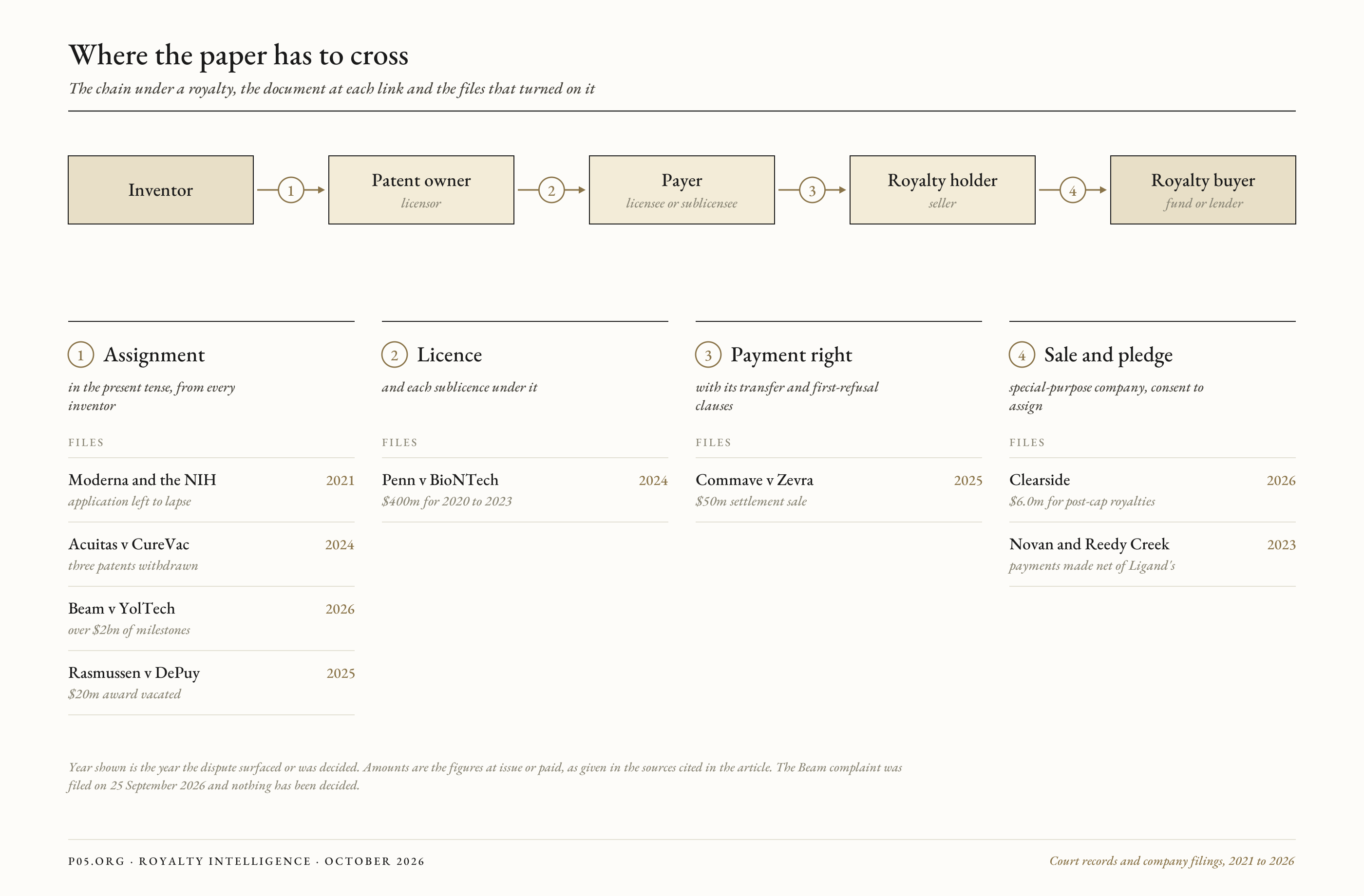
Figure 2. The seven files placed on the chain from inventor to royalty buyer, with the document each one turned on.
A court that starts with the register
In Europe the same questions now come before the Unified Patent Court, and its first answers put weight on the register.
Magna v Valeo was an application for a provisional injunction decided by the Düsseldorf Local Division on 31 October 2024. Under Rule 8.5 of the court's Rules of Procedure the registered proprietor is presumed to own the patent. The division called it "a strong presumption", which in injunction proceedings gives way only where the registered title is "manifestly erroneous".
Licensees are treated differently. Under Article 47 of the court's founding agreement, as the court summarises it, an exclusive licensee may sue as the proprietor could unless the licence says otherwise. In Texport v Sioen, decided on 31 July 2025, the claimant was an exclusive licensee on no national register. It produced a letter from the proprietor dated three days before the statement of claim, and the Nordic-Baltic Regional Division accepted that as proof of standing.
What the 2025 contracts added
Two purchase agreements filed since August 2025 contain clauses written for these gaps. The economics of both deals are covered elsewhere on this site.
On 29 December 2025 Royalty Pharma bought the last of PTC Therapeutics' Evrysdi royalty, in the deal the secondary market piece describes. From that day the buyer owned the whole stream and PTC still owned the patents, with no income left to justify the cost of keeping them up. Amendment No. 2 deals with this in its recitals, where PTC "desires to convey to the Buyer additional rights in respect of related patents".
Those rights take the form of a covenant. PTC must take whatever steps to maintain the PTC Patent Rights and the Joint Patent Rights the buyer reasonably requests, and a request counts as reasonable if the buyer would do the same as owner or joint owner. The negative pledge in section 5.9 was widened to cover the patents and the licence agreement, which is the protection Commave's clause gave a licensee, written this time for a royalty buyer. The covenant binds only PTC, and the term "Joint Patent Rights" shows that some of the patents have a second owner.
The BeOne Medicines agreement with Royalty Pharma, signed on 25 August 2025, sold a royalty that Amgen pays on Imdelltra. Its seller option is discussed in the put options piece. The contract defines "Amgen" to include any successor entity. In each country the royalty runs while a valid claim of a patent owned or exclusively controlled by Amgen covers the product, and should Amgen license, sell or transfer those patents, the same test applies in the hands of whoever receives them. Without that wording Amgen could shorten the royalty by parting with the patent.
The agreement is less generous on title. BeOne represents that it has good and marketable title to the royalty, free of liens. The buyer takes that title subject to the collaboration agreement with Amgen, so any weakness in the collaboration agreement comes with it.
| File | Decisive document | Dispute or order | Link in the chain | Amount |
|---|---|---|---|---|
| Clearside and HealthCare Royalty | 2022 contribution, sale and pledge | Objection 9 January 2026, orders June 2026 | Royalty holder to buyer | $6.0 million for the post-cap royalties |
| Novan, Reedy Creek and Ligand | 2019 royalty agreements, 2023 assignment | 11 September 2023 | Royalty holder to new product owner | $12.15 million bid |
| Commave v Zevra | 2019 licence, 2024 loan | 31 December 2025 | Licensor's payment right to lenders | $50 million settlement sale |
| Penn v BioNTech | 2017 Cellscript sublicence | Term sheet 23 December 2024 | Licensor to sublicensee | $400 million for 2020 to 2023 |
| Moderna and the NIH | 2020 collaboration, patent application | Statement 17 December 2021 | Inventor to owner | $400 million on a separate licence |
| Acuitas v CureVac | Patents asserted against Comirnaty | Settled 25 April 2024 | Inventor to owner | Three patents withdrawn |
| Beam v YolTech and Serapha | 2021 employment, 2022 application | Filed 25 September 2026 | Inventor to owner | Over $2 billion of milestones at stake |
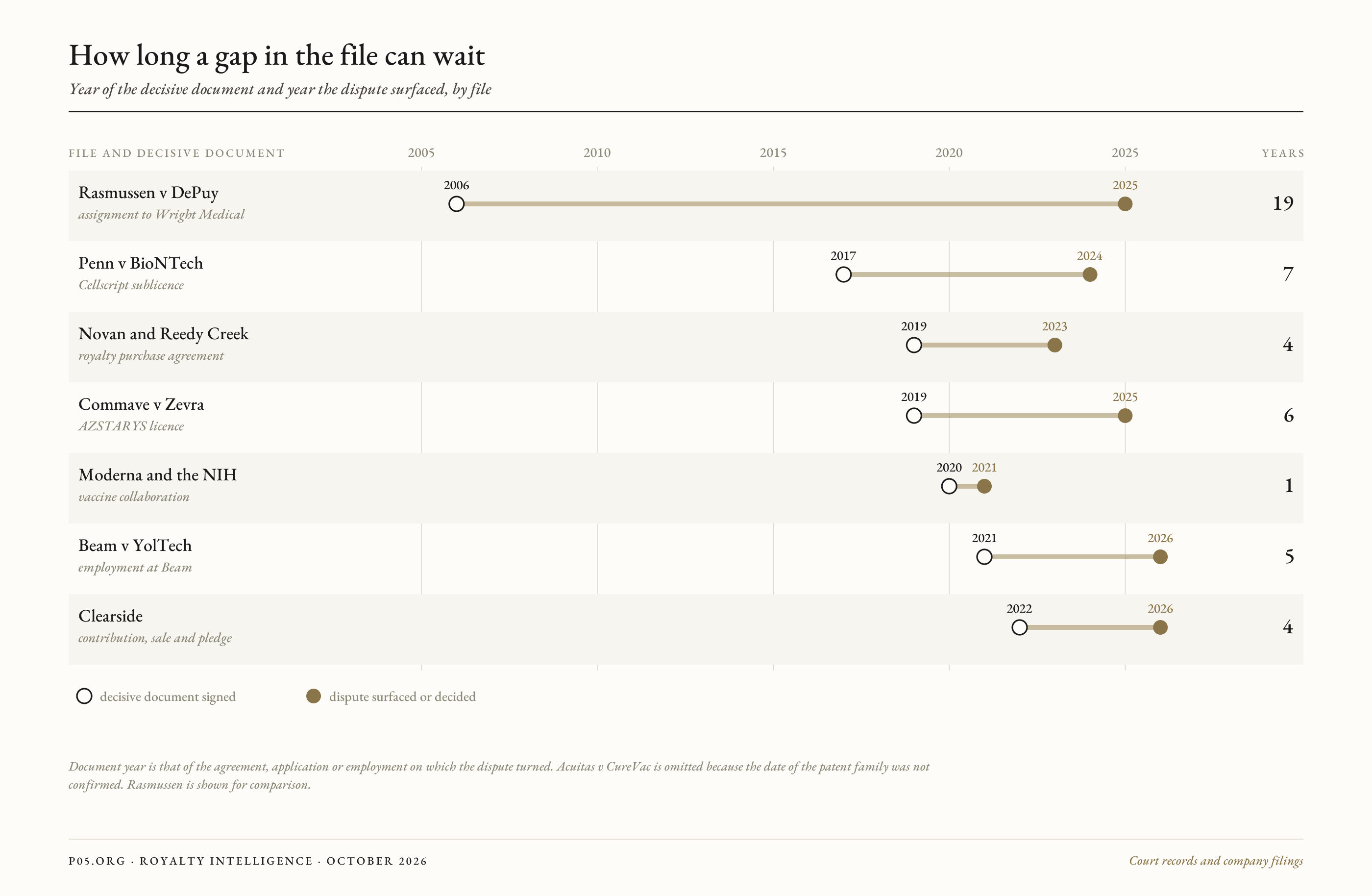
Figure 3. The year of the decisive document and the year the dispute surfaced, for six of the files and for Rasmussen.
What moves the position on title, and what only appears to
Terms that move it:
- A special-purpose company that holds the royalty, with a recorded pledge of its shares. HealthCare Royalty's objection rested on both.
- Consent rights over any assignment of the royalty contract, so that the buyer chooses its terms before a sale and not during one.
- A reading of the licence for first-refusal and transfer clauses that a lien would trigger.
- A copy of each sublicence under which the payer calculates what it owes, read for territory and rate.
- A present-tense assignment from every inventor, and a review of who else worked on the invention. The NIH and Acuitas were both collaborators.
- A royalty end date that follows the patent to a new owner, and a payer definition that includes successors.
- For European sales, a register entry in the owner's name and a licence clause granting the right to sue.
Terms that only appear to:
- A sale "free and clear" proposed by a debtor that holds only shares in the company that owns the royalty.
- Permitted-lien status in a bankruptcy sale. Reedy Creek kept its contract and lost its rank.
- A title representation qualified by the seller's knowledge.
- Good and marketable title made subject to the underlying licence.
- A patent maintenance covenant from one of two co-owners.
All information in this report was accurate as of the research date and is derived from publicly available sources including court opinions, regulatory guidance, academic literature, SEC filings, and financial news reporting. Information may have changed since publication. This content is for informational purposes only and does not constitute investment, legal, or financial advice. The author is not a lawyer or financial adviser.