
Company of the week: Neuren Pharmaceuticals
Neuren's entire commercial income is one royalty, on one drug, sold by one counterparty. It owes nothing upstream, carries no debt, and in August declared the first dividend of its corporate life.

Neuren Pharmaceuticals collects a tiered percentage of the worldwide net sales of trofinetide, the first and so far only approved treatment for Rett syndrome, from Acadia Pharmaceuticals, which holds an exclusive global licence. That is the whole of the commercial business. There is no second product and no second licensee.
There is also nothing above it. The company's 2023 annual report states the position flatly: no royalties or similar costs are payable by Neuren to third parties, so revenue from Acadia flows through to pre-tax profit. Gross equals net.
A royalty desk spends most of its time reconstructing stacked obligations, redacted tiers and legacy claims that may or may not still be live. This one behaves differently. Acadia publishes quarterly net sales, the North American rate ladder is disclosed in full, and the two together reproduce Neuren's reported full-year royalty income for 2025 to the first decimal place. The section below shows the working.
Three things have changed in the last six weeks. Trofinetide posted a record quarter in June. The European Commission granted marketing authorisation on 24 August, under a different brand name and a narrower label than the American one. And Neuren declared its first dividend after twenty-five years as a development-stage company, against a formally defined pool of after-tax royalty income.
The company has stopped behaving like a biotech and started behaving like a royalty holder.
At a glance
| Item | Detail |
|---|---|
| Company | Neuren Pharmaceuticals Limited (ASX: NEU), Victoria, Australia; approximately 37 employees |
| Founded | 17 December 2001, with research origins in Auckland; incorporated in Australia 22 November 2004 |
| Leadership | Chief Executive Jon Pilcher; Chairman Patrick Davies |
| Shares on issue | 126,639,526 as at 11 February 2026 |
| Market capitalisation | Approximately $1.8bn (A$2.6bn) in early September 2026. The share traded at A$12.86 in early May and around A$20.45 to A$23.00 through August |
| Royalty asset | Trofinetide. DAYBUE and DAYBUE STIX in the United States, DAYBUE in Canada, DAYBU in the European Union |
| Licensee | Acadia Pharmaceuticals (Nasdaq: ACAD), worldwide exclusive |
| Licence 1 | August 2018, North America. $10m upfront, up to $455m in milestones, tiered royalties |
| Licence 2 | July 2023, rest of world plus global NNZ-2591 rights in Rett and Fragile X. $100m upfront, up to $426.3m trofinetide milestones and up to $831.3m NNZ-2591 milestones |
| North American royalty | 10 per cent to 15 per cent of net sales in four tiers, reset annually |
| Ex-North American royalty | Mid-teens to low-twenties per cent; tier thresholds redacted |
| Royalties paid out | None. No upstream licensor, university interest or institutional claim on trofinetide |
| Net sales | $124.8m in Q2 2026, a record, up 30 per cent year on year; $226m in H1 2026 against $181m in H1 2025; full-year guidance of $480m to $510m |
| Neuren royalty income | $23.3m (A$33.2m) in H1 2026, up 29 per cent; guidance of $52.6m to $56.2m (A$70m to A$77m) for the full year |
| Cumulative DAYBUE income | A$445m through 2023 and 2024; A$525m at 27 May 2026; approximately A$543m at 30 June 2026 |
| Balance sheet | Approximately $201m (A$287m) cash and short-term investments at 30 June 2026; no debt; H1 2026 revenue A$42.7m and net profit A$4.9m |
| Capital returns | A$50m buyback completed in 2025 at an average A$12.27; 5 per cent buyback authorised 11 February 2026; first dividend of A$0.15 fully franked, ex-date 15 September, payable 7 October 2026 |
| Unpartnered pipeline | NNZ-2591 (ercanetide) in Phelan-McDermid, Pitt Hopkins, Angelman, Prader-Willi, SYNGAP1 and hypoxic-ischaemic encephalopathy |
| US exclusivity | Orphan drug exclusivity to 10 March 2030; last-to-expire Orange Book patent 12 July 2042 |
| Royalty posture | Net collector, gross equals net, no monetisation to date |
Currency note: Neuren reported royalty income in Australian dollars through 2025 and switched to US dollars from the first quarter of 2026, so the two halves of the series below are not directly comparable without conversion. Neuren's own guidance assumptions used AUD/USD 0.65 for 2025 and 0.70 to 0.72 for 2026; its half-year accounts used 0.702. Conversions here follow those rates unless a source states its own.
What Neuren is
The company was built around a single chemical idea. Trofinetide, originally NNZ-2566, is a synthetic analogue of glycine-proline-glutamate, the tripeptide cleaved from IGF-1 in the brain. The molecular lineage runs back through work associated with the Auckland chemist Margaret Brimble. Neuren carried the compound for roughly two decades before it reached a market, including a period of US Department of Defense funding when the indication under study was traumatic brain injury.
Rett syndrome became the successful indication. It is an X-linked neurodevelopmental disorder occurring in approximately one of every 10,000 to 15,000 female births. Neuren and Acadia have put the diagnosed US population at 5,500 to 5,800 in their 2025 disclosures and at roughly 6,000 in 2026, with an estimated 9,000 to 12,000 in Europe. Before March 2023 there was no approved therapy for it anywhere.
Neuren never commercialised the drug. It licensed North American rights to Acadia in 2018 and sold the rest of the world to the same partner in 2023. What remains inside the company is a research organisation of fewer than forty people, a second compound called NNZ-2591, and a contractual right to be paid.
The second compound matters to how the equity is priced and hardly at all to how the royalty is priced. NNZ-2591 is wholly owned by Neuren in every territory and indication except Rett and Fragile X syndrome, which went to Acadia in the 2023 transaction. In the indications Neuren is actually developing, the asset is unpartnered as of September 2026 and has produced no revenue at all.
The two licences, in sequence
North America, August 2018
Acadia acquired exclusive North American rights to develop and commercialise trofinetide in Rett syndrome and other indications. Neuren received $10m upfront and became eligible for up to $455m in milestones, comprising $105m in development milestones across Rett and Fragile X and up to $350m tied to sales thresholds.
It also secured one third of the value of any Rare Pediatric Disease Priority Review Voucher.
The relationship had been established several months earlier through an exclusivity deed. Acadia paid $0.9m for the exclusive right to negotiate and subscribed for 1,330,000 Neuren shares at a cost of $3.1m. It sold that holding during 2023 for $12.3m.
The rest of the world, July 2023
Four months after the FDA approval, Acadia bought everything else: ex-North American rights to trofinetide, plus global rights to NNZ-2591 in Rett and Fragile X. Neuren received $100m upfront and became eligible for up to a further $426.3m in ex-North American trofinetide commercial and sales milestones, plus up to $831.3m in NNZ-2591 milestones. Royalty rates on NNZ-2591 match the trofinetide rates in each territory.
Neuren sold worldwide rights immediately after an approval had de-risked the asset, at a point when ex-US value was entirely prospective and no ex-US regulatory pathway had been established. Three years on, the European authorisation has arrived. The milestone attached to it has not yet been triggered, because it turns on first commercial sale rather than approval.
The rate card
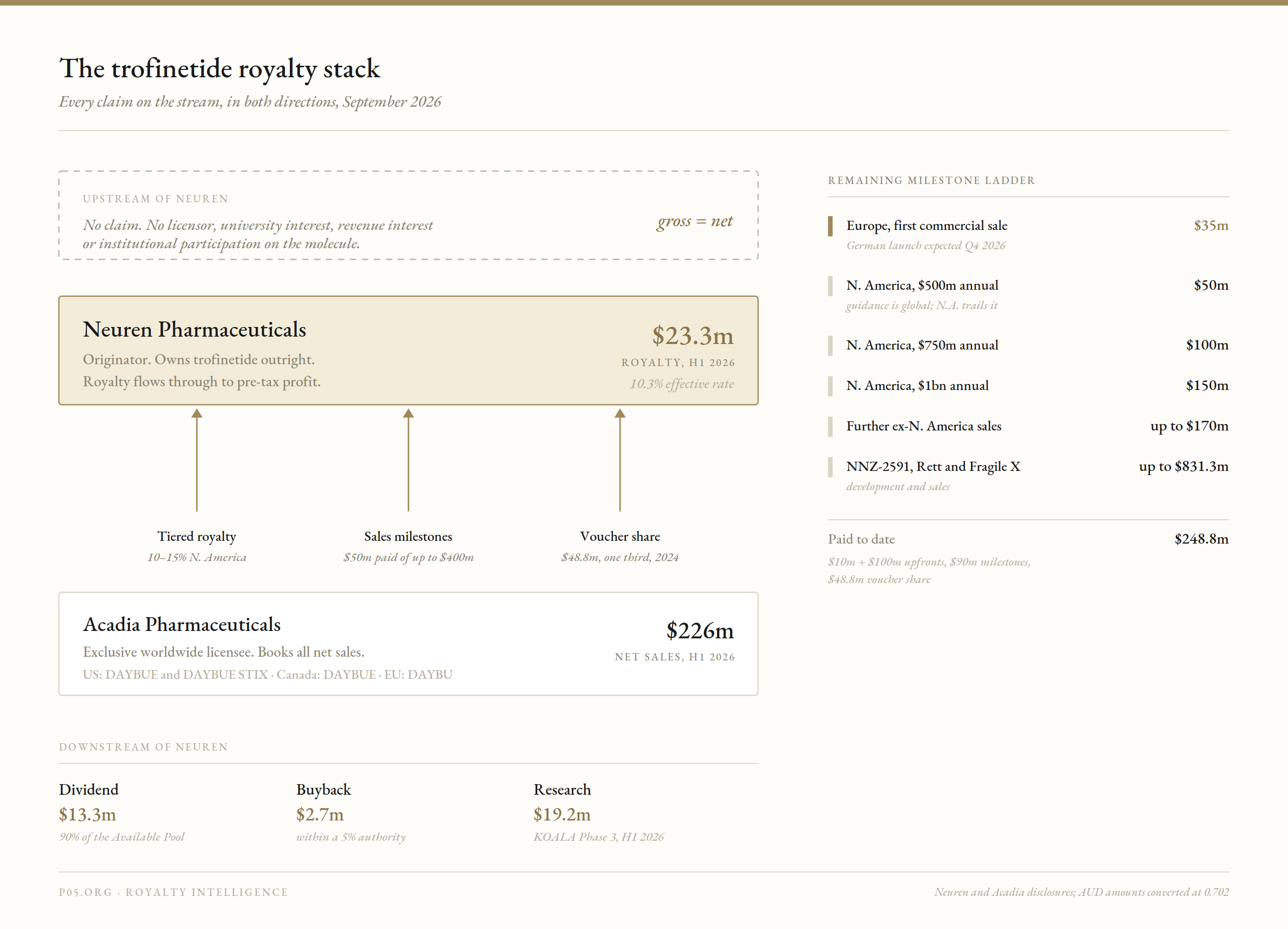
Figure 1. The trofinetide royalty stack, September 2026
North American royalties step up in four bands.
| Annual North American net sales | Royalty rate |
|---|---|
| Up to $250m | 10 per cent |
| Above $250m to $500m | 12 per cent |
| Above $500m to $750m | 14 per cent |
| Above $750m | 15 per cent |
Source: Acadia's 2024 annual report.
Ex-North American rates are disclosed only qualitatively, as mid-teens to low-twenties per cent of net sales. The thresholds at which they step are redacted, and the expanded licence was filed as a redacted exhibit. A desk modelling the European contribution has the band without the ladder.
The North American sales milestone schedule runs alongside the royalty:
| Annual North American net sales threshold | Milestone |
|---|---|
| $250m | $50m, earned Q4 2024, received Q1 2025 |
| $500m | $50m |
| $750m | $100m |
| $1bn | $150m |
Acadia's 2025 Form 10-K records $50m paid of up to $400m in North American Rett milestones as at 31 December 2025, with up to $55m more available on Fragile X. Earlier receipts were $10m in January 2023 on FDA acceptance of the NDA and $40m in June 2023 on first commercial sale.
Outside North America, a $35m milestone falls due on first commercial sale in Europe, with up to $170m in further ex-North American sales milestones as annual thresholds are met.
The priority review voucher resolved to an exact number. Acadia sold it in 2024 for aggregate net proceeds of $146.5m and paid Neuren one third.
Combined with the $50m annual net sales milestone, Acadia paid Neuren $98.8m during the first quarter of 2025, which puts Neuren's voucher share at $48.8m. Neuren received A$176m from Acadia across royalties, the milestone and the voucher share in that quarter.
The royalty series, quarter by quarter
Neuren reports royalty income every quarter alongside Acadia's results, in Australian dollars through 2025 and in US dollars from 2026. The series below stitches the two together. Figures marked derived are calculated from the growth rates Neuren published rather than stated directly.
| Period | Net sales | Neuren royalty (A$) | Neuren royalty (US$) |
|---|---|---|---|
| FY2023 | $177m | A$27m | |
| Q2 2024 | $84.6m | A$12.7m derived | |
| Q3 2024 | $91.2m | A$13.2m derived | |
| FY2024 | $348.4m | A$56.2m | |
| Q1 2025 | $84.6m | A$13.5m derived | $8.5m |
| Q2 2025 | $96.1m | A$14.7m | $9.6m derived |
| Q3 2025 | $101.1m | A$16.4m | |
| Q4 2025 | $110.0m | A$20.0m derived | |
| FY2025 | $391m | A$64.6m | approximately $42m |
| Q1 2026 | $101m | $10.4m | |
| Q2 2026 | $124.8m | $12.9m | |
| H1 2026 | $226m | A$33.2m | $23.3m |
Sources for the stated figures are Neuren's quarterly ASX announcements, including Q2 2025, Q3 2025 and the 2025 preliminary final report, together with Acadia's results releases. Growth rates published by Neuren and used for the derived cells: Q2 2025 royalty up 16 per cent on Q2 2024 and 9 per cent on Q1 2025; Q3 2025 up 24 per cent on Q3 2024 and 12 per cent on Q2 2025; Q1 2026 up 23 per cent on Q1 2025; Q2 2026 up 34 per cent on Q2 2025 and 24 per cent on Q1 2026. Q4 2025 is the residual of the reported full year.
The tier reset, and why Q4 is worth more than Q1
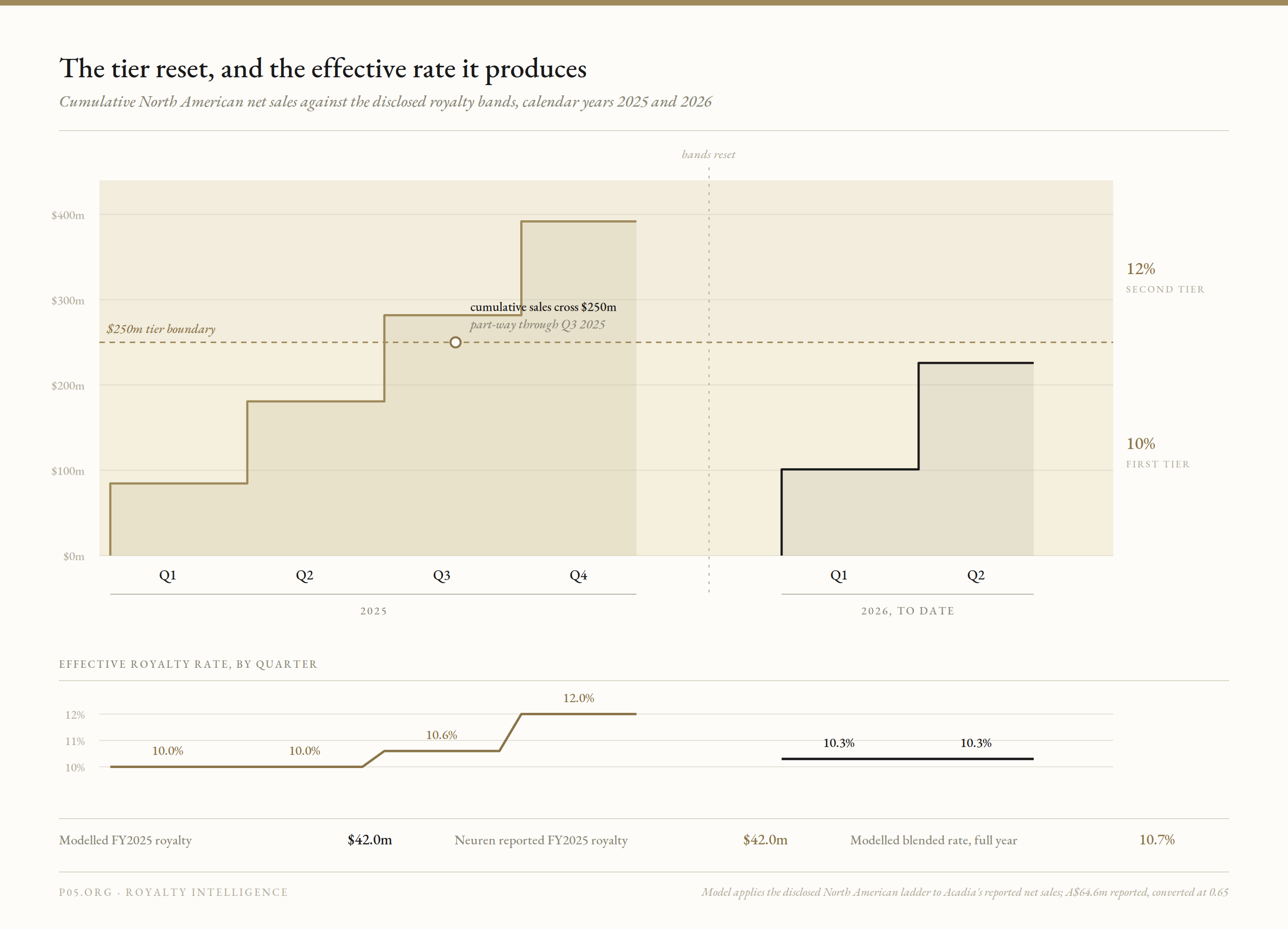
Figure 2. Cumulative net sales against the disclosed royalty bands, 2025 and 2026
The North American bands reset each calendar year. Every January the rate drops back to 10 per cent and climbs again as cumulative annual sales cross the thresholds. The effect is a predictable intra-year shape that a desk modelling quarterly cash should carry explicitly.
Applying the published ladder to Acadia's reported quarterly net sales for 2025, and assuming ex-North American volumes were immaterial that year and an AUD/USD rate of 0.65:
| Quarter | Net sales | Cumulative | Modelled royalty | Effective rate |
|---|---|---|---|---|
| Q1 2025 | $84.6m | $84.6m | $8.46m | 10.0 per cent |
| Q2 2025 | $96.1m | $180.7m | $9.61m | 10.0 per cent |
| Q3 2025 | $101.1m | $281.8m | $10.75m | 10.6 per cent |
| Q4 2025 | $110.0m | $391.8m | $13.20m | 12.0 per cent |
| FY2025 | $42.02m, or A$64.6m | 10.7 per cent |
Neuren reported full-year 2025 royalty income of A$64.6m. The model returns A$64.6m. The stated Q1 figure of $8.5m matches the modelled $8.46m, and the modelled Q3 of A$16.5m sits against a reported A$16.4m. The cumulative $281.8m at the end of the third quarter matches the nine-month DAYBUE net sales figure in Acadia's Form 10-Q.
Two things follow. Fourth-quarter royalty income runs roughly 20 per cent above first-quarter royalty income on comparable sales, purely from the tier position, which makes any single-quarter annualisation misleading in both directions.
And the effective blended rate for a full year sits near 10.7 per cent rather than anywhere near the 15 per cent headline top tier, because sales have to reach $750m in a single calendar year before that band applies at all.
Running the same model over 2026 produces a small and consistent gap. Modelled Q1 is $10.10m against $10.4m reported, and modelled Q2 is $12.48m against $12.9m reported, leaving roughly 3 per cent unexplained in each quarter.
The most likely source is ex-North American named-patient sales earning the higher ex-North American rate, which would imply a few million dollars a quarter of managed-access volume. That is an inference from the residual rather than anything either party has disclosed.
The same arithmetic corrects a natural misreading of the milestone schedule. Acadia's 2026 guidance of $480m to $510m is a global figure, while the $50m milestone turns on annual North American net sales reaching $500m.
North American sales in 2026 will be the guidance figure less whatever Europe and the named-patient programmes contribute, so the threshold is reached only at the very top of the range. On current guidance that payment looks more like a 2027 event than a 2026 one.
What the sales record shows
Reported income fell between 2024 and 2025, from A$216.83m to A$84.84m, and net profit fell from A$142m to A$30.44m. The share price dropped 8.8 per cent on the day and 24.75 per cent over the following month.
The underlying royalty rose 15 per cent across the same period. The difference is the absence in 2025 of the one-off milestone and voucher receipts that inflated 2024.
Cash flow shows the same distortion in a different place. Net cash used in operating activities was A$11.3m in 2024, against A$184.9m generated in 2023, because the sales milestone and voucher share were earned in the fourth quarter of 2024 and received in the first quarter of 2025. Neuren published a pro-forma cash figure of A$359.4m to bridge it. Operating cash flow was A$125m in 2025 and A$8.0m in the first half of 2026, against A$128.3m in the equivalent half of 2025.
Patient numbers give the volume picture underneath the dollars. Unique US patients receiving shipments reached a record 987 in the second quarter of 2025 and passed 1,000 for the first time in the third, when 74 per cent of new patient prescriptions came from community physicians rather than specialist Rett centres.
Against $101.1m of net sales in that quarter, roughly 1,000 patients implies something near $100,000 per patient per quarter at net prices, before considering partial-quarter starts and discontinuations. Two thirds of the diagnosed US population had yet to try the drug.
The June 2026 quarter was a record at $124.8m. Acadia attributed roughly 27 of the 30 percentage points of year-on-year growth to volume rather than price, and chief executive Catherine Owen Adams described the increase as driven almost entirely by volume. Full-year guidance rose to $480m to $510m from $460m to $490m, and Neuren's implied royalty range moved to $52.6m to $56.2m from $50m to $54m.
A formulation change sits behind the step up. DAYBUE STIX, a dye-free and preservative-free powder presentation approved in December 2025, ran a limited launch through Rett Centres of Excellence in the first quarter of 2026, recording over 250 prescriptions of which approximately 30 per cent went to treatment-naive or previously discontinued patients.
Broad US availability followed in April. By the end of June it accounted for roughly 40 per cent of all US patients and 60 per cent of prescriptions written in that month, with 55 per cent of STIX users switching from the oral solution and 45 per cent new or returning.
Persistence has followed this asset since launch and remains the central commercial question. Twelve-month persistence has held above 50 per cent since 2025, chief commercial officer Thomas Garner put it above 50 to 55 per cent in August 2026, and eighteen-month persistence sits at approximately 50 per cent.
The proportion of active patients on therapy for twelve months or longer moved from 65 per cent to 70 per cent across the second quarter of 2025 and stood at 70 per cent a year later. Gross-to-net ran at 24.4 per cent in the June quarter, within the 24 to 26 per cent range the product has held, and the Medicare Part D redesign produces a recurring first-quarter dip in net price that compounds the tier reset in the Q1 figures.
Clinical positioning has firmed in parallel. A twenty-five member expert panel using a modified Delphi method with a 75 per cent agreement threshold supported trofinetide as standard of care for eligible patients, with early initiation.
Gross equals net
Neuren discovered and owns trofinetide outright. The 2023 annual report states that no royalties or similar costs are payable to third parties. Historical relationships around the compound, including the 2005 cooperative research agreement with the Walter Reed Army Institute of Research for the brain injury programme, did not leave a live claim on the molecule.
No university interest, legacy licensor, revenue interest or institutional participation sits between Acadia's payment and Neuren's pre-tax line.
Compounds carried for twenty years across multiple indications and multiple funding sources usually acquire encumbrances on the way, and reconstructing them from public sources is frequently impossible. Acadia pays a percentage of net sales, Australian corporate tax and US withholding apply, and what remains is available to the company.
The inward side of Neuren's royalty book is empty.
Territories, and the European label
The United States remains the commercial base and, until the fourth quarter of 2026, effectively the entire revenue base. Canada is approved by Health Canada, with first sales anticipated from the third quarter of 2025, and sits inside the North American royalty tiers.
Europe took two attempts. The CHMP issued a negative opinion at its meeting of 23 to 26 February 2026 and Neuren shares fell approximately 25 per cent. On re-examination the committee adopted a positive opinion on 25 June 2026, and the European Commission granted marketing authorisation on 24 August across the twenty-seven member states plus Iceland, Liechtenstein and Norway.
The terms of that authorisation matter to the size of the ex-US royalty base, and they differ from the American ones in two respects. The European brand is DAYBU rather than DAYBUE. More consequentially for the royalty, the European indication is the treatment of neurobehavioural symptoms of Rett syndrome in adults and paediatric patients aged five years and older, against a US label covering Rett syndrome in adults and paediatric patients aged two years and older.
The European label is narrower on both the age floor and the scope of the claim. Pricing and reimbursement negotiations with national authorities have only just begun. Launch in Germany is expected early in the fourth quarter of 2026, which triggers the $35m first-sale milestone and starts the ex-North American royalty in the higher band.
Japan is next. Orphan drug designation is granted, Acadia is running a confirmatory trial with topline results expected between September and November 2026, and a regulatory submission is planned for 2027 against a population of roughly 1,000 patients.
The oral solution was approved in Israel in January 2026. Named-patient supply programmes run through Clinigen in Europe, Rafa in Israel and Farmamondo elsewhere, with the first European shipment made in April 2025 under a managed access programme. Trofinetide is not approved for sale in Australia, where Neuren is listed.
Acadia has told the market it expects less than 15 per cent of 2028 sales to come from outside the United States, against a stated ambition of roughly $700m in trofinetide revenue that year. Those are expectations rather than realised results, and the ex-US contribution has not yet appeared as a disclosed line in any reported quarter.
The asset that is not licensed
NNZ-2591, now carrying the international non-proprietary name ercanetide, is the only part of Neuren capable of changing the shape of the company.
The lead indication is Phelan-McDermid syndrome. KOALA, the first Phase 3 trial ever run in that disorder, registered as NCT07281079, dosed its first patient on 6 February 2026. It enrols approximately 160 children aged three to twelve for thirteen weeks of twice-daily dosing after a four-week screen, with the Vineland-3 receptive communication subdomain and a disease-specific assessment of change as endpoints.
Fifteen sites across the United States and Canada were enrolling in the first half of 2026, with eight active for the open-label extension. Neuren guides the programme cost at $80m to $90m and has said it will provide topline timing after further enrolment milestones.
The compound holds Fast Track designation in Phelan-McDermid and Angelman, alongside Fast Track in Pitt Hopkins and rare pediatric disease designation across all three, and Neuren reached agreement with the FDA on a single Phase 3 design following a Type C meeting in early 2025.
Positive Phase 2 results have been reported in Phelan-McDermid, Pitt Hopkins and Angelman, with the eighteen-patient Phelan-McDermid study published in Neurology: Genetics in December 2025. An end-of-Phase-2 meeting on Pitt Hopkins is scheduled for late October 2026. Hypoxic-ischaemic encephalopathy, Prader-Willi and SYNGAP1 sit earlier in the sequence.
None of it is licensed. If Neuren wanted a second royalty stream, this is the asset that would create one, and the 2023 transaction shows the company is willing to sell worldwide rights on royalty-bearing terms shortly after de-risking.
Duration
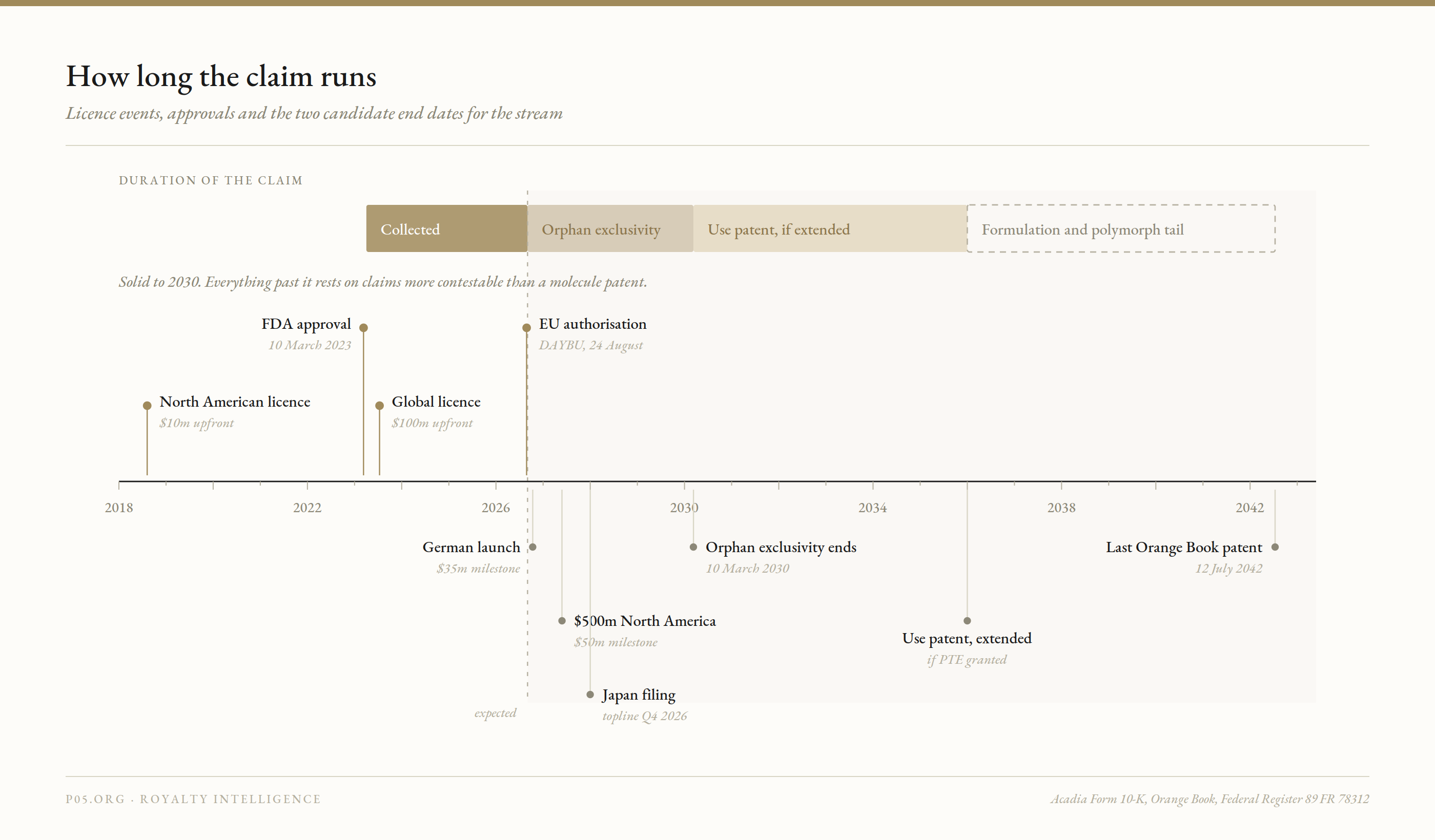
Figure 3. Licence events, approvals and the two candidate end dates for the stream
Two candidate end dates sit a decade apart.
Regulatory exclusivity is the near boundary. New chemical entity protection runs to 10 March 2028 and orphan drug exclusivity to 10 March 2030, with pediatric exclusivity adding roughly six months to the NCE date.
Patents run considerably further. Acadia's 2025 Form 10-K describes exclusive licences to seven US patents from Neuren plus a company-held patent on crystalline trofinetide, three of them listed in the Orange Book.
The use patent covering treatment of Rett syndrome, US 9,212,204, expires around January 2032. Acadia is seeking a patent term extension of 1,443 days that would carry it to approximately January 2036, and the Federal Register notice of 25 September 2024 determined the regulatory review period at 5,106 days, which is the input to that calculation.
Behind the use patent sit a formulation patent, US 11,370,755, expiring around August 2040, and two crystalline form patents, US 11,827,600 and US 12,492,167, expiring 12 July 2042.
What the runway is built from should govern how much of it a desk underwrites. There is no long-dated molecule patent doing the work here.
Protection past the early 2030s rests on formulation and polymorph claims, which historically hold up less reliably against a determined generic or 505(b)(2) filer than a composition of matter claim. Taking 2030 as the floor and discounting the 2030 to 2042 tail is the conservative reading of the same Orange Book.
What the company does with the cash
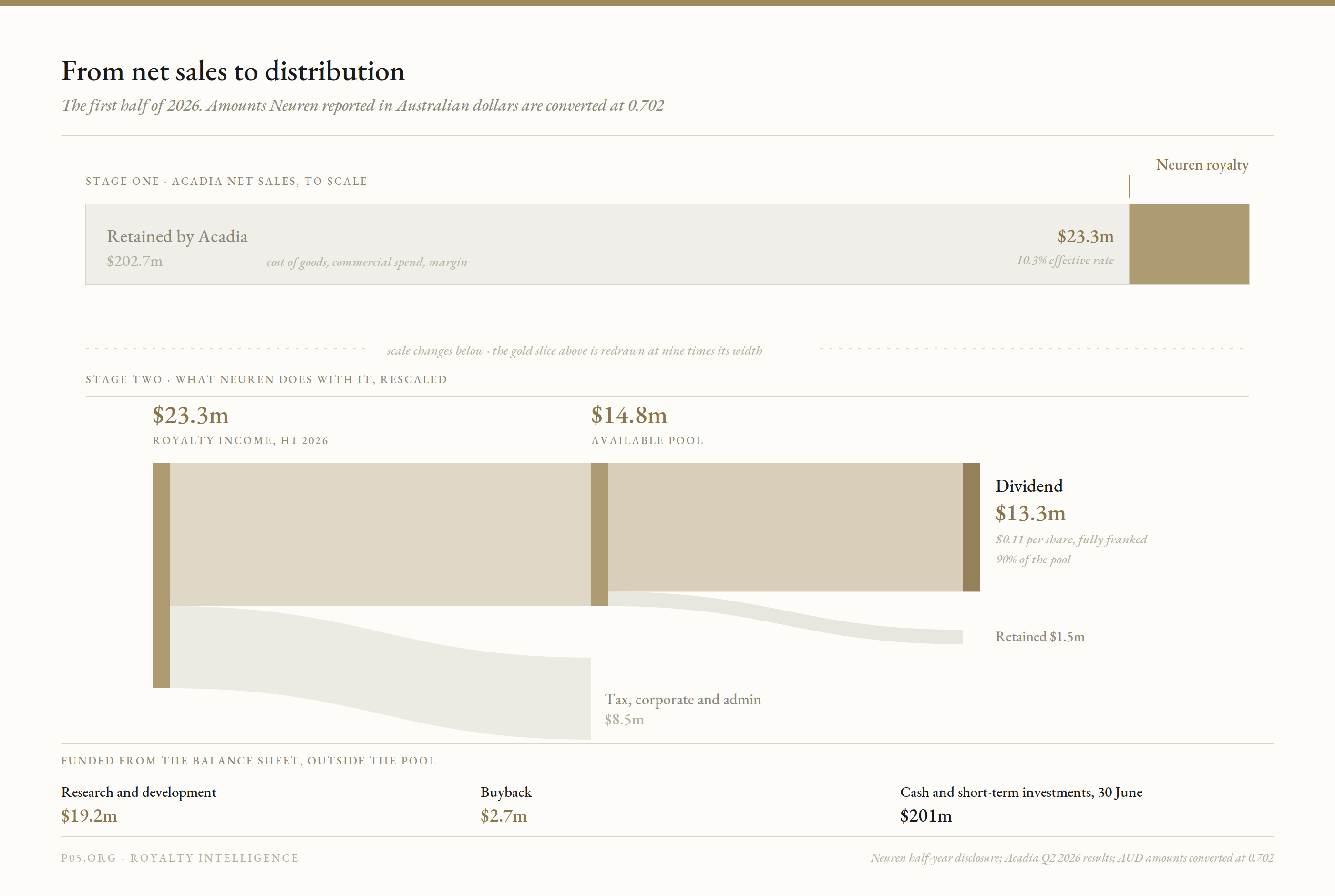
Figure 4. From net sales to distribution, first half of 2026
Neuren is profitable and unlevered, and funds itself from the royalty. It held approximately $201m (A$287m) in cash and short-term investments at 30 June 2026, against approximately $190m (A$296m) at 31 December 2025, A$341m at 31 March 2025 and A$222m at 31 December 2024.
Research spending was A$36m in 2025 and A$27.4m in the first half of 2026 alone, the increase driven by KOALA. Half-year revenue was A$42.7m, up 8 per cent, and net profit after tax A$4.9m.
With the pipeline fully funded, the board turned to distribution. A A$50m buyback announced in November 2024 completed during 2025 at an average price of A$12.27. A further buyback of up to 5 per cent of issued capital, 6,350,631 shares for cancellation, was authorised on 11 February 2026 and runs to March 2027, with A$3.9m repurchased in the first half.
In August 2026 came the first dividend in the company's history: an interim A$0.15 per share, fully franked, ex-dividend 15 September and payable 7 October 2026, totalling A$19.0m.
The stated policy is a semi-annual payout of 70 to 100 per cent of an "Available Pool" defined as after-tax royalty income less corporate and administrative costs. The half-year pool was A$21.1m, the dividend represented 90 per cent of it, and the full-year pool is guided at A$48.0m to A$51.6m.
Neuren has not sold, securitised or borrowed against the trofinetide stream, and no management commentary indicates an intention to do so. The chosen posture is to hold the royalty and distribute the cash it produces.
Red team versus blue team
Risk analysis (red team)
Concentration is the position. One drug, one licensee, one indication, one geography until the fourth quarter. Every commercial dollar depends on Acadia's execution, pricing, payer relationships and supply chain. There is no second asset to absorb a disappointment, and the equity carries a market capitalisation of approximately $1.8bn against royalty guidance of $52.6m to $56.2m for the year.
The counterparty is concentrated too. Acadia recorded total revenues of $308m in the June quarter, of which NUPLAZID contributed $183.2m and trofinetide $124.8m, and guides to $1.24bn to $1.30bn for the year.
Its most significant near-term event is the Phase 2 readout for remlifanserin in Alzheimer's disease psychosis, expected in September or October 2026. A licensee absorbing a pipeline disappointment can change commercial investment behind a licensed asset without any change to the licence.
The next milestone is further away than the headline suggests. Acadia's $480m to $510m guidance is global, while the $50m payment turns on annual North American net sales of $500m. Netting off Europe and named-patient volumes puts the trigger at the top of the range at best.
Persistence has not been settled. Roughly half of patients remain on therapy at eighteen months, and the twelve-month figure has sat in a narrow band above 50 per cent since 2025 without improving materially.
STIX has lifted the near-term trajectory, and whether a formulation change addresses tolerability-driven discontinuation over several years is not established from the disclosed data.
The European label is narrower than the American one. DAYBU is authorised for neurobehavioural symptoms in patients aged five and older, against age two and older in the United States. Ex-US royalties carry a higher rate on a smaller eligible population, before national pricing and reimbursement negotiations that have barely started. Acadia's own expectation is that Europe delivers less than 15 per cent of 2028 sales.
Competition is arriving in a small population. Anavex's blarcamesine, Neurogene's NGN-401, Taysha's TSHA-102, Biomed's Bionetide and UCB's fenfluramine programme are all in clinical development for Rett.
Neurogene has reported durability data running to thirty months. A one-time gene therapy competing against a chronic oral therapy in a 6,000-patient US population is a structurally different threat from a second oral entrant.
Protection after 2030 rests on formulation and polymorph patents. Orphan exclusivity ends 10 March 2030. Everything past it depends on claims more contestable than a molecule patent would be.
Currency translation is unhedged in the reported numbers. Royalties are earned in dollars and the accounts are presented in Australian dollars.
The 2025 accounts carried an A$8.0m foreign exchange gain and the 2024 accounts an A$7.2m loss, against a royalty line of similar magnitude to those swings. The change in reporting currency for royalty income between 2025 and 2026 also breaks the published series.
Milestones make the reported line volatile. The 2025 result read as a collapse and was a 15 per cent increase in the underlying stream. The 2024 operating cash outflow was a receipt-timing artefact. Both gaps recur whenever a large one-off lands or fails to.
Opportunities and mitigants (blue team)
Gross equals net, and that is rare in an originator royalty of this vintage. No upstream obligation, no revenue interest, no institutional claim. The percentage Acadia pays is the percentage Neuren keeps before tax.
The stream is modellable from public data. Acadia's disclosed quarterly net sales and the published North American ladder reproduce Neuren's reported 2025 royalty income to A$64.6m against a reported A$64.6m. Very few single-name royalty positions can be validated that precisely from filings alone.
The stream is growing, and the growth is volume. A record quarter at $124.8m, 30 per cent year on year with roughly 27 points of that from volume, raised full-year guidance, and a European authorisation that has not yet contributed a single euro of reported sales.
Duration may run far past the orphan period. If the crystalline form patents hold, the stream extends to 12 July 2042, with a pediatric addition beyond. Even the intermediate case, a granted patent term extension to January 2036 on the use patent, reaches materially past 2030.
The company is unlevered, cash generative and paying out. No debt, approximately $201m in cash, a fully funded Phase 3, and a formal distribution policy tied to royalty receipts. Few single-asset royalty holders are also dividend payers.
NNZ-2591 is optionality the shareholder is not paying extra for. The pipeline is funded from royalty income rather than dilution, and the company's history shows a willingness to out-license de-risked assets on royalty terms.
Summary
| Risk | Concern |
|---|---|
| Single asset | All commercial income from trofinetide |
| Single counterparty | Acadia execution, pricing and pipeline risk passes straight through |
| Milestone timing | $500m trigger is North American; 2026 guidance is global |
| Persistence | Approximately half of patients remain on therapy at eighteen months |
| European label | Age five and older, neurobehavioural symptoms only; reimbursement unresolved |
| Competition | Gene therapies and oral entrants in a 6,000-patient US population |
| Patent composition | Post-2030 protection rests on formulation and polymorph claims |
| Currency | Dollar royalty, Australian dollar accounts, reporting currency changed in 2026 |
| Opportunity | Observation |
|---|---|
| Clean structure | No upstream royalty; gross equals net |
| Modellable | Published tier ladder reproduces reported 2025 royalty income |
| Growth | Record Q2 2026, guidance raised, roughly 27 of 30 growth points from volume |
| Near-term milestone | $35m on European first sale, expected on German launch in Q4 2026 |
| Ex-US upside | Authorisation granted 24 August 2026, nothing yet in reported sales |
| Duration | Orange Book patents to 12 July 2042 if they hold |
| Capital position | No debt, cash funded pipeline, dividend and buyback in place |
Conclusion
Neuren discovered a molecule, carried it for two decades, licensed North America in 2018 and sold the rest of the world in 2023. It now collects a tiered percentage from a single counterparty with no obligation running the other way.
Through 2026 it raised guidance, bought back stock, declared a dividend against a formally defined pool of after-tax royalty income, and put its second compound into a pivotal trial paid for out of the first compound's receipts.
The tests ahead are dated and specific. The German launch has to land in the fourth quarter for the European milestone to trigger. North American sales, not global sales, have to cross $500m for the next one, which on current guidance points to 2027. Japan reads out between September and November, with a filing targeted for 2027.
Eighteen-month persistence needs to hold around 50 per cent as the STIX cohort matures, and European reimbursement has to convert a narrower label into volume. Further out, the crystalline form patents face a filer sometime after 2030. KOALA is the only event that would make this company something other than a single-royalty vehicle.
Everything a desk needs to price this position sits in two filings and a rate card, and the rate card can be checked against the cash. That is the unusual part.
All information in this article was accurate as of September 2026 and is derived from publicly available sources including Neuren Pharmaceuticals' quarterly ASX announcements, preliminary final report and annual reports, SEC filings, results releases and earnings call transcripts from Acadia Pharmaceuticals, European Medicines Agency records, Federal Register notices, Orange Book patent data accessed through a third-party mirror, peer-reviewed literature and financial news reporting. Neuren reported royalty income in Australian dollars through 2025 and in US dollars from 2026; the combined series above spans both conventions and cells marked "derived" are calculated from growth percentages Neuren published rather than stated directly, with Q4 2025 taken as the residual of the reported full year. The quarterly tier model is an analytical reconstruction applying Acadia's published North American royalty schedule to Acadia's reported net sales, assuming annual tier resets, immaterial ex-North American volumes in 2025 and an AUD/USD rate of 0.65; it is not a calculation either party has published, and the approximately 3 per cent residual identified in 2026 is an inference rather than a disclosed figure. Royalty rate tiers for territories outside North America are disclosed by Acadia only qualitatively and the underlying licence was filed in redacted form; the exact thresholds are not public and are not stated here. The observation that the $500m milestone turns on North American rather than global sales is drawn from the licence description in Acadia's filings read against Acadia's stated global guidance, and the resulting timing view is analytical rather than a statement by either party. Full-year guidance figures from both companies, the 2028 sales ambition, the timing of the European launch and the Japanese readout window are company expectations rather than realised results. Patent term extension to January 2036 and pediatric exclusivity dates are prospective and not finalised. Acadia's 2025 Form 10-K describes three Orange Book listed patents while a third-party patent database lists four, a discrepancy that may reflect the December 2025 grant date of the fourth; the live FDA Orange Book could not be accessed directly to reconcile it. The date of the CHMP re-examination opinion is given as 25 June 2026 per the European Medicines Agency record; some secondary reporting gives 29 June. Market capitalisation and share price quoted for September 2026 vary between data vendors. Information may have changed since publication. This content is for informational purposes only and does not constitute investment, legal, or financial advice. The author is not a lawyer or financial adviser.