
The exit written in: put options in pharmaceutical royalty financing

On 11 August 2026, DRI Healthcare received about US$178 million from Chiesi Group. Its royalty on Ekterly, the oral hereditary angioedema drug, then ceased to exist. The stream had been underwritten in November 2024 to run through at least 2041. It paid for roughly a year.
No patent was invalidated. No payor defaulted. No licensee abandoned the product. Sales were growing. What ended the royalty was a clause. A contractual put option, drafted into the deal on day one, let DRI sell the stream back at a formula price once KalVista Pharmaceuticals was acquired.
When the Money Stops Early mapped the six vectors that kill a royalty against the holder's will.
The put is the seventh way the money stops, and the only one the holder pulls on purpose.
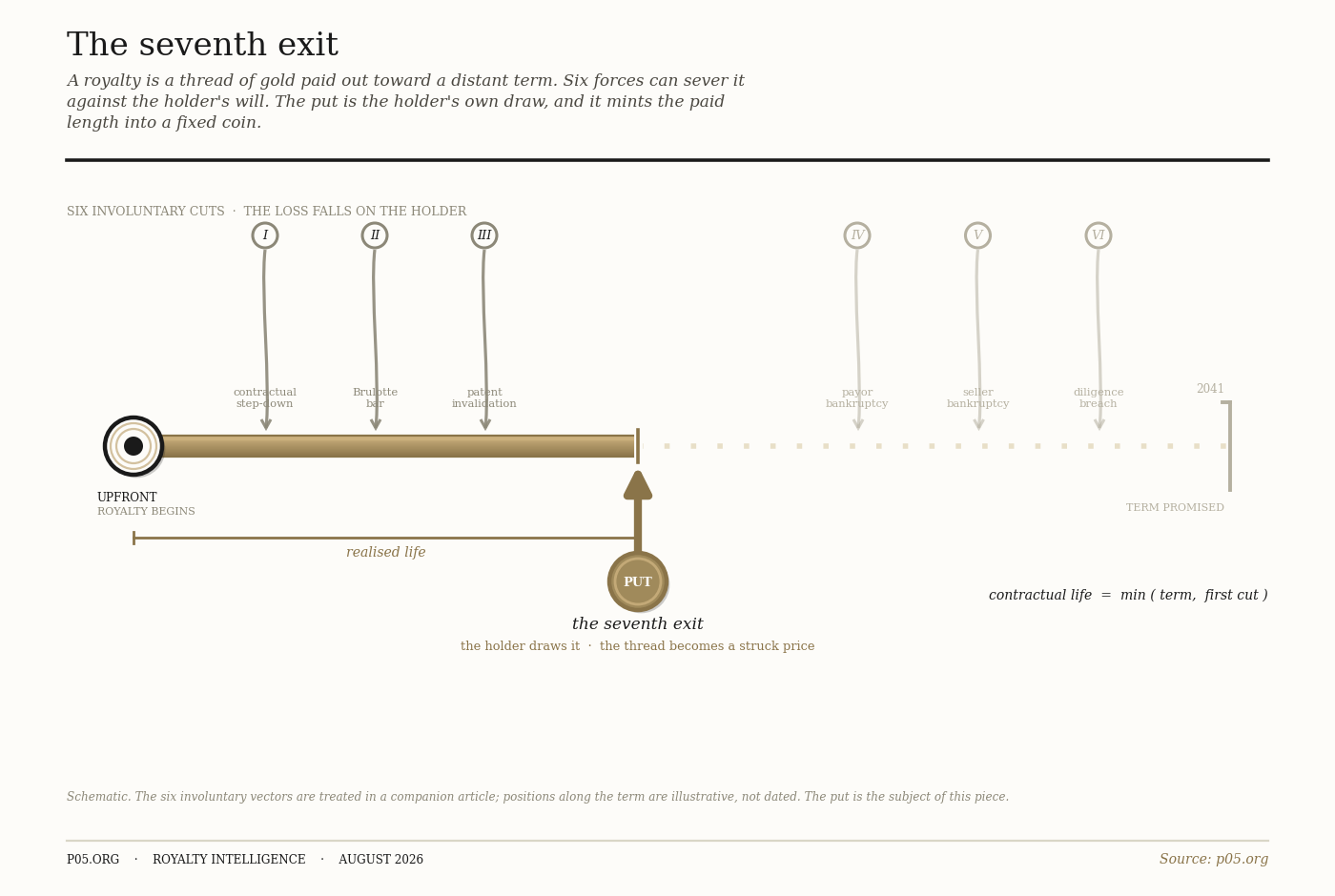
Figure 1. Six forces sever a royalty against the holder's will. The put is the seventh, and the only one the holder draws.
It converts an uncapped, uncertain, fifteen-year stream into a fixed cheque. The price is agreed before anyone knows whether the drug will even be approved. This piece covers that clause: where it sits in the documents, what triggers it, how the price is written, how it is valued as an option, how common it is, and what the Ekterly exercise reveals about the economics.
What the clause is
The put in a royalty financing has nothing to do with listed options. It is a covenant. One section of a revenue interest purchase agreement lets the investor require the company to repurchase the royalty at a contractually defined price on defined events.
Its mirror is the call: the company's right to buy the stream back, usually at the same or a closely related price. Some agreements collapse both into a single defined term, the "Put/Call Price."
The architecture has been stable for over a decade.
The AxoGen and PDL BioPharma agreement of October 2012 already contains the full kit in its Section 5.07:
- mandatory repurchase on change of control
- an investor put on a menu of trigger events
- an automatic put on bankruptcy, requiring no notice at all
- a company call opening after year four
What changed since 2012 is not the machinery but where it is deployed. The put migrated from small revenue-interest loans on medical devices into nine-figure synthetic royalties on pre-approval drugs. That migration is how a US$178 million exercise became the largest single line in a royalty trust's 2026.
Three things called "put" in this market
One vocabulary trap first. Three different instruments trade under the word "put," and only one is this article's subject.
One: the investor's repurchase put. The right to hand the stream back at a formula price. This is the subject here.
Two: the company's buy-back, or call. Its mirror, the company's right to reacquire the stream.
Three: a seller's option to sell more later. Royalty Pharma's US$950 million acquisition of BeOne Medicines' Imdelltra royalty in late 2025 included a US$65 million put, exercisable within twelve months, letting BeOne sell an additional slice of its interest.
That third kind is an issuance option, closer to a delayed-draw facility. When a release announces a "put option," the first question is which of the three it is. Ekterly was the first kind. BeOne's was the third.
Which business is this, really
One distinction organises everything else. In a pure royalty sale of the Royalty Pharma type, the buyer takes the stream and keeps it through anything. It has no right to hand it back. The seller's credit is irrelevant by design, and the market's true-sale opinions depend on that.
The repurchase put lives at the other end. It sits in structured revenue-interest financings where the investor wants a defined exit if the world changes.
The presence or absence of the clause is the fastest way to tell, from outside, which of the two businesses a "royalty deal" actually is.
The trigger set
Read enough of these agreements and the put option events resolve into a recurring menu. Five deals span fourteen years, four investors, and purchase prices from US$21 million to US$179 million.
| Deal | Investor | Put triggers | Call |
|---|---|---|---|
| AxoGen, 2012 (RIPA) | PDL BioPharma | Fourth anniversary of closing; bankruptcy (automatic); MAE; transfer of the interests or product; uncured breach. Change of control is a mandatory repurchase, not an option | Company call, years five to eight, at the CoC price |
| Acorda (Zanaflex) (10-K) | Paul Royalty Fund | Change of control; bankruptcy; transfer of Zanaflex interests or substantially all assets; covenant, rep or warranty breach | Company call on CoC, 180-day window, same price |
| Curis (Erivedge), 2019 (10-K) | Oberland Capital | Event of default under the security agreement, 180-day window | Company call at any time, same Put/Call Price |
| Esperion, 2019 (10-K) | Oberland Capital | Bankruptcy; uncured breach; MAE; change of control | Company call at any time on notice |
| KalVista (Ekterly), 2024 (10-Q) | DRI Healthcare | Change of control of the selling subsidiary, until 31 Dec 2026 | Company buy-back on CoC or failed tax confirmation, same window |
Three observations follow.
First, the trigger list is a loan's events-of-default section in sale clothing.
Bankruptcy, breach, MAE, change of control. This is what acceleration clauses protect lenders against, transplanted into an instrument whose granting language says "sell, assign, transfer and convey." A lender accelerates on these events; a royalty buyer with a put does the economic equivalent, forcing a repurchase at a formula price. That tension between sale form and loan substance runs through the accounting and the legal treatment below, and it is the thing to hold in mind when reading one of these agreements.
Second, the triggers have narrowed at the top of the market.
AxoGen's 2012 put fired on a bare calendar date, the fourth anniversary. That makes the "royalty" a four-year loan with revenue-linked coupons and an IRR-formula balloon. Esperion's 2019 put needs a genuine credit or corporate event. KalVista's 2024 put is narrower still: change of control only, and only inside a window that expires at the end of 2026.
The instrument has drifted from loan-with-royalty-features toward royalty-with-one-escape-hatch. That direction is what makes sale accounting and true-sale opinions easier to sustain. The prevalence data below puts numbers on the drift.
Third, the bankruptcy trigger is often automatic.
AxoGen's agreement deems the put exercised the instant a bankruptcy event occurs. No notice, no election. The drafting is trying to fix the investor's claim at the formula price before a filing. Once the payor is in Chapter 11, a right to future royalties is a prepetition unsecured claim, and the put converts that open-ended claim into a liquidated number.
Whether the number gets paid is another matter, taken up below.
How the price is written
The repurchase price is a formula, not a valuation. It is drafted at signing and pays out on a number the parties fix in advance. Three primitives recur. Most agreements combine them.
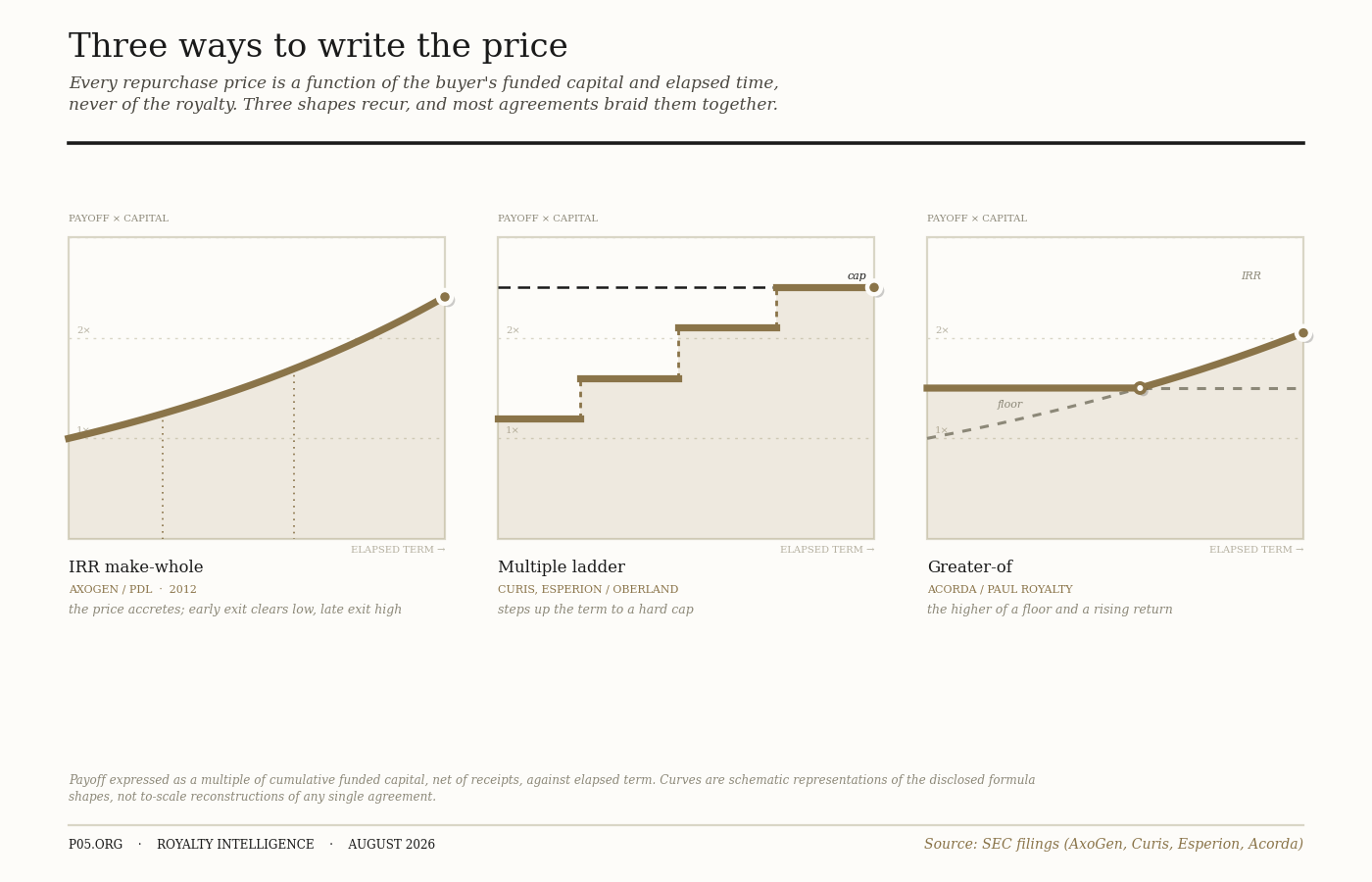
Figure 3. The three repurchase-price archetypes, as payoff against elapsed term.
The IRR make-whole
The price is whatever figure brings the buyer to a stated internal rate of return on funded capital, cash flow by cash flow, net of receipts. AxoGen and PDL priced this way in 2012. The agreement names the mechanic in the contract: the XIRR function in Excel. The rate was redacted at signing and disclosed in a later amendment at 32.5 percent.
Ariad and PDL ran a 10 percent IRR floor on the Avexta facility in 2015, a lower rate that reflects a larger, later-stage borrower than the AxoGen device deal.
An IRR price accretes with time. Exercise it early and it clears at a low multiple. Exercise it late and it clears at a high one. It behaves like a bond make-whole, and it is the reason a holder's realised return on a putted position is a function of how long the position ran, not of how the drug performed.
The multiple ladder
The price is a percentage of cumulative funded capital, net of receipts, stepping up over the term. Curis and Oberland (2019) runs from a low-triple-digit percentage to 250 percent of upfront plus lump-sum milestones. Esperion and Oberland priced a first-year put outside a change of control at 120 percent of net purchaser payments. That figure ratchets toward the 195 percent ceiling at which Oberland's collection right terminates.
The top rung is normally the overall cap. Put, call, and a natural run to the cap all pay at the same ceiling.
The greater-of
The price is the higher of a multiple and an IRR. Acorda and Paul Royalty set the Zanaflex put and call at the greater of 150 percent of net payments and a 25 percent IRR. The multiple protects the buyer on an early exercise. The IRR protects it on a late one.
The full credit stack: Adaptive/OrbiMed
The mature drafting splits the price by trigger. Adaptive Biotechnologies and OrbiMed (2022) is the clearest specimen, because it carries every credit lever at once. Adaptive drew US$125M of a US$250M commitment, secured on the clonoSEQ platform. OrbiMed collects to a Return Cap of 165 percent of cumulative funded capital. That cap steps to 175 percent if OrbiMed has not been repaid by September 2032.
A put fired by any event other than change of control or material divestiture pays the Return Cap. A change-of-control or divestiture put is priced separately, and higher.
The same agreement carries a rate ratchet unrelated to the put.
If OrbiMed has not recovered its invested capital by September 2028, the revenue-interest rate resets. It resets to whatever rate, applied retroactively to the cumulative revenue base, would have returned that capital in full. The base rate itself steps 5 to 8 to 10 percent of quarterly GAAP revenue as the three tranches draw.
That is a term loan wearing a revenue interest. Every number in it is a credit term.
What every formula shares
Two features hold across the set. Receipts to date are always netted. And no agreement claws back royalties already paid where cumulative collections have run past the formula.
The third shared feature is a silence, and it matters most: none of these formulas references the royalty.
The price is a function of the buyer's funded capital and its target return. Forward sales, remaining patent life, and the discount rate on the stream do not enter. A put is in the money for the holder when the formula sits above the stream's fair value on the trigger date. It is out of the money when the stream is worth more than the formula pays.
The formulas at a glance
| Deal (year) | Funded | Repurchase formula | Realised exit |
|---|---|---|---|
| AxoGen / PDL (2012) | US$20.8M | XIRR to 32.5% IRR, net of receipts | US$30.3M paid Nov 2014; booked as principal, interest, embedded derivative |
| Ariad / PDL (2015) | up to US$200M | greater-of, 10% IRR floor | unwound in 2016 refinancing |
| Acorda / Paul Royalty | staged | greater-of: 150% of net payments or 25% IRR | ran to term |
| Curis / Oberland (2019) | US$65M + milestones | ladder to 250% of funded capital | live |
| Esperion / Oberland (2019) | US$150M net (195% cap) | 120% first-year put, laddering to 195% cap | US$343.75M repurchase Jun 2024; US$53.2M ASC 470 loss |
| Adaptive / OrbiMed (2022) | US$125M of US$250M | 165% Return Cap (175% if unpaid by 2032); CoC higher | live |
| KalVista / DRI (2024) | US$122M | 1.5x invested capital, net of receipts | US$178M put paid Aug 2026; ~1.5x, high-20s IRR |
Two exits that settled as debt
Two of these ran to a documented cash settlement. Both settled as debt. AxoGen paid US$30.3 million to retire a US$20.8 million book. Esperion is the larger case, and the numbers are exact. A US$50 million partial call in 2024 first cut Cumulative Purchaser Payments to US$177.8 million. Then, on 27 June 2024, Esperion repaid US$343.75 million to retire the whole facility.
It funded that repurchase out of OMERS's US$304.7 million purchase of the European bempedoic-acid royalty. And it booked the US$53.2 million shortfall as a loss on extinguishment of debt under ASC 470.
A synthetic royalty was retired by selling a real one. The accounting called the first instrument what it was.
The put as a traded option
The put and its matching call are embedded derivatives. Under ASC 815 the seller must bifurcate them from the host royalty obligation and carry them at fair value. They are remeasured every quarter, with the change running through the income statement.
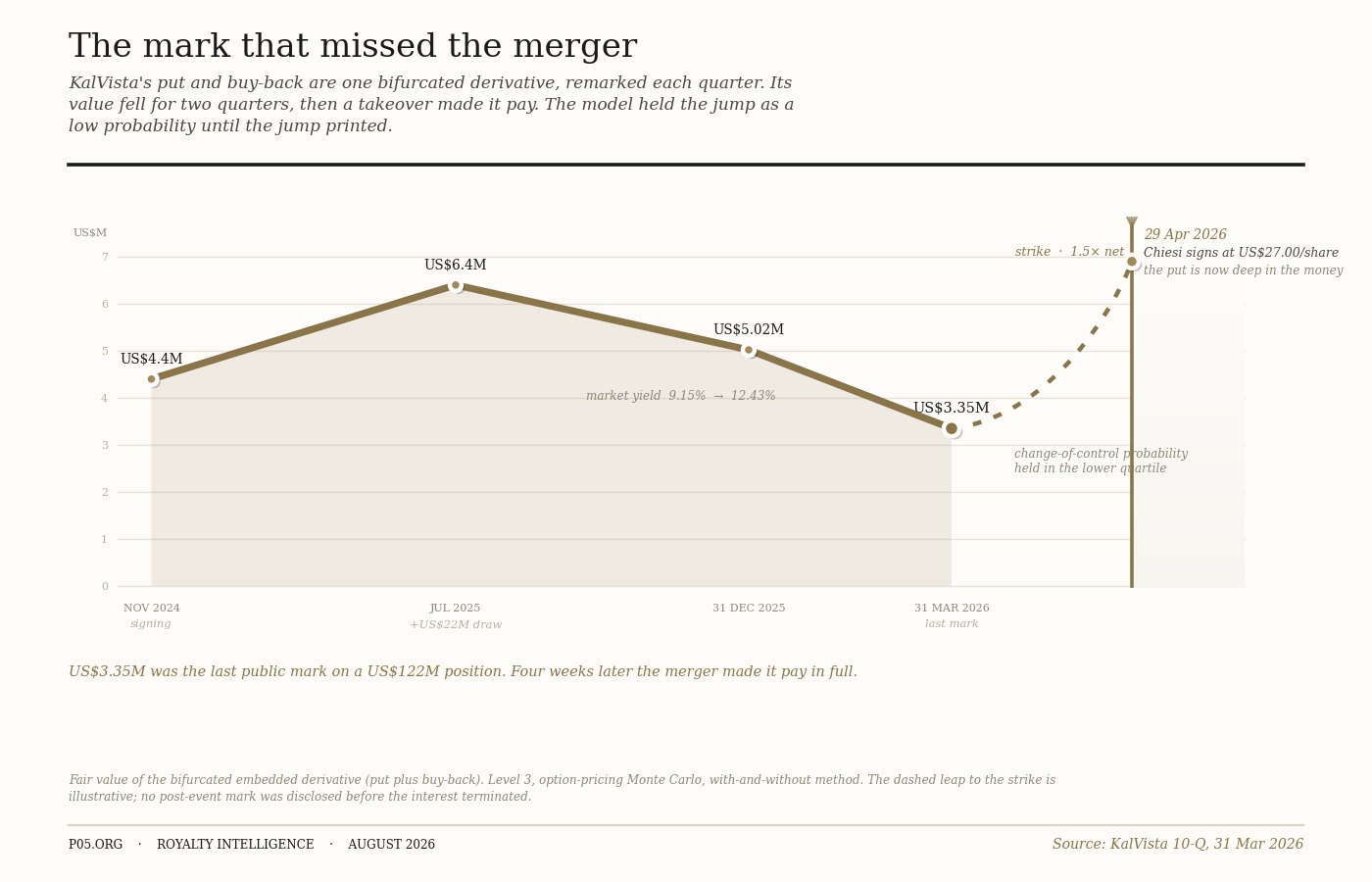
Figure 2. KalVista's put-and-buy-back derivative, marked each quarter, falling into the takeover that made it pay.
This is a live options book, marked by the issuer's auditors. It exposes the Greeks a royalty analyst would otherwise have to model.
The strike
KalVista's filing discloses the exact payoff. On either the Put Option or the Buy-Back Option, the repurchase price is 1.5 times the Investment Amount, net of payments already received. Both options share that strike. Both fire on the same trigger, a change of control before 31 December 2026.
A shared strike on a shared trigger is not two options. It is a forward struck at 1.5x, with the notice right handed to whichever party is in the money.
The valuation model
The method is standard for a change-of-control payoff. KalVista uses an option-pricing Monte Carlo simulation under a with-and-without method. Value the royalty obligation with the options, value it without, take the difference. The two named Level 3 inputs are the risk-adjusted discount rate and the probability of a change of control within the term.
Humacyte discloses the discount stack more finely.
On a differently structured revenue-interest put, it used 13.9 percent to present-value the revenue forecast and 17.5 percent for the put payoff as of March 2024. The prior year-end marks were 14.5 and 17.1 percent. The payoff leg is discounted harder than the revenue leg. The payoff is the riskier, more contingent cash flow.
The marks, quarter by quarter
KalVista published a full option-life in four data points.
- Nov 2024, signing: derivative worth US$4.4M against a US$100M host
- Jul 2025: the US$22M drawdown added US$2.0M
- 31 Dec 2025: US$5.02M
- 31 Mar 2026: US$3.35M, a US$1.6M quarterly fall booked through other income
Two model inputs moved it. Management judged the change-of-control probability to sit in the lower quartile of outcomes. And the market yield rose from 9.15 percent at inception to 12.43 percent by March 2026.
Reading the Greeks against the outcome
Now read those marks against what happened next. The derivative was marked at US$3.35 million on 31 March 2026, change-of-control probability in the lower quartile. On 29 April 2026, four weeks later, KalVista signed a US$27.00-per-share merger agreement with Chiesi.
The option was days from deep in the money, and the last public mark valued it at a few million dollars on a US$122 million position.
That is not a mispricing. It is the nature of a change-of-control option on a takeover-prone small cap. Theta and rho grind the mark down quarter after quarter. The whole value sits in a jump the model can only carry as a low probability, until the jump prints.
The mark is an expected value across paths. The payoff is a single path. For a concentrated holder they are rarely close, and the gap is why the instrument gets bifurcated and watched.
The delta a holder actually carries
The put's value moves against the change-of-control probability. That is the same takeover probability the equity market prices in the payor's stock every day.
A royalty holder carrying one of these puts is short a piece of its own counterparty's M&A optionality.
The clonoSEQ discovery pipeline had nothing to do with DRI's Ekterly return. KalVista's tender offer had everything to do with it.
How common the clause is
Prevalence is measurable, with caveats. The sellers in this market are overwhelmingly US-listed and file their definitive agreements. The best census is Gibson Dunn's Royalty Finance Tracker. Its 2026 update covers 133 transactions and US$32.7 billion across 2020 to 2025.
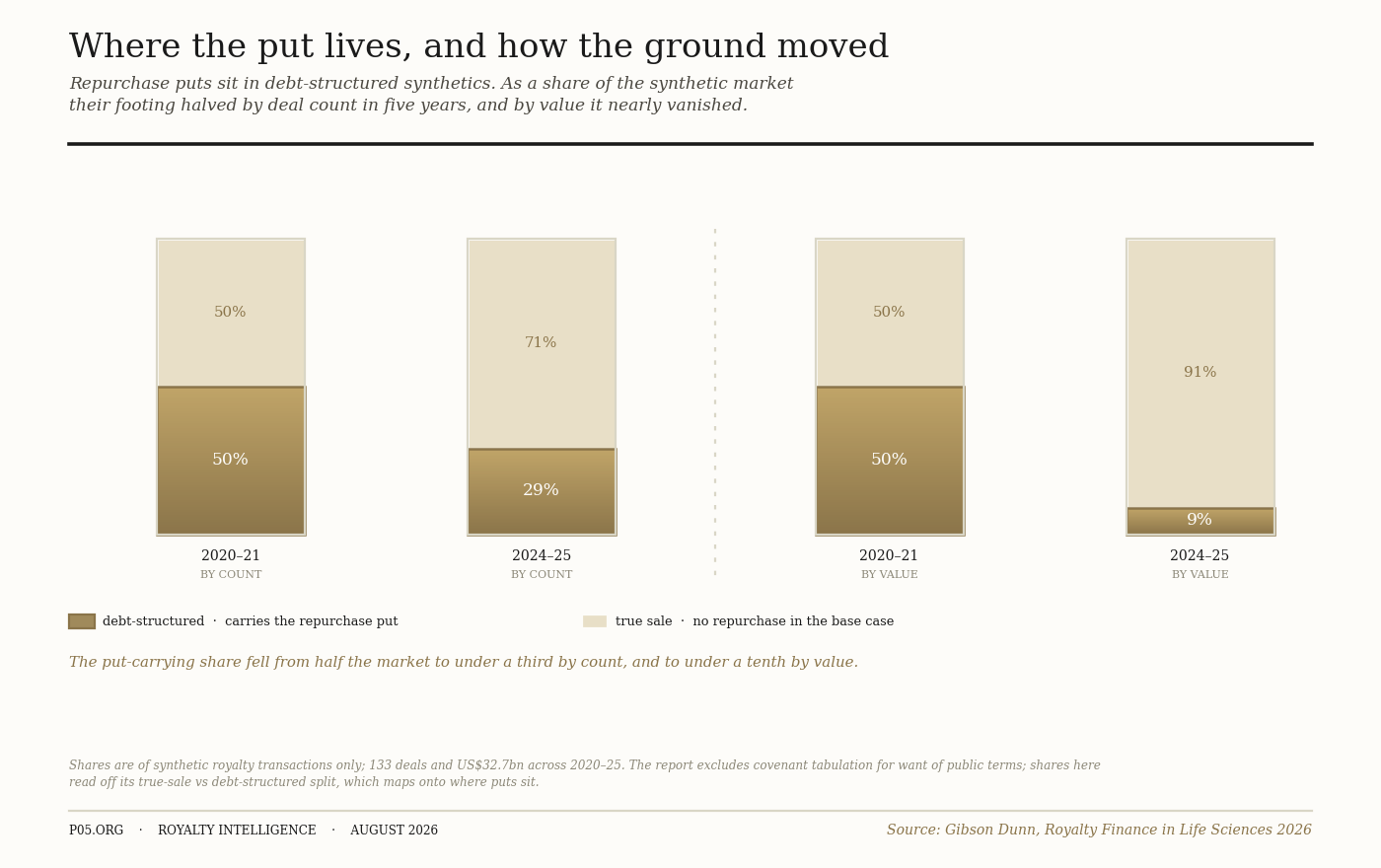
Figure 4. The put-carrying, debt-structured share of the synthetic market, by deal count and by value, 2020-21 against 2024-25.
The report does not tabulate put clauses directly. It says covenant and security analysis was excluded for lack of public terms. But its structural split maps onto where puts live, so the frequency reads off with some confidence.
Puts live in the debt-structured half
The organising fact is the divide the report draws through the synthetic market. In a debt-structured synthetic, the buyer holds a secured creditor position. The obligation carries true-up payments and a maturity. Every debt-structured deal with disclosed terms includes a functional return cap, typically 1.55x to 2.50x. It is expressed as a hard multiple, an IRR make-whole, or a floating-rate return.
That cap-and-make-whole apparatus is the put architecture. The same formula that ends the instrument at maturity prices the repurchase on a trigger. Curis, Esperion, and AxoGen all sit here. A debt-structured revenue interest without repurchase mechanics barely exists, because the mechanics are what make it debt.
True sales mostly don't carry them
In a true-sale synthetic, the seller irrevocably transfers the interest. It retains no repurchase right in the base case, and the buyer takes uncapped or tier-capped product risk. The template is the 2020 BioCryst and Royalty Pharma Orladeyo deal. Royalty Pharma has structured every synthetic that way since 2020.
The shares have moved hard
So the prevalence question reduces to market share. And the shares have shifted. In 2020 and 2021, half of synthetic deals were true sales. By 2024 and 2025 the figure was 71 percent of deals and 91 percent of value.
Run it the other way. The put-carrying, debt-structured species has fallen from roughly half of synthetic issuance to under a third of deals and under a tenth of the money. Full-menu investor puts of the Esperion type, triggered on breach, MAE, and bankruptcy, are now a niche within a niche. They cluster among a few structured buyers and in smaller deals where downside protection is the price of capital.
Traditional monetisations, still 84 of the 133 transactions, mostly carry no repurchase features at all. Where caps appear there they run 1.30x to 2.50x, median 1.65x, on de-risked mature assets.
The narrow put is what survives
The clause is not disappearing. It is being rebuilt in a narrower shape inside the true-sale world. The survey flags the mechanic directly. Buyback options, the company-side call, are described as an emerging key deal point the authors expect to become standard.
It is a right to terminate the royalty early by paying a reduced cap on an accelerated timeline. Valuable to the seller for clearing a royalty overhang ahead of an M&A exit. Valuable to the buyer because the same capped return arrives sooner at a higher IRR.
The deal the report uses to illustrate it is DRI's own first true-sale synthetic. The 2021 CTI BioPharma financing on Vonjo gave CTI a time-limited right after closing to reacquire the full royalty at a fixed premium multiple, net of royalties paid.
The KalVista structure three years later is the matured version. An uncapped, tiered, true-sale-style royalty carrying one narrow, dated, change-of-control put for the investor and a mirror buy-back for the company. Nothing else.
Two caveats on the numbers
Public prevalence understates private prevalence. Put and call terms live in definitive agreements only SEC registrants file, and confidential treatment routinely redacts the prices even there. The AxoGen IRR was invisible until an amendment. Classification is done from the outside. A deal announced as a royalty sale can carry repurchase mechanics that only surface in the 10-Q footnotes, which is where KalVista's did.
The triage rule
The state of the market in 2026:
- Royalty-backed debt → assume a put, price its formula
- Traditional monetisation → assume none
- Synthetic true sale → read the footnotes for a dated change-of-control pair, because that is the one piece of the old machinery the seller-friendly era kept
The Ekterly file, worked through
The timeline first, because the speed is the point. 4 November 2024. DRI buys a synthetic royalty on sebetralstat from KalVista for up to US$179 million. The structure: US$100 million upfront, a one-time US$22 million payment at KalVista's option on early US approval, up to US$57 million in a sales milestone, plus a US$5 million equity placement.
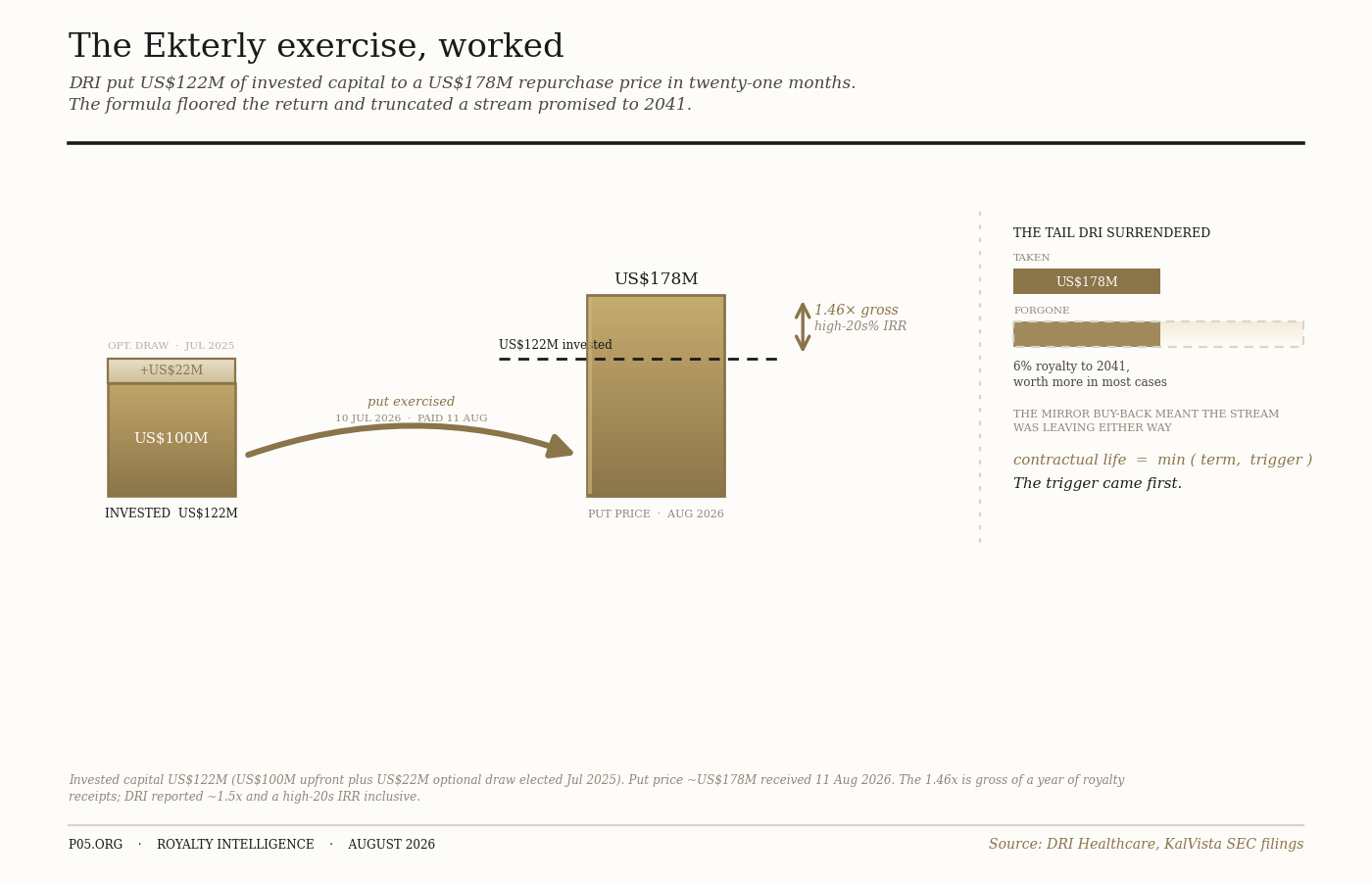
Figure 5. US$122M of invested capital crystallised at a US$178M put price, and the stream to 2041 that DRI surrendered to take it.
The royalty is tiered: 5.00 percent of worldwide net sales to US$500 million, 1.10 percent to US$750 million, 0.25 percent above. Collected quarterly on a one-quarter lag, anticipated through at least 2041. The drug is unapproved. The PDUFA date is the following June.
DRI holds a put on change of control of the selling subsidiary, exercisable until 31 December 2026. KalVista holds a mirror buy-back over the same window. 7 July 2025. The FDA approves Ekterly, the first oral on-demand HAE therapy, after a short delay past the June PDUFA date.
KalVista elects the US$22 million optional payment. That steps the first-tier royalty from 5.00 to 6.00 percent and the milestone from US$50 million to US$57 million. DRI's invested capital now stands at US$122 million. 11 June 2026. Chiesi completes its acquisition of KalVista, a US$27.00 per share tender offer signed that spring.
The change-of-control trigger is live. A clock is running: the put and the buy-back both lapse on 31 December 2026. 10 July 2026. DRI exercises the put for a total net repurchase price of about US$178 million. It calls this its first pre-approval transaction and describes the exercise as crystallising the return.
11 August 2026. Payment received. The royalty participation right terminates.
The multiple reconciles
In its second-quarter results, DRI reported roughly 1.5 times purchase price and an IRR in the high twenties. The multiple checks out. US$178 million against US$122 million invested is 1.46 times, before counting a year of royalty receipts. Those receipts were not small. KalVista reported US$40.9 million of revenue in the quarter ended March 2026, on the US and German launches.
A high-twenties IRR over twenty to twenty-one months of exposure is what a 1.5 times gross multiple produces over that period. The put behaved like the Acorda greater-of: a return floor struck when the trigger fired.
The tail DRI gave up
A put exercised is also a tail surrendered. A 6.00 percent royalty on a first-in-class oral therapy, running to 2041, on a drug analysts peg at several hundred million dollars of peak US sales, is worth well north of US$178 million in most base cases.
DRI did not capture that value. It could not have. The mirror structure meant the stream was leaving either way. Had DRI declined to put, Chiesi held the buy-back and every incentive to use it. Extinguishing a 6 percent royalty on its newly acquired lead asset at 1.5x the investor's cost is cheap against fifteen years of servicing it.
Paired options on the same trigger, at the same price, are not really options. Together they are a forward. The royalty matures at the change of control, at the formula price, and the only open question is which party sends the notice. The decision that mattered was made in November 2024, when both clauses went into the contract.
What DRI actually bought
Not a 2041 stream with an escape hatch. A package. The royalty for as long as KalVista stayed independent, plus a fixed-formula terminal payment at whatever moment it did not. For a pre-approval financing, that package is far easier to underwrite than the naked stream.
The downside cases that matter, approval aside, involve a struggling KalVista selling itself cheaply. In those states the put pays the formula anyway. The blue-sky case involves a strong KalVista acquired at a premium. That is what happened, and the formula pays there too.
The put is why a royalty trust could write a US$100 million pre-approval cheque and describe the outcome, honestly, as underwriting discipline. The return was drafted, not forecast.
What the clause does to the balance sheet
The put has a second life in the accounting. It is the main reason "sales" of future revenue sit on sellers' balance sheets as debt. KalVista's treatment is the standard one. On receipt of the US$100 million, it recorded a deferred royalty obligation of US$93.6 million. It is accounted for as long-term debt at amortised cost under the effective-interest method, the rate recalculated as sales forecasts move.
The gap to US$100 million is issuance costs plus the initial fair value of the bifurcated embedded derivative. That derivative is the put and buy-back, carved out and marked at fair value each quarter on Level 3 inputs. Curis discloses the identical structure for its Oberland agreement, down to concluding the put is an embedded derivative requiring bifurcation.
Why proceeds land as debt
Two points come out of that treatment. The first is definitional. Under the sale-of-future-revenues guidance, a repurchase obligation that can be forced on the seller pushes the proceeds into debt classification. The royalty payments then run through the income statement as interest expense. KalVista booked US$5.7 million of it in the first part-year. For the seller's investors, the "royalty" is a borrowing whose coupon floats with sales.
The second is informational. The derivative's carrying value is a market-consistent, auditor-reviewed estimate of what the put and call were worth at signing. On KalVista's numbers the initial value was small, a few million against a US$100 million host. That is what a modest change-of-control probability, times a payoff that nets formula against stream value, produces. Nineteen months later the trigger fired.
Small carrying values on Level 3 derivatives measure model inputs, not destiny.
The recharacterisation trap
The legal analogue of the accounting is recharacterisation, treated at length in Vector V of the extinguishment piece. In one line: recourse to the seller, and a repurchase obligation is recourse in its purest form, is the single strongest factor pushing a purported sale toward secured-loan treatment in the seller's bankruptcy.
The put-heavy structures accept that. They perfect backup security interests, take deposit-account control, and live with loan characterisation, because they are loans. AxoGen's 2012 agreement swept product revenues daily through a controlled joint concentration account. Esperion's covenants sprang a US$50 million blocked-account deposit when sales thresholds were missed.
The pure-sale end runs the opposite trade: no put, no recourse, and a true-sale opinion that survives the seller's Chapter 11. A holder cannot have both, and the choice is made at signing.
Where the put breaks
That exposes the put's structural weakness, and it explains all the account machinery. The bankruptcy-triggered put is a right to be paid a formula price by a counterparty that has just become unable to pay anything. Exercised against a solvent acquirer, as against Chiesi, the put is as good as cash in thirty days.
Exercised automatically into a bankruptcy, it is a liquidated unsecured claim in the queue with everyone else, unless the security package and swept accounts have put real dollars within reach.
The trigger that fires most often, change of control, is the one where the put works. The trigger the drafting works hardest on, insolvency, is the one where it mostly does not.
The acquirer's side of the table
Ekterly is not an isolated print. When MannKind closed its acquisition of scPharmaceuticals in October 2025, its financing disclosures itemised a US$82.6 million "scPharma Debt Extinguishment." That figure covered repayment of the target's credit agreement and the repurchase of a revenue participation right from Perceptive Credit Holdings, funded alongside the equity out of a Blackstone facility.
From the acquirer's model, the revenue interest is simply debt. A claim on the target's cash flows, sized, priced off its repurchase formula, and cleared at closing like any term loan.
The contrast: a stream that survived
The contrast case sits inside DRI's own portfolio, and it differs in exactly one respect. DRI's 2021 Vonjo financing with CTI BioPharma, its first true-sale synthetic, gave CTI a time-limited post-closing right to reacquire the royalty at a fixed premium multiple, net of royalties paid, tied to a change of control. But no matching investor put.
Swedish Orphan Biovitrum acquired CTI in 2023. The buy-back was not used, and Vonjo remains on DRI's drug list today. Same investor, same species of counterparty event, opposite outcome. A one-sided call leaves the exercise decision with the acquirer. An acquirer that likes the price of servicing the royalty simply keeps paying it. The two-sided KalVista structure took that discretion away.
The sorting rule at the M&A boundary
That gives the analyst a rule.
- Matched put and call on a shared price formula → model the stream as maturing at acquisition, at the formula price
- Company-side call only → model it as maturing at the acquirer's option, whenever the formula is cheap against the stream
- Neither → model it as surviving, with the payor's credit upgraded
For the survival-curve framing of the extinguishment piece, the put adds a hazard with a distinctive shape. The six involuntary vectors pay zero or a damaged claim. This one pays the strike. It truncates the upside and floors the downside at the same moment.
A putted royalty is a shorter, narrower, more predictable instrument than its stated term suggests.
Small-cap biopharma, where takeout probability over any five-year horizon is material, is exactly where the truncation binds. KalVista went from signing to acquired in nineteen months.
Where the structure points
Underwrite both exits, separately.
A royalty with a put is two positions: the stream held to term, and the formula payment at the first trigger. Price each. Probability-weight the triggers. For change-of-control puts, the trigger probability is the takeout probability the equity market prices in the payor's stock every day. DRI's Ekterly return was decided by KalVista's tender offer, not by HAE epidemiology.
Read the pair, not the clause.
A holder-side put looks like protection. A matched company call at the same price converts it into a mutual forward, and the tail above the formula belongs to the company and its eventual acquirer. A one-sided company call is worse for the holder still, since it caps the upside without flooring anything.
Where the mandate is to own long-dated pharmaceutical cash flow, an unencumbered royalty without repurchase features is the only instrument that delivers it. Where the mandate is IRR, the pair is a feature. It is what turned a pre-approval synthetic into a high-twenties realised return in under two years.
Locate the deal on the prevalence map before reading a clause.
The base rates do most of the triage. Royalty-backed debt: a put and a cap are near-certain, 1.55x to 2.50x, so go straight to the formula and the trigger list. Traditional monetisation: repurchase features are the exception. Synthetic true sale: the base case is clean, but the fastest-growing feature is the dated change-of-control pair, so read the 10-Q footnotes, not just the release.
Price the formula against the stream at each trigger, not at signing.
The put is in the money when the formula exceeds the stream's value in the trigger state. On bankruptcy triggers it is deep in the money on paper and paid in unsecured dollars in practice. Its real value is the security package behind it: perfected liens, controlled accounts, swept cash.
On change-of-control triggers the strike is usually below the stream's market value. That is why the exercise looks voluntary and is not.
Expect debt treatment, and plan the seller's disclosure around it.
The repurchase feature is what classifies the proceeds as a deferred royalty obligation, runs an effective-interest expense through the P&L, and adds a Level 3 embedded derivative to every quarter's fair-value footnotes. A seller that wants sale accounting and a buyer that wants a put are negotiating against each other on the same clause. The resolution, narrow triggers inside a dated window, is precisely the KalVista drafting.
The clause, start to finish
The Ekterly clause ran its full course in twenty-one months. Drafted into a pre-approval financing, armed by an FDA approval, triggered by a tender offer, exercised, and paid. AxoGen's version ran its course in twenty-five, a decade earlier. It settled at a price its holder called principal, interest, and an embedded derivative.
Every date on both timelines was public. Each return was arithmetic once the trigger fired. The streams' stated lives reached to 2041 and to an eight-year term. Their contractual lives were always min(term, first trigger). The trigger, both times, came first.
Standard disclaimer
All information in this article was accurate as of the research date and is derived from publicly available sources including SEC filings, law firm survey publications, and company and trust press releases. Prevalence figures are drawn from Gibson Dunn's published market surveys and reflect that firm's dataset and methodology, including its stated exclusions. Figures described as inferences, including the reconciliation of DRI Healthcare's reported multiple to its invested capital, are identified as such and based on stated assumptions. Information may have changed since publication. This content is for informational purposes only and does not constitute investment, legal, or financial advice. The author is not a lawyer or financial adviser.