
Company of the week: Taisho Pharmaceutical
Taisho is a century-old, cash-generative over-the-counter giant whose royalties run in both directions, outward on a prescription pipeline it mostly rents, inward on a consumer brand it licenses to the world-
Most of the companies this series reads are young, single-asset, and desperate to be seen. Taisho Pharmaceutical is the opposite on every count. It is one hundred and thirteen years old, sells a portfolio of household brands that generate cash without a clinical readout in sight, and has just spent roughly five billion dollars to make itself harder to look at.
For a royalty desk, that combination is exactly why Taisho is worth an hour. The molecule risk that dominates a clinical-stage name is almost absent here. What remains, once the drinks and the cold remedies are set aside, is paper, and it runs in both directions: outward on a prescription pipeline Taisho increasingly rents from others, inward on a consumer brand it has licensed to partners across Asia for sixty years. Wrapped around all of it is an acquisition-financed take-private that has now drawn a shutter across the whole set of cash flows.
Taisho was, until 2024, Taisho Pharmaceutical Holdings Co., Ltd. (TSE: 4581), Japan's largest over-the-counter drugmaker, based in Toshima, Tokyo and founded in 1912 by Shokichi Uehara. In January 2024 it was taken private by a vehicle controlled by the founding family, delisted from the Tokyo Stock Exchange that April, and removed from the disclosure regime it had sat inside for six decades.
This piece treats Taisho the way a royalty desk would: not as a drinks-and-drugs conglomerate, but as a set of cash-flow claims running in both directions, wrapped around brands the company owns and molecules it mostly does not.
At a glance
| Item | Detail |
|---|---|
| Company | Taisho Pharmaceutical (formerly Taisho Pharmaceutical Holdings Co., Ltd.; TSE: 4581 until delisting), Toshima, Tokyo |
| Founded | 1912 by Shokichi Uehara; largest over-the-counter drug company in Japan |
| Structure | Two segments: Self-Medication Operation Group (OTC) and Prescription Pharmaceutical Operation Group |
| Scale | Consolidated net sales of roughly ¥320 billion (about $2.2 billion) for the year to March 2024, the last full period reported before the company went dark |
| Control | Founding Uehara family, which held roughly 40 per cent before the buyout |
| Take-private | Management buyout via Otemon Co., Ltd., a vehicle controlled by Executive Vice President Shigeru Uehara; tender offer at ¥8,620 per share |
| Deal size | Equity valued at about ¥731.8 billion ($4.9 billion), the largest management buyout in Japanese history |
| Completion | Tender closed 15 January 2024 with 73.12 per cent tendered; squeeze-out via share consolidation; delisted 9 April 2024 |
| Dispute | Offer priced below book value; Curi RMB Capital, Oasis Management and Kaname Capital contested the price and governance in court |
| Owned OTC brands | Lipovitan energy drinks, Pabron cold remedies, RiUP hair regrowth, Naron analgesics, Taisho Kampo; plus brands bought from Bristol-Myers Squibb in 2009 and 2019 |
| Inbound brand | Perpetual Japanese rights to Vicks, licensed from Procter & Gamble, with P&G retained as contract manufacturer |
| Originated assets | Clarithromycin (Clarith), discovered by Taisho and out-licensed to Abbott as Biaxin/Klacid (patent long expired); Lusefi (luseogliflozin), an in-house SGLT2 co-marketed with Novartis |
| Royalties paid | Nanozora (ozoralizumab) to Ablynx/Sanofi; KG006 to Kaigene; a hair-loss asset to Applied Biology; historically Arena, Neurocrine, Millennium |
| Royalties collected | Lipovitan brand licensed to Osotspa in Thailand (since 1965; Libogen/Livita elsewhere); plus its own early assets out-licensed to biotechs (e.g. Ancora Bio, BioAge Labs) |
| In-house build-out | Licensed in Biocytogen's RenNano VHH discovery platform (Mar 2026) to originate its own heavy-chain antibodies rather than rent them |
| Newest event | Exclusive Japan licence for Kaigene's FcRn inhibitor KG006 (CT-P77), announced 30 July 2026; Taisho becomes one of two regional licensees under a private US originator |
| Royalty posture | Net payer on its prescription growth pipeline; net collector on its flagship consumer brand abroad; owner of the domestic annuity; now private and undisclosed |
What Taisho is
Taisho runs on two engines that could not be more different in their cash-flow character.
The first, and by far the larger, is the Self-Medication Operation Group: over-the-counter drugs, quasi-drugs, functional foods and hygiene products. This is where the names live. The Lipovitan series of energy tonics, the flagship since 1962, alone runs to roughly ¥40 billion a year.
Around it sit the Pabron cold and sinus range, the RiUP hair-regrowth line (topical minoxidil), the Naron analgesics, the Colac laxatives, the Preser haemorrhoid range and the Taisho Kampo gastrointestinal products. These are owned brands throwing off owned cash. No milestone ladder, no patent cliff, no royalty pledged upstream on the great majority of them.
The second engine is the Prescription Pharmaceutical Operation Group: ethical drugs sold to physicians, anchored historically by Clarith (clarithromycin), Edirol (eldecalcitol, an active vitamin D3 osteoporosis agent), and the in-house SGLT2 diabetes inhibitor Lusefi (luseogliflozin, discovered by Taisho and co-marketed with Novartis), and more recently by in-licensed biologics. This is the smaller segment, and it is where almost all of the outward-running paper is, because it is where Taisho increasingly does not own what it sells.
The shorthand a desk would use is this. On the consumer side Taisho is a brand owner with clean cash flows, and, on its flagship brand internationally, a licensor that collects. On the prescription side it is increasingly a licensee, and a licensee is a royalty payer. The company's own framing of the prescription strategy is candid about the direction: it aims to enhance its pipeline by licensing new drug candidates from external partners. That is a description of an outward-running royalty book bolted onto an inward-running brand.
The family, and the shutter it lowered
Most take-privates are executed by an outside sponsor. Taisho's was executed by the family that already controlled it, and the mechanism is the more distinctive part of the story.
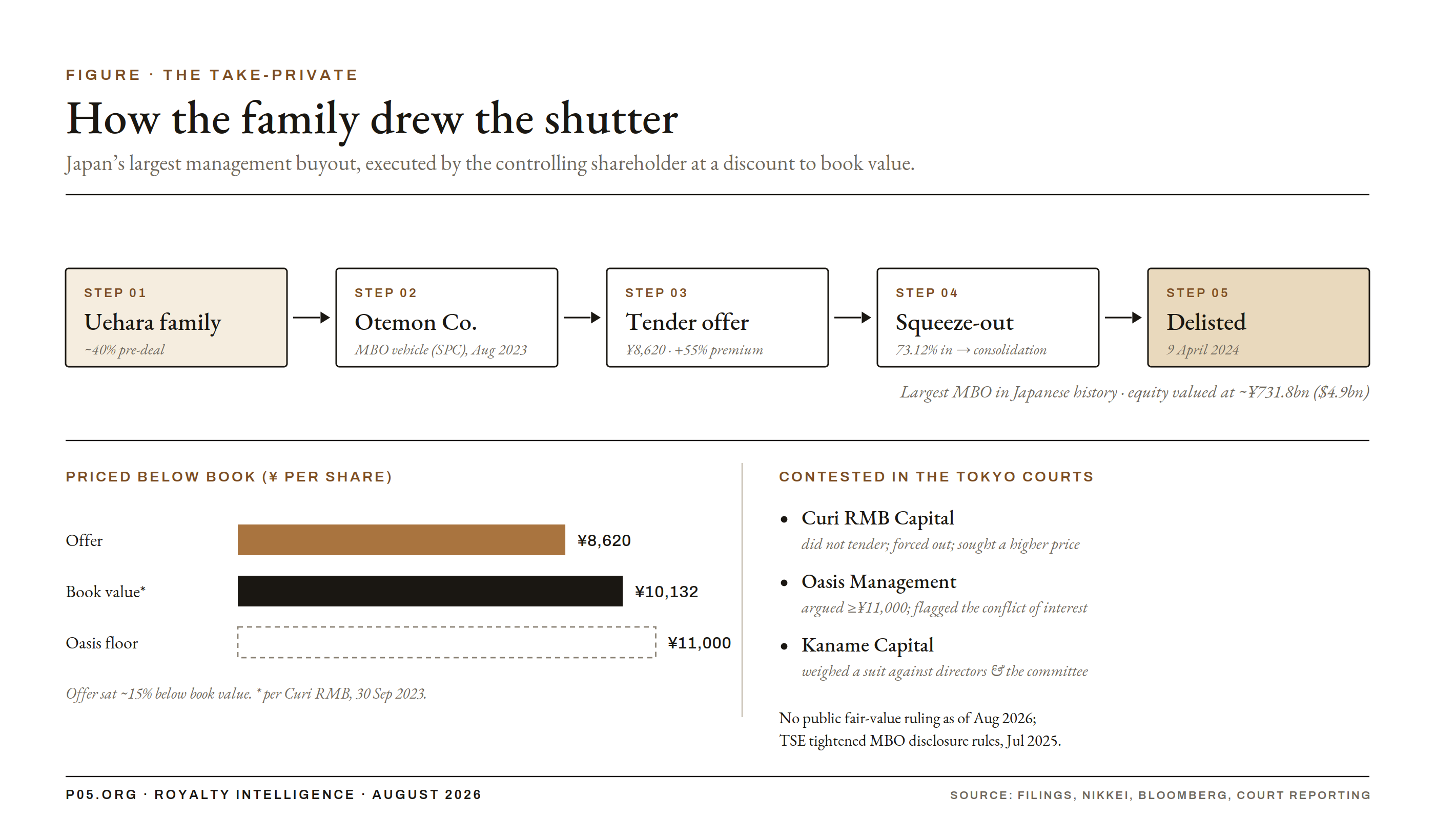
The Uehara family had long held roughly 40 per cent of Taisho, the largest block by a wide margin. In November 2023, a company named Otemon Co., Ltd., controlled by Executive Vice President Shigeru Uehara, launched a tender offer at ¥8,620 per share, a 55 per cent premium to the prior close, valuing the equity at about ¥731.8 billion, or $4.9 billion. It was, and remains, the largest management buyout in Japanese history.
The stated rationale was that a family-controlled OTC business needs to make mid-to-long-term bets, shifting toward online and overseas sales in a shrinking domestic market, without the quarterly scrutiny of public ownership. The tender closed on 15 January 2024 with 73.12 per cent of the shares tendered.
That was short of the 90 per cent threshold that would have allowed a clean squeeze-out, so the offeror took the remaining route: an extraordinary general meeting approved a share consolidation that forced out the minority, and the stock was delisted on 9 April 2024.
The number a desk fixes on is not the premium but the base. The offer sat below the company's book value. Curi RMB Capital put book value per share at ¥10,132 as of 30 September 2023, making the offer a discount of roughly 15 per cent to book, and argued that Taisho's excess cash, long-term securities, and its property and hotel holdings had not been fully reflected in the valuation.
That asset base is the substance of the complaint: Taisho carried a real-estate-leasing and hotel-management operation alongside a large securities and cash pile, the kind of non-core value that a discount-to-book offer leaves on the table. Oasis Management argued the price should have been at least ¥11,000 and pointed to a conflict of interest in a deal where the buyer already controlled more than a third of the target. Both funds, along with Kaname Capital, contested the price and the independence of the special committee in the Tokyo courts.
The dispute has outlived the delisting, and it did not stay contained to Taisho. As of the research date no public court determination of a higher fair value for Taisho shares had been reported. But the episode landed in the middle of a wider governance shift. In October 2024 the Tokyo High Court recognised a higher value for minority shareholders in the FamilyMart squeeze-out, a case Oasis had pressed on the same fairness grounds it raised at Taisho.
In July 2025 the Tokyo Stock Exchange tightened its rules on management buyouts and controlling-shareholder deals, mandating fuller disclosure of special-committee reasoning and the assumptions behind the price, precisely the gaps the Taisho objectors had complained about.
For this series the governance dispute matters less as a fairness question than as a structural fact. A cash-rich, asset-heavy company was taken private by its controlling family at a discount to its own balance sheet, and the minority that disagreed was consolidated out. Whatever any court eventually decides on price, the outcome is the same: the cash flows described in the rest of this piece now sit behind a wall.
That is the single most important thing a royalty desk needs to register about Taisho, and it is a matter of corporate structure, not clinical result.
The owned side: brands bought, and one licensed in
The consumer business is the part of Taisho that behaves least like the companies this series usually covers, and that is precisely its value.
Lipovitan, Pabron, RiUP and the rest are self-originated brands. They carry no upstream royalty on the bulk of their sales, they do not depend on a single patent, and they compound slowly through brand equity rather than stepping off a cliff. This is the annuity underneath everything else, and it is the reason the family could raise acquisition debt against the company at all.
Where Taisho expanded that owned base, it tended to buy rather than license. It has twice absorbed Bristol-Myers Squibb's discarded consumer businesses. In 2009 it acquired BMS's Asia-Pacific OTC assets outside China and Japan for $310 million, taking the Tempra, Counterpain, Theragran-M and related brands along with a controlling stake in BMS's Indonesian subsidiary.
A decade later it bought UPSA, BMS's French consumer-health business, for $1.6 billion, completed on 1 July 2019 and structured as a put-option arrangement, bringing European analgesic brands such as Efferalgan and Dafalgan and a French manufacturing base.
The one major consumer brand Taisho did not buy outright but licensed in is Vicks. Taisho holds perpetual Japanese rights to the Vicks trademark and formula for the Japanese market, acquired from Procter & Gamble, with P&G retained as contract manufacturer. It is the exception that sets up the pattern on the prescription side: when Taisho wants a molecule or a mark it does not own, it takes it on someone else's paper.
The structural point is that Taisho's international consumer growth came overwhelmingly through ownership transfers, outright purchases of brands and businesses, rather than through royalty-bearing licences taken in. On the consumer side, in other words, Taisho is mostly a buyer of assets, not a renter of them. That is the clean half of the company.
The one it originated
One molecule in Taisho's history stands out as the clearest case of it becoming a global royalty collector on the prescription side, and it is instructive precisely because that position has been the exception rather than the rule.
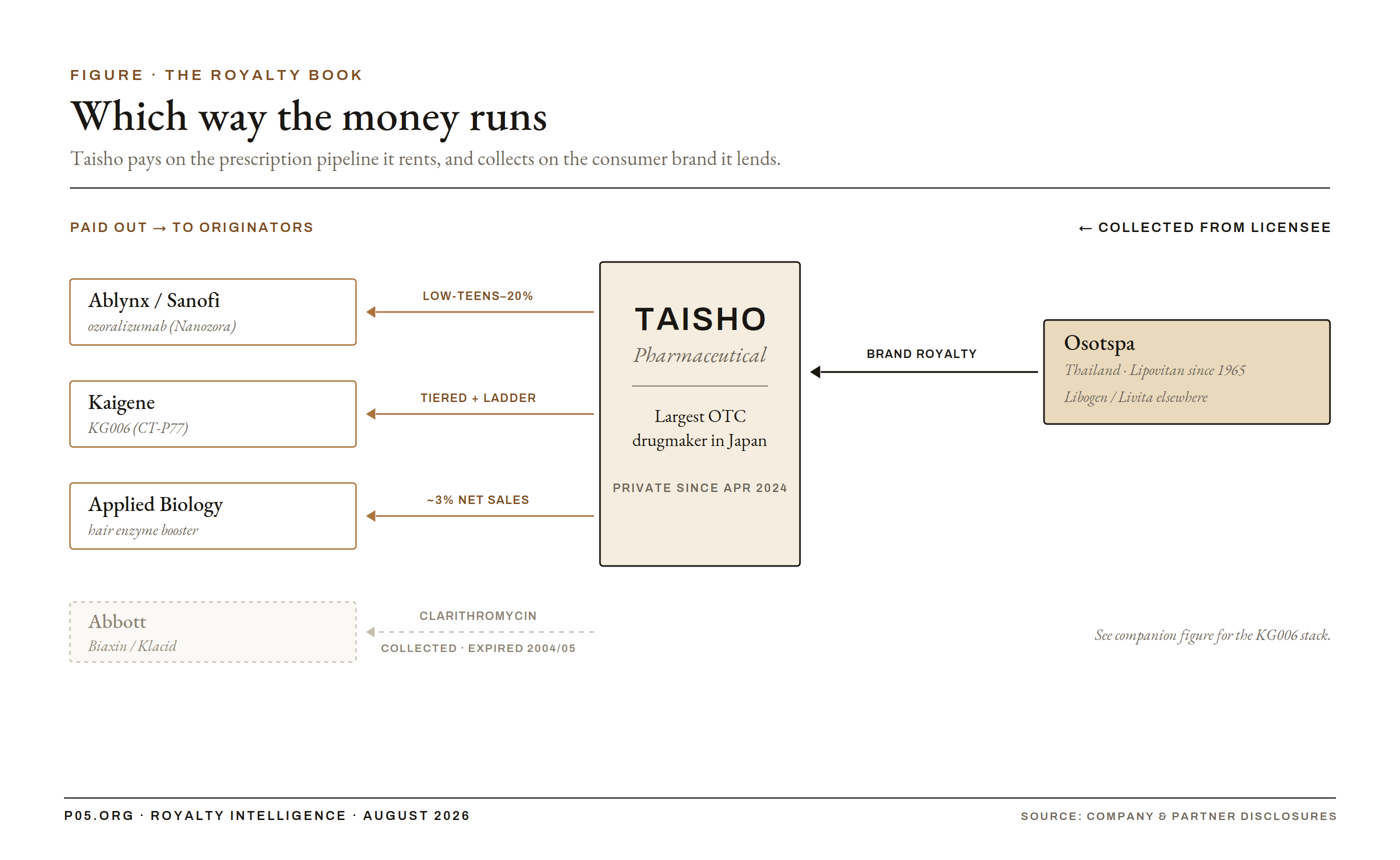
Clarithromycin was invented by Taisho's own chemists in the late 1970s, in an effort to build a version of erythromycin that survived stomach acid without the nausea that limited the parent compound. Taisho secured the composition patent (US 4,331,803, granted 1982), branded the drug Clarith in Japan, and in 1985 licensed the international rights to Abbott Laboratories. Abbott commercialised it worldwide as Biaxin in the United States and Klacid across Europe and Asia, and it went on to sell in more than fifty countries.
Read as paper, this is the mirror image of the modern prescription book. On clarithromycin, Taisho was the originator and the licensor. It held the molecule, took the upfront and the royalty, and let a larger partner carry the global commercial burden. It is the single clearest case of Taisho occupying the position a royalty desk likes best on the drug side: owning the compound and collecting on someone else's distribution.
The stream is also long gone. The original patent expired in Europe in 2004 and in the United States in 2005, and clarithromycin has been generic for two decades. The lesson a desk draws is not about the drug but about the company's trajectory.
Taisho originated a genuine blockbuster once and monetised it as a licensor, and it has not stopped originating: Lusefi is its own molecule, co-marketed rather than merely resold, and it has out-licensed early assets it chose not to carry itself, including a failed-Phase-II depression candidate handed to the Aditum-backed Ancora Bio and a metabolic candidate licensed to BioAge Labs, each carrying upfronts, milestones and royalties back to Taisho. But on the assets that now drive its prescription growth, it sits on the paying side more often than the collecting one.
The royalty book, and which way it runs
This is the centre of the company, and the point most easily missed is that it is not one-directional. Taisho pays royalties on the prescription pipeline it rents, and collects them on the consumer brand it lends. Read the two together and the shape of the enterprise resolves.
Outward: the rented prescription pipeline
Taisho's recent prescription growth has been built on assets originated by others, which means the drivers of its ethical business sit beneath royalty obligations running outward.
Ablynx and Sanofi, the Nanozora royalty. Taisho's flagship in-licensed biologic is Nanozora (ozoralizumab), a trivalent anti-TNFα NANOBODY for rheumatoid arthritis and the asset it now cites as evidence of its biologics capability.
Taisho licensed Japanese rights from Ablynx in June 2015. Ablynx, since acquired by Sanofi, took a $3 million upfront, development and commercial milestones, and, per Ablynx's own disclosure, a tiered royalty ranging from the low teens up to 20 per cent on Japanese net sales. Nanozora was approved in Japan in September 2022.
Kaigene, the newest layer, and the stack in miniature. On 30 July 2026, Taisho took an exclusive Japan licence to KG006 (Celltrion designation CT-P77), a next-generation, subcutaneous, patient-administered anti-FcRn antibody for autoantibody-mediated autoimmune disease, from Kaigene, Inc., a private Rockville, Maryland originator built on a Pathogenic Antibody Degrader (PDEG) platform.
Kaigene receives a $5 million upfront, up to a combined $22 million and ¥57.5 billion (about $351 million) in development, regulatory and sales milestones, and tiered royalties on Japanese net sales. Taisho assumes full responsibility for development, registration and commercialisation in Japan, and the deal sets up a three-way multi-regional trial with Kaigene and Celltrion.
This one repays a closer read, because it is a royalty stack of exactly the kind this series usually has to reconstruct, laid out in the open around a single preclinical molecule.
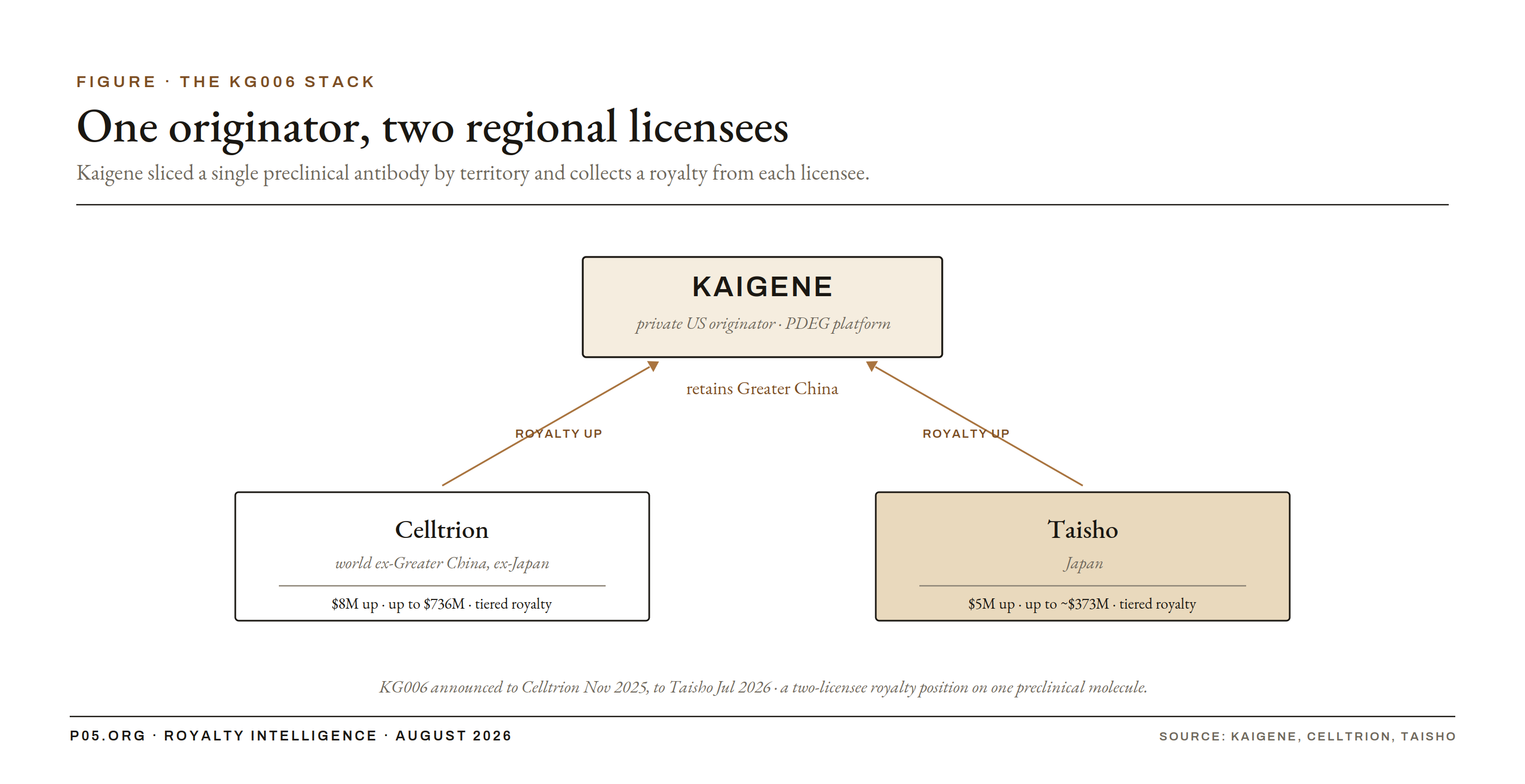
Kaigene did not license KG006 to one partner. It sliced the world by territory and licensed it to two, keeping a piece for itself. In November 2025 it granted Celltrion KG006 for the world excluding Greater China and Japan (plus worldwide rights to a second asset, KG002), for $8 million upfront, up to $736 million in milestones, and tiered royalties.
In July 2026 it granted Taisho the Japanese rights. Greater China it retained. The result is a private, preclinical-stage originator sitting above two regional licensees on one antibody, collecting a tiered royalty from Celltrion across most of the world and a second tiered royalty from Taisho in Japan, with the milestone ladders stacked on top. That is a two-licensee royalty position on a molecule that has not yet entered the clinic.
One structural detail is worth flagging because it shows who is bearing what. The Taisho milestones are split by currency: the development and regulatory payments are dollar-denominated, the commercial milestones yen-denominated. That ties the sales-based obligations to the currency Taisho actually earns in and pushes the foreign-exchange exposure onto Kaigene, the originator. It is a small clause, but it is the sort of thing a desk pricing either side of this stack would need to read rather than assume.
For Taisho the takeaway is narrower. It is one of two regional payers feeding a single US originator's royalty position, on an early asset in a validated but crowded class, the FcRn inhibitors already led in Japan by argenx's Vyvgart, with UCB's Rystiggo and Johnson & Johnson's Imaavy also in the field. The stated rationale is that Taisho already knows how to launch an antibody of this kind, having commercialised Nanozora.
The economics, though, run the familiar way: Taisho carries the Japanese development and commercial risk, and pays a royalty and a milestone ladder out to the party that originated the molecule.
Applied Biology, the small print. Further down, Taisho holds Japanese rights to a hair-loss asset (JW-700, the Hair Enzyme Booster) from Applied Biology, now part of Caring Brands. Per the licensor's 2025 filing, Taisho has exclusive Japanese marketing rights and pays a royalty on all sales, against an earlier disclosed 3 per cent rate, with a one-year non-compete after any termination.
It is a minor line, but it fits the shape, and it connects the rented pipeline back to RiUP and the hair-care franchise where Taisho is otherwise a brand owner.
The historical bench. The pattern is not new. Taisho has been a serial in-licensee for decades: a GPCR psychiatric collaboration with Arena Pharmaceuticals, under which Arena was entitled to a low-single-digit royalty on any Taisho product; an option over Neurocrine's Type 1 diabetes candidate NBI-6024 taken in 2000; and an asthma licence from Millennium. Not all reached market, but the direction is consistent across twenty-five years.
Inward: the brand it lends
Against all of that sits one substantial stream running the other way, and it is attached to the most famous thing the company owns.
Osotspa, the Lipovitan royalty. Taisho does not sell Lipovitan itself across much of Asia. It licenses the brand. In Thailand, Osotspa has manufactured and distributed Lipovitan (as "Lipo") under licence from Taisho since 1965, a relationship that passed its sixtieth year in 2025 and moves on the order of three hundred million bottles annually.
The two sides also run a majority-Taisho joint venture, Osotspa Taisho, for the wider drug and health business, but the brand itself is Taisho's, licensed out. In other English-speaking markets the same product carries the Libogen and Livita names. On its single most valuable consumer mark, Taisho is the licensor, and the royalty runs in.
Reading the two together
One observation follows from holding both sides in view at once, rather than either alone. On the prescription side, the growth assets, Nanozora and KG006, run outward: Taisho carries the local commercial risk and pays a royalty and a milestone ladder to the originator. On the consumer side, the flagship, Lipovitan, runs inward: partners carry the local risk and pay Taisho for the brand.
The one prescription molecule Taisho itself originated and licensed out, clarithromycin, is expired. So the company that once sat in Abbott's seat on a drug now sits in the licensee's seat on its drugs, and in Abbott's seat on its drink. That is the net royalty posture, and it is more interesting than a one-word label allows.
There is one sign that Taisho would like to change the drug side of that ledger. Both Nanozora and KG006 are VHH-class, heavy-chain-only antibodies, and both are other people's molecules.
In March 2026 Taisho licensed in Biocytogen's RenNano platform, a fully human VHH discovery engine, for its own internal research, on undisclosed terms. That is a tool licence rather than a product royalty, so it creates no obligation on sales. But its purpose is to let Taisho generate the next generation of these antibodies itself rather than rent them, which is the one move that would push the drug book back toward collecting.
The opacity, and why it is the point
The most consequential thing about Taisho for a royalty desk is not any single agreement. It is that all of them have just gone dark.
While Taisho was listed, the shape of this analysis was reconstructable from public filings: segment sales, brand-level disclosure down to the Lipovitan line, and the counterparties' own accounts of the royalty terms.
The Ablynx rate band is knowable today only because Ablynx, as a public company, disclosed it. The Osotspa relationship is visible chiefly through Osotspa's own announcements. Taisho's own quarterly reference data told you what Lipovitan and Pabron earned at home.
That reporting has now stopped. Since the April 2024 delisting, Taisho files no public consolidated results, no segment breakdown, and no brand-level detail. The last clean look at the business is the nine-month period to December 2023, reported as the company was on its way out.
Everything since sits inside a private, family-controlled holding structure carrying acquisition debt from the buyout, against cash flows no outside party can now size directly.
This is the exact condition this platform exists to address. A private company with real, durable, royalty-bearing cash flows and no public disclosure is not an absence of information. It is information held on one side of a wall, reconstructable only from the counterparties, the filings that predate the delisting, and the paper the partners still disclose.
Taisho is a large, blue-chip instance of the private-company data gap: the royalties it pays are visible chiefly through Ablynx, Sanofi, Kaigene and Applied Biology, the royalty it collects is visible chiefly through Osotspa, and the brands it owns are visible chiefly through the last public year before the shutter came down. The company itself has stopped saying.
Red team versus blue team
Risk analysis (red team)
The disclosure has gone. A desk cannot currently size Taisho's segment cash flows, its post-buyout leverage, or the scale of its royalty obligations from the company directly. Everything must be triangulated from counterparties and stale filings, and each year that passes ages the last public picture further.
The prescription pipeline runs against the company economically. Taisho's most important recent ethical assets are in-licensed, which means the drivers of its prescription growth carry royalties and milestone ladders out to Ablynx/Sanofi, Kaigene and others.
The one molecule it originated and monetised as a drug licensor, clarithromycin, has been generic for twenty years. On the drug side, Taisho sits on the paying side of its own pipeline.
The inbound royalty is a brand, not a molecule. The Lipovitan stream Taisho collects is durable but mature, tied to a single decades-old consumer franchise in competitive Asian energy-drink markets, and dependent on partners such as Osotspa continuing to invest behind it. It is a good annuity, not a growth engine.
The governance signal is unflattering. A controlling family took the company private at a discount to book value and consolidated out the objecting minority, in a deal now cited alongside the cases that pushed the Tokyo exchange to tighten its rules.
Whatever the courts conclude on price, the episode tells a desk how minority economic interests are weighted inside this structure, which is a relevant input when the same family now controls all the cash flows.
Opportunities and mitigants (blue team)
The owned cash flow is real and rare in this series. Lipovitan, Pabron, RiUP and the wider OTC book generate cash without a clinical readout, a patent cliff on most lines, or an upstream royalty on the majority of sales.
That annuity is what makes the buyout debt serviceable and what would make the company, in principle, a sound counterparty on any obligation it did choose to enter.
The royalty book is more balanced than it first looks. Yes, the prescription assets pay out, but on the smaller of the two engines, and against that Taisho collects a long-running brand royalty on its flagship consumer product across Asia. The company is not simply a payer. It sits on both sides of the table, and the inbound stream is attached to the asset least likely to fade.
The private structure can be a feature, not only a risk. Freed from quarterly scrutiny, a family owner with a stable cash base is exactly the kind of counterparty that can take a long view on international expansion and on selective in-licensing, and can transact on royalty or structured terms without needing to explain them to a public market.
For an originator or an arranger, an opaque but cash-solid private company is a business to understand, not to avoid.
The precedent for collecting still means something. Taisho has done the harder thing twice, in different registers: it originated a global molecule and licensed it out as Clarith, and it built a consumer brand it still licenses out as Lipovitan. The capability that produced both is the same capability that could, in principle, tilt the drug side of the book back toward collecting rather than paying.
Summary
| Risk | Concern |
|---|---|
| Post-delisting opacity | No public results since April 2024; cash flows behind a wall |
| Outward prescription book | Nanozora and KG006 carry royalties and milestones out to originators |
| Expired originator stream | Clarithromycin, the one out-licensed drug, long generic |
| Inbound royalty is mature | Lipovitan stream durable but tied to one ageing consumer franchise |
| Minority treatment | Taken private below book value; forced-out minority; rules since tightened |
| Opportunity | Observation |
|---|---|
| Owned brand annuity | OTC cash flows carry no clinical or patent-cliff risk on most lines |
| Two-directional royalty book | Pays on the smaller drug engine; collects on the flagship brand abroad |
| Long-view private owner | Stable family control can transact on structured terms off the public eye |
| Proven ability to license out | Clarith, Lusefi, Lipovitan and out-licensed early assets all show a collecting side |
Conclusion
Taisho Pharmaceutical is a useful counterpoint to almost everything this series usually reads. There is no single readout that decides its fate, no incubator royalty stacked on a pre-clinical molecule, no stream waiting to be bought.
There is a century-old brand annuity, a prescription pipeline rented mostly from others, a flagship consumer brand it lends to partners across Asia, one originated blockbuster now decades expired, and a family that has just spent five billion dollars to take the whole thing private at a discount to its own book value.
For a royalty desk the density is still the point, only inverted and running both ways. Where a clinical-stage name lays out its royalty obligations in a prospectus because it has to, Taisho has spent decades quietly accumulating outward royalties on its ethical pipeline and inward royalties on its consumer brand, and has now removed the disclosure that let anyone see either.
The paper runs the way it does everywhere: an originator collects, a licensee pays, and the terms sit in the counterparties' filings. What has changed is that Taisho no longer files its own side of the story.
That is the reason to read it now rather than later. The tests ahead are concrete. Whether the post-buyout structure services its debt against a soft domestic market, whether the in-licensed biologics like Nanozora and KG006 grow enough to matter net of the royalties they carry, and whether the Lipovitan brand keeps its partners investing behind it, will determine what this company is worth to anyone underwriting it.
Until those resolve, Taisho is best understood not as a drinks-and-drugs conglomerate, but as a large, cash-solid company whose royalties run in both directions and which has just made itself deliberately hard to read. Reconstructing exactly that kind of business is what a royalty desk is built to do.
All information in this article was accurate as of the research date and is derived from publicly available sources including the company's pre-delisting financial disclosures, counterparties' SEC and regulatory filings, partner press releases, court and exchange reporting, and financial news. Taisho Pharmaceutical was a public company (TSE: 4581) until its delisting in April 2024 and files no public consolidated results thereafter; figures for periods after that date cannot be independently verified and are not stated here. The royalty rates and licence terms described for the Ablynx (Sanofi), Kaigene, Applied Biology, Arena, Osotspa, Vicks and clarithromycin arrangements are as disclosed by those counterparties, partners, or in the relevant filings; where a rate is described by band rather than a precise figure, that reflects the counterparty's own disclosure, and some brand-licence economics are not publicly quantified. The characterisation of Taisho as a net payer on its prescription pipeline and a net collector on its consumer brand is an analytical reading drawn from the disclosed relationships, not a figure stated by the company. Deal figures cited, including the 2009 and 2019 Bristol-Myers Squibb acquisitions and the management buyout valuation, are as reported by the parties and the financial press. The management buyout price and the conduct of the special committee were the subject of shareholder litigation and of subsequent regulatory change; nothing here is a statement on the merits of that litigation. This content is for informational purposes only and does not constitute investment, legal, or financial advice. The author is not a lawyer or financial adviser.