
When the Money Stops Early: How a Pharmaceutical Royalty Is Extinguished Before Term

A royalty's contractual term is the longest the stream can live, not the length it will live. Between the date the money starts and the date the contract says it stops, the stream is exposed to six mechanisms that can cut it off early, each with its own trigger, its own body of law, and its own answer to the question of who eats the loss. A model that discounts cash flows to the contractual term is pricing the ceiling. The stream that actually pays is priced by the earliest of these six.
A large royalty buyer underwrites the drug: peak sales, uptake, loss of exclusivity. The failure mode is underwriting the drug and ignoring the stream, because the drug can succeed while the stream dies. A patent can be voided while the product still sells. A payor can reject the licence while the molecule still works.
A seller's bankruptcy can pull a stream the buyer thought it owned back into an estate. A licensee can abandon a product that would have paid, and dare the holder to prove it in Delaware. None of these is on the term sheet, and all of them are priced in the market in units of tens to hundreds of millions of dollars.
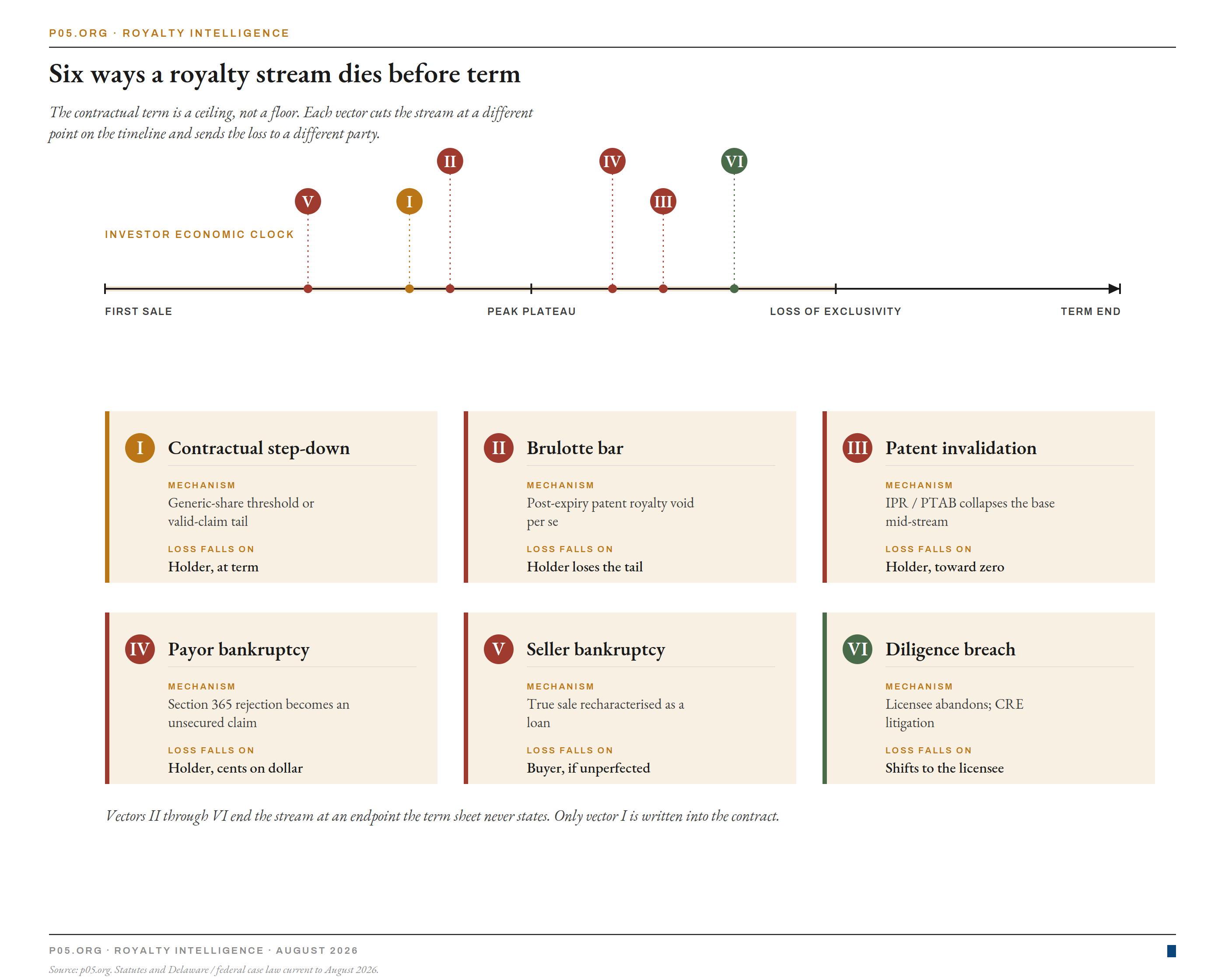
This piece is a field guide to the six vectors, current to August 2026. Two companion articles bounded the royalty window from the outside: When Does the Money Stop? treated the stream as a window with two moving edges and asked how wide it is, and The Safety Tax asked how high the window is once a REMS taxes the volume inside it. This one asks the third question, the one underneath both: what closes the window early, and who bears it.
The frame: realised life is a minimum, not a term
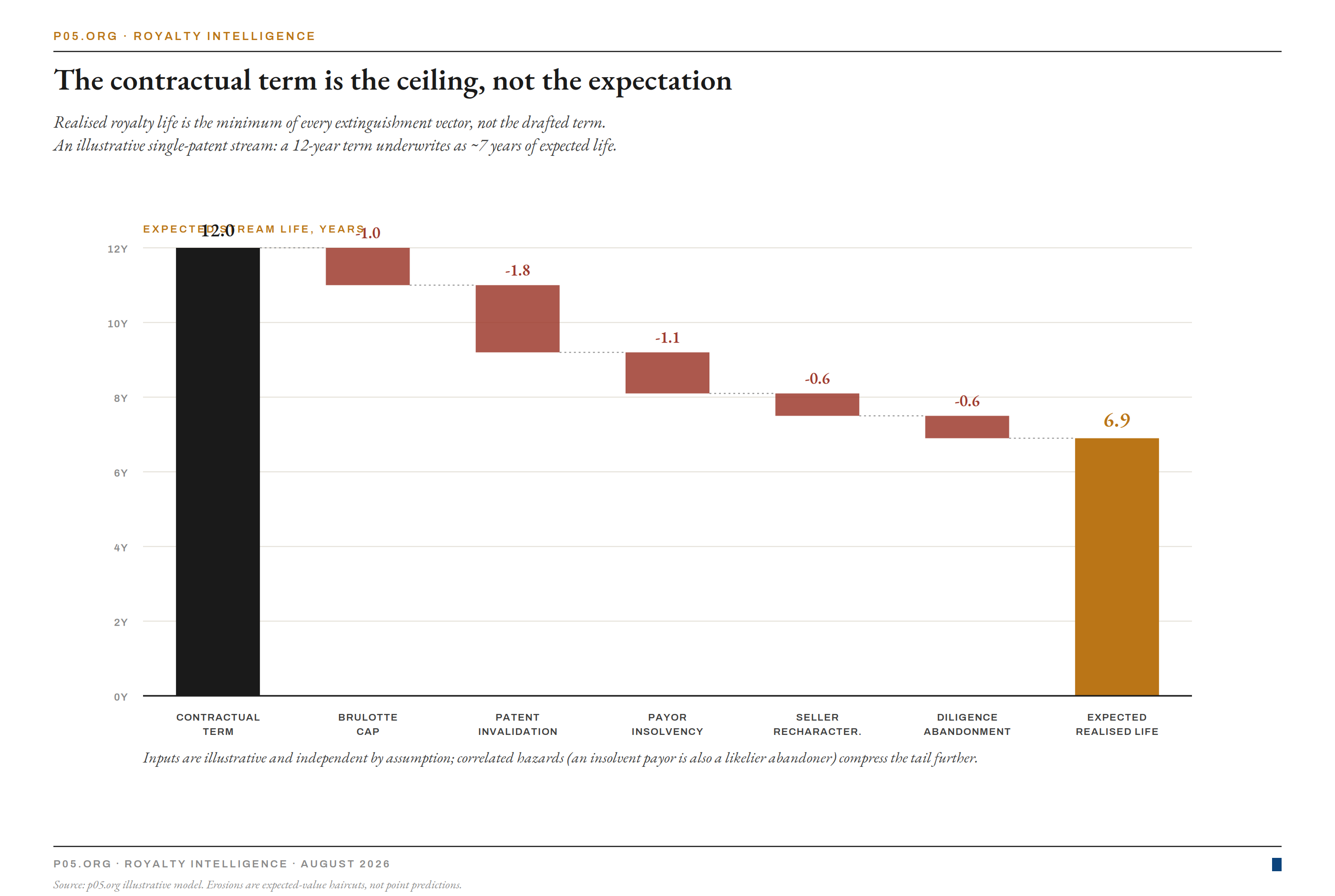
Start with the arithmetic, because it organises everything that follows. The realised life of a royalty is not the contractual term T. It is the minimum of the term and the time to each extinguishment event:
L = min(T, t_Brulotte, t_invalidation, t_payor, t_seller, t_diligence)
Each of those times is a random variable, not a date. Treated as a set of roughly independent hazards, they define a survival function S(t), the probability the stream is still paying at time t, and the correct valuation integrates cash flow against that survival curve rather than against a step function that holds at full value until T and then drops to zero:
PV = ∫ C(t) · S(t) · e^(−rt) dt
The practical consequence is that the contractual term is the maximum of the distribution, and discounting to it prices the best case. The expected realised life sits materially below it, and the gap is the sum of the extinguishment hazards. On an illustrative single-patent stream with a twelve-year term, plausible per-vector haircuts pull the expected life toward seven years, which at a mid-teens discount rate is a large repricing before any assumption about the drug itself changes.
The rest of this article is the six terms of that minimum, in rough order of how cleanly they operate, each with its trigger, its current law, and what it does to the model.
Vector I — Contractual expiry and the step-down
The cleanest endpoint is the one the contract writes, and the mechanics are covered in depth in When Does the Money Stop?. What matters for extinguishment is that the "endpoint" is rarely a single date. It is a stack of country-level triggers, and the stream does not end so much as erode.
The longer-of term sets the ceiling
Modern pharmaceutical royalties run for the latest of three clocks: expiry of the last valid claim covering the product in a given country, expiry of regulatory or data exclusivity, and a fixed tail, commonly ten to fifteen years from first commercial sale in that country.
The Bellicum 10-K for FY2015, disclosing the Agensys/Astellas terms, is a textbook print of the formulation: royalties run to the latest of last-valid-claim, regulatory exclusivity, or a fixed number of years from first sale. The "longer-of" is a floor under the term, and it is the reason a know-how tail can outlive the compound patent, subject to the Brulotte constraint in Vector II.
The step-down hollows the base out, country by country
The more consequential clauses run the other way, cutting the rate before the term ends. Three recur:
- No-valid-claim step-down. Where no valid claim covers the product in a country, the rate drops by a stated percentage. The Avalo/Lilly-Flame agreement filed in 2024 carries this structure.
- Generic-entry step-down. Once a generic or biosimilar reaches a defined unit-volume or market-share threshold, measured on a named data source such as IQVIA, the rate falls to a floor. The SELLAS agreement filed in 2022 sets exactly such a threshold at §5.4.3.
- Definitional erosion. The base itself is a drafted quantity. "Net sales," "licensed product," and "combination product" allocations decide how much revenue the rate even applies to, and the itemised deductions in the Pfizer license and royalty agreement show how much of the base can be defined away before any patent or generic question arises.
On a worldwide stream, none of these ends the royalty at once. They hollow it out jurisdiction by jurisdiction as exclusivity falls in each market, which is why a single blended "expiry date" misprices the tail.
The Freshfields analysis of royalty structuring finds a large share of disputes turn on precisely these two definitional questions, what the royalty is owed on and on what legal basis, and ambiguity in either is the seam the payor argues along later.
The invalidity-termination clause is where Vector I meets Vector III
The clause that links contractual expiry to patent invalidation is worth reading in the raw, because its exact wording decides whether an invalidation zeroes the stream.
A Therapeutic Solutions agreement filed in 2015 is representative: the licensee need not pay royalties owed only by reason of patents "held to be invalid by an Irrevocable Judgment" where no other valid, unexpired claim covers the product, but, critically, that relief does not reach royalties already paid more than six months before the licensee discovered the invalidity.
A Vilacto agreement states the same trigger more bluntly: royalty payments "shall terminate if all of the claims of the Licensed Patents are held invalid or unenforceable," on a final, non-appealable determination. Two drafting details do the work: whether invalidation of one patent among several stops the whole royalty or only the claim-specific slice, and whether there is a clawback window on royalties already paid. A buyer models both.
The modeling instruction is unglamorous: read the actual termination and step-down language, map each trigger to the country and date it bites, and never take a teaser's "patent-life" at face value. A stream advertised as patent-life may end at a fixed fifteen-year mark, or survive expiry on a know-how tail, and the two are worth materially different amounts.
Vector II — The Brulotte bar
One endpoint is not negotiable, and the parties cannot draft around it. Under Brulotte v. Thys Co., 379 U.S. 29 (1964), a patent holder cannot collect royalties for use of a patented invention after the patent expires.
The Supreme Court reaffirmed the rule fifty-one years later in Kimble v. Marvel Entertainment, 576 U.S. 446 (2015), declining to swap the bright-line prohibition for a case-by-case rule of reason and resting squarely on stare decisis.
Justice Kagan's opinion invited Congress to change the rule if it wished; Congress has not.
It is a patent-policy rule, which makes it unwaivable
Because Brulotte rests on patent policy rather than antitrust, it applies regardless of any demonstrable effect on competition, and a post-expiry royalty provision is unenforceable per se. In some formulations, including such a term can rise to patent misuse, rendering the patent unenforceable until the misuse is purged.
A contractual "we agree Brulotte does not apply" clause is worth nothing.
The trap is the undifferentiated hybrid
The danger for royalty structures is the hybrid licence, the fact pattern that sank Kimble himself, whose Spider-Man web-shooter deal bundled a patent and a toy idea into one perpetual 3 percent royalty.
Where an agreement folds patent and non-patent rights, know-how, trade secrets, data, into a single undifferentiated royalty, and the payments run past patent expiry, a court that cannot separate the patent component from the rest may hold the entire post-expiry obligation unenforceable, not merely the patent share.
The three escape routes, each a drafting choice a buyer must confirm is present before underwriting any tail that outlives the compound patent:
| Escape route | Mechanism | Confirm in the contract |
|---|---|---|
| Amortised pre-expiry use | Payments spread pre-expiry liability over a longer collection period | Royalty amount fixed by use during the patent term |
| Multi-patent step-down | Royalties run to the last-expiring licensed patent | Staggered-expiry thicket, latest-running patent identified |
| Differentiated non-patent rate | A rate differential takes effect on expiry, so the tail is plainly consideration for know-how | Separately stated, stepped-down post-expiry rate for non-patent rights |
The 2024 restatement: Brulotte is a question of law, and geography counts
The most useful recent gloss is C.R. Bard v. Atrium Medical Corp., No. 23-16020 (9th Cir. 23 Aug 2024), which reversed a district court that had voided a royalty as patent misuse.
Bard held one US and one Canadian patent on a vascular graft and licensed both to Atrium in a 2011 settlement, taking a 15 percent royalty on US sales until the US patent expired in 2019 and on Canadian sales until the Canadian patent expired in 2024, plus a 3.75 million dollar quarterly minimum. Atrium stopped paying after the US patent lapsed; the district court, examining the parties' negotiation history, found the minimum was really compensation for expired US rights and struck it.
The Ninth Circuit reversed and laid down a clean two-step test: first determine the parties' contractual obligations under state law, then ask, as a pure question of law, whether those obligations provide royalties for post-expiration use of a patent. Motivations and negotiation history are irrelevant.
Because Bard's structure tied US royalties to the US patent's life and Canadian royalties to the Canadian patent's life, it survived. The lesson for a worldwide stream is that a per-jurisdiction royalty term is not just cleaner; it is what keeps the cross-border tail enforceable, because a live foreign patent lawfully supports a royalty after the US patent is gone.
The valuation point is exact and easy to get wrong. A flat, undifferentiated rate that simply continues past the compound patent is not a conservative tail assumption. It is potentially an unenforceable one, worth zero rather than discounted.
A rate that tracks each jurisdiction's patent life is durable. This is where legal diligence and the cash-flow model have to converge, because "is this tail enforceable" and "how many years of tail do I model" are the same question.
Vector III — Patent invalidation
Vectors I and II run on a schedule. Invalidation does not.
A patent tied to a valid-claim royalty can be knocked out years before its natural term through inter partes review at the Patent Trial and Appeal Board, or through a district-court invalidity finding, and for a royalty resting on a single patent, invalidation is not a haircut.
It is a termination event that converts the stream to zero mid-life.
The licensee is free to try, and often paying while it does
Two Supreme Court rules frame the challenger's freedom. Lear v. Adkins, 395 U.S. 653 (1969) abolished licensee estoppel, so a licensee may attack the validity of the very patent it licenses. MedImmune v. Genentech, 549 U.S. 118 (2007) went further, letting a licensee in good standing sue for a declaratory judgment of invalidity without first breaching or ceasing payment.
MedImmune paid its Synagis royalties under protest, sued, and kept the licence alive while it litigated, which is now the standard posture. For a royalty holder, the takeaway is that a paying, apparently content licensee is not evidence the patent is safe; the licensee can be funding your royalty and your patent's invalidation at the same time.
The PTAB gate half-closed in 2025, but not for pharma
The board is the more probable venue, and the regime changed materially in 2025. The USPTO withdrew the 2022 guidance that had scaled back discretionary denials in February 2025 and, on 26 March 2025, established an interim process bifurcating institution into a separate discretionary-denial review by the Director before any look at the merits, on an expanded set of factors that includes denying review of long-held patents on the "settled expectations" of the parties.
In October 2025, Director John Squires took over the entire institution process. The headline effect on the overall docket was dramatic: RPX records the aggregate institution rate falling from 68 percent in Q1 2025 to 42 percent in Q2 and just 23 percent in Q3.
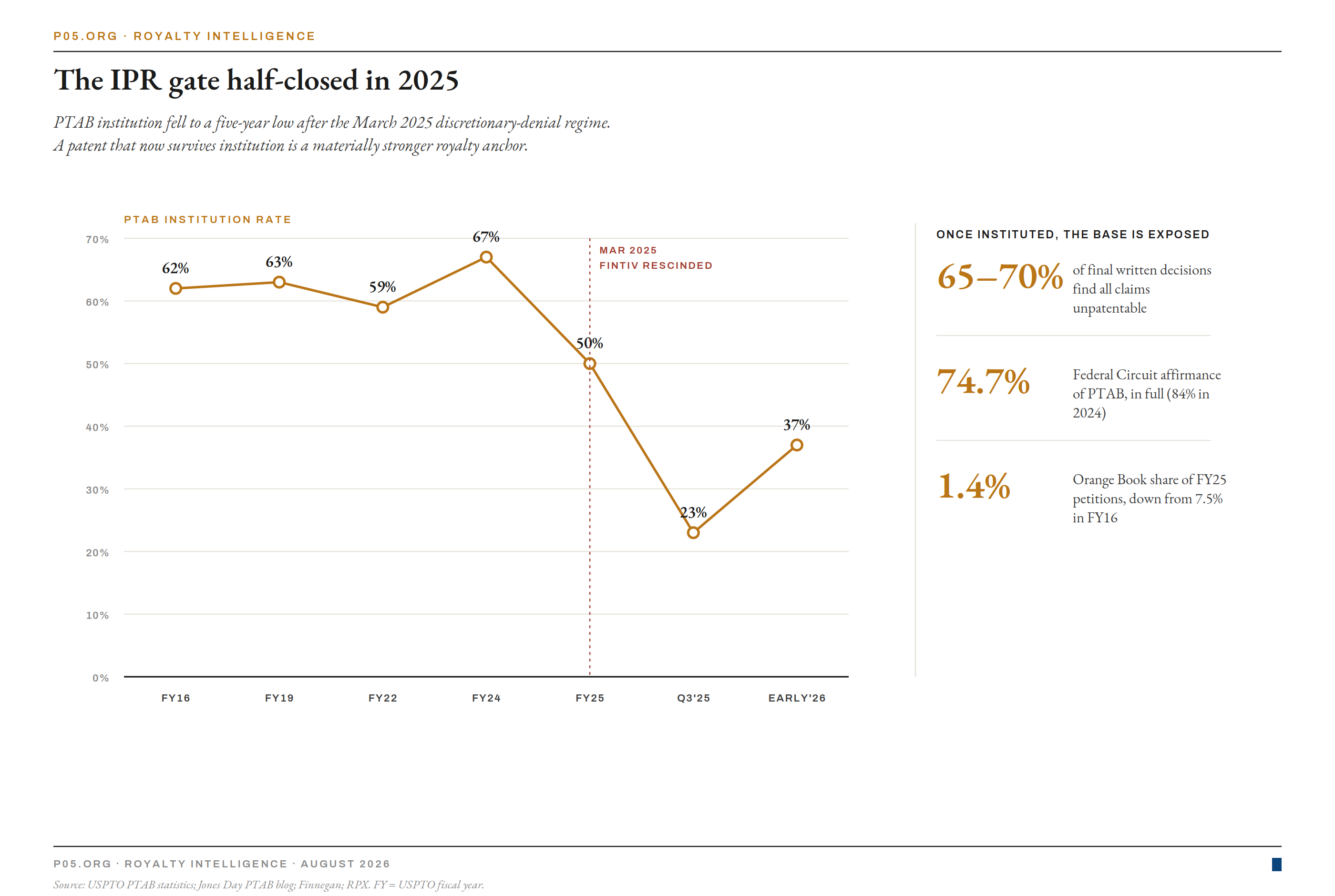
The trap for a royalty analyst is to read that aggregate number as a pharma number. It is not, and the asymmetry runs the opposite way to intuition. Three things have to be held at once:
- The collapse is concentrated in software and mechanical patents. The PTAB Litigation Blog's April 2025 snapshot recorded institution around 33 to 38 percent for mechanical and electrical/computer art units while every Bio/Pharma matter that month was instituted. Squires himself noted that of the cases referred to PTAB panels on the merits, an "extraordinarily high" share, at one point exceeding 95 percent, were then instituted. A pharma royalty holder should not assume the discretionary-denial wave protects the patent the stream rides on.
- Denominators diverge, so cite carefully. The USPTO Orange Book / biologics study shows a cumulative institution rate of 62 percent for Orange Book patents and 61 percent for biologics, but only around 25 percent in the most recent year once settlements and discretionary denials are counted across all petitions; among petitions actually reaching a merits panel, pharma institution is far higher. The two figures measure different things and should never be quoted interchangeably.
- Once instituted, the base is exposed, and biologics worse than small molecules. Where a final written decision is reached, biologic patents see all claims invalidated in roughly 70 percent of decisions against about 45 percent for Orange Book patents, and the Federal Circuit affirms the PTAB in full about 75 percent of the time cumulatively, 84 percent in 2024. An adverse instituted IPR is close to dispositive.
On invalidation, the licensee can generally cease paying prospectively, and its freedom to do so is worth pinning down, because it interacts with a remedies trap. Under Laboratory Corp. of America v. Metabolite Laboratories, No. 10-1194 (10th Cir. 2011), a licensor that terminates the licence in order to sue for infringement forfeits its contractual royalties: it must elect between keeping the agreement alive and suing for payments due, or terminating and pursuing infringement damages, and it cannot have both.
For a royalty holder, that means an aggressive response to a challenging licensee can extinguish the very stream it was meant to protect. Royalties paid before a challenge are ordinarily not recoverable by the licensee absent specific contract language, subject to any clawback window the agreement writes in.
The asymmetry that decides the model
The single most important structural fact is that a royalty base is only as broad as its narrowest surviving claim. A stream tied to a thicket of composition, formulation, and method-of-use patents with staggered expiries rarely zeroes on one invalidation; it shifts the effective loss-of-exclusivity date.
A stream resting on a single composition-of-matter patent is a binary on that one patent's PTAB docket. The 2025-to-2030 loss-of-exclusivity wave, with an estimated 200 billion dollars or more of branded revenue exposed to generic and biosimilar competition, is pushing an unusually large cohort of royalty-bearing products into the window where these challenges cluster.
Pull the actual patent list the royalty is written on. Check each patent's PTAB and litigation status. Probability-weight the survival of the claims that define the base, and put that page next to the cash flows, not in a legal appendix. A royalty is no more durable than the weakest claim its payment obligation depends on.
Vector IV — Bankruptcy of the payor
Bankruptcy is where extinguishment gets technical, and it splits into two problems that are mirror images. Take first the party that owes the royalty, the licensee or marketing sponsor, filing Chapter 11.
Section 365 converts the stream into a claim
The governing provision is 11 U.S.C. §365, which lets a debtor assume or reject an executory contract, one where both sides still owe material performance under the Countryman test. A running-royalty licence, where the debtor pays and the counterparty continues to grant rights, is typically executory.
If the debtor rejects, the effect is set by Mission Product Holdings v. Tempnology, 139 S. Ct. 1652 (2019): under §365(g), rejection is a breach, not a rescission. The 8-1 opinion held a debtor-licensor cannot use rejection to claw back rights already granted; the counterparty keeps its rights and is left with a prepetition damages claim.
The Seventh Circuit reached the same result for trademarks in Sunbeam Products v. Chicago American Manufacturing, 686 F.3d 372 (7th Cir. 2012), rejecting the Fourth Circuit's contrary Lubrizol rule.
For a royalty holder, the salient point is not the licensee-protection holding everyone cites. It is the payee's recovery. If the debtor is the payor and rejects, the holder's right to future royalties becomes a §502(b) general unsecured claim for damages, which in a typical Chapter 11 recovers cents on the dollar.
The stream as a stream is gone; what remains is a number in the unsecured queue, written down with the rest of the class.
| Party in the debtor's case | Statutory hook | What survives |
|---|---|---|
| Royalty payee whose payor rejects | §502(b) general unsecured claim | A prepetition damages claim; cents on the dollar |
| IP licensee whose licensor rejects | §365(n) election | Retains licensed rights for the term if it keeps paying; excludes trademarks |
| Any counterparty | §365(g) | Rejection is breach, not termination of vested rights |
Section 365(n) protects the wrong party for a royalty buyer
The instinct is to reach for §365(n), the IP-licence carve-out that lets a licensee, when a debtor-licensor rejects, elect to retain its licensed rights for the term provided it keeps paying.
That protects a licensee against losing its IP when the licensor fails. It does nothing for a royalty recipient whose payor fails, and it famously excludes trademarks from the statutory definition of intellectual property, which is why Mission had to be decided on general §365(g) principles at all.
The durable protection for a royalty buyer is not a statutory election but structural isolation of the asset. In In re Athenex (Bankr. S.D. Tex., No. 23-90295) the Klisyri royalty and milestone interests were placed in a bankruptcy-remote SPV and sold to Sagard and Oaktree for 85 million dollars, out of the estate's reach.
In re Sorrento Therapeutics (Bankr. S.D. Tex., No. 23-90085) is the reference the other way, for plan-level authority to assume and reject royalty-bearing licences. The lesson the cases teach in combination: for a royalty buyer, isolation is the strategy and §365(n) is a comfort that does not comfort.
Vector V — Bankruptcy of the seller
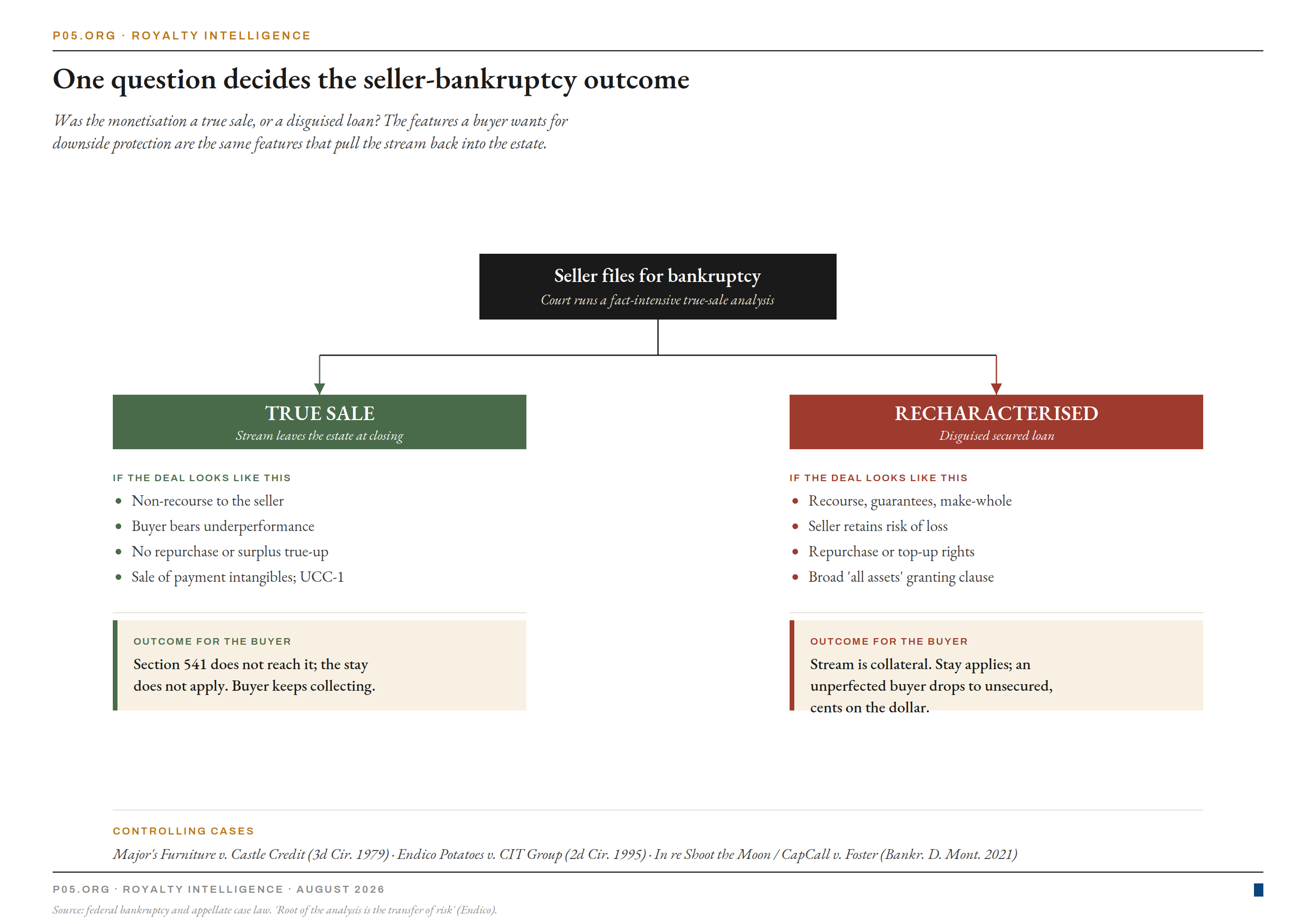
The mirror image is the scenario that should govern how a monetisation is papered, and it is the structural core of the whole royalty-buying market. A biotech sells its future royalty stream for upfront cash, then later files.
What happens to the payments turns almost entirely on one prior question: was the monetisation a true sale, or is it vulnerable to recharacterisation as a secured loan? The economics of buying early streams are treated in Pennies on the Dollar; the extinguishment mechanics are here.
True sale versus recharacterisation
If the transaction is a true sale, the royalty left the seller's estate at closing. It is not property of the estate under §541, the automatic stay under §362 does not reach it, and the buyer keeps collecting through the seller's bankruptcy largely undisturbed.
If a court recharacterises the deal as a disguised financing, the "sold" stream is merely collateral for a "loan," the buyer becomes a secured creditor at best, the stay applies, and if the buyer failed to perfect a backup security interest it drops to unsecured status and pennies on the dollar. Even a perfected buyer is capped at the collateral's value and can be crammed down in a plan.
The label the parties chose does not decide it. Courts run a fact-intensive, totality-of-the-circumstances analysis whose root, in the words of the Second Circuit, is the transfer of risk.
| Factor | Points toward true sale | Points toward secured loan |
|---|---|---|
| Recourse | Non-recourse to the seller | Full or partial recourse, guarantees |
| Risk of loss | Buyer bears underperformance | Seller retains risk (repurchase, top-up, make-whole) |
| Surplus / deficiency | Buyer keeps upside, no true-up | Seller entitled to surplus or liable for deficiency |
| Granting language | Sale of payment intangibles; precautionary UCC-1 only | Broad "all assets" security interest |
| Documentation | Parties as seller and buyer | Parties as debtor and creditor |
The controlling cases are worth holding by name. Major's Furniture v. Castle Credit, 602 F.2d 538 (3d Cir. 1979): full recourse plus a repurchase obligation is a loan, not a sale. Endico Potatoes v. CIT Group, 67 F.3d 1063 (2d Cir. 1995): risk transfer is the root of the analysis. In re Shoot the Moon / CapCall v. Foster, 635 B.R. 797 (Bankr. D. Mont. 2021): full recourse, an all-assets UCC-1, a personal guaranty and an acceleration right recharacterised a purported sale as a disguised loan.
The structural tension, and the defensive stack
The trap in synthetic royalty financing is that the features a buyer wants for downside protection are the features that most invite recharacterisation. The more the deal protects the buyer like a lender, through recourse, guarantees, make-wholes and repurchase rights, the more it looks like a loan.
Structuring practice has converged on a defensive stack that a buyer should confirm is present: genuine transfer of risk and reward with no recourse or repurchase; a backup UCC-1 security interest, properly perfected, in the purchased royalties and sometimes the underlying IP, so that even on recharacterisation the buyer is a perfected secured creditor; clean sale-not-loan documentation that names the parties as seller and buyer and keeps loan vocabulary out; and a reasoned true-sale opinion, bankruptcy-remote from the seller's estate, which is the document that anchors the buyer's position if the seller later files.
In re Clovis Oncology (Bankr. D. Del., No. 22-11292) is the caution that these fights can go either way and rarely resolve cleanly: the creditors' committee attacked Sixth Street's capped-and-accelerated Rubraca funding as a disguised equity and penalty arrangement, but the dispute settled with no merits ruling. Illustrative, not precedent, and a reminder that the cleanest protection is the structure at signing, not the argument at the hearing.
Vector VI — The diligence breach
The last vector looks least like extinguishment and behaves most like it, and it is the highest-dollar risk on this list in 2026. A royalty on an approved product assumes someone is still out there selling it.
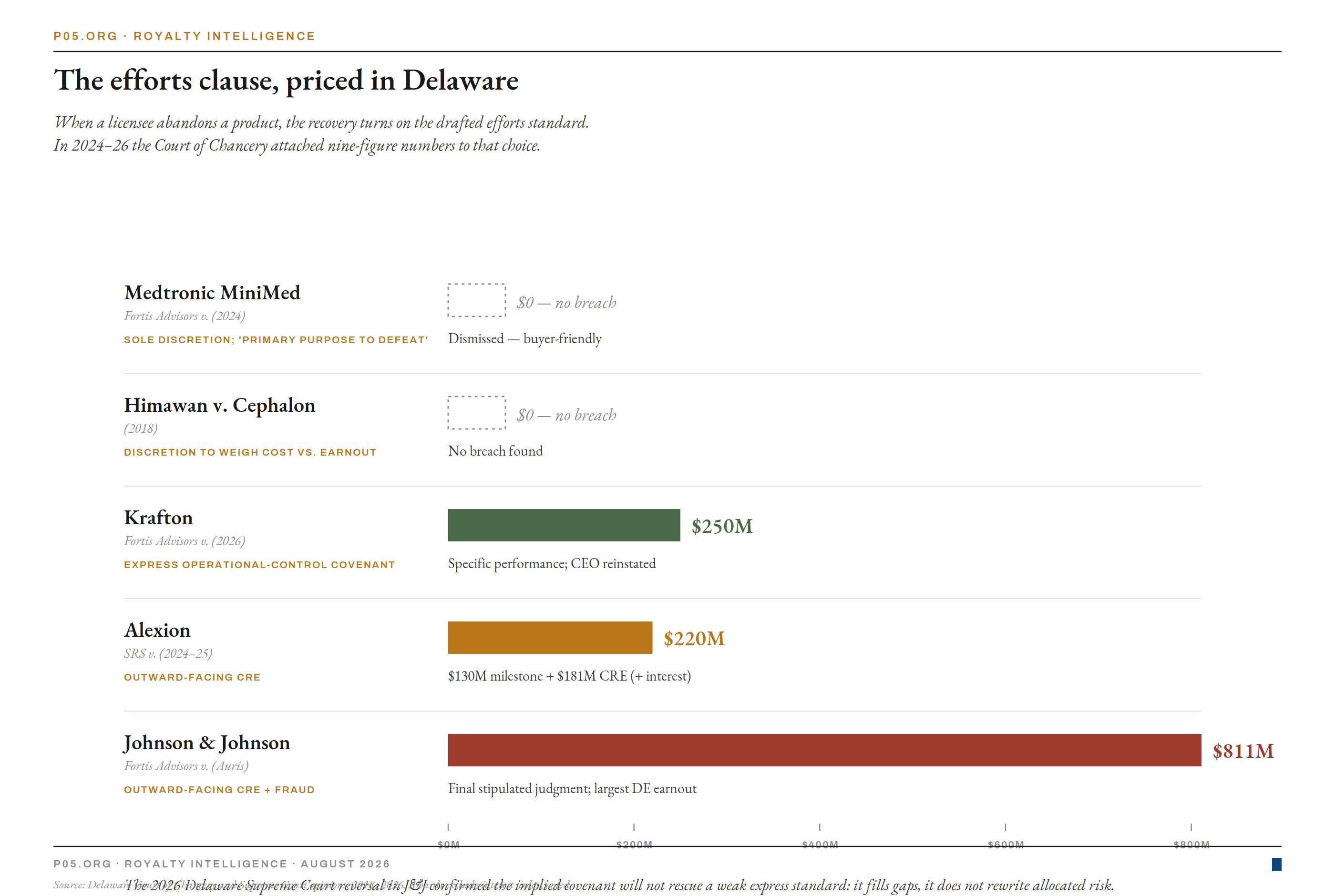
When the licensee or acquirer that controls commercialisation decides the asset is worth more dead than alive, or simply worth less than the effort, the stream can dwindle to nothing with no formal termination at all. The holder's protection is the diligence covenant and, behind it, the implied covenant of good faith and fair dealing. Delaware has spent 2024 to 2026 drawing these lines with very large numbers attached.
The efforts standard is outcome-determinative
The standards are not interchangeable, and the drafting choice decides the case before the facts are heard. As the Cooley review of diligence standards sets out, "good faith efforts" is an enforceable obligation to take affirmative, reasonable steps toward the contract's purpose, while "commercially reasonable efforts" layers a diligence requirement measured against business norms on top.
The decisive sub-distinction is between an inward-facing standard, which measures the buyer against its own treatment of comparable products, and an outward-facing one, which measures against a hypothetical similarly situated company. The outward-facing standard is far more protective of the seller, and Delaware applied it in Alexion.
The cases, and the damages methodology
| Case | Docket | Standard | Result |
|---|---|---|---|
| SRS v. Alexion | Del. Ch. 2020-1069-MTZ (VC Zurn) | Outward-facing CRE | $130M milestone + $180.94M CRE damages (~$220M with interest) |
| Fortis Advisors v. Johnson & Johnson (Auris) | Del. Ch. 2020-0881-LWW (VC Will) | Outward-facing CRE + fraud | Final stipulated judgment ~$811M (26 Jan 2026), largest Delaware earnout award |
| Johnson & Johnson v. Fortis (appeal) | Del. Supr. 352 A.3d 229 (2026) | Implied covenant | Reversed $300M implied-covenant milestone; affirmed fraud |
| Fortis Advisors v. Krafton | Del. Ch. 2025-0805-LWW (VC Will) | Express operational-control covenant | Specific performance; CEO reinstated; earnout window extended |
| Fortis Advisors v. Medtronic MiniMed | Del. Ch. (Companion Medical) | "Sole and absolute discretion," limited only by "primary purpose to defeat" | Dismissed; buyer-friendly |
| Himawan v. Cephalon | Del. Ch. 2018 WL 6822708 | Discretion to weigh cost vs. earnout | No breach found |
In Alexion, the facts are a template for how a stream dies by abandonment. Alexion acquired Syntimmune in 2018 for 400 million dollars at closing plus up to 800 million in earnouts tied to eight development and commercialisation milestones for the anti-FcRn antibody ALXN1830.
After AstraZeneca acquired Alexion in 2021, Alexion began to question the program's commercial viability and terminated it in December 2021, having hit only one of the eight milestones, even as outside experts opined the data showed no safety concern. The Court of Chancery held the merger agreement's efforts clause was objective and outward-facing, pegged to what a hypothetical similarly situated biotech would do, and that this left no room for Alexion to deprioritise the program on idiosyncratic, company-specific grounds.
It awarded 130 million dollars for the achieved Phase 1 milestone plus 180.94 million dollars in expectation damages on the abandoned ones, toward 220 million with interest.
In Fortis v. J&J, the court found J&J breached its efforts obligations on the Auris robotic-surgery earnout by opting for a more complex regulatory route and restructuring employee incentives so staff were no longer motivated to hit the milestones, contributing to the failure of six of ten milestones, and awarded around a billion dollars including a fraud component, later entered as a stipulated judgment near 811 million dollars, the largest earnout award in Delaware history.
The methodology is the point, because it is the analyst's own. The courts did not void the deals. They started with the dollar value of each unreached milestone, estimated its probability of achievement had the buyer complied, and awarded the probability-weighted expected value at the time of breach.
A diligence breach converts a lost contingent stream into a present damages claim measured by its expected value, which is a real protection for a holder, but a probabilistic one, and only after litigation.
The 2026 narrowing
The sequel hardened the lesson. On appeal, the Delaware Supreme Court in Johnson & Johnson v. Fortis Advisors, No. 490, 2024 (Del. 12 Jan 2026) reversed a 300 million dollar award tied to the first milestone. The Court of Chancery had used the implied covenant to require J&J to pursue a De Novo clearance as the functional equivalent of the 510(k) pathway the agreement named, on the theory that the contract was silent on what happened if 510(k) became unavailable.
The Supreme Court held that was legal error: the implied covenant is a limited gap-filler that applies only to genuine contractual silence about a truly unanticipated development, and may not serve as "an equitable remedy for rebalancing economic interests after events that could have been anticipated, but were not." Because the agreement conditioned each regulatory earnout expressly and repeatedly on 510(k) clearance, there was no gap to fill.
The fraud finding survived, because the agreement lacked a non-reliance clause. The through-line of the 2026 rulings, including the companion Fortis v. Krafton enforcement of an express operational-control provision, is that earnouts are risk-allocation mechanisms, not deferred purchase price, and Delaware courts will not use the implied covenant to reallocate risks the parties could have foreseen and addressed in the text.
For a royalty buyer relying on someone else's commercialisation, this is the whole ballgame. The implied covenant fills genuine gaps; it does not rescue a holder who accepted a weak express efforts standard. Draft the covenant explicitly, make it outward-facing, and reach for named operational controls where the leverage exists.
A vague diligence clause will not be improved by a court after the fact, and the remedy, when it comes, is a probability-weighted damages claim available only after years of litigation.
The contested-scope case: XOMA, Janssen, and the CVR carve-out
Sometimes the extinguishment question is prior to all six vectors: whether the royalty exists at all. The market now structures around that directly, and a 2026 deal is the cleanest illustration.
XOMA Royalty sued Johnson & Johnson's Janssen unit (E.D. Pa., No. 2:25-cv-04484) for breach of contract and unjust enrichment over Janssen's use of XOMA's bacterial cell expression technology in commercialising Tremfya (guselkumab).
Janssen's motion to dismiss was denied, and the litigation is ongoing. The point is structural, not who is right: the existence and scope of a royalty entitlement is itself the disputed question, and it could not be priced into a clean acquisition figure.
So it was carved out. Ligand completed its acquisition of XOMA Royalty on 14 July 2026 at 39.00 dollars per share in cash, roughly 739 million dollars, and XOMA is now a wholly owned Ligand subsidiary, delisted from Nasdaq and terminating its SEC registration.
Rather than value the uncertain litigation inside the cash price, the parties priced the operating royalty portfolio at 39.00 dollars and left the Tremfya claim in a non-transferable contingent value right entitling pre-close holders to a portion of 75 percent of the net litigation proceeds, held through a CVR trust and XOMA Royalty LLC.
A contested royalty is not a stream with a haircut. It is an option on a stream, and sophisticated counterparties now price and structure it as one.
Where a royalty's existence or scope is genuinely binary, carving it into a CVR lets the going-concern deal close at a clean price while the litigation upside travels separately to the holders who bore the risk.
The price-side compression underneath all of this
Two forces squeeze the base on the price axis while the six vectors act on duration and volume, and neither is curable by the durability levers the market once relied on. The CREATES Act (Pub. L. 116-94, 2019) foreclosed the REMS sample-blockade tactic that used to delay generics, covered in The Safety Tax. And the IRA's Medicare negotiation now cuts the price directly on exactly the specialty products the royalty market underwrites.
| IPAY-2027 drug | Manufacturer | List → MFP, monthly | Cut |
|---|---|---|---|
| Pomalyst | Bristol Myers Squibb | $21,744 → $8,650 | 60% |
| Ibrance | Pfizer | $15,741 → $7,871 | 50% |
| Ofev | Boehringer Ingelheim | $12,622 → $6,350 | 50% |
| Xtandi | Astellas | $13,480 → $7,004 | 48% |
| Calquence | AstraZeneca | $14,228 → $8,600 | 40% |
Prices effective 1 January 2027, per the CMS fact sheet. Several of these are protected-class antineoplastics, where plans already have limited rebate leverage, so the maximum fair price flows more directly to the royalty base.
Eligibility runs on a clock of its own: seven years post-approval for a small molecule, eleven for a biologic, conditioned on top-50 Part D gross spend and the absence of a generic or biosimilar. For any licensed product approaching that window, the price haircut belongs in the base projection alongside the duration and volume adjustments, because a stream can survive every one of the six extinguishment vectors and still lose forty to sixty percent of its base to a negotiated price.
Comparative summary
Each vector ends the stream through a different legal mechanism, attaches at a different point in the structure, and allocates the loss differently. A model that prices only contractual expiry captures the first row and none of the others.
| Vector | Mechanism | Where it attaches | Loss falls on |
|---|---|---|---|
| I Contractual step-down | Termination and no-royalty-threshold clauses | Product licence, country by country | Holder, at term |
| II Brulotte bar | Per se unenforceability of post-expiry patent royalties | Any patent royalty past expiry, especially undifferentiated hybrids | Holder loses the tail entirely |
| III Patent invalidation | IPR / PTAB or court invalidity finding | Valid-claim royalties, worst on single-patent streams | Holder; base collapses toward zero |
| IV Payor bankruptcy | §365 rejection; Mission / Tempnology | Executory licence where the debtor owes the royalty | Holder, downgraded to a prepetition unsecured claim |
| V Seller bankruptcy | True sale versus recharacterisation; §§541, 362 | The monetisation itself | Buyer, if recharacterised and unperfected |
| VI Diligence breach | CRE covenant; implied covenant (Delaware) | Commercialisation control in the licence | Shifts to the breaching licensee, via litigation |
Where the structure points
A few things follow for anyone deciding how to underwrite, structure, or hold one of these streams.
Underwrite the minimum, not the term. The realised life is min(T, and five hazards). Build the survival curve explicitly, mark each vector's contribution, and discount cash flow against S(t). Discounting to the contractual term prices the ceiling and systematically overpays.
Make the tail earn its enforceability, jurisdiction by jurisdiction. Any royalty running past the compound patent must clear Brulotte through amortised use, a multi-patent step-down, or a differentiated non-patent rate, and C.R. Bard confirms a rate that tracks each country's own patent life is durable where a flat global tail is not.
An undifferentiated rate past expiry should be modeled at zero, not discounted.
Put the patent docket on the cash-flow page, and do not over-credit the 2025 slowdown. The discretionary-denial collapse is a software and mechanical story; pharma and biologic petitions reaching a merits panel are still instituted at very high rates, and biologics are invalidated post-institution in roughly 70 percent of final written decisions.
Read the invalidity-termination clause for whether one invalidation zeroes the whole stream or a claim-specific slice, and whether there is a clawback window. A portfolio royalty is a different, more durable instrument than a single-patent one, and the two should not trade at the same multiple.
Mind the election of remedies. Under LabCorp v. Metabolite, terminating a licence to sue an infringing or challenging licensee forfeits the contractual royalty. An aggressive enforcement posture can extinguish the stream it was meant to defend; model the remedy path before assuming breach protects the holder.
Isolate the asset against the payor, and against yourself as seller. For a licence-based royalty, the payor's rejection converts your stream to an unsecured claim, and §365(n) will not save a payee; SPV isolation will. For a monetisation, the true-sale defensive stack, non-recourse framing, precautionary UCC-1, clean documentation, reasoned opinion, is what keeps the stream out of the seller's estate. The features that protect you most like a lender are the features that most endanger the sale.
Draft the efforts covenant like it is worth hundreds of millions, because in Delaware it is. Outward-facing commercially-reasonable-efforts, ideally with named operational controls, is the protection against an abandoning licensee. The implied covenant will not rescue a weak clause after the fact, and the remedy is a probability-weighted claim available only after litigation. Price that lag and that probability into the position.
Carry the price-side clock alongside the duration clock. Layer IRA maximum-fair-price haircuts onto the base for any product approaching the seven or eleven-year window in the top-50 Part D spend, and do not underwrite REMS-driven generic delay as tail value; the CREATES Act foreclosed it.
A royalty contract promises payments to a stated term. Whether those payments survive a Brulotte challenge, an IPR, a payor's rejection, a seller's insolvency, or a licensee's retreat is a separate question, answered not by the term but by the drafting and the structure.
The analytical edge, as with duration and with REMS, lives in the gap between what the contract nominally promises and what the law will actually enforce and protect. Pricing the term is describing the deal on paper. Pricing the ways the term can be cut short is describing the stream that will actually pay, and in 2026 the largest single answer to that question is not the patent. It is the efforts clause, and it is being priced in Delaware in units of hundreds of millions of dollars.
Standard disclaimer
All information in this article was accurate as of the research date and is derived from publicly available sources including court opinions, statutes, regulatory and agency materials, SEC filings, and company and trust press releases. The worked survival model is illustrative and based on stated assumptions; it is not a forecast. Information may have changed since publication. This content is for informational purposes only and does not constitute investment, legal, or financial advice. The author is not a lawyer or financial adviser.