
Company of the week: Werewolf
In one hundred days a platform company sold its royalty back to the licensee, sold the platform to a second buyer, and priced itself to a third at roughly the cash the first two produced. The two clinical assets went into a contingent right, carrying a royalty payable to Merck.
Werewolf Therapeutics (Nasdaq: HOWL) signed a merger agreement with Ambros Therapeutics on 21 August 2026. The surviving company takes Ambros's name, a San Diego address, the ticker AMBX and neridronate, an intravenous bisphosphonate approved in Italy for complex regional pain syndrome and now in a single Phase 3 trial intended to support US approval.
The ratio values Ambros at $500 million and Werewolf at $47.5 million. A $150 million private placement co-led by RA Capital and Janus Henderson closes alongside. Pre-merger Werewolf holders end with about 6.8 per cent, Ambros holders 71.7, the new money 21.5.
The shares more than doubled on the announcement and closed at $0.9708 on 27 August, for a market value of $47.2 million on 48.6 million shares. That is 99 per cent of the $47.5 million the ratio assigns. The spread that opened on 21 August had shut inside four sessions, which is what happens when the thing being valued is a bank balance rather than a business.
The interesting part is how the money got there, and what it cost. Between 6 May and 21 August the company ran three disposals through a Piper Sandler process, and the sequence is legible in the filings.
The Jazz royalty, and what it fetched
Werewolf's one outbound royalty was on WTX-613, a conditionally activated interferon alpha, which Jazz licensed in April 2022. The terms: $15 million upfront, up to $520 million in development and regulatory milestones, up to $740 million in sales milestones, and a tiered mid-single-digit royalty on net sales.
Jazz funded the work, filed the IND and renamed the molecule JZP898. A June 2024 transfer agreement assigning a manufacturing contract to Jazz discharged Werewolf's last performance obligation.
The stream can be sized from the payer's side, which is the more reliable one. Jazz's FY2025 10-K discloses contingent milestone obligations by counterparty and carries $1,255.0 million under the Werewolf agreement at 31 December 2025.
That is $515 million plus $740 million, and it sits $5 million below the announced $1,260 million, consistent with one development milestone having been paid at some point after signing. Neither party says which.
On 6 May 2026 the licence became a sale. Under an asset purchase agreement Jazz paid $21.0 million for the programme outright, with $2.0 million more contingent on a third party consenting to the partial assignment of an unnamed licence. The collaboration agreement terminated at closing.
Every unpaid milestone and the royalty went with it. Werewolf agreed not to work on any interferon alpha for eighteen months, with a change-of-control carve-out, and granted Jazz a fresh non-exclusive licence over platform technology that JZP898 needs but does not own.
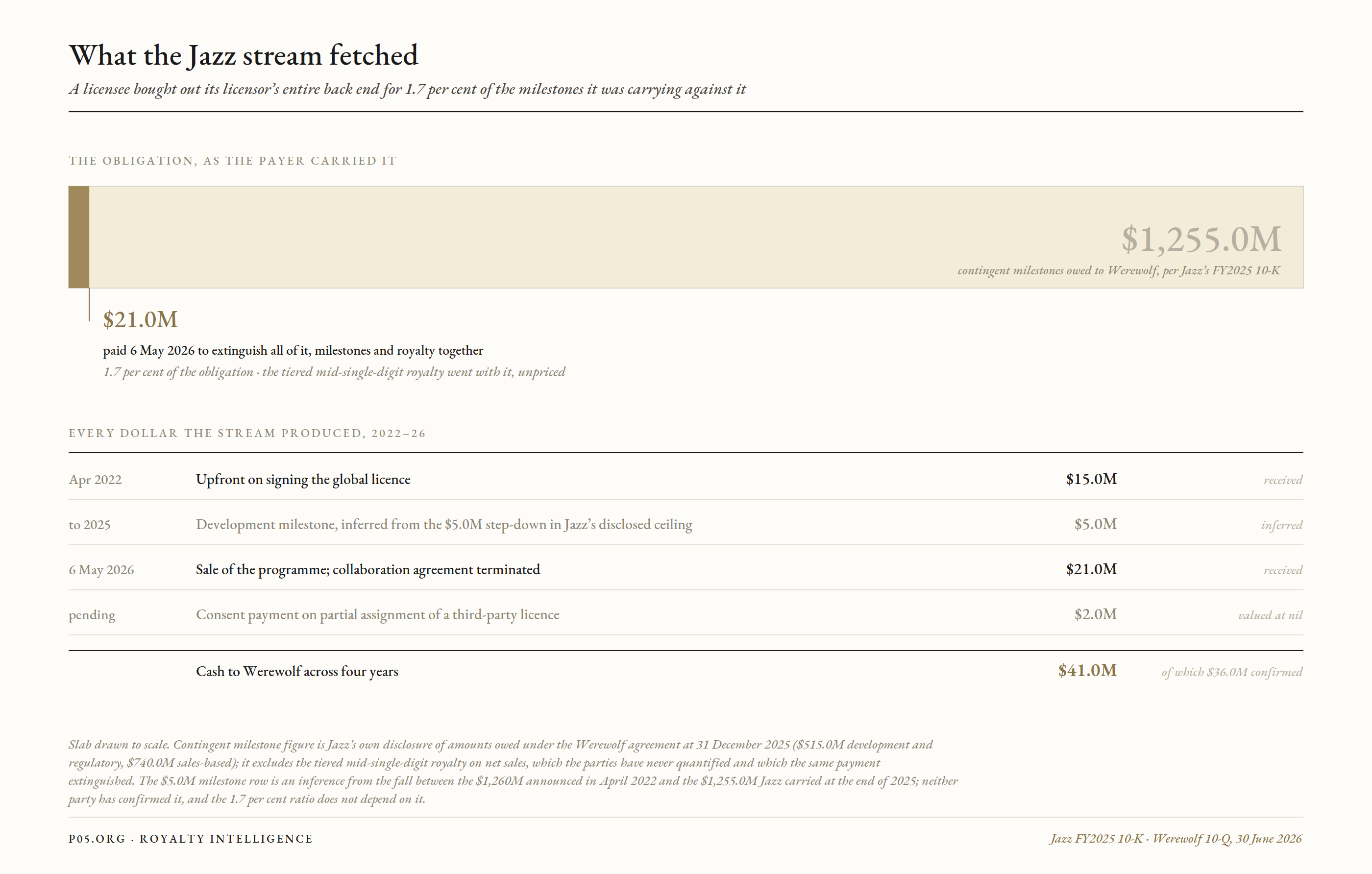
The obligation Jazz carried against the Werewolf agreement, and what extinguished it.
Twenty-one million against $1,255.0 million of contracted contingent payments is 1.7 per cent, before the royalty, which the disclosure does not size.
The comparison assumes those milestones had some probability-weighted value, and most were sales-based on a molecule in early clinical development, so the honest reading is narrower. What Jazz bought for $21 million was the removal of a royalty and a milestone schedule from a counterparty about to change hands, plus eighteen months of interferon exclusivity.
What Werewolf sold was every claim it had on the only partnered asset it owned, at a moment when it needed the cash on a date certain.
The accounting is clean because nothing was left to perform. The whole $21.0 million was recognised as collaboration revenue in the June quarter as a modification of the 2022 contract, the $2.0 million was valued at zero as variable consideration outside the company's control, and Werewolf reported net income of $3.7 million.
Why the date was fixed
Werewolf drew $30 million from K2 HealthVentures in May 2024 under a $60 million facility. The terms are in the June 10-Q: interest at the greater of 10.3 per cent and prime plus 1.8, a final fee of 6.95 per cent of the amount funded, interest-only for 24 months then amortisation to May 2028, a first lien on everything except intellectual property, and a $5 million conversion right at $6.3182.
The company records the effective rate at 19.24 per cent. The third and fourth tranches, $30 million between them, required a $60 million equity raise and lender consent respectively, and both expired undrawn. The covenants restricted asset disposals and mergers. The interest-only period ended in May 2026.
On 6 May Werewolf paid $31.4 million and the facility was discharged in full, with a $3.4 million loss on extinguishment for unamortised issuance costs and the unaccreted final fee. Same day: $21 million in from Jazz, $31.4 million out to K2. The royalty did not fund the company. It funded the lender's exit, and the lender's exit unblocked everything that followed.
The platform, sold for cash and nothing else
On 14 August, disclosed six days later and a day before the merger announcement, Werewolf sold the PREDATOR estate to EMD Serono, the US research arm of Merck KGaA.
The transferred assets are the preclinical INDUCER platform in full, including the STEAP1 and CDH6 T cell engagers, and the INDUKINE platform's patents, know-how and preclinical compounds, excluding the WTX-124 and WTX-330 clinical programmes.
Consideration is $28.0 million on closing and $5.0 million on completion of the technology transfer. There is no royalty. There are no milestones. A company that spent four years telling investors its platform was the asset sold the platform for $33 million of fixed cash and retained no participation in anything EMD builds with it.
The back-end structure of the two disposals is the arc worth marking. In 2022 Werewolf took $15 million upfront against $1.26 billion of contingent payments and a royalty. In 2026 it discovered what that back end was worth in a forced sale, and when it sold the platform three months later it did not ask for one.
Werewolf also had to license its way back in. EMD granted it an exclusive licence under certain transferred patents so it can continue clinical development of WTX-124 and WTX-330, plus further rights so it can keep granting the sublicences it already owes to Harpoon and to Jazz. The company now runs its two remaining programmes on patents it sold, under a licence from the buyer.
The royalty stack on what is left
This is where a royalty desk should spend its time, because the two assets going into the contingent value right are not clean.
Werewolf's foundational in-licence is the Second Amended and Restated Assignment and License Agreement with Harpoon Therapeutics, dated 20 December 2019, restating agreements from 2017 and October 2018.
It gives Werewolf non-exclusive worldwide rights to Harpoon patents incorporated into PREDATOR and exclusive irrevocable rights to certain Harpoon inventions from a defined collaboration period, and the 2019 restatement added an exclusive, irrevocable, transferable, sublicensable licence under further Harpoon patents covering certain proteins.
The consideration, as described in the company's 10-K filings: a $0.5 million upfront fee, and a low single-digit percentage royalty on net sales of covered products by Werewolf, its affiliates or its licensees, subject to a minimum annual royalty in the low hundreds of thousands of dollars once the first commercial sale occurs.
The 2019 additional licence carries its own low single-digit royalty on net sales of products covered by the added patents.
Three consequences follow.
First, the licensee limb matters. The royalty runs on net sales by Werewolf's licensees as well as by Werewolf, so a buyer of WTX-124 or WTX-330 does not escape it by being a third party. The obligation travels with the molecule.
Second, the counterparty is now Merck & Co, which acquired Harpoon in March 2024 for roughly $650 million. The royalty on Werewolf's assets is payable to a subsidiary of one Merck; the platform those assets came from now belongs to the other.
EMD Serono had to grant back licence rights specifically so that Werewolf could continue to perform the Harpoon sublicence, which is a fair indication of how tangled the estate was by August.
Third, the minimum annual royalty is a floor obligation on first commercial sale, not a percentage. Small, but it is a fixed cash cost attaching to a molecule that may sell modestly if it sells at all, and it is the sort of term a buyer prices.
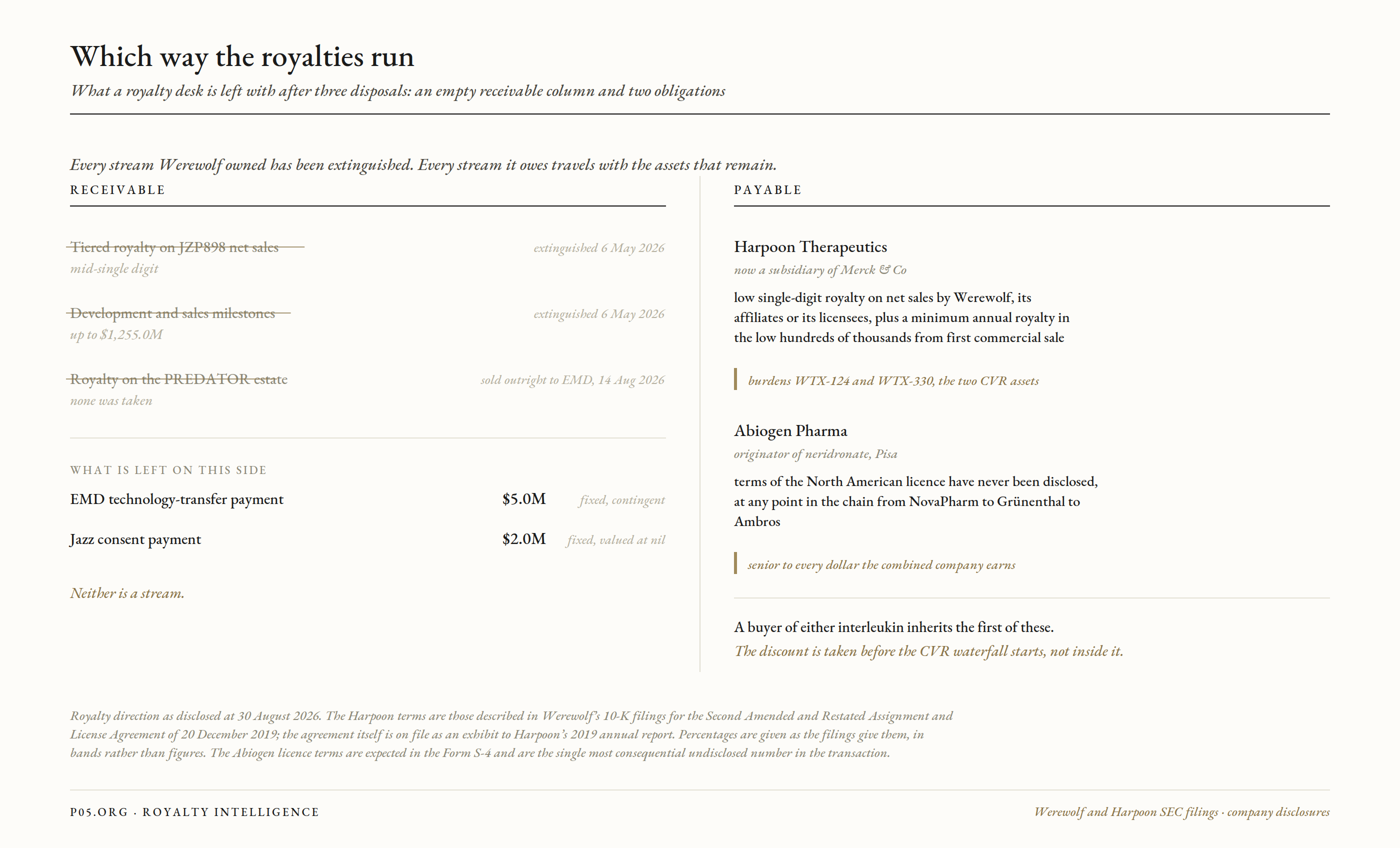
An empty receivable column and two obligations, one of them undisclosed.
Set against this, Werewolf holds no inbound royalty at all as of today. The Jazz royalty is extinguished. The EMD sale carries none. What remains on the receivable side is two fixed contingent payments, $5.0 million from EMD on technology transfer and $2.0 million from Jazz on a consent, neither of which is a stream.
The combined company will be a licensee too, and the chain behind it is longer than the announcement suggests. Neridronate was discovered and developed by Abiogen Pharma of Pisa and has been sold in Italy as Nerixia since 2014.
Abiogen licensed development and commercial rights for the Americas to NovaPharm Therapeutics; Grünenthal acquired those rights in 2013 and returned them after 2019. Ambros took North American rights from Abiogen in December 2025, with an option to widen the territory, and the merger materials describe the licence as covering the United States, Canada and Mexico. Abiogen's commercial director sits on the Ambros board. The Italian rights never left Pisa.
Financial terms of the Abiogen licence have not been disclosed at any point in that sequence. Whatever royalty and milestone ladder runs back to Abiogen on US sales is the single most consequential undisclosed number in the transaction, because it sits senior to every dollar the combined company might earn. It should appear in the S-4, and for anyone screening this asset that is the document to wait for.
The $47.5 million is a cash number
Put the disposals against the ratio.
Cash was $22.0 million at 30 June. Add $28.0 million from EMD on 14 August. Subtract seven weeks of operating burn and transaction costs; at the reduced post-restructuring run rate implied by the second-quarter accounts, and treating the second quarter's $13.8 million of operating expense as inflated by $1.4 million of restructuring and elevated deal fees, something in the region of $4 million to $6 million is a reasonable estimate, though the company has not disclosed a figure.
That lands net cash at signing somewhere near $44 million to $46 million, with $7 million of contingent receivables behind it.
Against that, an implied equity value of $47.5 million.
The ratio prices the cash and the two contingent payments. WTX-124 and WTX-330 are assigned nothing in it.
They are pushed out of the balance sheet and into the contingent value right, which is the structural point of the whole transaction: Ambros and its new investors buy a listing and a cash balance and decline to pay for two clinical programmes, while agreeing to pass on whatever those programmes fetch later.
The merger agreement makes the cash dependence explicit. Closing requires Werewolf's final net cash to be greater than zero, and the ownership percentages adjust to the number.
Every dollar burned between now and a closing expected by the first quarter of 2027 comes off the 6.8 per cent.
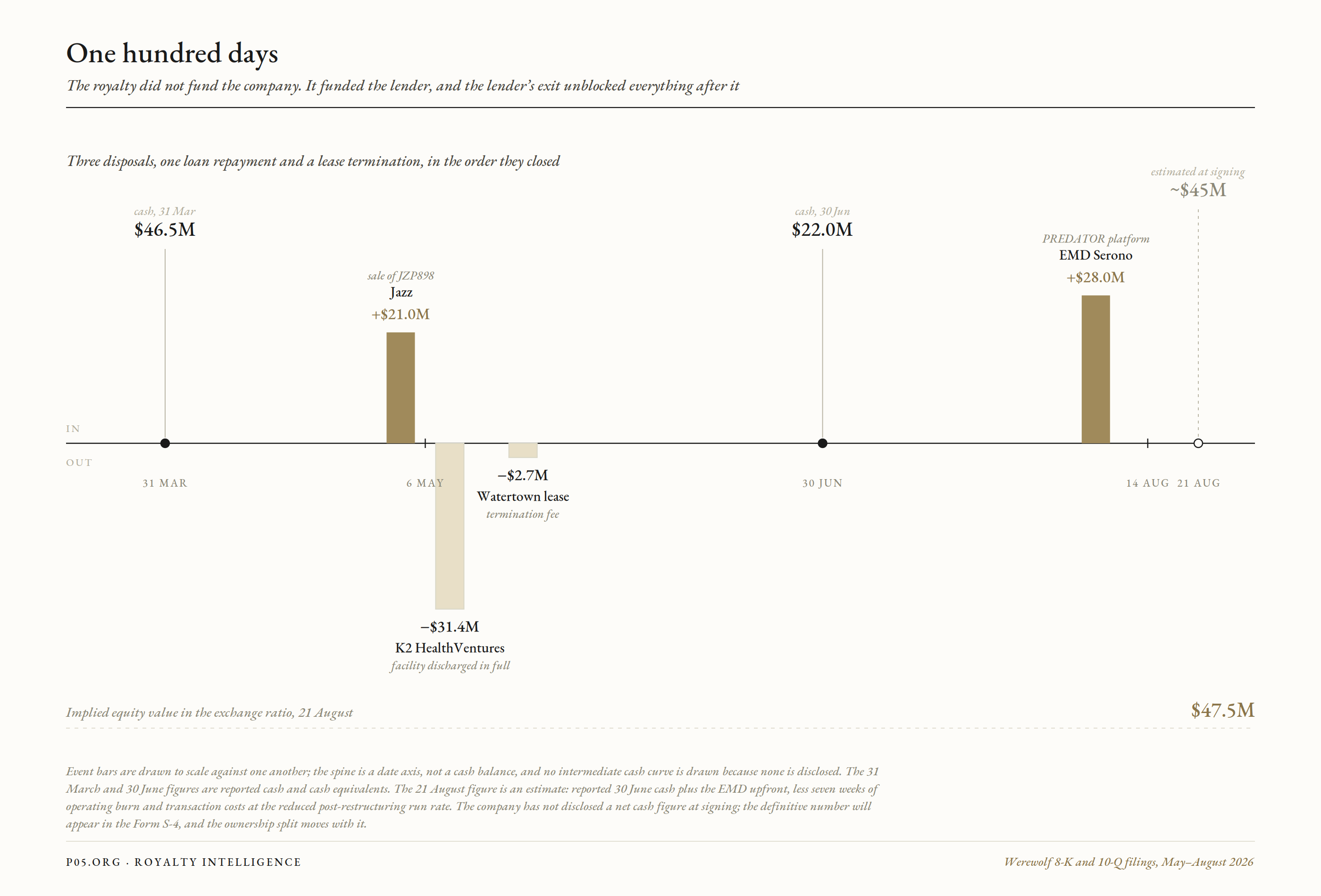
Three disposals, one loan repayment and a lease termination, in the order they closed.
The contingent value right
Werewolf holders of record on the last business day before closing receive one non-transferable CVR per share. The form is Exhibit 10.6 to the merger 8-K, and the definitions do most of the work the headline does not.
The payment is 100 per cent of net proceeds. The term is three years from closing. The window in which a qualifying disposal can be signed is twelve months.
The legacy assets are WTX-124 and WTX-330 and their related clinical and preclinical material, and nothing else, so the platform, already sold, and the EMD and Jazz contingent payments, already counted in net cash, sit outside.
Gross proceeds exclude reimbursement of research, development, manufacturing or patent costs; anything received after the expiry date; unlisted equity of any kind; and, expressly, profit-share, revenue-share or similar participation payments. Listed equity counts at a five-day volume-weighted average.
A sales royalty is not named in the exclusions, but on a Phase 1 asset a royalty would arrive well beyond year three, so in practice the instrument captures an upfront and any near-term milestones and little else.
Permitted deductions include tax computed at the highest marginal rate using only Werewolf's pre-closing loss carryforwards, and only to the extent Section 382 leaves them usable after a change of control; costs allocable to the assets; business development fees; patent maintenance; and the fees of a Legacy Asset Consultant and the rights agent.
Payment is annual, with nothing distributed until accumulated net proceeds pass $1 million, except at the end of the term.
Two provisions set the character of the thing. Werewolf "has no independent obligation to use efforts to market, monetize or dispose of the Legacy Assets"; the consultant's efforts are the only efforts required.
And Werewolf may not sign a legacy asset agreement without the consultant's written consent. Nobody is obliged to sell, and nobody can sell alone.
To that, add the Harpoon royalty. Whatever a buyer pays for WTX-124 will be net of the low single-digit obligation and the annual minimum it will inherit, which is a discount taken before the CVR waterfall starts, not inside it.
One detail in the exhibit tells you who drafted it. The CVR form gives Werewolf's notice address as 18575 Jamboree Road, Irvine, California, with a copy to Cooley in New York. Irvine is where Ambros was founded and Cooley is Ambros's counsel, so the instrument that governs the seller's residual assets is written from the buyer's desk, on the buyer's letterhead, for a company that will by then be the buyer.
The 8-K itself was filed from Waltham, Werewolf having surrendered its Watertown building on 31 July.
The two molecules
WTX-124 is a conditionally activated interleukin-2. The December 2025 update reported a 21 per cent objective response rate as monotherapy in heavily pretreated cutaneous melanoma and 30 per cent in patients not primarily resistant to prior immunotherapy, with no vascular leak syndrome.
The FDA accepted an 18 mg dose and gave initial guidance on a monotherapy registration path in post-checkpoint melanoma; the programme holds Fast Track designation there. The Phase 1/1b completes in the fourth quarter of 2026.
WTX-330 is the interleukin-12 counterpart. Part A of its Phase 1b/2 also completes in the fourth quarter. Disclosed activity to date is one confirmed partial response in gall bladder cancer with a 45 per cent reduction in target lesions.
Both have been on offer since February. Six months of a banked process found a buyer for the interferon programme, a buyer for the platform, and a buyer for the listing, and no buyer for either interleukin.
That is the base rate against which a twelve-month disposition window should be read, on the assumption that the same counterparties will be asked the same question again by a consultant rather than a bank.
What it cost to get here
The February restructuring cut 64 per cent of the workforce; a second cut in May removed 36 per cent of what remained. The company now reports 14 employees, against 39 at the start of the year. Estimated restructuring cost is $6.5 million, of which $5.7 million was incurred by June. The Watertown lease was terminated for a $2.7 million fee and the landlord took the space back on 31 July.
General and administrative expense rose to $7.7 million in the June quarter from $4.4 million, with accrued professional fees at $2.3 million, which is the shape of a strategic review in the accounts of a company with no product revenue.
Additional paid-in capital stands at $501.6 million against an accumulated deficit of $485.3 million. The company listed in 2021 in a $15 to $17 range and closed as high as $20.31 that July. Some 8.2 million options are outstanding at a weighted average strike of $5.24, all with nil intrinsic value. The going concern qualification remains in the June 10-Q.
Termination fees run the usual way for this structure: $20.0 million payable by Ambros if it leaves for a better offer, $1.9 million payable by Werewolf.
Werewolf insiders holding 1.4 per cent have signed support agreements; Ambros holders with 71.3 per cent have done the same. Closing also requires at least $100.0 million of the $150 million placement to have funded.
Two plaintiff firms opened investigations within seventy-two hours of the announcement. Monteverde & Associates on 23 August and Brodsky & Smith on 24 August, the latter framing the question as whether the Werewolf board breached its fiduciary duties by failing to run a fair process and whether the transaction pays fair value.
Neither is a filed complaint, and announcements of this kind follow essentially every small-cap merger, so the signal content is low. The specific allegation is worth noting anyway, because it is the mirror image of the argument this piece makes: a board that sold the assets separately and then valued the residue at cash will be asked why the assets were not worth more, and the answer is the six months of process that produced no bid for either interleukin.
That record will be laid out in the background-of-the-merger section of the S-4, which is where the question gets answered one way or the other.
How unusual is this
The wrapper is now standard: reverse merger, concurrent PIPE, legacy assets into a non-transferable CVR, reverse split and rename at the same meeting.
Within that, 100 per cent of net proceeds is at the generous end and a twelve-month disposition window inside a three-year term is at the short end. The two settings offset, and the holder receives all of a pool with little time to fill.
Two things depart from the pattern.
The first is the completeness of the strip. Most shells of this kind arrive at the merger with their assets attached and the CVR does the separating. Werewolf arrived having already sold the licensed programme to its licensee, the platform to a strategic and the preclinical pipeline with it, so the CVR covers the residue rather than the estate.
The merger valued what was left at cash.
The second is the Jazz transaction itself, which is the one to file. A licensee bought out its licensor's entire back end, milestones and royalty together, for a fixed sum equal to under 2 per cent of the milestone obligation the licensee carried on its own balance sheet three months earlier, from a seller whose senior lender was standing over the closing date.
No competing bid from a royalty fund or a synthetic royalty provider is disclosed. The interferon non-compete makes plain that part of what Jazz priced was freedom from the counterparty rather than the stream.
That ratio, 1.7 per cent of contracted contingent value realised in cash, belongs next to every biobucks headline printed on a preclinical licence this year. It is one distressed observation and should not be generalised into a discount rate.
It is, however, the only recent case where both the nominal and the buyout are disclosed on both sides of the same contract, which is rare enough to be worth keeping.
The designations are older than they look
The merger release lists neridronate's FDA Breakthrough Therapy, Fast Track and Orphan Drug designations as current attributes of the programme, which they are. It does not say when they were granted or what happened next.
Breakthrough Therapy came in December 2016, to Grünenthal, for neridronic acid in CRPS. Grünenthal enrolled the first patients in two confirmatory Phase 3 trials, KF7013-02 and KF7013-04, in June 2018, with 360 patients planned across the pair. In 2019 it discontinued both after a preplanned interim analysis indicated they were unlikely to succeed. The rights went back.
So the molecule now carrying a $500 million implied valuation and $150 million of fresh institutional money has already failed a Phase 3 programme in the same indication, under a pain specialist, holding the same designations.
Ambros's answer is a patient-selection thesis rather than a new molecule or a new dose. Its position, set out in the investor presentation, is that Grünenthal enrolled both CRPS-1 and CRPS-2, did not use nuclear imaging to confirm bone involvement, and took most patients well past the warm phase, and that within those trials the warm-phase CRPS-1 subgroup did better.
CRPS-RISE therefore requires a confirmed CRPS-1 diagnosis on Budapest criteria, symptom duration of six months or less, a positive triple-phase bone scan and defined warm-phase features.
Its post-hoc pooling of four Grünenthal and two Abiogen studies runs to 189 patients.
That is a coherent argument and it is also the standard shape of a failed-trial revival: the drug worked, in the patients you should have enrolled. It is testable, which is what the 2028 readout is for, and the trial's primary completion date on the register is December 2027. It is not the same thing as a clean asset with designations and no history, which is how the transaction has generally been reported.
What moves it
Three things. Final net cash at closing, which sets what the 6.8 per cent turns out to be. Whether a consultant can sell in twelve months two interleukin programmes, encumbered by a Merck royalty, that a bank could not sell in six, which determines whether the CVR pays anything. And whether a patient-selection hypothesis, applied to a molecule that already failed two Phase 3 trials in this indication, reads out positively in 2028, which sets what the 6.8 per cent is worth.
All information in this report was accurate as of the research date and is derived from publicly available sources including regulatory guidance, SEC filings, and financial news reporting. Information may have changed since publication. This content is for informational purposes only and does not constitute investment, legal, or financial advice. The author is not a lawyer or financial adviser. Figures are drawn from company disclosures and SEC filings as of August 2026; no filing has been made by Werewolf since the merger 8-K of 21 August, and the Form S-4 was not on file at that date. The net cash estimate at signing and the nominal-to-cash ratios are the author's own. The ownership percentages are the companies' own pro forma estimates and adjust with Werewolf's net cash at closing. Underlying assumptions are stated where they sit.