
Grant now, exercise later: the stand-by licence in royalty financing
A stand-by licence is a licence granted at closing that sits dormant until a default or an insolvency wakes it.

A stand-by licence is a licence granted at closing that sits dormant until a default or an insolvency wakes it. This is a practitioner's account of what the instrument does for a pharmaceutical royalty holder, why it must be a present grant rather than a springing one, and how differently it behaves in a US Chapter 11, an English administration, and a German Insolvenzverfahren.
A financed royalty is a payment right, and a payment right is the first thing an insolvency compresses.
The section 365 piece worked through the estate's powers over the contracts a stream rides on, and through what those powers did to Sanofi's unsecured Acthar royalty in Mallinckrodt. That case has been covered here at length and is not re-argued below. It appears only as the counterfactual, the position every structure in this piece exists to avoid.
The stand-by licence is one of the structural answers. Instead of holding only a right to be paid, the royalty investor also holds a licence to the product intellectual property: granted at closing, priced into the deal, and exercisable only if defined bad things happen.
In the ordinary course it does nothing. The payor develops, manufactures, and sells; the investor collects its percentage. On a trigger (payment default, abandonment of the product, insolvency, rejection of the purchase agreement) the investor steps from the position of creditor into the position of licensee.
What it can then do is whatever self-help the grant permits: collecting the royalty directly, running the asset through a substitute operator, or simply holding a statutory election the payor's estate cannot take away.
Three versions of the instrument circulate in royalty finance, and they should not be conflated.
The remedial licence in the security package. A non-exclusive, royalty-free licence to the collateral or purchaser agent, exercisable only during an event of default. Its purpose is to make foreclosure workable: a buyer at a UCC sale needs freedom to practice the IP, access data, and run the regulatory file. This is now boilerplate in royalty-backed note purchase agreements and revenue interest purchase agreements.
The stand-by commercial licence. A licence to the investor (or its designee) broad enough to commercialise the product itself if the payor fails. Sometimes it is exclusive; sometimes it springs from non-exclusive to exclusive. This is the direct fix for the Sanofi problem: it converts a bare payment right into a licensee position with insolvency-law protection attached, at least in the United States.
The back-up operating licence. In securitisations and supply-critical streams, a licence with technology transfer and manufacturing rights to a back-up operator. It is the IP analogue of the back-up servicer in receivables deals.
All three share one drafting maxim, and most of what follows elaborates it: the grant must exist today, with only its exercise deferred. A promise to grant a licence when the counterparty becomes insolvent is close to worthless in every jurisdiction covered here, for three different legal reasons.
1. United States: the licence that answers Mallinckrodt
Section 365(n) of the Bankruptcy Code protects a licensee when the debtor-licensor rejects. The licensee elects to retain its rights, including exclusivity and rights under any agreement supplementary to the licence, as those rights existed immediately before the petition, for the full term and any extensions the licensee can unilaterally invoke. The price of retention under section 365(n)(2) is continued payment of the royalties due under the licence and a waiver of setoff.
The election belongs only to a licensee, which is the whole of the Sanofi problem: no licence, no election, a discharged claim.
A royalty investor holding a stand-by licence sits differently. When the payor's estate rejects the purchase agreement, the investor's payment claim may still be a prepetition claim. But the licence survives rejection through the election, and the licence is where the product value lives.
The market read Mallinckrodt the same way. Covington's tracking found no unsecured synthetic royalty financings by public biotechs after the December 2022 district court ruling, and the structures that replaced them carry liens, licences, or both.
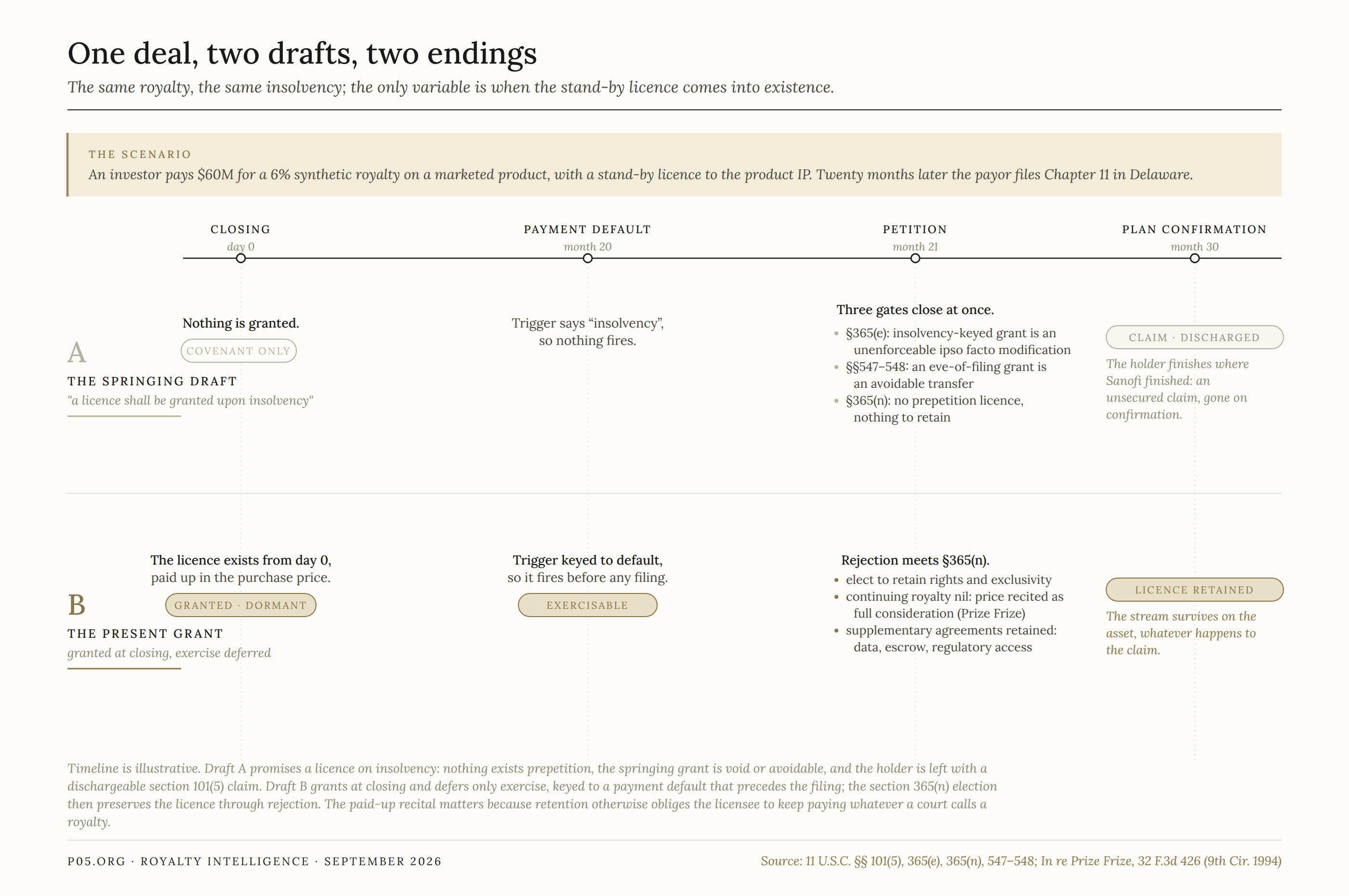
Figure 1. The same royalty and the same insolvency under two drafts of the stand-by licence. A grant that first arises on the filing meets sections 365(e), 547 and 548, and leaves nothing for section 365(n) to retain; a present grant with default-keyed triggers reaches confirmation as a retained licence.
The election is not a theoretical comfort. It has been run, and the run teaches a second lesson.
In In re CellNet Data Systems, Inc., 327 F.3d 242 (3d Cir. 2003), the debtor sold substantially all of its IP to Schlumberger under a $225M asset purchase agreement that expressly excluded an exclusive foreign licence, then rejected that licence. The licensee elected under section 365(n), kept its rights, and kept paying about $2.2M in royalties. Both the estate and Schlumberger claimed the money. The Third Circuit gave it to the estate: by carving the licence out of its purchase, the buyer had severed the royalty stream from the IP it acquired.
Read from the investor's side, the case holds twice. Rejection did not strip an electing licensee, which is the whole promise of the stand-by structure. And the post-election royalties follow the licence relationship rather than the patents, so a royalty buyer bidding in a 363 sale must take the licence agreement itself, or watch the stream stay behind with the estate.
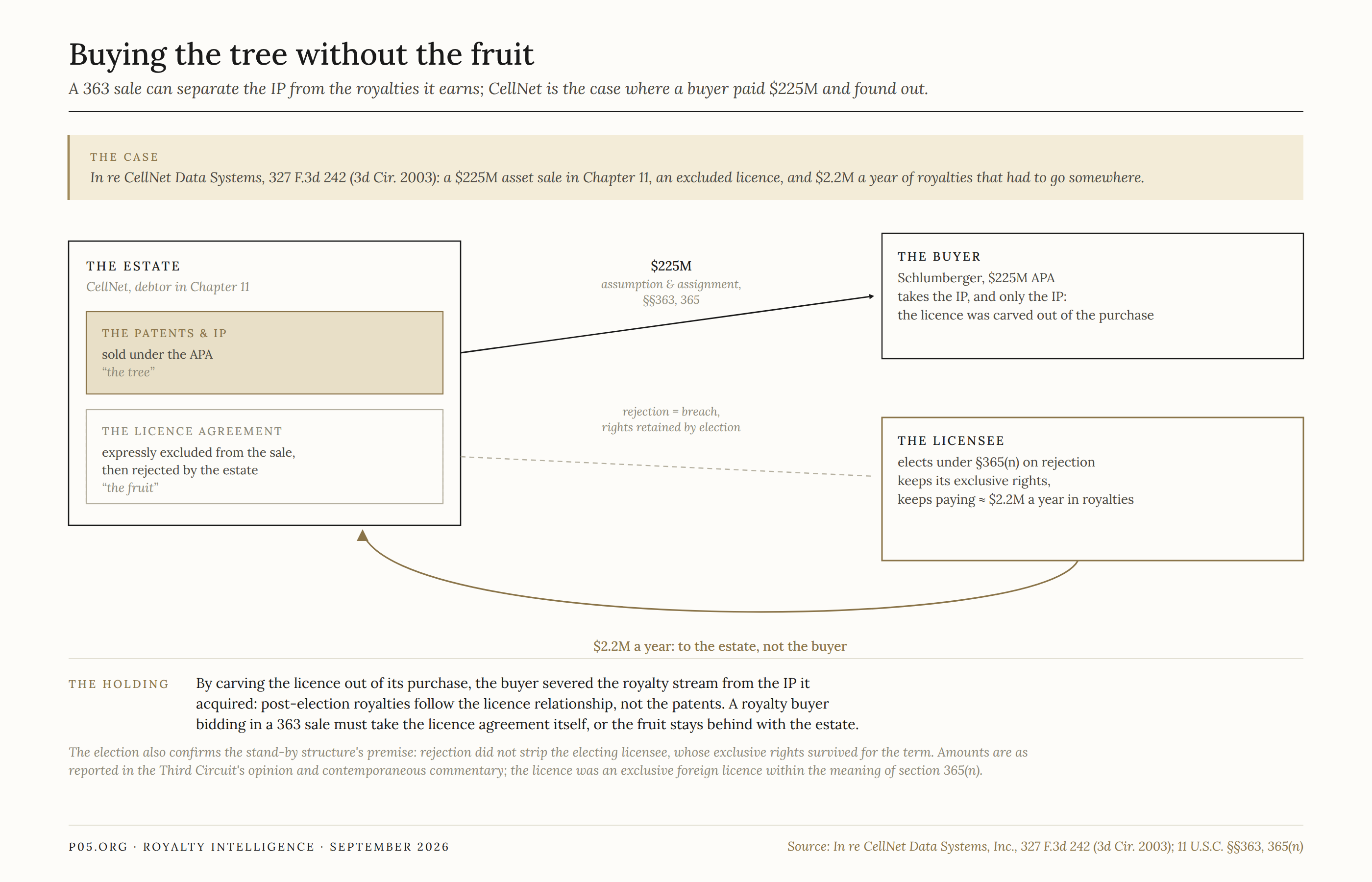
Figure 2. In re CellNet Data Systems, Inc., 327 F.3d 242 (3d Cir. 2003). The buyer took the IP and excluded the licence; the electing licensee's royalties, about $2.2M a year, stayed with the estate.
Four conditions decide whether the stand-by licence delivers the election when it is needed.
First, the grant must be present, not springing. Section 365(n) preserves rights "as such rights existed immediately before the case commenced." A licence that comes into existence only upon insolvency did not exist before the case; there is nothing to retain.
Worse, the springing mechanism itself is exposed. Section 365(e)(1) voids contract terms that modify the debtor's rights because of its insolvency, and a grant of estate IP triggered by the filing is squarely such a modification. A grant executed on the eve of the filing for no new value invites avoidance as a constructively fraudulent transfer under section 548 or a preference under section 547.
The clean structure grants the licence at closing, as part of the consideration the purchase price buys, and defers only the exercise conditions: the investor covenants not to practice the licence until a trigger occurs. A dormant right the investor contracted not to use is still a right that existed prepetition.
Second, the payments must be allocated. On retention, section 365(n)(2)(B) obliges the licensee to keep paying "royalties" for the licence, and In re Prize Frize, Inc., 32 F.3d 426 (9th Cir. 1994), decides what counts as a royalty by substance, not label. If the documents are silent, an estate will argue that the investor must fund the whole bundle of the payor's continuing obligations as the cost of keeping the licence.
The fix is drafted at closing. The stand-by licence is expressed as fully paid-up, with the purchase price recited as the entire consideration for both the royalty and the licence, so that the continuing royalty owed on retention is zero or nominal. Firms advising licensees make the same allocation point for service-heavy licences generally: separate what pays for the IP from what pays for everything else, or expect to pay for everything.
Third, the licence must cover enumerated IP, and the coverage has gaps. Section 101(35A) reaches patents, patent applications, trade secrets, and copyrights. Trademarks are outside the definition; a stand-by trademark licence survives rejection only on the breach-not-rescission logic of Mission Product Holdings, Inc. v. Tempnology, LLC, 139 S. Ct. 1652 (2019), a weaker and slower position than the statutory election, as the section 365 piece set out.
Foreign patents are arguably outside the definition entirely. In re Qimonda AG, 462 B.R. 165 (Bankr. E.D. Va. 2011), aff'd, 737 F.3d 14 (4th Cir. 2013), had to reach for the Chapter 15 public-policy exception to give licensees section 365(n)-equivalent protection, and only for the US patents, with roughly $47M of re-licensing fees at stake.
A stand-by licence over the EU patent family of a product sold across Europe therefore gets no statutory election in a US case for those patents. That is one of two reasons the European sections below matter even to a fund that only ever expects to litigate in Delaware.
Fourth, the exercise mechanics have to survive contact with the automatic stay. Electing under section 365(n) is protected conduct. Terminating the payor's rights, sweeping its customers, or converting the licence from non-exclusive to exclusive after the petition are not obviously protected, and an insolvency-keyed exclusivity flip is an ipso facto modification with the same section 365(e) exposure as a springing grant. Deal counsel therefore key the harder triggers to non-insolvency events (payment default, cessation of commercialisation, abandonment) that in practice precede the filing, an approach with an English pedigree discussed below.
The remedial licence, by contrast, asks for less and reliably gets it. Its function is collateral liquidity, and it has become standard text.
Biohaven's April 2025 note purchase agreement with Oberland Capital, under which <cite index="76-1">Oberland may purchase up to $600 million of senior secured notes, with $250 million funded at closing</cite> against milestone and royalty payments on troriluzole, grants the purchaser agent an irrevocable, non-exclusive, assignable licence to the obligors' IP, exercisable only during an event of default, royalty-free, for the purpose of exercising remedies. Verastem's January 2025 note purchase agreement carries the same section 9.6 grant, as does ClearPoint Neuro's 2025 facility, down to the provision that a sublicence granted by the agent binds the obligor even after the default is cured.
One background rule explains why the deal takes a licence from the grantor rather than relying on the lien alone. UCC section 9-408 lets a security interest attach to the payor's own in-licences despite anti-assignment terms, but makes that interest essentially unenforceable against the licensor. The only IP rights a foreclosure buyer can count on practising are the ones the grantor itself owned and licensed out in the security agreement.
2. United Kingdom: no election, different threats
English law has no section 365(n). It also has no general rejection power, which changes what the stand-by licence is for.
A licence governed by English law does not terminate automatically on the licensor's insolvency; the contract's own terms govern. An administrator has no statutory power to disclaim onerous contracts at all. If the company in administration stops performing, the counterparty holds an unsecured damages claim, but the granted rights are not stripped.
A liquidator can disclaim a licence as onerous property under section 178 of the Insolvency Act 1986. Yet even disclaimer is narrower than US rejection: it determines the company's rights and liabilities but does not affect the rights of any other person except so far as necessary to release the company, so a licensee that keeps performing can generally keep using. The disclaimer cases that bite involve licences loaded with continuing licensor obligations, such as maintaining and renewing a registration estate.
The English threat to a stand-by licence comes from the other direction: the common-law anti-deprivation rule. Belmont Park Investments Pty Ltd v BNY Corporate Trustee Services Ltd [2011] UKSC 38 invalidates arrangements that withdraw an asset from the estate on insolvency to the detriment of creditors, while sparing bona fide commercial arrangements entered into without the purpose of evading insolvency law.
Map that onto the drafting choices. A licence granted at closing for full value, with exercise deferred, is a completed commercial bargain; the estate was never deprived of anything on insolvency because the right left the estate (to the extent granted) at closing. An exclusive, royalty-free licence that springs into existence upon the appointment of an administrator, for no new consideration, is close to the paradigm the rule condemns: value leaves the estate at the moment of insolvency and because of it.
The Baker McKenzie insolvency survey makes the same point about automatic IP assignment clauses, which are workable in England only where the transfer price is set at arm's length so the clause does not fall foul of the anti-deprivation principle.
Belmont itself supplies the second drafting lesson: the flip there survived partly because a trigger other than the relevant insolvency had already occurred. Triggers keyed to payment default and abandonment, rather than to the filing, both start the clock earlier and stand on firmer doctrinal ground.
Two statutory overlays complete the English picture, and neither helps the investor. The Corporate Insolvency and Governance Act 2020 inserted section 233B into the Insolvency Act, which prevents suppliers from terminating supply contracts because the customer has entered an insolvency procedure.
The protection runs one way, to the insolvent customer. It gives a licensee facing an insolvent licensor nothing, and it can restrain an investor who is itself a "supplier" of anything to the distressed payor. Second, the administration moratorium bars enforcement of security without consent or leave of court, so a remedial licence coupled to a fixed charge waits at the same gate as the charge itself.
What does the work in England is therefore priority and publicity rather than election. A patent licence and any security over the patents should be registered at the UKIPO: under sections 33 and 68 of the Patents Act 1977, registration protects the licence against a later inconsistent transaction, including a purchaser buying the IP from the office-holder, and preserves full remedies. An investor whose stand-by licence is granted at closing, registered, and paired with a registered fixed charge holds a position an administrator must deal around, which in practice means the position gets bought out rather than breached.
3. European Union: the springing trigger is the part that fails
There is no EU-level licensee protection. The Insolvency Regulation 2015/848 points the effects of insolvency on current contracts to the law of the state of the main proceeding, with a carve-out (Article 8) preserving rights in rem over assets located in other Member States. So the analysis is national, and the two largest jurisdictions are instructive because they invalidate the stand-by licence's most tempting feature.
Germany. IP licences are treated as continuing mutual contracts within section 103 of the Insolvenzordnung: the administrator elects performance or non-performance, and on non-performance the licensee holds an insolvency claim for damages, paid in the quota.
The statute then closes the contractual exits. Section 119 InsO voids agreements that restrict the administrator's election, and the Bundesgerichtshof held in its judgment of 15 November 2012 that termination clauses triggered by insolvency are invalid because they hollow out that election, while clauses keyed to non-insolvency events survive. A stand-by licence whose grant or upgrade fires on Insolvenzantrag is, under German doctrine, drafted to fail twice over.
What German law leaves open is the completed disposition. In its software usage right decision the BGH accepted that a conditional transfer of the usage right, agreed before insolvency, takes effect despite the administrator's rejection of the licence agreement: rejecting the contract could not undo a transfer the debtor had already made.
The sublicence trilogy points the same way. Reifen Progressiv (2009), then M2Trade and Take Five (both 2012), held that sublicences survive the fall of the main licence, treating the granted right as detached from the continuing contract that spawned it.
The German version of the stand-by licence is therefore a fully paid-up grant completed at closing, structured as a disposition with as little continuing mutual performance as the deal allows. Ideally it is reinforced by a registered pledge over the IP itself, which travels through the Article 8 rights-in-rem carve-out if the main proceeding opens elsewhere in the EU.
None of this is as reliable as a statutory election, and the legislature has known it for two decades. The draft section 108a InsO, which would have made licences insolvency-proof, failed repeatedly against the combined resistance of administrators, secured creditors, and licensors, and as of September 2026 it remains unenacted.
France. The safeguard and redressement regimes give the administrator an election to continue contrats en cours under Article L.622-13 of the Code de commerce and void clauses that terminate or modify a contract by reason of the opening of the proceeding. The pattern matches Germany's: the election is mandatory law, the insolvency trigger is unenforceable, and the licensee's protection is whatever survived as a completed grant plus its priority position.
The Directive. For preventive restructuring (the pre-insolvency workbench that Germany's StaRUG and the Dutch WHOA implement), Directive 2019/1023 requires Member States to prevent creditors from terminating, accelerating, or modifying executory contracts solely because of the stay or the opening of the procedure. Article 7(5) is written against the counterparty of the distressed debtor, which includes a royalty investor: exercise triggers keyed to the payor's entry into a European restructuring procedure may simply be unavailable during the stay. The abandonment and payment-default triggers, which will usually have fired first, are again the ones that hold.
The EU conclusion is uncomfortable but usable. In a European main proceeding the stand-by licence protects to the extent it was already executed, paid, and (where a register exists) recorded before the crisis, and to the extent the exercise triggers do not mention insolvency. The springing exclusivity flip, the insolvency-keyed grant, and the ipso facto exercise right, the three features a US-trained drafter reaches for first, are the three features Continental law is built to strike down.
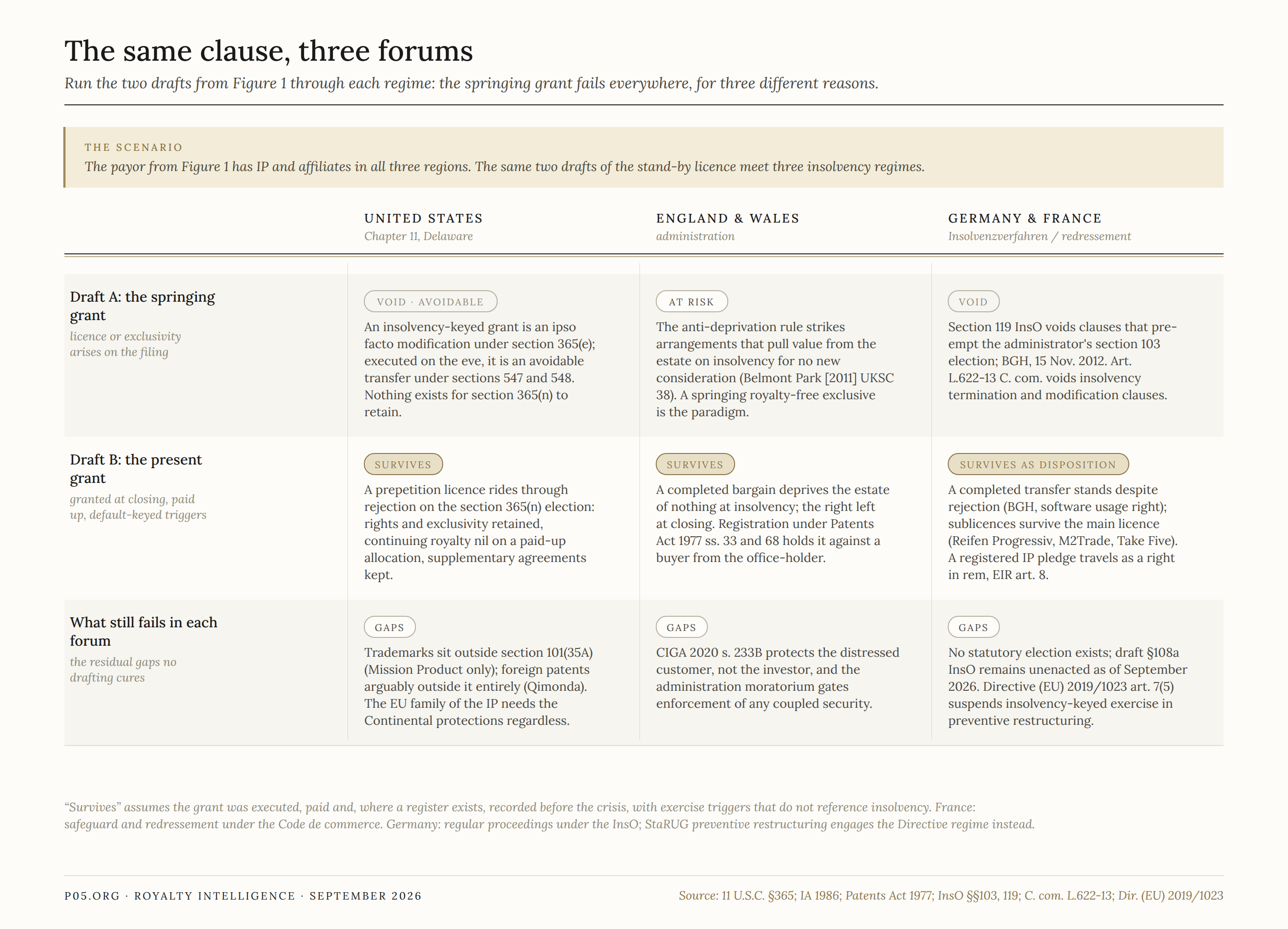
Figure 3. The two drafts of Figure 1 run through three insolvency regimes. The springing grant fails in each forum for a different reason; the completed grant survives, on different machinery in each.
4. What the stand-by licence changes in a royalty deal
It reprices the downside. A royalty on a well-capitalised marketer is underwritten on sales; the licence never wakes. The instrument matters in the segment the market has repriced since Mallinckrodt: single-product payors, levered mid-caps, and synthetic royalties, where the stream is a creature of the purchase agreement rather than of a pre-existing in-licence.
That is the segment growing fastest. Royalty Pharma's fourth-quarter 2025 call put <cite index="39-1">synthetic royalty transaction value at $4.7B in 2025, up about 50% from the prior year, with the company's own four synthetic deals exceeding $2B</cite>. Every one of those deals had to answer the Sanofi question in its documents, and the stand-by licence is one of the two standard answers, the other being the lien-plus-remedial-licence package in the Biohaven and Verastem form.
It changes what diligence has to read. For the investor, the licence is only as good as the payor's own chain of title. A stand-by licence granted by a payor that is itself a licensee conveys nothing the head licence forbids, and section 9-408's limits mean the security interest does not fix that. The upstream consent, the successor-in-interest clause, and the head licensor's estoppel move from nice-to-have to core diligence.
For the payor's other creditors, an exclusive stand-by licence is an encumbrance on the crown-jewel asset that sits invisible in ordinary-course financials; senior lenders now ask for it in the perfection certificate.
At small ticket sizes the same protections collide with the fixed-cost floor the aggregation piece priced: a stand-by licence adds drafting, consent, and registration cost on every name, which is bearable at $50M and punitive at $3M.
It sorts jurisdictions into two drafting families. Where the product IP and the payor sit in the US, the deal drafts toward the election: present grant, paid-up allocation, express section 365(n) and section 101(35A) recitals, supplementary-agreement language pulling the escrows and data access into the retained bundle.
Where the IP or the payor is European, the deal drafts toward the completed disposition: executed grants, local registration, registered pledges as rights in rem, non-insolvency triggers, and entity separation so that the licensor of record never files at all, the structure Sorrento's non-debtor Scilex demonstrated. Cross-border streams need both families at once, because a US election does not reach the EU patents (Qimonda) and a German completed grant does not need one.
It sits beside the put option. A put, of the kind DRI Healthcare exercised on Ekterly, converts the royalty into a repayment claim against the counterparty when defined events occur, and it is only as good as that counterparty's credit at the worst moment. The stand-by licence gives the holder recourse to the asset itself, whatever the balance sheet looks like.
A deal can rationally carry both: the put for credit deterioration short of insolvency, the licence for the proceeding itself, and both wired to the same abandonment and cessation triggers that the extinguishment piece treats as the events that end a stream before term.
What moves the position, and what only appears to
Six terms move the position.
A licence granted and effective at closing, with the purchase price recited as full consideration for royalty and licence together, so the section 365(n)(2) continuing royalty is zero and the anti-deprivation analysis sees a completed bargain.
Exercise triggers keyed to payment default, cessation of commercialisation, and abandonment, which fire before any filing and survive ipso facto scrutiny in all three legal families.
Coverage of patents, applications, trade secrets, and copyrights (the section 101(35A) set), with the trademark carried separately on Mission Product reasoning and an alternative-brand fallback.
Registration, done where each register sits: UKIPO recordal for UK patents, national pledge registration in the EU, a precautionary UCC-1 and, where exclusivity matters, USPTO recordation in the US.
Supplementary-agreement architecture: data access, regulatory file reference rights, and technology escrow named in the licence, so a section 365(n) election retains the means of exploitation and not just the abstract right.
And for EU exposure, a registered security right in the IP itself, which travels as a right in rem under Article 8 of the Insolvency Regulation when the main proceeding opens in another Member State.
Six terms only appear to.
A covenant to grant a licence upon insolvency. In the US it is an executory promise the estate can refuse and an avoidable eve-of-filing transfer if performed; in Germany and France the insolvency trigger is void; in England it is the anti-deprivation paradigm.
A springing flip from non-exclusive to exclusive keyed to the filing, for the same three reasons.
A stand-by licence from a payor whose own head licence bars sublicensing or assignment, unless the head licensor consented at closing.
Section 365(n) recitals attached to foreign patents, which the definition arguably does not reach.
An unallocated purchase price, which invites the estate to charge the full bundle of continuing payments as the cost of retention under Prize Frize.
And reliance on CIGA section 233B or Directive Article 7(5) as investor protection: both provisions protect the distressed company, and both can restrain the investor's own exercise rights.
What each side should ask
For the company raising royalty capital. What does the stand-by licence permit the investor to do on a trigger, to whom can it be assigned or sublicensed, and does that scope leak value in a workout that never reaches a filing?
Do the triggers reference insolvency directly, and if so, has anyone priced in that they are unenforceable in a German or French proceeding and vulnerable in an English one? Does the grant breach a head licence, a change-of-control clause, or a senior credit agreement's negative pledge as written today?
For the royalty investor. Is the licence a present grant with deferred exercise, or a promise to grant later, and could a trustee characterise its effective date as the eve of the petition? If I elect under section 365(n), what do I owe: is the licence expressed as paid-up, and are the royalty, service, and milestone components of the deal allocated? Which of the covered rights are US-enumerated IP, which are trademarks riding on Mission Product, and which are foreign patents with no election at all, and does the European remainder carry a registered pledge? Can I operate on exercise: do I hold data access, regulatory reference rights, and a manufacturing route, or only a naked patent licence to a product I cannot make?
For the fund or portfolio holder. Across the book, how many positions rely on a springing trigger that at least one relevant jurisdiction would strike, and what is the aggregate exposure if the answer is "the drafting we reused from the last deal"? Where a stream is money-good only through the licence, has local counsel in each IP jurisdiction confirmed the grant survives the local proceeding, or does the file hold a New York opinion for a Munich problem?
The stand-by licence has one job: when the estate's powers arrive, the royalty holder should already be standing somewhere those powers do not fully reach. Where that place is depends on the forum.
A Delaware filing puts the holder in the licensee's chair with the section 365(n) election Sanofi never had, and CellNet shows the election paying out in a live case. An English administration leaves a registered, completed grant that the office-holder can neither disclaim nor cheaply breach. A German or French proceeding respects only what was finished before it opened, since the election there belongs to the administrator and section 119 InsO strikes the clauses that try to take it back.
Across all three, the same drafting failure recurs in reviewed documents: a grant that waits for insolvency to exist, keyed to a trigger the governing law voids. The version that survives is granted at closing, paid for in the purchase price, recorded where a register exists, and woken by a payment default the payor committed while still solvent.
All information in this article was accurate as of the research date and is derived from publicly available sources including the United States Code, court decisions, UK and EU legislation, SEC filings and issuer press releases, and legal and financial commentary. Information may have changed since publication. This content is for informational purposes only and does not constitute investment, legal, accounting, tax, or financial advice. The author is not a lawyer, accountant, tax adviser, or financial adviser.