
Created, Not Bought: The Shape of a Vaccine Royalty Trade
An earlier piece on this site, The Landscape of Vaccine Royalties and Royalty Financing, mapped how vaccine royalty streams arise, how they differ from therapeutic royalties, which deals have printed, and how the messenger RNA patent wars redistributed the economics of the pandemic products. It ended on an observation it did not pursue.
Noting the royalty streams accruing to the National Institutes of Health and the University of Pennsylvania, it remarked that these are contractual cash flows which could in principle be monetised, just as the Children's Hospital of Philadelphia monetised its RotaTeq royalties.
This piece takes up that conditional, and arrives somewhere more useful than the question implies.
Vaccine royalties do trade. Five transactions since 2005, and on the available evidence all of them worked: HealthCare Royalty is still collecting roughly $29 million a quarter on a QS-21 stream it bought for $190 million in 2018, and Royalty Pharma's RotaTeq purchase was the kind of paediatric annuity the industry now spends a great deal of money trying to find. The problem is not that the asset resists financing.
The problem is that five transactions in twenty-one years is a rounding error against a royalty market that has closed more than $32 billion since 2020, is at record annual volume, and has stopped being a distress product at all. Set that beside an asset class in which no biosimilar has ever been approved anywhere, where franchises hold revenue for fifteen years and more past approval, and where erosion arrives as visible branded displacement rather than a cliff, and the gap stops looking like a verdict on vaccines and starts looking like an oversight.
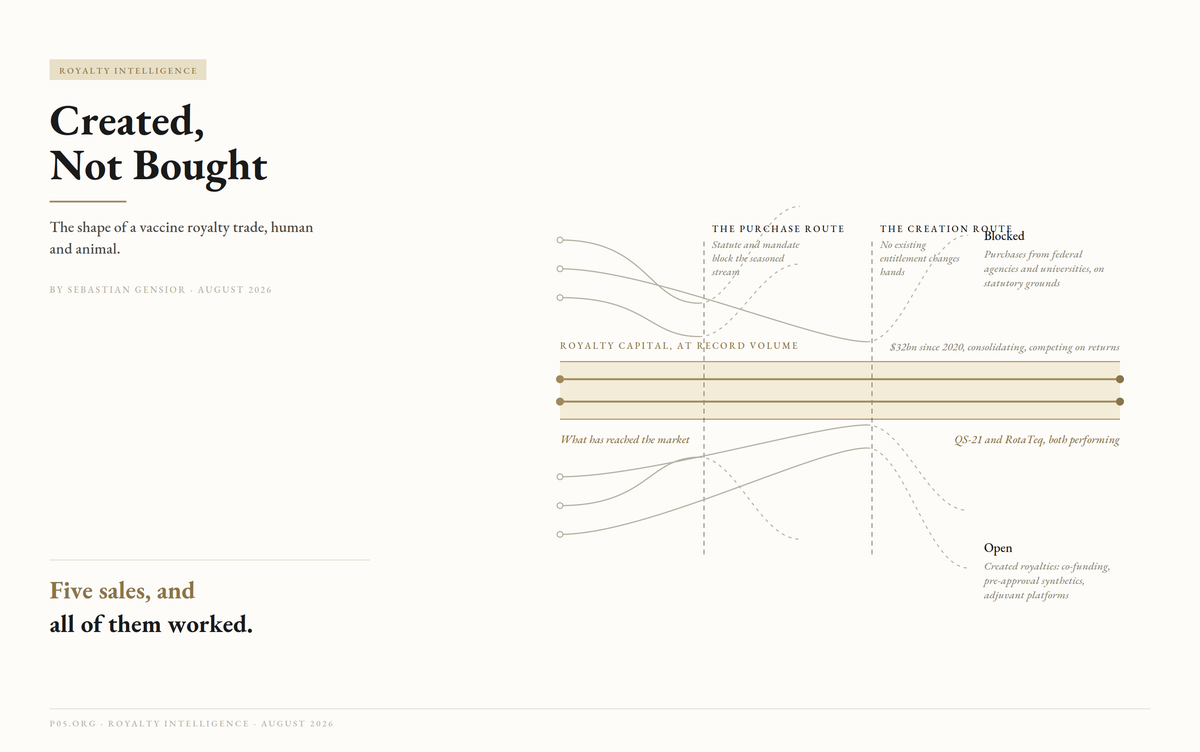
The argument here is that the market has been trying to structure the wrong transaction with the wrong counterparty. Buying a seasoned vaccine royalty means buying from a federal agency operating under a statutory allocation regime, a university whose governing statute restricts what it may do with the proceeds, or a developer who will be acquired outright before the negotiation finishes. Those are real obstacles and Part Three sets them out properly. None of them touches a created royalty, which requires no existing entitlement to change hands.
That distinction matters now rather than in the abstract. The buyers have consolidated, carry more capital than their core category can absorb at current returns, and have started constructing transactions rather than waiting for sellers to appear. Competition among them is rising, not falling: DRI's chief investment officer told the first-quarter 2026 call that there are more competitors and that post-approval returns have softened. That is precisely the condition under which a buyer looks at a sector it has never worked.
The two previous structural pieces in this series diagnosed a price failure in biosimilars, where the bond market funds the same revenue more cheaply than any structured buyer can, and an inventory failure in animal health, where streams are retired by licensee acquisition before they season. Vaccines are the third case and the most tractable of the three, because the constraint sits in the form of the transaction rather than in the price or the asset. Human and veterinary vaccines are both in scope, and the animal comparison earns its place because it removes almost every hazard the human segment carries and still produces no deals, which isolates the variable.
Part one: five sales in twenty-one years, and all of them worked
Here is the disclosed record in full.
Wistar Institute to Paul Royalty Fund, December 2005, $45 million for a partial interest in Merck's RotaTeq royalty. Children's Hospital of Philadelphia Foundation to Royalty Pharma, April 2008, $182 million for its worldwide RotaTeq interest.
Agenus to Oberland Capital, September 2015, a $115 million advance against QS-21 royalties at 13.5 per cent interest, followed by Agenus to HealthCare Royalty, January 2018, a sale of one hundred per cent of its worldwide QS-21 rights for $190 million at closing plus up to $40 million in milestones. Sutro Biopharma to Blackstone Life Sciences, 2023, $140 million upfront with up to $250 million in earn-outs for a four per cent royalty interest in Vaxcyte's pneumococcal candidates. And CureVac's monetisation of part of its United States product royalties to GSK, August 2025, for $50 million taken not in cash but as the value of an amendment reducing GSK's future royalty obligations, disclosed in GSK's own filing on the settlement.
One transaction commonly listed alongside these is not one. GSK's Gardasil royalty income fell from £472 million in 2023 to £42 million in 2024, which has been read as a divestiture. GSK's own filings describe it differently: the Q3 2023 announcement stated that the majority of the income from Gardasil royalties would cease at the end of 2023, and the 2024 Form 20-F attributes the fall to "the cessation of the majority of Gardasil royalties at the end of 2023". The entitlement ran out. Nobody bought it, and the earlier piece on this site, which described GSK as having divested the rights, should be read with that correction.
The conventional way to read that list is by asset type, which is what the February piece did: two paediatric annuities, one adjuvant, one pre-commercial synthetic, one cross-licence residual. Cutting it by seller turns out to be more revealing.
Wistar and the Children's Hospital of Philadelphia Foundation were research institutions with a defined use for present capital. Agenus was a chronically cash-hungry biotech that paid thirteen and a half per cent for an advance and then sold the asset outright three years later, using most of the proceeds to retire that same advance. Sutro was funding its own pipeline, and CureVac gave up part of a royalty entitlement while settling litigation and being acquired.
Removing the Gardasil entry sharpens the pattern rather than weakening it. What remains is five transactions in two categories only: research institutions with a defined capital use, and cash-constrained biotechs. The category of the large corporate calmly disposing of a non-core royalty is empty.
That is worth holding onto, because it is now out of step with the rest of the market. Elsewhere in biopharma the distressed seller has ceased to be the typical counterparty, and royalty structures are used routinely by well-capitalised companies as portfolio tools. Vaccines are running a version of royalty finance that the rest of the industry left behind, and Part Four takes up why.
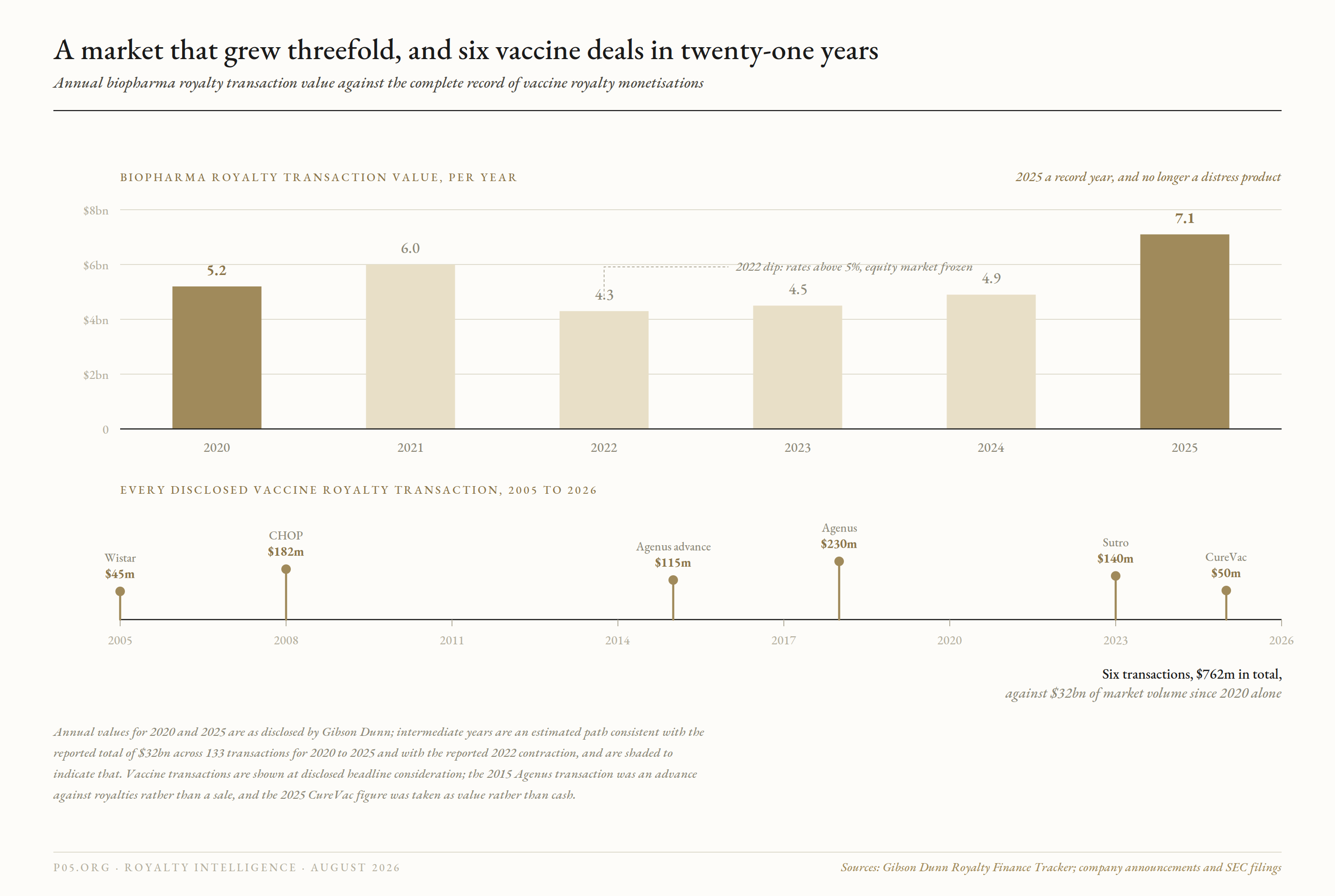
Figure 1. A market that grew threefold, and six vaccine deals in twenty-one years. Annual biopharma royalty transaction value against the complete record of vaccine royalty monetisations.
The performance question is worth settling first, because it determines whether the rest of the article is about an oversight or about a correctly priced avoidance. Agenus continues to account for the 2018 HealthCare Royalty sale as a liability, recognising the royalty flow through its income statement.
In the first quarter of 2026 alone it recorded $29.1 million of non-cash royalty revenue and $8.7 million of related non-cash interest expense on the HealthCare Royalty arrangement. Annualised, that is well over $100 million a year reaching the buyer, against $190 million paid at closing in 2018. Whatever else is true of vaccine royalties, the QS-21 trade performed.
Part two: the inventory the settlements created
Between late 2024 and early 2026 a series of settlements converted contested infringement claims into contractual royalty rights. The February piece catalogued them as litigation outcomes, but viewed as supply they look quite different.
BioNTech settled with the National Institutes of Health for $791.5 million and with the University of Pennsylvania for up to $467 million, in each case with continuing low single-digit royalties on future sales. Moderna's arrangement with NIH involved a reported $400 million with a low single-digit running royalty. The August 2025 settlement with CureVac and GSK produced $370 million to each party, plus a one per cent running royalty to each on United States sales of licensed messenger RNA COVID and influenza products from 1 January 2025.
A further $130 million and a one per cent rest-of-world royalty to GSK were triggered on completion of BioNTech's acquisition of CureVac, which closed in January 2026.
Leaving the lump sums aside, what remains is a set of perpetual or long-dated percentage entitlements on Comirnaty, Spikevax and their successors, held by a federal agency, a university, and a large pharmaceutical company.
These are, in cash-flow terms, exactly what a royalty buyer wants: contractual, uncapped, tied to products with established manufacturing and distribution, and senior to nothing because they sit on net sales rather than on profit. Created inside twenty-four months, they plausibly exceed in present value the aggregate of every vaccine royalty monetisation completed since 2005, and almost none of it is available to a buyer.
The exception is worth naming precisely, because it is the most obviously financeable vaccine royalty in existence and appears to have attracted no comment. GSK's own filing records that it receives a one per cent royalty on United States sales of influenza, COVID-19 and related combination messenger RNA products by BioNTech and Pfizer from the beginning of 2025, with a further $130 million and a one per cent rest-of-world royalty on completion of the CureVac acquisition.
Two features of the disclosure matter. The payments are stated to be due under the terms of GSK's pre-existing licence agreement with CureVac, so this is a contractual royalty rather than a bare settlement artefact. And GSK confirms that, unlike the upfront sum booked as an adjusting item, the royalty income is recorded in both total and core results, which is to say treated as recurring revenue.
A one per cent recurring royalty on Comirnaty and its successors, worldwide, held by an ordinary corporate with no statutory constraint on alienation. Whether GSK wishes to sell is a different question from whether it is able to, and on the second there is no real doubt.
Part three: why buying a seasoned stream is the hard route
The legal core of the argument sits here, and it is where the vaccine sector diverges from every other corner of royalty finance. It is also, importantly, a constraint on purchases and not on the sector as a whole, which is the distinction Part Six turns on.
The federal position
Royalty income received by a federal agency from licensing its own inventions is not general revenue that the agency may deploy as it chooses. It is subject to a statutory allocation regime under the Federal Technology Transfer Act, codified at 15 U.S.C. §3710c. The agency must pay the inventor at least fifteen per cent of royalties received, subject to an annual cap above which payment requires Presidential approval, and the balance is directed to specified purposes, principally further research and development, technology transfer activities, awards, and education, at the laboratory that produced the invention.
Two features of that regime bear on monetisation. The first is that the statute is written in terms of royalties received, contemplating a stream arriving and being allocated rather than the agency disposing of the right to receive it, and there is no evident mechanism by which the proceeds of such a disposal would be characterised, allocated between inventor and laboratory, or timed.
An agency selling a twenty-year stream for a present sum would have to decide whether the inventor's fifteen per cent minimum attaches to the sale proceeds in year one, to the notional royalties that would have arisen over twenty years, or to neither.
The second, and more fundamental, is that alienating a future federal receivable is a disposition of government property, which requires affirmative statutory authority. The Stevenson-Wydler and Bayh-Dole framework grants agencies authority to license. It does not obviously grant authority to sell the resulting income stream to a third party.
No federal agency appears to have tested any of this, and the reading above is an inference from the statutory structure rather than a settled proposition, so a reader with a contrary view of federal fiscal authority may well reach a different conclusion. The practical position is nonetheless not in doubt, in that the NIH royalty on Comirnaty is not, on any current understanding, an asset a royalty fund can buy.
The university position
Universities operate under a different constraint that arrives at a similar result by another route. Where an invention arises from federally funded research, 35 U.S.C. §202(c)(7)(C) requires a non-profit contractor to use the balance of royalties, after payment of expenses incidental to administration of the subject invention and after the share paid to inventors, for the support of scientific research or education.
A university selling a royalty therefore does not liberate capital in the way a biotech does. It converts a long-dated stream, which it must spend on research and education, into a discounted present sum, which it must also spend on research and education. The transaction changes the timing of institutional spending and reduces its total, in exchange for certainty. For an institution facing a specific near-term capital project, which is precisely the CHOP Foundation case, that can be a defensible trade; for one with no such project it is a poor one.
Layered on top is an inventor-share problem that is under-discussed and, in practice, may be the harder obstacle. The statute requires royalty sharing with inventors as well as restricted use of the balance, at 35 U.S.C. §202(c)(7)(B) and (C), and institutional policies implement it in ways that assume a recurring stream. Stanford, to take a documented example, allocates the first fifteen per cent of net licence revenue after patenting costs to its technology transfer office and then splits the remaining eighty-five per cent in three equal parts among the inventors, their department and their school.
A sale crystallises twenty years of that entitlement into a single event. Whether inventors are paid their share of the sale proceeds immediately, whether they are paid out of the proceeds over time, and whether they can object to a transaction that alters the character and timing of their entitlement are questions most university licensing policies do not squarely address, because they were drafted for a world in which royalties arrive quarterly.
Penn's own position illustrates the economics, in that having received cumulative licensing receipts of the order of $2 billion, and reporting close to $1 billion of licensing revenue in a single year, its response was to commit to a large research expansion. An institution in that position has no leverage, no maturity wall, no dilution pressure and no cost of capital problem. It has the opposite of the profile that produces sellers in every other royalty market.
The reputational overlay
To the legal and financial constraints add a third, which is not legal but is real. Selling a royalty derived from publicly funded vaccine research, to a financial buyer, at a discount, in the current political environment, is not a transaction most university or agency communications offices would welcome. The counterfactual is easy to state and hard to defend in a hearing: the institution took a lump sum from a fund, and the fund made a multiple on it, using research the taxpayer paid for.
That consideration appears in no licensing policy anywhere, and shapes behaviour regardless.
The observation to draw is that the royalty market's origination apparatus is calibrated to counterparties with a cost of capital, a funding gap or an impatient shareholder, and that the largest holders of vaccine royalty rights have none of those things. That rules out one route into the sector. It says nothing about the others, because none of the constraints above attaches to a royalty that does not yet exist.
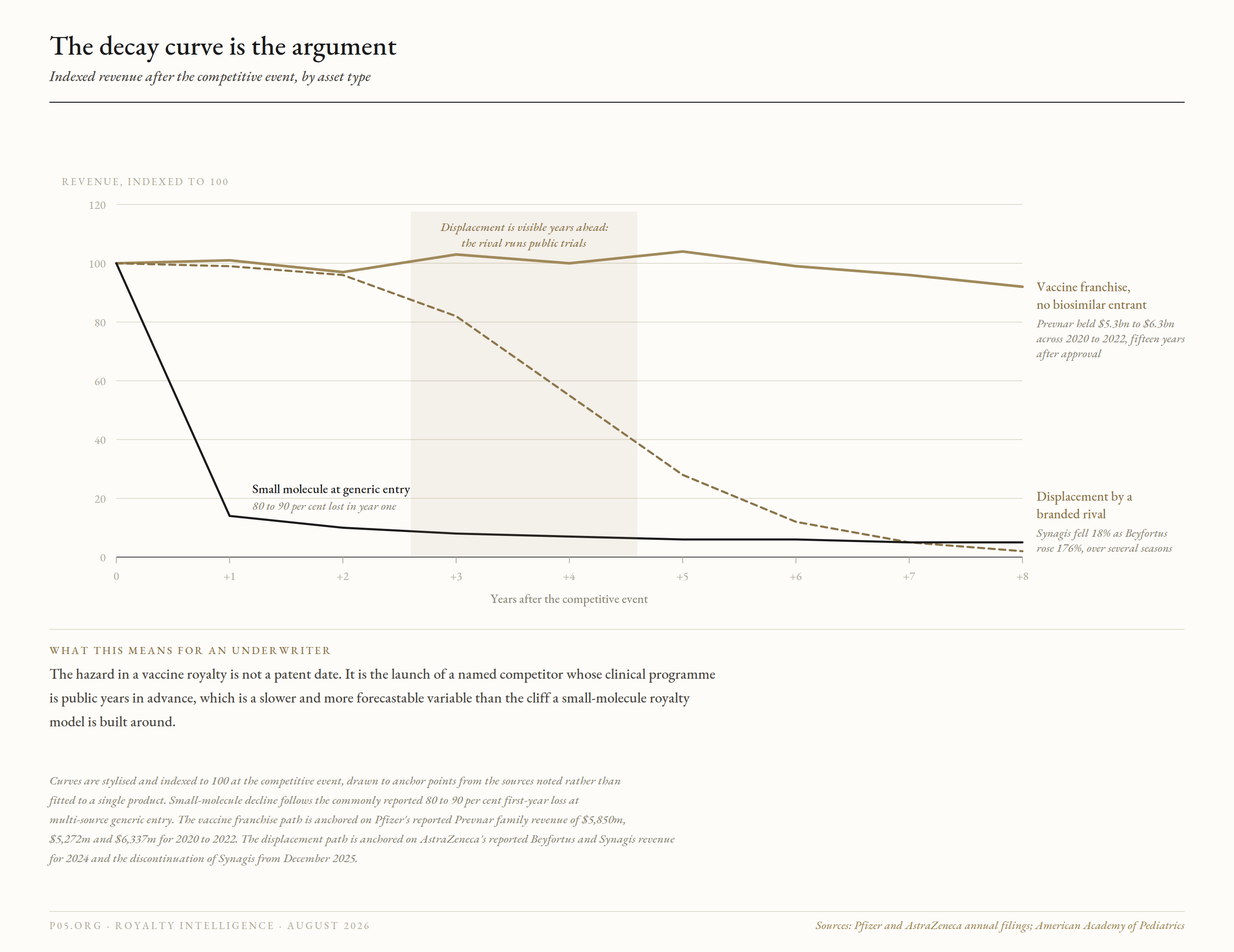
Figure 2. The decay curve is the argument. Indexed revenue after the competitive event, by asset type.
Part four: the instrument is booming, and vaccines are absent from it
There is an obvious objection to everything above, which is that the argument sounds like a story about a bad market. It is not, and the 2026 evidence makes the point sharply enough to be worth setting out before going further.
There is no funding winter
Biopharma is in the middle of a strong cycle. J.P. Morgan counts $96 billion of merger and acquisition value across 80 deals in the first half of 2026, with two consecutive quarters above $40 billion. BioPharma Dive records 38 acquisitions struck by mid-year, the fastest acquisition pace in at least seven years, alongside 13 initial public offerings raising a combined $4.5 billion at an unusually large median of roughly $302 million, most of them trading above issue. Venture funding reached $9.1 billion across at least 68 companies in the first half, the highest first-half total since the start of 2022.
The vaccine names are not excluded from this. Vaxcyte, the sector's flagship pre-commercial developer and the underlying of the only synthetic vaccine royalty in existence, holds more than $2.4 billion of cash against a market capitalisation of roughly $8.6 billion, with a completed manufacturing facility and an equity financing behind it. Novavax reports liquidity sufficient to fund operations into 2028. Moderna's shares were up 94 per cent over 2026 to mid-year.
Any argument that vaccine royalties do not trade because vaccine companies cannot raise money is therefore wrong on the 2026 facts, and an earlier draft of this piece made exactly that error.
Nor is the instrument out of favour
The second possibility is that royalty finance itself is counter-cyclical, and that an open equity market removes the reason to monetise. The evidence rejects that too, and does so explicitly.
Gibson Dunn's 2026 market update records that royalty deal value grew 37 per cent from $5.2 billion in 2020 to $7.1 billion in 2025, with volume stabilising at 25 to 27 transactions a year and more than $32 billion closed across 133 transactions since 2020. Its reading of the 2022 dip is the relevant part: volume recovered to record levels even as rates climbed above five per cent, which it takes as demonstrating that royalty finance demand is embedded in how biopharma companies fund themselves and is not dependent on cheap capital.
More to the point, the buyer base has moved beyond the distressed seller entirely. Gibson Dunn's 2026 outlook describes royalty and synthetic royalty transactions as increasingly used not only by capital-constrained companies but by large, well-capitalised biopharma companies as tools for portfolio de-risking and capital optimisation, and cites a Deloitte survey in which 87 per cent of biopharma executives expect to incorporate royalty financing into their capital-raising strategy over the following three years.
Royalty Pharma announced up to $1.25 billion of transactions in the first quarter of 2026 alone, grew royalty receipts 13 per cent, raised full-year guidance, and opened a research and development co-funding line with Johnson & Johnson and Teva.
So the instrument is at record volume, is no longer a distress product, and is being used by exactly the sort of well-capitalised counterparty that the vaccine sector is full of.
Which makes the absence harder to explain, not easier
Strip out the cyclical explanations and two remain, one of which is the subject of Part Three and one of which is new.
The first is the statutory holder problem. A federal agency subject to an allocation regime and a university subject to restricted use of proceeds do not become sellers because the equity market opened. Their constraint is indifferent to the cycle, which is why it is the durable half of this argument.
The second is that in vaccines, the whole company trades instead of the royalty, and the current cycle is accelerating that rather than slowing it. BioNTech's acquisition of CureVac closed in January 2026 and, alongside the settlement, folded the platform estate and the associated royalty and litigation exposure into the acquirer. Sanofi agreed to acquire Dynavax and with it the CpG 1018 adjuvant platform. AstraZeneca took Icosavax.
XOMA Royalty took HilleVax. In each case an asset that could have supported a royalty transaction was instead absorbed whole.
That is the same reflex identified in the animal health piece, operating in human vaccines and operating faster in a strong M&A market than in a weak one. A strategic acquirer buying the company pays for the platform, the pipeline, the manufacturing and the elimination of a liability. A royalty buyer purchasing a stream pays for the stream. The strategic will generally win that auction, and in 2026 it has the balance sheet to do so.
The revised reading is that vaccine royalties are absent from a booming royalty market for two reasons that have nothing to do with capital availability. The holders who could sell the best streams are statutorily constrained, and the developers who own the rest are being bought outright before a royalty transaction can be contemplated. Neither improves when the cycle improves. Both get worse.
Part five: what has changed since February, and what could change
Five matters have moved materially in the five months since the landscape piece, and each bears on valuation.
The recommendation apparatus was enjoined, and the injunction is on appeal
On 16 March 2026 Judge Brian E. Murphy of the United States District Court for the District of Massachusetts granted substantially all the preliminary relief sought in American Academy of Pediatrics v. Kennedy. The order stays the Secretary's appointments to the Advisory Committee on Immunization Practices as likely made in violation of the Federal Advisory Committee Act, and stays all votes the reconstituted committee took.
It also stays the revised childhood immunisation schedule issued on 5 January 2026, overturns the May 2025 secretarial directive on COVID-19 recommendations, and reverses the hepatitis B downgrade voted at the December 2025 meeting, with the committee's scheduled March 2026 meeting postponed in consequence.
The government appealed on 29 April 2026, and the docket shows a motion for stay briefed through July 2026. As of August 2026 the operative childhood schedule is the one in force before 5 January 2026, by injunction, pending appellate resolution.
The consequence for royalty valuation is not simply that recommendations were restored, but that the operative schedule has become a judicial artefact subject to reversal on appeal, which is a materially different thing to underwrite than an agency recommendation.
There is a second-order effect that has received almost no attention and matters more to a royalty holder than the schedule itself. The Congressional Research Service has examined the implications of the revised schedule for the Vaccine Injury Compensation Program. Coverage under that programme, and the excise tax that funds it, is tied to vaccines recommended for routine administration to children.
A vaccine removed from the schedule may fall outside the compensation system, which would return injury claims to the ordinary tort system and strip manufacturers of the liability channelling that has underwritten vaccine economics for four decades.
For a royalty holder that is the most consequential exposure in the entire policy sequence. A recommendation change moves volume, whereas a change in the liability architecture bears on whether the licensee wishes to remain in the business at all, and a royalty is worth nothing if the payor exits the product.
The largest vaccine patent case settled on the courthouse steps, and left the key question open
Moderna settled with Arbutus and Genevant days before the first of the pandemic patent cases was due to reach a Delaware jury. The structure is unusual and deliberate: $950 million payable in July 2026 resolving all infringement damages, and a further $1.3 billion contingent on the outcome of an appeal, with no future royalties owed.
The settlement caps Moderna's exposure at $2.25 billion while preserving a Federal Circuit fight over whether pandemic-era government contracts shield manufacturers from infringement claims. One academic observer had predicted the case could have produced the largest patent verdict in United States history.
The preserved question is the government-contractor defence under 28 U.S.C. §1498. Where an invention is used by or for the United States with its authorisation and consent, the patentee's remedy lies against the government in the Court of Federal Claims, sounding in reasonable and entire compensation, and injunctive relief is unavailable.
If that provision reaches Operation Warp Speed procurement, a substantial part of the pandemic infringement exposure converts from a private claim with injunction leverage into a compensation claim against the sovereign.
For anyone valuing a vaccine royalty this is the single most consequential pending legal question in the sector. It determines the size of the residual claims against Pfizer and BioNTech, whose Arbutus and Genevant litigation in the District of New Jersey continues, and it establishes whether the settlement-created royalty layer described in Part Two is a durable feature or a one-off consequence of parties choosing to settle rather than litigate a novel defence.
The only live pre-commercial vaccine royalty reaches its readout
The Sutro and Blackstone transaction is the sector's one synthetic royalty on an unapproved product, and it resolves shortly. Vaxcyte completed enrolment of the OPUS-1 pivotal non-inferiority trial in approximately 4,000 participants, and of OPUS-2, in March 2026, with topline OPUS-1 data expected in the fourth quarter of 2026 and OPUS-2 and OPUS-3 in the first half of 2027.
The underlying Sutro licence runs, per Vaxcyte's own disclosure, until the later of expiry of the last valid claim and ten years after first commercial sale, with the latest licensed patent application expiring in 2036, and carries low-teens percentage participation in net sublicensing revenue.
A single readout in the fourth quarter of 2026 will therefore mark the sector's only pre-commercial royalty position either into the money or out of it. Whichever way it resolves, it will be the first real evidence on whether synthetic royalties work in vaccines, and it will be read as such.
The buyer side consolidated, and now has to find somewhere to put the money
The most consequential development for this sector is happening among the buyers rather than the sellers.
KKR acquired a majority stake in HealthCare Royalty Partners in July 2025, a firm that had committed over $7 billion since inception and managed roughly $3 billion across more than 55 products, folding it into a platform with eighteen origination businesses and a $6.5 billion asset-based finance fund behind it. Ligand completed its purchase of XOMA Royalty in July 2026.
Royalty Pharma and DRI Healthcare have both internalised their management functions, and Royalty Pharma carries a Fitch upgrade to BBB.
Read the acquirers' own statements of why. KKR's rationale for HCRx was that the biopharma royalty market "is currently addressing only a small portion of total biopharma capital needs." HCRx's chief executive has said the market has been compounding at over twenty per cent and that he expects it to double or triple over three to five years, with an ambition to add equity and growth equity so as to offer multiple layers of financing to emerging biopharma companies.
At the same time returns in the established part of the market are compressing. DRI Healthcare's chief investment officer told the first-quarter 2026 call that there are more competitors and that returns in the post-approval setting may have slightly decreased, while the complexity of the business remains a barrier to entry, and described a deliberate shift toward pre-approval assets to extend duration and lift unlevered returns.
That combination, consolidated platforms with more capital, an explicit ambition to multiply the addressable market, and thinner returns in the category everyone already competes in, is the condition under which buyers go looking for new categories. Royalty Pharma has already answered it in one direction, opening research and development co-funding lines with Johnson & Johnson and Teva and describing the opportunity in trillions. DRI has answered it in another, moving earlier in the asset's life.
Vaccines are one of the few large categories none of them has yet worked.
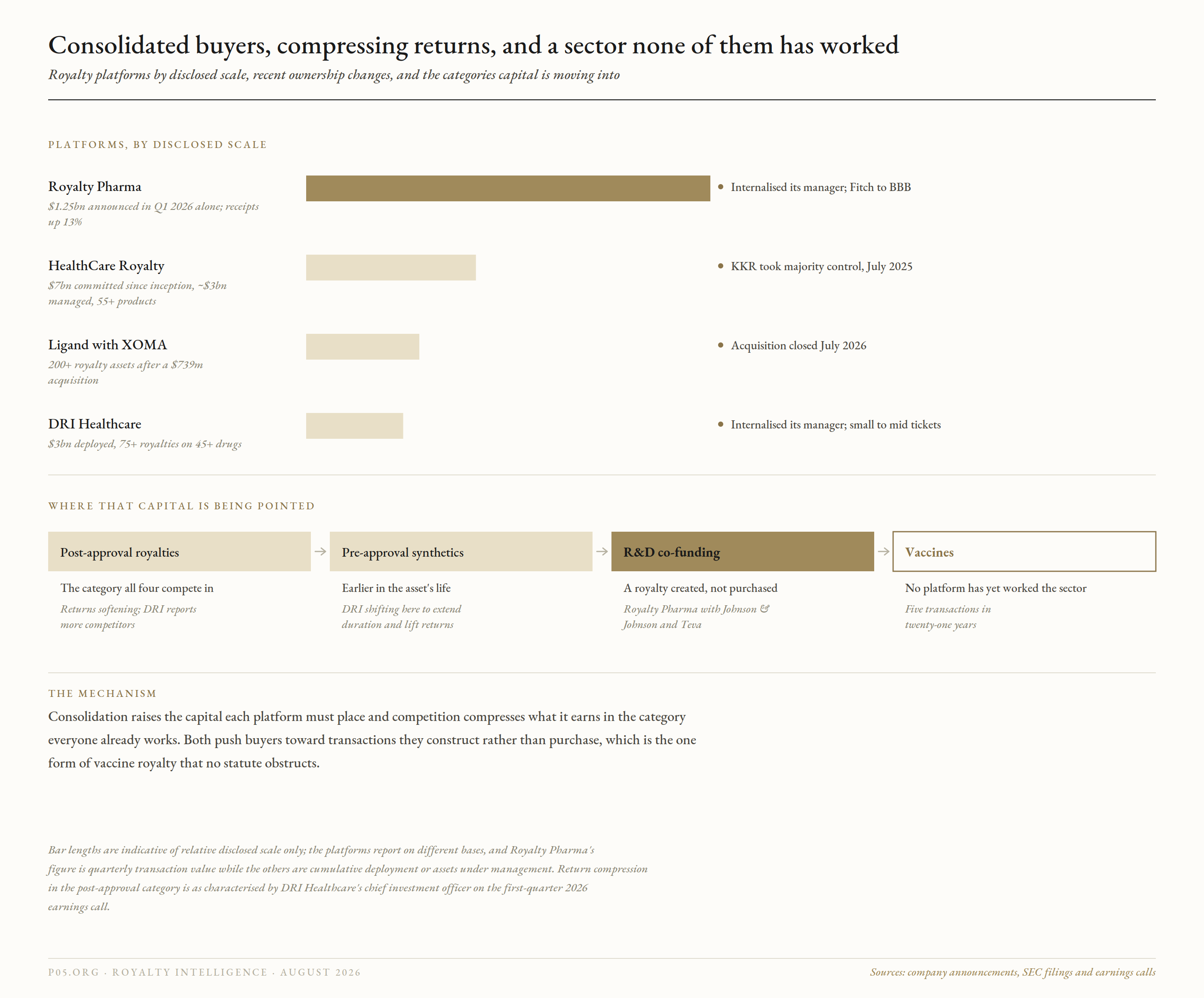
Figure 3. Consolidated buyers, compressing returns, and a sector none of them has worked. Royalty platforms by disclosed scale, recent ownership changes, and the categories capital is moving into.
The veterinary case, where policy is the entire variable
The animal segment removes almost every hazard the human segment carries. There is no reimbursement committee, no advance market commitment tiering and no schedule, demand follows flock and herd cycles and producer economics, and development is both shorter and cheaper.
The route runs through the United States Department of Agriculture's Center for Veterinary Biologics, and its conditional licence pathway permits marketing on a demonstration of reasonable expectation of efficacy.
And still nothing trades, for a reason that isolates the variable about as cleanly as the sector allows.
Zoetis obtained a conditional licence for an H5N2 avian influenza vaccine for chickens in February 2025. More than eighteen months later the United States has still not authorised vaccination of commercial poultry flocks, because vaccinated status affects export eligibility and the country is the world's second-largest poultry exporter. Losses since February 2022 exceed 165 million birds across all fifty states, indemnity payments to the poultry and egg sector have run to roughly $1.5 billion, and in May 2026 the egg industry's own working group put forward a vaccination plan for the layer flock, with the Department developing a parallel plan.
Legislation has been introduced that would require the Trade Representative and the Department to negotiate a vaccination strategy with trading partners.
Meanwhile France runs an official national HPAI vaccination campaign, grounded in the European Council's 2022 conclusions on vaccination as a control tool, and has done so across successive seasons.
The same product class generates revenue in one jurisdiction and none in another, on identical biology, for reasons of trade policy alone. A licensed product without a vaccination policy is a product without a market, and no discount rate expresses that. The veterinary analogue of the recommendation hazard therefore survives the removal of reimbursement, committees and schedules, because the underlying feature is not any of those things: in vaccines, whether the product sells is decided administratively.
Part six: the structural options
There are four worth setting out, each with what it would require.
Buy from the constrained seller. The pattern in Part One is the most reliable guide the record offers, and Part Four says that population is now unusually large. The seller is a cash-constrained biotech holding a platform royalty, or a corporate divesting a non-core stream.
Applied today that points at platform and adjuvant licensors with funding needs and at corporate holders of settlement-created royalties, of which the GSK position on BioNTech sales is the clearest. What this requires is nothing new; it requires looking at holders rather than at assets.
Design an instrument a Bayh-Dole holder can actually use. An outright sale is the wrong instrument for a university, because it converts restricted income into restricted capital at a discount. A forward, a collar, a participation that leaves title and the licence relationship with the institution, or a structure that funds a defined research programme against a pledge of future receipts, all achieve the timing benefit without the disposal.
What this requires is that a buyer approach the institution on its own terms, which is a different origination conversation from the one royalty funds normally have, and that the inventor-share treatment be settled in advance rather than discovered mid-negotiation.
Settle the inventor share before the stream exists. The obstacle described in Part Three is a drafting problem that becomes intractable only once the royalty is large.
University licensing policies could address the treatment of a monetisation event directly: whether the inventor share attaches to proceeds, over what period, and on whose consent. What this requires is that technology transfer offices treat monetisation as a foreseeable event rather than an anomaly.
Fund the programme instead of buying the stream. The fastest-growing modality in royalty finance is research and development co-funding, where the buyer pays for a trial in exchange for a created royalty rather than purchasing an existing one. Royalty Pharma opened co-funding lines with Johnson & Johnson and Teva in the first quarter of 2026.
That structure sidesteps the holder problem entirely, because it requires no existing entitlement to change hands, and it is available to precisely the well-capitalised vaccine developers who have no reason to sell anything today. What it would require is a sponsor willing to share the economics of a programme it can currently fund from its own balance sheet, which is a harder sell in a strong market than a weak one.
Price the section 1498 outcome explicitly. Any model of a settlement-created royalty on a pandemic product carries an embedded assumption about whether the government-contractor defence reaches Operation Warp Speed procurement. That assumption is currently unstated in most valuations and will be resolved by the Federal Circuit. What this requires is that it be an input rather than a residual.
What would make this reading wrong
The argument above says an unexploited opening exists in a sector with unusually durable cash flows. That is the kind of conclusion that deserves adversarial treatment, and the following would undo it.
No institution has sold since 2008, which is consistent with several stories. A search of the public record turns up no vaccine royalty monetisation by any university, hospital foundation or research institute in 2025 or 2026, and none since the CHOP transaction of 2008.
That is the central evidence for the argument here. It is also consistent with there being nothing worth selling, with buyers not asking, and with institutions quietly declining approaches that were never announced.
The M&A explanation may be doing too much work. Four vaccine acquisitions across three years is a thin base from which to claim a structural reflex, and each has an idiosyncratic explanation: CureVac was a litigation settlement, HilleVax a failed asset picked up cheaply, Icosavax a pipeline purchase. Whether these represent a pattern or a coincidence of a strong cycle will not be clear for several more years.
The durability argument rests on an absence that may not last. No biosimilar vaccine has been approved anywhere, and the structural obstacles are real. Some analysts argue that messenger RNA products, whose sequences are fixed and fully replicable, are the category most likely to invite an abbreviated pathway eventually. Nothing of the kind has been approved and this remains a hypothesis, but a vaccine royalty underwritten on a thirty-year view is taking a position on it.
The constraint may be demand rather than supply. This piece argues that holders will not sell. The observable fact is that they have not sold. Whether they have declined approaches or never received them cannot be established from the public record, and the two are entirely different diagnoses. If no royalty fund has ever seriously approached a university about a vaccine royalty, the holder analysis is a description of an untested market rather than a constraint.
The federal analysis is an inference. No agency has attempted to sell a royalty stream and been refused, and no court has considered whether 15 U.S.C. §3710c or general fiscal law bars it. A reader with a different view of agency disposition authority could reach a different conclusion, and a determined agency with congressional support could presumably obtain the authority.
Four transactions is a thin base for a pattern. The claim that sellers are always cash-constrained or indifferent rests on five data points across twenty-one years, at least one of which has undisclosed terms. Five instances make a pattern only in the loose sense that a repeated coincidence does.
Settlement-created royalties may not be durable. They exist because parties chose to settle rather than litigate a novel defence. If the Federal Circuit holds that section 1498 reaches pandemic procurement, the leverage that produced them disappears, and the layer described in Part Two may prove to be a one-time artefact of a specific procurement architecture rather than a new supply of financeable assets.
The QS-21 performance may be survivorship. Agenus's disclosures show the 2018 sale performing well for the buyer. The 2015 Oberland advance at thirteen and a half per cent, subsequently redeemed out of the sale proceeds, is a reminder that the same asset was earlier financed on terms that suggest a rather different view of its quality.
Comparative summary
| Holder type | Example | Can it sell? | Has it? | Binding constraint |
|---|---|---|---|---|
| Federal agency | NIH, on BioNTech and Moderna sales | Doubtful | No | Statutory allocation regime; disposition authority |
| University | Penn, on CellScript sublicences | Yes, with difficulty | No | Restricted use of proceeds; inventor share on a lump sum |
| Hospital foundation | CHOP, RotaTeq | Yes | Yes, 2008 | None; sold when it had a capital use |
| Research institute | Wistar, RotaTeq | Yes | Yes, 2005 | None |
| Cash-constrained biotech | Agenus, Sutro, CureVac | Yes | Yes, four times | None; the reliable seller |
| Large corporate | GSK, one per cent on BioNTech sales | Yes | No | Strategic preference only |
| Platform licensor | Novavax, Matrix-M | Yes | No | Treats the royalty as its revenue base |
| Animal health corporate | Zoetis, conditional licences | Yes | No | Nothing to sell until vaccination is authorised |
The shape of the answer
The vaccine royalty market is not short of assets, and it is not short of buyers. It is short of transactions of the right shape.
Five sales in twenty-one years, all of which appear to have worked for the buyer, is the record of a category nobody has systematically worked rather than one that has been tried and found wanting. The reason so few printed is specific and, once stated, narrower than it first appears.
Buying a seasoned vaccine royalty means buying from a federal agency whose royalty income is allocated by statute, a university whose governing statute restricts the use of proceeds and whose inventor-share policies were drafted for a recurring stream rather than a lump sum, or a developer who will be acquired outright first. Those constraints are durable and they are indifferent to the cycle.
They are also constraints on one route in, not on the sector. None of them attaches to a royalty created rather than purchased, because a created royalty involves no existing entitlement changing hands and therefore never engages a statute written about royalties received.
Which is where the underlying asset earns a second look. There is no approved biosimilar vaccine anywhere in the world and no practical pathway to make one. Prevnar held multibillion-dollar revenue for fifteen years past approval with no generic ever entering. Where vaccine revenue does erode it is displaced by a named competitor running public clinical trials, which is a slower and far more forecastable hazard than the eighty to ninety per cent first-year collapse a small molecule suffers at generic entry.
Liability is channelled away from manufacturers by the compensation programme. On duration and decay, this is among the better cash flow profiles in life sciences, and it is being underwritten by nobody.
Meanwhile the buyer side has changed in the direction that historically opens new categories. KKR sits behind HealthCare Royalty, Ligand has absorbed XOMA, Royalty Pharma and DRI have internalised their managers, and the acquirers say openly that the market addresses only a small share of biopharma capital needs and could double or triple within five years.
Returns in the post-approval category everyone already competes in are compressing. Firms in that position stop waiting for sellers and start constructing transactions, which is precisely what research and development co-funding and pre-approval synthetic royalties are, and what Royalty Pharma has begun doing with Johnson & Johnson and Teva.
So the trade, if there is one, has a shape. It is not a purchase from an institution. It is a created royalty written against a vaccine programme, most plausibly a cross-sponsor adjuvant or platform position of the sort QS-21 proved and Matrix-M has become, or a pre-approval interest of the kind Blackstone took on Vaxcyte. The counterparty is well capitalised and has no need to sell anything, which makes the conversation harder and the terms less desperate, and which is also why nobody has had it.
Three events will inform the price without changing any of this. A Federal Circuit ruling on section 1498 will resize the settlement layer and establish whether it is durable. The appeal in American Academy of Pediatrics will determine whether the recommendation apparatus, and with it the compensation and liability architecture beneath vaccine economics, is stable enough to underwrite.
Vaxcyte's fourth-quarter readout will mark the sector's only pre-commercial royalty position into or out of the money.
The four conditions that would produce a first transaction are a consolidated buyer with capital it cannot deploy at target returns in its core category, competition compressing those returns, an established appetite for created rather than purchased royalties, and a large sector none of the platforms has yet worked. Three are in place today. The fourth is a sponsor willing to take the call.
Standard disclaimer
All information in this report was accurate as of the research date and is derived from publicly available sources including SEC filings, court filings and opinions, statutory materials, company press releases and earnings materials, regulatory and agency publications, and financial news reporting. Statutory analysis is presented as informed reading, not as legal advice, and several propositions in Part Three are inferences from statutory structure that no court has considered. Currency conversions are approximate and taken at spot around the relevant announcement date. Litigation described here is ongoing and positions may have changed since publication. This content is for informational purposes only and does not constitute investment, legal, or financial advice. The author is not a lawyer or financial adviser.