
Company of the week: Relation Therapeutics
Relation sits at the top of the royalty stack, not the bottom. It holds no approved drug and almost no clinical risk, yet it is quietly assembling a royalty book on medicines that do not exist, across three different deal structures.
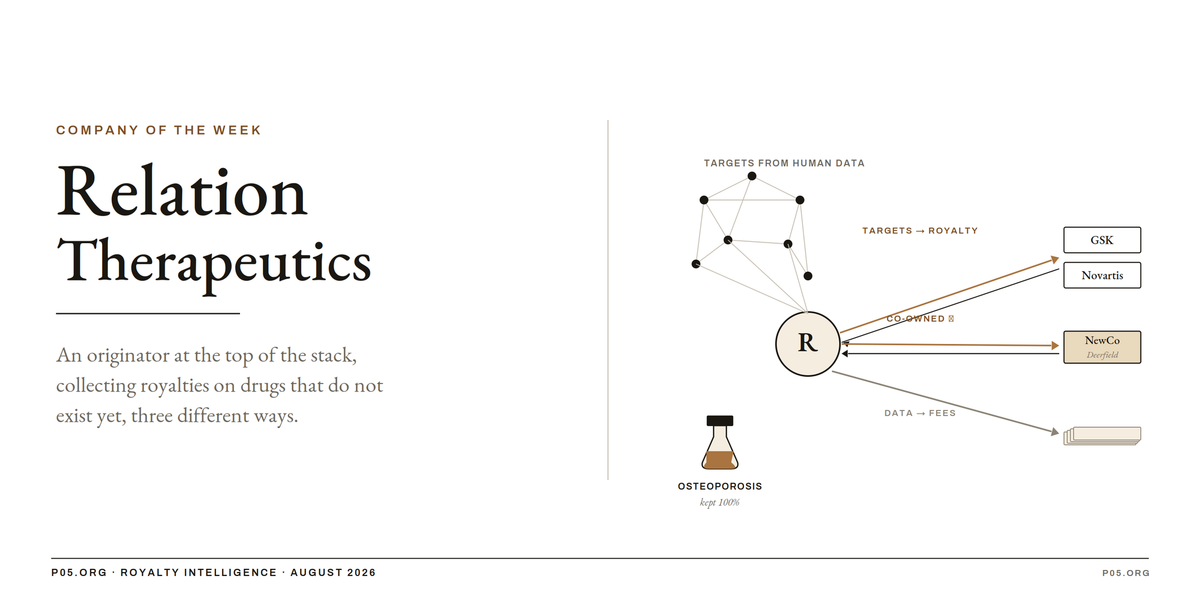
Relation (formally Relation Therapeutics, and increasingly styled just "Relation") is a privately held, London-based AI drug-discovery company, founded in January 2020 and built around a platform it calls Lab-in-the-Loop. It was incubated by Juvenescence, is backed by DCVC and by NVIDIA's venture arm, and has spent the past twenty months converting a data-and-algorithms platform into a run of partnerships with GSK, Novartis and the investor Deerfield Management. On 30 July 2026 it did something subtly different from all of them: it began selling the data underneath the platform itself.
At a glance
| Item | Detail |
|---|---|
| Company | Relation Therapeutics Ltd (private), London, United Kingdom; AI-driven drug discovery; incubated by Juvenescence |
| Founded | January 2020 by Charles (Charlie) Roberts, Benjamin Swerner and Jake Taylor-King |
| Leadership | David Roblin, chief executive (from 2022; ex-Pfizer, Crick, Summit, Juvenescence); Lindsay Edwards, CTO and president of platform; Charlie Roberts, co-founder and chair |
| Platform | Lab-in-the-Loop: active-graph machine learning + single-cell multi-omics + human genetics + CRISPR functional assays, in an integrated London wet/dry lab |
| Flagship model | MORGAN (Multi-Omic Regulatory Genomics using Artificial Neural Networks), a cellular-perturbation foundation model, unveiled 30 July 2026 (evidence so far a preprint) |
| Internal pipeline | Osteoporosis (lead, wholly owned, preclinical, advancing toward the clinic), plus fibrotic, osteoarthritis, metabolic and immune interests |
| Backers | DCVC and NVentures (NVIDIA) as leads; Magnetic Ventures, Khosla, OMERS, firstminute, Octopus, ARK Invest, Deerfield; angels incl. Jonathan Milner |
| Funding | Roughly $86 million of venture equity across three seed rounds; no traditional Series A; a $1.3M Gates Foundation grant (2020); trackers cite $116M to $168M once partner cash is counted |
| Defining deals | GSK (Dec 2024, fibrosis + osteoarthritis); Novartis (Dec 2025, atopic disease); Deerfield (Jan 2026, jointly owned NewCo); GSK again (Jul 2026, data for MORGAN) |
| Newest event | Expanded GSK collaboration worth up to $110 million, and the unveiling of MORGAN, both 30 July 2026 |
| Royalty posture | Pure originator and collector, across three structures: partner-owned target royalties, a co-owned NewCo royalty, and non-royalty data-generation fees |
What Relation is
Set the AI framing aside and Relation is a machine for turning human tissue into targets, and targets into deal paper.
The core is the Lab-in-the-Loop platform: an integrated wet-lab, dry-lab and translational-science loop in London's Knowledge Quarter, in which machine-learning predictions drive laboratory experiments and laboratory results refine the models. The company works from human data outward, generating proprietary maps of disease from human genetics, single-cell multi-omics taken directly from patient tissue, and functional perturbation assays using CRISPR.
The stated aim is "confidence in biology": validating that a target actually drives disease before a molecule is ever made, which is where most drug programmes quietly fail.
On top of that platform Relation has now learned to sell the same underlying capability in three distinct ways, and a royalty desk should keep them separate because they hand back very different economics.
The first, and most common, is selling validated targets. Relation runs its platform against a disease, finds and validates novel targets, and licenses them to a pharma partner that develops, owns and sells the resulting drugs. Relation keeps upfronts, research funding, milestones and royalties, but the drug is the partner's. This is the GSK and Novartis business.
The second is co-development. Rather than hand a target away outright, Relation can nominate it into a jointly owned vehicle and share the downstream economics. This is the shape of its January 2026 arrangement with Deerfield, and it lets Relation keep more of the upside and more control than a straight target licence.
The third, newest and structurally different, is selling data. On 30 July 2026 Relation unveiled MORGAN, a foundation model of how human cells respond to genetic and pharmacological perturbation, and simultaneously agreed to let GSK fund the generation of the training data that feeds it. That is not a target deal and not a licence to the model. It is a contract to manufacture proprietary biological data at scale, for fees rather than a royalty.
Underneath all three sits one wholly owned programme, in osteoporosis, that Relation has so far kept entirely for itself.
The origin: a seed-stage company that never grew up on purpose
Most biotechs march from seed to Series A to crossover to IPO. Relation has deliberately refused the march, and the refusal is central to how it is financed.
The company was founded in January 2020 by Charlie Roberts, a surgeon by training who chairs the company, Benjamin Swerner, now chief operating officer, and Jake Taylor-King, the machine-learning scientist behind the platform.
It was incubated by the longevity investor Juvenescence, whose then-executive David Roblin, a former National Health Service doctor and pharma R&D leader, served as Relation's chief medical officer before becoming chief executive in 2022.
Lindsay Edwards joined the same year as chief technology officer and president of platform. Its early scientific credibility came in part from Project RE, a 2020 COVID drug-repurposing effort co-led with Yoshua Bengio's Mila institute and Scripps Research, funded by a $1.3 million Bill and Melinda Gates Foundation grant.
The financing is the distinctive part. Relation has raised roughly $86 million of venture equity, and every tranche of it has been called seed. A $25 million round in 2022 brought in DCVC, Magnetic Ventures, Khosla Ventures, OMERS and firstminute Capital, alongside a bench of industry angels including Abcam founder Jonathan Milner.
A $35 million round in March 2024, co-led by DCVC and NVIDIA's NVentures, took the total to about $60 million. A further $26 million from the same core in December 2025 brought it near $86 million.
The structural point is that Relation has never raised a conventional Series A. It has funded itself with a run of seed rounds and, more importantly, with non-dilutive partner money.
When DCVC described the first GSK partnership as the largest deal ever for a seed-stage biotech, the phrase mattered: the company has substituted partner cash for venture cash, which keeps ownership concentrated and the balance sheet contingent on the deals continuing. That is the architecture, and architecture is what gets underwritten.
The platform, and the moat it is meant to build
Relation's whole case rests on a claim about data, so it is worth taking the claim seriously rather than as branding.
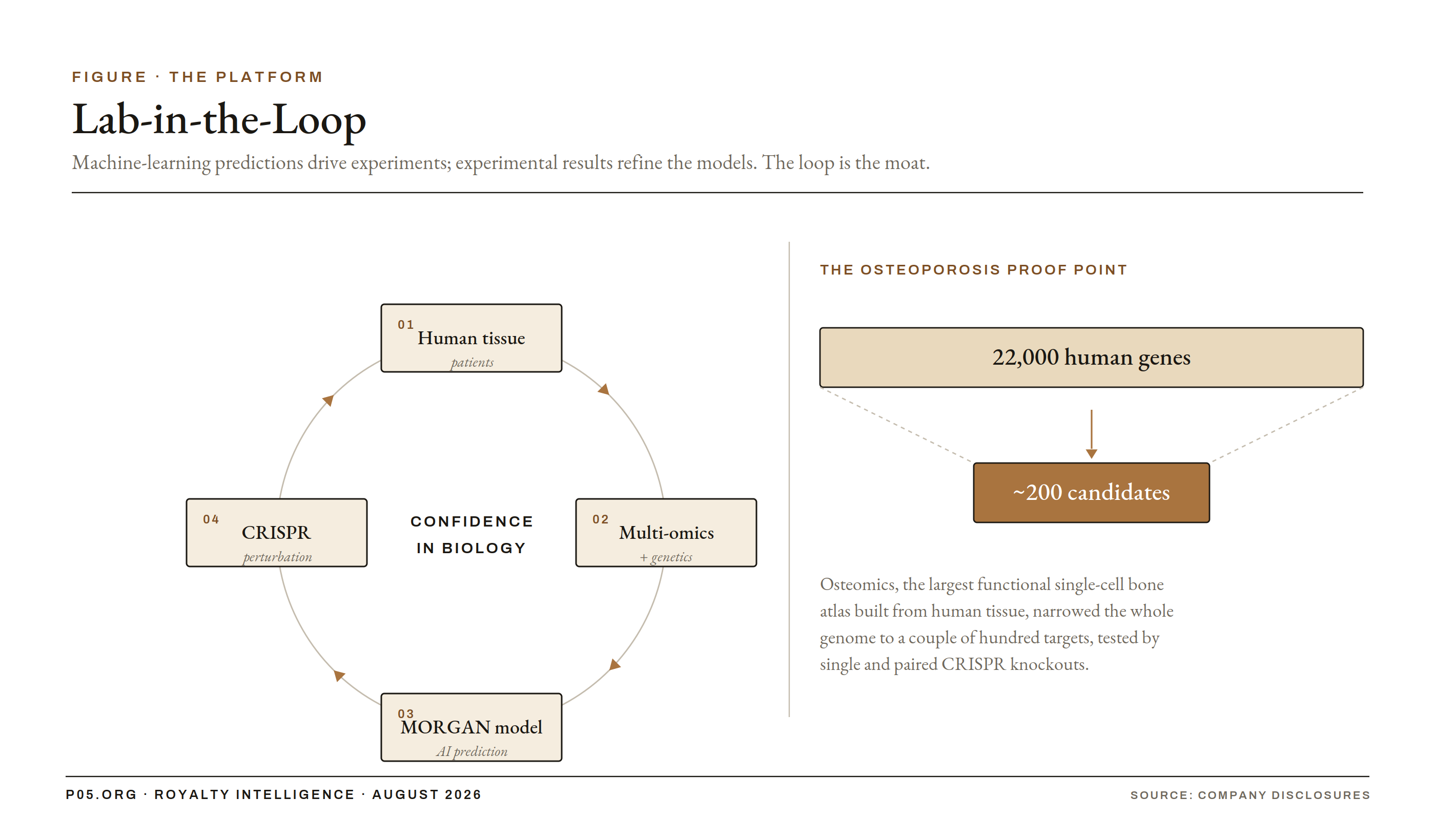
The osteoporosis programme is the clearest illustration of the method, because it is the one Relation built first and owns outright. The company assembled Osteomics, a clinical observational study it describes as the world's largest functional, single-cell bone atlas built from human patient tissue.
It sequenced human osteoblasts, the cells that build bone, fed the data into its models to flag gene variants associated with disease, and then used CRISPR to knock those genes out, singly and in pairs, measuring the effect on bone mineralisation. The claimed result is a reduction of the 22,000-gene human search space to a couple of hundred candidates worth pursuing.
MORGAN generalises that loop. Unveiled in July 2026, it is a foundation model trained on large-scale cellular-perturbation datasets, built to predict how therapeutically relevant human cells respond to genetic and pharmacological interventions across cell types and diseases rather than one indication at a time. Roblin's framing is a virtuous cycle: the platform strengthens the pipeline, and the pipeline's data makes the platform more predictive.
As of the research date, the public evidence for MORGAN is a preprint rather than peer-reviewed literature, which is worth holding in mind when weighing the claims.
The moat, if there is one, is the data. The parallel Relation's backers draw is to protein-structure prediction, which succeeded partly because decades of publicly funded science had deposited more than two hundred thousand experimentally determined structures for models to learn from.
No equivalent public library of human cellular-perturbation data exists. Relation's wager is that whoever manufactures that data at petascale, proprietarily, owns the substrate every cellular foundation model needs, and its relationship with NVIDIA, a repeat investor and the supplier of the compute the whole field runs on, is meant to compound that advantage.
The data, more than any single target, is the asset a desk is really being asked to value.
The royalty book
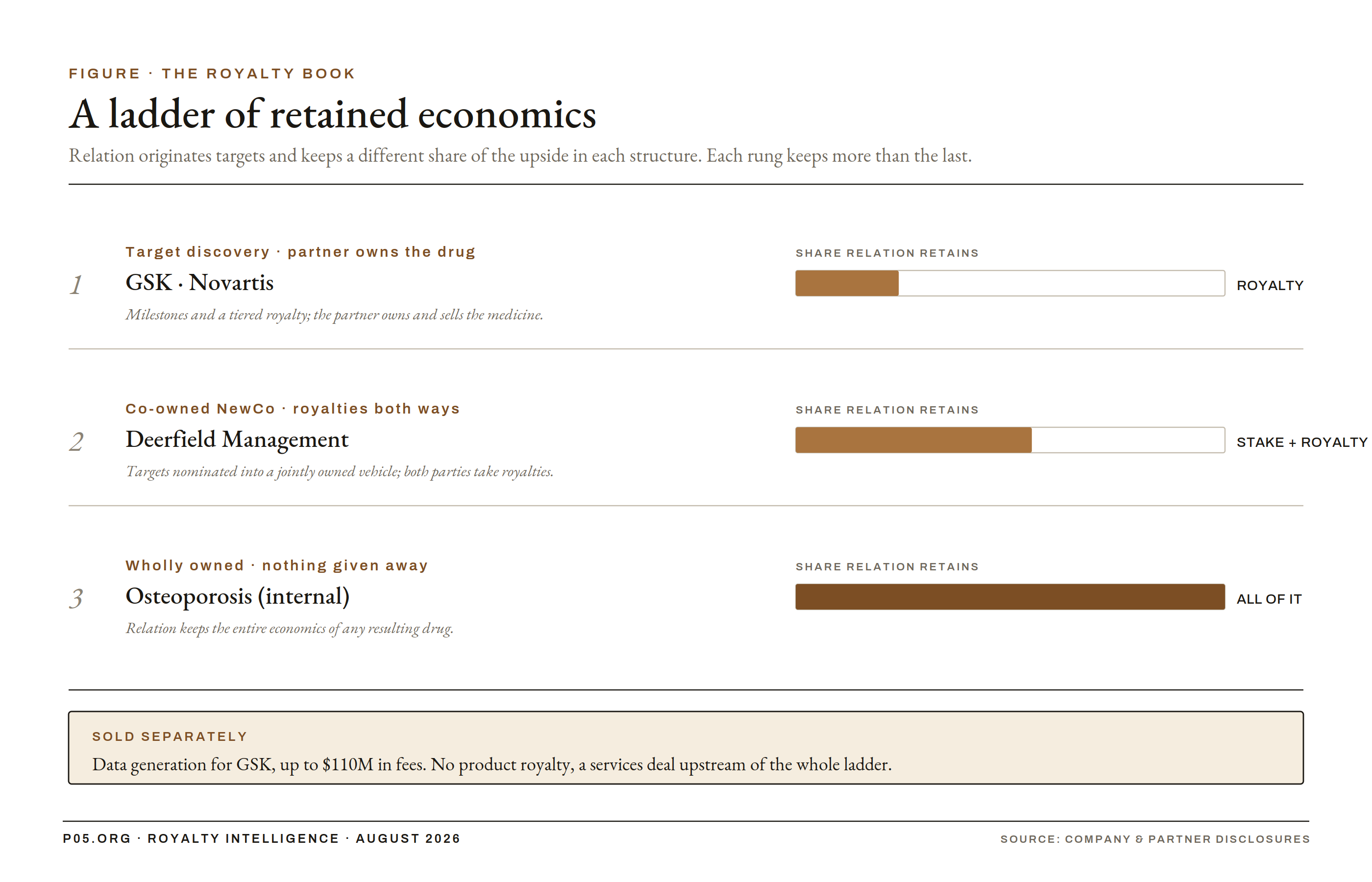
This is the centre of the company, and unusually for a business with no product, the terms are largely disclosed rather than inferred. Relation collects across four arrangements now, and they fall into three structures that hand back progressively more of the upside, plus one that hands back none.
GSK, the first target royalty. In December 2024 Relation signed two multi-programme collaborations with GSK, in fibrotic diseases and osteoarthritis. GSK paid $45 million upfront, including a $15 million equity investment, with up to $63 million more in success-based collaboration payments, milestone payments averaging around $200 million per target across the two deals, and tiered royalties on net sales.
Crucially, GSK retains all worldwide development and commercialisation rights: Relation supplies validated targets and a translational package, and keeps the royalty. This is the originator's position in its purest form, and DCVC called it the largest such deal ever struck by a seed-stage company.
Novartis, the second, and larger, target royalty. A year later, in December 2025, Relation signed its second big-pharma alliance, with Novartis, in atopic disease: allergic rhinitis, asthma and atopic dermatitis.
The shape is the same but the numbers are larger. Novartis committed $55 million upfront, as cash, equity and R&D funding, with up to $1.7 billion in milestones and tiered royalties on net sales, and Novartis takes worldwide development and commercialisation rights.
On the same day it disclosed the $26 million equity top-up from NVentures, DCVC and Magnetic.
Deerfield, the royalty that runs both ways. In January 2026 Relation added a different structure with Deerfield Management, already one of its investors. Instead of handing targets to a partner that owns the drug, Relation may nominate targets it discovers into a NewCo jointly owned by the two parties, with Deerfield supplying due diligence and development plans through its 3DC engine.
The clause a desk fixes on is that both Relation and Deerfield are entitled to royalties on net sales of any resulting products. This is the one deal where the royalty flows in more than one direction, and where Relation keeps an ownership stake in the drug rather than a pure licence royalty. Financial terms were not disclosed.
GSK again, the data fee that is not a royalty. On 30 July 2026 Relation expanded the GSK relationship with a deal worth up to $110 million in upfront and success-based payments. This one is structurally different again, and the difference is the story. GSK is not licensing MORGAN and is not buying a target.
It is paying Relation to manufacture large-scale human cellular-perturbation datasets, using automated labs, that will train MORGAN and support future target discovery. The dominant commercial model in AI drug discovery has been model licensing, a biotech builds a platform and a pharma pays to use it.
This inverts that: the pharma pays for the data that makes the model work, upstream of any licence. It carries fees and milestones, not a product royalty.
One observation follows from reading the four together. Relation is climbing a ladder of retained economics. On the GSK and Novartis target deals it keeps the least, a royalty on a drug someone else owns. In the Deerfield NewCo it keeps more, a co-ownership stake and a royalty.
On its wholly owned osteoporosis programme it keeps everything. And alongside all of that it sells the data substrate itself for near-term fees, with no royalty at all. That is an unusually wide spread of monetisation for a company this early, and a desk would read it two ways: as a platform genuinely valuable enough to sell four different ways, or as a company still testing which structure the market will actually pay for.
Both readings point at the same caveat. Everything above is contingent, and as of the research date no milestone under any of these deals has been publicly confirmed as triggered or paid.
The asset it kept
The most valuable thing Relation may own is the one programme it has not partnered, and it comes with the usual originator's dilemma.
Osteoporosis was Relation's first indication, a disease affecting more than forty-five million patients across the United States, Europe and Japan, and it remains the company's most advanced wholly owned asset, still preclinical and described as advancing toward the clinic.
Because Relation has not licensed it, it would keep the entire economics of any resulting drug, or command a far richer deal than a target-discovery royalty if it chose to partner it later.
That is the prize, and it is also the tension. Most of what Relation has monetised so far, it monetised by giving the target away and keeping a royalty. The osteoporosis programme is the test of whether it can also carry a drug itself, which needs capital, clinical infrastructure and time that a discovery-stage, seed-funded company does not obviously have.
It is worth noting that two of Relation's stated internal interests, fibrosis and osteoarthritis, are the very areas it has partnered to GSK, so the line between what Relation develops itself and what it discovers for others is already blurred. A desk would treat the osteoporosis asset as valuable optionality, not a near-term stream, and would watch whether Relation advances it alone, partners it, or lets it stand mainly as proof that the platform works.
The class it is entering
Relation is not alone, and the field it is in is both crowded and, so far, unproven.
The race Relation has joined is the one to build a foundation model of the cell: a general-purpose model that predicts how human cells respond to drugs and genetic change.
The competitors are well funded and well known, from Isomorphic Labs to insitro to Noetik to Xaira Therapeutics, and the shared constraint is the same one Relation has organised itself around: a shortage of the high-quality experimental data these models need. GSK's own behaviour underlines the point.
The same pharma partner that is funding Relation's data factory also licensed Noetik's OCTO virtual-cell models for oncology in a $50 million upfront deal in January 2026, and has signed data-driven discovery collaborations with others still. Big pharma is buying the category broadly, not betting on one platform, which validates the space and commoditises it at the same time.
The cautionary note is real and recent. A 2025 paper in Nature Methods found that current cellular foundation models performed no better than much simpler models at predicting perturbation responses.
That finding applies to models trained on existing public data, which is exactly the gap Relation says its proprietary, petascale data closes. Whether it does is the empirical question the whole thesis rests on, and it has not yet been answered in public. Relation is betting that data quality and scale change the result. Several equally serious competitors are betting the same way.
How it funds itself
Relation has almost no product revenue, so its history is a sequence of financings and deals, and the two have become hard to separate.
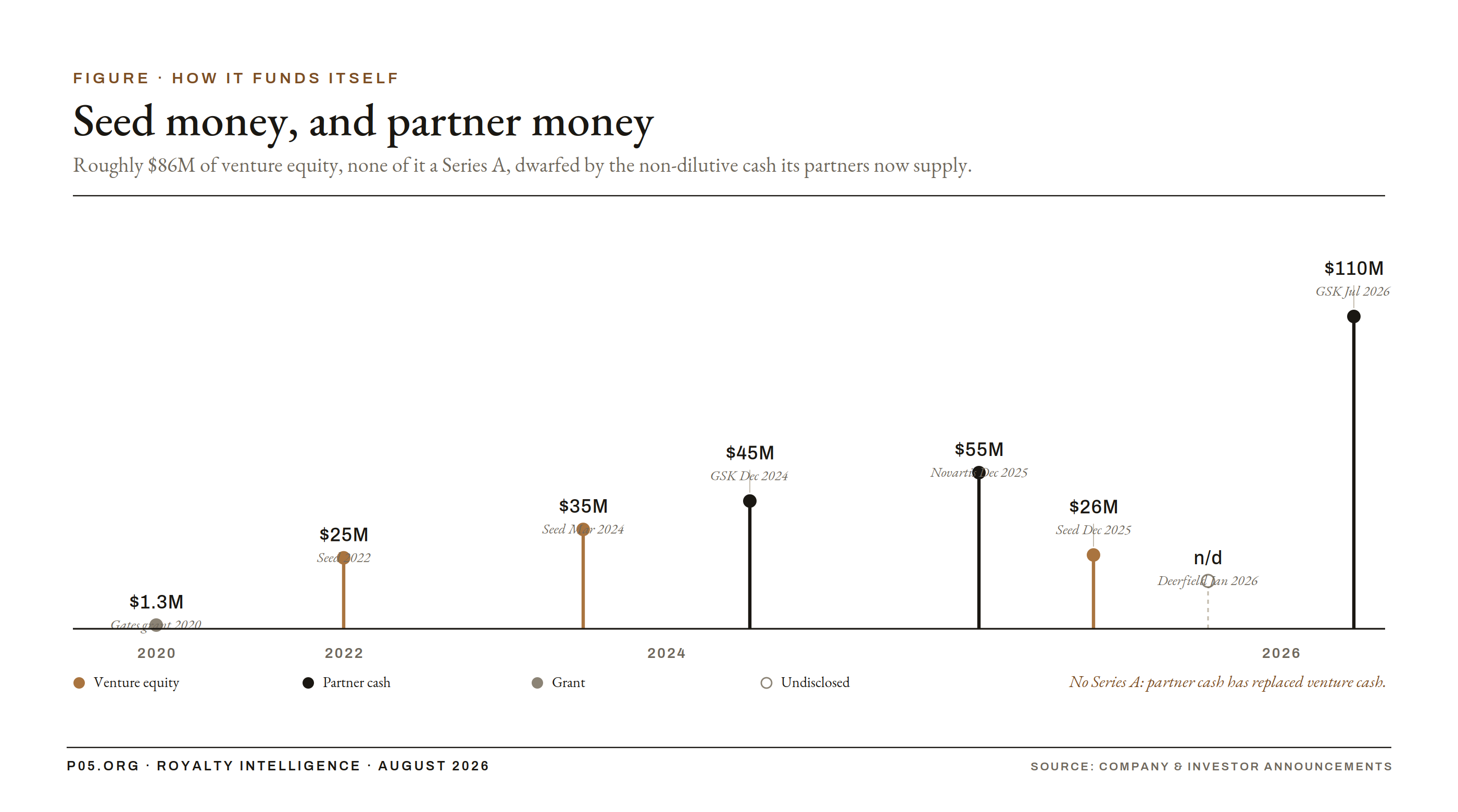
The venture funding is modest by the standards of the ambition: roughly $86 million across three seed rounds, led throughout by DCVC and, latterly, NVIDIA's NVentures. What has actually scaled the company is the non-dilutive money layered on top: $45 million upfront from GSK in 2024, $55 million from Novartis in 2025, and up to $110 million from GSK in 2026, alongside the success payments and equity investments folded into each.
In effect, Relation's partners have become its largest source of capital, and its equity investors have been able to hold a large stake in a company that has raised comparatively little dilutive money.
That mix is also why the headline funding figure varies so widely. The defensible venture-equity number is about $86 million; third-party trackers cite anywhere from $116 million to $168 million, inflated by counting the GSK and Novartis collaboration cash, strategic equity, and even a government scale-up programme as "funding raised."
As a private company, Relation files no profit-and-loss account under the UK small-company exemption, so its turnover and R&D spend are not public; its balance sheet, however, swelled visibly as the partner upfronts landed, with filings for end-2024 showing cash on the order of £24 million.
| Round or inflow | Amount | Date | Source |
|---|---|---|---|
| Gates Foundation grant | $1.3M | 2020 | Bill & Melinda Gates Foundation (Project RE) |
| Seed | $25M | 2022 | DCVC, Magnetic, Khosla, OMERS, firstminute |
| GSK collaborations (up) | $45M + up to $63M | Dec 2024 | GSK (fibrosis + osteoarthritis), incl. $15M equity |
| Seed (co-led) | $35M | Mar 2024 | DCVC, NVentures (NVIDIA) |
| Novartis alliance (up) | $55M | Dec 2025 | Novartis (atopic disease) |
| Seed top-up | $26M | Dec 2025 | NVentures, DCVC, Magnetic |
| Deerfield NewCo | undisclosed | Jan 2026 | Deerfield Management (co-owned vehicle) |
| GSK data collaboration | up to $110M | Jul 2026 | GSK (data generation for MORGAN) |
The size and timing of the July 2026 GSK deal are worth noting. Layering a $110 million data-generation contract on top of two royalty-bearing target alliances and a co-owned NewCo, in the same week it unveiled MORGAN, points to a company deliberately building near-term, lower-risk revenue around a longer-dated, higher-upside royalty book. All of it depends on the same underlying claim about data.
Red team versus blue team
Risk analysis (red team)
The royalty book is entirely forward and contingent. Relation collects on drugs that do not exist, discovered from targets its partners largely own and control. Every royalty it holds depends on GSK, Novartis or a Deerfield NewCo choosing to advance a Relation-originated target through years of development to an approved product, a path on which most programmes fail.
The near-term cash is upfronts, funding and success payments; no milestone has been publicly confirmed as paid, and the royalty tail is distant and conditional.
The core scientific claim is unproven in public. The whole thesis rests on proprietary data making cellular foundation models genuinely predictive, and the most recent independent evidence is that such models have not beaten simple baselines. Relation's answer, that its data is better, is plausible and unverified, and its own supporting work for MORGAN is so far a preprint.
Several well-funded competitors are making the identical bet, and the same pharma buying Relation is buying them too.
The financing is unusual and concentrated. A company of this ambition has never raised a Series A and depends on a continuing flow of partner deals and a tight investor base to fund itself. That keeps ownership concentrated but leaves the balance sheet reliant on the deals continuing, and on sentiment toward AI drug discovery staying warm.
The owned asset is the hardest thing it has not yet done. Osteoporosis is valuable only if Relation can carry a drug further than target discovery, which needs capital and clinical capability it has not yet demonstrated, and it overlaps with areas it has already partnered away.
Opportunities and mitigants (blue team)
The economics run almost entirely in Relation's favour. On the partnered work it takes upfronts, funding, milestones and royalties while the partner carries the cost and risk of development and commercialisation. It is paid to originate and keeps a call option on the upside, with very little downside exposure to any single clinical failure.
The deal book is real, repeat and escalating. Two of the largest pharma companies in immunology and respiratory disease have now paid Relation, GSK twice, with headline milestone potential of roughly $200 million per target at GSK and up to $1.7 billion at Novartis, plus royalties on both, and a further co-owned vehicle with Deerfield. That is external validation a desk can price, not a promise.
The monetisation is unusually diversified for the stage. Relation now sells targets for royalties, co-owns assets for a larger share, retains one programme outright, and sells data for near-term fees. The data business can generate cash while the royalty book matures, and the Deerfield structure shows the company reaching for more of the upside where it can.
The backing is strategic, not just financial. NVIDIA's venture arm as a repeat co-lead, alongside DCVC and Deerfield, ties Relation to the company that supplies the compute the whole field runs on, and to a data moat that, if it holds, compounds with every experiment.
Summary
| Risk | Concern |
|---|---|
| Forward, contingent royalties | Collects only if partners advance owned targets to market; no milestone paid yet |
| Unproven core claim | Cellular foundation models have not beaten simple baselines in public |
| Seed-only, concentrated | No Series A; balance sheet depends on continued partner deals |
| Owned asset unproven | Osteoporosis still preclinical; overlaps areas already partnered |
| Crowded, commoditised class | Isomorphic, insitro, Noetik, Xaira; GSK also buys rivals like Noetik |
| Opportunity | Observation |
|---|---|
| Originator economics | Upfronts, milestones and royalties with little clinical downside |
| Repeat validation | GSK twice, Novartis, and a co-owned Deerfield vehicle in under two years |
| Ladder of retained upside | Target royalty, co-owned NewCo royalty, wholly owned asset, plus data fees |
| Data moat | Proprietary petascale perturbation data as the substrate every rival needs |
| Strategic backing | NVIDIA and DCVC as repeat leads; compute plus capital |
Conclusion
Relation Therapeutics is a clear illustration of where value is trying to move in modern drug discovery: upstream, to the party that finds and validates the target, and further upstream still, to the party that owns the data the finding depends on.
It has no approved drug, has run almost no clinical risk on the work that pays it, and has nonetheless assembled a royalty book across two of the largest pharma companies in the field, a co-owned vehicle with a healthcare investor, and a data-services business layered on top.
For a royalty desk, that position is the point. Relation is not a stream to buy today. Its royalties are contingent on partner-owned drugs that do not yet exist, its milestone ladders pay only as those programmes advance, none has yet been confirmed to have triggered, and the scientific claim underneath the whole edifice has not been proven in public.
But it lays out, in disclosed terms, the originator's economics a desk usually has to infer, and then some: a target handed to a developer for a milestone ladder and a royalty, the same target co-owned in a shared vehicle for a bigger share, one asset kept outright, and the data moat sold separately for cash.
The tests ahead are concrete. Whether GSK, Novartis and the Deerfield NewCo advance Relation-originated targets far enough to trigger the milestones and, eventually, the royalties will determine whether the book is worth anything.
Whether MORGAN and the proprietary data behind it genuinely outperform simpler models will determine whether the moat is real, or whether pharma's willingness to fund several platforms at once has quietly commoditised the whole idea. And whether Relation ever carries its own osteoporosis programme, rather than only originating for others, will show whether it intends to remain a discovery engine or become a drug company in its own right.
Until those resolve, Relation is best understood not as an AI company with deals attached, but as a set of contingent royalty and milestone claims, spread across three structures, and a data business, all built on a single bet about biology. That is exactly what a royalty desk is built to read.
All information in this article was accurate as of the research date and is derived from publicly available sources including the company's and its partners' press releases, investor communications, UK corporate filings, and financial and trade reporting. Relation Therapeutics is a privately held company and does not publish a full profit-and-loss account; funding totals are drawn from company and investor announcements and third-party trackers, which differ materially, and are stated here as ranges or as the most defensible figure where they conflict. The deal terms described for the GSK (2024 and 2026), Novartis (2025) and Deerfield (2026) collaborations, including upfronts, success payments, per-target milestone averages, aggregate milestone potential, royalty entitlements and the co-owned NewCo structure, are as disclosed by the parties; milestone figures are maxima and averages, not amounts earned, and no milestone or royalty described here has been publicly confirmed as paid. The characterisation of Relation as a net originator and royalty collector, and the description of three monetisation structures, is an analytical reading of the disclosed relationships. Statements about the predictive performance of cellular foundation models reflect published literature current as of the research date and remain scientifically contested; MORGAN's supporting evidence was a preprint as of the research date. Nothing here is a statement on the clinical prospects of any programme. This content is for informational purposes only and does not constitute investment, legal, or financial advice. The author is not a lawyer or financial adviser.