
Fund of the week: Athyrium Capital Management

Athyrium Capital Management, LP is a New York healthcare investment manager formed in 2008 by Jeffrey A. Ferrell. It advises funds with more than $4.6B of committed capital across four vintages, and it describes its instrument set as royalties, structured credit, equities and select special situations.
The royalties have historically been the smallest part of that list. Athyrium's core business is healthcare credit. It writes senior secured term loans, convertible notes and structured preferred into commercial-stage pharmaceutical, device and healthcare services companies, in sizes up to $200M with the ability to flex up. Across roughly 85 portfolio companies it has lent against royalties considerably more often than it has bought them.
That changed on 2 April 2026. A Fund IV vehicle paid $50M for 100% of Esperion Therapeutics' royalty on Otsuka's Japanese sales of bempedoic acid, together with the related regulatory and commercial milestones, until aggregate receipts reach $100M. Athyrium did not participate in the incremental term loan funded the same day; that tranche was taken by HealthCare Royalty. Three months later Esperion was taken private by ArchiMed, the term loan was repaid and terminated, and the royalty was the position that remained.
Most of what follows comes out of that three-month sequence, which is the best-documented royalty transaction the firm has done.
Currency note: Swiss franc, euro, Danish krone and Swedish krona figures are converted to USD at approximate rates prevailing at the transaction date, with the original in brackets. Where a source published its own conversion, that figure is used. Historical conversions do not reflect any later rate.
At a glance
- What it is: a specialised healthcare asset manager formed in 2008, investing third-party institutional capital through closed-end funds across credit, structured equity, royalties and special situations in biopharma, medical devices, healthcare services and healthcare IT
- Founder: Jeffrey A. Ferrell, Managing Partner since inception
- Strategic partner: Neuberger Berman, since 2009. NB Alternatives co-manages the Opportunities funds and feeder vehicles are named NB-Athyrium Opportunities Fund II / III / IV LP
- Fund I: Athyrium Opportunities Fund, closed May 2013 at $507M, oversubscribed, more than 35 institutional investors, target cheque $25M to $75M
- Fund II: closed July 2015 at over $1.2B, more than 40 institutions, target cheque $25M to $150M
- Fund III: closed 4 December 2017 at approximately $2.025B, more than 45 institutions, taking cumulative committed capital past $3.7B
- Fund IV: closed 2022 at over $1.2B, PitchBook records a 2021 vintage, domiciled in Delaware and the Cayman Islands
- Committed capital: over $4.6B per the firm. The four published fund sizes sum to roughly $4.9B, so the headline figure is either conservative or measured on a different basis
- Regulatory AUM: $2.898B discretionary across 12 clients, Form ADV filed 25 March 2025
- Deployment to date: $5B+ invested, 85+ portfolio companies, per the firm's own website
- Cheque size: up to $200M per investment with the ability to flex up opportunistically
- Investor base: public and corporate pension funds, charitable endowments, insurance companies, funds-of-funds, family offices, university endowments and sovereign wealth funds. No roster is published
- Investment team: eight people, three of them partners
- Royalty interests held: one disclosed outright purchase, the Esperion Japan receivable acquired April 2026. Two royalty-backed loans in the historical record, Zealand Pharma (2014) and Halozyme (2016). One controlled operating company, RVL Pharmaceuticals, that is itself a royalty recipient
- Realised outcomes include BioFire Diagnostics, Verenium, InnoPharma, Ikaria, Relypsa, Dermira, Veloxis, Pharmaceutics International and Revance. Chapter 11 outcomes include Pernix, Biora Therapeutics, CareMax and RVL Pharmaceuticals plc
A note on scope
Athyrium publishes no fund-level performance figures, no position sizes and no limited partner list, and it does not mark positions publicly. It files 13Fs for its listed equity holdings and Form D for its fund offerings, and it maintains a portfolio page tagging each company to the fund or funds that hold it. Everything else about the book comes from counterparty disclosure.
In practice that is a large body of material. Athyrium lends to listed issuers, and listed issuers file their credit agreements. Interest rates, covenants, call protection, intercreditor terms and the mechanics of the royalty purchase are all in the public record, filed by the borrower. This piece is built almost entirely from that side of the ledger.
Two limits follow. With one exception no return figure has been published, so nothing here amounts to an assessment of performance. The portfolio described is also incomplete. Athyrium's page lists names without instruments, so a company can appear on it because Athyrium bought its bonds, led a preferred round, or now owns it outright.
Investment thesis and mandate
The stated approach is to provide flexible capital to commercial-stage healthcare companies with differentiated products, in structures the borrower could not obtain from a bank and would not want from the equity market.
The firm names six mandate conditions on its own site: up to $200M per investment with the ability to flex up, public and private companies, commercial-stage products and services, industry-leading management teams, multi-year commitments with the option to upsize, and a global mandate.
Its Form ADV brochure describes an approach that weighs clinical data, regulatory risk and intellectual property alongside financial metrics, and lists convertibles, loans, bonds, preferred and common stock, warrants and royalties as the instruments used.
The biopharma credit business is the part that touches royalty markets. Term loans and notes to Kala, Dermira, Portola, Puma, Revance, Basilea, Calliditas, Coherus, Omeros, Esperion and Hansa, generally secured, generally priced in the high single digits to low teens, generally with hard call protection.
A larger healthcare services and provider book sits alongside it, closer to sponsor finance and unrelated to intellectual property. TeamHealth, Sound Physicians, Upstream Rehabilitation, Elara Caring, Gentiva, Choice Health at Home, AQUA Dermatology, Heartland Veterinary Partners, Summit BHC. Fund III and Fund IV are heavily weighted here.
A small number of controlled positions arose out of restructurings. RVL Pharmaceuticals is the one that matters here.
Athyrium has not raised a dedicated royalty fund and does not describe itself as a royalty buyer. Royalties appear in its instrument list alongside credit, equity and special situations.
How capital enters and returns
Capital comes from closed-end institutional funds co-managed with Neuberger Berman. It comes back four ways.
Contractual interest and fees. The core of it. The Esperion loan is representative: $150M drawn in full at closing on 13 December 2024, 9.75% if paid in cash and 11.75% if paid in kind, with a PIK option for the first four quarters, interest-only for four years, then quarterly amortisation of 12.5%, a five-year final maturity, 2.5% original issue discount and a $50M minimum liquidity covenant.
Esperion took the PIK option in Q2 and Q3 2025, adding $9.1M to principal.
Call protection. Prepayment premiums and make-whole provisions are drafted explicitly and reset when facilities are amended. The Esperion facility is the clearest worked example and is set out below.
Equity kickers and conversion. Warrants attached to bond financings such as Biom'Up, and convertible structures such as the March 2026 Hansa note, which pays a 3% cash coupon but cannot be converted unless a 1.6x minimum return condition is satisfied on the calculation defined in the notes.
The economics of that instrument are closer to a capped structured note than to a conventional convert.
Ownership through restructuring. Loan-to-own, executed at least once. Athyrium emerged from the RVL Pharmaceuticals plc Chapter 11 owning RVL Pharmaceuticals, Inc., the operating company that sells Upneeq, while the Irish public parent was wound down and its equity cancelled with no recovery to public shareholders.
No royalty purchase appears among them before 2026.
Financial profile and assets
| Item | Amount | Source and date |
|---|---|---|
| Committed capital, all funds | over $4.6B | Firm website and press release, Apr 2026 |
| Fund I committed capital | $507M | Neuberger Berman, May 2013 |
| Fund II committed capital | over $1.2B | Neuberger Berman, Jul 2015 |
| Fund III committed capital | approximately $2.025B | Neuberger Berman, Dec 2017 |
| Fund IV committed capital | over $1.2B | Firm website, 2022 |
| Regulatory AUM, discretionary | $2,898,088,000 across 12 clients | Form ADV, 25 Mar 2025 |
| Capital invested since inception | $5B+ | Firm website, 2026 |
| Portfolio companies since inception | 85+ | Firm website, 2026 |
| Maximum stated cheque | $200M, flex up available | Firm website, 2026 |
| Investment team headcount | 8 | Firm website, Aug 2026 |
| Esperion Japan royalty purchase | $50M for receipts capped at $100M | 8-K, 2 Apr 2026 |
| Esperion term loan, initial | $150M at 9.75% cash / 11.75% PIK | Credit Agreement, 13 Dec 2024 |
| Esperion term loan, first amendment | $25M, funded by HCR only | First Amendment, 2 Apr 2026 |
| Omeros facility | $92.1M ($67.1M funded, $25M delayed draw) | Credit and Guaranty Agreement, 3 Jun 2024 |
| Hansa Biopharma convertible | $30M, 3% coupon, 2031 maturity | Note purchase agreement, 20 Mar 2026 |
| BioCryst facility | $200M ($125M drawn at close), LIBOR + 8.25%, 1.75% floor | Press release, 7 Dec 2020 |
| Halozyme royalty-backed loan (share) | $150M facility, 3M LIBOR + 8.75% | 10-Q, 2016 |
| Zealand royalty bond | $50M (DKK 300M), 9.375% | Company announcement, Dec 2014 |
| Revance note purchase | $300M | Press release, 21 Mar 2022 |
| Basilea senior secured loan | approximately $77M (CHF 75M) | Press release, 7 Sep 2022 |
| Calliditas senior secured facility | approximately $100M (EUR 92M) | Press release, 27 Dec 2023 |
| Secura Bio financing (led) | $145M | Press release, 5 Mar 2019 |
| Puma Biotechnology note purchase | $125M | Press release, 26 Jul 2021 |
| VillageMD growth financing | $80M | Press release, 4 Jan 2018 |
| Fund III net IRR, one LP, 31 Dec 2021 | 6.3%, 1.13x net multiple, 0.61x DPI | Greenwich CT schedule of investments |
| Fund III net IRR, same LP, 31 Dec 2020 | 9.0%, 1.14x net multiple, 0.34x DPI | Greenwich CT schedule of investments |
The portfolio book
Athyrium's portfolio page lists 79 companies with fund attribution.
Fund I holds the oldest names and the ones that produced clean exits: BioFire Diagnostics (acquired by bioMérieux for $450M plus net debt in 2013), Verenium (BASF, 2013), InnoPharma (Pfizer, 2014), Ikaria (Madison Dearborn, then Mallinckrodt at $2.3B in 2015), Ironwood, Travere, Tecomet, SynCardia, Universal Biosensors, Pernix, MedPro Safety Products, Tria Beauty, BioClinica.
Fund II is the broadest and the most pharmaceutical: AMAG, Amryt, Alvogen, Arbor, Bionpharma, Cipher, Halozyme, HLS Therapeutics, Horizon Pharma, Indivior, PTC, Relypsa, Sucampo, US WorldMeds, Valneva, Zealand, plus Clover Health, HealthSun, InnovaCare, Leon Medical and VillageMD on the services side.
Fund III adds scale services and value-based care: DuPage Medical Group, Elara Caring, naviHealth, OB Hospitalist, PharMerica, Sound Physicians, Teladoc, Clario, CareMax, alongside BioCryst, Dermira, Kala, OptiNose, Portola, Tesaro and Veloxis.
Fund IV is where the current book sits: Basilea, BridgeBio, Calliditas, Coherus, Crown Laboratories, Esperion, Omeros, Paratek, Puma, Revance, RVL, uMotif, Oui Therapeutics, Vita Health, plus TeamHealth, Gentiva, Summit BHC, Choice Health at Home, Heartland Veterinary Partners, Complete Health Partners and TEAM Services Group.
Four names carry Chapter 11 histories: Pernix, Biora Therapeutics (formerly Progenity), CareMax and RVL Pharmaceuticals plc. In CareMax's case the first lien term loan and DIP lenders were BlackRock and Crestline, and Athyrium's position and recovery are not disclosed anywhere in the record.
What the counterparties' filings show
Most of the detail in this profile comes from a single filing, and it is Esperion's rather than Athyrium's. The Form 8-K of 2 April 2026 attaches the First Amendment to the credit agreement in redlined form and describes the royalty purchase in the same document. Several details in it would not appear in any royalty database.
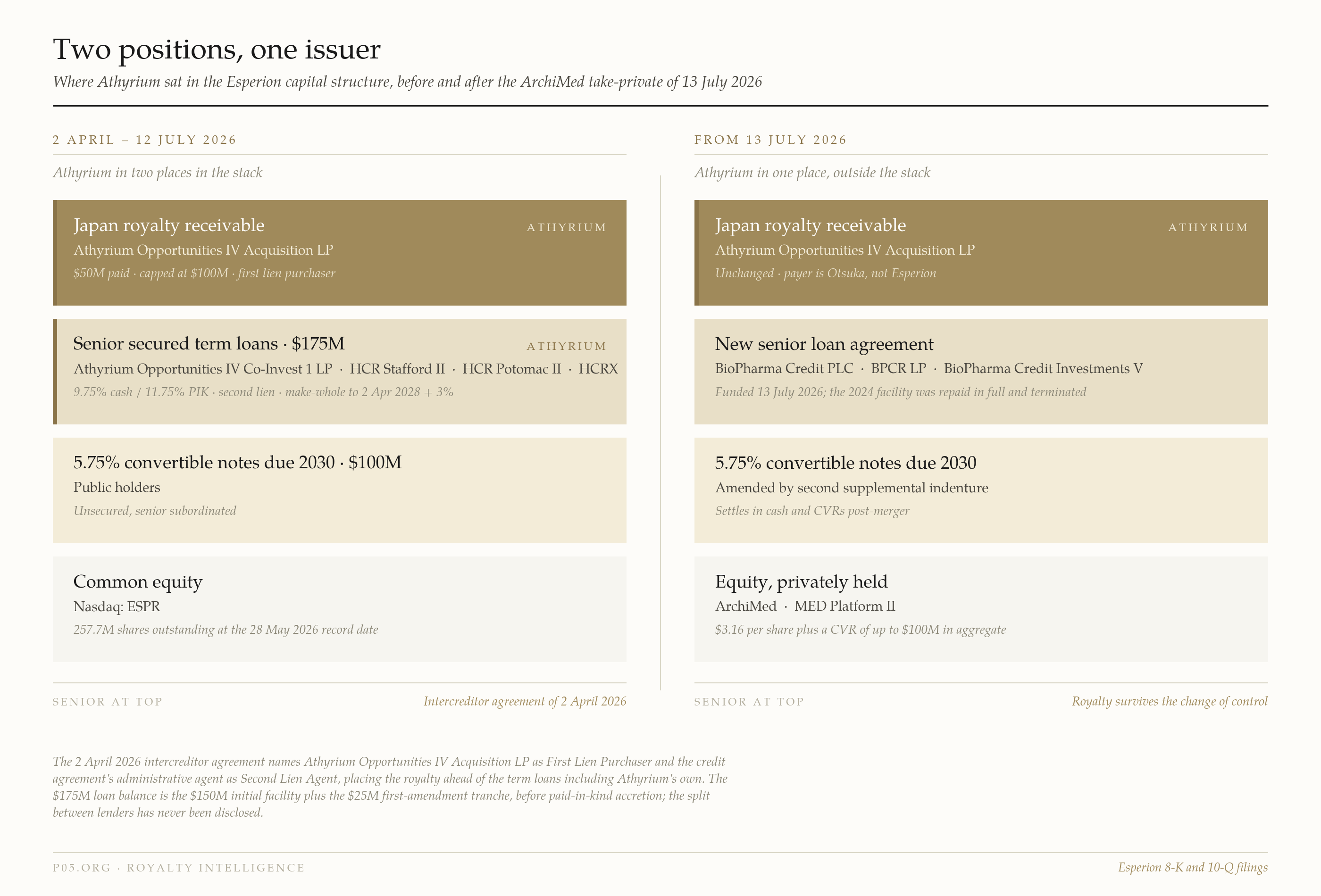
The purchasing entity is Athyrium Opportunities IV Acquisition LP, a Delaware limited partnership. The lending entity is Athyrium Opportunities IV Co-Invest 1 LP. Different vehicles, same fund family, different positions in the structure.
The incremental $25M of term loans on that date was funded $12.5M each by HCR Stafford Fund II and HCR Potomac Fund II, with Athyrium absent from the commitment schedule. Its incremental dollars that day went into the royalty.
A Subordination and Intercreditor Agreement dated 2 April 2026 names Athyrium Opportunities IV Acquisition LP as "First Lien Purchaser" and the credit agreement's administrative agent as "Second Lien Agent". The royalty position sits ahead of the loan, including ahead of Athyrium's own loan.
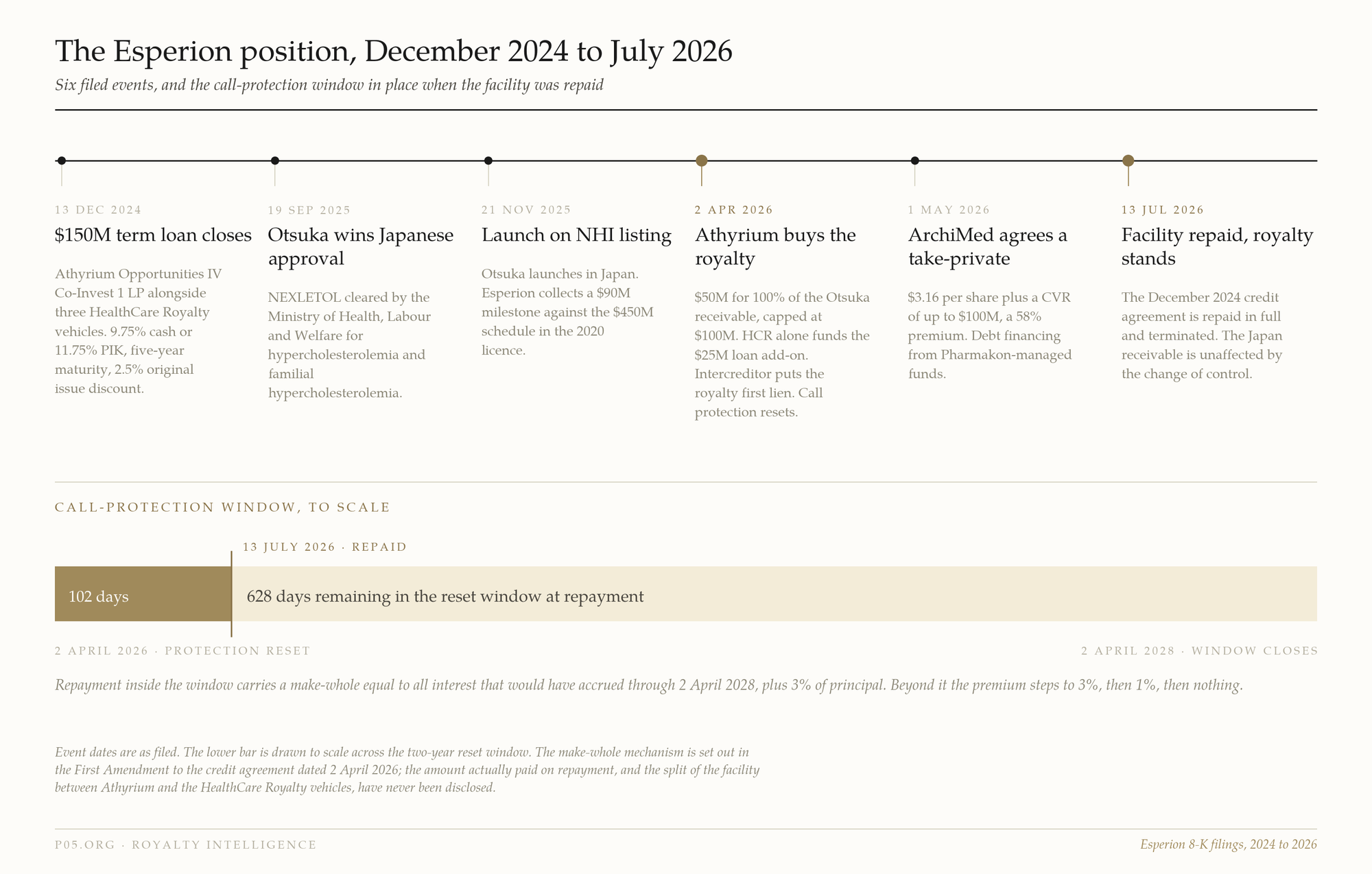
And the call protection was reset. Any repayment on or before 2 April 2028, other than scheduled amortisation, carries a make-whole equal to all interest that would have accrued through that date, plus 3%. The loan was repaid on 13 July 2026, one hundred and two days later.
Investors
There is no published limited partner roster, and Athyrium's own description of its investor base runs to a single sentence covering seven institution types.
Fundraising releases give the count and the shape. Fund I closed oversubscribed with more than 35 institutional investors. Fund II with more than 40. Fund III with more than 45, and Neuberger Berman noted at the time that a number of them had invested in both predecessors.
PitchBook fills in fragments. It records 9 limited partners for Fund I, 20 for Fund II, 26 for Fund III and 5 for Fund IV, which are coverage figures rather than complete lists, and names Abbott Laboratories Annuity Retirement Trust across Funds II, III and IV.
The only actual numbers come from public plan disclosure. The Greenwich, Connecticut retirement board committed $5M to Athyrium Opportunities Fund III as a 2017 vintage and disclosed the position in successive schedules of investments prepared by NB Alternatives. Those are reproduced below.
Fund IV closed at over $1.2B against Fund III's $2.025B. The 2021 to 2022 fundraising window was difficult across private credit and step-downs between vintages were widespread, so the comparison to Fund III only carries weight if you assume Athyrium faced average market conditions.
Nothing in the public record establishes that either way, and no manager-specific explanation has been published.
Governance and team
The investment team is eight people. Jeffrey A. Ferrell as Managing Partner, Laurent D. Hermouet and Mark Kavulich as partners, April Pun as Principal, and four associates.
Hermouet has been at the firm since the beginning; he was already a named partner in the 2013 Fund I closing release, and he is the quoted voice on both the Zealand royalty bond in 2014 and the Esperion royalty purchase in 2026. Twelve years apart, same person, same instrument category.
That continuity is unusual and it is the reason the royalty thread in this book is coherent rather than opportunistic.
Two names in the historical record do not appear on the current team page. Richard Pines was a partner at the Fund I close in 2013. Hondo Sen was the partner quoted on the BioCryst transaction in December 2020. Team pages are maintained at the manager's discretion and no conclusion should be drawn from an omission.
Firm operations are nine people under Andrew Hyman as COO and General Counsel, with Emily Au as CFO, Courtney Paul running investor relations alongside an associate general counsel role, and Rashida Adams as Senior Counsel, who signs fund-level loan documents as authorised signatory.
The external partners list includes four senior advisors and, separately, Samuel Porat, Managing Director at Neuberger Berman Group. Porat was co-head of the Fund I investment team alongside Ferrell in 2013 and his continued presence on the page indicates the NB relationship remains live at the deal level rather than as a distribution arrangement.
No carried interest arrangement, hurdle rate, management fee or performance benchmark has been published for any of the four funds.
IP, royalties, and the economics of return
Athyrium's exposure to royalty assets takes four forms, and they behave very differently from one another.
The one purchase
On 2 April 2026 Athyrium Opportunities IV Acquisition LP paid Esperion $50M for 100% of the royalties payable on net sales of bempedoic acid products in the Otsuka Territory from 1 January 2026, together with the related regulatory and commercial milestones, until aggregate receipts reach $100M, after which everything reverts to Esperion.
The underlying licence is the Esperion-Otsuka agreement of 17 April 2020, amended 5 November 2025. Esperion's 10-Q sets out its terms: a $60.0M upfront, up to $450.0M in milestones, and tiered twelve percent to thirty-three percent royalties on net sales in Japan.
Esperion had already collected $10.0M on JNDA submission in 2024 and $90.0M in Q4 2025 on approval, first NHI price listing and the CLEAR Outcomes MACE endpoint. What remains is up to $10.0M on approval of the combination product and up to $310.0M in sales milestones.
So the asset Athyrium bought is a 12% to 33% royalty on a drug approved in Japan on 19 September 2025 and launched on 21 November 2025, plus a claim on up to $320M of contingent milestones, capped at $100M in total receipts.
The cap is a flat dollar figure rather than a multiple of an accruing balance. Athyrium receives everything until it has received $100M, then nothing. No interest accrues, there is no PIK, no residual tail and no downside protection beyond seniority. Slow Japanese sales do not impair the claim; they push the $100M further out, or out of reach.
The royalty ranks ahead of the debt. The intercreditor agreement of the same date makes the purchaser the first lien party and the term loan agent the second lien party. The effect is that Athyrium's credit exposure ranks behind its own royalty exposure in enforcement, an ordering agreed in writing at the time both positions were put on.
The milestones are inside the purchase. Regulatory and commercial milestones travel with the royalty, which is unusual in smaller monetisations and materially changes the time-to-recovery profile. A single $310M sales milestone tier being hit would extinguish the entire position at once.
And the seller's own accounting for the transaction is not in the public record, because Esperion delisted before its next 10-Q. The comparable is on file, though. Esperion's earlier sale of its European royalty to Oaktree was treated as debt under ASC 470 and amortised under the effective interest method, and the Japan sale was structured through a Royalty Purchase Agreement with substantially the same architecture.
The Oaktree comparable, and an anomaly
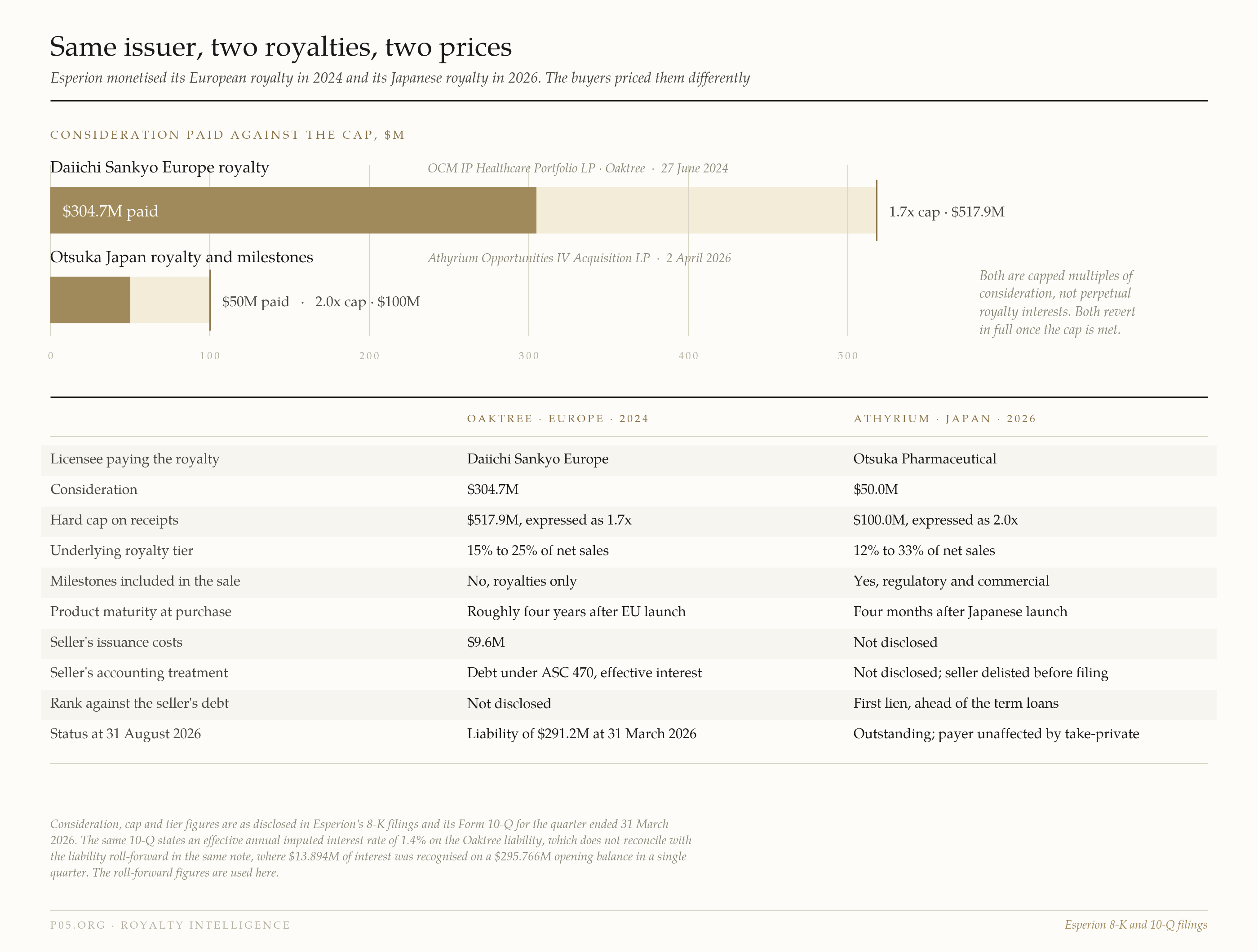
Esperion sold the Daiichi Sankyo Europe royalty on 27 June 2024. OCM IP Healthcare Portfolio LP paid $304.7M for 100% of the DSE royalty interests until it receives 1.7x, equal to $517.9M, with $9.6M of issuance costs. The underlying DSE tier is 15% to 25%.
Oaktree paid 1.7x for a European royalty on a product with several years of sales history. Athyrium paid 2.0x for a Japanese royalty on a product launched five months earlier, with a wider underlying tier and the milestones attached. The higher multiple is consistent with the shorter track record, though neither buyer has published its underwriting.
One figure in the Esperion disclosure on the Oaktree liability does not reconcile with the rest of the same note. In Q1 2026 the company recognised $13.894M of interest on an opening liability of $295.766M, which is 4.7% for the quarter, or roughly 20% annualised. The same note states that the effective annual imputed interest rate is 1.4% as of 31 March 2026 and 1.6% as of 31 December 2025.
Those two statements cannot both describe the same instrument on the same basis. Both figures are reproduced here as filed. The roll-forward is internally consistent and is the basis used in this article; the stated rate would need the annual report to reconcile.
The royalty-backed loans
Twice Athyrium has lent against a royalty instead of buying it. The two structures differ from each other and from the 2026 purchase.
Zealand Pharma, December 2014. $50M (DKK 300M), non-recourse, backed by 86.5% of the future annual royalties and other payments on lixisenatide as a stand-alone product under the Sanofi licence, with no recourse to LixiLan royalties. The coupon was 9.375% and the expected repayment period was 3.3 years, based on a lixisenatide sales forecast in a report commissioned from a US healthcare consulting firm.
Regulatory milestones on lixisenatide and LixiLan were placed in a collateral reserve account that could never exceed the remaining principal, released to Zealand on full repayment.
The escrow provision did most of the work. Lyxumia sold poorly. Sanofi withdrew it from Germany in April 2014, eight months before the bond closed, and quarterly royalties to Zealand were running at DKK 7.1M in Q3 2015. Zealand repaid half the bond in March 2017 using $25M (DKK 175M) of restricted cash, had a further $26.9M (DKK 184M) of collateral released against a parent company guarantee, and redeemed the balance in 2018.
Repayment came out of the milestone escrow rather than out of the royalty stream the bond was named for.
Halozyme, January 2016. $150M through a bankruptcy-remote subsidiary, Halozyme Royalty LLC, lent by BioPharma Credit Investments IV Sub LP and Athyrium Opportunities II Acquisition LP at three-month LIBOR plus 8.75%. Security was the ENHANZE royalties from the Roche and Baxalta collaborations only.
The cash sweep ramped: no royalties applied in 2016 with interest capitalised, 50% of royalties in 2017, 100% from 2018, all subject to quarterly caps, with the excess distributed back to Halozyme. Non-recourse to the parent, with a backstop maturity of 31 December 2050.
The Halozyme structure is conventional in every respect: the SPV, the named collaborations, the ramped sweep, the quarterly caps and the long backstop maturity. The co-lender is the detail that carries forward.
Pharmakon lent here in 2016 and appears again in July 2026 as the debt provider behind ArchiMed's take-private of Esperion, the transaction that repaid Athyrium. The same small group of firms recurs on both sides of these structures across a decade.
The controlled royalty recipient
RVL Pharmaceuticals, Inc. is an Athyrium-owned operating company with royalty obligations running in both directions.
Inbound, RVL owes. The Upneeq licence was acquired in 2017 through the RevitaLid transaction, and under the terms of that acquired licence the company agreed to make future earn-out, milestone and royalty payments based on net sales and regulatory developments.
Outbound, RVL receives. The July 2020 licence to Santen covers development, registration and commercialisation of RVL-1201 in Japan, China, other Asian countries and EMEA. Osmotica received a $25.0M upfront and $10.0M of licence milestones, with further milestones and royalties to come. On 8 January 2026 Santen obtained Japanese manufacturing and marketing approval for UPNEEQ Mini Ophthalmic Solution 0.1%.
Two Athyrium positions therefore cleared Japanese regulators within four months of each other, in unrelated therapeutic areas. Neither had been underwritten with Japan as the driver.
Where royalties do not exist
The healthcare services book, which is most of Funds III and IV by company count, produces no royalty streams of any kind. TeamHealth, Sound Physicians, Gentiva, Elara Caring, Upstream Rehabilitation, Choice Health at Home, Summit BHC and Heartland Veterinary Partners are staffing, provider and post-acute businesses financed on cash flow multiples.
The credit positions in biopharma sit near royalties without owning them. The clearest instance is Omeros. The June 2024 Credit and Guaranty Agreement with Athyrium and Highbridge provided a $92.1M facility with a $67.1M funded initial term loan and a $25.0M delayed draw, secured by a first-priority lien on substantially all assets, excluding royalty interests in OMIDRIA and certain related rights.
Those royalties had already been sold to DRI Healthcare, $125.0M in September 2022 and a further $115.5M in February 2024. Athyrium therefore underwrote a collateral package from which the royalty had already been carved out. That is a common position for a healthcare lender in this period, and the carve-out is disclosed on the face of the transaction.
The BioCryst transaction of December 2020 shows where Athyrium sat in an earlier paired structure. On the same day, in the same announcement, Royalty Pharma paid $125M for 8.75% of ORLADEYO net sales up to $350M, 2.75% between $350M and $550M, nothing above that, plus sublicence share and a 1.0% royalty on BCX9930; and Athyrium provided a $200M credit facility at LIBOR plus 8.25% with a 1.75% floor, interest-only across a five-year term with a bullet at maturity.
Two firms funded the same issuer on the same day and split the instruments between them, with Royalty Pharma on the royalty and Athyrium on the loan.
At Esperion in 2026 the allocation ran the other way, with Athyrium on the royalty and HealthCare Royalty on the incremental loan.
The Esperion trade, in sequence
The Esperion position is the only complete round trip in the current portfolio, and every leg of it is documented.
December 2024: Athyrium Opportunities IV Co-Invest 1 LP joins three HealthCare Royalty vehicles in a $150M senior secured term loan at 9.75% cash or 11.75% PIK, five-year maturity, 2.5% OID, $50M minimum liquidity covenant. Proceeds repay part of Esperion's 4.00% convertible notes due November 2025.
Through 2025: Esperion elects PIK for two quarters, adding $9.1M to principal. Otsuka wins Japanese approval in September and launches in November, paying Esperion $90M.
2 April 2026: Esperion closes the $75M acquisition of Corstasis. On the same day it draws $25M of incremental term loans, funded entirely by the two HCR vehicles, and sells the Japan royalty to Athyrium for $50M. The intercreditor agreement subordinates the loan to the royalty. Call protection resets to a make-whole through 2 April 2028 plus 3%.
1 May 2026: Esperion agrees to be acquired by ArchiMed at $3.16 per share plus a CVR worth up to $100M in aggregate, a 58% premium, valuing the equity at up to approximately $1.1B. Debt financing comes from Pharmakon-managed funds.
8 July 2026: shareholders approve.
13 July 2026: the merger closes. Esperion enters a new loan agreement with BioPharma Credit PLC and affiliated lenders, and repays in full and terminates the December 2024 credit agreement.
The loan therefore ran roughly nineteen months and was repaid inside the reset make-whole window. The contractual consequence is that repayment carried all interest that would have accrued through 2 April 2028, plus 3% of principal.
The actual amount paid has not been disclosed, and the split of the original $150M between Athyrium and the HCR vehicles has never been published, so the return cannot be computed from outside. The contractual mechanism itself is on file.
The royalty remains outstanding. It is a claim on Otsuka's Japanese sales, held by a Fund IV vehicle, against a payer unaffected by Esperion's change of control. Esperion recognised $2.1M of Otsuka collaboration revenue in Q1 2026, covering royalty and bulk tablet supply together, against nil in the comparable quarter. One quarter is thin evidence of a ramp in either direction.
Portfolio, as of August 2026
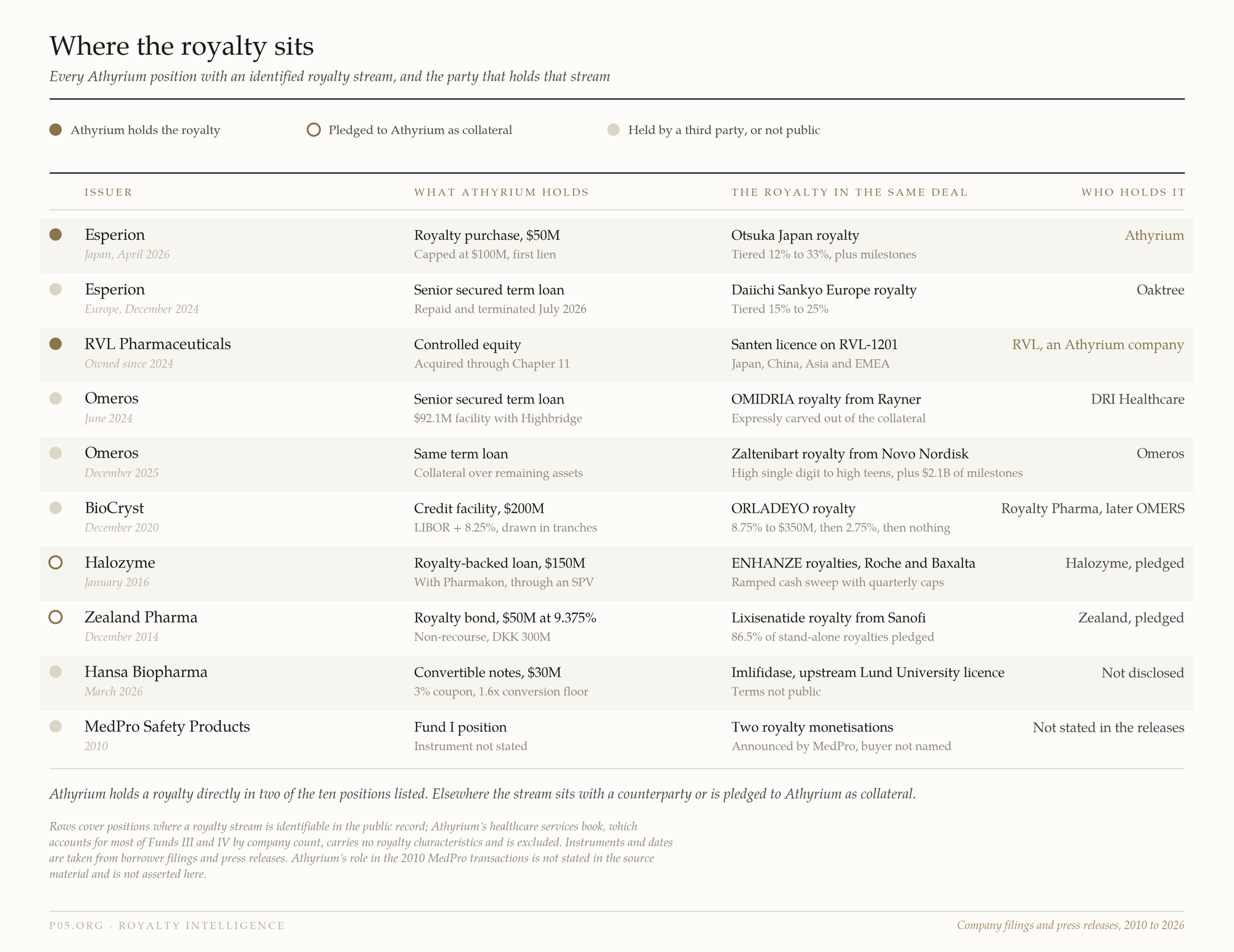
Positions with identified royalty relevance. Instrument, size and current mark are undisclosed except where stated.
| Position | What Athyrium holds | Royalty relevance |
|---|---|---|
| Esperion (formerly Nasdaq: ESPR) | Japan royalty and milestone receivable, purchased Apr 2026 for $50M, capped at $100M | The only outright royalty purchase in the current book. Underlying Otsuka tier 12% to 33%, plus up to $320M of remaining milestones. Payer is Otsuka, not Esperion |
| RVL Pharmaceuticals, Inc. | Controlled operating company, acquired through Chapter 11, 2024 | Receives milestones and royalties from Santen on RVL-1201 in Japan, China, other Asian countries and EMEA; Japanese approval Jan 2026. Owes earn-out, milestone and royalty payments under the 2017 RevitaLid licence |
| Omeros (Nasdaq: OMER) | Senior secured term loan, $92.1M facility with Highbridge, Jun 2024 | Collateral expressly excludes OMIDRIA royalty interests, previously sold to DRI Healthcare for $240.5M across two tranches. Omeros holds tiered high single-digit to high-teens royalties from Novo Nordisk on zaltenibart plus up to $2.1B of milestones |
| Hansa Biopharma (Nasdaq Stockholm: HNSA) | $30M unsecured convertible senior notes, 3% coupon, 2031 maturity, 25% conversion premium, 1.6x minimum return condition | Imlifidase BLA filed with FDA Feb 2026. Underlying IP licensed from Lund University; upstream academic licence economics not public |
| Halozyme (Nasdaq: HALO) | Historical: $150M royalty-backed loan with Pharmakon, Jan 2016, via Halozyme Royalty LLC | Secured on ENHANZE royalties from Roche and Baxalta collaborations only, non-recourse, ramped cash sweep with quarterly caps |
| Zealand Pharma (Nasdaq Copenhagen: ZEAL) | Historical: $50M (DKK 300M) royalty bond, Dec 2014, 9.375% | Backed by 86.5% of lixisenatide stand-alone royalties from Sanofi, with milestones escrowed as collateral. Half repaid from restricted cash 2017, redeemed 2018 |
| BioCryst (Nasdaq: BCRX) | Historical: $200M credit facility, Dec 2020, LIBOR + 8.25% | Paired with Royalty Pharma's simultaneous royalty purchase. Athyrium took the credit tranche, Royalty Pharma the royalty |
| Coherus, Puma, Paratek, Basilea, Calliditas, BridgeBio, Crown Laboratories, Revance | Credit and structured positions, Fund IV | Each carries inbound or outbound licence economics; no Athyrium royalty interest identified |
| MedPro Safety Products | Fund I, historical | Athyrium's news archive lists two MedPro royalty monetisation transactions, September and October 2010, the earliest royalty-related items in the record. The releases are MedPro's and Athyrium's role in them is not stated |
Blue team and red team
Blue team
- Eighteen years of continuous operation under one founder, with a partner in Laurent Hermouet who has personally covered the royalty-linked transactions from Zealand in 2014 to Esperion in 2026
- The Neuberger Berman relationship, dating to 2009, gives institutional distribution, back-office scale and a co-manager on every flagship fund, which is a durable structural advantage for a firm of eight investment professionals
- The Esperion trade demonstrates the ability to take two positions in the same issuer, price them differently, and subordinate one to the other in a signed intercreditor agreement. Few credit managers of this size execute that cleanly
- Call protection is drafted hard and reset when the facility is amended, which converted a nineteen-month loan into a full-term economic outcome when the borrower was taken private
- The royalty purchased is a hard-capped claim on an investment-grade Japanese pharmaceutical payer, insulated from the borrower's own credit and from its change of control
- Documented willingness to own assets through restructuring rather than sell claims, as at RVL, which gives the funds an alternative to distressed exit pricing
- Deep repeat-counterparty network across the specialty credit and royalty universe: Pharmakon, HealthCare Royalty, Royalty Pharma, Highbridge, DRI. Athyrium is in the room for the structures that get syndicated
- Realised exits across four vintages include trade sales to bioMérieux, BASF, Pfizer, Mallinckrodt, Galenica, Lilly, Asahi Kasei and Jabil
Red team
- One outright royalty purchase appears in the public record. Athyrium has not raised a dedicated royalty vehicle, so the Esperion transaction is a single data point rather than an established programme
- The Esperion royalty carries no interest accrual and no minimum payment, so recovery timing depends entirely on Japanese uptake. The launch is three quarters old, and the first disclosed quarter of Otsuka collaboration revenue to the seller was $2.1M, covering royalty and bulk tablet supply together
- Fund IV closed at over $1.2B against Fund III at $2.025B. Step-downs between 2017 and 2021 vintages were widespread across private credit, and no manager-specific explanation has been published in either direction
- Regulatory AUM of $2.898B at March 2025 against $4.6B of cumulative commitments is consistent with older vintages in harvest, but the composition is not disclosed
- No fund-level performance has ever been published, so nothing in this profile supports a view on returns. The single limited partner disclosure reproduced above is an interim mark on a 2017-vintage credit fund at 31 December 2021, and interim IRRs on partly realised credit portfolios are weak predictors of final outcomes
- Four portfolio companies have filed Chapter 11: Pernix, Biora Therapeutics, CareMax and RVL Pharmaceuticals plc. Recoveries are not disclosed in any of them. Two sat in value-based care, a sector that produced several Chapter 11 filings across multiple sponsors in 2024
- Two partners named in earlier transaction records do not appear on the current team page, and an eight-person investment team concentrates origination and monitoring in a small group relative to committed capital. Both are common features of specialist credit managers
- Fund III's weighting toward healthcare services and value-based care has no relationship to intellectual property and produces no royalty characteristics, so the royalty-relevant portion of the platform is smaller than the headline capital figure suggests
- No successor fund has been announced since Fund IV closed in 2022
Implications for the pharmaceutical royalty and biotech capital markets
Five points here generalise beyond this manager.
Credit funds are becoming royalty buyers one transaction at a time, and the transactions look different from royalty-fund transactions. The Athyrium-Esperion purchase is capped at a flat $100M rather than a multiple of an accruing balance, it swallows the milestones alongside the royalty, and it sits first lien ahead of the same fund family's own loan. That is a credit desk's structure applied to a royalty asset.
It prices for recovery speed rather than for terminal value, and it will be underwritten in a diligence process that starts with the borrower's covenant package rather than with the licence. Anyone marketing royalty paper to credit managers should expect those questions, in that order.
The intercreditor document is where the real information sits. No royalty database records that Athyrium subordinated its loan to its royalty at Esperion, because the fact only exists in a redlined credit agreement attached to an 8-K. The same is true of the Omeros collateral carve-out and the Halozyme cash-sweep ramp. Royalty terms are increasingly disclosed not in royalty agreements but in the financing documents that sit around them, and the searchable version of that disclosure sits in the exhibit list.
Take-privates create a specific and underpriced event risk for lenders and a specific benefit for royalty holders. ArchiMed's acquisition of Esperion repaid the term loan inside its call protection window and left the royalty untouched. The loan was repaid with a make-whole and the exposure ended there.
The royalty holder kept a claim on Otsuka that is indifferent to who owns Esperion. In a market where roughly the same investors provide both instruments, the divergence in change-of-control outcomes is worth explicit modelling.
Royalty-backed lending failed at Zealand for the right reasons and the structure saved the lender anyway. Lixisenatide never generated the royalties the third-party forecast projected, and the bond was repaid from an escrow funded by milestones on a different product.
Every royalty-backed loan should be tested on the question of what repays it if the forecast is wrong by an order of magnitude. In 2014 the answer was a collateral reserve account funded by milestones on a different product. Many structures written since have no equivalent.
Japan keeps showing up. Two Athyrium positions produced Japanese regulatory approvals within four months of each other, in unrelated therapeutic areas, and in both cases a Japanese licensee is now the party generating royalty cash for a US or European licensor.
Japanese approval and NHI listing produce a dateable, disclosed cash event on a schedule that is more predictable than US launch economics. For anyone building a royalty origination pipeline, licensor-side Japanese partnerships remain a thinly worked source of monetisable, single-territory streams.
Recent developments
- Athyrium acquired the Esperion Japan royalty on 2 April 2026 for $50M, taking 100% of the receivable to a $100M cap, with the intercreditor agreement placing it ahead of the credit facility
- Esperion's credit facility was repaid in full and terminated on 13 July 2026 on completion of the ArchiMed take-private, inside the make-whole window that had been reset on 2 April
- Athyrium invested $30M in Hansa Biopharma convertible notes on 20 March 2026 as sole investor, with a 3% cash coupon, a 25% conversion premium and a 1.6x minimum return condition on conversion. Hansa filed its US BLA for imlifidase in February 2026 and the financing extends runway into mid-2027
- Santen obtained Japanese approval for UPNEEQ Mini on 8 January 2026, activating milestone and royalty economics for Athyrium-owned RVL Pharmaceuticals
- RVL announced a strategic investment and alliance with OrangeTwist, a US medspa platform, on 5 January 2026, alongside leadership appointments in November 2025
- Omeros closed its asset purchase and licence agreement with Novo Nordisk for zaltenibart on 1 December 2025, with $240.0M paid at closing, up to $2.1B in total consideration and tiered high single-digit to high-teens royalties. Athyrium is a secured lender to Omeros, not a holder of those royalties
- US WorldMeds completed the acquisition of Adaptimmune's cell-therapy portfolio in August 2025, adding Tecelra and lete-cel to a Fund II portfolio company
- Signet, Athyrium, Hildred and Pharmascience exited Pharmaceutics International in February 2025 on its sale to Jabil
- Crown Laboratories completed its acquisition of Revance Therapeutics in February 2025, resolving a Fund IV position that began with a $300M note purchase in March 2022
- No new fund has been announced since Fund IV closed in 2022
Financial history and recent developments
| Date | Event |
|---|---|
| 2008 | Athyrium Capital Management formed by Jeffrey A. Ferrell |
| 2009 | Strategic relationship with Neuberger Berman's alternatives business |
| Sep and Oct 2010 | MedPro Safety Products royalty monetisation transactions, the earliest royalty items in Athyrium's archive |
| May 2013 | Athyrium Opportunities Fund closes at $507M, oversubscribed, 35+ institutions |
| Dec 2014 | Zealand Pharma raises $50M (DKK 300M) in a royalty bond at 9.375%, backed by 86.5% of lixisenatide stand-alone royalties |
| Jul 2015 | Athyrium Opportunities Fund II closes at over $1.2B, 40+ institutions |
| Jan 2016 | Halozyme closes a $150M royalty-backed loan with Pharmakon and Athyrium Opportunities II Acquisition LP at 3M LIBOR + 8.75% |
| Mar 2017 | Zealand repays half the royalty bond using $25M of restricted collateral cash |
| Dec 2017 | Athyrium Opportunities Fund III closes at approximately $2.025B, 45+ institutions |
| 2018 | Zealand redeems the balance of the royalty bond |
| Dec 2020 | BioCryst raises $325M: Royalty Pharma buys the ORLADEYO royalty, Athyrium provides a $200M credit facility |
| Mar 2022 | Revance closes a $300M note purchase agreement with Athyrium |
| 2022 | Athyrium Opportunities Fund IV closes at over $1.2B |
| Sep 2022 | Basilea announces an approximately $77M (CHF 75M) senior secured loan with Athyrium |
| Dec 2023 | Calliditas refinances with an approximately $100M (EUR 92M) senior secured facility from Athyrium |
| 2024 | Athyrium takes ownership of RVL Pharmaceuticals, Inc. through Chapter 11; the public parent is wound down with no recovery to shareholders |
| 3 Jun 2024 | Omeros enters a $92.1M facility with Athyrium and Highbridge, collateral excluding OMIDRIA royalty interests |
| 27 Jun 2024 | Esperion sells its European royalty to Oaktree's OCM IP Healthcare Portfolio LP for $304.7M, capped at 1.7x |
| 17 Nov 2024 | CareMax, a Fund III portfolio company, files Chapter 11 |
| 13 Dec 2024 | Esperion closes a $150M senior secured term loan with Athyrium Opportunities IV Co-Invest 1 LP and three HealthCare Royalty vehicles |
| Feb 2025 | Revance acquisition by Crown Laboratories completes; Pharmaceutics International sold to Jabil |
| 25 Mar 2025 | Form ADV reports $2.898B discretionary regulatory AUM across 12 clients |
| 19 Sep 2025 | Otsuka receives Japanese approval for NEXLETOL |
| 21 Nov 2025 | Otsuka launches NEXLETOL in Japan on NHI listing; Esperion receives $90M |
| 1 Dec 2025 | Omeros closes the Novo Nordisk zaltenibart transaction |
| 8 Jan 2026 | Santen obtains Japanese approval for UPNEEQ Mini, an Athyrium-owned RVL asset |
| 20 Mar 2026 | Hansa Biopharma issues $30M of convertible notes to Athyrium as sole investor |
| 2 Apr 2026 | Athyrium buys the Esperion Japan royalty for $50M; HCR funds $25M of incremental term loans; intercreditor agreement subordinates the loan to the royalty; call protection resets |
| 1 May 2026 | ArchiMed agrees to acquire Esperion at $3.16 per share plus a CVR of up to $100M |
| 8 Jul 2026 | Esperion shareholders approve the merger |
| 13 Jul 2026 | Take-private completes; the Athyrium and HCR credit facility is repaid in full and terminated; Pharmakon provides the new debt |
Conclusion
Athyrium is a healthcare credit manager that has used a royalty capability rarely. Four funds, over $4.6B committed, roughly 85 portfolio companies, and one disclosed outright royalty purchase in eighteen years.
The purchase itself is documented in unusual detail. Fifty million dollars, capped at one hundred, secured ahead of the manager's own loan, on a Japanese royalty tiered between 12% and 33% with up to $320M of milestones attached.
Three months after it closed the borrower was taken private, the loan was repaid inside its make-whole window, and the royalty came through the transaction unchanged. Whether the ordering reflected a view on the two assets or simply how the negotiation landed cannot be established from outside. It was agreed in writing before the take-private was announced.
The rest of the book is harder to read. Fund IV came in below Fund III in a difficult fundraising window. One $5M limited partner position marked at 6.3% net IRR at the end of 2021 is the only performance figure visible outside the LP base, and it is a mid-life mark on a 2017-vintage credit fund. Four portfolio companies have been through Chapter 11 with no public recovery.
All information in this article was accurate as of the research date, and is derived from publicly available sources including SEC filings, company press releases, fund websites, public pension disclosure, data-vendor records and financial news reporting. Athyrium Capital Management does not publish fund-level performance, position sizes, portfolio marks, limited partner identities or carried interest terms; no such figures should be inferred from this article. The Fund III net IRR, net multiple and DPI figures reproduced here are those of a single limited partner with a $5M commitment, as disclosed in schedules of investments prepared by NB Alternatives Advisers for the Town of Greenwich, Connecticut, and are net of underlying investment fees, expenses and carried interest; they describe one investor's experience at two dates and are not a fund-level or firm-level track record. The split of the December 2024 Esperion term loan between Athyrium and the HealthCare Royalty vehicles has never been disclosed, and no return on that position can be calculated from public information; the description of the make-whole mechanism reflects the contractual terms filed with the SEC, not any disclosed payment. The observation that Esperion's stated effective imputed interest rate on the Oaktree royalty liability does not reconcile with the same filing's liability roll-forward is drawn from the Form 10-Q for the quarter ended 31 March 2026 and is presented as an inconsistency in the disclosure, not as an assertion about the underlying transaction. Athyrium's role in the 2010 MedPro Safety Products royalty monetisations is not stated in the source releases and is not asserted here. Portfolio company fund attributions are taken from Athyrium's own portfolio page and reflect the fund or funds holding a position, not the instrument held. Currency conversions use approximate rates prevailing at the transaction date, with the original in brackets, unless the cited source published its own conversion. Holdings and contractual relationships described are as of the cited dates and do not constitute a recommendation. Information may have changed since publication. This content is for informational purposes only and does not constitute investment, legal, or financial advice. The author is not a lawyer or financial adviser.