Fund of the Week: California Institute for Regenerative Medicine
California's stem cell agency has committed most of $8.5B of voter-approved bonds as grants. A company that sells a product built on one of them owes the state a royalty of 0.1 per cent of sales for each $1M awarded, for ten years or until it has paid nine times the award.

On 29 October 2026 Aspen Neuroscience priced its initial public offering at $15 a share, raising $140.6M for sasineprocel, a Parkinson's treatment made from each patient's own cells. Among the obligations the prospectus lists is one to the State of California.
If Aspen does not elect within ten years to treat a 2024 award from the California Institute for Regenerative Medicine (CIRM) as a loan, it owes CIRM a low single-digit royalty on sales of sasineprocel "until such aggregate royalty payments equal nine times the total amount awarded".
The award was $8.0M, approved in March 2024 for the Phase 1/2a trial. Aspen had received $7.4M of it by the end of 2025 and books it against research costs, because it does not intend to repay it other than through royalties. Each such award works like a capped synthetic royalty.
The state pays in during development, takes no equity, and is repaid from sales if the product is sold, or by a loan repayment at a price the company chooses when to fix.
The Weekly Term Sheet recorded Aspen's offering in week 44. This profile covers the agency on the other side of the award.
At a Glance
- What it is: a California state agency that makes grants and loans for stem cell and gene therapy research, from discovery to clinical trials, and recovers part of the money through royalties on products that reach the market
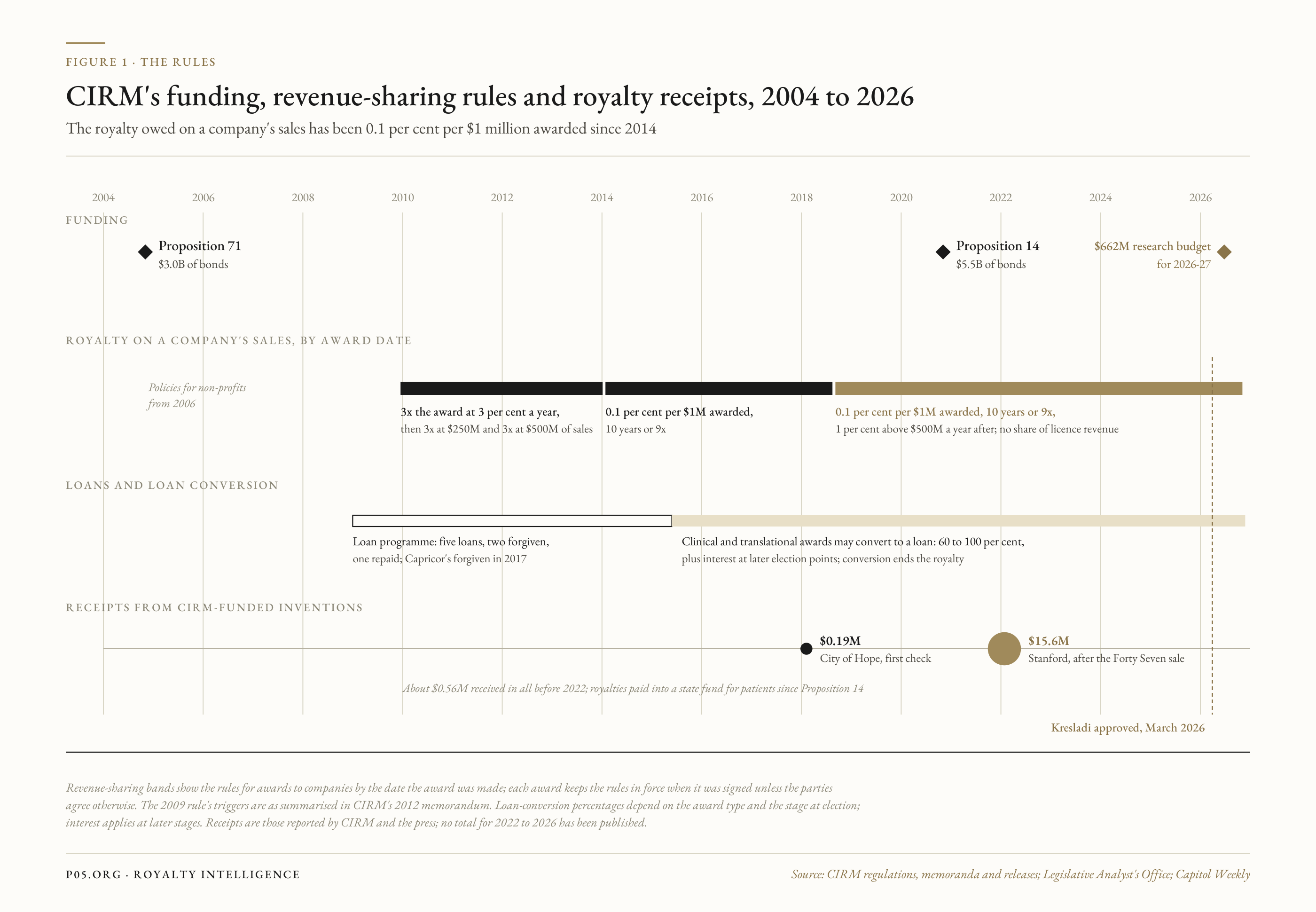
- Created by: Proposition 71 in November 2004, with $3.0B of general obligation bonds, and renewed by Proposition 14 in November 2020 with $5.5B more
- Funding to date: $8.5B allocated under the two measures
- Research budget for 2026-27: $662M, the largest single-year budget in its history
- Clinical trials supported: more than 100 since grants began
- Approved products: one, Rocket Pharmaceuticals' Kresladi for severe leukocyte adhesion deficiency-I, approved in March 2026 after a $5.87M award
- Royalty terms since September 2018: 0.1 per cent of net commercial revenue per $1M awarded, for ten years or until payments reach nine times the award, then 1 per cent of annual sales above $500M in some cases
- Exit for the company: clinical, translational and product development awards may be converted into a loan, repaid at 60 to 100 per cent of the award plus interest at later stages
- Royalties received: about $0.56M up to January 2022, then $15.6M from Stanford after the sale of Forty Seven to Gilead
- Leaders: Jonathan Thomas, president and chief executive since July 2024, and Vito Imbasciani, chair of the governing board
- Staff: 68, on an administrative budget of $36.2M for 2026-27
A Note on Scope
CIRM is a public agency, not a fund. It has no limited partners, reports no returns and owns no intellectual property in what it funds. This profile treats it as a holder of contingent royalty claims, which is how its award terms read to a company that accepts one. The agency's science, its workforce programmes and its clinics are left out except where they bear on those claims.
CIRM publishes no register of awards that carry royalty obligations and no total of royalties received since 2022. The award terms below come from CIRM's regulations and published guidance, and from the filings of companies that hold awards. Companies describe the royalty in their own words, and some descriptions differ from CIRM's formula.
Investment Thesis and Mandate
California's voters created CIRM in 2004. Proposition 71 let the state sell $3B of bonds for grants and loans, and required CIRM to adopt intellectual property rules that balance a return to the state against the development of therapies. Proposition 14 added $5.5B in 2020, widened the mandate to gene therapies and diseases of the brain, and enlarged the governing board from 29 to 35 members.
The Legislative Analyst's Office put the cost of the second measure, with interest, at about $7.8B over some 30 years.
The agency describes its mission as speeding treatments to patients. It funds discovery work at universities, translational and clinical projects at universities and companies, and a network of clinics that run trials in the state. Its clinical budget for 2025-26 was $135M, expected to fund nine to 12 awards.
CIRM does not take equity. Its return is set by regulation and applies to every award of the same vintage. The rules have the force of state law and CIRM calls them non-negotiable.
How Capital Enters and Returns
An award is paid in disbursements tied to project milestones. Aspen's was set to arrive in seven payments, one on signing and six on milestones, over about two and a half years. The award stays a grant unless the company converts it.
If a product reaches the market, the company selling it owes the royalty. That company may be the awardee or a licensee or buyer, which CIRM calls the Commercializing Entity, and the obligation follows the product. Under the 2018 regulation the rate is 0.1 per cent of net commercial revenue for each $1M of CIRM funding.
It runs for ten years from first commercial sale or until payments equal nine times the award, whichever comes first, and is paid within 60 days of each quarter. After that a royalty of 1 per cent is owed on net revenue above $500M a year, until the last patent on a CIRM-funded invention expires, if the awards behind it reached $5M and such an invention plays a part in the sales.
A company with a clinical, translational or product development award may instead elect to convert it into a loan, which extinguishes the revenue sharing. It must elect after the award ends and within ten years of its start. The price depends on the stage of the project when the award began and when the company elects.
A cell therapy that starts preclinical and elects before Phase 1 repays 60 per cent. One that elects before a registration trial repays 100 per cent plus interest at 7 per cent a year above a reference rate. For a clinical award that starts in Phase 1, as Aspen's did, election before Phase 2 costs 80 per cent for a cell therapy, before Phase 3 100 per cent, and before registration 100 per cent plus 10 per cent above the reference rate.
CIRM's primer and Aspen's prospectus name LIBOR as that rate; Allogene and Senti describe it as SOFR. Interest runs from each disbursement to the date of election.
Financial Profile and Assets
| Item | Amount | Source and Date |
|---|---|---|
| Bonds authorised, Proposition 71 | $3.0B | Legislative Analyst's Office, 2020 |
| Bonds authorised, Proposition 14 | $5.5B | same |
| Estimated cost of Proposition 14 with interest | about $7.8B | same |
| Funding allocated under both measures | $8.5B | CIRM release, Mar 2026 |
| Proposition 14 research funds unencumbered | $3.64B, 47 per cent | CIRM budget presentation, 30 Apr 2025 |
| Research budget, 2025-26 | $505M, of which clinical $135M | same |
| Research budget, 2026-27 | $662M | CIRM release, 25 Jun 2026 |
| Administrative budget, 2026-27 | $36.2M | CIRM budget presentation, Jun 2026 |
| Income from CIRM-funded inventions, 2017 to 2020 | about $350,000 | Legislative Analyst's Office, 2020 |
| Royalties received before January 2022 | $557,292 | Capitol Weekly, Jan 2022 |
| Royalties from Stanford, Forty Seven sale | $15.6M | same |
| Award to Rocket for the Kresladi trial | $5,867,085 | CIRM, Mar 2026 |
| Capricor repayment on loan conversion | about $6.3M, on a $3.4M award | Capricor 10-Q, 30 Jun 2026 |
| Award to Aspen for sasineprocel | $8.0M, $7.4M received by end-2025 | Aspen S-1/A, Oct 2026 |
| Loans made under the 2009 programme | five, two forgiven, one repaid | CIRM presentation, May 2015 |
Portfolio Book
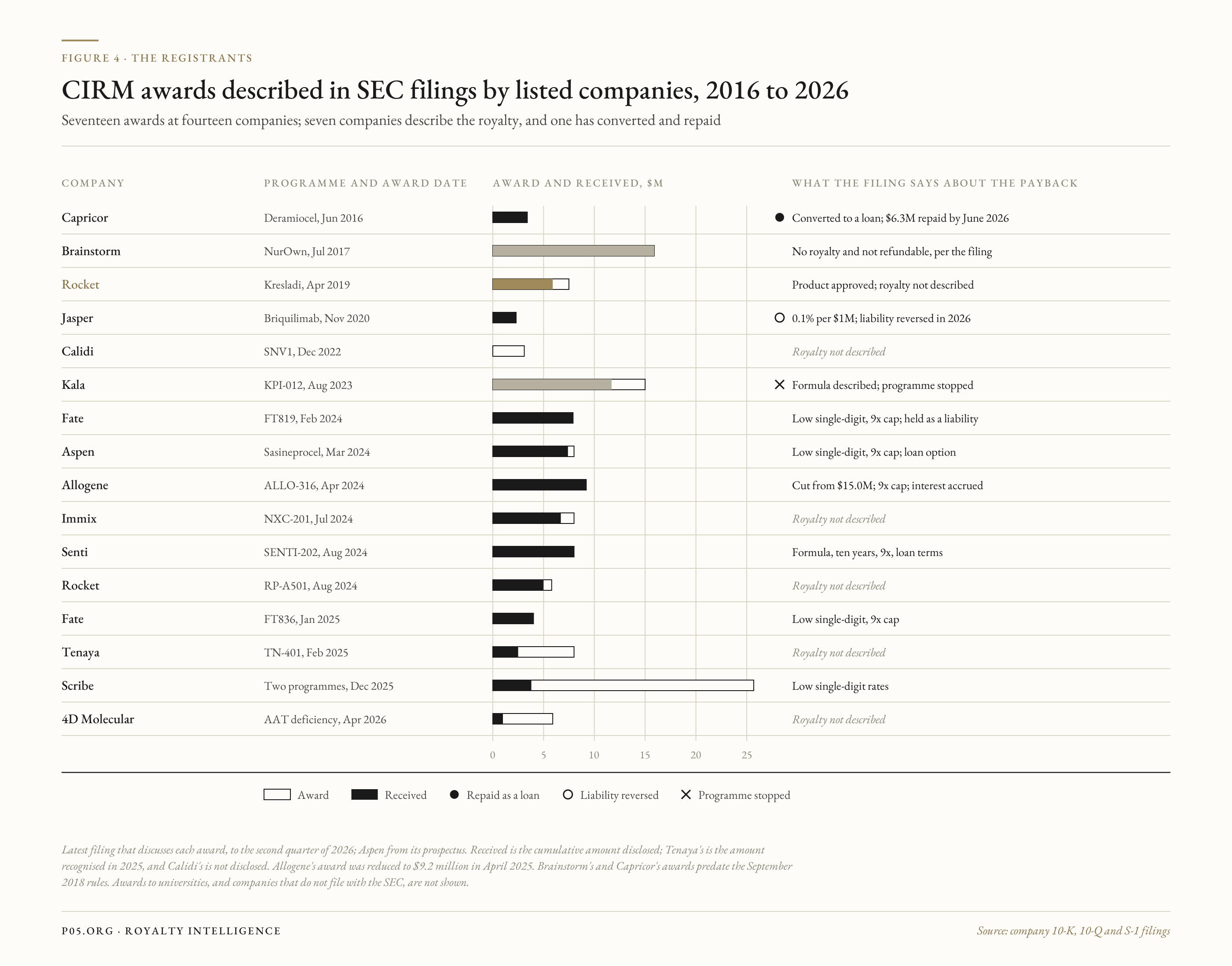
CIRM's awards run to universities, research institutes and private companies. The list below covers those described in the filings of listed companies, checked to the second quarter of 2026.
Approved and marketed: Kresladi (Rocket Pharmaceuticals; CLIN2 award of up to $7.5M in April 2019, $5.9M received; approved March 2026)
Converted to a loan and repaid: deramiocel (Capricor; $3.4M award of June 2016, converted in February 2025, $6.3M repaid by June 2026)
Clinical and preclinical awards outstanding: sasineprocel (Aspen, $8.0M); FT819 and FT836 (Fate, $7.9M and $4.0M); ALLO-316 (Allogene, reduced from $15.0M to $9.2M); SENTI-202 (Senti, $8.0M); NXC-201 (Immix, $8.0M); RP-A501 (Rocket, $5.8M); TN-401 (Tenaya, $8.0M); STX-1400 and STX-1200 (Scribe, $25.7M); an AAT deficiency gene therapy (4D Molecular Therapeutics, $5.9M); SNV1 (Calidi, $3.1M)
Programme stopped: KPI-012 (Kala Bio, $11.7M received of $15.0M; development ended after the Phase 2b trial missed its primary endpoint)
Liability reversed by the company: briquilimab (Jasper, $2.3M)
No royalty, according to the company: NurOwn (Brainstorm, $15.9M, 2017)
Earlier loans: ViaCyte and Capricor, outstanding in 2015; Geron, repaid; iPierian and StemCells, forgiven. Capricor's 2013 loan was forgiven in December 2017
Investors
The money comes from the state's general obligation bonds, which are repaid from the General Fund. CIRM has no outside investors. Royalties do not flow back to it as capital. Before 2020 they went into the General Fund and could be spent on any state programme. Proposition 14 directs them to an interest-bearing account to offset the cost of CIRM-funded treatments for Californians who cannot pay for them.
In February 2022 CIRM's access and affordability working group proposed naming that account the CIRM Patient Assistance Fund and asked for access to the $15.6M it held.
Loan repayments are different. When a company converts an award, the money returns to CIRM for new awards, a point the agency made in 2020 when asked about conversion.
Governance and Team
The Independent Citizens' Oversight Committee governs CIRM. Its up to 35 members are patient advocates, executives of California universities and research institutes, and industry figures, appointed by the governor, other statewide officers, the legislature and University of California chancellors.
The board approves every award and sets the intellectual property rules. Vito Imbasciani has chaired it since 2023 and Maria Bonneville is vice chair.
Jonathan Thomas became president and chief executive in July 2024, after serving as interim chief from January that year. He had chaired the board from 2011 to 2023. His predecessor, Maria Millan, left in November 2023. Rosa Canet-Avilés is chief science officer.
Regulatory note: CIRM presents its annual financial results to the Citizens Financial Accountability Oversight Committee, chaired by the State Controller.
IP, Royalties and Return Economics
From Three Payments to One Rate
The present formula is CIRM's third. Regulations approved in 2009 required a company selling a CIRM-funded product to pay three times the award at 3 per cent of revenue a year, then one-off payments of three times the award when annual revenue reached $250M and again at $500M, and 1 per cent above $500M where a patented invention was involved.
The nine times multiple dates from that schedule. Amendments adopted in 2013, for awards made on or after 27 January 2014, replaced it with the single rate of 0.1 per cent per $1M for ten years or nine times.
The 2018 rules, for awards made from 5 September 2018, kept the rate and dropped the share of licensing revenue that awardees had owed. Universities now owe nothing when they license a CIRM-funded invention, and the royalty passes to whoever sells the product.
What the Cap Means in Sales
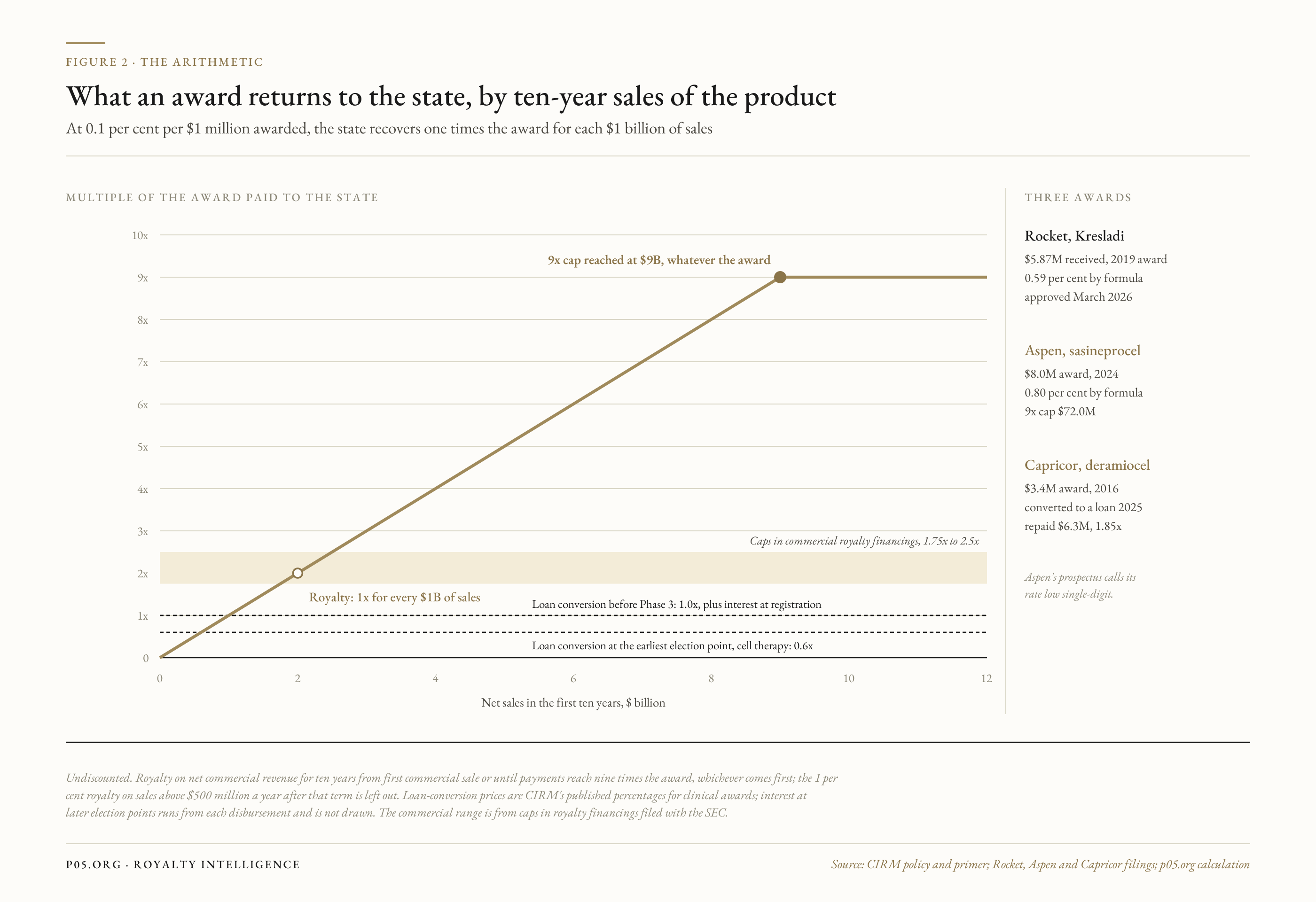
Because the rate rises in step with the award, the sales needed to reach the cap do not depend on its size. At 0.1 per cent per $1M, each $1B of sales returns one times the award, and nine times is reached at $9B. A product must therefore average $900M a year for the first ten years for the cap to bind.
Below that, the ten-year term ends the royalty first, and the state receives one times the award for each $1B sold. CIRM's own worked example, a $10M award and a 1 per cent rate, shows $36.3M over ten years, or 3.6 times, followed by blockbuster payments.
The state's claim is long-dated and small as a share of sales. Commercial royalty financings run at higher rates against caps of 1.75 times at Verona Pharma, 2.0 times at Phathom and 2.5 times at ADC Therapeutics, and are funded around approval. CIRM's award reaches the same multiples only if the product sells $1.75B to $2.5B in ten years, and the money goes in years before any sale.
The Loan as a Buy-Out
The conversion option sets a price at which the company can end the royalty, much as the buy-out clauses in commercial royalty financings do. A cell therapy whose clinical award began in Phase 1 can convert before Phase 3 at the amount received. On the arithmetic above, the royalty would cost more than that if the product's ten-year sales exceeded $1B, before discounting.
Converting before registration adds interest at 10 per cent above the reference rate. The election may be made up to ten years from the award's start.
Capricor is the one listed company to have used it. Its $3.4M award of June 2016 supported a Phase 1/2 trial of deramiocel in Duchenne muscular dystrophy. Capricor notified CIRM of its election in February 2025, agreed a repayment in two instalments in May 2026, and by 30 June had paid about $6.3M, of which $2.9M was interest.
That is 1.85 times the award, ten years after it was made. Allogene, which has not elected, accrues interest on its $9.2M and had $1.9M accrued at the end of June.
CIRM adopted the option in May 2015 to attract applications from companies. Its replies to questions at the time of the Forty Seven sale in 2020 said a buyer of an awardee could convert the grant to a loan and repay it with interest, ending any royalty.
Forty Seven had disclosed $15.2M of CIRM awards carrying a low single-digit royalty and the option to convert. Gilead removed magrolimab from its pipeline in 2024.
Kresladi, the First Approved Product
Rocket's award for its leukocyte adhesion deficiency programme was made in April 2019, after the current rules took effect. Rocket received $5.9M, the last payment in January 2024, for the trial site at the University of California, Los Angeles; sites in London and Madrid were funded separately.
The FDA granted Kresladi accelerated approval in March 2026, and Rocket's release credits grant CLIN2-11480.
By CIRM's formula the rate on $5.87M is 0.59 per cent of net sales for ten years, with a cap of about $52.8M. Rocket's filings describe neither the royalty nor any election, and book the award as a reduction of research costs. In April 2026 Rocket agreed to sell the priority review voucher that came with the approval for $180M.
Jasper Therapeutics, in its second-quarter report, states that voucher proceeds are excluded from royalty-bearing net sales under its CIRM grant, and reversed a $2.3M liability on that basis because it expects to realise briquilimab's value through a voucher.
Aspen and the Stack on Sasineprocel
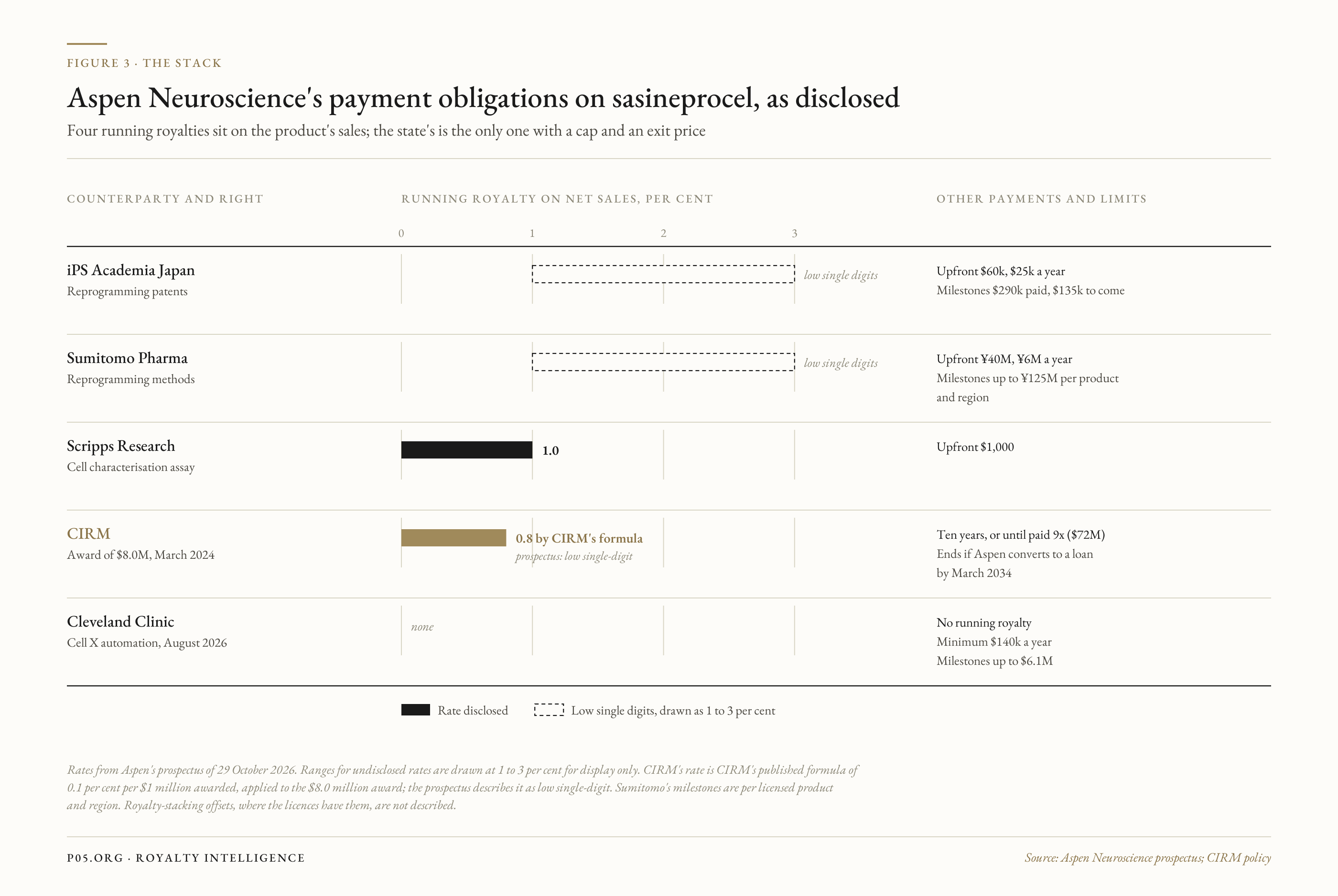
Sasineprocel carries four running royalties, according to the prospectus. iPS Academia Japan, which licenses the reprogramming patents, receives a royalty in the low single digits, after upfront fees of $60,000, annual fees of $25,000 and milestones of $290,000 paid and up to $135,000 to come.
Sumitomo Pharma receives a low single-digit royalty on its reprogramming methods, after ¥40M upfront and ¥6M a year, with development milestones of up to ¥125M per product and region. Scripps Research receives 1.0 per cent for a cell characterisation assay. The Cleveland Clinic licence of August 2026, covering automated manufacturing, carries no running royalty, a minimum of $140,000 a year and milestones of up to $6.1M.
CIRM's claim sits beside these. By CIRM's formula, an $8.0M award carries a rate of 0.8 per cent, the figure CIRM itself uses as its example; the prospectus calls it low single-digit. The cap is $72M. Aspen may elect to convert until March 2034, at a price that rises from 80 per cent of the award to 100 per cent plus interest as the programme moves to registration. Aspen expects to dose patients in a Phase 3 trial in the second half of 2027.
Universities and the Licensing Share
Before 2018, CIRM's largest receipts came from licensing, not sales. The first payment to the state, nearly $200,000 in February 2018, came from City of Hope after it licensed a CAR-T therapy to Mustang Bio.
The $15.6M of January 2022 came from Stanford after Gilead bought Forty Seven, whose science grew out of CIRM grants to Irving Weissman's laboratory. Awards made after September 2018 carry no such share.
Blue Team
- One approved product, Kresladi, from a $5.87M award, and more than 100 clinical trials supported
- A single published formula for all post-2018 awards, which companies can model and which licensees inherit
- Royalties that follow the product to licensees and buyers, as the Commercializing Entity rules provide
- A blockbuster tail of 1 per cent above $500M a year where a patented CIRM-funded invention is involved
- A loan option whose repayments return to CIRM for new awards
- $662M to commit in 2026-27, with Proposition 14 funds still unencumbered
- A $15.6M receipt from Stanford in 2022 and a $6.3M loan repayment from Capricor in 2026, 1.85 times its award
Red Team
- Royalties of about $0.56M in the 17 years to January 2022, against a 2004 campaign study's forecast of up to $1.1B
- One approved product in 21 years of grants
- A rate of 0.1 per cent per $1M, which returns one times the award for each $1B of ten-year sales
- A conversion price, fixed by the company's election, that can end the royalty at 60 to 100 per cent of the award plus interest
- Reference rates for conversion interest described as LIBOR in some documents and SOFR in others
- Seven of 14 listed holders describe the royalty in their filings; Rocket, the holder of the approved product, does not
- Voucher proceeds outside royalty-bearing sales, according to Jasper, and an award at Kala on a programme that has stopped
- Company descriptions that differ from the formula, such as Aspen's low single-digit for a 0.8 per cent rate
- No published register of royalty-bearing awards or of receipts since 2022
- Forty Seven, the largest CIRM-funded company sale, ended in 2024 with magrolimab dropped from Gilead's pipeline
Implications for the Pharmaceutical Royalty and Biotech Capital Markets
Measured by what the company gives up, a CIRM award costs less than the commercial instruments it resembles. A cell therapy with $8M of CIRM money owes 0.8 per cent of sales for ten years, and can end the obligation for the amount it received if it elects before Phase 3.
Capricor's conversion, at 1.85 times after ten years, sits inside the range of commercial caps, and Capricor chose when to pay it.
For a buyer of a CIRM-funded product, the claim is a known item in the stack. It transfers with the product, it is capped, and it can be removed by an election the seller may already have made.
A diligence review would ask whether the award has been converted, when the election window closes, how much interest has accrued from each disbursement, and whether the product uses a patented CIRM-funded invention that would carry the 1 per cent tail.
For licensors such as iPS Academia Japan, the state's royalty is one of several claims of about 1 per cent or a few per cent on the same sales. At Aspen, two licensors' rates are undisclosed, Scripps's is 1.0 per cent, and the state's can be calculated from the award.
For CIRM, the rules trade return for uptake. The 2015 conversion option was adopted to bring companies in. The state's royalty receipts so far come mainly from the licensing share that the 2018 rules removed, and the largest cash return disclosed since 2022 is a loan repayment.
Recent Developments
- Aspen Neuroscience prices its offering at $15 a share, disclosing its CIRM royalty, on 29 October 2026
- Capricor completes repayment of its converted award, about $6.3M including $2.9M of interest, by 30 June 2026
- Jasper reverses its $2.3M CIRM liability, citing a voucher route for briquilimab, in the second quarter of 2026
- CIRM approves a research budget of $662M for 2026-27 and more than $60M of preclinical and clinical awards on 25 June 2026
- The FDA approves Kresladi, the first therapy supported by CIRM to reach the market, in March 2026
- CIRM approves $111M of discovery and clinical awards, including $15M to Immusoft for mucopolysaccharidosis I, on 27 March 2026
- CIRM approves a $100M plan for rare-disease genetic therapies in January 2026
- CIRM updates its primer on commercialisation rights, setting out the loan conversion table, on 9 May 2025
Financial History and Recent Developments
| Date | Event |
|---|---|
| Nov 2004 | Proposition 71 creates CIRM with $3B of bonds |
| 2006 | First intellectual property policy for non-profit grantees |
| 2009 | Loan programme begins; revenue-sharing rules of three times plus milestones approved |
| Jan 2014 | 0.1 per cent per $1M rule applies to new awards |
| May 2015 | Loan conversion option adopted |
| Dec 2017 | Capricor's loan forgiven |
| Feb 2018 | First royalty check, from City of Hope |
| Sep 2018 | Current rules apply to new awards; licensing share removed |
| Mar 2020 | Gilead agrees to buy Forty Seven |
| Nov 2020 | Proposition 14 adds $5.5B |
| Jan 2022 | $15.6M received from Stanford |
| Nov 2023 | Maria Millan leaves as chief executive |
| Mar 2024 | $8.0M award to Aspen |
| Apr 2024 | $15.0M award to Allogene, cut to $9.2M in April 2025 |
| Jul 2024 | Jonathan Thomas named president and chief executive |
| Feb 2025 | Capricor elects to convert its 2016 award to a loan |
| Mar 2026 | Kresladi approved |
| Apr 2026 | Rocket agrees to sell the Kresladi voucher for $180M |
| Jun 2026 | Capricor completes repayment of $6.3M; Jasper reverses its CIRM liability |
| Jun 2026 | $662M research budget approved |
| 29 Oct 2026 | Aspen prices its offering |
Conclusion
CIRM has spent two decades and most of $8.5B of bonds paying for stem cell and gene therapy research. Its return to the state is written into regulation as a royalty of 0.1 per cent of sales per $1M awarded, capped at nine times and limited to ten years, with a loan the company may choose instead. Reported royalty receipts are about $16M, most of it a single licensing payment from Stanford, and one company has repaid an award as a loan at 1.85 times.
The first products to carry the post-2018 terms are now on the market or heading there. Rocket sells Kresladi with an obligation of 0.59 per cent by CIRM's formula, which its filings do not describe. Aspen, which listed on Nasdaq last week, has until 2034 to decide whether the state is paid 0.8 per cent of sasineprocel's sales for ten years or the $8.0M it put in, plus whatever interest the timing adds.
All information in this report was accurate as of the research date and is derived from publicly available sources including court opinions, regulatory guidance, academic literature, SEC filings, and financial news reporting. Information may have changed since publication. This content is for informational purposes only and does not constitute investment, legal, or financial advice. The author is not a lawyer or financial adviser.