Company of the Week: Rhythm Pharmaceuticals
On 2 and 3 November 2026 Rhythm Pharmaceuticals agreed to pay LG Chem $350M to cut a royalty to 1 percent, signed a $750M term loan led by its revenue interest investor, and loosened the terms of that revenue interest. All three contracts are claims on the same IMCIVREE sales.

Late on the evening of 2 November 2026 Rhythm Pharmaceuticals announced that it had amended its licence for bivamelagon with LG Chem. Rhythm will pay LG Chem $350M in four instalments by September 2029. In return the royalty it owes on its MC4R agonists, set at low to mid single digits in the 2024 licence, becomes a flat 1 percent of global net sales from 1 January 2029.
The same release announced a five-year term loan of up to $750M. KKR's HealthCare Royalty leads it, with funds managed by Blackstone, and $500M is committed. The first $250M is due to be drawn on 6 November.
HealthCare Royalty already held a claim on Rhythm's sales. Under a revenue interest financing agreement signed in June 2022 it paid $100M for a tiered share of Rhythm's revenue, secured by a first-priority lien on IMCIVREE and related assets. As part of the loan, HealthCare Royalty agreed to remove that agreement's debt-like covenants and default provisions, to limit its collateral, and to change its material adverse effect clause.
On 3 November Rhythm reported third-quarter sales of IMCIVREE of $92.1M, up 29 percent on the second quarter. It also reported $320.9M of cash and short-term investments, before the loan draw and before the first $70M owed to LG Chem.
At a Glance
| Item | Detail |
|---|---|
| Company | Rhythm Pharmaceuticals, Inc., Boston. Listed on Nasdaq (RYTM) since October 2017 |
| Marketed product | IMCIVREE (setmelanotide), an MC4R agonist licensed from Ipsen, approved for Bardet-Biedl syndrome, certain genetic obesities, and, since 19 March 2026 in America, acquired hypothalamic obesity |
| Product revenue, third quarter 2026 | $92.1M, of which $67.5M in America |
| Product revenue, nine months | $223.5M, against $137.5M a year earlier |
| Net loss, nine months | $146.3M |
| Cash and short-term investments | $320.9M at 30 September 2026, before the $250M draw and the $70M payment to LG Chem |
| Pipeline in the royalty base | Bivamelagon, an oral MC4R agonist licensed from LG Chem, due to enter Phase 3 by the end of 2026, and RM-718, in Phase 1/2 |
| LG Chem amendment | $350M in fixed payments over four years. Royalty cut from low to mid single digits to 1 percent on the MC4R portfolio from 2029 |
| Term loan | Up to $750M, $500M committed, SOFR plus 4.60 percent with a 1 percent floor, 1 percent original issue discount, no amortisation |
| Lenders | KKR's HealthCare Royalty, lead, and funds managed by Blackstone |
| Revenue interest | HealthCare Royalty, $100M funded 2022 to 2023, carried at $102.7M as a deferred royalty obligation at 30 September 2026 |
| Convertible preferred | Perceptive-led Series A, $150M issued in April 2024, 115,000 shares outstanding at 30 June 2026 |
| Royalty posture | Royalty payer. Owes royalties to Ipsen and Camurus on setmelanotide, to LG Chem on the MC4R portfolio, and revenue interests to HealthCare Royalty |
A Note on Scope
The LG Chem amendment, the credit agreement, and the amended revenue interest agreement had not been filed with the SEC at the research date. The 8-K of 3 November furnishes only the results release and the presentation, under Item 2.02. Terms in this profile come from the release of 2 November, the third-quarter presentation, and the conference call of 3 November.
The 2022 revenue interest terms come from the 8-K of June 2022 and the quarterly report for the period to 30 June 2026. Where this profile describes the revenue interest as it stood before the amendment, it uses those documents. Where it describes the amendment, it uses the company's summary, and the amended text may differ.
Rhythm has not disclosed the royalty rates it owes Ipsen or Camurus on setmelanotide. Calculations in this profile are the author's and state their assumptions where they appear.
Three Contracts in Two Days
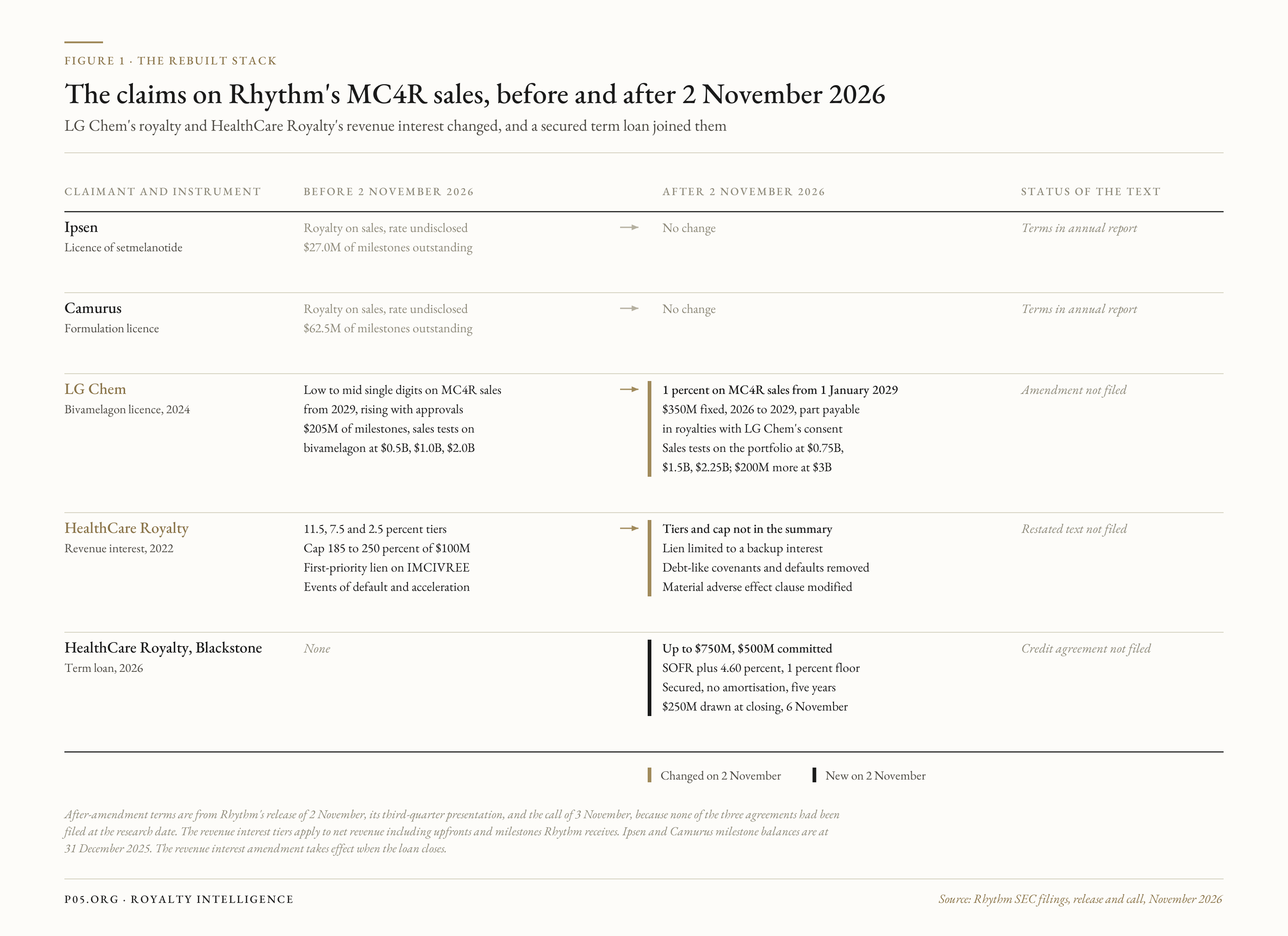
The four claims on Rhythm's MC4R sales after 2 November 2026, with what changed in each
Rhythm has paid for IMCIVREE with equity, with an asset sale, and with a share of revenue. Before its first approval it sold a rare pediatric disease priority review voucher to Alexion for $100M in February 2021. In June 2022, when the Food and Drug Administration approved IMCIVREE in Bardet-Biedl syndrome, it signed the revenue interest agreement with HealthCare Royalty.
That agreement gave Rhythm $100M in three tranches: $37.5M on the American approval, $37.5M on the European one, and $25M on a sales milestone met in 2023.
HealthCare Royalty takes 11.5 percent of annual net revenue up to $125M, 7.5 percent from $125M to $300M, and 2.5 percent above that. The revenue base includes upfront and milestone payments Rhythm receives, as well as product sales.
The 2022 terms resemble a loan in several places. Total payments are capped between 185 and 250 percent of the amount funded, depending on royalties paid from 2028 to 2032. If cumulative payments fall short of 60 percent of the funded amount by 31 March 2027, or 120 percent by 31 March 2029, Rhythm pays the difference in cash.
On a change of control or an event of default, HealthCare Royalty may accelerate up to the cap. On certain material adverse events it may terminate and ask for its money back with a specified return.
Rhythm accounts for the agreement as long-term debt. Its quarterly report for the period to 30 June 2026 gives an effective interest rate of 17.16 percent and cumulative payments of $51.5M. In June 2026 the parties amended a restricted payments covenant so that Rhythm could pay up to $21M of cash dividends on its preferred stock.
LG Chem's claim dates from 4 January 2024. Rhythm took worldwide rights to bivamelagon for $80M in cash, paid in two halves, and $20M of its own stock. Rhythm expensed the $92.4M of consideration as acquired research and development.
It agreed to up to $205M of milestones and to royalties of low to mid single digits on net revenue from its whole MC4R portfolio, including setmelanotide, from 2029. The rate rose with approvals and indications, and could reach low double digits on bivamelagon in a region where only LG Chem's patents covered it.
In April 2024 Perceptive Advisors led a $150M issue of convertible preferred stock, and in July 2025 Rhythm raised $188.7M net in a public offering. KKR completed its purchase of a majority of HealthCare Royalty on 30 July 2025.
The approval in acquired hypothalamic obesity in March 2026 changed the sales line. Rhythm had received more than 700 patient start forms by 30 September, and American revenue rose 32 percent in the third quarter on the second. Japan approved the indication in August, and sales there began on 13 October.
The LG Chem Amendment
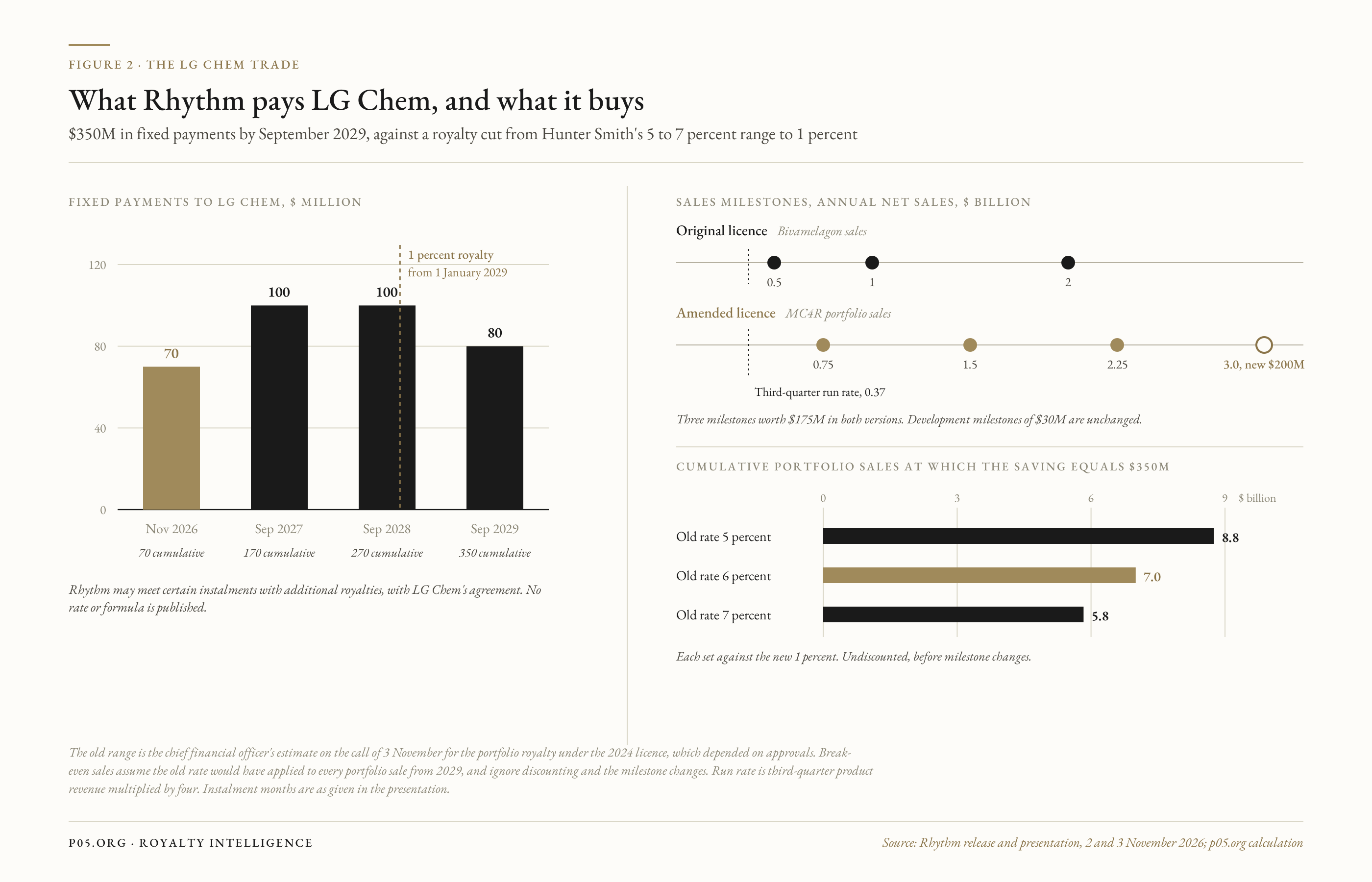
Fixed payments to LG Chem by date, the sales milestones before and after the amendment, and the cumulative sales at which the lower royalty repays $350M
Rhythm pays LG Chem $70M within 15 business days of 2 November, $100M in September 2027, $100M in September 2028, and $80M in September 2029. The variable royalty becomes 1 percent of global net sales of products in the MC4R portfolio, which the release names as setmelanotide, bivamelagon, and RM-718. It starts on 1 January 2029, or at the first sale of bivamelagon if that comes earlier.
The release adds that "with LG Chem's agreement, Rhythm may satisfy certain of the foregoing fixed payment obligations through additional royalties". It gives no rate, no list of the instalments concerned, and no formula.
The milestones changed too. Development milestones stay at $30M. The three sales milestones, worth $175M in all, were triggered by bivamelagon sales of $0.5B, $1.0B, and $2.0B a year.
They are now triggered by sales of the whole MC4R portfolio at $0.75B, $1.5B, and $2.25B. A new milestone of up to $200M is due if the portfolio reaches $3B in a year. Third-quarter product revenue, multiplied by four, comes to $368.5M.
Rhythm's chief financial officer, Hunter Smith, said on the call that the deal was initiated by Rhythm. He put the royalty under the old terms at 5 to 7 percent across the portfolio, depending on future approvals.
Rhythm measured the reduction against risk-adjusted sell-side consensus, and he said the deal takes about 5 percent off that consensus, which he described as implying a quick payback. The chief executive, David Meeker, said the old structure added royalty burden with each new indication for bivamelagon, including Prader-Willi syndrome, and that patents on bivamelagon and RM-718 run into the 2040s.
Rhythm will charge the present value of the $350M to research and development in the fourth quarter. The original $92.4M was treated the same way.
On Mr Smith's range, the amendment cuts the rate by 4 to 6 percentage points. Before discounting, and ignoring the milestone changes, the saving equals $350M once cumulative portfolio sales reach between $5.8B and $8.8B from 2029. The calculation assumes the old rate would have applied to all portfolio sales, which depended on approvals that had not occurred.
LG Chem's side of the trade is in its president's statement only. Jeewoong Son, who heads LG Chem Life Sciences, said in the release that the amendment reflects confidence in bivamelagon and that wider development should bring the drug to patients sooner.
LG Chem receives $350M between November 2026 and September 2029, all of it before or in the first year of the royalty under the original terms. Its sales milestones now count IMCIVREE sales, at higher thresholds.
The Loan and the Revenue Interest
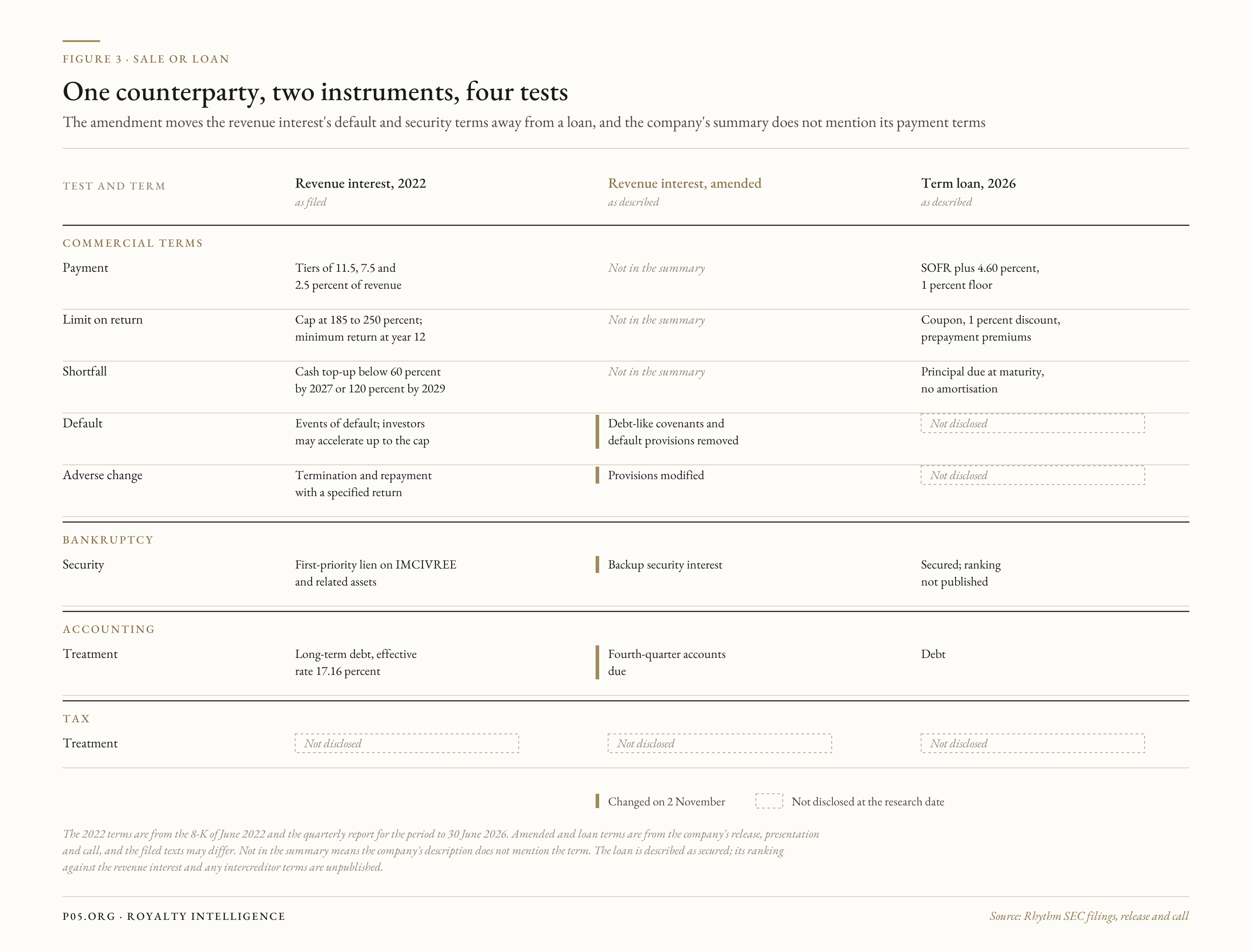
The 2022 revenue interest, the amended revenue interest, and the new term loan, set against the four tests that decide whether a revenue interest is a sale or a loan
The term loan runs five years. Rhythm draws $250M at closing, expected on 6 November, and may draw $250M more at its option by 30 June 2028, in tranches of $100M, $100M, and $50M. A further $250M is available if the lenders agree. Interest is SOFR plus 4.60 percent, with a 1 percent floor on SOFR.
The loan carries a 1 percent original issue discount, no scheduled amortisation, no warrants or other equity, and no exit fee. Prepayment premiums decline over the term, and the presentation describes the facility as secured.
Mr Smith said on the call that the revenue interest amendment removes certain debt-like covenants and default provisions, limits HealthCare Royalty's lien to a backup security interest, and modifies the material adverse event provisions. It takes effect when the loan closes. No analyst on the call asked about the loan or the revenue interest.
A backup security interest is the lien a buyer of a revenue stream usually takes for the case in which a court treats the purchase as a loan. Under the 2022 agreement HealthCare Royalty held a first-priority perfected lien on IMCIVREE and substantially all related assets. The loan the same firm now leads is described as secured.
Whether a revenue interest is a sale or a loan is decided separately for tax, for accounting, in bankruptcy, and in the commercial terms. The amendment changes the commercial terms that the company has described: events of default, the acceleration that followed them, and the lien.
The company's summary does not mention the payment tiers, the cap of 185 to 250 percent, the cash top-ups due in 2027 and 2029, or the minimum return at the twelfth anniversary. Rhythm records the agreement as debt at an effective rate of 17.16 percent. The same counterparty's new loan costs SOFR plus 4.60 percent, before the discount and any prepayment premium.
At the third-quarter run rate of $368.5M a year, and treating product revenue as the whole revenue base, the 2022 tiers produce about $29.2M a year for HealthCare Royalty, or 7.9 percent of revenue. The marginal rate on further sales is 2.5 percent. Rhythm had paid $51.5M by 30 June 2026 against the first top-up threshold of $60M, due on 31 March 2027.
What the Filings Do Not Yet Say
LG Chem has exchanged a royalty that depended on approvals and indications for $350M of fixed payments, and Rhythm may, with LG Chem's consent, pay part of that sum in additional royalties. The rate at which a dollar of fixed payment converts into royalty is not public.
Nor is whether LG Chem's consent is needed instalment by instalment, or whether a converted royalty would count toward the 1 percent or sit on top of it. A receivable that may turn back into a royalty has a different credit profile from cash due on a date, and LG Chem's own disclosures may show how it records the asset.
The release defines the base as global net sales of products within the MC4R portfolio and names three drugs. The original licence attached "customary deductions and anti-stacking" to the royalty, and a step-up to low double digits on bivamelagon where only LG Chem's patents applied. The release does not say whether these survive.
Mr Smith described the 1 percent as assuming American approval of bivamelagon, while the release starts it on 1 January 2029 whatever happens to bivamelagon. The text of the amendment will settle whether IMCIVREE sales owe 1 percent from 2029 if bivamelagon fails, and whether an MC4R agonist Rhythm later acquires falls inside the base.
The release does not say how the loan ranks against the revenue interest. Before the amendment the revenue interest held a first-priority lien on IMCIVREE assets. After it, HealthCare Royalty holds a backup lien as revenue interest investor and, with Blackstone, a lien as lender. An intercreditor agreement, if there is one, will set out the order of payment from IMCIVREE cash flows and what happens to the revenue interest on a default under the loan.
It will also show whether the acceleration right on a change of control, which ran up to the cap in 2022, has survived.
Rhythm has not said when it will file the three agreements, and material contracts are usually filed as exhibits to the next periodic report. The credit agreement will show any financial covenants, such as a minimum cash balance or a revenue test, and the events of default that replace those removed from the revenue interest.
The amended revenue interest agreement will show which of the cap, the top-ups, and the minimum return remain. The fourth-quarter accounts will show whether Rhythm still carries the revenue interest as debt after the amendment, and the size of the research and development charge for LG Chem.
Financial Profile
| Item | Amount | Source and date |
|---|---|---|
| Product revenue, third quarter | $92.1M, up 29 percent on the second quarter | Results release, 30 September 2026 |
| Product revenue, nine months | $223.5M, against $137.5M | same |
| Net loss, third quarter | $41.4M, against $52.9M | same |
| Net loss, nine months | $146.3M | same |
| Research and development, nine months | $137.6M | same |
| Selling, general and administrative, nine months | $197.8M | same |
| Interest expense, nine months | $13.6M | same |
| Cash and short-term investments | $320.9M, against $388.9M at 31 December 2025 | same |
| Deferred royalty obligation | $102.7M, of which $14.8M current | same |
| Series A convertible preferred | $113.6M carrying value | same |
| Revenue interest funded | $100M in three tranches, 2022 to 2023 | 8-K, June 2022 |
| Revenue interest paid to date | $51.5M | Quarterly report, 30 June 2026 |
| Revenue interest effective rate | 17.16 percent | same |
| LG Chem consideration to date | $80M cash and $20M in stock | Annual report, 31 December 2025 |
| LG Chem fixed payments | $350M: $70M, $100M, $100M, $80M | Release, 2 November 2026 |
| Term loan committed | $500M, of which $250M drawn at closing | same |
| Term loan pricing | SOFR plus 4.60 percent, 1 percent floor, 1 percent discount | Presentation, 3 November 2026 |
| Operating expense guidance, 2026 | $360M to $380M, non-GAAP | Results release |
| Ipsen milestones outstanding | $27.0M | Annual report, 31 December 2025 |
| Camurus milestones outstanding | $62.5M | same |
Blue Team
- IMCIVREE sales rose to $92.1M in the third quarter from $51.3M a year earlier, after the American approval in acquired hypothalamic obesity
- The LG Chem royalty falls from 5 to 7 percent, on Mr Smith's range, to 1 percent of portfolio sales
- The term loan has no amortisation and no equity component, and $250M of committed capacity stays undrawn until Rhythm calls it
- The revenue interest loses its debt-like covenants and default provisions, and its lien becomes a backup interest
- Above $300M of annual revenue the revenue interest takes 2.5 percent of each further dollar
- LG Chem's new $200M milestone is payable only at $3B of annual portfolio sales
- Rhythm expects its cash to fund planned operations for at least 24 months
- Patents on bivamelagon and RM-718 run into the 2040s, by the chief executive's account
Red Team
- None of the three agreements had been filed at the research date
- Rhythm owes LG Chem $350M by September 2029 whether or not bivamelagon reaches the market
- LG Chem's sales milestones now count IMCIVREE sales, and the first threshold of $0.75B is about twice the third-quarter run rate
- The loan adds at least $250M of senior secured debt to a company that lost $146.3M in nine months
- The company's summary of the revenue interest amendment does not mention the payment tiers, the cap, or the top-up payments
- HealthCare Royalty is now both revenue interest investor and lead lender, and the terms between the two claims are unpublished
- The conversion of fixed payments into royalties has no published rate or mechanism
- Shares fell 4.22 percent before the market opened on 3 November, to $89.50
Implications for the Pharmaceutical Royalty and Biotech Capital Markets
Rhythm's royalty to LG Chem was a percentage of future sales that grew with approvals. Rhythm has replaced most of it with fixed payments due over four years and paid for them with a floating-rate loan. A licensee buying down a licensor's royalty with borrowed money moves the licensor's exposure from sales to the licensee's credit, and LG Chem's option to take some of the payments as royalty moves part of it back.
HealthCare Royalty now sits in two places in the stack. As revenue interest investor it holds a share of revenue with a cap and minimum return, under terms the company describes as less debt-like than in 2022. As lead lender it holds a secured, floating-rate claim with prepayment premiums. The amendment that loosens the first claim took effect only with the closing of the second.
For holders and buyers of revenue interests the case puts the four tests on one counterparty at once. The commercial terms of Rhythm's revenue interest moved toward a sale on 2 November.
The accounting treatment, which turns on factors including the cap, the minimum return, and Rhythm's continuing involvement, is due for review in the fourth-quarter accounts. Tax treatment is undisclosed. In bankruptcy, a backup lien behind a secured term loan would leave the revenue interest's position to the documents not yet filed.
A buy-down of an inbound royalty by the licensee is a different trade from the royalty monetisations profiled in this series, where the holder sells. Here the payer bought, and the seller is a licensor with its own approval-dependent rate. Paragon's licensees and Hengrui's owe royalties that their licensors have kept. Rhythm's amendment shows a licensor accepting fixed payments, financed by a royalty investor, in exchange for most of its rate.
Recent Developments
- Rhythm reports third-quarter IMCIVREE revenue of $92.1M on 3 November 2026
- Rhythm and LG Chem amend the bivamelagon licence, and Rhythm signs a $750M term loan with HealthCare Royalty and Blackstone, on 2 November 2026
- IMCIVREE goes on sale in Japan for acquired hypothalamic obesity on 13 October 2026
- Health Canada approves the acquired hypothalamic obesity indication on 22 September 2026, and Japan's health ministry on 24 August
- Rhythm and HealthCare Royalty sign a second amendment to the revenue interest, permitting up to $21M of preferred dividends, on 29 June 2026
- The FDA approves IMCIVREE in acquired hypothalamic obesity on 19 March 2026
- KKR completes its purchase of a majority of HealthCare Royalty on 30 July 2025
- No sale or purchase of a royalty on Rhythm's sales, other than the 2022 revenue interest and the LG Chem buy-down, has been identified
Financial History
| Date | Event |
|---|---|
| Oct 2017 | Initial public offering on Nasdaq |
| Feb 2021 | Rare pediatric disease priority review voucher sold to Alexion for $100M |
| Jun 2022 | FDA approves IMCIVREE in Bardet-Biedl syndrome, and Rhythm signs a revenue interest of up to $100M with HealthCare Royalty |
| Sep 2022 | Second tranche of $37.5M on the European approval |
| Sep 2023 | Third tranche of $25M on a sales milestone |
| 4 Jan 2024 | LG Chem licenses bivamelagon for $80M in cash and $20M in stock |
| Mar 2024 | First amendment to the revenue interest |
| Apr 2024 | Perceptive-led issue of $150M of Series A convertible preferred |
| Jul 2025 | Second $40M payment to LG Chem, and a public offering raising $188.7M net |
| 30 Jul 2025 | KKR completes its majority purchase of HealthCare Royalty |
| 19 Mar 2026 | FDA approves IMCIVREE in acquired hypothalamic obesity |
| 29 Jun 2026 | Second amendment to the revenue interest |
| 13 Oct 2026 | Launch in Japan |
| 2 Nov 2026 | LG Chem amendment, term loan of up to $750M, and agreed amendment of the revenue interest |
| 3 Nov 2026 | Third-quarter results |
| 6 Nov 2026 | Expected closing and $250M first draw; revenue interest amendment takes effect |
| Nov 2026 | First fixed payment of $70M to LG Chem, within 15 business days of 2 November |
| 31 Mar 2027 | First revenue interest top-up test, at 60 percent of the funded amount |
| Sep 2027 | Second fixed payment of $100M |
| 30 Jun 2028 | Committed delayed-draw tranches expire |
| Sep 2028 | Third fixed payment of $100M |
| 1 Jan 2029 | 1 percent royalty to LG Chem begins, if bivamelagon has not launched earlier |
| 31 Mar 2029 | Second revenue interest top-up test, at 120 percent |
| Sep 2029 | Final fixed payment of $80M |
| Nov 2031 | Term loan matures |
| 8 Jul 2034 | Legal maturity of the revenue interest |
Conclusion
Rhythm sells one product, IMCIVREE, and four parties now hold claims on its sales. Ipsen and Camurus have royalties on setmelanotide. LG Chem will take 1 percent of the portfolio from 2029 and $350M in fixed payments before then. HealthCare Royalty takes a tiered share of revenue under the 2022 agreement and, with Blackstone, lends against the company at a floating rate.
The release of 2 November moved those claims in opposite directions. LG Chem's position moved from a share of future sales toward a receivable, and HealthCare Royalty's revenue interest moved away from the covenants and defaults of a loan while the firm took a secured loan beside it. The documents that set the order between the claims, the conversion of LG Chem's payments into royalty, and the accounting for the revenue interest after 6 November had not been filed when Rhythm reported its third quarter on 3 November.
All information in this report was accurate as of the research date and is derived from publicly available sources including court opinions, regulatory guidance, academic literature, SEC filings, and financial news reporting. Information may have changed since publication. This content is for informational purposes only and does not constitute investment, legal, or financial advice. The author is not a lawyer or financial adviser.