
Fund of the week: Celadon Partners
Celadon Partners is a private, transpacific private equity firm founded in 2018. It does not publish fund financials, does not disclose assets under management, holds no royalty interest identified in public sources, and carries no owned patent estate. Its documented activity in life sciences consists of a small number of structured positions, the most detailed of which is a multi-step engagement with Senti Biosciences: a manufacturing carve-out into a Celadon-owned company, GeneFab, followed by a lead equity placement and, by April 2026, senior secured convertible notes that put Celadon at a reported pro forma majority stake.
This profile sets out what is on the public record, why the firm is visible mainly through the filings of its listed counterparties, and what its structures do and do not involve for a royalty or structured-credit reader.
At a glance
- What it is: private equity manager, founded 2018, transpacific (United States and Greater China / Asia), concentrated and structured situations
- Headquarters: described by Tang in a January 2026 interview as headquartered in the US with offices in Asia; databases list Taipei, Hong Kong, or Los Angeles
- Founder and Managing Partner: Donald Tang, CFA, former CEO of D.E. Shaw & Co. (Asia Pacific), 2004 to 2017 (see the name note below)
- Strategy: control and structured opportunities in industries at an inflection or dislocation; the recent fund targets the data-centre value chain alongside the life-sciences positions
- Capital base: historically invested off its own balance sheet and via separately managed accounts; a debut blind-pool fund reportedly reached a first close of about US$200M in January 2026 (target US$500M, hard cap US$650M). Total AUM not disclosed
- Team: reported at roughly 12 to 13 people, with 2 to 4 partners; sources vary
- Disclosed life-sciences positions: Senti Bio (carve-out, PIPE, and 2026 secured notes), GeneFab (formed 2023), RegCell (seed 2025), NSG BioLabs (2024)
- Royalty income: none disclosed; no royalty interest held by Celadon or its subsidiaries identified in public filings
- Owned IP: none identified as held by the fund itself
- Disclosure: no Form 990, no issuer Form D, no Form ADV, no 13F; Celadon's only SEC filings are beneficial-ownership reports (Schedule 13D, Forms 3 and 4) made through the vehicle Celadon Partners SPV 24. The record is otherwise assembled from counterparties' filings, company and legal-advisor announcements, and commercial databases
- LP base: no third-party LPs historically (balance sheet and separately managed accounts); investors in the new fund are not disclosed
Celadon is a private manager, so its balance sheet, fund size, and investor base are not public. The available record comes largely from the disclosures of its listed counterparties, chiefly Senti Biosciences, and from company and law-firm announcements.
A note on the name
Two financiers are named Donald Tang, and databases sometimes conflate them. The Celadon founder is Donald Tang, CFA, a Carnegie Mellon graduate who was chief executive of D.E. Shaw & Co. (Asia Pacific) from 2004 to 2017 and a World Economic Forum Young Global Leader in 2016. He is a different person from the Donald Tang who chairs Shein, previously ran Bear Stearns Asia, and founded Tang Media Partners. Some automatically generated reference pages merge the two. This profile refers throughout to the D.E. Shaw and Celadon executive.
Investment thesis and mandate
Celadon describes itself as a mid-market firm pursuing concentrated value in growth industries undergoing rapid change and dislocation, with a control and structured-situations orientation and a transpacific nexus. Its record shows a small number of significant positions rather than a broad venture book, and instances of building or acquiring assets rather than taking minority stakes only.
The mandate is not disease-specific. Its life-sciences activity centres on cell and gene therapy, biomanufacturing infrastructure, and Asia-linked biotech, but the firm's stated approach is situation-driven rather than defined by a therapeutic area.
How capital enters and returns
Celadon deploys fund capital as equity, including into listed companies through private placements. In December 2024 it led a private placement of about $47.6 million into Nasdaq-listed Senti Bio, alongside New Enterprise Associates, Leaps by Bayer, Nantahala Capital, and others.
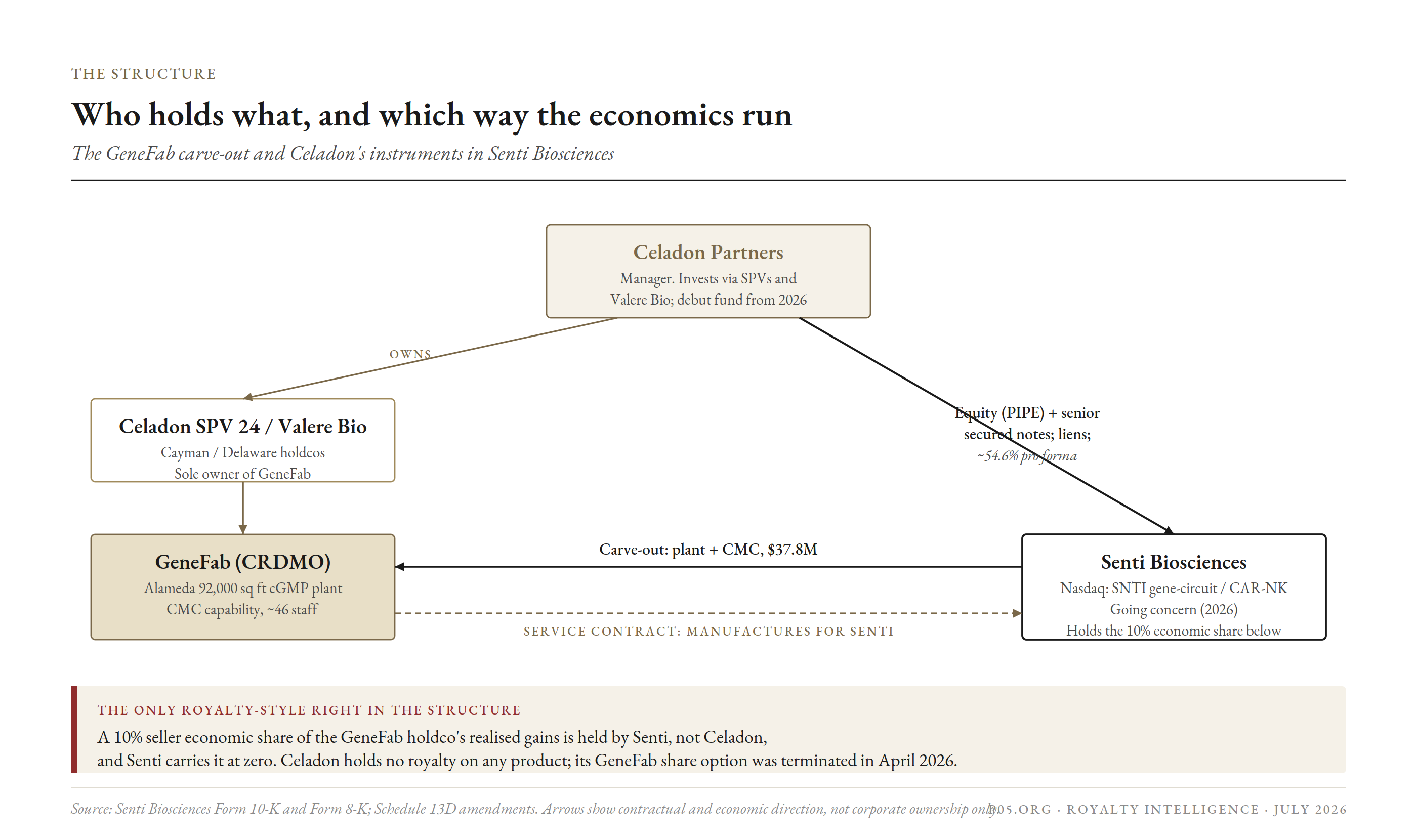
The more detailed transaction on the record is the GeneFab carve-out. In August 2023 Senti Bio entered a framework agreement with GeneFab, LLC and its parent, Valere Bio, Inc., which is owned by an entity managed by Celadon. Under the agreement Senti sold GeneFab its equipment and leasehold improvements at its Alameda facility and certain intellectual property related to the facility's design, and subleased the 92,000 square foot cGMP facility to GeneFab. GeneFab took on roughly 46 of Senti's employees, and Senti's co-founder and chief technology officer became GeneFab's chief executive. GeneFab then contracted to manufacture Senti's CAR-NK pipeline, including SENTI-202, under a service contract.
Per Senti's Form 10-K, total consideration was $37.8 million before the end of 2025. About $18.9 million was due at closing and was netted against a prepayment Senti owed GeneFab for manufacturing and research services. The remaining $18.9 million was later waived by the parties in connection with the December 2024 private placement in which Celadon participated. Senti described the transaction as extending its cash runway and reducing longer-term operating expenses.
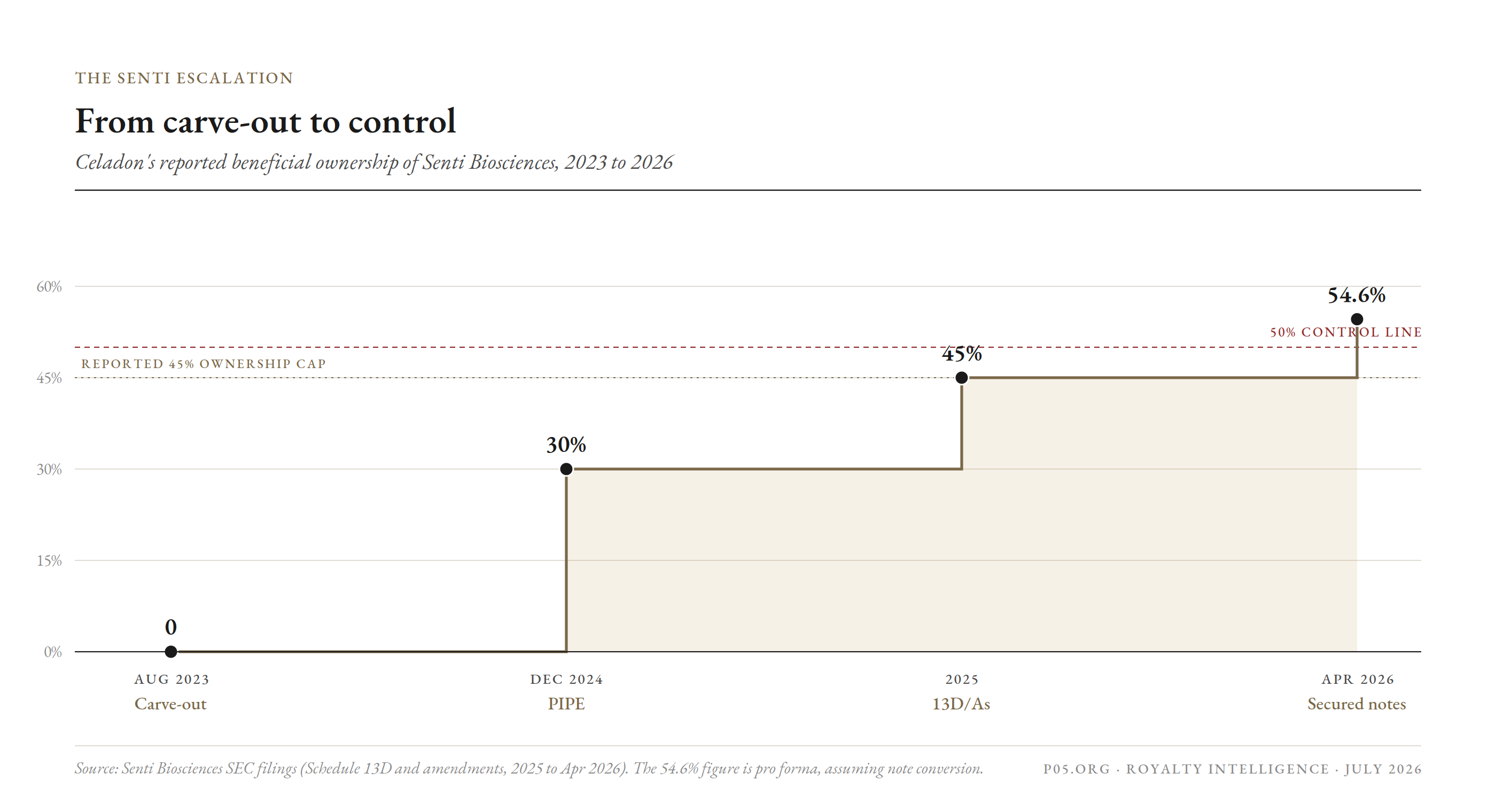
Through 2025 and into 2026 the Senti position escalated from investment to control. Celadon's beneficial ownership, reported through the vehicle Celadon Partners SPV 24, rose to about 45 percent (subject to an ownership cap) across Schedule 13D amendments in 2025.
In April 2026, following a holding-company reorganisation, Senti agreed to sell a Celadon affiliate up to $40.0 million of senior secured convertible notes: a $10.0 million initial tranche and up to $30.0 million more, convertible at $0.6261 per share, secured by first-priority liens on substantially all assets, with a 200 percent cash payback at maturity if not converted, full-ratchet anti-dilution, and a 3.0 percent fee. On an as-converted basis Celadon reported a pro forma stake of about 54.6 percent, a majority position. Senti disclosed substantial doubt as a going concern at the time.
Celadon's return in this structure comes from operating and eventually monetising GeneFab as a standalone contract manufacturer, and from equity instruments described in the royalties section below. It does not derive from any royalty on Senti's products.
Financial profile and assets
Celadon files no Form 990 and publishes no fund financials, and its AUM is not disclosed by the firm or reliably by the databases. The figures on the public record are those its counterparties were required to disclose:
| Item | Amount | Source and date |
|---|---|---|
| GeneFab total consideration for Senti CMC assets and facility | $37.8M (structured, see above) | Senti Bio Form 10-K; 8-K, Aug 2023 |
| Senti Bio PIPE led by Celadon | about $47.6M | Advisor disclosure and syndicate, Dec 2024 |
| Senti Bio senior secured convertible notes | up to $40M | Senti SEC filings, Apr 2026 |
| NSG BioLabs round led by Celadon | US$14.5M | Company announcement, May 2024 |
| RegCell seed (Celadon a participant) | $8.5M seed, within a reported $45.8M total | Company and press, Mar 2025 |
| Debut fund first close (reported) | about US$200M (target US$500M, cap US$650M) | Mergermarket interview, Jan 2026 |
Source: SEC-filing counterparties, company and legal-advisor announcements, and commercial databases. Figures are transaction or round sizes, not Celadon's own committed capital, which is not disclosed per deal.
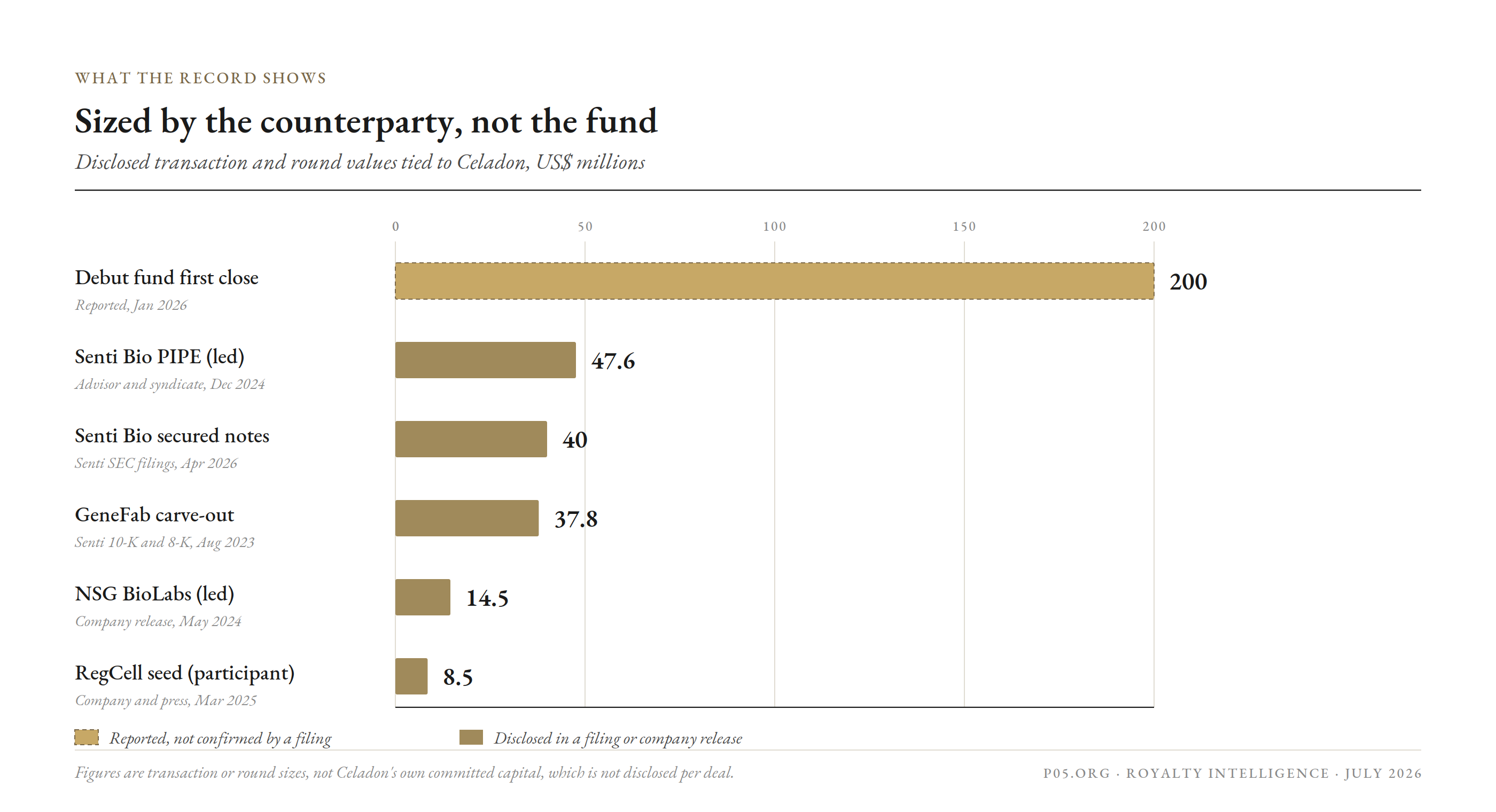
The figures describe counterparties, not the fund
Each amount above is a transaction value or round size. None states Celadon's own cheque, its fund size, or its returns. A firm leading a $47.6 million placement may commit a fraction of that total. The record therefore sizes the deals rather than the manager.
The portfolio is concentrated
Commercial databases credit Celadon with roughly four to six disclosed investments since 2018, consistent with the firm's description of concentrated, control-oriented positions.
No royalty line
There is no royalties field to track. Celadon holds no disclosed royalty interest, and no counterparty discloses a royalty or milestone payable to Celadon. Its life-sciences economics are equity, deferred consideration, and operating income.
Investors and the LP base
For most of its history Celadon did not have third-party limited partners in the conventional sense. In a January 2026 interview Tang described the firm as having invested from its own balance sheet and through separately managed accounts, and as only then launching its first blind-pool fund, reportedly at a first close of about US$200M against a US$500M target. Investors in that fund are not disclosed, and no Form D, Form ADV, pension or sovereign commitment, or Preqin record naming them was located. A commercial database also lists a "Celadon Partners Investment Fund II" at $500M domiciled in Taiwan; that entry conflicts with the account of a debut fund and is not confirmed by any filing.
Visible instead are the co-investors on individual deals, which are distinct from the fund's LPs. On the Senti placement, Celadon invested alongside New Enterprise Associates, Leaps by Bayer, and Nantahala Capital. On NSG BioLabs it co-invested with ClavystBio, the Temasek-backed life-sciences venture builder. On RegCell it participated in a round led by University of Tokyo Edge Capital Partners and Fast Track Initiative. These indicate deal syndicates, not the source of Celadon's capital, which cannot be characterised from public sources.
Governance and compensation
Celadon is led by founder and Managing Partner Donald Tang. Reported team size is roughly 12 to 13, with between 2 and 4 partners depending on the source, and Rachel Liu listed as a vice president; David Egglishaw signs the SPV 24 filings as manager.
Tang joined Senti's board at the December 2024 placement, and Celadon gained the right to designate two further directors, filled by Feng Hsiung of Acion Partners (March 2025) and Bryan Baum of K5 Global (July 2025). With the 2026 control step, Celadon-linked directors account for a substantial share of the board. There is no compensation disclosure for the firm itself, as no public filing carries one.
IP, royalties, and the economics of return
Celadon holds no royalty interest over its portfolio companies' products that is identified in public filings, and no owned patent estate attributable to the fund. The relevant instruments in the documented Senti transaction are the following.
First, the intellectual property flow runs from Senti to GeneFab, not the reverse. Senti sold GeneFab certain IP related to the Alameda facility's design, and agreed to grant GeneFab a license under certain of its IP to conduct manufacturing services and to research, develop, manufacture and commercialise products, under a license agreement described in the 10-K as under negotiation.
Any royalty under that license would be payable by GeneFab to Senti, not to Celadon; its terms were not disclosed. The license is also subject to third-party co-exclusive rights and to standard US government march-in and royalty-free research rights on the underlying patents. Separately, the one royalty-style right in the structure, a 10 percent seller economic share of the GeneFab holding entity's realised gains, is held by Senti rather than Celadon, and Senti has carried it at zero on its balance sheet.
Second, Celadon's upside instruments are equity and, latterly, secured debt, not royalties. GeneFab was granted an option, later transferred to a Celadon vehicle, to purchase up to 1,963,344 shares of Senti common stock (up to about $20.0 million) at $10.1867; that option was terminated in April 2026 without being exercised. From April 2026 Celadon's principal instrument in Senti is the senior secured convertible note described earlier.
Third, the deferred consideration and manufacturing-credit mechanics are contractual receivables and offsets, not revenue interests. The structure resembles an asset carve-out with a service-back arrangement rather than a royalty financing. Nothing on the record resembles a revenue-interest financing, a royalty purchase, or a rated structure.
No royalty interest attributable to Celadon or GeneFab was identified in the RegCell or NSG BioLabs disclosures either; those are equity positions.
Portfolio of disclosed positions, as of July 2026
The table reflects the publicly documented life-sciences positions. Celadon's own per-deal capital is not disclosed; amounts shown are transaction or round sizes.
| Position | What it is | Structure |
|---|---|---|
| GeneFab | Cell and gene therapy CRDMO and synthetic-biology biofoundry, formed 2023 | Carve-out of Senti Bio's manufacturing assets and facility ($37.8M total consideration, structured), plus a service contract back to Senti; owned via Valere Bio |
| Senti Biosciences | Nasdaq-listed gene-circuit / CAR-NK developer | Carve-out counterparty, then Celadon-led PIPE of about $47.6M (Dec 2024), then up to $40M senior secured convertible notes (Apr 2026); reported pro forma stake about 54.6%; board control |
| NSG BioLabs | Singapore biotech co-working lab provider | US$14.5M round led by Celadon with ClavystBio (May 2024) |
| RegCell | Emeryville regulatory T-cell company for autoimmune disease and transplantation | Celadon a participant in a seed within a reported $45.8M total (Mar 2025) |
| Vicarious Surgical | NYSE-listed surgical robotics company | Tang co-sponsored the D8 Holdings SPAC that merged with Vicarious in 2021 and was a director to 2025; a sponsor role rather than a fund position |
| DayOne Data Centers (reported Jan 2026) | Singapore data-centre operator, formerly GDS International | Fits the fund's data-centre-value-chain focus, but Celadon's participation appears only in a commercial database and is not named in DayOne's disclosed Series C investor list; treat as unconfirmed. Not Day One Biopharmaceuticals |
The DayOne row is listed as reported rather than confirmed: the position appears in a commercial database but is not corroborated by DayOne's own investor disclosures.
Blue team and red team
Blue team: the case for
- Demonstrated structuring capability: the GeneFab carve-out is a documented transaction that separated a biotech's manufacturing base into an independent company with an operator installed to run it.
- Reach below the royalty-desk floor: Celadon writes private placements and control cheques into small-cap and cross-border names that sit outside the scope of royalty buyers.
- Concentrated, operator-led positions: few holdings, board seats, and instances of building businesses (GeneFab, the NSG lab network) rather than allocating only.
- Credentialed principal: a former D.E. Shaw Asia chief executive with a transpacific network.
Red team: the case against
- Limited disclosure: no fund financials, AUM, or LP disclosure, and inconsistent basics such as headquarters and team size across databases.
- No royalties, owned IP, or rated paper: for this publication's core subject, Celadon is adjacent rather than central; it holds no cash-flowing royalty asset.
- Single-name concentration: the documented record leans heavily on Senti Bio, now spanning the carve-out, the placement, board control, and a secured-creditor position in a going-concern issuer.
- Name confusion in the record: routine conflation with the Shein-chairman Donald Tang is a due-diligence hazard.
Implications for the pharmaceutical royalty and biotech capital markets
Celadon is relevant to these markets as a structurer, a liquidity source, and an originator of infrastructure, rather than as a royalty counterparty.
As a structurer, the carve-out with a service-back contract is a method of monetising a biotech's non-pipeline assets, distinct from royalty spin-offs and revenue-interest financings.
As a liquidity source, its private placements and control positions reach small- and micro-cap and cross-border biotech that fall below the threshold for royalty monetisation.
As an originator of infrastructure, GeneFab and NSG BioLabs sit in the CRDMO and lab-space layer upstream of royalty-bearing product.
The constraint across all three is disclosure: because Celadon files nothing directly, it can be observed only through its counterparties, and cannot be underwritten as a name from filings.
Recent developments, as of July 2026
- Senti Bio: escalation from the December 2024 PIPE to about 45 percent through 2025 Schedule 13D amendments, then a holding-company reorganisation and up to $40M of senior secured convertible notes in April 2026, taking Celadon to a reported pro forma stake of about 54.6 percent. The GeneFab share option was terminated in April 2026.
- Fund: a debut blind-pool fund reportedly reached a first close of about US$200M in January 2026 (target US$500M, hard cap US$650M), per a Mergermarket interview. A commercial database separately lists a "Celadon Partners Investment Fund II"; the two accounts conflict and neither is confirmed by a filing.
- DayOne: a January 2026 position labelled "DayOne" in a commercial database refers to DayOne Data Centers, not Day One Biopharmaceuticals; Celadon's participation is not corroborated by DayOne's investor disclosures.
- RegCell: participation in a seed within a reported $45.8M total (March 2025).
- LPs and total AUM remained undisclosed as of July 2026.
Financial history and recent developments
| Date | Event |
|---|---|
| 2018 | Celadon Partners founded by Donald Tang, former CEO of D.E. Shaw & Co. (Asia Pacific) |
| Aug 2023 | GeneFab (owned via Valere Bio) formed; acquires Senti Bio manufacturing assets and facility, $37.8M total consideration, and contracts manufacturing back to Senti |
| May 2024 | Leads US$14.5M round in NSG BioLabs with ClavystBio |
| Dec 2024 | Leads about $47.6M PIPE in Nasdaq-listed Senti Bio; remaining GeneFab consideration waived; Tang joins Senti board |
| Mar 2025 | Participates in RegCell seed within a reported $45.8M total; Feng Hsiung joins Senti board as a Celadon designee |
| 2025 | Beneficial ownership in Senti rises to about 45% across Schedule 13D amendments; Bryan Baum joins the board (July) |
| Jan 2026 | Debut fund reportedly reaches a first close of about US$200M; a "DayOne" (DayOne Data Centers) position appears in a commercial database, unconfirmed |
| Apr 2026 | Senti holding-company reorganisation; up to $40M senior secured convertible notes from a Celadon affiliate; reported pro forma stake about 54.6%; GeneFab option terminated |
| Jul 2026 | LPs and total AUM remain undisclosed |
Conclusion
Celadon Partners is a private, transpacific private equity firm that files no public financials, discloses no AUM, and cannot be assessed from documents in the way a public filer can. It holds no royalty interest over its portfolio companies' products, no owned patent estate, and no rated paper.
Its documented structures are equity, asset carve-outs, and, most recently, secured debt. The GeneFab transaction separated Senti Bio's manufacturing base into a Celadon-owned company for $37.8 million in structured consideration; the equity that followed took Celadon to a reported pro forma majority, and its 2026 instrument is a senior secured convertible note rather than any product royalty. As a provider of capital to small-cap and cross-border biotech and an owner of manufacturing and lab infrastructure, Celadon operates in the layer below where royalty desks buy.
The near-term items to watch are whether the convertible notes convert and Celadon crosses into an actual majority of Senti, whether GeneFab scales into a standalone third-party contract manufacturer, and whether the debut fund's close brings any disclosure of investors or size beyond a single interview.
All information in this article was accurate as of the publication date and is derived from publicly available sources including the SEC filings of listed counterparties, company and partner press releases, legal-advisor announcements, and commercial databases. Celadon Partners is a private manager and does not publish fund financials; figures shown are transaction or round sizes disclosed by counterparties, not the fund's committed capital. Information may have changed since publication. This content is for informational purposes only and does not constitute investment, legal, or financial advice. The author is not a lawyer or financial adviser.