
Company of the week: Chai Discovery
Chai Discovery spent two years turning a benchmark result into a customer list. On 14 July 2026 it closed a $400 million Series C at a $3.8 billion valuation, roughly triple its mark seven months earlier, with Eli Lilly, Pfizer, and Novartis already using its models. Chai is a company in the drug value chain that has deliberately chosen to sit outside the royalty stack, and that positioning is the subject of this piece.
For a royalty desk, Chai is an unusual subject: there is no royalty here to price. That absence is the reason it is worth examining.
Every other name in this series is defined by a royalty it owes or one it collects. Last week's Vera piece was a company caught at the moment its first royalty obligation went live. Chai is the opposite specimen. It has structured its entire business to take fees, not net-sales participation, and it owns none of the drugs its technology helps design.
That makes it un-underwritable in the classic sense. There is no net-sales-linked stream to buy, no milestone ladder, no tiered royalty running to a fifteen-year floor. What there is instead is the input layer: the place where the antibodies that later throw off royalties get made.
So the interesting question is not what royalty Chai collects. It is the royalty it chose not to take, and what it captured instead.
At a glance
| Item | Detail |
|---|---|
| Company | Chai Discovery, Inc. (private), San Francisco, California |
| Founded | March 2024 |
| Leadership | Joshua Meier, co-founder and chief executive; Jack Dent, co-founder and president (ex-Stripe); Matthew McPartlon, co-founder and CTO; Jacques Boitreaud, co-founder |
| Board | Mikael Dolsten, M.D., Ph.D., former Pfizer R&D chief, joined at Series A; Annie Lamont (Oak HC/FT) and Hemant Taneja (General Catalyst), joined at Series B |
| What it sells | AI models for biomolecular structure prediction and de novo antibody design; platform access plus custom models trained on partner data |
| Flagship model | Chai-3, reported to cut antibody design failure rates by roughly 50% versus Chai-2; the model now licensed to Pfizer |
| Newest events | $400M Series C at $3.8B, closed 14 July 2026, led by Index Ventures; Novartis collaboration disclosed 13 July 2026 |
| Pharma partners | Eli Lilly (Jan 2026), Pfizer (June 2026), Novartis (July 2026); reported to be in talks with 15+ more |
| Total funding | ~$630M across four rounds since 2024 |
| Valuation | $3.8B post-money (July 2026), roughly 3x the $1.3B Series B mark set seven months earlier |
| Key backers | Index Ventures, OpenAI, Thrive Capital, General Catalyst, Oak HC/FT, Menlo Ventures, Kleiner Perkins, Sequoia Capital, Dimension |
| Defining royalty item | None. Chai sells software and model licences, not asset participation. It takes fees, not net-sales royalties or milestones. |
What it actually sells
Chai does not make drugs. It makes the models that design them.
The platform rests on a simple premise: if a model can learn the physical and chemical rules that govern how molecules interact at atomic resolution, it can generate new drug candidates on a computer, without the experimental library screening that has defined early discovery for decades.
There are three generations to date.
Chai-1 is the foundation. It performs multimodal structure prediction across proteins, small molecules, DNA, and RNA at once, including how they interact. Chai offers it free, and the reason is commercial: a free structure-prediction model lets a pharma team test the technology inside its own workflow before it signs a contract for the generative layer above it.
Chai-2, unveiled in June 2025, is what put the company on the map. It added a full-atom diffusion architecture that designs complete antibody sequences and structures from scratch, given only a target protein and a binding epitope. In a July 2025 preprint, Chai reported a 16 percent experimental hit rate in fully de novo design across 52 targets, which it framed as more than a hundredfold better than prior computational methods whose success rates typically sit below 0.1 percent. That gap is the commercial claim. At a 16 percent hit rate a customer can validate a small panel in a single well plate rather than screen large libraries, which is the threshold at which the technology becomes commercially useful rather than only a benchmark result.
Chai-3 is the current generation. It is reported to reduce the antibody design failure rate by about half relative to Chai-2, with better binding affinity and multi-specific engineering. It is the model Chai licensed to Pfizer, and it is the product the Series C valuation is pinned to. The compressed pitch is that an antibody design cycle that traditionally runs twelve to twenty-four months can be shortened to four to eight weeks.
One caveat, which the company does not emphasise, is that much of the value remains prospective. The hit rates come from preprints and curated benchmarks. Whether they hold across the harder targets pharma cares most about is what three of the world's largest drugmakers are now paying to test.
The founders, and a lineage from industry not academia
The AI protein field mostly spun out of university labs. Chai did not.
Chief executive Joshua Meier led protein language model research at Meta's FAIR lab, where he co-developed the ESM family of models, then served as chief AI officer at Absci, an antibody discovery company, where he worked on early generative antibody design. Chief technology officer Matthew McPartlon holds a computer-science Ph.D. from the University of Chicago focused on deep learning for protein design and was technical lead for de novo antibody design at Absci. Jacques Boitreaud did graduate research in generative molecular modelling at McGill before working at the French AI drug discovery firm Aqemia. The fourth co-founder, president Jack Dent, came from Stripe rather than the lab, and it is his commercial instinct that shows up most clearly in how the company is built to make money.
That matters for two reasons.
The first is credibility with buyers. A team that shipped ESM and ran antibody design inside a commercial discovery company speaks the language of a pharma research organisation, not a tenure committee. The second is board signal. Former Pfizer chief scientific officer Mikael Dolsten joined the board at the Series A. When Pfizer later became a customer, the line from that board seat to that contract was not hard to draw.
The deals, and what is deliberately not in them
Chai has signed three major pharma partners in under seven months, and the structure of all three tells the same story.
Eli Lilly came first, announced in January 2026. The arrangement pairs access to Chai's platform with a bespoke model trained exclusively on Lilly's proprietary discovery data. Pfizer followed in June 2026, taking early access to Chai-3 plus a custom model retrained on its own data. Novartis came the day before the Series C, described as a customer on the same platform-access footing.
Now read what is absent.
None of the three disclosed an upfront payment, a milestone ladder, a royalty rate, or territorial terms. The one figure that has surfaced is a reported mid-eight-figure annual access fee attached to the Lilly deal, and it is worth reading carefully: it is an anonymously sourced estimate, not a disclosed term, but its shape is telling. A recurring annual fee is a subscription, not a slice of a drug's sales. Novartis is described plainly as a customer, consistent with a platform-access or licensing structure rather than a drug-asset deal with milestone-linked economics. The IP flows to the pharma partner: the custom model weights and any candidates it produces belong to the buyer, not to Chai.
This is the crux of the whole company, so it is worth stating precisely. Chai is not co-developing assets in exchange for a slice of their eventual sales. It is selling software access and custom-model licences for fees. The molecules its models design become the buyer's property, and the royalties those molecules may one day pay run to the buyer, not through Chai.
The royalty it chose not to take
Here is the part that matters to a royalty desk, precisely because it explains why a royalty desk has nothing to buy.
Chai sits one full step upstream of the royalty stack. Consider the two paths it could have taken.
Path one is the platform. Sell model access, charge fees, hand the outputs to the customer, and walk away. This is what Chai does. The revenue is recurring and capital-light, it scales with the number of pharma customers rather than the success of any one molecule, and it arrives now rather than a decade from now. The cost is that Chai forgoes the long-tail participation in whatever its models help create.
Path two is the asset. Design a molecule, own it or license it out at standard biotech terms, and collect milestones plus a 5 to 20 percent royalty on net sales. This is the traditional discovery-biotech model, and on a per-asset basis it captures far more value. A single blockbuster could throw off tens of millions a year for decades.
Chai chose path one, and describes the trade as deliberate. President Jack Dent has said the company set out to challenge the assumption that the only way to make money in the field is to build one's own drug assets. Board member Mikael Dolsten, the former Pfizer R&D chief, has framed it as a matter of trust, arguing that a supplier which also runs its own drug programmes is harder for large pharma to treat as a neutral partner with proprietary data. In that framing, asset neutrality is presented not as a limitation but as part of what Chai sells.
As one analysis frames the economics, a pure platform arrangement might earn Chai something on the order of a low single-digit royalty even where net-sales terms exist, against the mid-teen ceilings an asset owner commands. On a blockbuster doing $1 billion a year, that is the difference between a handful of millions and tens of millions annually, per drug, forgone.
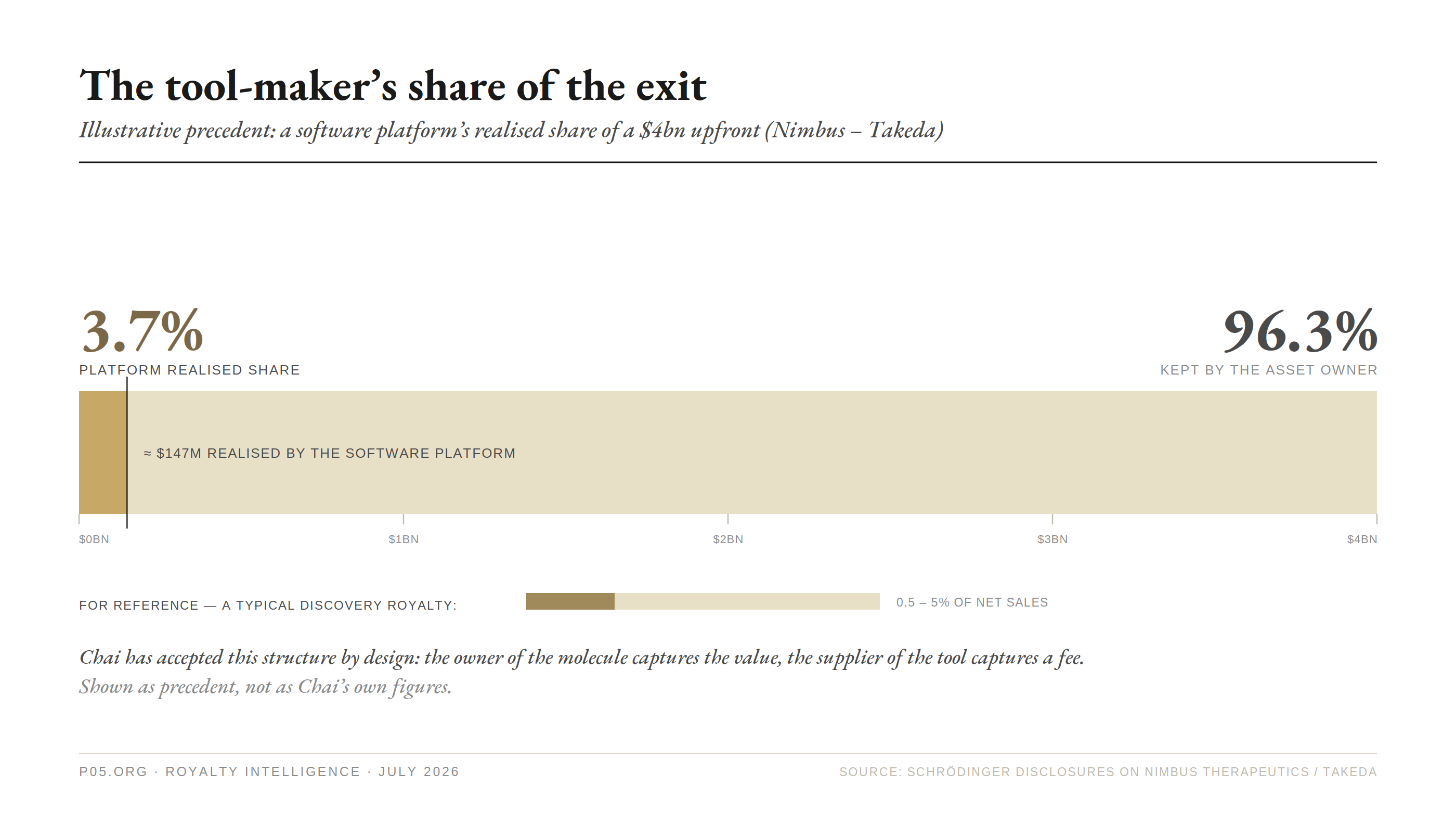
There is a cautionary precedent for how thin the platform slice can get. When Schrödinger's software helped seed Nimbus Therapeutics' TYK2 programme, and Takeda later bought that asset for a $4 billion upfront, Schrödinger's total realised distribution was on the order of $147 million, under 4 percent of the headline. That is the structural risk Chai has accepted by design: the party that owns the molecule captures the value, and the party that supplied the tool captures a fee.
What Chai gains in return is insulation from single-asset risk. It does not run trials, carry regulatory risk, or fund one asset through Phase 3. It supplies the tools while its customers develop the assets, and it is paid regardless of whether any given molecule succeeds.
For a royalty desk, the implication is straightforward. Chai holds no stream to underwrite, by design. It is neither a royalty payer nor a royalty collector, and it holds no monetisable net-sales interest. It sits instead at the upstream input layer, several parties removed from the assets its models help create.
In the terms of the royalty stack, Chai is a layer that does not appear in it. It supplies an input priced as a fee, and takes no position in the sales the resulting molecules may one day generate.
The moat is the data, not the model
If the models were the whole moat, it would be a thin one. The field is crowded with capable architectures, and capability roughly doubles every twelve to eighteen months across the whole sector.
The defensible layer is the custom model trained on a customer's proprietary data.
When Pfizer licensed not just the shared Chai-3 but a private version retrained on its own data, it did two things. It got a better tool, and it tied itself to Chai. A bespoke model built on years of a pharma company's internal discovery data is not something a competitor can replicate by shipping a marginally better public model, and it is not something the customer can easily walk away from. The switching cost lives in the training data, and the training data is the customer's own.
That is the real reason three of the largest drugmakers in the world appear on the customer list. They are not buying a benchmark. They are each building a private asset inside Chai's platform that gets more valuable, and more sticky, the longer they use it.
How it funds itself
Chai has raised roughly $630 million across four rounds since 2024, and the pace of the fundraising has tracked the pace of the deal-making almost exactly.
A seed round of about $30 million, backed by Thrive Capital, OpenAI, and Dimension, came first. A $70 million Series A followed in August 2025, led by Menlo Ventures, including its Anthology Fund partnership with Anthropic. A $130 million Series B co-led by Oak HC/FT and General Catalyst closed in December 2025 at a $1.3 billion valuation, making Chai a unicorn. Then the $400 million Series C closed on 14 July 2026 at $3.8 billion, led by Index Ventures with Kleiner Perkins, Sequoia Capital, and Dimension, alongside new investors including Bain Capital Ventures, Battery Ventures, Baillie Gifford, BDT & MSD, and Sapphire Ventures.
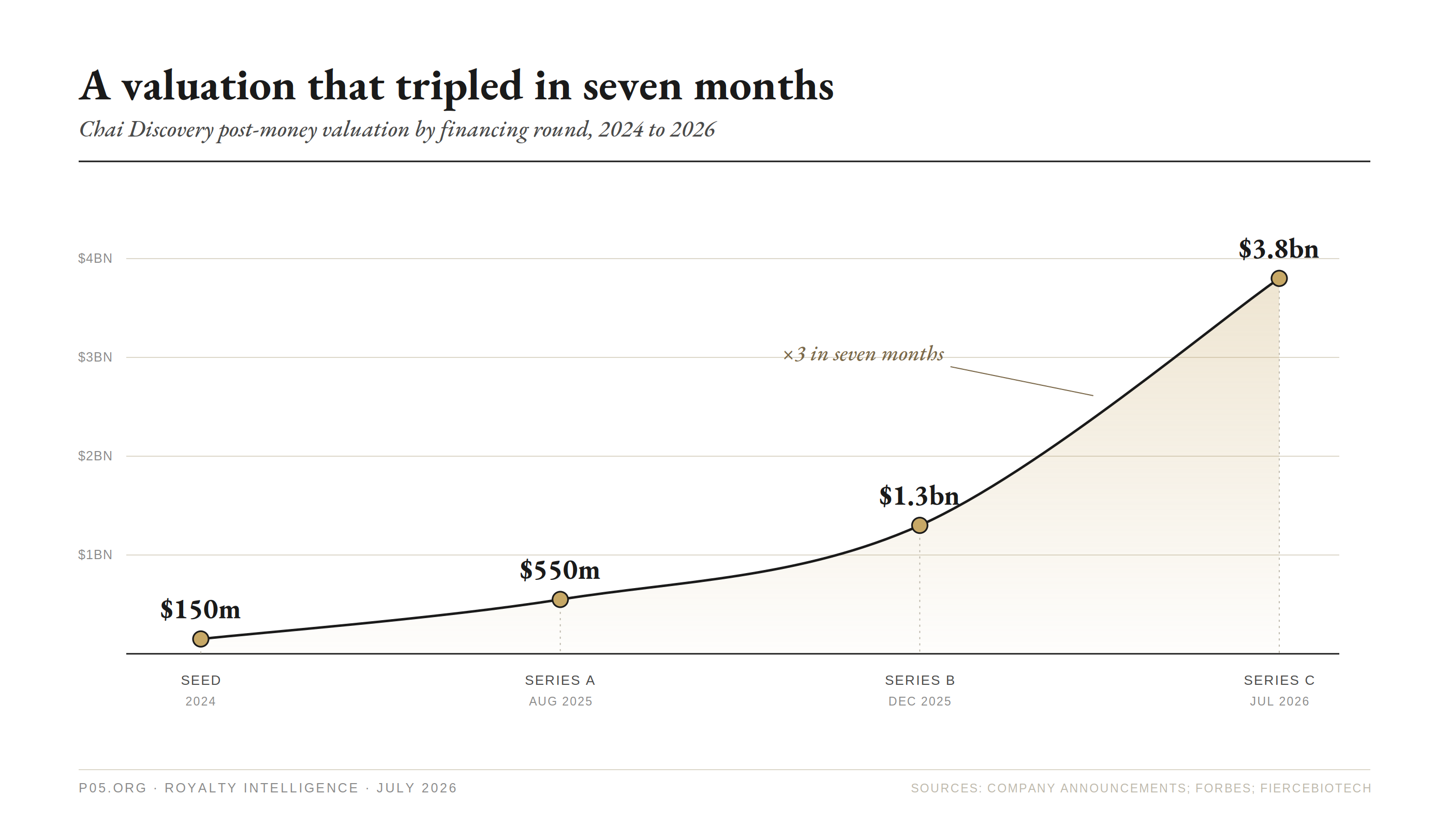
The valuation nearly tripled in about seven months. The investors were explicit that they were not repricing on technical progress alone. The decisive signal was the customer list: large pharma adopting the models under real contracts read as evidence that Chai had crossed the gap from lab demo to commercial deployment.
The specific deal economics stay private, but the peer frame is instructive, because it shows exactly what Chai walked away from. Isomorphic Labs, the Alphabet spinout, signed Lilly in 2024 for $45 million upfront, up to $1.7 billion in milestones, and tiered royalties into the low double digits on net sales, and its combined Lilly and Novartis book was described as worth close to $3 billion before any royalties.
Genesis Molecular's 2026 deal with Incyte pairs an $80 million cash upfront with a $40 million equity purchase, research funding, up to $232 million per programme, and royalties on top. Those are the milestone-and-royalty structures the field treats as standard. Chai took none of that shape. It declined to disclose its own numbers, but the reporting points to recurring access fees rather than biobucks, and three enterprise pharma customers at this valuation point to real, if fee-based, revenue.
| Round | Amount | Date | Valuation | Lead |
|---|---|---|---|---|
| Seed | ~$30M | 2024 | ~$150M | Thrive, OpenAI, Dimension |
| Series A | $70M | Aug 2025 | ~$550M | Menlo Ventures |
| Series B | $130M | Dec 2025 | $1.3B | Oak HC/FT, General Catalyst |
| Series C | $400M | 14 Jul 2026 | $3.8B | Index Ventures |
The cap table repays a closer look, because for a royalty desk it is the only way to get Chai exposure at all. There is no drug royalty to buy here, so the entire economic interest sits in privately held equity, and the question of who holds it is the question of who benefits if the platform thesis is right.
Two things stand out. The first is that Chai is tied to both frontier AI labs at once. OpenAI has backed every round, through its Startup Fund, whose own capital comes from outside limited partners including Microsoft, and Sam Altman is both a personal angel and, by several accounts, the person who catalysed the company's founding. At the same time, the Series A lead came partly through Menlo's Anthology Fund, its joint vehicle with Anthropic. Holding money from both camps is unusual, and it reflects Chai being priced as core AI infrastructure rather than as a biotech.
The second is the crossover money that arrived at Series C. Baillie Gifford is the name to watch for anyone wanting indirect public-market exposure: the Edinburgh manager runs listed private-growth vehicles, such as the Schiehallion Fund, whose limited partners include North American pension money, and those vehicles are the closest thing to a tradable Chai proxy short of an eventual IPO.
Bain Capital Ventures, Battery, Sapphire, and the merchant bank BDT and MSD add further institutional weight, and Emerson Collective, Laurene Powell Jobs' vehicle, sits among the earlier backers. No sovereign wealth fund is named in the disclosed rounds, and no secondary trading in Chai stock has been publicly reported, unlike peers Isomorphic and Xaira, both of which have been marked in secondary markets around $3 billion and $2.7 billion.
The market it is walking into
Chai is a leader in a fast-filling field, and the competition splits along exactly the line Chai has drawn for itself.
On one side are the platform players who, like Chai, sell tools rather than own drugs. On the other are the integrated shops that own laboratory capacity and take asset economics. Isomorphic Labs, the Alphabet spinout, and Recursion both own physical wet-lab capacity and pursue their own or co-owned assets. Xaira Therapeutics, valued at roughly $2.7 billion in secondary markets in April 2026, licensed the RFantibody model out of the University of Washington.
EvolutionaryScale, founded by the Meta ESM lead Alexander Rives, and the publicly traded Absci round out the frontier, alongside antibody-design specialists such as Nabla Bio and Antiverse.
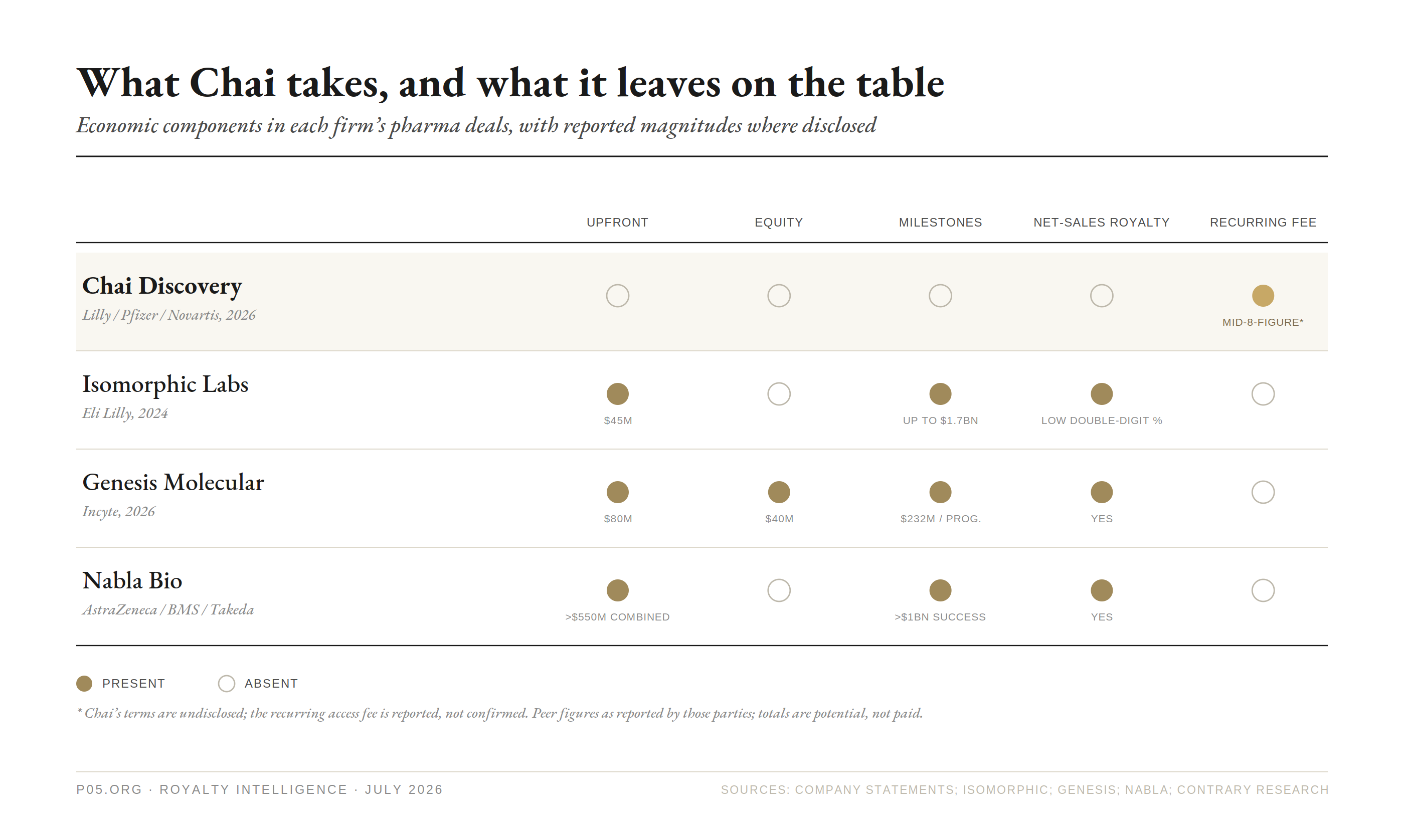
Chai's positioning sits at the tools end of that spectrum. It carries no clinical risk, no manufacturing, and no single-asset exposure, and in exchange it forgoes the asset upside the integrated players are pursuing.
The sector-level caveat sits underneath all of them. Generative AI drug discovery has absorbed something like $20 billion in cumulative capital, and not one drug it produced has yet cleared regulatory approval, though more than 170 AI-derived candidates have entered clinical trials. Design has gotten dramatically faster.
The layer of evidence that would prove one of these molecules actually becomes an approved drug is still largely empty. Chai's entire valuation rests on a bet that faster and cheaper design translates into higher clinical success, and that link is still unproven at the only bar that ultimately counts.
Red team vs blue team
Risk analysis (red team)
The clearest risk is that nothing has yet been validated in the clinic. The sector as a whole has absorbed roughly $20 billion and produced no approved drug, and Chai's hit-rate figures come from preprints and curated benchmarks rather than clinical outcomes. The valuation compounds that exposure: a near-tripling to $3.8 billion in seven months rests on three contracts whose terms are undisclosed and on a model deployed only recently, so a failure to renew or expand those deals would be difficult to absorb.
The business model caps upside as well as risk. By licensing access and leaving the resulting IP with the customer, Chai forgoes the milestones and royalties an asset owner would collect, so its return does not rise with the commercial success of the molecules it helps design.
The technical lead is also perishable: model capability across the field roughly doubles every twelve to eighteen months, and the durable moat rests on customers' proprietary data rather than on architecture alone. Revenue is concentrated in three large customers, each of which runs parallel AI programmes elsewhere, so Chai is one supplier within a portfolio rather than an exclusive one.
Opportunities and mitigants (blue team)
On the other side, the customer list is itself the strongest evidence. Lilly, Pfizer, and Novartis are paying under real contracts, with reporting of talks with fifteen or more further companies, which suggests Chai has moved from demonstration to deployment. The custom models trained on each customer's proprietary data are difficult to replicate and raise switching costs, giving the platform a source of durability that does not depend on staying ahead on public benchmarks.
The model is also structurally lighter than a drug developer's. With no wet lab, no trials, and no single-asset exposure, Chai is paid regardless of any individual molecule's fate, and it holds roughly $630 million from a cap table that includes OpenAI, Index Ventures, Sequoia, Kleiner Perkins, and General Catalyst.
The founding team's background at ESM and Absci, together with a former Pfizer R&D chief on the board, supports credibility with enterprise buyers. And if the design-speed claim holds outside curated benchmarks, compressing antibody design from twelve to twenty-four months to four to eight weeks, it would reprice a meaningful part of early biologics discovery, with Chai positioned as the infrastructure beneath it.
Summary
| Risk | Concern |
|---|---|
| No approvals | Sector has zero approved drugs on ~$20B of capital |
| Prospective pricing | $3.8B mark rests on three undisclosed, recent contracts |
| Value capture | Fees only, forgoes milestones and net-sales royalties by design |
| Eroding moat | Model capability doubles every 12 to 18 months |
| Concentration | Three large customers; any loss is material |
| Non-exclusivity | Partners run parallel AI programmes elsewhere |
| Opportunity | Observation |
|---|---|
| Customer proof | Lilly, Pfizer, Novartis live; 15+ more in talks |
| Data moat | Custom models on proprietary data raise switching costs |
| Capital-light | No trials, no single-asset risk, paid regardless of outcomes |
| War chest | ~$630M raised, marquee cap table |
| Team | ESM and Absci lineage, ex-Pfizer CSO on board |
| Workflow reprice | 12 to 24 months of design compressed to 4 to 8 weeks, if it holds |
Conclusion
Chai Discovery is the company this series exists to notice by its absence from the stack.
For two years it turned a benchmark into a business, and on 14 July 2026 the market rewarded that with a $3.8 billion valuation and three of the world's largest drugmakers on the customer list. It did so without owning a single drug, running a single trial, or taking a single net-sales royalty.
That is the deliberate choice at the heart of the company. Chai stands one step upstream of everything a royalty desk transacts in. It sells the models that design the molecules that, years and several parties later, throw off the royalties. It captured recurring, capital-light, de-risked fee revenue, and in exchange it gave up the milestone-and-royalty upside that a discovery biotech would have fought to keep.
The tests ahead are concrete. Whether the design-speed claims hold on harder clinical targets will indicate whether the platform is infrastructure or an early-stage bet. Whether the three anchor contracts renew and expand will test whether the valuation is supported by durable revenue. And whether the wider sector ever produces an approved, AI-designed drug will determine whether this activity repriced the industry or only the venture rounds within it.
Until those resolve, Chai is best understood as an input to the royalty economy rather than a participant in it. Its models help produce the assets that later generate royalties, but by design it holds no interest in those royalties itself.
For a royalty desk, that makes Chai a company to understand rather than one to transact with. It has structured its economics to sit outside the streams its technology helps create, and that positioning, more than any single deal, is what defines it.
All information in this article was accurate as of the research date, and is derived from publicly available sources including company press releases, financial news reporting, and third-party research. Chai Discovery is a private company; its funding figures, valuation, and round composition are as reported by the company and financial press, and the financial terms of its partnerships with Eli Lilly, Pfizer, and Novartis have not been officially disclosed. The mid-eight-figure annual access fee attributed to the Lilly deal is an anonymously sourced third-party estimate, not a confirmed term. Deal figures cited for peers such as Isomorphic Labs, Genesis Molecular, and the Schrödinger and Nimbus and Takeda transaction are as reported by those parties and are used here only for structural comparison. Model performance figures, including reported hit rates for Chai-2 and failure-rate reductions for Chai-3, derive from company statements and preprints and have not been independently verified at the bar of clinical outcomes. The comparison of platform versus asset royalty economics is an analytical framing based on industry-standard terms, not on any disclosed Chai contract. Figures and relationships may have changed since publication. This content is for informational purposes only and does not constitute investment, legal, or financial advice. The author is not a lawyer or financial adviser.