
Fund of the Week: Claret Capital Partners

Fund of the Week: Claret Capital Partners
Claret Capital Partners is a London-headquartered growth-debt manager that has lent to European technology and life-science companies since 2013, first as Harbert European Growth Capital and, after a 2020 management buyout, under its own name. Its funds hold warrants and equity kickers. They hold no purchased royalties.
The firm was built inside Harbert Management Corporation, the Alabama-based alternative asset manager, when HMC and the principals formed Harbert European Growth Capital Fund I in partnership in 2013.
In October 2020 David Bateman and Johan Kampe took full ownership and control of the general partners of the Harbert European Growth Capital funds, hired the entire investment team, and assumed the London office lease.
HMC and its affiliates stayed on as investors in the first two funds.
What earns the firm a royalty desk's attention is the counterparty layer. Several of its life-science borrowers carry royalty obligations on their own products: some owe running royalties to originators, some have sold revenue interests to third parties, and some are the recipients of out-licence royalties.
Claret sits in those capital structures as a senior secured lender, above equity and above the royalty and revenue-interest claims that rank behind its security, and its economics come from loan interest plus warrants.
TL;DR
- Claret closed its fourth fund at $668M (EUR 575M) on 7 September 2026, taking total capital raised since 2013 to about $1.5B (EUR 1.3B). It lends through senior secured growth loans with warrants.
- The royalty content belongs to the borrowers. Inventiva sold a 3 percent revenue interest in lanifibranor in July 2024 and carries it as a fair-valued financial liability, which points to a financing rather than a true sale. Claret took a $50M (EUR 43M) senior position in the same company in June 2026. Both sit in front of a Phase III readout anticipated in Q4 2026.
- Cinclus Pharma is the live monetisation candidate: royalty income already running from China, tiered double-digit Zentiva royalties on European approval, patent life into the 2040s, and no upstream originator royalty, since the rights came out of AstraZeneca free of charge. A $33M (EUR 28M) Claret facility sits against a HEEALING 1 topline in the second half of 2026.
- For a royalty originator the relationship is origination-side. Claret sources borrowers; it does not trade streams.
At a glance
- What it is: an independent, team-owned European growth-debt manager providing senior secured growth loans to technology, life-science and climate companies, investing third-party institutional capital
- Manager entity: Claret Capital Partners Limited, UK company number 12516001, authorised and regulated by the Financial Conduct Authority under FRN 993228
- Former identity: Harbert European Growth Capital, spun out via a 2020 management buyout
- Registered office: London. The firm said at the September 2026 final close it had placed team members in Paris and would add a Berlin presence before the end of the year
- Managing partners: David Bateman and Johan Kampe
- Capital raised since inception: approximately $1.5B (EUR 1.3B), per the Fund IV final-close release
- Capital deployed: more than $1.7B (EUR 1.5B) across more than 210 companies over successive vintages
- Named funds: Harbert European Growth Capital Fund I, L.P.; Harbert European Growth Capital Fund II, SCSp; Harbert / Claret European Growth Capital Fund III, SCSp; a 2023 Opportunity Fund; Claret European Growth Capital Fund IV
- Fund domicile: Luxembourg alternative investment funds, managed by IQEQ Fund Management (Luxembourg) S.A.
- Typical loan size: $2M to $116M (EUR 2M to EUR 100M)
- Instrument: senior loans secured on business assets, maturity of three to five years, usually amortising, with an equity participation
- Royalty interests held by the funds: none identified
- Recognition: Investor All Stars 2019 Specialty Debt Provider of the Year; Venture Debt Provider of the Year in 2024 and 2025
Investment thesis and mandate
The strategy is growth debt for European companies with revenue traction that want to grow with less equity dilution. Claret describes the target borrower as revenue generating, showing sustained revenue growth, with clear product-market fit and workable margins. Most but not all are backed by venture or private equity investors.
The firm funds cash-burning and negative-EBITDA companies and states that profitability is not a requirement.
Technology, life sciences and climate or impact carry the book. Within life sciences the mandate spans therapeutics, medical devices, diagnostics and digital health, and the Fund IV structuring documents name software, e-commerce, medical devices, biotech, energy efficiency, electronics, internet, diagnostics and specialty pharmaceuticals as target areas.
Claret says it has partnered with more than 20 life-science companies in recent years.
No royalty, revenue-interest or structured-royalty mandate appears anywhere in the firm's stated activity.
How capital enters and returns
Capital comes from institutional limited partners into Luxembourg fund vehicles, with a slice of private-wealth money entering Fund IV through an ELTIF structure. Returns come back through loan amortisation, interest, repayment at refinancing or exit, and the realisation of warrants when a borrower is acquired or lists.
Harbert European Growth Capital Fund I was formed in 2013. By 1 May 2014 it had reached about $108M (EUR 93M) in commitments, anchored by a European pension plan, a European government institution, family offices and HMC's cornerstone investment of $29M (EUR 25M), and it was targeting $232M (EUR 200M) with a final close scheduled for December 2014.
Typical facilities at that stage ran from $2.3M (EUR 2M) to $12M (EUR 10M).
Harbert European Growth Capital Fund II, SCSp followed. Between them, Funds I and II backed more than 120 European SMEs and invested more than $464M (EUR 400M) by the time of the spin-out.
Fund III launched as Harbert / Claret European Growth Capital Fund III, SCSp, the first fund independent of Harbert. It held a first close in January 2021 and a final close in August 2022 at $345M (EUR 297M), above its $290M (EUR 250M) target.
It made its first investment in March 2021 and took on 29 companies. Co-investment agreements alongside Fund III lifted available facility size to as much as $58M (EUR 50M).
A $84M (EUR 72M) Opportunity Fund launched in May 2023 to provide follow-on funding for the existing portfolio.
Fund IV held its first close in August 2024, a second close above $407M (EUR 350M) in September 2025 that took firm AUM above $1B, and a final close of $668M (EUR 575M) on 7 September 2026 against a $580M (EUR 500M) target. The total splits into $510M (EUR 440M) of Fund IV commitments and $157M (EUR 135M) of affiliated discretionary mandates.
At the final close, 32 percent of the fund had been deployed across 27 companies, among them Billie, Cinclus Pharma, PRODA, Inventiva, SIS Medical, Surfe and VIOTAS.
Certain LPs had separately documented more than $133M (EUR 115M) of discretionary co-investment partnerships.
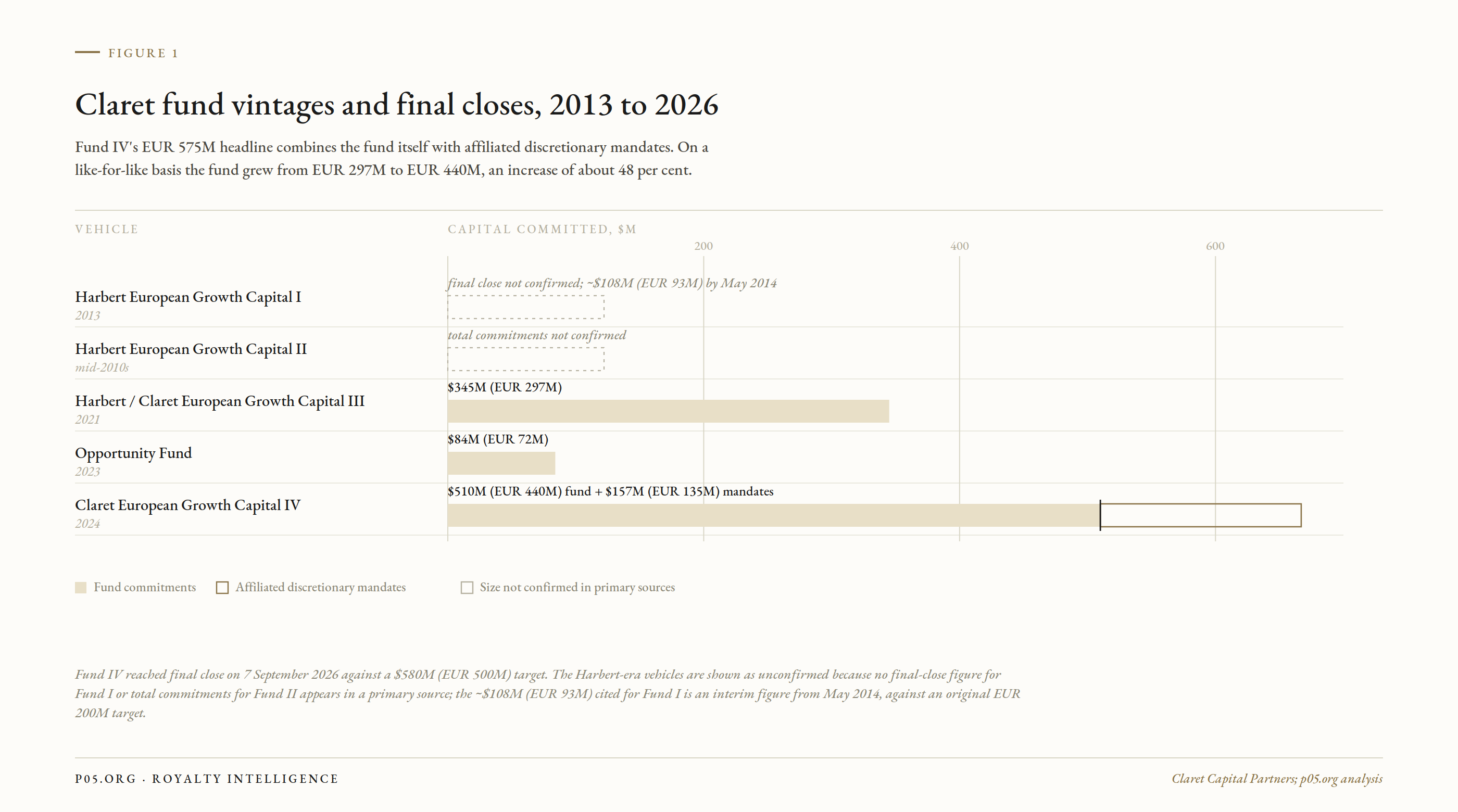
| Fund | Structure | Vintage | Final close | Original currency |
|---|---|---|---|---|
| Harbert European Growth Capital Fund I | L.P. | 2013 | targeted $232M (EUR 200M); ~$108M (EUR 93M) by May 2014 | EUR |
| Harbert European Growth Capital Fund II | SCSp | mid-2010s | not confirmed in primary sources | EUR |
| Harbert / Claret European Growth Capital Fund III | SCSp (Luxembourg) | 2021 | $345M (EUR 297M) | EUR |
| Opportunity Fund | follow-on vehicle | 2023 | $84M (EUR 72M) | EUR |
| Claret European Growth Capital Fund IV | Luxembourg AIF / ELTIF-RAIF | 2024 | $668M (EUR 575M), incl. $157M (EUR 135M) discretionary mandate | EUR |
Investors
Claret names its institutional backers at each close and rarely publishes commitment sizes.
Fund III's repeat investors were EIF, British Business Investments, RAG-Stiftung, Certior Capital and KfW Capital. Its new cohort added Allied Irish Banks, Aozora Bank, Banca March, HNA and the Ireland Strategic Investment Fund.
British Business Investments committed $46M (EUR 40M) to Fund III at first close, roughly $46M, following an earlier commitment to Fund II in 2017.
The European Investment Bank ran a parallel co-investment facility rather than a fund commitment. Its Claret Capital co-investment facility under the European Guarantee Fund was signed on 27 January 2022 at $41M (EUR 35M), roughly $41M, to deploy venture debt alongside Fund III into EU SMEs affected by COVID-19.
ISIF disclosed its own figure: its $35M (EUR 30M) investment in Fund IV was its second commitment to Claret. Bateman has said more than 90 percent of Fund IV is institutional, including European and North American pension funds, two European banks and sovereign-linked lenders, with a further $81M (EUR 70M) raised from Banca March clients through an ELTIF, and family offices and entrepreneurs making up the remaining 10 percent.
The EIF's confirmed commitment to Fund IV carries no published figure.
The LP base skews toward European public-sector and development-finance institutions, which gives the funds a long horizon and a policy alignment toward SME growth lending.
Governance and team
Claret is owned and run by its partners. David Bateman and Johan Kampe are the managing partners. Kampe was at ETV Capital from 2005 to 2011 and co-founded Silicon Valley Bank's European subsidiary before that; with Bateman he co-founded Benefide, a deal-by-deal specialty-debt originator, before both joined HMC in January 2013.
The wider team named on the firm's team page includes Raj Shah as CFO and operating partner, Joey Mason as life sciences venture partner, Antony Baker as senior investment director, Daniel Mallon as principal, Nick Smith as portfolio director, Nathaniel Norgren as chief legal counsel, and vice-presidents Philip Treacy and Clément Hardy.
Chantal Toft authors the firm's life-science capital-stack commentary. Claret added two senior hires in June 2025 and reported 31 employees at the September 2026 close.
Regulation runs through the FCA. No separate Central Bank of Ireland authorisation was found; the fund vehicles are Luxembourg AIFs administered by IQ-EQ, and the Irish connection runs through Irish LPs and Irish borrowers.
Concentration on the two founding partners is the clearest structural feature of the governance. Both are originators, investment-committee anchors and the public face of the firm, and no succession arrangement has been disclosed.
Strategy and instrument mechanics
Claret's product is a senior secured growth loan with a warrant. The firm's stated structure is senior loans secured on business assets only, with a maturity of three to five years, usually amortising, capable of being tranched to fit a borrower's cash flow, plus an equity participation.
Pricing sits in the low double digits. Claret's own commentary describes venture debt as secured term loans with low or no covenants, an interest rate typically in the low double digits, and warrant coverage giving the right to buy shares at a defined price.
Execution speed is part of the offer. Claret states that signed term sheet to committed capital typically takes eight weeks, with funding available at close and additional capacity structured in tranches linked to agreed milestones.
Milestone tranching matters to anyone modelling the borrower's cash profile, because undrawn capacity is contingent on clinical or commercial events rather than committed at signing.
The 2019 Novacyt facility carried an 11 percent fixed rate over 48 months, with a 12-month interest-only period followed by 36 equal monthly payments, a first-ranking charge over the UK businesses, and warrants over 6.0 million shares.
A Claret illustrative model of an acquisition loan used a 12-month interest-only period, 36 months of amortisation, and warrants equal to 1.25 percent of the company for 12 percent warrant coverage.
The economics Claret holds are loan interest, warrants and, in its life-science deals, convertibles. Abivax, Cinclus and Inventiva each involved convertible tranches alongside the secured debt, so the equity-linked component in therapeutics lending runs deeper than a warrant alone.
A warrant is a right to subscribe for equity at a set strike; an equity kicker is a share of equity upside; a convertible turns the debt itself into equity at a set price. A royalty or revenue interest is a contractual right to a percentage of product sales, which pays whether or not the company's equity ever has value and which sits in a different place in the waterfall.
Claret takes security over assets and an option on equity, and its return is uncorrelated with any single product's sales except through the borrower's overall ability to service and repay the loan.
Portfolio: the royalty-relevant names
Claret and its Harbert predecessor have backed more than 210 companies. The names below are the life-science borrowers where royalty or revenue-interest content exists somewhere in the capital structure.
Inventiva (French MASH biotech, Euronext Paris and Nasdaq). Claret invested $50M (EUR 43M) through its funds on 16 June 2026, roughly $50M, as its own ticket inside a facility provided alongside funds and accounts managed by BlackRock. That facility totals up to $151M (EUR 130M) in committed tranches with a further uncommitted tranche of up to $23M (EUR 20M), and it forms part of a capital-structure optimisation Inventiva announced on 2 June 2026.
Lanifibranor, an oral pan-PPAR agonist, is in the Phase III NATiV3 trial with top-line readout anticipated in Q4 2026.
Inventiva's capital structure carried royalty claims before Claret arrived. The company issued 201 royalty certificates in July 2024 for gross proceeds of about $23M (EUR 20.1M), roughly $23M, entitling holders to a 3 percent royalty on future net sales of lanifibranor in the United States, the European Union and the United Kingdom over a 14-year term.
The subscribers were Samsara BioCapital alongside existing shareholders BVF Partners, NEA, Sofinnova and Yiheng. Claret did not participate.
Inventiva carries the certificates as a financial liability measured at fair value, not as equity and not off balance sheet. Its FY2024 Form 20-F reports royalty certificate liabilities of $33.9M (EUR 29,207k) at 31 December 2024, up from $7.3M (EUR 6,327k) a year earlier, with a fair-value discount rate of 20.2 percent.
The June 2026 financing also cleared the prior senior debt. Proceeds from the initial $87M (EUR 75M) drawdown, issued 12 June 2026 for net proceeds of $82.7M (EUR 71,298,750) across a Tranche A convertible and a Tranche B amortising bond, repaid the EIB loan in full at roughly $73M (EUR 63M) including accrued interest, and funded a buyback of 60 percent of the dilution-protected EIB warrants at a 40 percent discount to intrinsic value, with the remaining EIB warrants restructured to strip the dilution protection.
Tranche A converts at EUR 5.2893; the lenders' warrants carry an exercise price of EUR 4.1559. Inventiva also holds a milestone-and-royalty right on odiparcil owed to it by Biossil, per its 2026 filings.
Cinclus Pharma (Cinclus Pharma Holding AB (publ), Stockholm-listed). Claret invested up to $33M (EUR 28M) through Fund IV on 13 March 2026, roughly $33M, for linaprazan glurate, a next-generation potassium-competitive acid blocker prodrug for GERD. The money does not fund the first Phase III study: HEEALING 1 was fully financed independently of the Claret agreement, with topline results expected in the second half of 2026.
Claret's capital brings forward the start of the final stage of the Phase III programme and funds remaining development and pre-launch activity toward approval and commercialisation. Philip Treacy was the vice-president on the deal.
The facility is drawn in four tranches aligned to clinical and operational milestones, structured as a secured term loan with warrants and convertibles. Tranche A of $9M (EUR 8M) was drawn as a convertible at EUR 2.0496 per share, a 28.53 percent premium to the 12 March 2026 close, convertible into a maximum 3,903,200 shares.
Cinclus issued 1,272,683 warrants at an exercise price of EUR 1.6697, half granted at signing and a further quarter contingent on Tranche C. Claret holds first-ranking security over substantially all material assets of the company and its subsidiaries, with customary undertakings and no financial covenants.
Cinclus is a royalty recipient: its 2025 European licence to Zentiva carries a total deal value of $255M (EUR 220M), a $15M (EUR 13M) upfront, a $5.8M (EUR 5M) near-term milestone in 2026, and tiered double-digit royalties starting in the high teens and exceeding 20 percent at the top tier, across the EEA plus the United Kingdom and Switzerland. Cinclus retains full US rights.
The China stream is already running. Linaprazan glurate received NMPA marketing approval in December 2024, the first approval for the compound anywhere, on the back of a 380-patient Phase III run in China by licensee and co-developer Jiangsu Sinorda Biomedicine.
It was then added to China's 2025 National Reimbursement Drug List, with launch expected during 2026 through HuaDong Medicine, which replaced SPH Sine Pharmaceutical as Sinorda's commercialisation partner.
The China economics need reading carefully, and Cinclus's own 2024 annual report describes them two different ways. Its partnerships note says Cinclus takes a low double-digit percentage of the development, regulatory and sales milestones Sinorda receives from its commercialisation partner, and a low single-digit percentage of the corresponding sales royalties Sinorda receives, which makes the Cinclus entitlement a royalty on a royalty.
The CEO statement in the same document describes it as a low single-digit percentage of ongoing net sales in Sinorda's territory. The two are not the same base and the difference matters to anyone pricing the stream.
The note also records an offsetting obligation running the other way: Sinorda is entitled to compensation from Cinclus at half the percentage Cinclus receives from Sinorda, subject to a cap on the milestone element.
Approval triggered milestone revenue of $327k (SEK 3.1M), following $158k (SEK 1.5M) of development milestones earlier in 2024. Group net sales for 2024 were $483k (SEK 4,580k). Cinclus reported $1.1M (SEK 10M) of revenue in Q1 2026 against nil a year earlier, drawn from the Zentiva licence and Sinorda royalty income, against an operating loss of $9.6M (SEK 91M) and cash of $50M (SEK 476M).
The compound traces to linaprazan, developed by AstraZeneca and abandoned when the group closed its gastrointestinal business. Cinclus's 2024 annual report states that the company was founded in 2014 when the development and global rights to linaprazan glurate were acquired from AstraZeneca free of charge and without financial obligations. No upstream originator royalty or milestone attaches to the product.
Patent life runs long. A polymorph patent in the United States is valid to 2042 and a formulation patent in Europe to 2040, with regulatory data exclusivity of up to ten to eleven years in Europe and five years in the United States from approval, plus a further five-year FDA extension available if H. pylori is the first indication approved there.
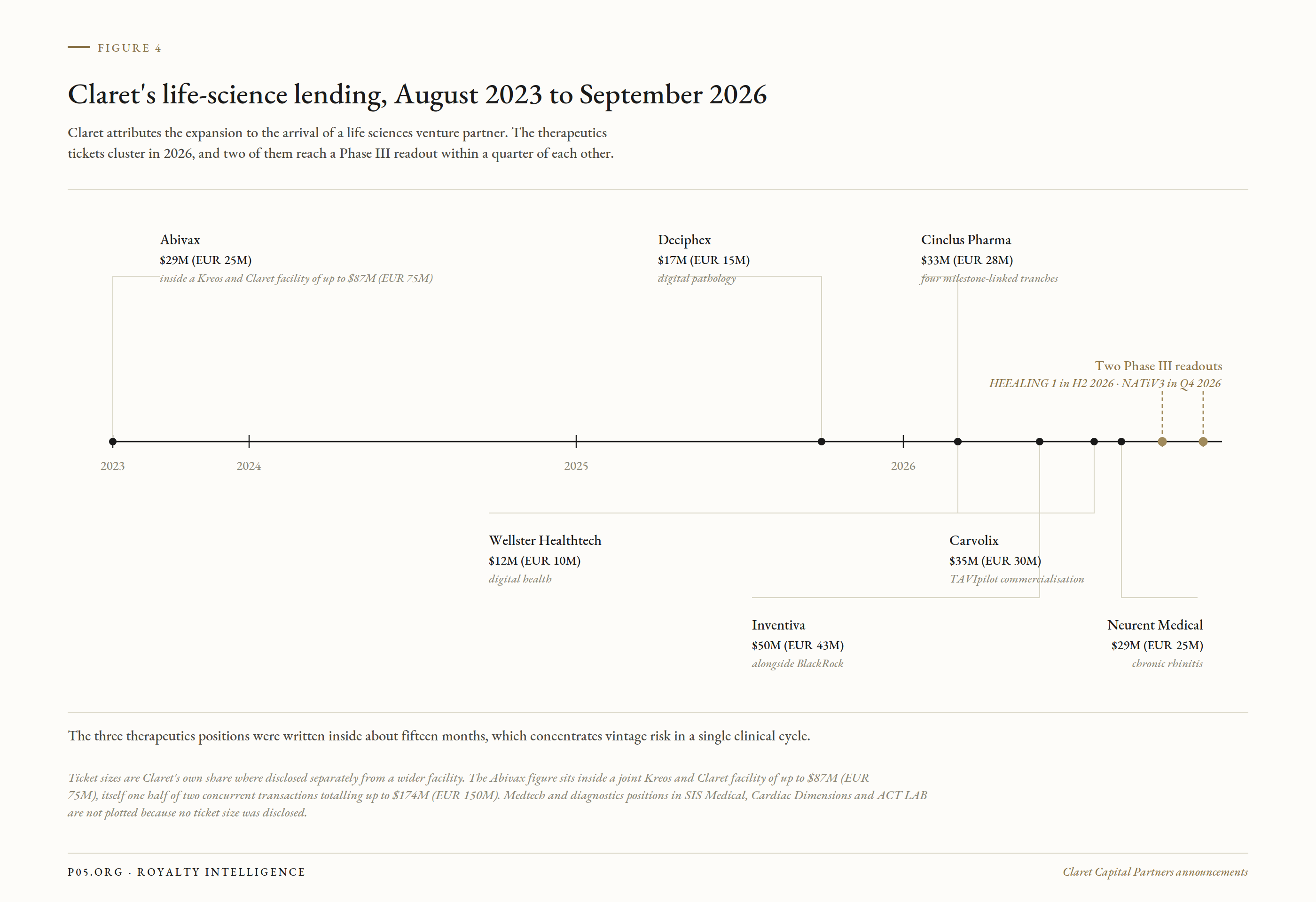
Abivax (French immunology biotech, Euronext Paris and Nasdaq: ABVX). Claret's $29M (EUR 25M) sits inside a joint Kreos Capital and Claret European Growth Capital facility of up to $87M (EUR 75M), itself one half of two concurrent structured debt transactions totalling up to $174M (EUR 150M) signed on 20 August 2023, the other half provided by a fund advised by Heights Capital Management.
The Kreos and Claret facility is drawn in three tranches of $29M (EUR 25M). Tranche 1 was senior secured convertible bonds with attached warrants; Tranche 2 was senior secured non-convertible bonds, drawable before 31 March 2024 and subject to a maximum 10 percent debt-to-market-capitalisation ratio at drawdown.
Warrants were exercisable for up to $9M (EUR 8M) of ordinary shares, $4.6M (EUR 4M) granted at signing for no additional consideration.
The security package is the part a royalty desk should read. Per Abivax's SEC filing, the lenders took first-ranking collateral over the company's principal tangible and intangible assets, including a pledge over the fonds de commerce and over the intellectual property rights in the lead drug candidate.
The transaction repaid $38.0M (EUR 32,762,852) of pre-existing debt, being $8.9M (EUR 7,660,993) owed to Kreos and $29.1M (EUR 25,101,859) of OCEANE bonds. No royalty, revenue-interest or synthetic-royalty obligation attaches to obefazimod under this facility.
Novacyt (diagnostics, Euronext Growth and AIM). Harbert provided a $5.8M (EUR 5.0M) four-year term loan in November 2019 at 11 percent, with warrants over 6.0 million shares. Novacyt's COVID-19 test drove a share spike, and the company settled the loan early in June 2020, repaying $7.1M (EUR 6.1M) including $5.8M (EUR 5.0M) of capital. Novacyt's 2019 accounts recorded the Harbert warrant liability at $905k (EUR 780,000). The economics here were interest plus a warrant.
Neurent Medical (Galway medtech, chronic rhinitis). Backed from Fund III for its NEUROMARK system, Neurent won Claret the Debt Funding Deal of the Year at the Irish Investor Awards 2026 and secured a $29M (EUR 25M) growth-debt facility on 9 September 2026, roughly $29M.
Carvolix, formerly Affluent Medical (French medtech, Euronext Paris). Claret provided $35M (EUR 30M) in August 2026, roughly $35M, to commercialise the TAVIpilot AI-guided platform for transcatheter aortic valve implantation.
Wellster Healthtech (digital health). Claret extended $12M (EUR 10M) in March 2026, roughly $12M, to support European expansion.
Endomag (breast-cancer medtech). The company behind the Sentimag localisation system, Magseed marker and Magtrace tracer was acquired by Hologic, a realised exit from Fund III.
Cardiac Dimensions (structural-heart medtech). Backed by Fund III, the company raised a $53M Series E in March 2025 with Claret among the participants.
SIS Medical (Swiss cardiovascular medtech). Named among the Fund IV portfolio at the September 2026 final close.
Other health and life-science names on the portfolio page include Deciphex, the digital-pathology company that took $17M (EUR 15M) in October 2025, and Clue, the UK menstrual-health app. ACT LAB was a US-based investment announced in March 2026. SpineGuard, Longboat Clinical and Eurobio Scientific date from the earlier funds.
The royalty stack
Claret's own position. Claret holds no purchased royalties and no revenue interests. Its instruments are senior secured loans and warrants. A search of borrower disclosures, public-sector disclosure pages, SEC filings and Claret's own materials produced no royalty or revenue-interest transaction at the fund or manager level. Where Claret has security, it ranks at the top of the borrower's waterfall, ahead of unsecured creditors and equity, and its warrant is an equity-linked claim that ranks with equity.
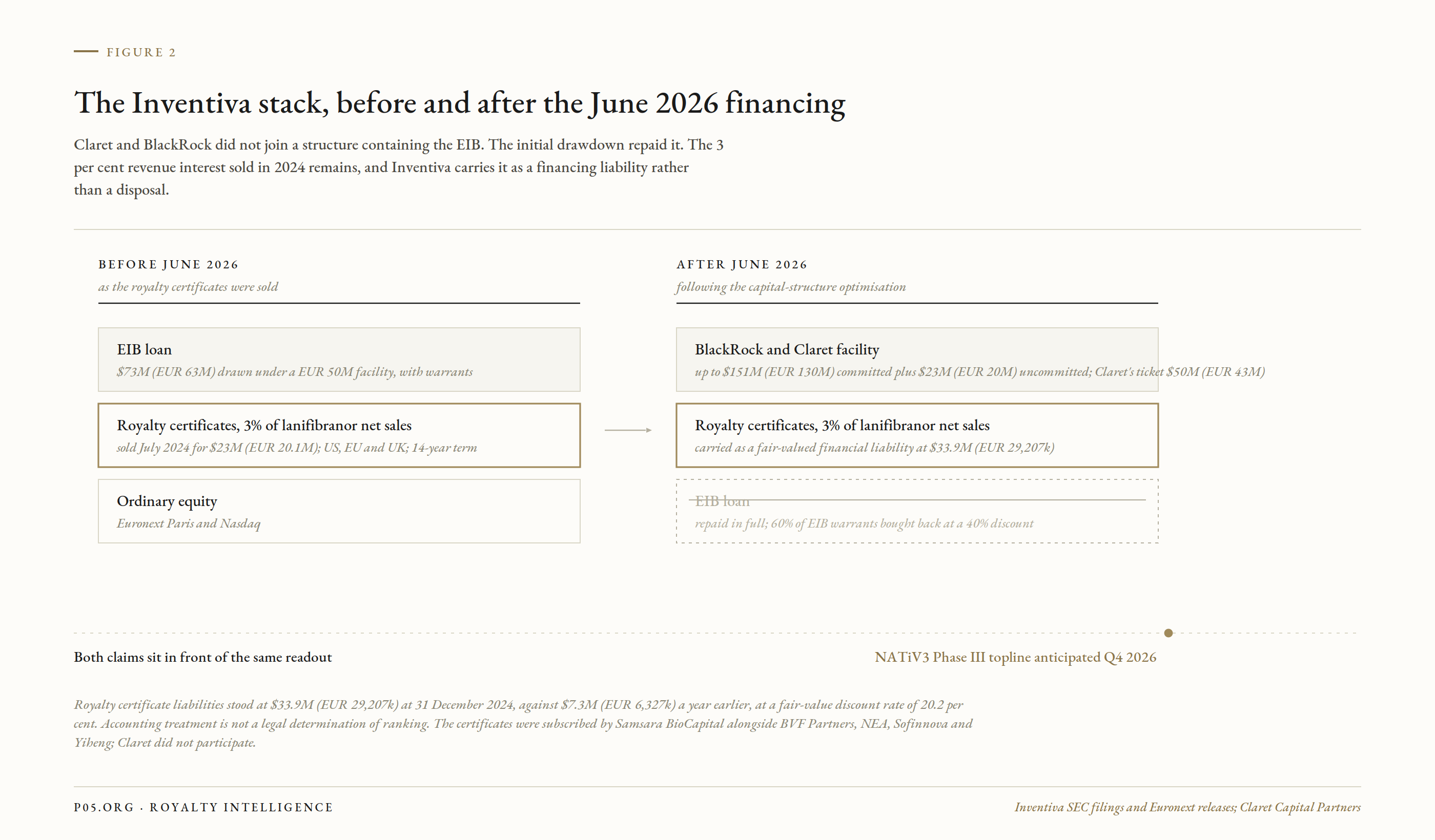
Inventiva: a royalty and a senior loan in front of the same readout. The royalty-certificate holders own a 3 percent revenue interest in lanifibranor across the three largest Western markets for 14 years, bought in July 2024. Claret's $50M (EUR 43M), inside a facility of up to $174M (EUR 150M) shared with BlackRock, arrived in June 2026. Both claims now sit in front of the NATiV3 top-line readout anticipated in Q4 2026.
A 3 percent top-line royalty and a senior secured loan do not compete for the same collateral in the ordinary case: the royalty is a claim on a revenue line, while the loan is secured on assets and repaid from cash flow, and the two coexist unless an insolvency forces a contest.
The characterisation question, whether the certificates are a true sale of a revenue interest or a financing, has an answer in Inventiva's own accounts. The company carries them as a financial liability at fair value, at $33.9M (EUR 29,207k) on 31 December 2024 with a 20.2 percent discount rate, which is the treatment applied to a financing rather than to a disposed asset.
Accounting treatment is not a legal determination of ranking, and a court in a restructuring would read the certificate terms rather than the balance sheet. It does indicate how the issuer itself understands the instrument, and it places the certificate holders inside the estate rather than outside it.
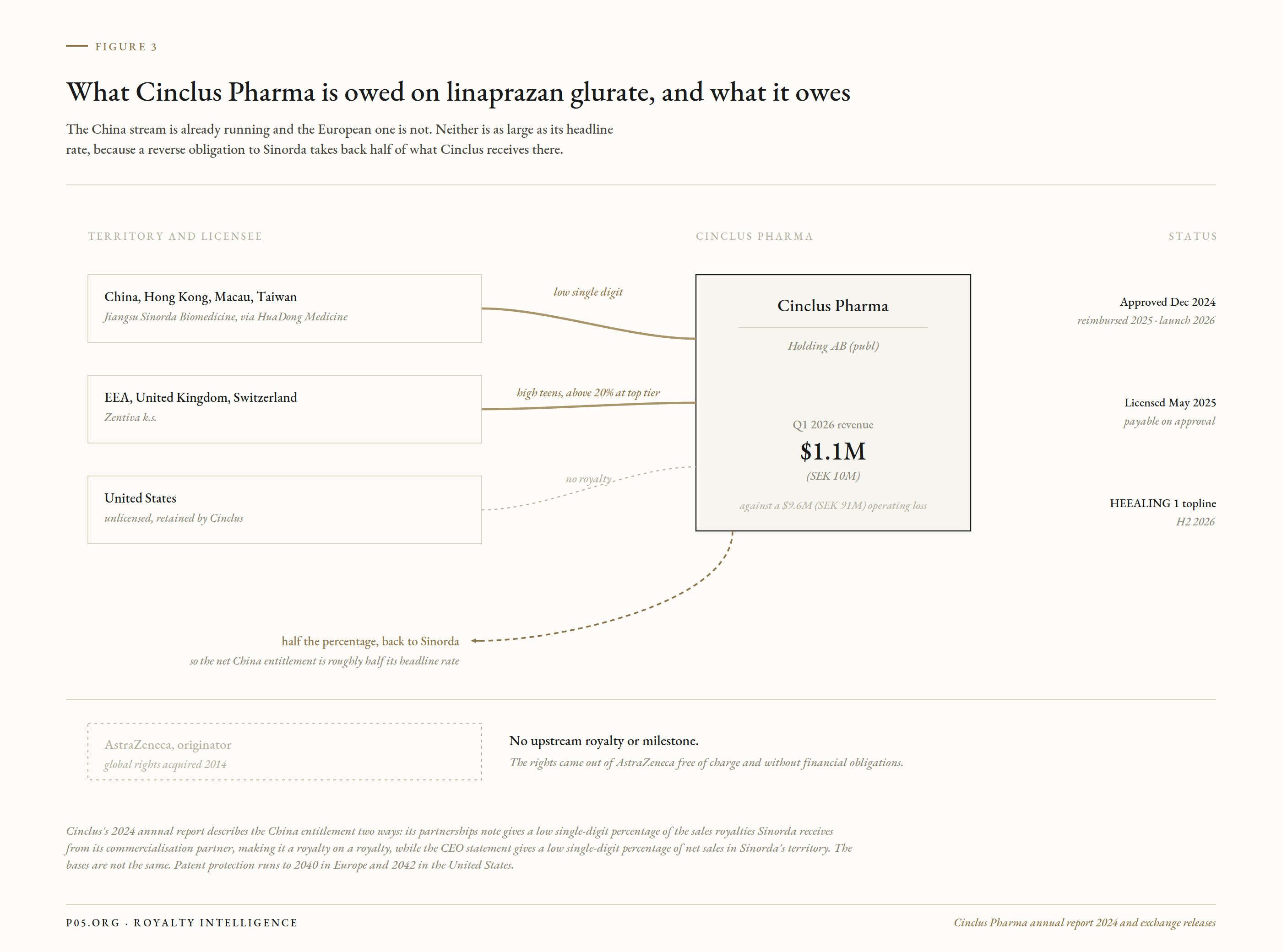
Cinclus: the royalty is an incoming asset, and part of it is already paying. Cinclus is owed tiered double-digit royalties by Zentiva across the EEA, the United Kingdom and Switzerland on a product not yet approved there, and a low single-digit entitlement from Sinorda on a product approved in China since December 2024 and reimbursed from 2025. Those streams support its ability to repay Claret rather than ranking against it.
US rights are unlicensed and remain with the company.
Nothing ranks above them upstream. The global rights to linaprazan glurate came out of AstraZeneca free of charge and without financial obligations, so the product carries no originator royalty, which leaves the full licence economics with Cinclus and its partners.
The offset sits downstream instead: Sinorda is owed compensation back from Cinclus at half the percentage Cinclus receives, so the net China entitlement is roughly half its headline rate before any question of whether the base is net sales or Sinorda's own royalty receipts.
Claret's first-ranking security covers substantially all material assets of Cinclus and its subsidiaries, so a buyer of either stream would be taking a royalty generated by assets already pledged to the lender.
Abivax shows the same structure in sharper form. The Kreos and Claret security package there includes a pledge over the intellectual property rights in the lead drug candidate, which is the asset any future royalty on that candidate would be carved out of.
HEEALING 1 topline results are expected in the second half of 2026 and the NATiV3 readout in Q4 2026, so both of the royalty-relevant borrowers reach a Phase III readout within roughly one quarter of this publication.
Inbound licence royalties. Several borrowers owe royalties to universities or originators as a cost of their in-licensed programmes. Those obligations reduce the net margin available to service Claret's loan and rank as ordinary contractual obligations of the borrower.
The record shows Claret as a lender whose borrowers generate and carry royalty claims. It does not show Claret holding, having held, or moving to acquire any purchased royalty.
Blue team
- A track record spanning 2013 to 2026 across four flagship vintages, with more than $1.7B (EUR 1.5B) deployed across 210-plus companies. Fund III exits named by the firm are Cytora to Applied Systems, Endomag to Hologic, Logpoint to Summa Equity, Lyst to ZOZO, Tiqets to Expedia, and the Abivax Nasdaq IPO. Earlier vintages produced SuperAwesome to Epic Games, Bright Computing to NVIDIA, and TIS to Marlin Equity from the Fund I portfolio.
- A larger capital base after the Fund IV close. On a like-for-like basis the fund itself grew from $345M (EUR 297M) to $510M (EUR 440M), an increase of about 48 percent; the $668M (EUR 575M) headline adds $157M (EUR 135M) of affiliated discretionary mandates that Fund III's figure does not include. Total capital raised since inception reached $1.5B (EUR 1.3B)
- Manager-reported operating momentum in the book: Claret says active portfolio companies across its funds average 40 percent revenue growth, the only performance-adjacent figure the firm publishes, and cites PitchBook's Q1 2026 European Venture Report for growth debt now representing 22 percent of total venture capital funding in mature markets
- A senior secured lender-of-record position on business assets, which ranks ahead of royalty and equity claims in a distressed borrower
- Development-finance backing across vintages, with the EIF, the EIB's $41M (EUR 35M) EGF facility, the British Business Bank's $46M (EUR 40M), ISIF's $35M (EUR 30M), KfW Capital and Wachstumsfonds Deutschland among the LPs
- A specialist life-science bench and more than 20 life-science borrowers, spanning therapeutics, medical devices, diagnostics and digital health
- An execution timeline the firm puts at eight weeks from signed term sheet to committed capital, which is the operational basis of its late-stage biotech pitch
- Repeat "Venture Debt Provider of the Year" recognition in 2024 and 2025, and a demonstrated ability to re-lend as borrowers scale: Open Cosmos grew from a $3.7M (EUR 3.2M) initial loan to more than $58M (EUR 50M) as its revenue rose from $2.3M (EUR 2M) to more than $58M (EUR 50M) a year, and Claret completed a $41M (EUR 35M) follow-on into Holidu to fund growth and M&A
Red team
- Fund-level returns, loan pricing, warrant strikes and most LP commitment amounts are unpublished, so the track record cannot be independently marked; the AUM and deployment figures come from the manager
- Growth-debt vintages from 2020 to 2022 carry sector-wide default and workout risk, because the equity expected to refinance venture loans became scarcer and more expensive after 2022. PitchBook records wefox, a Claret borrower whose valuation fell from its $3B peak, as an exit in March 2026, with terms undisclosed
- Warrant value is realised on an up-round, acquisition or listing. Where fewer borrowers reach those outcomes, the equity kicker meant to lift a lender's return above the coupon can expire worthless. This is a market condition across venture debt
- Two of the largest life-science positions sit against binary Phase III readouts falling within roughly one quarter of this publication: $50M (EUR 43M) in Inventiva against NATiV3 in Q4 2026, and up to $33M (EUR 28M) in Cinclus against HEEALING 1 in the second half of 2026. Claret's security ranks ahead of royalty certificates and equity in both, though a negative readout would test the recovery value of the collateral and, at Inventiva, the drawdown of the uncommitted tranche
- Life-science concentration built quickly. Claret attributes the expansion to the arrival of Joey Mason as Life Sciences Venture Partner, and the therapeutics positions in Inventiva, Cinclus and Abivax were written inside about fifteen months, which concentrates vintage risk in a single clinical cycle
- Key-person concentration on Bateman and Kampe, with no disclosed succession plan
- The firm holds no purchased royalties, so for a royalty counterparty the relationship is origination-side only
- A duration and cash-flow mismatch exists between amortising three-to-five-year loans and the long, back-ended cash profiles of royalty-style assets. A clinical-stage borrower whose value sits in a future royalty may not generate the near-term cash an amortising loan needs
- Reporting is thin by design. A counterparty or LP begins diligence from borrower filings and public-sector disclosure pages, and much of the loan-level detail exists only because a given borrower is listed
Implications for royalty originators and funds
The origination opportunity sits in the life-science sub-portfolio. Claret lends to commercial and near-commercial companies with marketed or soon-to-be-marketed products, funded on amortising debt.
Cinclus is the one candidate that does not require waiting for data. It has an approved and reimbursed product in China generating royalty income today, a European licence carrying tiered double-digit royalties on approval, and a milestone-tranched $33M (EUR 28M) Claret facility secured on substantially all its assets. Its first revenue arrived in Q1 2026 at $1.1M (SEK 10M) against a $9.6M (SEK 91M) operating loss, so the China royalty alone does not fund the company.
A monetisation conversation there is about the Zentiva stream, with the China royalty as evidence the licensing model pays rather than as the asset itself. Two features improve the underwrite: the product carries no upstream originator royalty, and patent protection runs to 2040 in Europe and 2042 in the United States, which gives a purchased stream a long tail. Carvolix and Neurent, both commercialising medtech products on Claret debt, fit the same profile once revenue builds.
Pre-revenue borrowers are a different underwrite. Inventiva's lanifibranor royalty depends on the Q4 2026 readout and subsequent approval, and the 3 percent revenue interest already sold via royalty certificates was priced ahead of data.
A royalty buyer entering there underwrites clinical risk.
Diligence starts with the listed borrower's filing. Claret's loan terms, and the royalty and revenue-interest claims sitting around them, became visible through Novacyt's RNS, Inventiva's SEC filings and Cinclus's exchange releases.
A royalty originator screening for European monetisation candidates would find more in the disclosures of growth-debt borrowers than in the lender's own reporting.
Settle the intercreditor question early, and read the issuer's accounts while doing it. Where a borrower has both a senior secured growth loan and a sold revenue interest, the characterisation of the royalty and the intercreditor position between royalty buyer and secured lender determine who sits inside the estate in a restructuring.
Inventiva's treatment of its certificates as a fair-valued financial liability is the kind of disclosure that answers the question without access to the contract.
Any royalty bought into a Claret-financed company should be underwritten with the senior secured loan explicitly in the model, including the milestone-linked tranches that may draw later and, where the security runs to a pledge over the product IP as at Abivax, the fact that the stream's source asset is already encumbered.
Recent developments
- Open Cosmos raised $348M (EUR 300M) on 14 September 2026, roughly $348M
- Neurent Medical secured a $29M (EUR 25M) growth-debt facility on 9 September 2026
- Fund IV reached a final close of $668M (EUR 575M) on 7 September 2026, 32 percent deployed across 27 companies
- Claret backed EdgeTier in August 2026
- Claret provided $35M (EUR 30M) to Carvolix in August 2026
- Chantal Toft published the firm's late-stage therapeutics capital-stack case on 7 July 2026, setting out the eight-week execution timeline and the Inventiva dilution arithmetic
- Claret invested $50M (EUR 43M) in Inventiva on 16 June 2026 alongside BlackRock
- Claret strengthened its Paysend partnership with a US$25M follow-on in March 2026
- Claret invested up to $33M (EUR 28M) in Cinclus Pharma in March 2026
- No royalty or revenue-interest transaction has been identified at the fund level at any point in the firm's history
Financial history and milestones
| Date | Event |
|---|---|
| 2013 | Harbert European Growth Capital Fund I formed by HMC and the principals in partnership |
| 1 May 2014 | Fund I reaches about $108M (EUR 93M) in commitments, targeting $232M (EUR 200M) |
| 2017 | British Business Investments commits to Harbert European Growth Capital Fund II |
| Nov 2019 | Harbert lends Novacyt $5.8M (EUR 5.0M) at 11 percent with warrants over 6.0M shares |
| Jun 2020 | Novacyt repays the Harbert loan early |
| Oct 2020 | Bateman and Kampe complete the MBO of Harbert European Growth Capital, forming Claret Capital Partners |
| Jan 2021 | First close of Harbert / Claret European Growth Capital Fund III |
| Mar 2021 | Fund III makes its first investment |
| 27 Jan 2022 | EIB signs a $41M (EUR 35M) co-investment facility alongside Fund III |
| Aug 2022 | Fund III final close at $345M (EUR 297M) |
| May 2023 | $84M (EUR 72M) Opportunity Fund launched for follow-on funding |
| Aug 2023 | Abivax signs up to $174M (EUR 150M) of structured debt; Claret's $29M (EUR 25M) sits in a joint Kreos and Claret facility of up to $87M (EUR 75M) secured on the lead candidate's IP |
| Jul 2024 | Inventiva issues 201 royalty certificates carrying a 3 percent lanifibranor revenue interest |
| Aug 2024 | Fund IV first close |
| Dec 2024 | Linaprazan glurate approved in China, the compound's first marketing approval anywhere; Cinclus books a $327k (SEK 3.1M) approval milestone |
| Mar 2025 | Cardiac Dimensions raises a $53M Series E with Claret participating |
| May 2025 | Cinclus licenses European rights to Zentiva for up to $255M (EUR 220M) plus tiered double-digit royalties |
| Dec 2025 | Linaprazan glurate added to China's National Reimbursement Drug List; HuaDong Medicine replaces SPH Sine as Sinorda's commercialisation partner |
| Sep 2025 | Fund IV second close above $406M (EUR 350M); ISIF commits $35M (EUR 30M) |
| Oct 2025 | SIS Medical investment marks Claret's 200th portfolio company; Deciphex takes $17M (EUR 15M) |
| Mar 2026 | $33M (EUR 28M) to Cinclus Pharma; $12M (EUR 10M) to Wellster Healthtech; US$25M follow-on to Paysend; ACT LAB investment; wefox recorded as an exit |
| Jun 2026 | $50M (EUR 43M) to Inventiva alongside BlackRock, inside a facility of up to $174M (EUR 150M); initial $87M (EUR 75M) drawdown repays the EIB loan in full |
| Jul 2026 | Claret passes $1.7B (EUR 1.5B) deployed across 200-plus companies |
| Aug 2026 | $35M (EUR 30M) to Carvolix; EdgeTier backed |
| 7 Sep 2026 | Fund IV final close at $668M (EUR 575M) |
| 9 Sep 2026 | $29M (EUR 25M) growth-debt facility for Neurent Medical |
| 14 Sep 2026 | Open Cosmos raises $348M (EUR 300M) |
All information in this report was accurate as of the research date and is derived from publicly available sources including court opinions, regulatory guidance, academic literature, SEC filings, and financial news reporting. Information may have changed since publication. This content is for informational purposes only and does not constitute investment, legal, or financial advice. The author is not a lawyer or financial adviser.