
Fund of the week: Coefficient Giving, Biosecurity & Pandemic Preparedness Fund

What is Coefficient Giving?
Coefficient Giving is a San Francisco-based philanthropic funder and advisor that recommends and administers grants on behalf of major donors pursuing what it calls cost-effective, high-impact giving. Until November 2025, the organisation was known as Open Philanthropy. The name change formalised a strategic shift toward operating multi-donor pooled funds rather than functioning primarily as outsourced foundation staff for a single family office.
Coefficient Giving has directed more than $5 billion in grants since 2014, including over $1 billion in 2025 alone, the largest single-year deployment in its history. It now operates 13 separate funds covering global health, scientific research, biosecurity, AI safety, farm animal welfare, lead exposure, economic growth, and other neglected cause areas. The Biosecurity & Pandemic Preparedness Fund is one of the two largest pillars of its Global Catastrophic Risks program, alongside the Navigating Transformative AI Fund.
Coefficient Giving is structurally distinct from anything that life sciences finance professionals typically encounter. It is not a venture fund, a royalty fund, or a private equity vehicle. It does not raise capital from limited partners on a fund-by-fund basis, does not seek financial returns, and does not write equity checks into commercial biotech with rare exceptions. It uses the word "fund" in the philanthropic sense, meaning a thematic pooled vehicle that donors contribute to, rather than the limited-partnership sense familiar from VC and royalty markets.
Despite that structural difference, Coefficient Giving is included in this Fund of the Week series because it is one of the largest and most consequential non-governmental funders shaping the life sciences ecosystem, particularly in diagnostics, pandemic preparedness, and the emerging governance of AI-enabled biology.
This piece focuses on the Biosecurity & Pandemic Preparedness Fund specifically, the team and operating thesis behind it, its grantee base, its donor structure, and its relevance to the commercial life sciences capital markets.
Overview and Investment Focus
The Biosecurity & Pandemic Preparedness Fund is one of the largest philanthropic vehicles in the world dedicated specifically to catastrophic biological risk. Its mandate is to reduce the probability and severity of global catastrophic biological risks (GCBRs), particularly those amplified by advances in artificial intelligence and synthetic biology.
For any pharmaceutical royalty investor, biotech VC, or licensing executive, the Fund is impossible to ignore: it is one of the largest single sources of capital flowing into diagnostics, next-generation PPE, pathogen-agnostic detection, far-UVC light technology, and DNA synthesis screening, all areas where commercial markets are nascent and government funding is uneven.
Investment Thesis: The Fund's thesis rests on three propositions. First, that engineered biological threats, particularly those enabled by AI-assisted molecular design, represent a low-probability but extreme-severity risk to civilisation. Andrew Snyder-Beattie, the Fund's Managing Director, has publicly estimated the lifetime risk of human extinction from a biological catastrophe at 1–3%.
Second, that this risk space is structurally neglected: even where governments fund biosecurity, the great majority is allocated to dual-purpose programs combining biosecurity with broader scientific research or general disaster preparedness, while philanthropic involvement remains very limited compared to global health and other priorities.
Third, that the risk is tractable through a combination of physical defenses, technical safeguards, governance, and policy, even against pathogens that have not yet been designed.
The Fund applies Coefficient Giving's importance-neglectedness-tractability framework and operates under what the organisation calls "hits-based giving", explicitly accepting that many individual grants will fail in pursuit of occasional outsized civilisational impact.
Background and Formation
The biosecurity program was formalised around 2014, well before COVID-19 brought catastrophic biological risk into mainstream policy attention. Early grants concentrated on think tanks, scholarships, and convenings rather than on technology development directly, reflecting both the early-stage nature of the field and the deliberately small initial team.
The thesis was effectively validated in 2020. By the time COVID-19 became a global pandemic, the program had already funded Sherlock Biosciences (a CRISPR diagnostics spinout from the Wyss Institute and the Broad Institute), Pardis Sabeti's pandemic pre-emption work, and the Johns Hopkins Center for Health Security. The 2019 $17.5 million grant and accompanying equity investment into Sherlock, issued nine months before COVID-19 was identified, became one of the most-cited examples of the organisation's "prescient" cause selection.
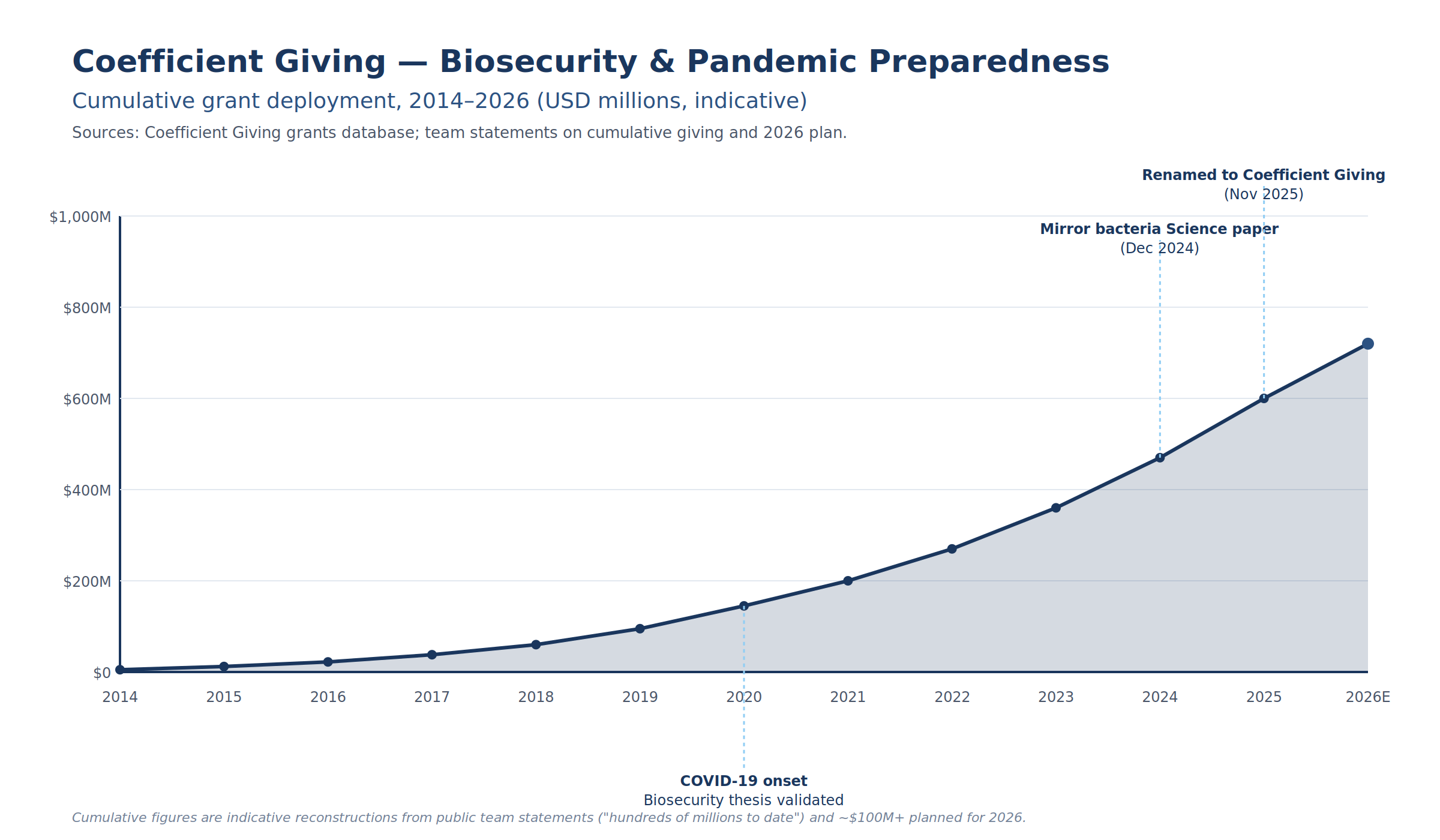
The November 2025 rename to Coefficient Giving reflected the organisation's transition from working primarily with Good Ventures to supporting multiple major donors. The biosecurity program continued under the same leadership and mandate. As of mid-2025, Coefficient Giving had cumulatively directed more than $4 billion in grants, with the biosecurity team alone responsible for hundreds of millions of that total.
Strategic Differentiators
Hits-based philanthropy at scale. The Fund explicitly applies a venture-capital-style logic to grantmaking: it accepts that most grants will not produce transformational outcomes, in exchange for the possibility that a small number will. Examples cited by Coefficient Giving as philanthropic "hits" include the Green Revolution, early support for oral contraceptives, and (within its own portfolio) early backing of David Baker's computational protein design work, which contributed to the science underlying the 2024 Nobel Prize in Chemistry.
The "Four Pillars" framework as an operating thesis. In October 2025, Snyder-Beattie published a hypothesis for "four pillars" of biodefense intended to function against engineered pathogens and unknown unknowns: (1) personal protective equipment for individuals;
(2) biohardening of indoor environments;
(3) early detection of pathogens, particularly via pathogen-agnostic metagenomic sequencing;
and (4) medical countermeasures for sustained protection.
The framework is now the operating thesis of the Fund and the explicit organising principle of its 2026 Request for Proposals. The first three pillars are framed as "future-proof" because they exploit fundamental constraints that all pathogens must face, regardless of how they are engineered.
AI × Bio as the most urgent priority. Coefficient Giving has positioned the intersection of artificial intelligence and biology as the area where the risk environment is changing fastest. Current concerns include AI-assisted bioweapon design, the dual-use risks of open-weight biological foundation models, DNA synthesis screening at benchtop synthesisers, and the question of whether dangerous capabilities can be removed from frontier models without compromising legitimate research utility.
Convening power on contested science. Coefficient Giving program staff convened the scientific group that produced the December 2024 mirror bacteria paper in Science, which argued that research on so-called mirror cells, organisms built from biomolecules of opposite chirality to natural life, should be prohibited as too dangerous. This is a textbook example of the Fund's distinctive contribution: convening, evaluating, and shaping the scientific consensus on emerging risks before commercial or regulatory frameworks exist.
Capacity bottleneck, not capital bottleneck. Coefficient Giving's April 2026 hiring announcement stated explicitly that across its Global Catastrophic Risks teams, "our biggest bottleneck is people, not funding." The combined GCR funds plan to deploy approximately $1 billion in 2026, with the Biosecurity & Pandemic Preparedness Fund alone targeting more than $100 million. This makes the Fund's grant-deployment rate in 2026 comparable to a mid-tier biotech VC fund, executed entirely as non-recoupable philanthropy.
Funders and Donor Base
Coefficient Giving is structurally a 501(c)(3) public charity (Coefficient Giving Advisors, Inc.) and a network of related entities including the Coefficient Giving Action Fund (a 501(c)(4) social welfare organisation) and Coefficient Giving Research (a separate research nonprofit). It does not raise capital from limited partners on a fund-by-fund basis. Instead, it operates as a philanthropic advisor and grant administrator on behalf of Good Ventures and a growing roster of partner donors.
Funder structure as of May 2026:
| Donor / Funder | Role | Primary cause focus |
|---|---|---|
| Good Ventures (Tuna / Moskovitz) | Founding partner, principal funder | All Coefficient Giving funds |
| Patchwork Collective | Partner donor | Global Health & Development |
| Livelihood Impact Fund | Partner donor | LMIC growth program |
| Gates Foundation | Co-funder | Lead Exposure Action Fund |
| ELMA Foundation | Co-funder | Lead Exposure Action Fund |
| Patrick Collison | Co-funder | Abundance & Growth Fund |
| 12 LEAF philanthropic partners | Co-funders ($125M total) | Lead Exposure Action Fund |
| Multiple anonymous philanthropists | Partner donors | Various funds |
Good Ventures remains the principal funder. It is the foundation of Cari Tuna and Dustin Moskovitz, who signed the Giving Pledge in 2010, at the time becoming its youngest signatories. Moskovitz's net worth, derived from his Facebook co-founding stake and from Asana (where he was the founding CEO until 2025), provides the underlying capital base. Good Ventures is the funder of record for the great majority of biosecurity grants, and Coefficient Giving describes itself as serving as "outsourced foundation staff" for Good Ventures.
According to Coefficient Giving's own 2024 disclosures, funders beyond Good Ventures accounted for approximately 15% of total funds raised or directed in 2024. The November 2025 press release accompanying the rename reported that the organisation directed more than $100 million in funding from donors beyond Good Ventures in 2024 and more than doubled that amount in 2025. The partner-donor model is now formalised, with Coefficient Giving's Partnerships team (10 people as of late 2025) accepting new donor partnerships starting at $250,000 per year through
The Biosecurity & Pandemic Preparedness Fund is open to additional donor partnerships. As of May 2026, the public donor list for this specific fund is dominated by Good Ventures, with no analogue yet to the dozen-partner Lead Exposure Action Fund, although the Fund's RFP and partner-donor materials suggest active outreach to additional biosecurity-aligned philanthropists.
Royalty and Investment Positions
Coefficient Giving operates almost entirely through grants. It does not maintain a pharmaceutical royalty portfolio, does not hold revenue interests in commercial biotech assets, and does not earn ongoing income from any of the products its grantees develop. This is a fundamental structural difference between Coefficient Giving and any commercial fund profiled in this Fund of the Week series.
There is one notable exception. The 2019 Sherlock Biosciences position combined a five-year grant of up to $17.5 million with a direct equity investment in the company. This hybrid grant-plus-equity structure, sometimes referred to in philanthropy as a program-related investment (PRI), allows a 501(c)(3) entity to take an equity position in a for-profit company when the investment substantially advances a charitable purpose. Coefficient Giving has used PRIs sparingly across its overall portfolio.
Known investment-style positions in life sciences:
| Investee | Year | Structure | Purpose |
|---|---|---|---|
| Sherlock Biosciences | 2019 | Grant + equity (PRI) | CRISPR-based viral diagnostics |
| Other PRIs | Various | Equity / convertible | Not publicly disclosed in the biosecurity portfolio |
Sherlock's commercial trajectory has been mixed. The company acquired Sense Biodetection in 2022, expanded into rapid molecular diagnostics, and continues to operate as a private company with funding from BARDA, traditional venture investors, and philanthropic backers. Coefficient Giving has not publicly disclosed the size of its equity stake, the terms of the investment, or any liquidity events that may have occurred. Because Coefficient Giving is structured as a charity rather than an investment fund, even successful PRI exits do not flow back to private LPs; they recycle into further grantmaking.
For commercial life sciences capital markets, the practical implication is that Coefficient Giving competes for very few of the same opportunities as commercial royalty funds, biotech VCs, or specialty credit lenders. It funds upstream of the commercial pipeline (basic research, policy development, field-building) and supports nonprofit grantees that occasionally graduate into venture-backed companies. It does not bid against Royalty Pharma, HealthCare Royalty Partners, or DRI Healthcare Trust for royalty streams.
Portfolio of Grantees
The Fund had recommended cumulatively more than $150 million in grants by 2023, more than $300 million by mid-2025, and is on track to exceed $700 million cumulative by year-end 2026 if the team executes its stated plan. The disclosed grant book spans next-generation diagnostics, transmission-suppression technology, policy and advocacy, scholarships and fellowships, and direct support for research at universities and national laboratories.
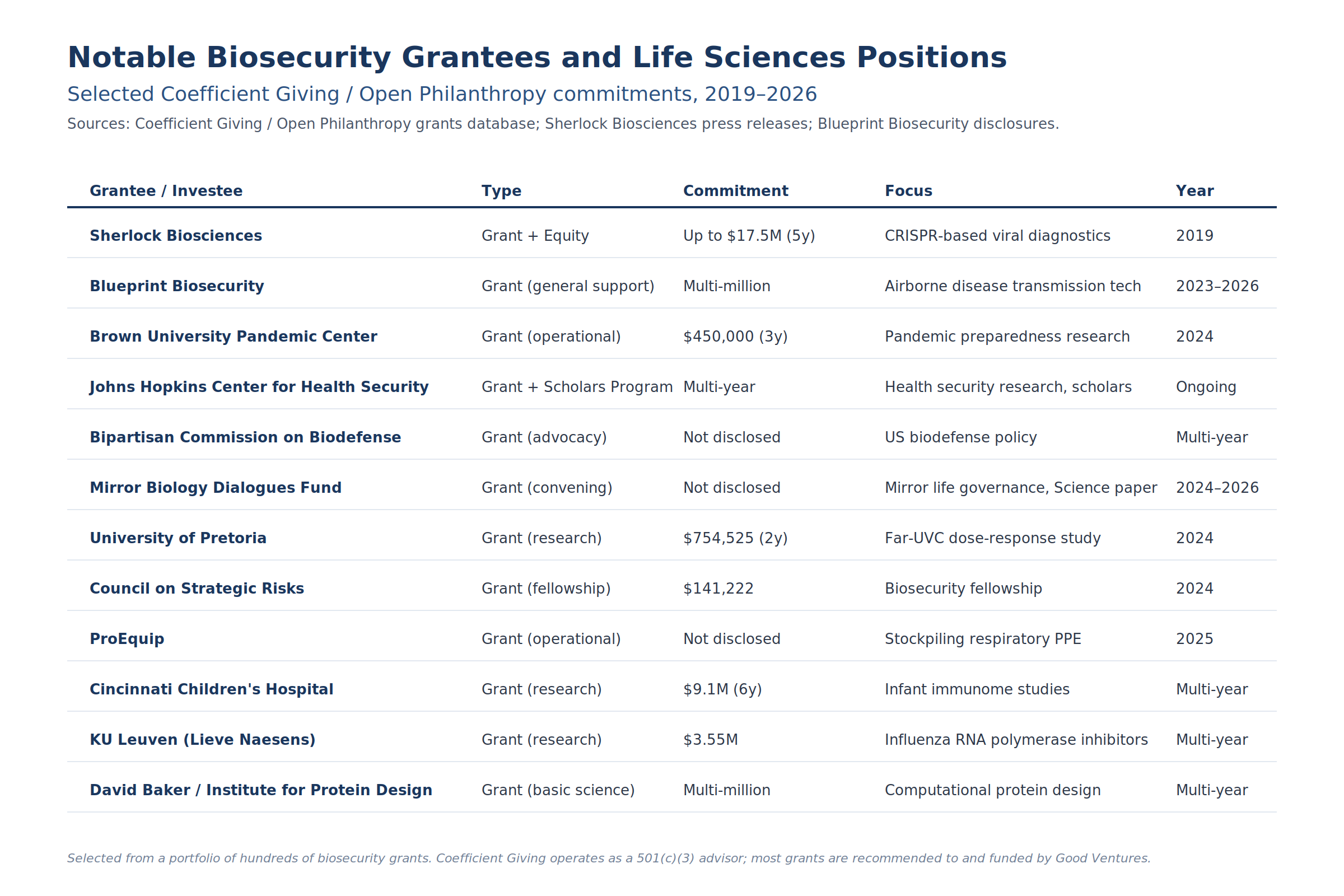

The most commercially relevant position remains Sherlock Biosciences, described in the previous section. Beyond Sherlock, the grantee base divides into operational nonprofits, university research centres, policy and advocacy bodies, and individual scholars and fellows.
Blueprint Biosecurity is the most operationally important nonprofit grantee. Founded as a nonprofit dedicated to advancing technologies and policies for preventing the spread of airborne disease, Blueprint is in many respects an operational arm of the Fund's transmission-suppression pillar. It runs research, policy work, regranting programs, and a Bioresilience Fund that channels capital into far-UVC light, elastomeric respirators, and verification tools for respiratory protection efficacy. Multi-million-dollar grants have supported Blueprint's general operations and its regranting capacity since 2023.
University and policy grantees include the Brown University Pandemic Center, the Johns Hopkins Center for Health Security (which also runs the Health Security Scholars Program), the Bipartisan Commission on Biodefense, the Council on Strategic Risks, the Mirror Biology Dialogues Fund, and individual investigators including Lieve Naesens at KU Leuven (influenza RNA polymerase inhibitors).
The Fund also supports a substantial scholarships and fellowships infrastructure. The legacy Open Philanthropy Biosecurity Scholarships program has been superseded by the broader Career Development and Transition Funding program, which provides individualised support for master's, PhD, and mid-career transitions into biosecurity, with submissions due July 1, 2026. AI-bio-specific fellowships at ERA in Cambridge UK and Cambridge Boston Alignment Initiative extend the program's reach into the AI safety community.
Leadership
| Person | Role | Background |
|---|---|---|
| Alexander Berger | CEO, Coefficient Giving | Joined early; CEO since 2021 |
| Emily Oehlsen | Global Catastrophic Risks executive team | GCR program co-lead |
| George Rosenfeld | Global Catastrophic Risks executive team | GCR program co-lead |
| Andrew Snyder-Beattie | Managing Director, Biosecurity & Pandemic Preparedness Fund | Oxford; 8+ years leading the program; co-author of Existential Risk and Cost-Effective Biosecurity (2017) |
| James Wagstaff | Senior Program Officer | Returned to team early 2026 |
| Fiona Conlon | Associate Program Officer | Joined early 2026 |
| Aman Patel | Senior Program Associate | Joined early 2026 |
Alexander Berger, Chief Executive Officer, leads Coefficient Giving overall. He has been CEO since 2021 and oversaw the strategic shift from "focus areas" to "funds" and the November 2025 rename. He is the public face of the institution's organisational direction and donor relations.
Andrew Snyder-Beattie, Managing Director of the Biosecurity & Pandemic Preparedness Fund, is the operational and intellectual leader of the Fund. Trained at the University of Oxford, where he co-authored the foundational 2017 paper Existential Risk and Cost-Effective Biosecurity with Piers Millett, he has led the biosecurity program for over eight years. He authored the Four Pillars hypothesis and is the Fund's most public-facing voice through podcast appearances on 80,000 Hours and writing on Defenses in Depth.
The team is actively hiring for a Chief of Staff for Biosecurity & Pandemic Preparedness reporting to Snyder-Beattie, alongside multiple grantmaker roles. Senior Program Officers each typically deploy more than $10 million per year in grants, and many move materially more in their first year.
2026 Priority Categories
The Fund's April 2026 Request for Proposals, with an Expression of Interest deadline of May 11, 2026, sets out four explicit priority categories. These map closely onto the Four Pillars framework but extend it into governance and field-building.
Transmission suppression focuses on technologies and deployment strategies that can reduce pathogen exposure at scale: next-generation PPE, elastomeric respirators, far-UVC light, disinfectant vapours, and verification tools that allow rapid empirical assessment of whether transmission-suppression technologies work as advertised. The category covers both PPE stockpiling for critical infrastructure workers and the development of new deployment pathways.
Tech safeguards and governance addresses risks from advanced biological capabilities, with a particular emphasis on the AI × bio intersection. Specific areas of interest include using AI to accelerate biosecurity defenses (patching vulnerabilities in DNA synthesis screening, KYC policies, benchtop synthesiser controls), empirical evaluations of how quickly open-weight models are catching up on dual-use bioweapon capabilities, and analysis of whether specific biological datasets are genuine bottlenecks for harmful capabilities. Mirror life governance is an explicit sub-priority following the December 2024 Science publication.
Policy and advocacy funds work that educates policymakers and the public about biological risks and potential interventions. Long-standing grantees in this space include the Bipartisan Commission on Biodefense and the Johns Hopkins Center for Health Security.
Growing the field covers scholarships, fellowships, career-transition funding, and capacity-building for the broader biosecurity community. The team has stated that capacity, not capital, is its current bottleneck, which makes field-building a strategic priority rather than a peripheral activity.
Strengths and Competitive Advantages
Unmatched scale within philanthropic biosecurity. No other private foundation deploys comparable capital into catastrophic biological risk specifically. The Bill & Melinda Gates Foundation is larger overall but its biosecurity work is embedded within broader global health programs and concentrated on natural pandemic preparedness rather than engineered threats. Within the dedicated catastrophic biorisk space, Coefficient Giving's Biosecurity & Pandemic Preparedness Fund is structurally the largest dedicated funder.
Direct line into the AI safety ecosystem. Coefficient Giving's combined GCR program means that the biosecurity team operates alongside, rather than separately from, one of the largest AI safety funders in the world. This allows the Fund to support work at the AI × bio intersection that purely biosecurity-focused funders cannot easily evaluate, and that purely AI-focused funders cannot easily reach into the bench-science community.
Influence on scientific consensus. The mirror bacteria episode demonstrates the Fund's ability to shape the scientific agenda on emerging risks. Convening the relevant scientists, funding their preparation work, and supporting publication in Science is a form of soft power that conventional life sciences VCs cannot replicate.
Long time horizon and patience. Multi-year grants of three to six years are standard, and the Fund supports academic and policy work that traditional funders find difficult to underwrite because of long timelines and uncertain measurable outcomes. This patience is a structural advantage in an area where useful research often takes more than a decade to mature.
Grantee infrastructure as a moat. Over a decade of grantmaking, the Fund has built an interconnected ecosystem (Sherlock, Blueprint, Brown Pandemic Center, Johns Hopkins, the Council on Strategic Risks, the Mirror Biology Dialogues Fund, the Cambridge AI×Bio fellowships) that reinforces itself through cross-referrals, joint publications, and shared researcher pipelines. This network effect is difficult to replicate from scratch.
Risks, Challenges, and Vulnerabilities
Concentration risk on a single donor base. Despite the multi-donor framing of the Coefficient Giving rename, the great majority of biosecurity grants remain funded by Good Ventures. This creates a single-point-of-failure dependency: any material change in the Tuna-Moskovitz family's giving capacity, priorities, or strategic direction would have an outsized effect on the field. Asana's market performance, Moskovitz's other holdings, and family-level decisions all flow through to the Fund's deployment capacity. Good Ventures has publicly committed to spending down within its founders' lifetimes, which establishes a finite horizon for the principal funder.
Capacity-constrained growth. The team's own statements identify people, not money, as the binding constraint. Hiring senior grantmakers in a niche field with limited talent supply is structurally difficult, and the aggressive 2026 hiring round for 10+ grantmakers and senior generalists may take time to fill. Until it does, deployment may lag the stated $100M+ annual target.
Field-capture criticism. Some observers in the biosecurity community have argued that by "flooding" capital into specific areas of biosecurity, Coefficient Giving is absorbing much of the field's experienced research capacity, focusing attention on a relatively narrow conception of catastrophic biorisk at the expense of more conventional public-health pandemic preparedness. The criticism is not new, but it is structurally meaningful: when a single funder controls a large share of available capital in a narrow field, intellectual diversity within that field can suffer.
Political and regulatory risk on dual-use research. The Fund's positions on gain-of-function research restrictions, DNA synthesis screening, and mirror life governance are not universally shared within the scientific community. Legitimate scientific disagreement about dual-use research oversight, the appropriate scope of biosecurity policy, and the balance between research freedom and security creates ongoing tension with parts of the academic community. Changes in US administration priorities, particularly on biodefense funding, BARDA, and pandemic preparedness, could either amplify or constrain the Fund's policy reach.
Hits-based logic does not fit institutional grantee timelines. The venture-style framing of "most grants will fail, a few will be transformational" maps imperfectly onto multi-year academic research, policy advocacy, and institutional capacity-building. Some grantees have publicly noted the tension between Coefficient Giving's preference for high-conviction, high-variance bets and the operational reality of running a research center or policy think tank that needs predictable funding to function.
Brand reset risk from the Coefficient Giving rename. The November 2025 rename was strategic, but it imposes ongoing transition costs: URL migrations, email re-routing, citation discontinuities in academic literature, and brand recognition rebuild. Many in the academic and policy community still refer to "Open Philanthropy" by reflex, and the still-incomplete consolidation of Wikipedia and other reference sources reflects the brand transition.
Implications for the Pharmaceutical Royalty and Biotech Capital Markets
For commercial capital markets, the Fund matters less as a competitor than as an upstream actor that shapes which technologies become commercially relevant. Three patterns are worth tracking.
First, the Fund's grantees regularly transition into venture-backed companies. Sherlock Biosciences is the canonical example, but the broader pattern of nonprofit-to-commercial transition (rapid diagnostics, far-UVC, metagenomic sequencing, AI-bio safety platforms) means that royalty investors and biotech VCs benefit from monitoring Coefficient Giving's grant book as a leading indicator of which platforms may reach commercial inflection in five to ten years.
Second, the Fund is helping to define the regulatory environment for an entire generation of dual-use technologies. DNA synthesis screening standards, benchtop synthesiser KYC, AI evaluation methodology for biological models, and mirror life governance will shape product approvability, export controls, and insurance underwriting for any company operating at the AI × bio intersection. Companies developing protein-design AI, gene synthesis, automated wet labs, or AI-assisted antibody discovery will encounter the regulatory and norm-setting environment that Coefficient Giving is actively building.
Third, the Fund's stated $100M+ 2026 deployment, against a ~$1B combined GCR target, makes it one of the largest non-government funders shaping pandemic preparedness infrastructure globally. For royalty funds and structured credit investors active in vaccines, antivirals, diagnostics, and PPE manufacturing, the Fund's grant priorities are a signal of where commercial scale-up capital may be needed in the medium term, particularly when Fund-backed grantees graduate into commercial financing.
Recent Developments (2025–2026)
| Date | Event |
|---|---|
| December 2024 | Mirror bacteria paper published in Science, convened with Fund support |
| October 2025 | Snyder-Beattie publishes the Four Pillars framework |
| November 2025 | Open Philanthropy renamed Coefficient Giving |
| January 2026 | Snyder-Beattie 80,000 Hours podcast appearance |
| Early 2026 | James Wagstaff returns; Fiona Conlon and Aman Patel join the team |
| April 2026 | Biosecurity RFP published; major GCR hiring round targeting ~$1B 2026 deployment |
| May 11, 2026 | EOI deadline for the biosecurity RFP |
| End of June 2026 | Initial RFP responses to applicants |
| July 1, 2026 | Career Development and Transition Funding submission deadline |
As of May 2026, the Fund is in active deployment mode. Grantees including Blueprint Biosecurity, ProEquip, Brown Pandemic Center, and the Mirror Biology Dialogues Fund continue to receive material support.
Conclusion
The Coefficient Giving Biosecurity & Pandemic Preparedness Fund is one of the more clearly differentiated institutions in the global life sciences capital ecosystem. Its structural thesis, that catastrophic biological risks are large, neglected, and tractable through a combination of physical defenses, technical safeguards, governance, and policy, is specific, testable, and supported by more than a decade of grantmaking that COVID-19 retroactively validated. The Four Pillars framework provides a coherent operating principle, and the AI × bio focus places the Fund at the centre of one of the most consequential emerging areas of dual-use technology policy.
The open questions are primarily ones of scale and execution. Can the team grow grant-deployment capacity fast enough to absorb the additional capital that the Coefficient Giving rename and partner-donor model are intended to attract? Will the field-building investments in scholars, fellowships, and career-transition support produce a generation of biosecurity professionals matching the scale of the funding flowing into the field? And can the Fund sustain its convening power on contested scientific questions (mirror life today, AI-bio tomorrow) without overreach that could erode its credibility within parts of the academic community?
For commercial capital markets, the Fund is not a competitor or a peer. It is an upstream actor whose grant priorities, scientific convenings, and policy positions help determine which biosecurity-adjacent technologies become commercially viable, which regulatory frameworks emerge, and which talent pipelines feed into commercial biotech, diagnostics, and platform companies. Royalty investors, biotech VCs, and licensing executives who pay close attention to Coefficient Giving's grant book and policy positioning will see a meaningful share of the next decade's pandemic-preparedness commercial activity well before it reaches conventional financing channels.
All information in this article was accurate as of May 2026 and is derived from publicly available sources including Coefficient Giving (formerly Open Philanthropy) grant disclosures, official press releases, regulatory and policy publications, and financial news reporting. Information may have changed since publication. This content is for informational purposes only and does not constitute investment, legal, or financial advice. The author is not a lawyer or financial adviser.